May Day: An Answer to Rampant Individualism

In its failed attempts to undermine and abolish the May 1 bank holiday, the French government has sought to depict International Workers’ Day as an anachronism. But when we look at the problems facing society today — and the ways in which people are trying to deal with them — it strikes me that a day dedicated to the collective power of working people is needed as much now as ever before.
Everywhere we turn now, we are confronted with the negative impact on people of the politics of isolationism. A world in which every problem you face is your fault and can only be resolved by you alone. It’s not a new phenomenon. British Prime Minister Margaret Thatcher told us in the 1980s that “there is no such thing as society.” But it certainly has been exacerbated by the social conditions of our time.
In his new documentary on the “manosphere,” Louis Theroux shines a light on the online community that tells young men they are struggling financially because they are simply not “alpha” enough. Many are convinced to send what little money they have to influencers who share the supposed path to success. That usually consists of treating women appallingly, abusing drugs to acquire a certain physique, and putting themselves in further financial difficulties to obtain status symbols.
Equally, women can’t look at their phones without being tormented by videos of “tradwives.” Women struggling to juggle work and care responsibilities are told that their stresses will disappear by donning an apron and turning the clock back to simpler time, when women were, allegedly, taken care of economically by their breadwinning husband, on the condition that they provided labor in the domestic sphere. Keep scrolling, and you’ll find someone else sitting crossed-legged on the floor telling you all your problems can be resolved by breathing slowly and thinking positively. That may well have a role to play, but as a new book by sociologist Damien Karbovnik points out, that kind of “positive psychology puts the responsibility on individuals, as if the social or economic context has no influence.” Worse still, any form of collective resistance, dare we say rage, has no place or legitimacy, as that would run counter to a “positive mindset.”
In fact, anyone looking to improve their personal wellbeing would do well to start by accepting that we exist as individuals as part of a society. That we cannot solve every problem we face alone. Sometimes we face common challenges that require common solutions.
The isolated young men on which the likes of Andrew Tate prey are experiencing the same problems as millions of their peers. Problems caused by political and economic decisions taken after the financial crisis to dismantle security and promote precarity. The women targeted by “tradwives” have had their lives made harder by cuts to welfare and public services that have exacerbated already unequal caring responsibilities. The same women are likely to be exposed to a wave of hatred and misogyny, online and offline, of which new shocking variations seem to appear every single day, while support networks are targeted by funding cuts or criminalized. We all, women and men, old and young, are worse off — materially and mentally — because of the decisions taken by neoliberal politicians who then tried to convince us it was all our own fault. That is called gaslighting.
In this context, a day dedicated to the power of collective action could not be more relevant. On May Day, we celebrate the victories we have already achieved by coming together in trade unions, and we demand a better future still. Not only is coming together a practical solution to our problems, but it’s empowering for individuals and liberating to know we have others on our side. May Day demonstrations will be taking place in towns and cities across Europe today, each with different demands to meet their circumstances. What we in the European Trade Union Confederation are trying to do is to create the conditions for workers to come together and win wherever they are.
The key is rebuilding collective bargaining. More than three million workers have lost the benefits of collective bargaining since the turn of the century because of austerity and union busting. The results have been lower living standards and an explosion in insecurity. Not everyone lost out though. CEOs and shareholders have taken a greater share in profits at our expense. This increased economic inequality and weakened social cohesion, leaving people vulnerable to the snake oil salesmen on social media.
Through the European Union’s Minimum Wage Directive, we won a requirement for all member states to take action to restore the share of workers covered by collective bargaining to at least 80 percent. Now we are fighting to ensure that public contracts — worth €2 trillion every year — go to companies that respect workers’ right to collective bargaining. That would give working people not only the power to negotiate better wages but also create a requirement for companies to create apprenticeships for young people and deliver equal pay for women who are paid hundreds of euros less than men for doing work requiring the same levels of skills, education, and physical effort. Through the EU’s new Pay Transparency Directive, “which aims to force companies to reveal and act upon gender disparities,” the collective fight for equal pay will be supported, as every woman worker can count on their trade union reps to face employers that are paying their workers unfairly.
Trade unions have every reason to be proud of what we have achieved together: decent wages, safer workplaces, and stronger rights that benefit all workers, not just our members. Those gains didn’t come easily; they were won through collective strength, solidarity, and a willingness to stand firm when it mattered most. And that hasn’t changed. When workers are threatened, intimidated, or treated unfairly, trade unions don’t back down. To anyone who thinks they can bully workers: we see you, and we will stand up to you.
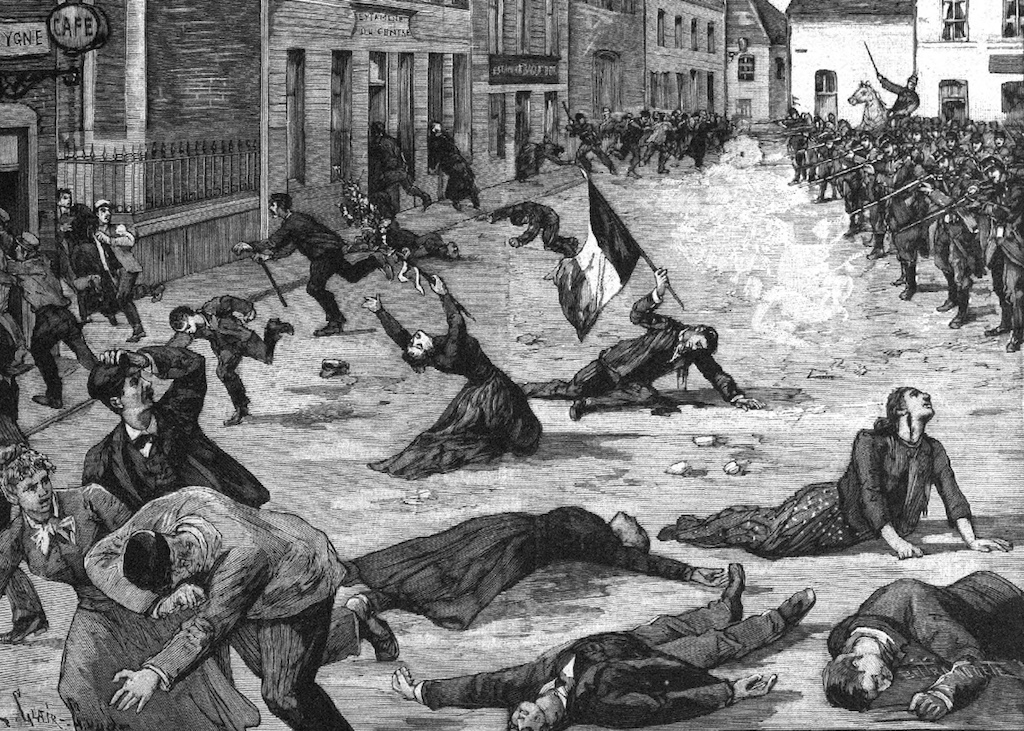
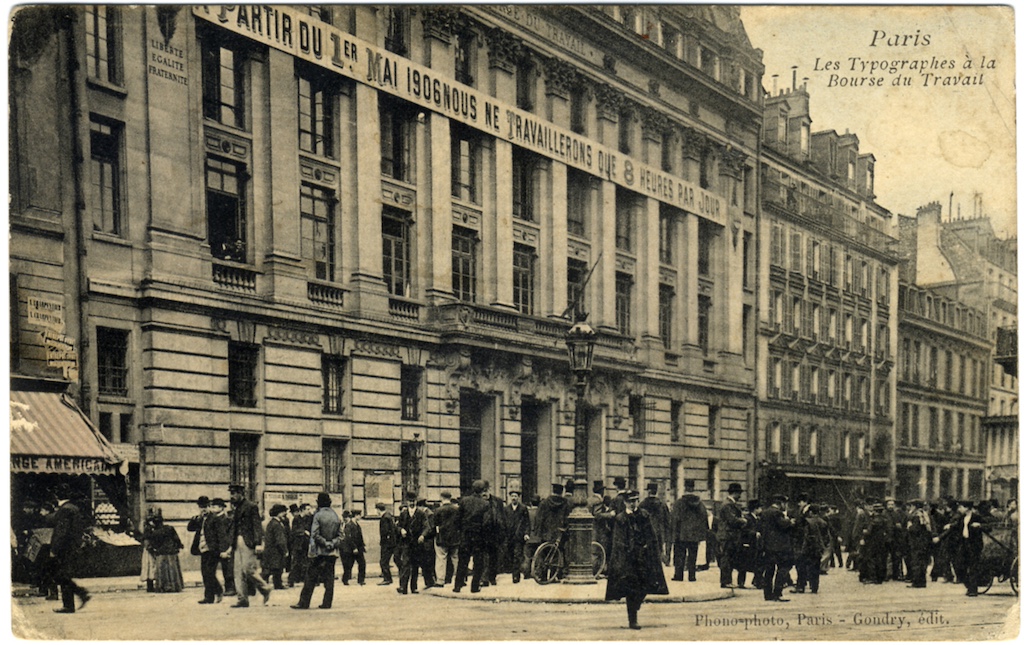
As the saying goes, united we bargain, divided we beg. That’s as true today as it was 140 years ago when European workers came out to demonstrate on May 1 for an eight-hour working day. We face different challenges now, but the answer to most of them still lies in coming together. May Day reminds us of that essential truth.



Labour Day sees clashes as French unions demand pay rise and bakery row continues
Labour Day marches across France on Friday focused on wages, workers’ rights and the future of the 1 May public holiday, as unions pushed for higher pay, bakers and florists opened despite legal uncertainty and clashes broke out in Lyon and Nantes.
Issued on: 01/05/2026 - RFI
 A man carries a mock petrol pump during the traditional Labour Day union march in Paris on 1 May 2026, as protesters called for higher wages and action on rising living costs. REUTERS - Benoit Tessier
In Lyon, police fired tear gas after black bloc groups launched fireworks, mortars and other projectiles, while clashes in Nantes left a police officer with injuries to the face.
Around 320 demonstrations were planned across the country, Interior Minister Laurent Nunez said. In Paris, union leaders led the main march, while large rallies were also held in Toulouse, Marseille, Nantes and Lille.
“This is not the theft of May Day that must be put on parliament’s agenda. It is a major plan to increase wages,” Sophie Binet, leader of the hard-left CGT union, said, marching beside Marylise Léon of the reformist CFDT union in Paris.
Binet called for a 5 percent rise in the minimum wage and for salaries to be linked to prices in a letter to Prime Minister Sébastien Lecornu.
Léon also called for a minimum wage increase because of inflation, along with “negotiations in the different professional sectors”.
French unions rally on Labour Day to defend paid holiday rights
People pressure
In Lyon, the prefecture counted 6,500 demonstrators, while unions said 12,000 people joined the march. Four arrests were reported. In Nantes, 4,000 people marched.
In Toulouse, between 5,500 people, according to the prefecture, and 12,000, according to the CGT, marched behind a banner calling for action “for our wages, for our pensions, against the far right and for peace”.
The same banner also declared: “Day of struggle since 1889, public holiday since 1947, May Day – you will not touch it.”
In Marseille, 3,400 people marched without incident.
Bakers and florists
Amid a national dispute over bakers and florists opening, many did so with government backing – despite 1 May’s special legal status as a paid holiday for almost all workers.
Lecornu visited a bakery in Haute-Loire, while former prime minister Gabriel Attal briefly stepped behind the counter at another in Vanves, near Paris.
“This is a provocation punishable by two fines,” labour inspector and CGT official Céline Clamme told French news agency AFP.
One fine would be for working on Labour Day, while the other concerned labour rules, since unpaid voluntary work is not permitted in a commercial business, Clamme said.
Checks took place across several parts of France, including in eastern and western regions as well as the Paris area and Marseille, Clamme said, as labour inspectors monitored whether businesses were breaking France’s work restrictions.
“We treated it like a normal Labour Day. There is no grey area – the law has not changed.”
The bakery visits by senior politicians also drew criticism from union leaders, who said the focus should be on working conditions rather than political messaging.
“The political leaders who go into a bakery, I think that is part of a politics of spectacle that we do not need,” Léon said. “What we need to show is the reality of a bakery worker.”
 Gabriel Attal, leader of France’s centrist Renaissance party, visits a bakery in Vanves near Paris on Labour Day, as France debates whether bakers and florists should be allowed to open on the public holiday. AFP - JULIE SEBADELHA
Protests, picnics and politics as France marks fraught May Day
Some bakers defended opening their shops. In Lille, Marianne Chevalier said it “doesn’t bother anyone”.
“Everyone is happy to work, 10 hours or five hours, knowing that we are paid double,” she said.
At a bakery in Mérignac, near Bordeaux, a manager who gave only her first name, Morgane, said there was “no logic” in allowing fast food restaurants to open while bakeries could not.
(with newswires)
In Lyon, police fired tear gas after black bloc groups launched fireworks, mortars and other projectiles, while clashes in Nantes left a police officer with injuries to the face.
Around 320 demonstrations were planned across the country, Interior Minister Laurent Nunez said. In Paris, union leaders led the main march, while large rallies were also held in Toulouse, Marseille, Nantes and Lille.
“This is not the theft of May Day that must be put on parliament’s agenda. It is a major plan to increase wages,” Sophie Binet, leader of the hard-left CGT union, said, marching beside Marylise Léon of the reformist CFDT union in Paris.
Binet called for a 5 percent rise in the minimum wage and for salaries to be linked to prices in a letter to Prime Minister Sébastien Lecornu.
Léon also called for a minimum wage increase because of inflation, along with “negotiations in the different professional sectors”.
French unions rally on Labour Day to defend paid holiday rights
People pressure
In Lyon, the prefecture counted 6,500 demonstrators, while unions said 12,000 people joined the march. Four arrests were reported. In Nantes, 4,000 people marched.
In Toulouse, between 5,500 people, according to the prefecture, and 12,000, according to the CGT, marched behind a banner calling for action “for our wages, for our pensions, against the far right and for peace”.
The same banner also declared: “Day of struggle since 1889, public holiday since 1947, May Day – you will not touch it.”
In Marseille, 3,400 people marched without incident.
Bakers and florists
Amid a national dispute over bakers and florists opening, many did so with government backing – despite 1 May’s special legal status as a paid holiday for almost all workers.
Lecornu visited a bakery in Haute-Loire, while former prime minister Gabriel Attal briefly stepped behind the counter at another in Vanves, near Paris.
“This is a provocation punishable by two fines,” labour inspector and CGT official Céline Clamme told French news agency AFP.
One fine would be for working on Labour Day, while the other concerned labour rules, since unpaid voluntary work is not permitted in a commercial business, Clamme said.
Checks took place across several parts of France, including in eastern and western regions as well as the Paris area and Marseille, Clamme said, as labour inspectors monitored whether businesses were breaking France’s work restrictions.
“We treated it like a normal Labour Day. There is no grey area – the law has not changed.”
The bakery visits by senior politicians also drew criticism from union leaders, who said the focus should be on working conditions rather than political messaging.
“The political leaders who go into a bakery, I think that is part of a politics of spectacle that we do not need,” Léon said. “What we need to show is the reality of a bakery worker.”
Some bakers defended opening their shops. In Lille, Marianne Chevalier said it “doesn’t bother anyone”.
“Everyone is happy to work, 10 hours or five hours, knowing that we are paid double,” she said.
At a bakery in Mérignac, near Bordeaux, a manager who gave only her first name, Morgane, said there was “no logic” in allowing fast food restaurants to open while bakeries could not.
(with newswires)
Labor Day 2026 in Germany

One of the rituals repeated annually is the criticism of Germany’s government by workers and trade unions during the Labour Day rallies held on 1 May. This year, Germany’s trade unions, union apparatchiks and, at times, even union members celebrated big wins wherever trade unions concluded collective agreements.
This year, German trade unions had reasons to celebrate the day of work, albeit in the context of the – as usual – crisis of capitalism, made worse by Donald Trump’s attack on Iran and the subsequent closing of the Strait of Hormuz.
This year’s calls, such as “our jobs”, appeared amid substantial job losses caused by artificial intelligence, the transition to a sustainable economy, and Trump’s war. For union officials, there was a very clear motto: corporate coffers are full. Workers will retain a “kind of existence” under capitalism – an exchangeable commodity.
Despite all the doom and gloom of Germany’s corporate press, there is still economic growth. Germany’s capital, Berlin, was even celebrated as a boomtown by the press. But it is not the workforce that is booming.
In many industries, thousands of jobs were lost, particularly in sectors under pressure. The majority of East Germany’s provinces act as an extended workbench – low-cost manufacturing with few benefits for workers.
East Germany is home to none of Germany’s major corporations. Corporate Germany maintains only “branches” – and these are presented in quotation marks, i.e. ready to be closed down. When it comes to shutting factories, East German branches, rather than West German factories, are the ones that close.
Corporate Germany still treats East Germany with disdain. Not much has changed since conservative politician Helmut Kohl promised “blooming industrial landscapes” during the 1990s – an electoral lie.
Germany’s chemical giant BASF illustrates this clearly. In February 2026, BASF announced a comprehensive “restructuring plan” – managerial code for job losses. Its works council and the trade union swung into action on the spot. For the East German state of Brandenburg, the management plan would mean production and services being outsourced or transferred.
In Berlin alone, management threatens the loss of 2,800 jobs. BASF’s corporate apparatchiks want to “combine” – a conveniently vague word – its Berlin services with those in India. This means severe job losses are on the horizon. In other words, corporate bosses treat workers as a disposable human resource.
Despite the attacks of corporate management on workers, German trade unions also had reasons to celebrate. Trade unions managed to fend off attacks by Germany’s government and its “private jet–flying” and neoliberal-worshipping chancellor on the eight-hour day.
Meanwhile, the very same multi-million-euro chancellor frustrated Berlin’s inhabitants, the unemployed, and social welfare recipients with political attacks on what remains of the welfare state after Kohl, Schröder, and Merkel.
Not just on 1 May, Germany’s peak union body, the DGB, issued a massive counterattack against Germany’s conservative government. Unionists spoke of the largest assault on Germany’s welfare state and public services since the 1990s.
Instead of neoliberal cuts, Germany’s unions are calling for forward-looking policy, investment, and improved conditions so that companies can maintain operations.
Unionists from IG BCE (mining, energy, chemicals) said there is strong resistance inside companies to these government plans, and that this resistance is substantial. Yet, in upcoming collective bargaining rounds, employers are preparing to challenge workers.
In Germany’s public transport system, unions have put forward a comprehensive wage claim. Unionists said it is about public transport as such. Yet employers in East Germany’s Thuringia seek to increase working hours to 42 hours a week – an attack on the eight-hour day.
In other words, government policies and corporate bosses work hand in hand when attacking Germany’s welfare state and workers’ conditions. Regularly, German employers’ associations – the direct counterparts of trade unions in collective bargaining – advocate loudly for far-reaching restrictions on collective bargaining. While employers seek to contest hard-fought agreements, collective bargaining provides security for workers.
Yet only 42% of all workers in Berlin and Brandenburg, for example, are covered by collective agreements – far too low. For only 16% of companies does a collective agreement apply. Taken together, the DGB trade unions have lost ground in the context of industrial and demographic changes. Yet they have also gained members, as recent strike waves have been rather successful.
What German trade unions observe is that wherever unions enter disputes, wherever they engage in conflict and strike action, particularly young people are joining trade unions. This is a positive development. It also means that trade unions can slow their losses, halt them, or ideally reverse them.
Sadly, the once-revolutionary day – 1 May – has all too often degenerated into a commercialised street festival. Instead of “workers unite!”, today it is “revellers unite!”. This trend may be reinforced as a majority of young people connect through TikTok and Instagram.
Yet calls for union-organised rallies still dominate and remain visible. Rallies on 1 May also include queer, feminist, and “take back the night” demonstrations. At least one revolutionary rally countered this trend while trying to make up for the prevailing tendency. About 25,000 people took part. Meanwhile, hundreds of thousands gathered to celebrate and attend large radical-progressive rallies across the country.
Many still agree that 1 May is, without a doubt, the most important holiday of the working-class movement. For the past 136 years, workers have celebrated it as one of the few secular holidays around the world. As the day of the working class, it became established in 1889 in Paris. On one 1 May, workers were shot and killed in Chicago by police officers while demonstrating for the eight-hour day.
For many workers, 1 May remains an important day. In 2026, this is also because of Chancellor Friedrich Merz’s attacks on the basic rights of workers – an attack on the working class as a whole.
In mid-January 2026, the conservative, neoliberal, and rather zealous Merz (CDU) spoke in Halle in East Germany against Germany’s long-standing Working Time Act. He called for its abolition. The act regulates, among other things, the right to the eight-hour day and the 40-hour week.
Merz’s assault was an attack on workers’ rights, but it was also offensive to those who once fought for the labour movement and the eight-hour day. So far, major protests against Merz’s attacks have remained limited. Perhaps his insults against – in his view – workers will change after 1 May, at least for a few days.
As in many countries, there has been, at least since the 1960s, a well-engineered decay of a unified working-class movement. Corporate bosses, along with an ever-compliant business press, constantly question the usefulness of trade unions – every year.
It is, as the actor Sean Penn might say, “one battle after another” to defend workers against the sustained onslaught of corporate media, CEOs, right-wing politicians, pro-business think tanks, corporate lobbying, and the adjacent propaganda apparatus of capitalism.
Despite all this, people still take to the streets every year on 1 May across Germany. Even if workers are no longer as highly organised as they once were, union rallies are still held in almost all cities.
Some union rallies count more than 10,000 participants. In some cities, there were radical left-wing rallies. One rally included 800 anarchists – not a strong tradition in Germany – organised under the black-and-red flag. Around 3,000 people attended a Communist Revolutionary 1 May rally. The youth bloc at a DGB rally argued against compulsory military service, holding posters that read:
if hundreds of billions can be spent on arms,
why not on schools, universities, and healthcare systems,
where funding is lacking?
In other words, 1 May remains an important day. At some rallies, the powerful metalworkers’ union IG Metall (IGM) was accused of hypocrisy. On the one hand, IGM opposes arms manufacturing. On the other hand, it participates in it, for example at the Blohm + Voss shipyard. A similar contradiction is currently playing out at Volkswagen.
IGM knows that €1 million creates 6.9 jobs in arms manufacturing, compared to 10 in sustainable energy, 14.3 in healthcare, and a striking 19.2 in education – almost three times more. In other words, the critique of Germany’s most powerful trade union, IGM, is not unfounded. Yet while job creation is minimal, profits in Germany’s military-industrial complex are far from minimal.
In fact, 1 May is almost the only day of the year when workers, trade unions, and the labour movement rally against the injustices of corporate capitalism. On this day, people demonstrate that the social composition of Germany’s working class still exists – despite claims by the pro-business media.
In spite of their best efforts, political workers have not vanished into thin air over recent decades. In other words, as long as there is capitalism, there are workers – and as long as there are workers, there are organised workers. These workers continue to rally on 1 May.

Climate Coalition Block 395 Freeway Exit; Access to Capitol, in May-Day Protest Against Fossil Fuel Lobby
 Image by Will, Insta - @Current.Noise, Bluesky - @Current.Noise
Over 40 local climate activists shut down rush-hour traffic leading to the Capitol to condemn the American Petroleum Institute (API) and American Gas Association (AGA) for their role in enabling fossil fuel companies in driving climate catastrophe.
The three year period between 2022-2025 was the hottest in recorded human history, with 2026 already positioned to be another record-breaking year. In DC alone, residents have been facing violent heat waves, flooding, sea level rise, and unpredictable storm surges, the extreme threat they pose a direct result of Big Oil’s greenhouse gas emissions.
“In the few years I’ve lived in DC, I’ve almost passed out due to extreme heat, been forced to hide out from tornado warnings, and watched my utility costs skyrocket just so I can stay safe from the escalating temperatures,” said Liana SC, an organizer with Sunrise DC. “This is not normal, and it’s only happening because of the chokehold oil and gas companies have over our government.”
Thanks to lobbying efforts by API and AGA, Big Oil reports yet another year of soaring profits, all while continuing to mislead the public about their role in worsening climate disasters. And now, they have pressured lawmakers into proposing new legislation to shield the oil and gas industry from litigation that could otherwise pave the way to a greener and more just future.
“Corrupt lawmakers on both sides of the aisle are working hand-in-hand with the Trump regime and the fossil fuel lobby to incinerate what’s left of our futures for a quick buck,” said Jackson Schnabel, a student organizer with Sunrise Georgetown. “They are profiting off of our suffering, and we’re here to say we’ve had enough.”
At 8 a.m., activists from Sunrise Movement DC, Extinction Rebellion DC, and the Elders Coalition for Climate Action used banners to blockade Massachuesetts Ave NW and the 395 freeway exit, stalling rush hour traffic outside both the API and AGA headquarters. Protesters chanted “No Trump, No API, No fascist USA” while carrying a giant model Earth along with banners that read “API, AGA, USA: End Fossil Fuel Fascism,” “Big Oil Fuels War,” and “No Jobs on a Dead Planet.”
This blockade occurred simultaneously with three other May Day blockades stationed at different intersections in downtown DC, all calling for investment in American communities over corporate profit–their specific demands being tied to No War, DC Statehood, and Labor Rights.
“We are in the street this May Day because business as usual cannot continue,” Said Alex Ames, a DC resident. “Not when ‘business as usual’ means funds that should be supporting working people are instead going into the pockets of oil billionaires, tech billionaires, and war profiteers.”
The morning efforts of these four coalitions kicked off a full International Worker Solidarity “Day of Action,” made up of a midday rally and evening concert, all of which was part of the nationwide May Day Strong movement that called for No Work, No School, No Shopping, and for everyday people to take the streets on Friday to demand our government prioritize people over billionaires. DC May Day actions were hosted by a large coalition of local organizations and unions, including Free DC, CASA, DC Jobs With Justice, Sunrise Movement, and more.
Sunrise DC is a local hub of the national Sunrise Movement, a youth-led climate justice organization fighting for collective liberation and a better future through a Green New Deal.
Extinction Rebellion DC is a local hub of an international movement using non-violent direct-action to fight for climate justice. Extinction Rebellion believes it is a citizen’s duty to rebel, using peaceful civil disobedience, when faced with criminal inactivity by their Government.
Elders Coalition for Climate Action recognizes the unique responsibility that elders have facing the linked crises of a near total erosion of our basic freedoms with the endangerment of life itself on earth. We are never too old!

Over 40 local climate activists shut down rush-hour traffic leading to the Capitol to condemn the American Petroleum Institute (API) and American Gas Association (AGA) for their role in enabling fossil fuel companies in driving climate catastrophe.
The three year period between 2022-2025 was the hottest in recorded human history, with 2026 already positioned to be another record-breaking year. In DC alone, residents have been facing violent heat waves, flooding, sea level rise, and unpredictable storm surges, the extreme threat they pose a direct result of Big Oil’s greenhouse gas emissions.
“In the few years I’ve lived in DC, I’ve almost passed out due to extreme heat, been forced to hide out from tornado warnings, and watched my utility costs skyrocket just so I can stay safe from the escalating temperatures,” said Liana SC, an organizer with Sunrise DC. “This is not normal, and it’s only happening because of the chokehold oil and gas companies have over our government.”
Thanks to lobbying efforts by API and AGA, Big Oil reports yet another year of soaring profits, all while continuing to mislead the public about their role in worsening climate disasters. And now, they have pressured lawmakers into proposing new legislation to shield the oil and gas industry from litigation that could otherwise pave the way to a greener and more just future.
“Corrupt lawmakers on both sides of the aisle are working hand-in-hand with the Trump regime and the fossil fuel lobby to incinerate what’s left of our futures for a quick buck,” said Jackson Schnabel, a student organizer with Sunrise Georgetown. “They are profiting off of our suffering, and we’re here to say we’ve had enough.”
At 8 a.m., activists from Sunrise Movement DC, Extinction Rebellion DC, and the Elders Coalition for Climate Action used banners to blockade Massachuesetts Ave NW and the 395 freeway exit, stalling rush hour traffic outside both the API and AGA headquarters. Protesters chanted “No Trump, No API, No fascist USA” while carrying a giant model Earth along with banners that read “API, AGA, USA: End Fossil Fuel Fascism,” “Big Oil Fuels War,” and “No Jobs on a Dead Planet.”
This blockade occurred simultaneously with three other May Day blockades stationed at different intersections in downtown DC, all calling for investment in American communities over corporate profit–their specific demands being tied to No War, DC Statehood, and Labor Rights.
“We are in the street this May Day because business as usual cannot continue,” Said Alex Ames, a DC resident. “Not when ‘business as usual’ means funds that should be supporting working people are instead going into the pockets of oil billionaires, tech billionaires, and war profiteers.”
The morning efforts of these four coalitions kicked off a full International Worker Solidarity “Day of Action,” made up of a midday rally and evening concert, all of which was part of the nationwide May Day Strong movement that called for No Work, No School, No Shopping, and for everyday people to take the streets on Friday to demand our government prioritize people over billionaires. DC May Day actions were hosted by a large coalition of local organizations and unions, including Free DC, CASA, DC Jobs With Justice, Sunrise Movement, and more.
Sunrise DC is a local hub of the national Sunrise Movement, a youth-led climate justice organization fighting for collective liberation and a better future through a Green New Deal.
Extinction Rebellion DC is a local hub of an international movement using non-violent direct-action to fight for climate justice. Extinction Rebellion believes it is a citizen’s duty to rebel, using peaceful civil disobedience, when faced with criminal inactivity by their Government.
Elders Coalition for Climate Action recognizes the unique responsibility that elders have facing the linked crises of a near total erosion of our basic freedoms with the endangerment of life itself on earth. We are never too old!

Building Beyond May Day
Florida Workers Deserve a Better May Day Than This
May Day is traditionally a day for workers to celebrate their collective power. In Florida, however, lawmakers have advanced yet another bill meant to undercut just that by weakening the state’s public-sector unions. Critics have characterized SB 1296 as a naked attempt to bust public sector unions. The bill’s champions include the Freedom Foundation, whose CEO reportedly lauded the legislation as a step toward the “decimation of Florida unions.”
SB 1296 would harden existing hurdles for unions by tightening the rules for union certification and recertification. Recertification elections require workers in an already-unionized bargaining unit to affirmatively vote to retain their existing union as their representative. Requiring them shifts the burden onto an already certified union to repeatedly prove that it should continue to exist. Under the bill, unions would need not only a majority of votes cast, but also participation from a majority of eligible voters in the bargaining unit. In other words, even if most participating workers vote to keep their union, the union could still fall short if too many eligible workers do not vote. SB1296 effectively treats failure to cast a ballot as a vote against the union rather than an abstention.
SB 1296 builds on SB 256, which passed in 2023. That law prohibited many public employers from deducting union dues directly from workers’ paychecks, requiring unions to spend time and resources moving members onto less efficient alternative payment systems. It also required unions to submit annual registration renewal applications that include audited financial statements and detailed membership information. Public employers may challenge those applications before the Public Employees Relations Commission (PERC), and PERC may revoke a union’s registration and certification if it finds the application inaccurate or noncompliant. If fewer than 60 percent of workers in the bargaining unit were dues-paying union members, the union would have to petition PERC for recertification within one month of submitting its renewal application. This requirement means that even unions with clear majority support in a workplace could be forced to spend time and resources defending their existing status as workers’ bargaining representative.
Taken together, the laws are clearly designed to weaken existing unions. SB 256 makes dues collection more difficult, then uses the dues-paying share of the bargaining unit as a basis for forcing recertification. SB 1296 then raises the stakes of recertification elections by adding a participation requirement, giving employers another avenue to bust unions merely by obfuscating and undermining election turnout. Both SB1296 and SB256 exempt police and firefighters unions, a common thread among state laws that otherwise target state and local government workers.Both SB1296 and SB256 exempt police and firefighters unions, a common thread among state laws that otherwise target state and local government workers.
The underlying principle of solidarity is that an attack on one is an attack on all. In Florida’s case, however, it’s an attack on many. Public sector workers account for 52.7 percent of union members in Florida, and state and local government workers comprise 38.6 percent.
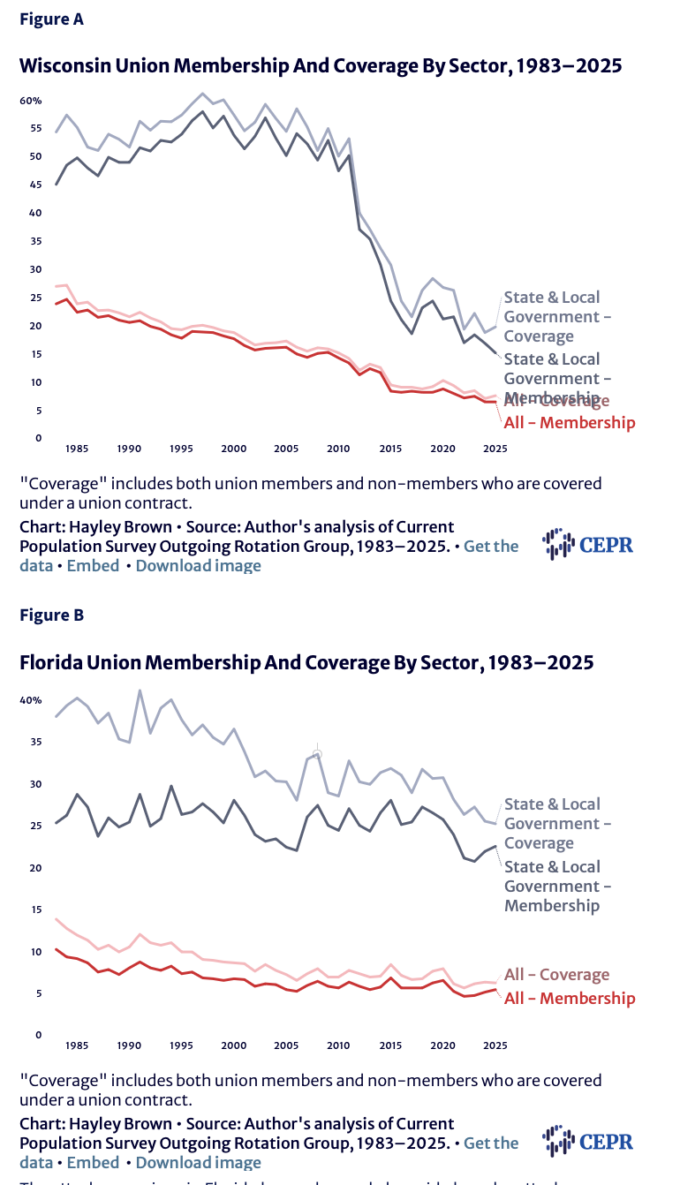
The effects of anti-union legislation can be dramatic. In Wisconsin, the passage of Act 10 — one of the most sweeping pieces of anti-union state legislation in recent history — coincided with a significant decline in public-sector unionization, driven by a decline in state and local unionization (Figure A). Wisconsin differs from Florida in that it started as a strong union state and thus had further to fall. Florida’s trajectory since 2023 (Figure B) has been far less striking than Wisconsin’s in the wake of Act 10, which was admittedly a harsher piece of legislation for unions. However, additional evidence suggests that more than 63 thousand Florida workers have lost union representation because of SB256 alone. It remains to be seen how much the addition of SB1296 may affect union membership rates among Florida’s state and local government workers going forward.
The attacks on unions in Florida have advanced alongside broader attacks on unions in general and public sector unions in particular. But despite conservatives’ best efforts to demonize them, unions remain very popular with the US public. The Freedom Foundation, a key union antagonist, asserts that “…government unions are a root cause of every growing national dysfunction in America.” Polls suggest that Americans believe the opposite, however, with 60 percent agreeing that falling unionization hurts the country and 62 percent saying that it hurts working people.
Laws that target public sector unions are attacks on the entire labor movement. A meaningful workers’ movement must explicitly include public-sector workers, and their right to organize must not be treated as optional. Federal legislation like the Public Service Freedom to Negotiate Act of 2025, which would codify organizing and collective bargaining rights for government workers, is an important step toward this goal. This May Day, lawmakers at every level of government should do both the right and the popular thing and ensure that all workers — public-sector included — have a real, enforceable right to organize and bargain collectively.
This first appeared on CEPR.

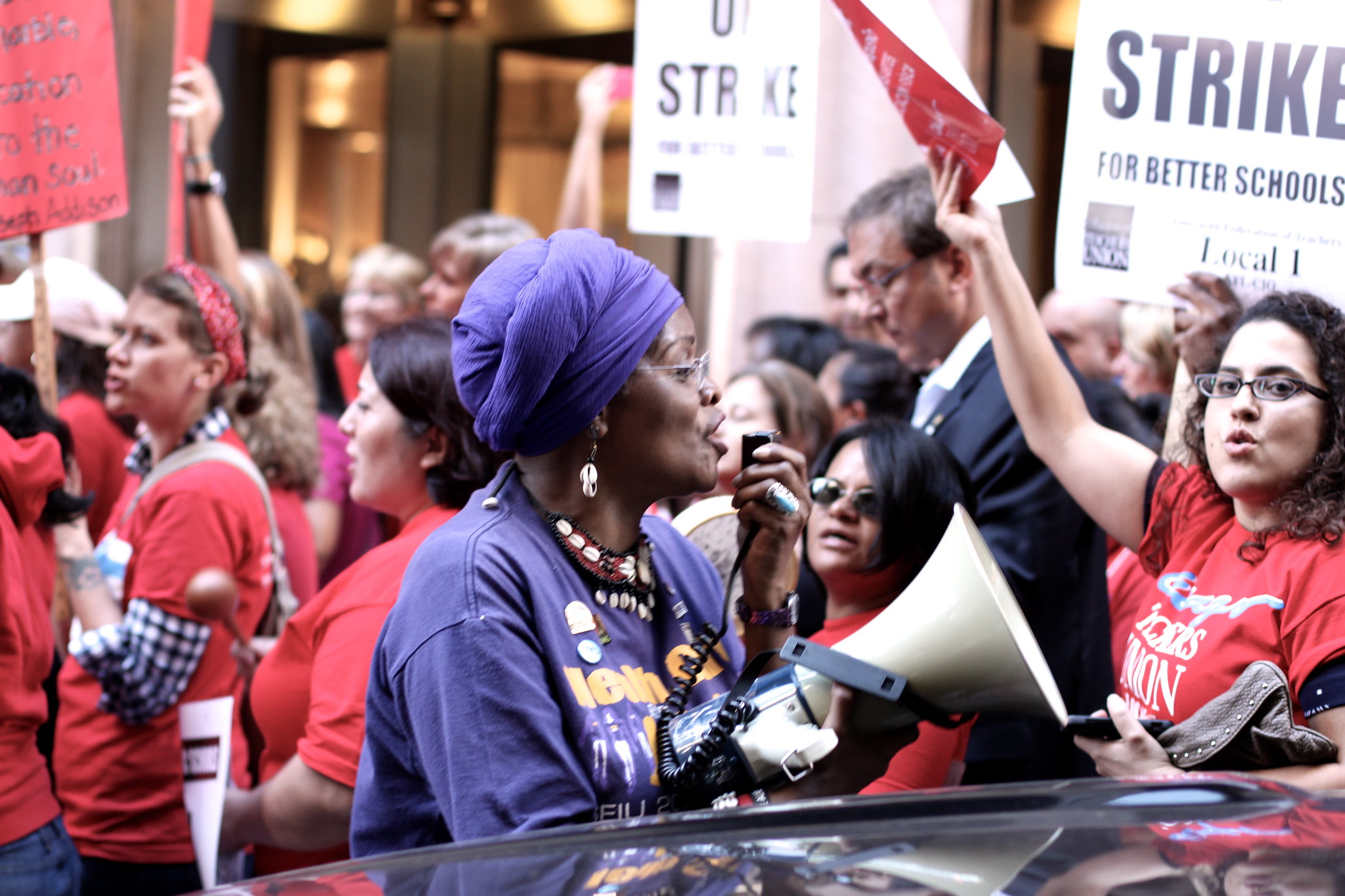
This May Day, workers, students, and families across the country are set to turn out in the thousands or even millions to make their voices heard against the growing power of the billionaire class.
May Day, often referred to as International Workers’ Day, has a long legacy in the labor movement. In the late 1800’s — an era of extreme wealth concentration much like our own — American workers organized a general strike on May 1st demanding an eight-hour workday. After a wave of violent state and police repression of labor epitomized by the 1886 Haymarket Affair in downtown Chicago, May 1 was enshrined as a celebration of the working class.
This year, organizers are hoping to expand the scope of the day of action into a broader movement against corporate power and the start of a longer organizing process.
Inequality.org spoke with Jackson Potter, vice president of the Chicago Teachers Union, about their plans and hopes for this year’s May Day.
For people who don’t follow labor or politics closely, what do you want them to understand about what is happening this May Day?
May Day has always been International Workers Day, and this year it is something more. On May 1, workers, students, and families across the country are going to march, rally, and in many cities, refuse business as usual entirely, no work, no school, no shopping, to show this country what it looks like when working people decide not to show up for the people who profit from our labor.
The reason for that is straightforward. Working people are already being forced to choose between food on the table and medicine on the shelf, between paying rent and keeping the lights on. At the same time, resources that should be going to schools, housing, and health care are being diverted to pay for billionaires’ fortunes and arming federal agents to attack our neighbors. People are fed up, and they have every right to be. May Day is the moment when that fed-up energy takes a coordinated form.
The Chicago Teachers Union voted to make May Day a civic day of action. What does that mean, and why did CTU decide to do it?
It means that on May 1, instructional time in Chicago public schools will be devoted to civic engagement, with buses being provided for students who want to attend the rally, discussions in classrooms, and educators and students participating in the kind of collective action that we spend all year teaching young people about in the abstract.
Teaching students what civic action looks like requires more than textbooks. It requires educators who are willing to model what it looks like to stand up when the stakes are real. We teach about the eight-hour workday, about the labor movement, about the history of people organizing to change what was considered politically impossible, including the Children’s Crusade in Birmingham, when on May 2, 1963, young people left their classrooms and helped force the country to confront injustice.
This is not a new idea for CTU. When Rahm Emanuel tried to turn our 300-page contract into a 50-page document and close 50 schools in Black communities, we did not just file grievances. We organized parents, students, and community members and fought back. May Day is that same tradition applied to this moment.
You have watched the Department of Education be systematically dismantled over the past several months. What does that mean concretely for public school students and teachers?
We have seen this before. In Chicago, we watched the Civic Committee of the Commercial Club publish a report calling for 100 charter schools in the city’s Black communities, and watched Democratic and Republican mayors alike implement it. Closing 200 schools over two decades. The research has been clear for years that school closings destabilize communities, increase violence, and produce no educational gains. None of that stopped it. What stopped it, finally, was organized power. It was parents, educators, and community members who refused to accept that their schools were expendable.
The dismantling of the Department of Education is the same agenda, scaled to the national level. It is not about improving education. It is about transferring public resources to private operators. And the response has to be the same, organized power at every level.
How do attacks on public education, the threat of undermining elections, and an illegal war in Iran connect? Are these separate fights or the same fight?
They are the same fight, and understanding that is essential to building the kind of coalition that can actually win.
Think about who benefits from the war in Iran. Oil companies that invested $75 million in Trump’s reelection are collecting tens of billions in extra revenue from the price spike. That money does not go to schools, or health care, or housing. It goes to executives and shareholders. Meanwhile, working families are paying more for gas and groceries, and the U.S. Postal Service has proposed a fuel surcharge on package deliveries because of war-driven oil prices. The war is not separate from the affordability crisis, it is one of its causes.
The attack on elections follows the same logic. When working-class communities cannot vote, the people making decisions about school funding, about ICE operations, about war, do not have to answer to them. The corporate oligarchy did not start with Trump. It was built over decades by Democrats and Republicans alike who put the interests of billionaires before workers. Protecting free and fair elections is not a procedural question. It is a question of who has power over the decisions that determine whether working families can survive.
Workers are already stretched thin by the affordability crisis. How does the war in Iran make that worse?
The connection is direct and it is not complicated. When U.S. oil companies are generating an extra $63 billion in revenue because of war-driven oil prices, that money comes from somewhere. It comes from every working family filling up a gas tank, every small business paying more for deliveries, every school district paying more for transportation. The war is a wealth transfer from working people to the top of the income distribution, and it is happening in real time.
The three demands of May Day Strong are not random. Tax the rich, no ICE and no war, expand democracy. They fit together because the same billionaires driving authoritarianism are the ones profiting from federal contracts, war spending, and the suppression of wages and unions. You cannot address the affordability crisis without confronting the concentration of wealth and power that is producing it.
What are you seeing on the ground heading into May 1? What does it look like when labor and community organizations actually move together?
The school district has officially made May Day a civic day of action. The labor movement has called for an economic blackout. That kind of alignment does not happen automatically. It is built through years of relationships, through showing up for each other’s fights. In Chicago, the CTU has been in relationship with immigrant rights organizations, with tenant organizing groups, with community organizations in Black and Latino neighborhoods for a long time. Those relationships are what make it possible to move together at scale.
Nationally, more than 500 labor and community organizations have come together under the May Day Strong coalition. That includes National Nurses United, SEIU, UNITE HERE, and hundreds of others. As many as 3,000 events are anticipated across all 50 states. This is not a moment. It is a movement that has been building.
What do you want someone reading this to do on May Day and after?
Show up on May 1. Find a march or rally in your city. If there is not one, organize one. The May Day Strong website has a map.
But the more important answer is what comes after. May Day is not the destination, it is a test of the infrastructure we are building. After May Day, go back to your workplace and organize your union. Connect with the community organizations in your neighborhood. Find out what your local school board is doing about funding, about ICE in schools, about the resources your students need. Run for something. Support someone who is running.
The corporate oligarchy did not get here overnight and it will not be dismantled overnight. What has always changed the balance of power is workers and communities moving together over time. That is what we are building. May Day is where we show what that kind of power looks like.
Chicago Teachers Are Making This May Day Count
This May Day, workers, students, and families across the country are set to turn out in the thousands or even millions to make their voices heard against the growing power of the billionaire class.
May Day, often referred to as International Workers’ Day, has a long legacy in the labor movement. In the late 1800’s — an era of extreme wealth concentration much like our own — American workers organized a general strike on May 1st demanding an eight-hour workday. After a wave of violent state and police repression of labor epitomized by the 1886 Haymarket Affair in downtown Chicago, May 1 was enshrined as a celebration of the working class.
This year, organizers are hoping to expand the scope of the day of action into a broader movement against corporate power and the start of a longer organizing process.
Inequality.org spoke with Jackson Potter, vice president of the Chicago Teachers Union, about their plans and hopes for this year’s May Day.
For people who don’t follow labor or politics closely, what do you want them to understand about what is happening this May Day?
May Day has always been International Workers Day, and this year it is something more. On May 1, workers, students, and families across the country are going to march, rally, and in many cities, refuse business as usual entirely, no work, no school, no shopping, to show this country what it looks like when working people decide not to show up for the people who profit from our labor.
The reason for that is straightforward. Working people are already being forced to choose between food on the table and medicine on the shelf, between paying rent and keeping the lights on. At the same time, resources that should be going to schools, housing, and health care are being diverted to pay for billionaires’ fortunes and arming federal agents to attack our neighbors. People are fed up, and they have every right to be. May Day is the moment when that fed-up energy takes a coordinated form.
The Chicago Teachers Union voted to make May Day a civic day of action. What does that mean, and why did CTU decide to do it?
It means that on May 1, instructional time in Chicago public schools will be devoted to civic engagement, with buses being provided for students who want to attend the rally, discussions in classrooms, and educators and students participating in the kind of collective action that we spend all year teaching young people about in the abstract.
Teaching students what civic action looks like requires more than textbooks. It requires educators who are willing to model what it looks like to stand up when the stakes are real. We teach about the eight-hour workday, about the labor movement, about the history of people organizing to change what was considered politically impossible, including the Children’s Crusade in Birmingham, when on May 2, 1963, young people left their classrooms and helped force the country to confront injustice.
This is not a new idea for CTU. When Rahm Emanuel tried to turn our 300-page contract into a 50-page document and close 50 schools in Black communities, we did not just file grievances. We organized parents, students, and community members and fought back. May Day is that same tradition applied to this moment.
You have watched the Department of Education be systematically dismantled over the past several months. What does that mean concretely for public school students and teachers?
We have seen this before. In Chicago, we watched the Civic Committee of the Commercial Club publish a report calling for 100 charter schools in the city’s Black communities, and watched Democratic and Republican mayors alike implement it. Closing 200 schools over two decades. The research has been clear for years that school closings destabilize communities, increase violence, and produce no educational gains. None of that stopped it. What stopped it, finally, was organized power. It was parents, educators, and community members who refused to accept that their schools were expendable.
The dismantling of the Department of Education is the same agenda, scaled to the national level. It is not about improving education. It is about transferring public resources to private operators. And the response has to be the same, organized power at every level.
How do attacks on public education, the threat of undermining elections, and an illegal war in Iran connect? Are these separate fights or the same fight?
They are the same fight, and understanding that is essential to building the kind of coalition that can actually win.
Think about who benefits from the war in Iran. Oil companies that invested $75 million in Trump’s reelection are collecting tens of billions in extra revenue from the price spike. That money does not go to schools, or health care, or housing. It goes to executives and shareholders. Meanwhile, working families are paying more for gas and groceries, and the U.S. Postal Service has proposed a fuel surcharge on package deliveries because of war-driven oil prices. The war is not separate from the affordability crisis, it is one of its causes.
The attack on elections follows the same logic. When working-class communities cannot vote, the people making decisions about school funding, about ICE operations, about war, do not have to answer to them. The corporate oligarchy did not start with Trump. It was built over decades by Democrats and Republicans alike who put the interests of billionaires before workers. Protecting free and fair elections is not a procedural question. It is a question of who has power over the decisions that determine whether working families can survive.
Workers are already stretched thin by the affordability crisis. How does the war in Iran make that worse?
The connection is direct and it is not complicated. When U.S. oil companies are generating an extra $63 billion in revenue because of war-driven oil prices, that money comes from somewhere. It comes from every working family filling up a gas tank, every small business paying more for deliveries, every school district paying more for transportation. The war is a wealth transfer from working people to the top of the income distribution, and it is happening in real time.
The three demands of May Day Strong are not random. Tax the rich, no ICE and no war, expand democracy. They fit together because the same billionaires driving authoritarianism are the ones profiting from federal contracts, war spending, and the suppression of wages and unions. You cannot address the affordability crisis without confronting the concentration of wealth and power that is producing it.
What are you seeing on the ground heading into May 1? What does it look like when labor and community organizations actually move together?
The school district has officially made May Day a civic day of action. The labor movement has called for an economic blackout. That kind of alignment does not happen automatically. It is built through years of relationships, through showing up for each other’s fights. In Chicago, the CTU has been in relationship with immigrant rights organizations, with tenant organizing groups, with community organizations in Black and Latino neighborhoods for a long time. Those relationships are what make it possible to move together at scale.
Nationally, more than 500 labor and community organizations have come together under the May Day Strong coalition. That includes National Nurses United, SEIU, UNITE HERE, and hundreds of others. As many as 3,000 events are anticipated across all 50 states. This is not a moment. It is a movement that has been building.
What do you want someone reading this to do on May Day and after?
Show up on May 1. Find a march or rally in your city. If there is not one, organize one. The May Day Strong website has a map.
But the more important answer is what comes after. May Day is not the destination, it is a test of the infrastructure we are building. After May Day, go back to your workplace and organize your union. Connect with the community organizations in your neighborhood. Find out what your local school board is doing about funding, about ICE in schools, about the resources your students need. Run for something. Support someone who is running.
The corporate oligarchy did not get here overnight and it will not be dismantled overnight. What has always changed the balance of power is workers and communities moving together over time. That is what we are building. May Day is where we show what that kind of power looks like.


No comments:
Post a Comment