Thursday 7 May 2026, by Paul Martial
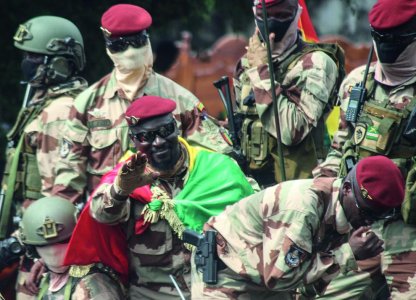
The latest measure to dissolve political parties in Guinea reinforces a dictatorship that prefers to adopt an extractivist policy at all costs rather than respond to the social needs of the population. Forty political parties were dissolved on the night of Friday 6 to Saturday 7 March by the Guinean government, on the eve of the legislative elections scheduled for May 2026. [1]
Among them are mainstream parties such as the Union des forces démocratiques de Guinée (UFDG) led by former prime minister Cellou Dalein Diallo, the le Rassemblement du peuple de Guinée (RPG) of former president Alpha Condé and the Union des forces républicaines (UFR) of former prime minister Sidya Touré.
A coup d’état against a backdrop of crisis
This measure is part of a long sequence aimed at consolidating the dictatorship of Mamadi Doumbouya. A former corporal in the Foreign Legion of the French army, he climbed the ladder on his return to Guinea, taking command of the Special Forces Group, an elite battalion, before becoming a lieutenant general.
By running for a third term thanks to a change in the constitution, Alpha Condé provoked a serious political crisis marked by demonstrations and clashes in the country’s main cities. Doumbouya took advantage of this situation to overthrow the president, whose election was illegitimate.
When he took power on 5 September 2021, Mamadi Doumbouya had declared that he would not stay in office forever: “I would like to reiterate here my commitment that neither I nor any member of the CNRD and the organs of the Transition will be a candidate in the upcoming elections and that we have no intention of clinging to power”, also promising not to run in the presidential election and to guarantee the fundamental freedoms of Guineans. [2]
He also affirmed that “the personalization of political life is over, we are no longer going to entrust politics to one man, but to the people”. [3]
All-out repression
Four years later, the situation is bitter. None of the promises have been kept. Posters glorifying Doumbouya are omnipresent in the public space. He adopted a new constitution on 21 September 2025, officially approved by 90% of voters, which allows him to run for president with a seven-year term, renewable once. Like the constitutional referendum, the presidential election was a vast masquerade, with the main opponents excluded from the race. It was with an official score of 86.7% that Doumbouya was “elected” president of the Republic.
This accession to power was accompanied by increasingly ferocious repression. Demonstrations were bloodily repressed and a policy of enforced disappearances was deployed throughout the country. Sally Bilaly Sow, a journalist, Mohamed Traoré, a lawyer, Néné Oussou Diallo, leader of the UFDG, Abdoul Sacko, coordinator of the Forum des forces sociales de Guinée, and Foniké Menguè and Billo Bah, civil society activists, are among dozens of abductees, most of whom have never reappeared. For those who have gone into exile, the regime is relentless on their loved ones. Recently, hooded men kidnapped the 84-year-old sister and mother of Tibou Kamara, a former adviser to Alpha Condé.
The new liberticidal measure to dissolve 40 political parties is based on incoherent legal quibbles. Thus, the UFDG was supposed to hold its congress on 6 July 2025, but a court ordered it to be postponed indefinitely. This formation is therefore now dissolved for obeying court orders.
From now on, banned parties lose their legal status and legal personality. It is forbidden to use the acronym, name or logo of these formations. Their premises were sequestered and their property confiscated.
The stakes for the dictatorship are high, because at least the three main parties have a real capacity to mobilise and represent a danger to the regime. Especially since its social and economic policy is catastrophic.
Extractivism vs. social progress
The social situation in Guinea is worsening: nearly half of the population lives below the poverty line. Food insecurity affects 11% of Guinea’s 14 million people, up from 2.6% in 2020, one of the highest increases in Africa. Failing to fight poverty, the authorities have attacked the poor with brutality. Thus, without prior information, at dawn, construction machinery, escorted by the police, razed the small shops of odds and ends installed on the sidewalks of the capital. These small informal businesses provided a living for hundreds of families. No compensation or relocation measures to a market or other space have been proposed: overnight, these people have lost their livelihood.
The Guinean Oil Palm and Rubber Company (Soguipah), which is 100% owned by the Guinean state, does not comply with the minimum wage set at €55 per month. Some workers, for 170 hours of work per month, receive only €7. This company does not hesitate to trample on workers’ rights. [4]
The “emergence” plan known as Simandou 2040 provides for the exploitation of one of the largest iron mines in the world. The authorities promise an improvement, but there are great concerns about the environmental consequences, as the site is located in the Nimba Mountains, an area classified as a UNESCO World Heritage Site. The NGO Climate Rights International, which produced an impact study, stresses that the iron ore mining project at Mount Nimba “could have major negative environmental, climate and human impacts” and is concerned about “irreversible long-term consequences”. The project also threatens to worsen the situation of farmers, since it “has the potential to undermine food security and the local economy, because mining infrastructure will reduce or eliminate farmland in the villages of Gbakoré, Zouguepo, Bossou Centre, Seringbara and Thuo. The loss of arable land and pastures land will increase land pressure in the same prefecture where there have been deadly conflicts between herders and farmers.” [5]
As for the predicted economic upturn, it will mainly benefit the country’s elites, in particular the Doumbouya clan, in view of the number of corruption cases brought to light. [6] The president’s frenzy of real estate purchases in the upscale district of La Minière, in Conakry, is an illustration of this.
Concealing dictatorship
Since the presidential election, ECOWAS, the West African regional organisation, considers that constitutional order has been restored and has lifted its sanctions. This hypocrisy is shared by the French government, which is very happy not to be blacklisted as it is by the Sahelian states of Mali, Burkina Faso and Niger. In Guinea, despite a sovereignist discourse, the government does not fall into anti-French propaganda, perhaps because the former colonial power does not hesitate to lend a hand to the dictatorship through military and police cooperation. Aid workers are based in Conakry; they are conducting training and training projects for elite units of the Guinean army and security forces, who do not hesitate to fire live ammunition at unarmed demonstrators. NGOs report about a hundred deaths during the demonstrations.
As for the other powers, such as the United States, China or Canada, too satisfied to see their multinationals benefit from the country’s mineral wealth, they turn a blind eye to the regime’s abuses. If there is hope for change, it lies in the action of civil society organizations, trade unions and in the combativeness of the population, especially young people who represent half of Guineans.
27 April 2026
Translated by International Viewpoint. In French Inprecor.
Footnotes
[1] Phot: Mamadi Dumbaya during the carnival celebrating the anniversary of Guinean independence, 2 October 2021. CC BY-SA 4.
[2] “Le serment de Mamadi Doumbouya”, Tierno Monénembo, 27 January 2026, Le Point.
[3] Bulletin Francopaix Vol. 10, number 9, November 2025.
[4] “Guinée. Un nouveau rapport révèle les abus envers les droits de travailleurs de plantations liées à la Soguipah, une entreprise d’État”, 23 October 2025, Amnesty International.
[5] “Guinea: Iron project threatens forests and communities”, 12 January 2026, Climate Rights International.
[6] “Guinée : Pourquoi cette persistance des scandales financiers?”, Aïssatou Chérif Baldé, 21 January 2025, African Panorama Magazine.
Paul Martial
Paul Martial is a correspondent for International Viewpoint. He is editor of Afriques en Lutte and a member of the Fourth International in France.
.png)
.png)

No comments:
Post a Comment