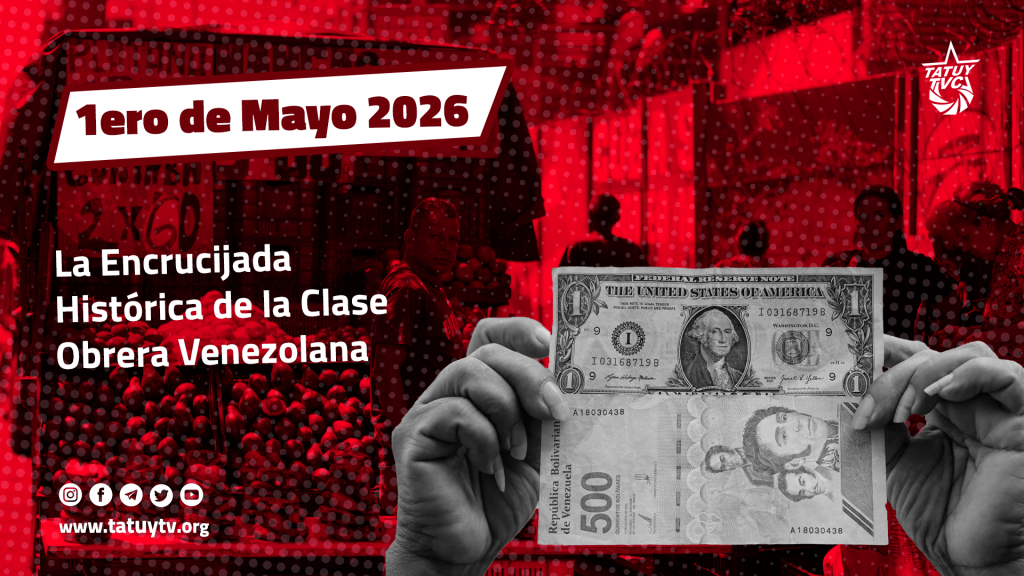
May 1, 2026: The Venezuelan working class at a historic crossroads
First published in Spanish at TatuyTV. Translation by LINKS International Journal of Socialist Renewal.
As we approach another International Workers’ Day, Venezuela finds itself amid one of the most decisive political and economic junctures in its contemporary history. Recognising that media is not a sterile exercise, but a factory producing ammunition for the battle of ideas, we are initiating a crucial debate on the minimum wage in Venezuela in 2026. Our analysis goes beyond the mere expectation of an isolated presidential announcement.
Today, the wage issue has become the epicentre of a structural struggle over the model of society we defend in the face of imperial siege and deep internal contradictions. In this article, we examine the real threats facing the Venezuelan working class — from US tutelage over energy geopolitics to the state’s silent reconfiguration — to provide grassroots activists with solid arguments in this non-negotiable struggle for life and dignity.
The LOTTT: A historic achievement under imperial siege
To understand the scale of the minimum wage crisis in Venezuela, it is essential to draw on historical memory. Working people experienced a highpoint in the struggle for their rights when, on April 30, 2012, Commandante Hugo Chávez enacted the Organic Law on Labour and Workers (LOTTT).
This legal instrument represented a historic safeguard: it restored the retroactive calculation of retirement/redundancy payouts, established job security as a principle, and built a powerful legal bulwark against outsourcing and precarious employment. The LOTTT was, in essence, a legal expression of the socialist ideal of the Bolivarian Revolution, ensuring that labour was recognised as a social fact and not a commodity subject to the savage laws of capital.
However, this emancipatory project was the target of a fierce onslaught by imperialism. Barely five years later, on August 24, 2017, the first economic sanctions imposed by Washington marked a tragic turning point. Designed with surgical precision against PDVSA [the state oil company] and the national financial system, these measures deliberately sought to strangle the republic’s revenues, with a direct impact on people’s purchasing power, at a time when the nation was already suffering a severe recession as a result of falling oil prices.
The blockade is not a metaphor: it is an act of economic warfare that resulted in estimated annual losses of more than US$25 billion and the confiscation of international assets worth more than $30 billion — resources that could have been channelled into social welfare and decent wages.
The blockade’s devastating impact on workers
The financial siege imposed since 2017 not only shattered the country’s macroeconomic equilibrium, it triggered a hyperinflationary cycle that ultimately wiped out the value of the minimum wage. By 2019, year-on-year inflation exceeded 300,000%, according to official figures, destroying a decade of progress in income distribution.
The working class’ purchasing power collapsed. If in 2012 a minimum wage could cover the basic food costs of three households, by the end of the hyperinflationary cycle that same wage was not enough to cover even 1% of the food that a typical family of five needed. The sanctions made no distinction between political activists and the civilian population; they penalised the entire nation, plunging Venezuela’s historic working class into an unprecedented crisis of survival in peacetime.
Internal blows: The dismantling of labour rights
If external aggression is the starting point for understanding Venezuela’s reality, the next step is turning our attention to the government’s response. Faced with this economic siege, the executive’s response was to liberalise, yielding more and more to the demands of capital.
In the labour sphere, this entailed a progressive erosion of rights and safeguards. On August 20, 2018, the so-called Programme for Economic Recovery, Growth and Prosperity brought with it currency devaluation and a de facto relaxation of controls, severely impacting the labour ecosystem.
One of the most insidious and lethal blows to institutionalised protections was Memorandum 2792, issued on October 11, 2018. This ministerial document, which had no force of law, served to flatten pay scales in the public administration and overrode vital clauses in collective agreements signed over many years. This memorandum was the first direct blow to the heart of collective bargaining. The measure was strongly rejected by the trade union movement.
Subsequently, the offensive against public sector pay intensified on March 22, 2022 with the ONAPRE Directive, which cut bonuses, eliminated historic compensation and sparked the most intense street protests in recent times, led by educators and healthcare workers.
In parallel with making working conditions more precarious, the government established control of inflation as an absolute priority. One of the tools it used was to freeze the minimum wage. Set at 130 bolivars a month since March 15, 2022 — equivalent to at the time — it is now a purely symbolic figure, completely eroded by devaluation [and equivalent to $0.27].
The bonus trap: Subsistence with no future
Faced with a declining minimum wage, the government adopted a compensation strategy that generates deep scepticism among organised workers: bonuses. Denounced by Chávez as a recurring policy of the Fourth Republic, bonuses [non-salary compensations] reduce costs for employers, erode labour liabilities, and facilitate redundancies.
Ahead of an expected May 1 announcement, workers fear a repeat of the policy introduced in 2023: indexation of variable bonuses through the Patria System, without touching the statutory minimum wage. The acting president and other spokespeople have sought to lower expectations, insisting that wage increases must be “responsible”.
This bonuses policy amounts, in practice, to the hollowing out of labour rights. Although it allows for immediate survival, it has no bearing whatsoever on the calculation of holiday pay, benefits and long service, or severance pay. More critically, and perversely, it wipes out a lifetime’s savings by not contributing to retirement payouts, as severance pay is calculated based on the final salary, condemning the worker to a retirement without assets. It is the philosophy of day-to-day survival, a trap that robs the working class of its future and hides behind the technical justification of “not fuelling inflation”.
The situation regarding pensions is even more dire. The elderly population receives even less in bonuses than public sector workers.
Expectations regarding a new minimum wage in Venezuela for 2026 will put the macroeconomic reality to the test. Despite five consecutive years of growth, Venezuela’s current GDP stands at about 36% of the 2012 figure. However, demands are fuelled by optimistic forecasts, realistic or otherwise, regarding the country’s future.
However, the current context of US semi-colonial tutelage is a major obstacle. The government does not directly manage oil revenues, the economy’s main source of foreign exchange, leaving it at the mercy of the Trump administration’s whims to access (part of) its own resources. US officials have arrogantly stated that the Venezuelan government must submit a budget proposal for approval before funds are released.
Another spectre looming large is the International Monetary Fund (IMF), with its “recommendations” for fiscal discipline. Although the Venezuelan government has stated that there are currently no plans to take on debt, it is possible that external debt could pave the way for a future of debt and structural adjustments. For all these reasons, it is likely that Delcy Rodríguez’s government will adopt a conservative stance in the face of the increasingly widespread demands for wage rises.
The state’s restructuring: modernisation or silent dismantling?
Alongside job insecurity, an enigmatic “modernisation of the state” is currently underway. Strategic, albeit unofficial, information confirms a thorough purge of the public administration’s payrolls through the Patria System and ONAPRE, under the formal pretext of eliminating duplicate positions and conducting attendance audits.
However, the underlying political interpretation is far harsher: we are facing an imminent and silent structural reduction of the state apparatus. In parallel with the commission assessing the “strategic” value of state assets, the trend towards shrinking the state is clear. One scenario is the creation of a bureaucratic elite with privileged salaries to sustain the various institutions, casting hundreds of thousands of workers into the unprotected ranks of casual labour, the informal sector and the transnational subsistence economy.
At the same time, a commission has been set up to draft up a reform of the labour law and the pension system.
Proposals for the minimum wage: The battle over figures
The class struggle is being waged on several fronts, from the streets to the tripartite negotiating tables. The fundamental demands of the trade union rank-and-file are non-negotiable:
- Full restoration of rights: A radical minimum wage rise and the total and immediate conversion of bonuses into wages.
- Scientific indexation: A wage indexed to the real household costs, currently estimated by Cendas-FVM at more than $530 a month for a family.
- Dismantling of illegal measures: Complete repeal of Memorandum 2792 and the ONAPRE Directive.
- Freedom of association: Release workers and trade union leaders detained for peaceful protest.
- Collective bargaining: The immediate resumption of negotiations on fair collective agreements, preserving the historic achievements of the LOTTT at all costs.
In quantitative terms, the differences highlight the tension between street-level realism and technical adjustments:
- Trade union sectors: The Bolivarian Socialist Workers’ Confederation (CSBT, pro-government) is proposing quarterly increases of $50. The Confederation of Workers of Venezuela (CTV, centre-right) is demanding an initial $200, rising to $450. The Federation of University Professor Associations of Venezuela (FAPUV) is requesting a base pay of $300 plus indexation. The Independent Trade Union Alliance (ASI, Christian Social) estimates its minimum at $377.
- Liberal economists: Spokespersons such as Luis Oliveros and José Guerra, representatives of orthodox austerity thinking, propose amounts of just $100 and $150, figures completely disconnected from the dollarisation of the popular economy and more in line with employers’ need to contain labour costs.
The capitalists demand flexibility
While various labour organisations demand dignity and fair wages, the business sector, represented by trade associations such as Fedecámaras and Conindustria, is seizing the opportunity and “tripartite dialogue” (state, trade unions and business) to sink its claws into protective legislation. Taking advantage of the weakness of incomes, their aims are clear and directly undermine the doctrine of social justice that characterised the original Chavismo:
- Abolition of retroactive calculations: Elimination or drastic reduction of the retroactive application of social benefits, seeking a simple payment system that liquidates accumulated labour liabilities.
- Make it easier to sack workers: Complete dismantling of job security to facilitate low-cost mass redundancies, allowing staff turnover without fair compensation.
- Dismantling of historical calculation: Comprehensive review of the pension system to eliminate historic pension calculation mechanisms, replacing them with capitalisation schemes or universal minimum amounts.
Conclusion: A May Day of struggle and dignity
This May 1 is not a date for empty applause or for the complacency of bureaucracies disconnected from reality. The Venezuelan working class, which stoically resisted the onslaught of the United States’ illegal sanctions, cannot be sacrificed once again, this time on the altar of “macroeconomic stabilisation” or the internal re-engineering of the capitalist state under imperialist tutelage.
Unconditional defence of the LOTTT is the indispensable starting point for any project of national recovery with a human face. Wages are not a variable in spreadsheets to be optimised in the face of monetarist conceptions of inflation. They are a materialisation of the social debt owed by the state and capital to those who actually produce wealth. Precarious employment is not an inevitable fate. We demand indexation, back pay and full respect for the history of workers’ struggle. In the face of transnational capital and our own mistakes, there must be but one slogan: not one step back.
‘Fighting for a wage rise is also an act of resistance against imperial tutelage’: Interview with Venezuelan retired oil worker’s leader Denis Ospino

Retired oil worker Denis Ospino was a prominent part of the revolutionary resistance against the 2002–03 management lockout at Venezuela's state oil company, PDVSA. She was crucial to restoring and stabilising oil production, playing an active role in protecting the Western Oil Production Directorate headquarters, and as part of the civilian and reserve unit defending operational facilities on Lake Maracaibo’s eastern shore. A staunch defender of oil workers’ rights, she is an executive committee member of the Autonomous and Independent Workers’ Committee (CAIT).
Speaking with Federico Fuentes for LINKS International Journal of Socialist Renewal, Ospino discusses the situation for Venezuelan workers, the regime of “tutelage” imposed by US President Donald Trump after January 3, the economic measures announced by Acting President Delcy Rodríguez, the growing wave of trade union protests since February, and the importance of anti-imperialist international solidarity with the Venezuelan people.
Rodríguez’s 8 April announcement that there would be a “responsible” wage rise was met with derision by many workers and trade unions. Could you describe the situation facing Venezuelan workers? Why is the issue of wages so important?
It is important to note that the economic sanctions imposed on Venezuela since 2017 are still in place, despite United States President Donald Trump imposing control mechanisms over our economy and the country’s reintegration into the US’ geopolitical orbit. These sanctions have profoundly impacted working people, undermining the Constitution and the Organic Law on Labour and Workers (LOTTT). This led to a significant reduction in the value of formal employment, which is now seen more as a burden than a means to obtain a dignified livelihood. This situation forced millions of Venezuelans to seek opportunities abroad or resort to informal activities to survive.
Now more than half of the workforce is in the informal sector, and the minimum wage is among the world’s lowest. We have gone four years without a minimum wage rise, which has remained stagnant at 130 bolivars a month (about US$0.27) since 2022. Meanwhile basic food costs for a family are between $500–700 a month. The comprehensive minimum income in Venezuela consists mainly of bonos [non-salary benefits, known as bonuses], which are adjusted according to the value of the BCV [Central Bank of Venezuela] dollar, and amounted to $190 a month for formal sector workers in early 2026. But those who live off bonuses — that is, workers and pensioners — face a complex reality: not only do prices fluctuate upwards from one day to the next, but they are often marked in dollars and even euros while we are paid in bolivars. This market chaos ultimately devours any “responsible increase” in the minimum wage.
The first thing the government must do, if it wants to act responsibly, is stop this dollar-induced economic chaos and fix prices. The Commission for Labour Dialogue and Social Security, also announced on April 8, must also address inflation, so that wage rises are not rendered meaningless. Also, any minimum wage rise must be real and not symbolic. It must boost benefits, holiday pay and pensions, and serve as a basis to adjust upwards workers’ pay scales covered by collective agreements.
What is the prevailing mood among workers and trade unions after the imperialist attack on January 3?
It is more than three months since the military aggression against Venezuela and the start of Delcy Rodríguez’s interim government. Workers are in a state of uncertainty because the country’s revenue and finances depend on the US. Venezuela is 90% dependent on oil revenues. Simply opening up the oil sector is not enough for workers, we must understand the terms of this opening, which is being controlled by the Trump administration, where transnational corporations will control oil production, and where PDVSA’s role is scaled back. Ever since the bombardment, our energy sovereignty has been ceded. We have entered a political and economic phase that is worse than that of the Fourth Republic [before the election of Hugo Chávez in 1999].
Oil workers believe this situation will benefit them, but as they see the US’s intentions, they view their employment future with concern. Will outsourcing return? Will they lose their collective agreement? Will they become employees of transnational corporations, and under what conditions? What will become of PDVSA? Even retired oil workers are worried their pension fund will disappear. In a country under the tutelage of a capitalist power, nothing is sustainable or secure.
How do you view the relationship between Venezuela and US imperialism after January 3?
US government representative Chris Wright, during his visit to Venezuela, said that since the arrest of Venezuelan President Nicolás Maduro on January 3, at least 150 million barrels of Venezuelan oil have been sold on the global market. This was according to the US newspaper Nuevo Herald. The US sold this Venezuelan crude at an average price of $60.48 a barrel during the first quarter. The sale of this oil would therefore amount to about $9.070 billion in gross revenue. But Venezuela has only received $500 million.
At a recent press conference, Trump clearly outlined the nature of his administration’s relationship with Venezuela and the future of our strategic resources. He said: “The relationship’s been great. We’ve taken out 100 million barrels of oil already… We paid for the war many times over, and we’re going to be running the oil.” This confirms imperialism’s intention to appropriate oil sale proceeds.
Given the return of the World Bank and the International Monetary Fund (IMF) to the country, along with other announced economic measures, is there a strategic shift in the government’s economic policy?
Economic plans are not neutral; they are tools to determine which sectors, social groups or economic interests will receive state support. Rodríguez’s recent announcements show a revealing shift in Venezuela's economic direction. The economic opening up initiated with the 2018 recovery plan is being expanded. This shift aims to attract foreign capital via a new free-market economic architecture and legal guarantees for capital, with the absolute priority being Venezuela’s reintegration into international financial markets.
Following the military aggression against our country and Maduro’s kidnapping, there has been a complete U-turn in the nation’s foreign and economic policy. New foreign investment and strategic agreements with Chevron to increase oil production have been announced, facilitated by legal reforms to encourage greater domestic and foreign investment. Also, the World Bank and the IMF have resumed their relations with the Venezuelan government. This is against the backdrop of an emerging new financial architecture, driven by reforms in the oil and mining sectors and a restricted and conditional lifting of financial sanctions. Despite the easing, the sanctions have not been completely lifted. Restrictions remain on oil operations and relations with certain sanctioned countries. Commercial transactions with the Venezuelan government also require prior authorisation from Washington.
Nevertheless, the IMF’s return brings the debt issue to the fore. Venezuela has a recognised debt of about $170 billion. Of this, $150 billion is owed to international organisations, while $19 billion is bilateral loans from China and Russia. A particularly sensitive issue is the $60 billion in PDVSA sovereign bonds, which defaulted at the end of 2017. The scale of the debt represents 193% of Venezuela’s gross domestic product, according to the latest available figures. A return to the IMF inevitably involves “refinancing debt” and also reaching agreements with other development banks and creditor nations. By expanding international oil companies’ operations, Venezuela will have greater resources to pay interest and debt.
What can you tell us about some of the other measures taken to date, such as the Amnesty Law and the forthcoming “responsible” pay rise, which you already mentioned?
The government signalled its willingness to politically open up through the Amnesty Law, appointing a new Attorney General and Ombudsman, initiating a process to renew Supreme Court of Justice (TSJ) authorities and resuming dialogue with the democratic opposition. The aim has been to pass reforms to the hydrocarbons and mining laws and agree on 29 laws and eight new codes covering various areas, including criminal, civil, economic, environmental and electoral law. This is a managed reconfiguration of the political chessboard. Alongside the government’s ongoing control over essential institutions, Rodríguez seeks political cohabitation with the opposition in the National Assembly. Her aim is forming a power bloc in which the interests of the capitalist class predominates, ahead of the upcoming presidential elections.
The announced wage rise is also concerning. It marks a definitive break with the policy of decreed wage rises, insofar as it aligns with broader shifts in economic policy that seek to undermine labour rights, as part of the worldwide attack by the capitalist class against workers. According to Rodríguez, wage rises must be “responsible”; that is, they are conditional on economic sustainability, inflation and sufficient profits. This approach erodes the constitutional right to a dignified wage. It is not being enacted under traditional state direction, but as part of the shift towards prioritising economic liberalisation and foreign investment. The new wage policy, alongside the oil royalties cut in the Hydrocarbons Law reform, is part of the state’s adaptation to forms of capitalist accumulation that are dependent on imperialism. Analysts estimate that direct tax revenues could fall by up to $7.445 billion
Finally, the announced Commission for Labour Dialogue, which seeks to adapt the legal framework to the new economic realities through tripartite dialogue, aims to secure agreement on a new model of social protections and improved working conditions. Business leaders, government and opposition MPs, and senior government officials all agree with this approach. So too does [far-right opposition leader] María Corina Machado. For all of them, a living wage must be the result of economic growth, private investment and the regular functioning of the labour market. All agree on reforming the labour law as the means of improving wages.
What does all this tell us about the nature of Rodríguez’s government?
It is important to clarify certain aspects: the January 3 military aggression carried out by Trump against our sovereignty marked a new phase of direct interventions in Latin America, within the context of Trump’s National Security Strategy presented in early December. It aims to align all regional governments with Washington’s interests, offering cooperation in return, or otherwise face economic, political or military pressure.
Without oversimplifying, we must recognise the different stages of the political process in Venezuela. During Chávez’s government, there was a notable rise in political and social participation of historically marginalised groups, which created spaces for popular participation and the expansion of social rights. However, after Chavismo — now under Maduro — lost its parliamentary majority in 2015, there was a steady process of democratic deterioration. The TSJ’s intervened to limit and nullify the opposition’s legislative power through various rulings, marking the start of absolute political control that undermined the 1999 Constitution. This period featured strong authoritarianism, with the concentration of power, erosion of institutions and the criminalisation of labour protests.
Post January 3, with Rodríguez in office now for more than 100 days, Trump has imposed a subordinate regime, which can be described as “tutelage” under Washington’s supervision. This control is evident in oil revenue management, with oil sale proceeds deposited into special accounts controlled by the US rather than into PDVSA’s accounts. Thus, the government faces a paradox: it needs the “economic freedoms” offered by the US to survive, but these freedoms aim to weaken its political control in the long term, steering it away from the Bolivarian agenda.
What position has the CAIT taken?
Faced with this economic and political reconfiguration, the Autonomous and Independent Workers’ Committee believes we urgently need broad unity to combat the policy of converting wages into bonuses. We firmly state: “Wages yes! Bonuses no!” As trade unionists, we understand that a minimum wage rise will have a direct and significant impact on collective agreements and pay scales.
On unity, we issued a call to the Bolivarian Socialist Workers’ Confederation (CSBT), who have said they will defend workers’ redundancy/retirement pay outs and oppose changes to the labour law. We said to them we must agree on a common agenda and take these proposals to the Commission for Labour Dialogue, alongside maintaining our street demonstrations. Trade unions remain an essential pillar in defending labour rights, despite the difficulties they face.
Demanding a pay rise is not merely an economic demand; it is an act of resistance against the government’s anti-labour policies and also against imperialist tutelage. Demanding “Wages yes, bonuses no” means denouncing the US Treasury Department, through the Office of Foreign Assets Control (OFAC), confiscating proceeds from Venezuela’s crude oil sales. It means demanding the total and unconditional lifting of all sanctions.
We must promote spaces to come together and debate, which unite different sectors in defence of sovereignty, independence, democracy and the Bolivarian Constitution. Reversing the loss of sovereignty is, above all, a political task that requires strengthening internal capacities, sustained mobilisations of the people and constantly confronting the US government as it attempts to impose control. In this context, the failure of senior government officials to condemn imperialism and its aggressions in their speeches and positions since 3 January is concerning.
What is the current state of the trade union movement?
Venezuela’s trade union movement faces a serious crisis. It is fragmented and dispersed, with more than 50% of the workforce in the informal sector. Job insecurity particularly affects young people, who lack knowledge of labour laws or a trade union culture. The collapse of labour relations and absence of collective bargaining has hindered progress on wages and labour rights. Mass migration has also weakened trade union organisations, as many members and leaders have left the country. However, trade unionism remains vital to defending labour rights, as shown by the recent mobilisations.
What was the significance and political orientation of these protests?
These demonstrations are significant, but they have not brought together all workers. Various national trade union coalitions, together with the Intergremial, the CTV [Confederation of Venezuelan Workers] and other sectors such as university lecturers and public sector workers, submitted a national list of demands to the labour ministry in February. This document demanded drastic wage rises and respect for labour rights after years of wage freezes.
On March 12, hundreds of workers and retirees from the education, university and health sectors, as well as pensioners, marched in cities across Venezuela. They are the hardest hit by the current situation. In Venezuela, there are disparities in allocating bonuses and wages. This policy is discriminatory because workers’ needs are the same. As for pensioners, they only receive a “war bonus,” which is half of what workers get, and no food allowance. This means pensions are as low as $60 a month.
The April 9 demonstration was organised by the National Trade Union Coalition to march towards Miraflores [the presidential palace]. The coalition’s politics align with Machado’s electoral agenda, with the march demanding “Elections now.” Historically, the Venezuelan opposition have believed that a mass march reaching Miraflores is enough to force a president to resign. The choice for the final destination showed it was about seeking to force political change. For working people, marches on Miraflores stir memories of the coup attempt on April 11, 2002, against Chávez.
Some right-wing trade unions and political parties also organised a march to the US Embassy to demand a pay rise there…
Yes. A protest was called for April 16 to march on the US Embassy. This march was not strictly a labour protest, as it was accompanied by slogans such as “Mr Trump, complete the transition now” and calls for elections. The delegation, however, was not received by a high-level diplomatic staff. Despite a small turnout, it had a notable impact on social media, with extensive live coverage. They have also called for a demonstration on April 30 to mark May Day, again with the aim of ending at Miraflores. They are not seeking to reclaim the labour rights we have lost, but to capitalise on existing discontent and channel it in Machado’s political interests.
But we already know how this story ends. In 2019, Juan Guaidó’s proclamation as “interim president” attracted many groups of workers, who abandoned their autonomous and independent struggle for better wages and against Memorandum 2792 and the criminalisation of labour protests. A similar situation occurred in 2023, when educators mobilised for their demands, only for many of the union’s leaders to then focus on the opposition’s primaries, which were won by Machado’s candidate, Edmundo González Urrutia.
How can leftists and trade unionists demonstrate anti-imperialist solidarity with Venezuelan workers’ struggles today?
On international solidarity, we must explain that, after the events in Venezuela, Trump is gambling on exporting this model of intervention, with bombings and assassinations, to impose control on other nations. This aggressive strategy involves, in particular, tightening economic pressure and direct military intervention in Latin America. Following the attack on our country, the US began confronting Iran. At the same time, on March 7, Trump summoned 12 Latin American presidents to Miami to reorganise “hemispheric security” through a political-military alliance with allies in his “backyard”. This strategy forms part of the US National Security Strategy’s plan for domination, which redirects military spending towards preparations for a “world war”. This makes total control of the Western Hemisphere essential. Against this, the working people and the social and political organisations of Latin America must unite around an anti-imperialist agenda.
At the same time, millions in the US have protested against Trump, particularly in the huge “No Kings” marches in March, expressing a profound rejection of authoritarianism, harsh immigration policies and unilateral actions. More than 8 million people demonstrated out of concern for democracy, the rising cost of living and war. The crisis of capitalism is affecting all the peoples of the region, and those countries around the world with mineral, energy and rare earth resources. It is essential to link up with this anti-Trump movement in the US, as part of our resistance and progress. This represents the best form of solidarity that the left can adopt.

No comments:
Post a Comment