Thursday, December 09, 2021

Deck the T. Rex With Christmas Sweaters, 
Fa La La La La


Rotem Rusak
Wed, December 8, 2021

‘Tis the season for celebration. And all creatures, great and small, should get to partake in the festivities. And one very great one has got out their Jurassic jumper, just in time for the holidays. London’s Natural History Museum has dressed its animatronic Tyrannosaurus Rex in its very own Christmas sweater.


British Christmas Jumpers

The museum shares:
Our animatronic T. rex is getting into the Christmas spirit. It’s been kitted out in its very own theropod-size seasonal sweater, made from 100% recycled materials.

A joyous dino, who also cares about the environment? We 100 percent needed this holiday cheer. The sweater, of course, had to be custom-made. Because how else would the King of the Dinosaurs get his little arms in? The sweater was designed by the brand British Christmas Jumpers. And the good news is you can match your favorite sweater-clad dinosaur. Just pre-order an adult-sized version of the sweater from the Natural History Museum’s online shop. Happily, the sweater also comes in children’s sizes.

Museum of Natural History


Here’s more about the design:

The navy, red, green, and white pattern features snowflakes, fir trees – and everyone’s favourite dinosaurs: Triceratops, Stegosaurus, T. rex and Diplodocus. Even the Museum’s famous Hans Sloane nautilus shell appears along the hem and cuffs.

Now, I know what you’re thinking. Doesn’t the T. Rex eat Triceratops? Well, it did. But the good news is, it’s Christmas, and everyone has called a cease-fire. That’s how this magical season works, right? And who doesn’t love a little bit of dark humor in with the holidays?

Now, all we need is to get the T.Rex its very own Christmas tree. And invite it to sing some Christmas carols. Like those classics, Growling Night and Jingle Bell Mesozoic Rock. But let’s leave Christmas stars, or any other mentions of outer space out of it. We wouldn’t want our Christmas sweater-wearing T. rex, or any of his dinosaur friends, to have a blue Christmas.

The post Deck the T. Rex With Christmas Sweaters, Fa La La La La appeared first on Nerdist.


Jurassic crocodile relative could breathe easily while drowning its prey

Mindy Weisberger 

Around 155 million years ago in what is now Wyoming, a crocodile relative clamped its jaws around a thrashing animal and dragged it below the water's surface, and the ancient reptile could still breathe comfortably as its prey slowly drowned.

© Provided by Live Science Amphicotylus milesi lunges at its Jurassic prey.

That's because the croc had specialized structures that prevented water from flowing through its mouth and into its airway. This feature is known in modern crocodilians — crocodiles and their close relatives — and scientists recently identified the same mechanism in a newly described species of croc cousin that lived during the Jurassic period (201.3 million to 145 million years ago).

This is the earliest evidence of crocodilian adaptations for submerging their heads (and prey) underwater while still being able to breathe through nostrils on top of their snouts; this ability is an important part of the group's deadly feeding habits today, and may have helped crocodilians survive the Cretaceous extinction that wiped out most of the dinosaurs.

Related: Crocs: Ancient predators in a modern world (photos)

Scientists named the newfound species Amphicotylus milesi, and it belongs to a group of early crocodile relatives called goniopholidids, which lived in the Northern Hemisphere from the Jurassic through the early Cretaceous period (145 million to 66 million years ago) and had a body plan suggestive of a semiaquatic lifestyle.

The near-intact skeleton, discovered in 1993 in Wyoming's East Camarasaurus Quarry, is the most complete goniopholidid fossil ever found. When it was alive, the reptile would have measured about 7.5 feet (2.3 meters) long and weighed up to 500 pounds (227 kilograms), study co-author Michael J. Ryan, an adjunct research professor in the Department of Earth Sciences at Carleton University in Ontario, told Live Science in an email.

A. milesi also has one of the biggest known skulls among this group of early crocs, measuring 17 inches (43 centimeters) long, and the broad, elongated snout accounts for about 60% of the skull length, the scientists reported Dec. 8 in the journal Royal Society Open Science. However, unfused sutures in some of the bones hint that the reptile was a youngster that was still growing, according to the study.

"I believe that it was approximately adult size, but reptiles like this would have had indeterminate growth — continuing to grow through their lives, but slowing down after maturity," Ryan said. "A conservative estimate would be that an 'adult' could have been half again as long and heavy," measuring nearly 12 feet long (3.7 m) and weighing up to 750 pounds (340 kg), he added.
Breathe deep

Modern crocodilians — crocodiles, alligators, caimans and gharials — can breathe through their mouths and through nostrils on top of their snouts. The nostrils have protective valves at the openings, and air travels through canals and down the back of the throat, where it passes through another valve, according to the IUCN-Species Survival Commission's Crocodile Specialist Group (CSG), a global network of experts involved in crocodilian conservation.

When a crocodilian basks on land, it typically breathes through its open mouth, and the palatal valve in the throat (also known as a gular flap) is open. However, when it is holding prey in the water, the crocodilian breathes through its nostrils and the flap is closed, which prevents the animal from inhaling water through its open mouth, according to the CSG. When this flap isn't in use, it rests in the underside of the throat, and a network of muscles lifts the flap into place to block the flow of water.

Related: Photos: Early dinosaur cousin looked like a croc

As the researchers examined the size, shape and curvature of skull structures in A. milesi, they found similarities to certain features in modern crocodiles with the gular flap, such as an extension in the roof of the mouth toward the back of the throat and a shortened bone called the ceratobranchial, which lies in the throat and supports the tongue. This combination of anatomical features in A. milesi suggests that this ancient croc relative also had a flap that would have kept it from inhaling water while drowning its prey, so long as it kept its nostrils above the water, the study authors reported.

Other crocodilian relatives dating to the late Jurassic and early Cretaceous periods have similar modifications, "suggesting that they, too, may have had a similar ability," Ryan said. "But this combination of anatomical features is unique to Amphicotylus."

Adaptations for underwater dining could help to explain why the ancestors of modern crocodiles were able to weather the mass extinction event at the end of the Cretaceous period while their nonavian dinosaur contemporaries died out, Ryan explained.

"The features now recognized in Amphicotylus allowing for a feeding strategy that nonavian dinosaurs did not have might have contributed to their survival of the Cretaceous extinction — by staying and feeding in the water," Ryan said.

Originally published on Live Science

Researchers discover how a prehistoric creature the size of a giraffe was able to fly

Imagine a giraffe, but with a 40-foot wingspan and a massive beak.

That was the Quetzalcoatlus, a type of pterosaur that dominated the skies millions of years ago. Neither a bird nor a dinosaur, the pterosaur was around for millions of years alongside the likes of the Tyrannosaurus rex and is one of the most recognizable creatures from prehistoric times.

However, not much is known about the giant Quetzalcoatlus. It is regarded as the biggest flying creature to ever exist, but there is skepticism as to whether it did fly, and if it did, how it got in the air.

Now, a group of researchers say they have figured out the Quetzalcoatlus did in fact fly and have learned how it did so by discovering two new types of pterosaurs. Their findings were published in the Journal of Vertebrate Paleontology on Wednesday.

Matthew Brown, director of the University of Texas at Austin’s Vertebrate Paleontology Collections and co-author of the study, told USA TODAY the findings are 50 years worth of research put together. He added it took so long to understand how the species functions because their bones are as thick as a "potato chip," so it required more time to carefully inspect them.
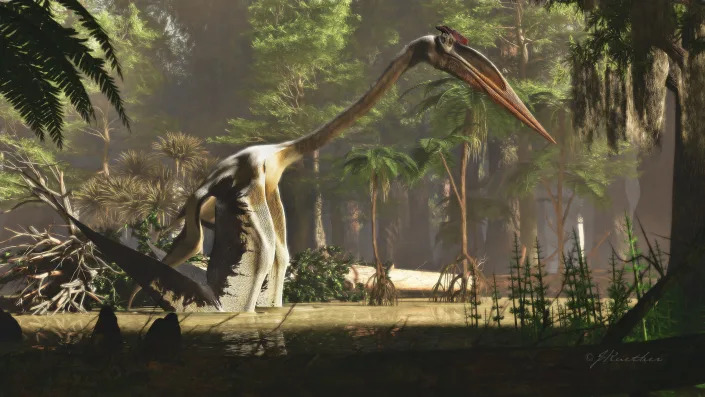
An artist’s interpretation of Quetzalcoatluswading in the water.

There are few fossils of the Quetzalcoatlus, but Brown said there were hundreds of bones for a smaller type of pterosaur, which instead had a wingspan of 18 to 20 feet. From there, the team brought in an aerospace engineer and biomechanic.

"You kind of have to shift your mindset to think about these as living, breathing animals and not just dead skeletons sitting in a drawer," Brown said. "Part of that is looking at modern animals that are alive today that have similar body types."

Together, the team determined that these animals leaped over 8 feet into the air in order to take flight.

"(The team) applied a lot of the aerospace knowledge to understanding how something like airfoil works and how much speed you need to generate lift," Brown said. "There are a couple of models that have been proposed, but the one that that is more attractive is that they're jumping up in the air and then flapping their wings."

Show-Me-a-saurus!: Skeleton of a new type of dinosaur unearthed in Missouri

Supersaurus: Scientists may have found the longest dinosaur in the world

Ferocious sea creature: Researchers discover skull of deadly, fast swordfish-like reptile with a 3-foot-long skull

Kevin Padian, co-author of the study and an emeritus professor of integrative biology at the University of California, Berkeley, added the creatures had large breastbones, so they were "terrific flyers." With its long jaws, the Quetzalcoatlus often ate crabs, worms and clams from rivers and lakes.

Brown said this analysis will hopefully lead to being able to connect all the different types of pterosaurs; there have been an estimated 100 types discovered. The biggest goal is to be able to find a complete skeleton of a Quetzalcoatlus, but for now, Brown is grateful for the team's work.

"It's exciting working with these materials," he said. "This was an early Christmas for us."

Follow Jordan Mendoza on Twitter: @jordan_mendoza5.

This article originally appeared on USA TODAY: A giant, giraffe-sized pterosaur leaped in the air to fly, study says

Hydras can live forever, and the key to their immortality is in the genes

Scientists have some new insights into the workings of one of the few animals that can arguably live forever.
 
© Provided by CNET Hydras are regenerative all-stars. David Plachetzki

Eric Mack 

Hydras are tiny organisms related to jellyfish. They have simple bodies, made up of a cylindrical tube called a body column, with a head structure at the top and a sticky foot on the opposite end (which they use to hold themselves in place). What's remarkable about hydras is that they don't seem to age, thanks to some incredible regenerative powers. Chop off a hydra's head and it just grows right back.

Hydra are regenerative all-stars.

This process has long been a source of fascination for researchers eager to understand how it works down to the genetic level. A new study published Wednesday in Genome Biology and Evolution digs into how a hydra's genes are regulated -- a field known as epigenetics -- to allow it to keep growing back and always be heads up.

A key finding is that the process for head regeneration is different than the one for reproducing, which happens through an asexual process called "budding." Hydras reproduce by forming "buds" along the body column that eventually develop into new, independent animals with their own heads.

"Even though the result is the same (a hydra head), gene expression is much more variable during regeneration," says Aide Macias-Muñoz, a biologist at the University of California, Irvine and the paper's lead author.

The study provides some new insights into the processes behind regeneration, which have been something of a mystery to scientists. It finds that hydras use sequences of DNA called "enhancers" that regulate regeneration on the genetic level.

Macias-Muñoz says this suggests that some of the mechanisms hydras use were passed down through evolution, and may even have made it all the way down to mammals, including humans.

This prompts some fascinating questions. If some of the same genetic programming that allows hydras to regenerate was passed down to humans, is the fountain of youth present in the guts of our own cells, just waiting to be tapped?

Unfortunately, we're still far off from being able to answer such massively consequential questions, but Macias-Muñoz and colleagues believe that digging deep into the genomes of hydras and other species is an important step down that road.
This Lake In Alberta Was Ranked As The Most Beautiful Natural Wonder In The World

The most beautiful natural wonders in the entire world have just been ranked, and a lake in Alberta took the number one spot
!
© Provided by Narcity

Morgan Leet 

The research was conducted by the tourism company Kuoni, which discovered that Peyto Lake is the most eye-catching natural wonder in the world.

This probably hurts for anyone living in B.C. who prides themselves on having the most beautiful province around. Looking at the lake though, it's undeniable that this place is gorgeous.

The Kuoni website said that the lake is "known for its turquoise blue colour, which looks even more impressive contrasted against the dark forest that surrounds the shoreline."

The bright blue water comes from the glacier, making it pretty chilly too.

You can hike up to see the lake and the stunning mountains that surround it.

It's within Banff National Park, which is a big tourist destination because it has so many activities, and is absolutely breathtaking all over.

If you want to get a great view of the lake, try doing the Peyto Lake Panorama Overlook hike, which is 2.4 kilometres. It's an easy hiking loop that will give you a view that you won't ever forget.

Not only did this destination beat out B.C. spots, but it came in ahead of Meeru Island in the Maldives! Being a step up from the iconic Maldives, which is a hot spot for beautiful vacations that are all over Instagram, is pretty cool.

The lake also beat out Yosemite, Niagara Falls and the Jurassic Coast!

It's safe to say that if you haven't had the chance to make it out to Peyto Lake yet, you should hurry up and do it!

SEE MORE INSTAGRAM POSTS HERE
Massachusetts company cooks world's largest pot brownie


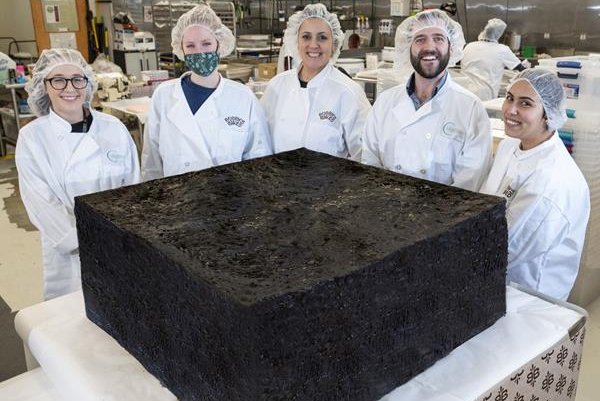
Massachusetts-based MariMed celebrated Wednesday's National Brownie Day and the launch of its new Bubby's Baked brand by cooking an 850-pound confection believed to be the world's largest marijuana-infused brownie. Photo courtesy of MariMed


Dec. 8 (UPI) -- A marijuana dispensary in Massachusetts cooked what it claims to be the world's largest cannabis-infused brownie -- an 850-pound THC treat.

MariMed, based in Norwood, celebrated the launch of its new brand Bubby's Baked by cooking the brownie infused with 20,000 milligrams of TCH, the primary psychoactive ingredient in marijuana.

The brownie measures 3 feet long on each side and 15 inches high. It dwarfs the Guinness World Record holder for largest brownie, a 234-pounder made by Alabama's Something Sweet Bake Shop in 2013.

But MariMed said the record-keeping agency told the company its brownie would not be considered.

"Unfortunately, Guinness World Records rejected our entry because they don't accept cannabis-related records," Ryan Crandall, MariMed's chief product officer, told McClatchy. "That was a disappointment, but we're still very proud of what we accomplished."

The brownie, which was unveiled to coincide with Wednesday's National Brownie Day, will be sold to a MariMed medical marijuana patient, Crandall said.

EAT BROWNIE GET MUNCHIES

Northern Ireland company cooks up world's largest vegan burger


Dec. 8 (UPI) -- A Northern Ireland food company earned a Guinness World Record by serving up a vegan burger that weighed 358 pounds, 4 ounces.

Finnebrogue Artisan, based in Downpatrick, County Down, said a team of 10 employees used the company's Naked Evolution Burger recipe to create the patty, and local bakery Irwins was employed to bake the vegan bread bun.

The burger was topped with tomatoes, lettuce, vegan cheese, onions, gherkins, vegan bacon and the company's burger sauce.

Finnebrogue said the giant patty -- the equivalent of 1,274 of the company's standard-sized vegan burgers -- took 9 hours to cook.

A Guinness adjudicator was on hand to verify that the finished product was a new world record for the largest vegan burger.

The burger was sliced into portions and served to Finnebrogue employees for lunch, with the remainder being donated to local homelessness charity The Simon Community.
Alligator captured after months in Massachusetts river


Dec. 8 (UPI) -- A Massachusetts man captured an alligator in the Westfield River after months of sightings.

Jeremy White, of Agawam, said he saw a TV news report Tuesday morning featuring footage of the alligator the day before near the Eastern States Exposition fairgrounds by a West Springfield resident.

So, he decided to head out in his kayak to find the reptile.

White located the gator near where it had been spotted the previous day, and was able to pull it onto his kayak for a ride back to shore.

"Some people spotted me carrying an alligator in the boat, and they were like, 'Is that the alligator?' and I'm like, 'Yes, that's the alligator,'" White told WWLP-TV.

White contacted the Massachusetts Environmental Police, which turned the 3-foot reptile over to West Springfield Animal Control.

Animal Control officials said the alligator appeared to be in good health and would be turned over to a reptile specialist.

The nonprofit West Springfield Environmental Committee said numerous alligator sightings had been reported in the area since August.
END FUR FARMING
Denmark's PM to be grilled over decision to cull minks


The Danish government decided to slaughter all of the country's 15-17 million minks after a new Covid strain was discovered in some of the animals
Mette Frederiksen
27th and current prime minister of Denmark
 (AFP/Mads NISSEN)

Camille Bas-Wohlert
Wed, December 8, 2021

A parliamentary commission is to grill Denmark's prime minister Thursday over her government's illegal decision last year to cull all farmed minks nationwide over fears of a new coronavirus strain.

Formerly the world's leading exporter of mink fur, the Scandinavian country in November last year controversially decided to kill all of its 15-17 million minks after studies suggested the variant found in some of the animals could jeopardise the effectiveness of future vaccines.

The commission will be seeking to determine whether Prime Minister Mette Frederiksen was aware that the order had no legal basis -- a fact that emerged soon after the cull was underway and led the country's agriculture minister to resign.

At the time, the government only had the authority to ask mink farmers in the seven municipalities affected by the mutation to cull their minks.

But an agreement was reached retroactively, rendering the government's decision legal, and the nationwide cull went ahead as planned.

Prior to the cull, Denmark was also the world's second largest producer of mink fur after China.

A specially appointed parliamentary commission has since April been scrutinising the government's decision and all documents related to it, as well as questioning witnesses to dissect the decision-making process.

Ultimately, the commission will decide whether or not to recommend that the matter be brought before a special court that judges the actions of cabinet members while in office.

Frederiksen has maintained that she did not know her decision was unlawful, and insisted that it was "based on a very serious risk assessment".

"So far, during the hearings, we have not seen any evidence that the prime minister was aware of the illegality," Frederik Waage, a law professor at the University of Southern Denmark, told AFP.

"As someone who was personally very involved in the handling of the case... it is obviously important to hear her own version of events," Waage stressed.


- Deleted text messages -

In October, controversy around the decision was reignited when it was revealed that Frederiksen's text messages from the time had disappeared.

Her office said they had been automatically deleted after 30 days for security reasons.

But many politicians greeted the claim with scepticism. Only two of the 51 ministers and ex-ministers interviewed by public broadcaster DR said they had the same setting installed on their phones while in office.

The commission called on police and intelligence services to help, but they were unable to recover the text messages.


Media and lawmakers have repeatedly questioned Frederiksen on the issue.

According to political commentator Hans Engell, her at times annoyed responses have become a problem of their own, as the opposition has managed to capitalise on the subject and keep it in the headlines.

"It is clear that the government and Mette Frederiksen are very irritated," he wrote in the daily Berlingske.

Unlike the Delta or Omicron variants, the mink mutation has disappeared.

A few weeks after the cull in the North Jutland region in northwestern Denmark, where many mink farms were concentrated, the mutation was declared extinct.

The Danish parliament later passed an emergency law which banned the breeding of the mammals in 2021, which was then extended to 2022, devastating the industry.

Mink is the only animal so far confirmed to be capable of both contracting Covid-19 and recontaminating humans, which is why it has been under special surveillance during the pandemic.

The commission is due to report its findings in April 2022.

cbw/jll/po/ah
PATRIARCHY; MEN LOVE THEIR CAMELS
More than 40 camels disqualified from Saudi contest over Botox, enhancements
MORE THAT THEIR WIVES


Officials with the King Abdulaziz Camel Festival in Saudi Arabia said 43 camels entered in the monthlong event's beauty contest were disqualified when they were found to have been subjected to Botox injections, face lift procedures and other artificial enhancements.

 File Photo by Abhishek/UPI | License Photo

Dec. 8 (UPI) -- Organizers of a beauty contest for camels in Saudi Arabia said 43 animals have been disqualified for receiving Botox treatments, face lifts and other cosmetic procedures.

Officials with the monthlong King Abdulaziz Camel Festival in the desert northeast of Riyadh said examinations of the camels entered in the beauty contest revealed 43 of the animals had received Botox injections, face-lift procedures, hormone injections and other banned enhancements.

The contest, which carries a price of $66 million for the winning animal's breeder, features judges rating the camels based on the shapes of their heads, necks and humps, as well as the camels' dress and postures.

Officials said advanced technology was used to screen the camels for artificial enhancements, and 43 of the camels were disqualified due to the findings. They said it was the highest number of disqualifications in the contest's history.
Dolly: The Sheep That Changed the World, review – an ode to British ingenuity and one unoriginal sheep

Anita Singh
Wed, December 8, 2021, 

Dolly the sheep with her surrogate mother - BBC

Karen Walker was in her hotel room after a wedding when a fax came through announcing a birth. “She has a white face and furry legs. Both doing fine,” it read. “What the girl on reception must have thought… what kind of baby has furry legs?” said Walker.

Dolly: The Sheep That Changed the World (BBC Two) explained how a team based in a sleepy Scottish village created the first cloned mammal from an adult cell, and how Dolly became an unlikely superstar.

The programme explained the science but kept it simple, with the contributors adding colour. The plan was to breed genetically engineered sheep as “drug factories”, with the end goal of one day eliminating conditions such as motor neurone disease and Parkinson’s. And why sheep? “It’s because they were cheap. A sheep costs the same as a pint of beer or a bottle of posh fizzy water,” said Roger Highfield, who covered the story for the Telegraph.

The team, who worked at the Roslin Institute, painted an entertaining picture of their working conditions: Walker carrying the specimens in her bra to keep them warm, her fellow embryologist Bill Ritchie chosen for the painstaking nuclear transfer work because he had “a steady hand and the patience of a saint”. John Bracken, the animal anaesthetist, slept in the unit overnight in case Dolly’s mother went into labour.

There isn’t space to acknowledge all the scientists here, but special mention must go to Ian Wilmut, who led the research, and Keith Campbell, the maverick cell biologist whose “crazy theory” became a reality.

Prof Ian Wilmut led the research behind the creation of Dolly the sheep - Chris Watt

And then there was Dolly herself. We could pause here to accuse the team of anthropomorphising her – posing for the world’s press, aware that she was a star – but they knew her better than anyone. Certainly better than the animal rights campaigner who broke into Dolly’s barn to liberate her from the research facility, but failed when they were unable to pick her out from the flock.

Ethics were touched on only briefly. If these animals can be used to find successful treatments for life-threatening human conditions, then the work is justified, the programme said. Walker herself was born with spina bifida; Wilmut was later diagnosed with Parkinson’s.

As for Dolly: she’s stuffed and mounted in the National Museum of Scotland. “She’s this piece of cutting edge technology in sheep’s clothing. She’s just a superstar,” said the museum director. But as the programme showed, the Roslin team were the real stars.
BOTANICAL
Canadian drugmaker says its COVID-19 vaccine is effective

The Associated Press
December 7, 2021

1 of 4
This Sept 10, 2021, photo provided by Medicago, shows a tray of N. Benthamiana sprouts inside a Medicago greenhouse, in Quebec City. On Tuesday, Dec. 7, 2021, the Canadian drugmaker says its plant-based COVID-19 vaccine showed strong protection against the coronavirus. (Louise Leblanc/Courtesy of Medicago via AP)

A Canadian drugmaker said its plant-based COVID-19 vaccine showed strong protection against the virus and will soon seek authorization at home and elsewhere.

Medicago announced Tuesday that its two-dose vaccine was 71% effective at preventing COVID-19 infection in a large, late-stage study that included several variants including the delta variant. The company’s results did not include the emerging omicron variant, which wasn’t circulating during the study period.

The Quebec City company said it will seek Canadian approval “imminently” and has also begun the process to file with regulators in the U.S., U.K. and other countries. The company said it’s also preparing to send its data to the World Health Organization.

Medicago uses plants as living factories to grow virus-like particles, which mimic the spike protein that coats the coronavirus. British partner GlaxoSmithKline contributes an immune-boosting chemical called an adjuvant to the vaccine.

While numerous COVID-19 vaccines have been rolled out around the world, global health authorities are looking to additional candidates in hopes of increasing the supply in developing countries. As the omicron variant spreads, experts have warned that the coronavirus will continue to thrive as long as vast parts of the world aren’t vaccinated.

The Medicago study involved 24,000 adult volunteers who received either the vaccine or a dummy shot and were followed to track COVID-19 infections and complications. They received two shots three weeks apart.

The company said no serious safety issues were detected and common side effects like fever or fatigue were “mild to moderate” and resolved in three days or less. The results were released in a press statement and have not yet been independently vetted by experts.

___

The Associated Press Health and Science Department receives support from the Howard Hughes Medical Institute’s Department of Science Education. The AP is solely responsible for all content.
Colombian Amazon: casualty of peace

In just a few minutes, an enormous century-year-old tree is felled by an electric saw in the middle of a protected national park. The giant collapses, sending a shockwave through the Colombian Amazon.

Its executioner is a 40-year-old man with a scarf bound around his face. The purpose of the crime: to plant coca, used to make cocaine -- the only means of survival for many who dwell in the forests of Colombia's southern Guaviare region.

© Raul ARBOLEDA Government data shows that some 925,000 hectares of Colombian forest have been destroyed since 2016, an area about the size of Cyprus"We do it out of necessity," the man told AFP on condition of anonymity because logging in the Serrania de La Macarena national park is a crime, as is growing coca.

"If not, we find ourselves without food."

Ironically, the 2016 peace pact that ended near six decades of civil war in Colombia has boded ill for the Amazon.

© Raul ARBOLEDA Ironically, the peace pact that ended near six decades of civil war in Colombia has boded ill for the Amazon which covers two-thirds of the country's forested areaAs FARC rebels disarmed and left the forest cover, land grabbers moved into areas that were once no-go zones, chopping down trees and farming in this protected area famous for its unique biodiversity.

- 'A hectare a day' -

According to government data, 925,000 hectares of Colombian forest have been destroyed since 2016, an area about the size of Cyprus.

As the guerillas left, land thieves moved in with hired men armed with chainsaws and machetes, carving out large expanses of land for themselves and erecting fences with the wood of the felled trees.

© Raul ARBOLEDA People caught cutting down trees in the protected reserve, or sponsoring such destruction, risk up to 15 years in prisonOne local told AFP he himself deforested about 200 hectares before giving up for fear of arrest. He was paid by a boss he never met.

"I was able to cut down a hectare a day," he told AFP.

An aerial view offers a devastating panorama of the destruction in Guaviare: ever-expanding patches of freshly-cleared land, crops, pastures and cow herds amid shrinking tree cover.

People caught cutting down trees in the protected reserve, or sponsoring such destruction, risk up to 15 years in prison.

The government conducts anti-deforestation operations, but the area is vast, remote, and hard to police. Since 2019, authorities have detained 96 people in raids.

- 'The rich came to destroy everything' -


© Raul ARBOLEDA Coca growers can earn the equivalent of $1,700 every 30 or 40 days in a country with a minimum monthly wage of less than $250Livestock herding is a major source of deforestation.

In the so-called "Amazon deforestation arc" -- stretching across the central regions of Meta, Guaviare, Caqueta and Putumayo -- the livestock herd increased by 60 percent from 2016 to 2019, according to the Foundation for Conservation and Sustainable Development (FCDS).

There has also been a recent explosion of illegal land tilling -- ever-expanding plantations of corn, bananas and rice in what was until recently virgin forest.

"Here, the worst deforestation started about five years ago," community leader Luis Calle told AFP, standing next to what he calls a "cemetery" of dead trees.

Locals say the guerillas protected the forest, even if inadvertently.

They imposed their own laws and tightly controlled the activities of coca growers and traders -- the illicit economy that financed the FARC's armed uprising.

But "after they made peace, the rich came to destroy everything," said Edilberto Lozada, a 50-year-old small-scale farmer.

Land-grabbers took advantage of the fact that locals were left "out of pocket" as their guerilla drug-handlers left, paying cheaply for patches of land on which the peasants held 10-year government leases, added Calle.

In return for the leases, the government expected of the beneficiaries to take care of the forest and to replace illicit coca-growing with "productive activities" such as pig farming.

Based on UN data showing a decline in drug cultivation, the government of President Ivan Duque insists its crop-replacement program is making progress.

But locals say they received little, if any, help. Some tried other crops, without success, and many returned to the coca fields.

- With hunger, 'no peace' -

Agricultural chemicals are another threat.

The Amazon soil "is not the most suitable place for agriculture," said Claudio Maretti of the International Union for the Conservation of Nature, and the new plantations would have required "very strong" use of fertilizers.

According to the World Wildlife Fund, 63.7 percent of forest destruction in Colombia is in the Amazon -- a unique South American ecosystem shared by nine countries.

For those without money to pay for land-clearing, crop-planting and cattle, growing coca leaf remains the only viable option.

In Guaviare region, there are 3,227 hectares of drug crops, according to the UN, out of 124,000 hectares countrywide.

Growers can earn the equivalent of $1,700 every 30 or 40 days in a country with a minimum monthly wage of less than R250.

In Guaviare and neighboring regions, some 2,700 armed dissident FARC fighters who rejected the 2016 peace deal still run the drug scene.

"We’re tearing down the jungle... because it's the only thing that gives us a livelihood," said the 40-year-old masked tree feller who, like many others, claims he did not get any or all of the money promised by the government.

Colombia is the world's largest producer of cocaine, and the United States its biggest market.

"Where there is hunger, there is no peace," summarized farmer Lozada.