Wednesday, January 05, 2022

Bread and Roses: Orwell's Sumptuous Resistance

The grave of George Orwell - born Eric Blair - is marked by his beloved roses in the village of Sutton Courtenay, Oxfordshire. Photo by Mark Hodson/Alamy


ABBY ZIMET
January 2, 2022

At the start of a fraught new year - "Every day is Jan. 6 now" - we celebrate the act of faith and hope that are the enduring, seemingly improbable roses planted decades ago by George Orwell, that staunch, prophetic Socialist who nonetheless saw beauty as a citadel against the forces of totalitarianism we now face. In a new book - equal parts discursive biography, natural history of gardening and capitalist critique - Rebecca Solnit re-imagines the bleak author of 1984 through the prism of his love for gardening, finding an Orwell who embraced the link between our personal, political and natural worlds, cherished “the intangible, ordinary pleasures," and insisted, "Beauty is meaningless until it is shared." "In 1936, a man born Eric Blair, who had rechristened himself George Orwell, planted roses," she begins Orwell's Roses, describing a cottage in the small English village of Wallington where Orwell and his wife Eileen moved that spring; during their stay, they kept hens and goats, grew fruit and vegetables, and, she found over 80 years later, nurtured at least two rose bushes that still survive today. "What did this great prophet of totalitarianism - what the hell was he doing planting roses?" Solnit wonders. She goes on to explore the many other things that gave Orwell pleasure, even within his pessimistic political vision - his love of toads, the English countryside, a good cup of tea, "the surface of the earth" - suggesting we, too, find joy alongside "the important work we're here to do": "People think of politics as always eating your spinach, when often it's eating cream puffs and champagne."

In her habitually meandering way, Solnit's book weaves a tapestry that roves from roses to war, capitalism, Stalinism, climate change. She acknowledges the colonial history of much of what Orwell, a product of his era, loved, and travels to Colombia - which raises 80% of the roses sold in the U.S. - to visit its brutal, exploitative, "invisible factories of visible pleasure." She revisits Orwell's work to unearth a writer whose oft-unseen perspectives "counterbalance his cold eye on political monstrosity,” whose grimmest writings reveal beauty and joy. Re-reading 1984, she finds Winston Smith creates "a self that can resist" through "a world of sensory perception (to) counter the propaganda and lies"; the first thing he does is pull out "this beautiful book with luscious creamy paper" and start writing on it, relishing "the sheer pleasure of the texture of the paper." "It gave me a different Orwell," she says. "The writing had shown that all along, but we hadn't seen it." Thus does Orwell emerge as an "impeccable example" of the melding of personal and political lives: A man with a stubborn, delighted, abiding belief in "the joy available in the here and now"; who called planting a tree "a gift (to) posterity that (can) far outlive (any) other actions, good or evil"; who said, “Outside my work, the thing I care most about is gardening" - for, like the rest of us, its "beauty for today, hope for tomorrow." Orwell died at 46 of tuberculosis; he asked that roses be planted on his grave, and so they were. Like him, may we all claim both bread and roses. And may a new year bring kindness, resilience, good health, peace of mind, and many indictments.

"If you can feel that staying human is worthwhile, even when it can’t have any result whatever, you’ve beaten them." - George Orwell


ABBY ZIMET

Abby has written CD's Further column since 2008. A longtime, award-winning journalist, she moved to the Maine woods in the early 70s, where she spent a dozen years building a house, hauling water and writing before moving to Portland. Having come of political age during the Vietnam War, she has long been involved in women's, labor, anti-war, social justice and refugee rights issues.
Making a Killing: The US Opioid Epidemic

Those responsible for the opioid-related deaths of hundreds of thousands of Americans are yet to be held accountable.


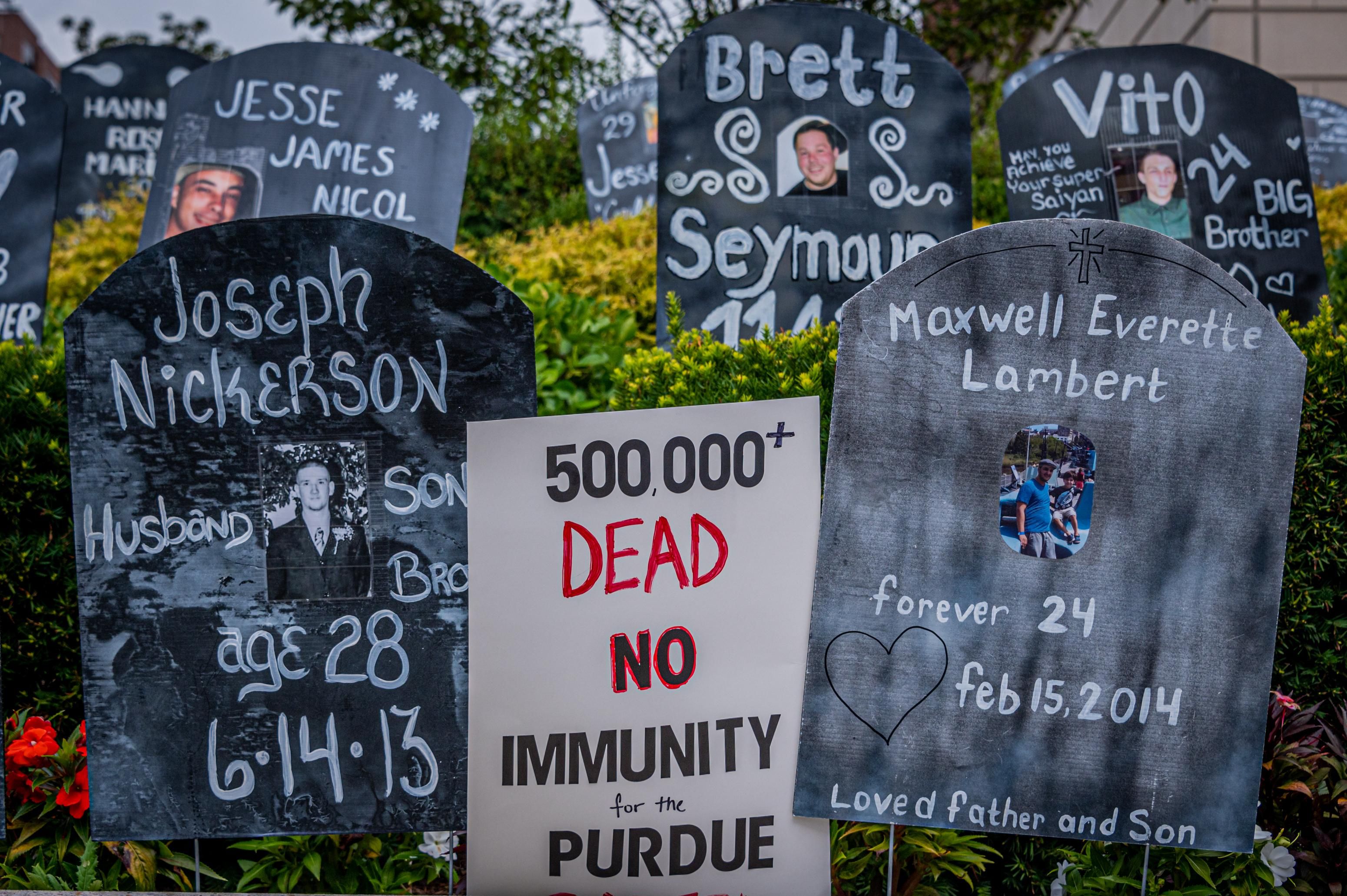
Tombstones honoring the victims of the overdose crisis seen planted outside the courthouse. Members of P.A.I.N. (Prescription Addiction Intervention Now), Truth Pharm, and a coalition of survivors and advocacy groups working in response to the overdose crisis held a demonstration outside of The United States Bankruptcy Court in White Plains to call out the United States justice system for allowing the billionaire Sackler Family to walk away unscathed after igniting one of the worst public health care scandals in the history of the nation. (Photo: Erik McGregor/LightRocket via Getty Images)

BELÉN FERNÁNDEZ
January 3, 2022 
by Al-Jazeera English

The other day in Mexico, I fell into conversation with an older gentleman from Virginia who had recently lost a brother to cancer. Choking up as he recalled how, as a child, his brother would approach parents on the street to compliment them on the beauty of their offspring, the gentleman added that cancer had not been his brother's only affliction. He had also, he said, been a victim of "the other epidemic"—meaning the opioid crisis that caused some 500,000 overdose deaths in the United States between 1999 and 2019, while destroying countless more lives through addiction.

The company's deflection of culpability onto the very victims of its predatory business model is furthermore symptomatic of a domestic neoliberal landscape in which poor individuals are blamed for their failure to succeed in the society that is effectively killing them.

The coronavirus pandemic has only exacerbated the overdose phenomenon, with deaths in the US now surpassing 100,000 per year. Approximately 75 percent of these are attributed to opioids—a class of drugs that includes heroin, synthetic fentanyl, and prescription painkillers like oxycodone.

A December op-ed in the New York Times, titled "Opioids Feel Like Love. That's Why They're Deadly in Tough Times", explains that such drugs "mimic the neurotransmitters that are responsible for making social connection comforting—tying parent to child, lover to beloved".

The article emphasises that isolation and loneliness often fuel addiction, and that a quadrupling of overdose death rates in the US over the past several decades has occurred in tandem with an increase in social isolation. A 2018 survey, for example, "found that only about half of participants felt that they had someone to turn to all or most of the time."

It is hardly surprising, then, that coronavirus stay-at-home protocols and social distancing measures would prompt many Americans to seek substitutes for human contact and affection—not that US society was ever very, um, loving.

To be sure, life can get pretty lonely in a country that prefers to spend trillions on war rather than ensuring that its citizens have adequate access to basic rights like healthcare—and where a depraved capitalist system actively thwarts inter-human solidarity in the interest of maintaining a tyranny of the elite.

Speaking of war, the figure of half a million—the number of Americans killed by opioid overdoses over two decades—happens to be the same as the number of Iraqi children reportedly killed by US sanctions alone as of 1996. When confronted with this statistic at the time, then-US Ambassador to the United Nations Madeleine Albright affirmed that "we think the price is worth it", which pretty much perfectly encapsulates capitalism's lethal logic.

So, too, does the case of Purdue Pharma—manufacturer of the massively addictive prescription painkiller OxyContin—owned by the billionaire Sackler family. As was noted in a December 2020 U.S. congressional hearing on the role of Purdue and the Sacklers in the opioid epidemic, "Purdue targeted high-volume prescribers to boost sales of OxyContin, ignored and worked around safeguards intended to reduce prescription opioid misuse, and promoted false narratives about their products to steer patients away from safer alternatives and deflect blame toward people struggling with addiction."

Indeed, former Purdue executive Richard Sackler once stated in an email that "abusers" of OxyContin (a brand of oxycodone) were "the culprits and the problem. They are reckless criminals"—a charming assessment, no doubt, from the person overseeing the reckless flooding of US communities with dangerously addictive substances.

Purdue Pharma was dissolved in 2021 in a settlement that will render the Sacklers slightly lesser billionaires, a predictable form of "justice" in a country where poor people of colour are regularly sentenced to life in prison or forced to endure other, similarly life-shattering punishments for minor drug-related offences. The scene becomes all the more sickening when one considers that persons addicted to OxyContin often turn to heavily criminalised drugs like heroin when the so-called "legal" ones are not available.

During the aforementioned US congressional hearing, one state representative offered his straightforward opinion to David Sackler, a former member of the board of directors of Purdue Pharma: "I'm not sure that I'm aware of any family in America that's more evil than yours".

But while the Sacklers have been singled out for allegedly uniquely nefarious machinations, Purdue Pharma was merely part and parcel of the American way: making a killing from killing. Just ask the arms industry.

The company's deflection of culpability onto the very victims of its predatory business model is furthermore symptomatic of a domestic neoliberal landscape in which poor individuals are blamed for their failure to succeed in the society that is effectively killing them—and making them foot the bill for the honour.

Other US corporate actors have also faced litigation for their contributions to the opioid epidemic. In November, a federal jury in Ohio found that CVS, Walgreens, and Walmart—three of the country's most prominent pharmacy chains—had been complicit in creating a "public nuisance." And yet this is still a rather banal indictment in a criminally carceral nation where government-corporate collusion in a profitable and lethal addiction to capitalism has produced a system that is thoroughly sick.

And as long as opioids "feel like love" in an otherwise loveless panorama, there is no end in sight to the crisis.

© 2021 Al-Jazeera English


BELÉN FERNÁNDEZ

Belén Fernández is the author of "Exile: Rejecting America and Finding the World" and "The Imperial Messenger: Thomas Friedman at Work." She is a member of the Jacobin Magazine editorial board, and her articles have appeared in the London Review of Books blog, Al Akhbar English and many other publications.
Psychopathic CEOs are quite literally committing crimes against the American people

Thom Hartmann, Independent Media Institute
January 04, 2022

Wildfire In Colorado (AFP)

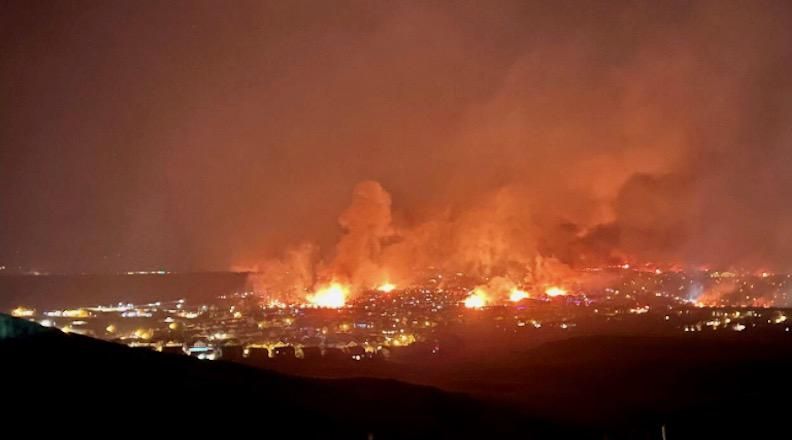
Most recently, 100 mph winds swept grass-fires through Colorado, leaving thousands homeless. It was 116 degrees here in Portland last summer, as wildfires and drought ravage the West. The Gulf Coast, South and Eastern Seaboard are now annually torn apart by superstorms, while the Midwest faces mile-wide tornadoes never before seen with this ferocity and frequency.

Climate change has gone from the theoretical to slapping us in the face.

From drought and fires that killed hundreds in California, to massive tornadoes ripping apart Kentucky, to sea-level rise and flooding cities, America is being hammered and Americans are dying. Right now.

And it’s expensive. Individual families (and their insurance companies) are bearing the brunt of the burden right now, but as climate disasters continue to scale up it’s going to not only cost more and more American homes and lives, it’s also already costing the country hundreds of billions — soon to be trillions — every year.

So, who’s going to pay for this?

If an arsonist lit your house on fire, in addition to sending him to jail you could also sue his estate for damages.

In this case, we have corporations and individuals who intentionally lied to us for half a century about the impact of their fossil fuels on global warming just to enrich themselves.

Now they’re standing back with their hands in their pockets shrugging and whistling while people die and our homes are frozen, flooded or destroyed by tornadoes.


Those who perpetrated the lies that led to this must be held to account, both financially and with the force of criminal law.

On top of that, now that climate change is here and walloping us, we must harden our nation’s infrastructure and relocate both vulnerable people and those who lost their homes and communities to wild weather, drought, and floods.

Shouldn’t the fossil fuel companies and the millionaires and billionaires they’ve created pick up that bill, too?

We’ve been having a similar conversation around other 20th century corporate crime for decades, and generally we’ve screwed it up.

America is pock-marked with mansions and estates owned by families enjoying multi-generational wealth that came from their ancestors or parents lying to the American government and the public in ways that killed people.

For example, in 1943 Samac Laboratory told the nation’s largest asbestos producer, Johns-Manville, that asbestos exposure definitely and predictably caused the excruciatingly painful and always-fatal lung cancer called mesothelioma. The company’s executives made the corporate decision to cover the science up and then lied about it to their employees, customers and the government for two generations.

That was eight years before my father dropped out of college in 1950 and went to work in a Grand Rapids steel mill because Mom got pregnant with me; he was surrounded every day with a cloud of asbestos dust that his bosses told him was “safe.” Dad died of mesothelioma in 2006.

One of the best known of the many fabulously rich heirs to the Manville fortune was Tommy Manville, who became famous for marrying eleven blonde 20-something showgirls thirteen times. Seriously. The first paragraph of his obituary in The New York Times reads: “Tommy Manville, who took 11 wives in 13 marriages and was heir to the Johns-Manville asbestos fortune, died of a heart attack yesterday at his estate in Chappaqua, N.Y. He was 73 years old.”

To this day, no asbestos fortunes have been attached and none of the criminal liars went to prison: we missed that opportunity a generation ago.

Similarly, thousands of million-dollar estates across our country are owned by heirs or current executives of the tobacco industry, which also knew their product killed Americans and lied to us. We missed that chance to do right, too: none of these wealthy executives have ever gone to prison, even though their product continues to kill hundreds of thousands of Americans every year.

When it finally came out a few years ago that Roundup causes cancer, none of the multimillionaire heirs to the Monsanto fortune lost their mansions and none of Monsanto’s executives went to jail.

Neither did the owners of chemical companies that left behind deadly Superfund sites like the one that caused birth defects and stillbirths at Love Canal; others do so to this day across the nation.

When it came out that the Sackler family decided to lie that their new Oxycontin drug was less addictive than normal opioids they walked away with billions; none have seen the inside of a jail cell for even an hour.

Owners and operators of mining operations across the country lied to communities for generations that they’d clean up their poisonous waste: instead, they routinely bankrupt their companies and walk away with millions, leaving behind moonscape-like devastation.

Even banksters like “Foreclosure King” Steve Mnuchin, who reveled in “earning” around $200 million by throwing over 36,000 of California families out of their homes while his Wall Street buddies stole trillions of dollars, continues to troll us with his twitter pontifications like he’s some kind of elder statesman worthy of our respect.

As Honoré de Balzac noted in 1834 (in slightly less compressed language), “Behind every great fortune lies a great crime”:

Americans are quick to forget about the families of the thousands of small businessmen John D. Rockefeller destroyed before Congress outlawed and Teddy Roosevelt broke up his predatory monopoly.

Seven tobacco CEOs lied to Congress and took home millions in bonuses; their families are still morbidly rich and their children and grandchildren are the toast of high society.
Defense contractors take over half of our Pentagon budget and steal billions from us every year; their mansions, complete with servants’ quarters and riding stables, still ring Washington, DC. and we literally have never been able to successfully audit them.

Historically, the only corporate criminals we hold to account are those who rip off rich people: Ken Lay, for example, defrauding his Enron investors, and Bernie Madoff scammed millions from Wall Street oligarchs.

On the other hand, if you can make billions exploiting, poisoning, misinforming, or ripping off working-class Americans you’re generally guaranteed a soft landing.

We have to change the rules.

We’re now confronted with a crisis that goes far beyond this routine orgy of corrupted capitalism: climate change isn’t just killing a few Americans; it’s threatening civilization itself and perhaps even the future of the human race.

Fossil fuel companies have known for two generations that their products would at the least disrupt society and at worst produce a great extinction on the order of what killed off the dinosaurs.

Not only did they cover it up: they actively funded climate change “disinformation” campaigns with front groups and bought-off scientists openly lying in the press and before Congress.

And now, like with asbestos, tobacco, and dozens of other known-as-deadly products, the bill is coming due.

In the face of this fossil-fueled climate change we need immediate and expensive action: America needs to harden its infrastructure, and fast.

If high-tension power lines had been buried underground in California and Colorado, for example, the worst of the wildfires would have been avoided, as they were caused by wind-downed wires.

Cities from Miami to New York are regularly crippled by sea-level-rise flooding and therefore must spend hundreds of billions on levees, pumps and reconfiguring water, power, mass transit, and sewage systems.

So many American homes have been destroyed by global-warming-worsened fires and freezes (see: “Texas”) that building materials have exploded in price and fireproof “intumescent” house paint is the hot new product.

The bad guys should be paying for this. We’ve certainly established a legal framework for it.

Before my dad died, he joined an asbestos lawsuit that, after lawyer fees, got his estate around $40,000 which eased life for my mom. Similarly, states have received compensation from tobacco companies for their costs treating lung cancers and the federal government steps in to remediate old mines and superfund sites.

While the majority of people injured by the kind of raw capitalism we practice in this country never see a penny, there is precedent for holding lying industries responsible for the harms they intentionally and knowingly cause.

At the very least, this could take the form of a carbon tax, with the revenue going to reimburse victims and harden our infrastructure.

But given how egregious these companies have behaved — and how many are still, to this day, funding climate denial and lobbying against green energy — Congress should extract restitution and recompense from the companies and punish the psychopathic executives who oversaw their campaigns of deadly lies.

This goes way beyond garden variety crime, even dwarfing the damage caused by asbestos or tobacco. These are quite literally crimes against the American people and crimes against our larger humanity.

It’s time to hold the perpetrators to account and make them pay.

Thom Hartmann is a talk-show host and the author of The Hidden History of American Healthcare and more than 30+ other books in print. He is a writing fellow at the Independent Media Institute and his writings are archived at hartmannreport.com.

This article was produced by Economy for All, a project of the Independent Media Institute.
GODFEARING COVID
Ron Johnson escalates attack on vaccines: 'Why do we think that we can create something better than God?'

David Edwards
January 04, 2022

Ron Johnson speaks to CNN (screen grab)

Sen. Ron Johnson (R-WI) this week doubled down on his campaign to promote the so-called "natural immunity" that occurs after one has been infected by Covid-19.

During an interview with WCPT, Johnson said that vaccine scientists are wrong to think that they "can create something better than God."

The Wisconsin Republican recalled that he had tested positive for Covid-19 last year while being free of symptoms.

"Why would we just automatically assume that our natural immunity is going to be awful?" he ranted. "You would think the default position would be, if you've already had it, you ought to be pretty well protected. Why do we assume that the body's natural immune system isn't the marvel that it really is?"

"Why do we think that we can create something better than God in terms of combatting disease?" the senator added. "There are certain things we have to do, but we have just made so many assumptions, and it's all pointed toward everybody getting a vaccine."

Public health experts recommended vaccinations for most people regardless of previous Covid-19 infections.

Listen to the audio clip below.


Navy captain becomes 1st woman to command US nuclear carrier
Jan 4, 2022


This aerial photo released by the U.S. Navy shows the aircraft carrier USS Abraham Lincoln (CVN-72) as it deploys from San Diego on Monday, Jan. 3, 2022. The USS Abraham Lincoln deployed this week from San Diego under the command of Capt. Amy Bauernschmidt, the first woman to lead a nuclear carrier in U.S. Navy history.
Mass Communication Spc. 1st Class Robert S. Price - hogp, U.S. Navy


In this photo released by the U.S. Navy, Capt. Amy Bauernschmidt, left, incoming commanding officer of the aircraft carrier USS Abraham Lincoln (CVN 72), reads her orders during a change of command ceremony held on the flight deck in San Diego, Calif., on Aug. 19, 2021. Capt. Walt "Sarge" Slaughter, right, successfully completed his 26 month tour as commanding officer during which Abraham Lincoln completed a 10-month combat deployment, the largest carrier work package ever completed in San Diego, and returned to sea in preparation for an upcoming deployment amidst the COVID-19 pandemic. Slaughter was relieved by Capt. Amy Bauernschmidt. The USS Abraham Lincoln deployed Monday, Jan. 3, 2022, from San Diego under the command of Capt. Amy Bauernschmidt, the first woman to lead a nuclear carrier in U.S. Navy history.
Mass Communication Spc. 3rd Class Jeremiah Bartelt - hogp, U.S. Navy


USS Abraham Lincoln (CVN-72) deploys from San Diego, Calif., on Jan. 3, 2022. US Navy Photo

SAN DIEGO (AP) — The USS Abraham Lincoln deployed this week from San Diego under the command of Capt. Amy Bauernschmidt, the first woman to lead a nuclear carrier in U.S. Navy history.

Bauernschmidt, who previously served as the Abraham Lincoln's executive officer from 2016 to 2019, took over command from Capt. Walt Slaughter during a ceremony last August, CBS 8 in San Diego reported.

The carrier deployed Monday from Naval Air Station North Island as part of the Abraham Lincoln Carrier Strike Group.

“There is no more humbling sense of responsibility than to know you are entrusted with the care of the people who have chosen to protect our nation,” Bauernschmidt said, according to a Navy news release. “Thank you, Capt. Slaughter, for turning over the finest ship in the fleet.”

Bauernschmidt previously served as the commanding officer of Helicopter Maritime Strike Squadron 70 and the amphibious transport dock San Diego.

She has completed more than 3,000 flight hours during her career, the news station reported.

The Abraham Lincoln completed its maintenance period in April, following a 294-day, around-the-world deployment.

The Carrier Strike Group is led by the command staff of Carrier Strike Group 3 and consists of Nimitz-class aircraft carrier USS Abraham Lincoln, Carrier Air Wing 9, the guided-missile cruiser USS Mobile Bay and the guided-missile destroyers of Destroyer Squadron 21 — USS Fitzgerald, USS Gridley, USS Sampson and USS Spruance.

The strike group is deploying with what the Navy is touting as its “most advanced air wing” and is heading to the Indo-Pacific region.

The first women to serve in the Navy were nurses in the early 20th century and the first large-scale enlistment of women came during World War II, according to an official military history website. The Navy designated the first woman as an aviator in 1974 and women were first assigned to a combat ship, the USS Dwight D. Eisenhower, in 1994.


1st woman to command USS Constitution, aka Old Ironsides

BOSTON (AP) — A woman is taking over as the commanding officer of the U.S.S. Constitution, also known as Old Ironsides, for the first time in the warship’s 224-year history, the Navy announced Tuesday.

Cmdr. Billie J. Farrell is scheduled to assume command at an on-board ceremony Jan. 21. She will relieve Cmdr. John Benda, who has led the ship’s crew since February 2020.

“I am honored to have the privilege to soon command this iconic warship that dates back to the roots of both our nation and our Navy and to have been afforded the amazing opportunity to serve as U.S.S. Constitution’s first female commanding officer in her 224 years,” Farrell said in a statement.

Farrell is a native of Paducah, Kentucky, a 2004 graduate of the U.S. Naval Academy, and most recently served as the executive officer aboard U.S.S. Vicksburg, a Ticonderoga-class guided missile cruiser, according to her Navy biography.

“I hope to strengthen the legacy of U.S.S. Constitution through preservation, promotion, and protection by telling her story and connecting it to the rich heritage of the United States Navy and the warships serving in the fleet today,“ she said.

The Constitution, based at Boston’s Charlestown Navy Yard, is the world’s oldest commissioned warship still afloat. It played a crucial role in the Barbary Wars and the War of 1812 and defended sea lanes from 1797 until 1855. The ship was undefeated in battle and destroyed or captured 33 opposing vessels. It earned the nickname Old Ironsides during the war of 1812, when British cannonballs were seen bouncing off its wooden hull.

It is crewed by active-duty sailors.

The first woman to serve on the Constitution’s crew was enlisted sailor Rosemarie Lanam in 1986. The first woman to serve as a commissioned officer on the ship was Lt. Cmdr. Claire V. Bloom, who served as executive officer and led the 1997 sail, the first time Old Ironsides had sailed under her own power since 1881.


Tuesday, January 04, 2022


Scientists praise 'Don't Look Up' as 'evocative' climate change parable


Ben Adler
·Senior Climate Editor
Tue, January 4, 2022

Climate change has often struggled to penetrate the popular imagination, but now a movie intended to evoke it has taken the world by storm. “Don’t Look Up,” the dark comedy about a comet headed toward Earth that director Adam McKay calls “a Clark Kent-level disguise for the climate crisis,” topped the Netflix most-watched list last week, the first it was available to stream, in 88 of 89 countries. (The reference to Clark Kent, Superman’s alter ego who merely wears glasses, is McKay’s way of saying it’s barely disguised at all.)


Director Adam McKay in Beverly Hills in 2019. (David McNew/Reuters)

While the movie’s central metaphor has struck some reviewers as inapt, climate scientists are overwhelmingly impressed by the film’s accurate depiction of their struggle to communicate to the public and policymakers the urgency of the climate crisis. Spoiler alert: In the movie, politicians including the president treat the threat to humanity’s existence as an issue to be used for political gain, and tech industry leaders do the same, prioritizing profit. The movie’s title comes from the refrain heard in the film from astronomy deniers who argue that the comet can simply be ignored into oblivion.

“I actually stayed up till midnight to watch it at the very first moment it was available to me on the West Coast,” Lisa Graumlich, president-elect of the American Geophysical Union and a professor at the University of Washington School of Environmental and Forest Sciences, told Yahoo News. “I went between laughing and sort of feeling ready to weep, because it did ring so true.”

One particularly poignant element of the movie for some scientists is the shallow, even dismissive, treatment that their warnings have sometimes received in the media. In “Don’t Look Up,” the scientists who discover the comet go to a New York Times-esque newspaper, and the resulting exposé leads to an appearance on a morning TV talk show, where they are told to lighten up and make the news more appealing. The subsequent despair and rage that the younger researcher, played by Jennifer Lawrence, feels is familiar to Graumlich.

“To have ourselves not taken seriously, at times ridiculed by the press, to have politicians sometimes pay attention for a while but then lose their focus, for many of us it was very evocative of what we’ve experienced,” she said.

Early in her career, Graumlich had an eerily similar experience to the one Lawrence’s character, a PhD student, has in “Don’t Look Up.”


Lisa Graumlich at the University of Washington in Seattle in 2014.
 (Elaine Thompson/AP)

“I’m a tree ring scientist: I study how climate has changed over the long term, in part to understand whether what we’re seeing is natural variability or human-caused,” Graumlich said. “So, imagine, being a young scientist, I turned 30. A week later, my science was covered in the New York Times: about tree rings, looking for past climate variability. This is something you send to your mother, you feel proud. And later that day, the story was picked up by Rush Limbaugh on his radio show. And he was making fun of me, my name, and the silliness of someone thinking they could understand global warming from looking at tree rings.”

To some climate scientists, the way that the news media treats the comet in “Don’t Look Up” is analogous to the way American society as a whole has reacted to climate change. “There’s obviously some criticism of the media in the film — I don’t think it’s a media problem, per se, it’s a societal problem,” UCLA climate scientist Daniel Swain told Yahoo News. “But there are some scenes that were funny in the movie, but on further reflection not all that funny,” he added, referring to the scientists’ appearance on the morning show. “They’re essentially told to lighten up, loosen up, don’t be so gloomy. I’ve had people in a similar role tell me the same thing, almost verbatim, when talking about climate change and extreme [weather] events.

“Usually my interactions with journalists are very positive and constructive, but the criticism about the broader media landscape and about the way society interprets bad news rings very true,” Swain said.

Of course, the threat posed by climate change is not much like a comet that will hit the Earth in less than seven months. Its effects are so slow-moving that despite beginning as early as the late 19th century, they have become perceptible to the average observer only in recent decades. But, while acknowledging that distinction, scientists mostly say the film nonetheless captures the political and economic challenges to mobilizing the public against any future threat.


Jennifer Lawrence, Leonardo DiCaprio, Meryl Streep, Jonah Hill and Adam McKay at the world premiere of “Don’t Look Up” at Lincoln Center on Dec. 5 in New York. (Evan Agostini/Invision/AP)

“It was a kind of parody that revealed an underlying truth,” Kerry Emanuel, a professor of atmospheric science at the Massachusetts Institute of Technology, told Yahoo News about the new film. “It was obviously a huge exaggeration, but that’s what parodies are. And the underlying truth is that scientists are growing increasingly frantic that they’re not being listened to and the media and politicians are basically ignoring them.”

“I enjoyed the movie,” Christopher Field, director of the Stanford Woods Institute for the Environment and professor for interdisciplinary environmental studies at Stanford University, told Yahoo News. “It is really thought-provoking about lots of issues. It’s also a parable about climate change; it’s not about what we actually expect to happen with climate change. I enjoyed the insight into the frustrations and temptations that scientists feel when talking about important issues. It’s also important to keep in mind that climate change isn’t Earth-ending in six months and 14 days, or whatever the timeline is in ‘Don’t Look Up.’”

“Climate change is not like a physical object hurtling towards Earth that could instantly wipe out humanity,” Swain said. “In the physical science sense, it’s not a good analogy for climate change. But I think that was deliberate, because, at this point, there are some pretty alarming things that have been going on in the global climate system that we’ve been pretty good at closing our eyes, plugging our ears and burying our heads in the sand collectively. Apparently, some of these climate disasters are too subtle. So I think this was a necessary choice, to make it an over-the-top, end-of-humanity, physical object impacting Earth, with everything being over in a moment.”


Leonardo DiCaprio at the world premiere of “Don’t Look Up” on Dec. 5. (Evan Agostini/Invision/AP)

“My own view is that it’s an imperfect analogy by design,” Michael E. Mann, a professor of atmospheric science at Penn State, told Yahoo News. Mann was specifically mentioned by Leonardo DiCaprio as an inspiration for the character he plays in “Don’t Look Up” because of how Mann handles his frequent media appearances.

“I suspect that McKay wanted to focus our attention on a crisis that isn’t laden with ideological baggage in the way that climate change has become thanks to the fossil-fuel-funded disinformation campaign,” Mann said. “So instead he created a politically neutral vehicle for exploring the strictures of our politics and media environment when it comes to acting on an imminent crisis where vested interests stand to benefit from inaction. Among other things, McKay drives home a central point I make in my recent book ‘The New Climate War’ about the risk in allowing techno-billionaires to dictate how we respond to the crisis.”

“Don’t Look Up” also captures the way humanity has delayed action to address climate change, such as transitioning from fossil fuels to clean energy sources, for so long that it now requires bigger, faster and more aggressive action than it otherwise would have.

“No metaphor is perfect, but there are two aspects of it that do afford a comparison with the climate problem,” Emanuel said. “One is that it’s something that’s going to happen in the future that’s not having much effect today. The other thing that is dramatically true in that case, and is also true in the climate case, is that the longer you wait, the harder it is to do anything about it and the more expensive it is to do anything about it.

An illustration of an asteroid approaching Earth. (Getty Images)

“If you catch this meteor or asteroid when it’s still very far away, you don’t need very much energy at all to knock it off course,” Emanuel said. “But if you wait until the last minute, you have to exert huge forces on it. And at some point, you don’t have enough energy to do anything about it. And the climate is similar in that sense. If we had started doing [climate action] 40 years ago, we wouldn’t have had to spend very much money and we’d be fine today. You keep putting it off, putting it off, and hoping it will be the next generation’s problem and not ours, and it’s getting more and more expensive. And at some point, you won’t be able to do anything about it.”

In fact, some climate scientists themselves have previously used the analogy of an object from outer space. “Imagine a giant asteroid on a direct collision course with Earth. That’s the equivalent of what we face now,” said James Hansen, former longtime director of the NASA Goddard Institute for Space Studies, in a 2012 TED talk on climate change. Hansen noted how “Don’t Look Up” echoed his own observation on his website at Columbia University, where he is now an adjunct professor in the program on climate science, awareness and solutions at the Earth Institute.

In his blog post, Hansen went on to note both the similarities and differences between the scenario in the film and climate change. “Scientists are frustrated as they try to communicate the emergency in both the asteroid story and the real-world climate story,” Hansen writes. “Villains in the asteroid story include greedy industrialists, incompetent and corrupt government, media that abdicate responsible reporting in favor of ratings, and a public focused on tabloid entertainment. With all that headwind, can the asteroid story have a happy ending? ... The real climate story faces those headwinds and more. The long timescale brings intergenerational conflict: today’s adult leaders fail to take needed actions, but today’s young people and offspring bear the consequences.”

Several climate scientists said their frustration with political denialism and inaction on climate change seems to be felt by scientists with other specialties, such as the COVID-19 pandemic and other threats to public health and safety. Although the filmmakers had climate change in mind when making the movie, “it could well have been” about COVID, Emanuel said. Being ignored by politicians and members of the public who are unwilling to accept an unpleasant truth “is frustrating for climate scientists, as it is for the whole medical profession trying to get people to wear masks and get vaccinated,” he added.

People protest vaccine mandates on Aug. 9 in New York City. (Michael M. Santiago/Getty Images)

“[‘Don’t Look Up’] sort of distills a lot of the societal and systemic issues that relate not only to climate change, but to a bunch of other global-scale society problems like the pandemic, to its most essential form,” Swain said. “There’s hard empirical evidence that a very bad thing is going to happen, but that it potentially can be completely averted, in all likelihood, if society and governments do what needs to be done quickly enough. And despite that overwhelming evidence, the things that need to be done aren’t done, for reasons that have more to do with political ideology and money than anything else.”

Swain also observed that living through climate change increasingly feels like a dystopian fantasy, making “Don’t Look Up” an overdue artistic expression of that growing reality.

“Getting real tired of living in a real-world disaster movie,” Swain tweeted on Dec. 30. He was referring to the fires that ravaged Boulder County, Colo., last week, an unusual incident in winter made more likely by climate change and the COVID-19 pandemic.

“It’s shocking to me that there aren’t more climate change shows,” Swain told Yahoo News. “Why isn’t there more science fiction that talks about climate? Why isn’t climate just folded into more narratives that aren’t directly about climate change?”

Perhaps, now that Hollywood has seen the success of “Don’t Look Up,” there will be.
Teachers at culture war front lines with Jan. 6 education
By HEATHER HOLLINGSWORTH

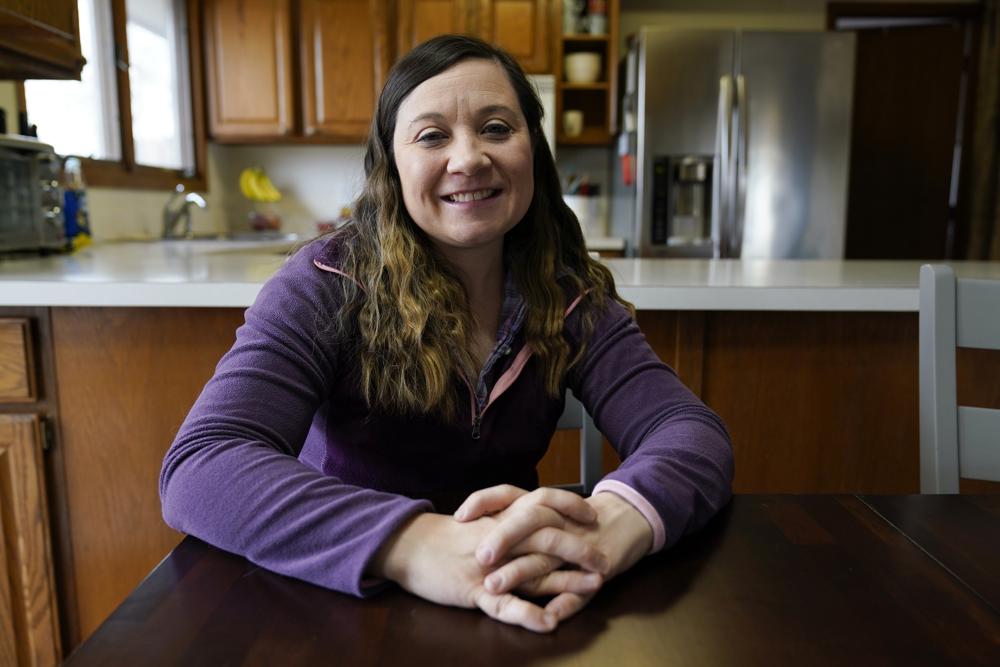
Waukee School District teacher Liz Wagner in her home, Thursday, Dec. 23, 2021, in Urbandale, Iowa. Teachers have already landed on the front lines of the culture war. Now the Jan. 6 anniversary is prompting some to decide how -- or whether -- to teach their students about the events that sit at the heart of the country’s division.
 (AP Photo/Charlie Neibergall)

MISSION, Kan. (AP) — What students are learning about the insurrection at the U.S. Capitol on Jan. 6 may depend on where they live.

In a Boston suburb in heavily Democratic Massachusetts, history teacher Justin Voldman said his students will spend the day journaling about what happened and talking about the fragility of democracy.

“I feel really strongly that this needs to be talked about,” said Voldman, who teaches history at Natick High School, 15 miles (24 kilometers) west of Boston. As the grandson of a Holocaust survivor, he said “it is fair to draw parallels between what happened on Jan. 6 and the rise of fascism.”

Voldman said he feels fortunate: “There are other parts of the country where ... I would be scared to be a teacher.”

Liz Wagner, an eighth and ninth grade social studies teacher in a Des Moines suburb of increasingly Republican Iowa, got an email from an administrator last year, warning teachers to be careful in how they framed the discussion.

“I guess I was so, I don’t know if naïve is the appropriate word, perhaps exhausted from the pandemic teaching year last year, to understand how controversial this was going to be,” she said.

Some students questioned Wagner last year when she referred to what happened as an insurrection. She responded by having them read the dictionary definition for the word. This year, she will probably show students videos of the protest and ask them to write about what the footage shows.

“This is kind of what I have to do to ensure that I’m not upsetting anybody,” Wagner said. “Last year I was on the front line of the COVID war, trying to dodge COVID, and now I’m on the front line of the culture war, and I don’t want to be there.”

With crowds shouting at school board meetings and political action committees investing millions of dollars in races to elect conservative candidates across the country, talking to students about what happened on Jan. 6 is increasingly fraught.

Teachers now are left to decide how — or whether — to instruct their students about the events that sit at the heart of the country’s division. And the lessons sometimes vary based on whether they are in a red state or a blue state.

Facing History and Ourselves, a nonprofit that helps teachers with difficult lessons on subjects like the Holocaust, offered tips on how to broach the topic with students in the hours after the riot.

Within 18 hours of publication, it had 100,000 page views — a level of interest that Abby Weiss, who oversees the development of the nonprofit’s teaching tools, said was unlike anything the group has seen before.

In the year that has followed, Weiss said, Republican lawmakers and governors in many states have championed legislation to limit the teaching of material that explores how race and racism influence American politics, culture and law.

“Teachers are anxious,” she said. “On the face of it, if you read the laws, they’re quite vague and, you know, hard to know actually what’s permissible and what isn’t.”

Racial discussions are hard to avoid when discussing the riot because white supremacists were among those descending on the halls of power, said Jinnie Spiegler, director of curriculum and training for the Anti-Defamation League. She said the group is concerned that the insurrection could be used as a recruitment tool and wrote a newly released guide to help teachers and parents combat those radicalization efforts.

“To talk about white supremacy, to talk about white supremacist extremists, to talk about their racist Confederate flag, it’s fraught for so many reasons,” Spiegler said.

Anton Schulzki, the president of the National Council for the Social Studies, said students are often the ones bringing up the racial issues. Last year, he was just moments into discussing what happened when one of his honors students at William J. Palmer High School in Colorado Springs said, “’You know, if those rioters were all Black, they’d all be arrested by now.”

Since then, three conservative school board candidates won seats on the school board where Schulzki teaches, and the district dissolved its equity leadership team. He is covered by a contract that offers academic freedom protections, and has discussed the riot periodically over the past year.

“I do feel,” he said, “that there may be some teachers who are going to feel the best thing for me to do is to ignore this because I don’t want to put myself in jeopardy because I have my own bills to pay, my own house, to take care of, my own kids to take back and forth to school.”

Concerned teachers have been reaching out to the American Federation of Teachers, which last month sued over New Hampshire’s new limits on the discussion of systemic racism and other topics.

“What I’m hearing now over and over and over again is that these laws that have been passed in different places are really intended to chill the discussion of current events,” said Randi Weingarten, the union’s president and a former social studies teacher. “I am very concerned about what it means in terms of the teaching as we get closer and closer to January 6th.”

The biggest fear for Paula Davis, a middle school special education teacher in a rural central Indiana district, is that the discussion about what happened could be used by teachers with a political agenda to indoctrinate students. She won’t discuss Jan. 6 in her classroom; her focus is math and English.

“I think it’s extremely important that any teacher that is addressing that topic does so from an unbiased perspective,” said Davis, a regional chapter chair for Moms for Liberty, a group whose members have protested mask and vaccine mandates and critical race theory. “If it cannot be done without bias, then it should not be done.”

But there is no way Dylan Huisken will avoid the topic in his middle school classroom in the Missoula, Montana, area town of Bonner. He plans to use the anniversary to teach his students to use their voice constructively by doing things like writing to lawmakers.

“Not addressing the attack,” Huisken said, “is to suggest that the civic ideals we teach exist in a vacuum and don’t have any real-world application, that civic knowledge is mere trivia.”
Massachusetts' Sokhary Chau elected as 1st Cambodian American mayor in U.S.

By UPI Staff

Jan. 4 (UPI) -- Sokhary Chau made history on Monday night in becoming the first mayor of color in the town of Lowell, Mass. -- and the first Cambodian American mayor anywhere in the United States.

The former city councilor was elected by unanimous vote, 11-0, from the Lowell City Council.

Chau will serve as mayor for at least the next two years.

Erik Gitschier was elected Lowell's vice mayor.

RELATED  U.S. hits Cambodia with arms embargo over growing Chinese military influence

During his address, Chau said that he stands on the shoulders of the many immigrants who came before him. He said that regardless of their origins, they all arrived in search of their own American dream.

"We cannot change the world. But collectively, we can make historic change in Lowell," he said, according to The Lowell Sun.

RELATED U.S. targets corruption in Cambodia with advisory, sanctions

"To the Cambodian diaspora around the world, we can no longer be just victims. It is our time to now to be leaders and to succeed."


Chau fled the Khmer Rouge in Cambodia with his mother and six siblings in 1979. They ultimately traversed the jungles of Thailand while attempting to reach refugee camps. His mother died last month.


‘Our time now’: 1st Cambodian American mayor in US sworn in

By PHILIP MARCELO

1 of 5
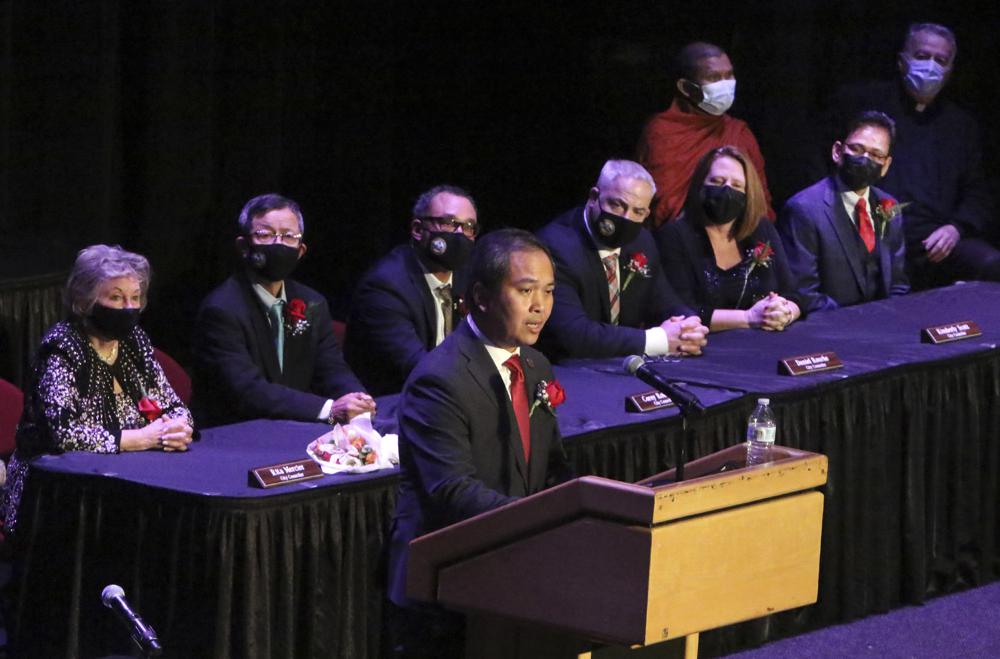
Mayor Sokhary Chau addresses the assembly during the Lowell City Council swearing-in ceremony, Monday, Jan. 3, 2022, in Lowell, Mass., held at Lowell Memorial Auditorium due to the COVID-19 pandemic. Chau, a refugee who survived the Khmer Rouge’s bloody regime, has become the city’s first mayor of color and the first Cambodian American mayor in the United States. 
(Julia Malakie/The Lowell Sun via AP)

BOSTON (AP) — He came to the U.S. as a young refugee, having survived Khmer Rouge’s brutal rule. Now, Sokhary Chau is the nation’s first Cambodian American mayor.

The 49-year-old city councilor in Lowell, Massachusetts, was unanimously picked by his colleagues to assume the body’s top post Monday, in the process also becoming the city’s first Asian American mayor.

“God bless America, right? I was a refugee, now I’m mayor of a major city in Massachusetts,” Chau said hours after he was officially sworn in. “I don’t know if that could happen anywhere else in the world. I’m still trying to absorb it.”

Chau, in his inaugural remarks, reflected on his family’s perilous escape from Cambodia and the deep immigrant roots in Lowell, about about 30 miles (50 kilometers) north of Boston near the New Hampshire line. It was an early center of America’s textile industry, drawing waves of European and Latin American immigrants over generations.

Today, the city of more than 115,000 residents is nearly 25% Asian and home to the nation’s second-largest Cambodian community.

“As a proud Cambodian American, I am standing on the shoulders of many immigrants who came before me to build this city,” Chau said Monday before a crowd that included his wife and two teenage sons.

Chau recounted how his father, a captain in the Cambodian army, was executed by the communist Khmer Rouge in 1975 during civil war.

His mother, who died late last year, managed to keep her seven children alive for four years, surviving “landmines, jungles, hunger, sickness and uncertainty” to deliver them safely to the U.S., he said.

In an interview later, Chau said he was around 9 years old when his family arrived in Pittsburgh with the help of the Catholic Church. They lived for a time in a convent and embraced Christianity.

They made their way to Lowell’s growing Cambodian community in the mid-1980s, where some of his older siblings immediately set to work in local manufacturing operations.

Chau, however, continued his studies and earned a scholarship to Phillips Academy, an elite boarding school in nearby Andover. He went on to Macalester College in St. Paul, Minnesota, where he studied economics and political science, also on a scholarship.

Before running for office, Chau said, he worked mostly in financial services, including running a mortgage lending company in Lowell with his wife. He now works for the Social Security Administration.

Chau’s election follows the ascendance of new Boston Mayor Michelle Wu, whose parents immigrated to the U.S. from Taiwan. She was sworn in last November as Boston’s first woman and first person of color elected to the post.

Chau is also among a growing list of Cambodian American officeholders in Massachusetts that includes two other city councilors, a school committee member and two state lawmakers, all from Lowell, said Vannak Theng, president of the Cambodian Mutual Assistance Association of Greater Lowell.

But while Cambodian Americans served on local boards and state legislatures nationwide, none were elected mayor, according to the Asian Pacific American Institute for Congressional Studies, a nonprofit that helps Asian Pacific Americans pursue public office.

In fact, Long Beach, California, home to the nation’s largest Cambodian community, elected its first Cambodian American city councilor only in 2020, the organization noted.

Chau’s election also comes on the heels of a federal lawsuit that argued Lowell’s election process violated the voting rights of minority residents, who comprise nearly 50% of its population.

recent settlement in the case led the city to change its electoral system, starting with the 2021 elections. The result was the city’s most diverse class of officeholders, said Oren Sellstrom, litigation director at Lawyers for Civil Rights, a Boston group that brought the 2017 suit.

“Just four years ago, the city’s elected officials were all white and largely unresponsive to the needs of the city’s communities of color,” he said.

Chau’s role as mayor is largely ceremonial. Lowell’s day-to-day operations are handled by a city manager picked by the council, and Chau effectively serves as council president, leading its meetings and also serving as chair of the school committee.

But he believes he can make a difference by ensuring the city workforce, including its police department and school system, better represents its diverse populace.

He also acknowledges his election is significant to the Cambodian diaspora. The community’s political dynamics played a role during the lead-up to Monday’s vote — his primary rival was a fellow Cambodian American councilor.

Chau says he tries to stay out of “old world politics” and intends to focus on the nuts and bolts of governance. But hopes he can inspire the next generation of Cambodian Americans to step up.

“We can no longer be just victims,” Chau said as he closed his inaugural remarks. “It is our time now to be leaders and to succeed.”


Once a status symbol, older BlackBerry devices to go dark on Tuesday


A Blackberry Z10 is seen at a launch event in New York City on January 30, 2013. Starting Tuesday, older BlackBerry devices that run on the BlackBerry operating system will no longer work. File Photo by John Angelillo/UPI | License Photo

Jan. 4 (UPI) -- Americans who still own and use classic BlackBerry devices will no longer be able to use them after Tuesday.

BlackBerry, based in Canada, says that the cellular networks and WiFi service for the older devices will no longer be available.

Specifically, BlackBerry devices that run on the company's own operating system will no longer work. Android-powered models, such as the BlackBerry KEY2, will not be affected by the shutoff.

"We thank our many loyal customers and partners over the years and invite you to learn more about how BlackBerry provides intelligent security software and services to enterprises and governments around the world," BlackBerry said in a statement.

"The legacy services for BlackBerry 7.1 OS and earlier, BlackBerry 10 software, BlackBerry PlayBook OS 2.1 and earlier versions, will no longer be available after January 4, 2022."

For years, the BlackBerry was the hip device for executives and other business players on the move. It set itself apart from cellphones with its QWERTY keyboard, which allowed users to quickly send text messages. File Photo by John Angelillo/UPI

The closure of the service marks the end of an era that began in the early 2000s, when BlackBerry offered unique service and phones that were different than ordinary cellphones. The BlackBerry, in fact, was sort of a forerunner to modern smartphones.

For years, the BlackBerry was the hip device for executives and other business players on the move. It set itself apart from cellphones with its QWERTY keyboard, which allowed users to quickly send text messages. Some have continued to hang onto the devices, even after they were surpassed in capability by modern smartphones.

"They've been holding onto it for so long because there's no replacement," said Adam Matlock, who operates the YouTube technology review channel TechOdyssey, according to The New York Times.

"I always felt like BlackBerries, they were special because they had a keyboard and were not trying to be another phone with a touch screen."
China's Mars orbiter captures series of selfies using remote camera


The China National Space Administration published a stunning Martian selfie captured by the Tianwen-1 Mars orbiter above the Red Planet after releasing a small camera and beaming photos via WiFi to mission control. Photo by CNSA/UPI | License Photo

Jan. 4 (UPI) -- The China National Space Administration released photos on New Year's Day, of its Mars orbiter circling high above the Red Plant.

The selfies were taken by a small camera which was deployed by the Tianwen 1, capturing images of the orbiter and sending them back to it via a WiFi connection.

The photos were then relayed back to Earth where they were published by China's space agency.

Three of the four photos capture the orbiter above Mars' frozen northern ice cap, while a fourth shows the planet's surface, as captured by a previously-deployed rover.

RELATED China releases new images from Zhurong rover to mark 100 days on Mars

The first two give a clear shot of Tianwen 1's golden body and silver antenna and include the first full-body shot of the craft.


Tianwen 1 has now obtained and transmitted nearly 540 gigabytes of data back to mission controllers, according to the administration

The spacecraft, officials say, is now approximately 350 million kilometers away from Earth.

The Tianwen 1 was originally launched in July 2020 and has now traveled a total of 475 million kilometers, carrying out several trajectory maneuvers en route to entering Martian orbit on Feb. 10, 2021.

The probe successfully deployed a landing capsule to the planet's surface on May 15, 2021, becoming the second country after the United States to successfully do so.

The solar-powered Zhurong rover has now worked for 224 days and outlived its three-month life expectancy, while traveling over 1,400 meters.


The China National Space Administration published a stunning image of the northern ice cap on Mars after releasing a small camera and beaming photos via WiFi to mission control. Photo by CNSA/UPI | License Photo