Tuesday, March 01, 2022


'Out of the Question': Claims of Russian Use of Cluster, Vacuum Munitions in Ukraine False - Kremlin

Tochka-U guided missiles Kiev's forces used against DPR civilians - Sputnik International, 1920, 01.03.2022

On Monday, Ukrainian ambassador to the United States Oksana Markarova accused Russia of using a vacuum bomb in the northeastern Ukrainian town of Okhtyrka. Amnesty International and Human Rights Watch further alleged that Russia has deployed banned cluster munitions, supposedly using them to target a preschool containing civilians.
Reports accusing Russia of using cluster and vacuum munitions in the conflict in Ukraine are "false," Kremlin spokesman Dmitry Peskov has said.

"Russian troops do not carry out any strikes on civilian infrastructure or residential complexes. This is out of the question. We are talking only about the demilitarisation of Ukraine, about military facilities," Peskov said, speaking at a briefing Tuesday.

"It's worth remembering that in a large number of cases which you've mentione d, we're talking about attacks by the same nationalist units which use civilian objects as a human shield," he added, answering a question on reports of attacks on non-military infrastructure and built-up areas.
The Russian military and the Donetsk and Lugansk people's militias have reported multiple instances of Ukrainian volunteer battalions using Grad artillery against urban areas containing civilians as they retreat from their positions. Similar attacks have been reported on towns and cities in the Donbass republics. The Russian MoD has accused the Ukrainian Army and nationalist units of deploying artillery and mortar system in heavily built up areas to shield them from Russian attack. On Monday, the MoD accused Ukraine of using phosphorus munitions in areas around Kiev and near Gostomel Airport on a wide scale.
Ukrainian 122 mm MLRS BM-21 Grad fires rocket during a military exercise at a shooting range close to Devichiki in the Kiev region on October 28, 2016 - Sputnik International, 1920, 27.02.2022
Situation in Ukraine
Russian MoD: Azov Battalion Used Grad Systems to Hit Residential Areas on Mariupol Outskirts
On Monday, Ukraine's ambassador to the US accused Russia of using a vacuum bomb - a type of thermobaric weapon which takes in oxygen to create extremely powerful explosions, against Ukrainian forces at an army base in Okhtyrka. White House spokeswoman Jen Psaki said she could not confirm the information, but said if the reports were "true, it would potentially be a war crime." Separately, Amnesty International and Human Rights Watch charged Russian forces with using cluster munitions, including to target a preschool containing civilians.
Russian defence minister Sergei Shoigu reiterated Tuesday that Russian troops were doing everything possible to preserve civilian lives, including by limiting attacks to military objects using precision weapons.
FGM-148 Javelin - Sputnik International, 1920, 25.02.2022
Russian MoD: Large Amount of Weapons Supplied by West to Ukraine Has Been Seized

Profile: What is Ukraine’s neo-Nazi Azov Battalion?

The far-right neo-Nazi group has expanded to become part of Ukraine’s armed forces, a street militia and a political party.

A veteran of the Ukrainian National Guard Azov battalion conducts military exercises for civilians
A veteran of the Ukrainian national guard's Azov Battalion conducts military exercises for civilians in Kyiv, Ukraine on January 30, 2022 [File: Gleb Garanich/Reuters]

As the Russian invasion of Ukraine enters its sixth day, a Ukrainian far-right military battalion is back in the headlines.

Russian President Vladimir Putin referenced the presence of such units within the Ukrainian military as one of the reasons for launching his so-called “special military operation … to de-militarise and de-Nazify Ukraine”.

On Monday, Ukraine’s national guard tweeted a video showing Azov fighters coating their bullets in pig fat to be used allegedly against Muslim Chechens – allies of Russia – deployed in their country.

Azov has also been involved in training civilians through military exercises in the run-up to Russia’s invasion.

So what is the Azov regiment?

Azov is a far-right all-volunteer infantry military unit whose members – estimated at 900 – are ultra-nationalists and accused of harbouring neo-Nazi and white supremacist ideology.

The unit was initially formed as a volunteer group in May 2014 out of the ultra-nationalist Patriot of Ukraine gang, and the neo-Nazi Social National Assembly (SNA) group. Both groups engaged in xenophobic and neo-Nazi ideals and physically assaulted migrants, the Roma community and people opposing their views.

As a battalion, the group fought on the front lines against pro-Russian separatists in Donetsk, the eastern region of Ukraine. Just before launching the invasion, Putin recognised the independence of two rebel-held regions from Donbas.

A few months after recapturing the strategic port city of Mariupol from the Russian-backed separatists, the unit was officially integrated into the National Guard of Ukraine on November 12, 2014, and exacted high praise from then-President Petro Poroshenko.

“These are our best warriors,” he said at an awards ceremony in 2014. “Our best volunteers.”

Who founded Azov?

The unit was led by Andriy Biletsky, who served as the the leader of both the Patriot of Ukraine (founded in 2005) and the SNA (founded in 2008).  The SNA is known to have carried out attacks on minority groups in Ukraine.

In 2010, Biletsky said Ukraine’s national purpose was to “lead the white races of the world in a final crusade … against Semite-led Untermenschen [inferior races]”.

Biletsky was elected to parliament in 2014. He left Azov as elected officials cannot be in the military or police force. He remained an MP until 2019.

The 42-year-old is nicknamed Bely Vozd – or White Ruler – by his supporters. He established the far-right National Corps party in October 2016, whose core base is veterans of Azov.

Before becoming part of Ukraine’s armed forces, who funded Azov?

The unit received backing from Ukraine’s interior minister in 2014, as the government had recognised its own military was too weak to fight off the pro-Russian separatists and relied on paramilitary volunteer forces.

These forces were privately funded by oligarchs – the most known being Igor Kolomoisky, an energy magnate billionaire and then-governor of the Dnipropetrovska region.

In addition to Azov, Kolomoisky funded other volunteer battalions such as the Dnipro 1 and Dnipro 2, Aidar and Donbas units.

Azov received early funding and assistance from another oligarch: Serhiy Taruta, the billionaire governor of Donetsk region.

Neo-Nazi ideology

In 2015, Andriy Diachenko, the spokesperson for the regiment at the time said that 10 to 20 percent of Azov’s recruits were Nazis.

The unit has denied it adheres to Nazi ideology as a whole, but Nazi symbols such as the swastika and SS regalia are rife on the uniforms and bodies of Azov members.

For example, the uniform carries the neo-Nazi Wolfsangel symbol, which resembles a black swastika on a yellow background. The group said it is merely an amalgam of the letters “N” and “I” which represent “national idea”.

Individual members have professed to being neo-Nazis, and hardcore far-right ultra-nationalism is pervasive among members.

In January 2018, Azov rolled out its street patrol unit called National Druzhyna to “restore” order in the capital, Kyiv. Instead, the unit carried out pogroms against the Roma community and attacked members of the LGBTQ community.

“Ukraine is the world’s only nation to have a neo-Nazi formation in its armed forces,” a correspondent for the US-based magazine, the Nation, wrote in 2019.

Human rights violations and war crimes

2016 report by the United Nations Office of the High Commissioner for Human Rights (OCHA) has accused the Azov regiment of violating international humanitarian law.

The report detailed incidents over a period from November 2015-February 2016 where Azov had embedded their weapons and forces in used civilian buildings, and displaced residents after looting civilian properties. The report also accused the battalion of raping and torturing detainees in the Donbas region.

What has been the international response to Azov?

In June 2015, both Canada and the United States announced that their own forces will not support or train the Azov regiment, citing its neo-Nazi connections.

The following year, however, the US lifted the ban under pressure from the Pentagon.

In October 2019, 40 members of the US Congress led by Representative Max Rose signed a letter unsuccessfully calling for the US State Department to designate Azov as a “foreign terrorist organisation” (FTO). Last April, Representative Elissa Slotkin repeated the request – which included other white supremacist groups – to the Biden administration.

Transnational support for Azov has been wide, and Ukraine has emerged as a new hub for the far right across the world. Men from across three continents have been documented to join the Azov training units in order to seek combat experience and engage in similar ideology.

The oscillation of Facebook

In 2016, Facebook first designated the Azov regiment a “dangerous organisation”.

Under the company’s Dangerous Individuals and Organizations policy, Azov was banned from its platforms in 2019. The group was placed under Facebook’s Tier 1 designation, which includes groups such as the Ku Klux Klan and ISIL (ISIS). Users engaging in praise, support or representation of Tier 1 groups are also banned.

However, on February 24, the day Russia launched its invasion, Facebook reversed its ban, saying it would allow praise for Azov.

“For the time being, we are making a narrow exception for praise of the Azov regiment strictly in the context of defending Ukraine, or in their role as part of the Ukraine national guard,” a spokesperson from Facebook’s parent company, Meta, told Business Insider.

“But we are continuing to ban all hate speech, hate symbolism, praise of violence, generic praise, support, or representation of the Azov regiment, and any other content that violates our community standards,” it added.

The reversal of policy will be an immense headache for Facebook moderators, the Intercept, a US-based website, said.

“While Facebook users may now praise any future battlefield action by Azov soldiers against Russia, the new policy notes that ‘any praise of violence’ committed by the group is still forbidden; it’s unclear what sort of nonviolent warfare the company anticipates,” the Intercept wrote.

SOURCE: AL JAZEERA

Ukraine Invasion Shows Putin isn’t as Competent as Most Assumed, Sergey Medvedev Says

Paul Goble

            Staunton, Feb. 28 – Even those who disagree with all of Vladimir Putin’s policies have long assumed that the Kremlin leader is extremely competent in his pursuit of his strategic goals, Sergey Medvedev of the Free University says; but his moves in Ukraine show how wrong they were to do so.

            Including themselves in that number, Medvedev says he based his judgment that Putin would not be so foolish as to invade Ukraine because that would compromise his ability to achieve “his main goal, the preservation of this semi-colonial, corrupt regime based on resource rent achieved by inclusion in the world economy” (region.expert/akela/).

            But with Putin’s invasion, “all this rational scheme collapsed like a house of cards,” the result of the Kremlin leader’s “blind, irrational and pathological hatred to Ukraine, its history, statehood, identity, language, and to the very fact of its existence,” the scholar continues. Tragically, there are many in Russia who share this irrational vision.

            “Behind this hatred are hidden images about the world … about imaginary ‘Banderovtsy,’ baseless fears about the inclusion of Ukraine in NATO and about the supposed weakness [of Ukraine’s government] which supposedly would collapse with the first shelling and lead to a situation in which [the Ukrainians] would welcome Russian soldiers with flowers.”

            As a result of this irrationality, Putin has made “the greatest strategic mistake of his entire presidency.” His “blitzkrieg has failed and the number of victims among Russian soldiers is growing.” Ukrainians are resisting, and the world is uniting against Putin. Now, “every day and every hour of the war is working against him.”

            Putin’s blind hatred of Ukraine has led him to “a suicidal mistake” which is undermining the foundations of his regime – “the flows of rent, the consensus of the elites, the conformism of the population, and the reluctant agreement of the West which had been forced to cooperate with authoritarian Russia.”

            His “regime is not going to collapse instantly; but instead of keeping things as they were, Putin has radically accelerated history” and put himself and much else into “a terminal phase,” hardly the actions of a brilliant strategic planner.


Kirill’s Description of Ukraine and Belarus as ‘Russian Land’ Certain to Further Weaken ROC MP in Ukraine and Elsewhere

Paul Goble

            Staunton, Feb. 28 – Patriarch Kirill’s declaration yesterday that Ukraine, Belarus and Russia are one single “Russian land” (interfax-religion.ru/?act=dujour&div=370may be consistent with Vladimir Putin’s thinking and even please the Kremlin leader, but its consequences for the Orthodox church across the former Soviet space almost certainly will not.

            A the very least, Father Andrey Kurayev says, Kirill’s words will cost the Russian Orthodox Church members and priests in Ukraine where neither will want to identify with a country that is invading their own. That in itself may lead to massive losses for the Russian church there (rosbalt.ru/russia/2022/02/27/1946225.html).

            Indeed, the Orthodox in Ukraine who have remained loyal to the Moscow Patriarchate may exit the Moscow church that Russian influence in Ukraine will plummet still further, the Russian Orthodox priest who has often criticized the Patriarchate in the past says. And that may lead to the collapse of the Russian church there.

            All this may come to a head in May when the Moscow patriarch has scheduled a church council to which 100 Ukrainian churchmen still loyal to his structure have been invited. Whether they even show up is very much in question, but if they do, they are almost certain to make demands Kirill won’t like.

            And beyond that, Father Andrey says, Kirill’s doubling down on the Russian identity of the Russian Orthodox Church will lead to the loss of its membership and authority elsewhere across the former Soviet space, quite possibly sparking new demands for autocephaly in countries where that possibility has not yet gained much support.

            So by playing to an audience of one in the Kremlin, Patriarch Kirill has not only failed in his responsibility to oppose violence on religious grounds but has quite possibly lost ground for his church across the former Soviet space which he claims is the core of what he refers to as its “canonical territory.”

            Andrey is blunt: “Already in 2014,” he says, he “remarked that the very first Russian soldier who crosses the border of Ukraine will be the gravedigger of the Russian Orthodox Church with that country.” Now that such soldiers have arrived in massive numbers and Kirill has made his remark, that outcome is even more inevitable.

http://windowoneurasia2.blogspot.com/


Turkey will implement Montreux pact on access to Black Sea - Erdogan


Ahval
Last Updated On: Mar 01 2022

President Recep Tayyip ErdoÄŸan said Turkey will exercise its legal rights to control shipping through the Bosporus Straits to the Black Sea due to the war in Ukraine.

“Turkey is determined to use the authority given by the Montreux Convention on the Turkish Straits in a manner to prevent escalation of the Russia-Ukraine crisis,” ErdoÄŸan said at a televised news conference late on Monday after a meeting of his cabinet.

Under the 1936 Montreux Convention, Turkey is in charge of regulating the passage of ships into and out of the Black Sea and has the power to close them to warships. Russia has large naval bases in the Black Sea, where Ukraine is also located.

ErdoÄŸan repeated his disappointment at Russia's decision to go to war with Ukraine and reiterated an offer to mediate between the two countries, which he called friends of Turkey.

“It Turkey is not a warring side, it has the authority to stop the ships of warring countries from transiting the straits,” Foreign Minister Mevlüt ÇavuÅŸoÄŸlu said after the cabinet meeting, according to the state-run Anadolu news agency.

“If warships are returning to bases in the Black Sea then passage is not restricted. We are implementing the provisions of Montreux. We have warned all countries on the Black Sea and elsewhere to not sail warships through the Straits. Furthermore, there has been no request for passage.”

According to the Montreux convention, Black Sea nations must notify Turkey eight days in advance of their warships, including submarines, transiting the straits. Ships belonging to other nations require 15 days notice. The decision to block ships could affect an estimated 16 Russian warships and submarines currently in the Mediterranean, some of which are part of their Black Sea fleet.

In anticipation of any disruption to Turkey’s energy supplies from the conflict, the Turkish leader announced that taxes on energy would be cut and a discount would be provided for electricity providers.

On Saturday, a phone call took place between Ukrainian President Volodymyr Zelensky and ErdoÄŸan in which Zelensky praised ErdoÄŸan for his support in the ongoing war with Russia. After the call, Zelensky tweeted his thanks to Turkey for a "ban on the passage of Russian warships" to the Black Sea. Turkish officials refuted that any such decision had been made.

A day later, Çavuşoğlu said that a state of war existed between Russia and Ukraine, citing an analysis provided by Turkish legal experts. That distinction would allow Turkey to move forward with closing the Straits if it chose to do so, he said.

On Monday, ErdoÄŸan refrained from explicitly saying whether Turkey would restrict access to Russia’s warships. Since the initial warnings that Russia was planning to invade Ukraine in late 2021, Turkey has tried to position itself as a neutral between Ukraine and Russia while offering mediation.

ErdoÄŸan said that Turkey was ready to fulfill its commitments as a member of NATO and a supporter of international efforts to end the war, but made it clear that it could not sacrifice its own interests by taking sides.

“Turkey will not give up its national interests but won’t neglect the regional and global balance either," he said. "We won’t turn away from Russia or Ukraine."

Diplomatic efforts by the United States and European Union were unable to prevent Russia from launching what President Vladimir Putin called a “special military operation” into Ukraine on Feb. 24. Prior to the invasion, Moscow demanded that the West refuse Ukraine membership in NATO, halt any expansion of the alliance and retreat to its pre-1997 boundaries in Central and Eastern Europe. The West refused.

ErdoÄŸan said he was sceptical of what he considered Russia’s excessive demands, but has also criticised the West for being indecisive in halting the emerging conflict. Turkey has not joined in on sanctions against Russia despite condemning the 2014 annexation of the Crimean Peninsula. ErdoÄŸan has also built up a personal rapport with Putin in subsequent years and the two countries cooperate on key regional issues such as Syria.

Russia has rejected ErdoÄŸan’s offers to negotiate a solution to the conflict. Moscow has also been sharply critical of Ankara’s military exports to Ukraine, including shipments of its TB-2 Bayraktar drones that have been assailing Russian convoys and troop formations in the last week.

This has not prevented Turkey from continuing to pursue talks with Russia. Over the weekend, Çavuşoğlu and Defence Minister Hulusi Akar spoke to their counterparts in Moscow to encourage de-escalation. Azerbaijani President Ilham Aliyev encouraged Putin to consider Turkish-Azeri mediation of the conflict.

Although Turkey has been critical of Western diplomacy and sanctions, Turkish diplomats have been in touch with their Western counterparts throughout the crisis.

İbrahim Kalın, ErdoÄŸan 's chief foreign policy advisor, spoke over the phone on Monday with Biden's national security advisor Jake Sullivan about the war and reiterated Turkish support for Ukraine. According to ErdoÄŸan’s office, Kalın and Sullivan agreed to “intensify efforts towards a ceasefire”.

Representatives from Ukraine and Russia met on the Ukrainian side of the border with Belarus on Monday to discuss terms for a possible ceasefire. The talks did not produce an initial outcome, but the two sides agreed to convtinue negotiations.


Turkey could be forced to take sides with West in Ukraine war - scholar

Mar 01 2022 

Turkey could be forced to take sides with the West in the Ukraine war by banning the passage of Russian warships through the Bosporus Straits to the Black Sea under the Montreux Convention, said Serhat Güvenç, a professor of international relations at Istanbul's Kadir Has University.

Turkey may be selling a decision this week to implement the convention as an obligation under international law, but the move signals where Ankara could lean if the war continues, Güvenç told CNN television on Monday.

"Turkey has decided to align more with its traditional allies in NATO and the European Union, and a bit away from Russia," he said.

The Ukraine, which views the presence of Russian warships in the Black Sea as a threat, has made an official request to Turkey to close the straits to Russian ships.

On Monday, President Recep Tayyip Erdoğan announced that Turkey would use the authority given by the Montreux Convention to restrict access to the Black Sea. Foreign Minister Mevlüt Çavuşoğlu warned all warring and non-warring countries against sailing their warships through the straits.

The Montreux Convention, signed in Switzerland in 1936, grants Turkey rights to regulate maritime traffic through the straits and to close them to warships of countries in a state of war. The 1936 treaty does however allow for the ships of warring countries to return to their bases in the Black Sea.

Russia has already completed a naval buildup in the Black Sea by shifting units from the Baltic ahead of the start of hostilities, Güvenç said.

"They [Russia] probably have enough resources to sustain their naval power in the Black Sea for about two to three months," Güvenç said. "But if conflict drags on, it'll be a different story."

Six Russian warships and a submarine passed through the Bosporus and Dardanelles straits on Feb. 8, Tass reported at the time, for naval drills near Ukraine.

Implementing the treaty is in Ankara's best interest because it supports Turkey during times of war, Güvenç said.

“Any exception made to please Russia could jeopardise the treaty's credibility in the long run,” he said.

NATO member Turkey has built close relations with Russia over the past five years, raising concern among fellow NATO members. In 2019, it acquired advanced S-400 air defence missiles from Moscow. In response, the United States has barred Turkey from a programme to develop and purchase the advanced F-35 stealth fighter jet.

Russia also supplies the largest number of visitors to Turkey’s tourism industry. Turkey, which lies south of Ukraine over the Black Sea, has sold armed drones to Kyiv, and has sought to increase cooperation in defence and economic matters.


Woman in Mardin risks up to 5 years in prison for twitting picture of Zapatista fighter

Zilan O. is charged with terrorist propaganda for sharing a picture of a Zapatista fighter and an armed Yazidi woman on Twitter. The public prosecutor's office in Mardin is demanding two to five years in prison.

The Turkish government is systematically restricting freedom of expression. Tweets on social media are used to silence critical opinions. A new case is the criminalization of Zilan Ö. She is accused of sharing a picture of a Zapatista fighter and one of an armed Yazidi woman. The chief public prosecutor's office in Mardin has initiated proceedings for terrorist propaganda and is demanding between two and five years in prison.

The accusation is based on a picture by North American artist Sam Philips depicting a Zapatista fighter. Prosecutors consider the Zapatista woman portrayed to be a "member of the armed separatist terrorist organization PKK/KCK". Publishing such a photo, according to the prosecutor, meant “legitimizing” their actions.

In addition, a tweet dated 6 September 2020 is also the subject of the indictment. It shows a Yazidi woman with a gun and a baby in her arms. This Yazidi, who is protecting herself against the IS genocide, was also considered a "PKK member" by the public prosecutor.

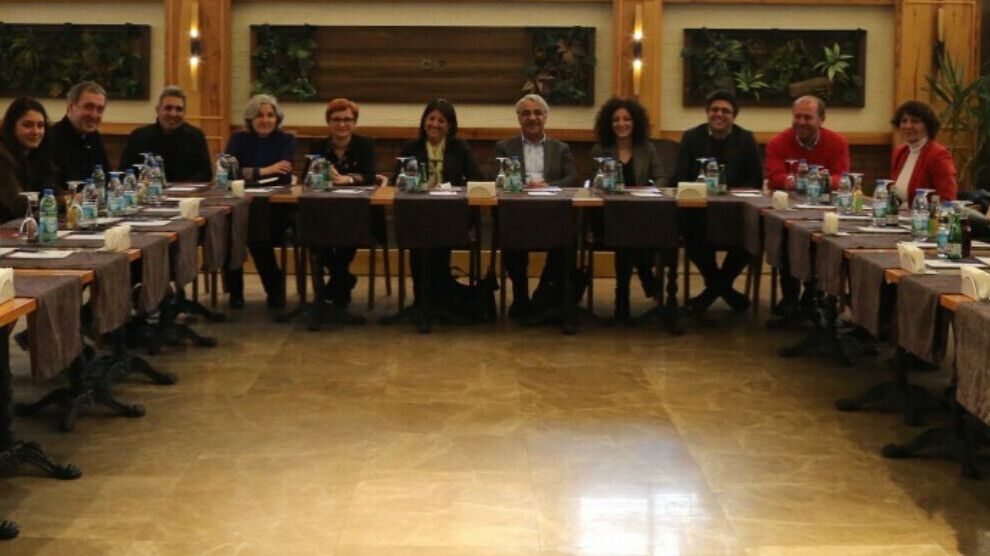
Seven parties in Turkey against the war in Ukraine: "We refuse the unjust war!"

A newly formed coordination of left parties and organisations in Turkey opposes the war in Ukraine and accuses Russia and NATO of plunging the world into war for their economic interests.

An alliance of the left parties and organisations, HDP (Peoples’ Democratic Party), EMEP (Labor Party), EHP (Proletarian Movement Party), Halkevleri (People’s Houses), SMF (Federation of Socialist Councils), TİP (Workers’ Party of Turkey) and TÖP (Social Liberty Party), was formed in Ankara at the weekend. A statement by the coordination of the alliance on the war in Ukraine said: "While the world is struggling to heal the wounds of the pandemic, it is facing a great new threat of war. Capitalism is not interested in the bread or health of humanity, instead it is creating the basis for a new war in which peoples are slaughtered for energy and weapons monopolies. This is what the war and occupation that began with the escalation of the conflict between Ukraine and Russia in the Donbass is all about. We do not stand with Russia and the US-led NATO, which disregard the will of the peoples with their expansionism. We refuse unjust wars and the slogans of war. Our side is peace, our side is the same as that of the peoples who oppose war all over the world.

"Taking to the streets for world peace and against rearmament"

We salute the democratic forces that have taken to the streets in Turkey demanding 'Peace Now!'. We call on everyone to take to the streets for world peace and against the global expansion of the war apparatus. Turkey should not be a party in a war and polarisation that puts fire to the fuse of the Third World War. We warn the AKP government, which collaborates with regional and international powers and has long been in an aggressive position of constant conflict with neighbouring peoples. Turkey must not be included in the NATO or Russian war bloc. The people who want peace will not allow this.

"Together against war and militarism"

War is the enemy of the workers who fight for equality and human life. The workers, the poor, the women and the youth are the ones who lose the most in war. All peoples, the workers of our country, must unite against war, militarism and chauvinism. War is also the enemy of democracy. It is the shortest road to dictatorship, autocracy and oligarchy. War means more displacement, assault and rape for women. War means destruction of the environment. It threatens all living beings, not just human beings.

"Solidarity is a weapon against war"

All forces fighting for democracy in our country must unite against war. It is an imperative necessity of the struggle for democracy to stop this war and prevent the slaughter of peoples and the barons of war from becoming even stronger. For this we must show the greatest solidarity.

"Withdraw troops now - preserve the right to self-determination"

In Donetsk, Lugansk and Ukraine, civilians are being killed, people are being displaced en masse. All war and occupation forces must be withdrawn from the region and the peoples’ right to self-determination should be recognised. Imperialism and fascism have reached a level of madness and desperation that even the use of nuclear weapons is apparently being considered. Hiroshima, Nagasaki, Vietnam and Halabja are historic warnings against such forms of criminal war. We will not stand by and watch! Now is the time to raise our voices against war and for peace and brotherhood!"

Ukraine-Russia war: Shelling of Kharkiv is a war crime - Zelensky

By AARON REICH AND REUTERS 
© (photo credit: Vitaliy Gnidyi/Reuters) The Ukrainian national flag is seen in front of a school which, according to local residents, was on fire after shelling, as Russia

The recent shelling of the city of Kharkiv in Ukraine by Russian forces was a war crime, Ukrainian President Volodymyr Zelensky said as the conflict stretched into its sixth day.

The president called for a no-fly zone for Russian missiles, planes and helicopters, though he did not specify how this would be enforced. Washington has firmly declined a Ukrainian request for the West to impose a no-fly zone to shield Ukraine from Russian airstrikes - a step that would bring Western forces into direct conflict with the Russian military.

Zelensky argued that Russia has committed war crimes in Ukraine, specifying that the artillery shelling of the city of Kharkiv constituted as the targeting of civilians.

According to Ukrainian Ambassador to the US Oksana Markarova, Russian forces used an illegal weapon known as a vacuum bomb against Ukraine.

"They used the vacuum bomb today, which is actually prohibited by the Geneva convention," Markarova said after briefing members of the US Congress. "The devastation that Russia is trying to inflict on Ukraine is large."

© Provided by The Jerusalem Post Ukraine's ambassador to the United States Oksana Markarova walks between meetings with members of the U.S. Congress on Capitol Hill in Washington, US. February 28, 2022.
 (credit: REUTERS/JONATHAN ERNST)

A vacuum bomb uses oxygen from the surrounding air to generate a high-temperature explosion, typically producing a blast wave of a significantly longer duration than that of a conventional explosive.

In addition, Amnesty International and Human Rights Watch both said that Russian forces appeared to have used widely banned cluster munitions, with Amnesty accusing them of attacking a preschool in northeastern Ukraine while civilians took shelter inside.

Amnesty International said international humanitarian law prohibits the use of inherently indiscriminate weapons such as cluster munitions. Launching indiscriminate attacks that kill or injure civilians constitutes a war crime.

White House Press Secretary Jen Psaki said she had seen reports but did not have confirmation that Russia had used such weapons. "If that were true, it would potentially be a war crime," she told a press briefing, noting that there are international organizations that would assess that and President Joe Biden's administration "would look to be a part of that conversation."

The Russian embassy in Washington did not respond to requests for comment.

Any state that has committed war crimes should not be allowed to be a permanent member of the United Nations Security Council, Zelensky said.

"Dozens of eyewitness accounts" indicated that this was a targeted attack of a residential area without military facilities, Zelensky said, according to the New Voice of Ukraine news outlet. "The Russians knew where they were shooting," he said, adding that "No one in the world will forgive you for killing peaceful Ukrainian people."

This comes after the International Criminal Court said they might investigate any war crime committed in Ukraine.

Military developments


Satellite images taken on Monday show a Russian military convoy north of the Ukrainian capital of Kyiv that stretches for about 40 miles (64 km), substantially longer than the 17 miles (27 km) reported earlier in the day, according to Maxar Technologies.

Further, Ukraine cut communications for Russian cellphone numbers in the country, according to the Derzhspetszviazok (The State Service of Special Communications and Information Protection of Ukraine), the country's intelligence and technical security service.

In addition, Ukraine will allow foreigners traveling to the country to help fight against Russia to do so without a visa, according to a new decree signed by the president that went into effect Tuesday.

The decree, signed by President Volodymyr Zelensky, allows for all foreigners hoping to join the new unit for foreign volunteers, known as the International Legion of the Territorial Defense Force, with the exception of those coming from Russia.

The new unit for foreign volunteers was announced on Sunday, with Ukrainian authorities having said the next day that thousands have already applied to join.

Some young volunteers are traveling straight to Ukraine to enlist.

Others are applying at Ukrainian embassies and consulates before quitting jobs or dropping out of university. Full story here.
Negotiations

Zelensky said the negotiations between Russia and Ukraine were conducted against the background of Russian bombardments into Ukrainian territory.

The fact that these two events took place at the same time, Zelensky said, was no coincidence, accusing Moscow of doing it intentionally, according to NV.

"Don't waste your time, we don't accept this tactic," Zelensky said, according to NV. "Fair negotiations can only happen when one side doesn't hit the other with artillery during negotiations."

Regarding the points brought up in the talks themselves, Zelensky said that he would go over what was discussed with the Ukrainian delegation when they return to Kyiv so they can decide how to move forward when the second round of negotiations begins, according to Ukrainian media.


Diplomacy


Ukraine has made an effort to reach out to the West repeatedly during the conflict, including Europe.

Zelensky officially applied on Monday to join the European Union, with the application being on its way to Brussels for processing, Ukrainian President's Office deputy head Andrij Sybiha wrote on Facebook.

In response, the heads of state for eight different EU member states – Bulgaria, Estonia, Lithuania, Latvia, Poland, Slovakia, Slovenia and the Czech Republic – pushed for immediately admitting Ukraine into the bloc.

This follows Slovakian Prime Minister Eduard Heger telling Politico that Ukraine should have a "special track" towards EU membership.

Energy ministers from European Union countries on Monday agreed to urgently link a European power system to Ukraine's grid, a move that would increase its independence from Russia.

Ukraine disconnected its grid from a Russian system last week and has asked for emergency synchronization with a European system. That would mean Russia would no longer control technical aspects of Ukraine’s network such as grid frequency. EU officials said the link could be completed within weeks. Full story here.
Sanctions, economy and corporate reactions

The financial impact of the conflict, international reaction to it from businesses and Western sanctions has been noted in analyses of the Russian economy.

The rouble stabilized somewhat on Tuesday after its crash to an all-time low, while the safe-haven yen and Swiss franc were steady after their biggest rallies in almost seven weeks with traders focused squarely on the developing crisis in Ukraine.

This impact was also felt by Russian companies, with many of its key companies taking hits.

Ukrainian Foreign Minister Dmytro Kuleba said on Tuesday morning that US Secretary of State Antony Blinken had offered his country, which is under attack from its neighbor Russia, more support in the form of sanctions and weapons.

A stream of Western companies pulling out of Russia is expected to grow on Tuesday, as corporations and investors across industries follow the lead of energy firms BP and Shell, which abandoned multi-billion-dollar positions after the invasion of Ukraine.

Disney is believed to be the first major Hollywood studio to pause theatrical releases in Russia in response to its invasion of Ukraine.

The impact has also been felt in sports, too.

International football governing body FIFA has expelled Russia from competing in the World Cup, with Russia's business partnerships with the US hockey league the NHL ending and Russia and Belarus being sanctioned by the International Ice Hockey Federation sanctioned Russia and Belarus, which is supportive of the invasion, banning both nations from upcoming world championship tournaments. Full story here.

This is a developing story.
'Mom, it’s so hard': Russian soldier allegedly texts home invasion details from Ukraine

Courtney Greenberg 

Text messages allegedly written by a Russian soldier to his mother describe how the invading army is “hitting everyone, even civilians.”
© Provided by National Post The Security Service of Ukraine published texts allegedly written by a Russian soldier on their Telegram account. The photo shows the cracked phone of the soldier, described the role of Russia in Ukraine.

They were read aloud by Ukrainian Ambassador to the U.N. Sergiy Kyslytsya at the U.N. General Assembly Emergency Meeting on Monday.

“I would like to read from a screenshot of a smartphone of a killed Russian soldier,” he said, before reading the exchange in Russian.

Photos of the texts were released earlier by the Security Service of Ukraine on Telegram (an instant messaging service) and published in the Ukrainian media outlet Ukrinform . The circumstances surrounding the soldier’s death were not disclosed, other than it occurred in combat. Kyslytsya said the texts were sent “several moments before he was killed.”

In the exchange that has only been verified by Ukrainian sources, the soldier tells his mother, in Russian, that he is no longer in Crimea doing training exercises. When his mother asks if she can send him a parcel, he says “the only thing I want now is to hang myself.” He goes on to explain that he is in Ukraine, where there is a “real war.”

“I’m scared, we’re hitting everyone, even civilians,” he wrote. “We had been told that people would welcome us here but they jump under our vehicles, not letting us pass. They call us fascists. Mom, it’s so hard.”


© Security Service of Ukraine/Telegram A series of text messages allegedly written by a Russian soldier before he was killed in combat were published by the Security Service of Ukraine. The texts say that civilians were “hit” in the Russian invasion of Ukraine.

“If you want to just visual the magnitude of the tragedy, you have to imagine next to you, next to every name plate of every single country in this general assembly, more than 30 souls of killed Russian soldiers already,” said Kyslytsya, when he finished reading the text messages. “Next to every name of every single country in this assembly, 30 plus killed Russian soldiers. Hundreds of killed Ukrainians. Dozens of killed children. And it goes on and on and on.”

This comes as Ukraine and its allies called for a United Nations inquiry into possible war crimes committed by Russia during its actions in Ukraine.

The United Nations Human Rights Council voted on Monday to accept Ukraine’s request to hold an urgent debate on Thursday on Russia’s invasion. A Ukrainian draft resolution will be considered at the urgent debate.

If adopted, a commission of three independent experts would investigate all alleged violations of international law in Crimea and the Donetsk and Luhansk regions since 2014 and in other areas of Ukraine since Russia’s invasion last week.

Ukraine’s ambassador to the United Nations in Geneva, Yevheniia Filipenko, told the Human Rights Council: “Russian forces attempt to sow panic among the population by specifically targeting kindergartens and orphanages, hospitals and mobile medical aid brigades thus committing acts that may amount to war crimes.”

Sheba Crocker, U.S. ambassador to the U.N. in Geneva, said in a statement to Reuters that Monday’s vote to hold the debate showed Russia was totally isolated on the Council.

“Only 4 countries supported Russia’s position, clearly demonstrating the international community is united in condemning Russia’s egregious action,” she said.

Russia’s ambassador Gennady Gatilov said it had launched “special operations to stop the tragedy” in Ukraine’s breakaway Donbass region, and that Russia’s forces were not firing on civilian targets in Ukraine.

Russian Foreign Minister Sergei Lavrov canceled his planned visit to Geneva to address the forum on Tuesday, which Moscow’s mission said was “due to an unprecedented ban on his flight in the airspace of a number of EU countries that have imposed anti-Russian sanctions,” but gave no specifics.

The cancelation coincided with neutral Switzerland imposing financial sanctions against Russian President Vladimir Putin, Prime Minister Mikhail Mishustin and Lavrov.

British minister of state Lord Ahmad called for a probe into alleged human rights violations by Russia.

“There are various discussions taking place here at the Human Rights Council on this investigative mechanism. There are other engagements that we are having, including with the ICC (International Criminal Court), to ensure there is accountability for those crimes that are being committed every hour, every day on the sovereign territory of Ukraine,” he told Reuters.

He said Russia was increasingly isolated economically, politically and diplomatically.

“We will continue to work with our international partners to make sure that again a very clear message is given to Russia that there is a major cost economically for Russian institutions, Russian banks, that this invasion is going to be costly to them.”

Canada’s Foreign Minister Melanie Joly told the U.N. rights forum: “Allow me to convey something directly to the representative from Russia: Human rights are universal and can’t be manipulated to justify wars and crimes.”

(Additional reporting by Emma Farge; writing by Stephanie Nebehay; Editing by Peter Graff and Angus MacSwan)

With reporting from Reuters