It’s possible that I shall make an ass of myself. But in that case one can always get out of it with a little dialectic. I have, of course, so worded my proposition as to be right either way (K.Marx, Letter to F.Engels on the Indian Mutiny)
IMAGE: A FLAT LINE IN A TRANSMISSION SPECTRUM, LIKE THIS ONE, CAN BE EXCITING – IT CAN TELL US A LOT ABOUT THE PLANET. RESEARCHERS USED NASA’S JAMES WEBB SPACE TELESCOPE’S NEAR-INFRARED SPECTROGRAPH (NIRSPEC) TO OBSERVE EXOPLANET LHS 475 B ON AUGUST 31, 2022. AS THIS SPECTRUM SHOWS, WEBB DID NOT OBSERVE A DETECTABLE QUANTITY OF ANY ELEMENT OR MOLECULE. THE DATA (WHITE DOTS) ARE CONSISTENT WITH A FEATURELESS SPECTRUM REPRESENTATIVE OF A PLANET THAT HAS NO ATMOSPHERE (YELLOW LINE). THE PURPLE LINE REPRESENTS A PURE CARBON DIOXIDE ATMOSPHERE AND IS INDISTINGUISHABLE FROM A FLAT LINE AT THE CURRENT LEVEL OF PRECISION. THE GREEN LINE REPRESENTS A PURE METHANE ATMOSPHERE, WHICH IS NOT FAVORED SINCE IF METHANE WERE PRESENT, IT WOULD BE EXPECTED TO BLOCK MORE STARLIGHT AT 3.3 MICRONS.view more
CREDIT: CREDITS: ILLUSTRATION: NASA, ESA, CSA, L. HUSTAK (STSCI); SCIENCE: K. STEVENSON, J. LUSTIG-YAEGER, E. MAY (JOHNS HOPKINS UNIVERSITY APPLIED PHYSICS LABORATORY), G. FU (JOHNS HOPKINS UNIVERSITY), AND S. MORAN (UNIVERSITY OF ARIZONA)
Researchers confirmed an exoplanet, a planet that orbits another star, using NASA’s James Webb Space Telescope for the first time. Formally classified as LHS 475 b, the planet is almost exactly the same size as our own, clocking in at 99% of Earth’s diameter. The research team is led by Kevin Stevenson and Jacob Lustig-Yaeger, both of the Johns Hopkins University Applied Physics Laboratory in Laurel, Maryland.
The team chose to observe this target with Webb after carefully reviewing targets of interest from NASA’s Transiting Exoplanet Survey Satellite (TESS), which hinted at the planet’s existence. Webb’s Near-Infrared Spectrograph (NIRSpec) captured the planet easily and clearly with only two transit observations. “There is no question that the planet is there. Webb’s pristine data validate it,” said Lustig-Yaeger. “The fact that it is also a small, rocky planet is impressive for the observatory,” Stevenson added.
“These first observational results from an Earth-size, rocky planet open the door to many future possibilities for studying rocky planet atmospheres with Webb,” agreed Mark Clampin, Astrophysics Division director at NASA Headquarters in Washington. “Webb is bringing us closer and closer to a new understanding of Earth-like worlds outside our solar system, and the mission is only just getting started.”
Among all operating telescopes, only Webb is capable of characterizing the atmospheres of Earth-sized exoplanets. The team attempted to assess what is in the planet’s atmosphere by analyzing its transmission spectrum. Although the data shows that this is an Earth-sized terrestrial planet, they do not yet know if it has an atmosphere. “The observatory’s data are beautiful,” said Erin May, also of the Johns Hopkins University Applied Physics Laboratory. “The telescope is so sensitive that it can easily detect a range of molecules, but we can’t yet make any definitive conclusions about the planet’s atmosphere.”
Although the team can’t conclude what is present, they can definitely say what is not present. “There are some terrestrial-type atmospheres that we can rule out,” explained Lustig-Yaeger. “It can’t have a thick methane-dominated atmosphere, similar to that of Saturn’s moon Titan.”
The team also notes that while it’s possible the planet has no atmosphere, there are some atmospheric compositions that have not been ruled out, such as a pure carbon dioxide atmosphere. “Counterintuitively, a 100% carbon dioxide atmosphere is so much more compact that it becomes very challenging to detect,” said Lustig-Yaeger. Even more precise measurements are required for the team to distinguish a pure carbon dioxide atmosphere from no atmosphere at all. The researchers are scheduled to obtain additional spectra with upcoming observations this summer.
CAPTION
How do researchers spot a distant planet? By observing the changes in light as it orbits its star. A light curve from NASA’s James Webb Space Telescope’s Near-Infrared Spectrograph (NIRSpec) shows the change in brightness from the LHS 475 star system over time as the planet transited the star on August 31, 2022. LHS 475 b is a rocky, Earth-sized exoplanet that orbits a red dwarf star roughly 41 light-years away, in the constellation Octans. The planet is extremely close to its star, completing one orbit in two Earth-days. The planet’s confirmation was made possible by Webb’s data.
CREDIT
Credits: Illustration: NASA, ESA, CSA, L. Hustak (STScI); Science: K. Stevenson, J. Lustig-Yaeger, E. May (Johns Hopkins University Applied Physics Laboratory), G. Fu (Johns Hopkins University), and S. Moran (University of Arizona)
Webb also revealed that the planet is a few hundred degrees warmer than Earth, so if clouds are detected, it may lead the researchers to conclude that the planet is more like Venus, which has a carbon dioxide atmosphere and is perpetually shrouded in thick clouds. “We’re at the forefront of studying small, rocky exoplanets,” Lustig-Yaeger said. “We have barely begun scratching the surface of what their atmospheres might be like.”
The researchers also confirmed that the planet completes an orbit in just two days, information that was almost instantaneously revealed by Webb’s precise light curve. Although LHS 475 b is closer to its star than any planet in our solar system, its red dwarf star is less than half the temperature of the Sun, so the researchers project it still could have an atmosphere.
The researchers’ findings have opened the possibilities of pinpointing Earth-sized planets orbiting smaller red dwarf stars. “This rocky planet confirmation highlights the precision of the mission’s instruments,” Stevenson said. “And it is only the first of many discoveries that it will make.” Lustig-Yaeger agreed. “With this telescope, rocky exoplanets are the new frontier.”
LHS 475 b is relatively close, at only 41 light-years away, in the constellation Octans.
The team’s results were presented at a press conference of the American Astronomical Society (AAS) on Wednesday, Jan. 11, 2023.
The James Webb Space Telescope is the world’s premier space science observatory. Webb will solve mysteries in our solar system, look beyond to distant worlds around other stars, and probe the mysterious structures and origins of our universe and our place in it. Webb is an international program led by NASA with its partners, ESA (European Space Agency) and CSA (Canadian Space Agency).
New Webb image reveals dusty disk like never seen before
IMAGE: THESE TWO IMAGES ARE OF THE DUSTY DEBRIS DISK AROUND AU MIC, A RED DWARF STAR LOCATED 32 LIGHT-YEARS AWAY IN THE SOUTHERN CONSTELLATION MICROSCOPIUM. SCIENTISTS USED WEBB’S NEAR-INFRARED CAMERA (NIRCAM) TO STUDY AU MIC. NIRCAM’S CORONAGRAPH, WHICH BLOCKED THE INTENSE LIGHT OF THE CENTRAL STAR, ALLOWED THE TEAM TO STUDY THE REGION VERY CLOSE TO THE STAR. THE LOCATION OF THE STAR, WHICH IS MASKED OUT, IS MARKED BY A WHITE, GRAPHICAL REPRESENTATION AT THE CENTER OF EACH IMAGE. THE REGION BLOCKED BY THE CORONAGRAPH IS SHOWN BY A DASHED CIRCLE.view more
CREDIT: CREDITS: NASA, ESA, CSA, AND K. LAWSON (GODDARD SPACE FLIGHT CENTER). IMAGE PROCESSING: A. PAGAN (STSCI)
NASA’s James Webb Space Telescope has imaged the inner workings of a dusty disk surrounding a nearby red dwarf star. These observations represent the first time the previously known disk has been imaged at these infrared wavelengths of light. They also provide clues to the composition of the disk.
The star system in question, AU Microscopii or AU Mic, is located 32 light-years away in the southern constellation Microscopium. It’s approximately 23 million years old, meaning that planet formation has ended since that process typically takes less than 10 million years. The star has two known planets, discovered by other telescopes. The dusty debris disk that remains is the result of collisions between leftover planetesimals – a more massive equivalent of the dust in our solar system that creates a phenomenon known as zodiacal light.
“A debris disk is continuously replenished by collisions of planetesimals. By studying it, we get a unique window into the recent dynamical history of this system,” said Kellen Lawson of NASA’s Goddard Space Flight Center, lead author on the study and a member of the research team that studied AU Mic.
“This system is one of the very few examples of a young star, with known exoplanets, and a debris disk that is near enough and bright enough to study holistically using Webb’s uniquely powerful instruments,” said Josh Schlieder of NASA’s Goddard Space Flight Center, principal investigator for the observing program and a study co-author.
The team used Webb’s Near-Infrared Camera (NIRCam) to study AU Mic. With the help of NIRCam's coronagraph, which blocks the intense light of the central star, they were able to study the region very close to the star. The NIRCam images allowed the researchers to trace the disk as close to the star as 5 astronomical units (460 million miles) – the equivalent of Jupiter’s orbit in our solar system.
“Our first look at the data far exceeded expectations. It was more detailed than we expected. It was brighter than we expected. We detected the disk closer in than we expected. We're hoping that as we dig deeper, there's going to be some more surprises that we hadn't predicted,” stated Schlieder.
The observing program obtained images at wavelengths of 3.56 and 4.44 microns. The team found that the disk was brighter at the shorter wavelength, or “bluer,” likely meaning that it contains a lot of fine dust that is more efficient at scattering shorter wavelengths of light. This finding is consistent with the results of prior studies, which found that the radiation pressure from AU Mic — unlike that of more massive stars — would not be strong enough to eject fine dust from the disk.
While detecting the disk is significant, the team’s ultimate goal is to search for giant planets in wide orbits, similar to Jupiter, Saturn, or the ice giants of our solar system. Such worlds are very difficult to detect around distant stars using either the transit or radial velocity methods.
“This is the first time that we really have sensitivity to directly observe planets with wide orbits that are significantly lower in mass than Jupiter and Saturn. This really is new, uncharted territory in terms of direct imaging around low-mass stars,” explained Lawson.
These results are being presented today in a press conference at the 241st meeting of the American Astronomical Society. The observations were obtained as part of Webb’s Guaranteed Time program 1184.
The James Webb Space Telescope is the world's premier space science observatory. Webb will solve mysteries in our solar system, look beyond to distant worlds around other stars, and probe the mysterious structures and origins of our universe and our place in it. Webb is an international program led by NASA with its partners, ESA (European Space Agency) and CSA (Canadian Space Agency).
NASA's Webb uncovers star formation in cluster’s dusty ribbons
IMAGE: NGC 346, SHOWN HERE IN THIS IMAGE FROM NASA’S JAMES WEBB SPACE TELESCOPE NEAR-INFRARED CAMERA (NIRCAM), IS A DYNAMIC STAR CLUSTER THAT LIES WITHIN A NEBULA 200,000 LIGHT YEARS AWAY. WEBB REVEALS THE PRESENCE OF MANY MORE BUILDING BLOCKS THAN PREVIOUSLY EXPECTED, NOT ONLY FOR STARS, BUT ALSO PLANETS, IN THE FORM OF CLOUDS PACKED WITH DUST AND HYDROGEN. THE PLUMES AND ARCS OF GAS IN THIS IMAGE CONTAINS TWO TYPES OF HYDROGEN. THE PINK GAS REPRESENTS ENERGIZED HYDROGEN, WHICH IS TYPICALLY AS HOT AS AROUND 10,000 °C (APPROXIMATELY 18,000 °F) OR MORE, WHILE THE MORE ORANGE GAS REPRESENTS DENSE, MOLECULAR HYDROGEN, WHICH IS MUCH COLDER AT AROUND -200 °C OR LESS (APPROXIMATELY -300 °F), AND ASSOCIATED DUST. THE COLDER GAS PROVIDES AN EXCELLENT ENVIRONMENT FOR STARS TO FORM, AND, AS THEY DO, THEY CHANGE THE ENVIRONMENT AROUND THEM. THE EFFECT OF THIS IS SEEN IN THE VARIOUS RIDGES THROUGHOUT, WHICH ARE CREATED AS THE LIGHT OF THESE YOUNG STARS BREAKS DOWN THE DENSE CLOUDS. THE MANY PILLARS OF GLOWING GAS SHOW THE EFFECTS OF THIS STELLAR EROSION THROUGHOUT THE REGION. IN THIS IMAGE BLUE WAS ASSIGNED TO THE WAVELENGTH OF 2.0 MICRONS (F200W), GREEN WAS ASSIGNED TO 2.77 MICRONS (F277W), ORANGE WAS ASSIGNED TO 3.35 MICRONS (F335M), AND RED WAS ASSIGNED TO 4.44 MICRONS (F444W).view more
CREDIT: CREDITS: NASA, ESA, CSA, O. JONES (UK ATC), G. DE MARCHI (ESTEC), AND M. MEIXNER (USRA). IMAGE PROCESSING: A. PAGAN (STSCI), N. HABEL (USRA), L. LENKIC (USRA) AND L. CHU (NASA/AMES)
NGC 346, one of the most dynamic star-forming regions in nearby galaxies, is full of mystery. Now, it is less mysterious with new findings from NASA’s James Webb Space Telescope.
NCG 346 is located in the Small Magellanic Cloud (SMC), a dwarf galaxy close to our Milky Way. The SMC contains lower concentrations of elements heavier than hydrogen or helium, which astronomers call metals, compared to the Milky Way. Since dust grains in space are composed mostly of metals, scientists expected there would be low amounts of dust, and that it would be hard to detect. New data from Webb reveals the opposite.
Astronomers probed this region because the conditions and amount of metals within the SMC resemble those seen in galaxies billions of years ago, during an era in the universe known as “cosmic noon,” when star formation was at its peak. Some 2 to 3 billion years after the big bang, galaxies were forming stars at a furious rate. The fireworks of star formation happening then still shape the galaxies we see around us today.
“A galaxy during cosmic noon wouldn’t have one NGC 346 like the Small Magellanic Cloud does; it would have thousands” of star-forming regions like this one, said Margaret Meixner, an astronomer at the Universities Space Research Association and principal investigator of the research team. “But even if NGC 346 is now the one and only massive cluster furiously forming stars in its galaxy, it offers us a great opportunity to probe conditions that were in place at cosmic noon.”
By observing protostars still in the process of forming, researchers can learn if the star formation process in the SMC is different from what we observe in our own Milky Way. Previous infrared studies of NGC 346 have focused on protostars heavier than about 5 to 8 times the mass of our Sun. “With Webb, we can probe down to lighter-weight protostars, as small as one tenth of our Sun, to see if their formation process is affected by the lower metal content,” said Olivia Jones of the United Kingdom Astronomy Technology Centre, Royal Observatory Edinburgh, a co-investigator on the program.
As stars form, they gather gas and dust, which can look like ribbons in Webb imagery, from the surrounding molecular cloud. The material collects into an accretion disk that feeds the central protostar. Astronomers have detected gas around protostars within NGC 346, but Webb’s near-infrared observations mark the first time they have also detected dust in these disks.
“We’re seeing the building blocks, not only of stars, but also potentially of planets,” said Guido De Marchi of the European Space Agency, a co-investigator on the research team. “And since the Small Magellanic Cloud has a similar environment to galaxies during cosmic noon, it’s possible that rocky planets could have formed earlier in the universe than we might have thought.”
The team also has spectroscopic observations from Webb’s NIRSpec instrument that they are continuing to analyze. These data are expected to provide new insights into the material accreting onto individual protostars, as well as the environment immediately surrounding the protostar.
These results are being presented Jan. 11 in a press conference at the 241st meeting of the American Astronomical Society. The observations were obtained as part of program 1227.
The James Webb Space Telescope is the world's premier space science observatory. Webb will solve mysteries in our solar system, look beyond to distant worlds around other stars, and probe the mysterious structures and origins of our universe and our place in it. Webb is an international program led by NASA with its partners, ESA (European Space Agency) and the Canadian Space Agency.
For more information about the Webb mission, visit:
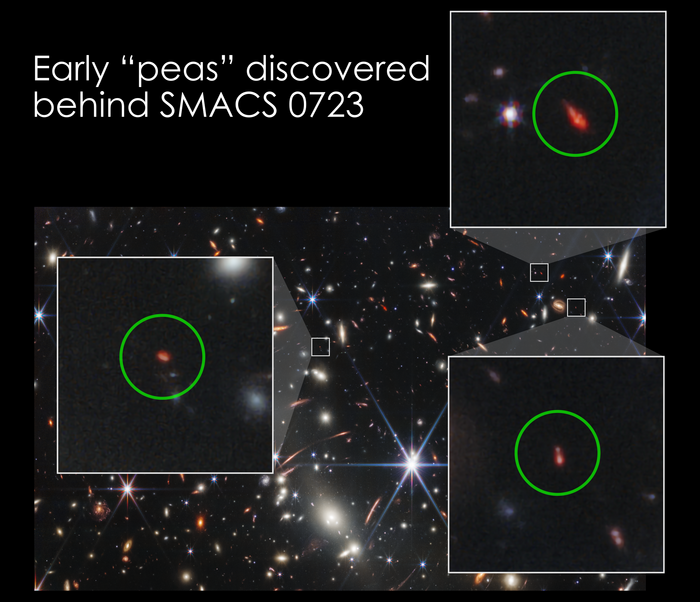
IMAGE: A TRIO OF FAINT OBJECTS (CIRCLED) CAPTURED IN THE JAMES WEBB SPACE TELESCOPE’S DEEP IMAGE OF THE GALAXY CLUSTER SMACS 0723 EXHIBIT PROPERTIES REMARKABLY SIMILAR TO RARE, SMALL GALAXIES CALLED “GREEN PEAS” FOUND MUCH CLOSER TO HOME. THE CLUSTER’S MASS MAKES IT A GRAVITATIONAL LENS, WHICH BOTH MAGNIFIES AND DISTORTS THE APPEARANCE OF BACKGROUND GALAXIES. WE VIEW THESE EARLY PEAS AS THEY EXISTED WHEN THE UNIVERSE WAS ABOUT 5% ITS CURRENT AGE OF 13.8 BILLION YEARS. THE FARTHEST PEA, AT LEFT, CONTAINS JUST 2% THE OXYGEN ABUNDANCE OF A GALAXY LIKE OUR OWN AND MIGHT BE THE MOST CHEMICALLY PRIMITIVE GALAXY YET IDENTIFIED.view more
CREDIT: CREDIT: NASA, ESA, CSA, AND STSCI
A new analysis of distant galaxies imaged by NASA’s James Webb Space Telescope shows that they are extremely young and share some remarkable similarities to “green peas,” a rare class of small galaxies in our cosmic backyard.
“With detailed chemical fingerprints of these early galaxies, we see that they include what might be the most primitive galaxy identified so far. At the same time, we can connect these galaxies from the dawn of the universe to similar ones nearby, which we can study in much greater detail,” said James Rhoads, an astrophysicist at NASA’s Goddard Space Flight Center in Greenbelt, Maryland, who presented the findings at the 241st meeting of the American Astronomical Society in Seattle.
A paper describing the results, led by Rhoads, was published Jan. 3 in The Astrophysical Journal Letters.
Green pea galaxies were discovered and named in 2009 by volunteers taking part in Galaxy Zoo, a project where citizen scientists help classify galaxies in images, starting with those from the Sloan Digital Sky Survey. Peas stood out as small, round, unresolved dots with a distinctly green shade, a consequence of both the colors assigned to different filters in the survey’s composite images and a property of the galaxies themselves.
Green pea galaxy colors are unusual because a sizable fraction of their light comes from brightly glowing gas clouds. The gases emit light at specific wavelengths – unlike stars, which produce a rainbow-like spectrum of continuous color. Peas are also quite compact, typically only about 5,000 light-years across or about 5% the size of our Milky Way galaxy.
“Peas may be small, but their star-formation activity is unusually intense for their size, so they produce bright ultraviolet light,” said Keunho Kim, a postdoctoral researcher at the University of Cincinnati and a member of the analysis team. “Thanks to ultraviolet images of green peas from Hubble and ground-based research on early star-forming galaxies, it’s clear that they both share this property.”
In July 2022, NASA and its partners in the Webb mission released the deepest and sharpest infrared image of the distant universe yet seen, capturing thousands of galaxies in and behind a cluster known as SMACS 0723. The cluster’s mass makes it a gravitational lens, which both magnifies and distorts the appearance of background galaxies. Among the faintest galaxies behind the cluster were a trio of compact infrared objects that looked like they could be distant relatives of green peas. The most distant of these three galaxies was magnified by about 10 times, providing a significant assist from nature on top of the telescope’s unprecedented capabilities.
Webb did more than image the cluster – its Near-Infrared Spectrograph (NIRSpec) instrument also captured the spectra of selected galaxies in the scene. When Rhoads and his colleagues examined these measurements and corrected them for the wavelength stretch resulting from the expansion of space, they saw characteristic features emitted by oxygen, hydrogen, and neon line up in a stunning resemblance to those seen from nearby green peas.
Additionally, the Webb spectra made it possible to measure the amount of oxygen in these cosmic dawn galaxies for the first time.
As stars produce energy, they transmute lighter elements like hydrogen and helium into heavier ones. When stars explode or lose their outer layers at the ends of their lives, these heavier elements become incorporated into the gas that forms the next stellar generations, and the process continues. Over cosmic history, stars have steadily enriched the universe.
Two of the Webb galaxies contain oxygen at about 20% of the level in our Milky Way. They resemble typical green peas, which nevertheless make up less than 0.1% of the nearby galaxies observed by the Sloan survey. The third galaxy studied is even more unusual.
“We’re seeing these objects as they existed up to 13.1 billion years ago, when the universe was about 5% its current age,” said Goddard researcher Sangeeta Malhotra. “And we see that they are young galaxies in every sense – full of young stars and glowing gas that contains few chemical products recycled from earlier stars. Indeed, one of them contains just 2% the oxygen of a galaxy like our own and might be the most chemically primitive galaxy yet identified.”
NIRSpec was built for ESA (European Space Agency) by Airbus Industries. Its array of nearly half a million microshutters – tiny doors that can be opened or closed to admit or block light – allow it to capture spectra of up to 100 individual objects at a time. The microshutter array and detector subsystems were fabricated by NASA.
The James Webb Space Telescope, an international mission led by NASA with its partners ESA and CSA (Canadian Space Agency), is the world's premier space science observatory. NASA Headquarters oversees the mission for the agency’s Science Mission Directorate. NASA’s Goddard Space Flight Center manages Webb for the agency and oversees work on the mission performed by the Space Telescope Science Institute, Northrop Grumman, and other mission partners. In addition to Goddard, several NASA centers contributed to the project, including the agency’s Johnson Space Center in Houston, Jet Propulsion Laboratory in Southern California, Marshall Space Flight Center in Huntsville, Alabama, Ames Research Center in California’s Silicon Valley, and others.
IMAGE: THIS IMAGE SHOWS A VIAL WITH RESIDUE LEFT OVER AFTER DANNA QASIM AND HER TEAM IRRADIATED SIMULATED INTERSTELLAR ICES USING A VAN DE GRAAFF PARTICLE ACCELERATOR AT NASA GODDARD.view more
CREDIT: CREDITS: NASA GODDARD/JASON DWORKIN
Amino acids make up millions of proteins that drive the chemical gears of life, including essential bodily functions in animals. Because of amino acids’ relationship to living things scientists are eager to understand the origins of these molecules. After all, amino acids may have helped spawn life on Earth after being delivered here about 4 billion years ago by pieces of asteroids or comets.
But if so, were amino acids produced inside asteroids or comets? Or did life’s raw ingredients come intact from the interstellar molecular cloud of ice, gas, and dust that formed our solar system and countless others?
If amino acids formed in our solar system, then life could be unique here. But if they came from an interstellar cloud, these precursors to life could have spread to other solar systems, as well.
Scientists at NASA’s Goddard Space Flight Center in Greenbelt, Maryland, sought to explore how amino acids and amines – their chemical cousins – may have formed by simulating a mini, cosmic evolution in the lab. The researchers made ices like those found in interstellar clouds, blasted them with radiation, and then exposed the leftover material, which included amines and amino acids, to water and heat to replicate the conditions they would have experienced inside asteroids.
“The important take-away is that the building blocks of life have a strong link not only to processes in the asteroid, but also to those of the parent interstellar cloud,” said Danna Qasim, who worked on this experiment while she was a postdoctoral fellow at NASA Goddard from 2020 to 2022. Qasim now is a research scientist at the Southwest Research Institute in San Antonio and lead author of a study published on January 9 in the journal ACS Earth and Space Chemistry.
For their study, Qasim and her colleagues made ices out of molecules that telescopes have commonly detected in interstellar clouds, such as water, methanol, carbon dioxide and ammonia. Then, using a Van de Graaff particle accelerator at Goddard, they zapped the ices with high-energy protons to mimic the cosmic radiation the ices would have experienced in a molecular cloud. The radiation process broke apart simple molecules. Those molecules recombined into more complex amines and amino acids, such as ethylamine and glycine. The amino acids were left in gooey residues.
“We expect that these residues from the interstellar cloud are transferred to the protoplanetary disk that creates a solar system, including asteroids," Qasim said.
Asteroid simulations came next. By submerging the residues in tubes of water and heating them to different temperatures and for varying durations, scientists replicated the conditions inside some asteroids billions of years ago, called “aqueous alteration.” Afterward, they analyzed the effects these warm, watery conditions had on the molecules.
They found that the types of amines and amino acids created in laboratory interstellar ices, and their proportions, stayed constant regardless of asteroid conditions. This implies that amines and amino acids can stay intact as they migrate from the interstellar cloud to an asteroid. But each molecule reacted differently to asteroid-like conditions depending on how much heat the researchers applied and for how long. Glycine levels doubled after 7 days of asteroid simulations, for example, while ethylamine levels barely budged.
Many other scientists have created interstellar ices and plied them with radiation. Like the Goddard team, they’ve also found that this process creates amines and amino acids. But the set of compounds produced in labs doesn’t match the set detected in meteorites. Meteorites are pieces of asteroids and, perhaps, comets that scientists can find on Earth’s surface and probe in the lab.
Qasim and her colleagues wanted to investigating this discrepancy, so they designed an experiment — the first one to add asteroid simulations to the ice experiment. The process began with an idea by Christopher Materese, a Goddard research scientist who was principal investigator of this project. Materese wondered whether asteroid conditions were the missing link between lab-made interstellar ice and meteorite compositions.
“Laboratory experiments focused solely on ice irradiation are not fully capturing the reality of the chemistry experienced by these compounds,” Materese said. “So part of the goal of this work was to see if we can close that gap.”
The research team has not yet closed the gap. They found that even after simulating asteroid conditions, the amines and amino acids they produced still didn’t match those in meteorites.
This could be happening for a variety of reasons. One has to do with possible contamination. Because meteorites fall through Earth’s atmosphere and spend some time on the surface before they’re scooped up, it’s possible that their chemical makeup changes and doesn’t perfectly reflect the asteroids they came from. But scientists will be able to address this issue with pristine samples of asteroid Bennu, currently being ferried by NASA’s OSIRIS-REx spacecraft to Earth for a Sept. 24, 2023, delivery to the surface. Scientists also will improve their ice experiments after NASA’s James Webb Space Telescope returns detailed information about the types of ices that make up interstellar molecular clouds.
“We are not nearly at the end of this work yet, we still have more to do,” Materese said.
JOURNAL
ACS Earth and Space Chemistry
ARTICLE TITLE
Meteorite Parent Body Aqueous Alteration Simulations of Interstellar Residue Analogs
Scientists have detected a record-breaking radio signal from atomic hydrogen in a very distant galaxy.
The galaxy that the signal originated from is believed to have come from a galaxy at redshift z=1.29.
Because of the galaxy’s immense distance, the emission line had shifted to a 48 cm line from the 21 cm line they had expected.
This discovery is phenomenal because the galaxy that it originated from is believed to have existed when the universe was only 4.9 billion years old – making the source of the record-breaking radio signal 8.8 billion years old.
The detection was possible because the scientists used gravitational lensing to detect and follow the signal back to its source galaxy. The magnification of the lensing was a factor of 30, the scientists explained, which allowed the group to see through the high redshift of the universe. Further, the team observed that the atomic hydrogen mass of the galaxy was twice as high as its stellar mass.
These findings were published in the Monthly Notices of the Royal Astronomy Society, and they show that the overall feasibility of observing the atomic gas in galaxies at long distances. It could also open new doors for probing the cosmic evolution of neutral gas with exiting and upcoming low-frequency radio telescopes in the future.
The astronomers involved in the study work with the McGill University in Canada, as well as the Institute of Science (IISc) in Bengaluru. The team used data from the Giant Meterwave Radio Telescope (GMRT) in Pune. This instrument allowed the team to detect the record-breaking radio signal originating from the distant galaxy, allowing the researchers to dig deeper into the discovery.
By detecting these kinds of record-breaking radio signals, we may be able to use similar instances to explore the mysteries of the early universe more thoroughly.
Discovery of three faint, distant galaxies may expand knowledge of early universe
First ultra-faint dwarf galaxies found around Milky Way-mass galaxy similar to those within Milky Way’s neighborhood
IMAGE: RESEARCHERS DISCOVERED THE FIRST ULTRA-FAINT DWARF GALAXIES TO BE FOUND AROUND A SPIRAL GALAXY WITH THE MASS OF THE MILKY WAY THAT’S OUTSIDE OF THE CLUSTERING OF GALAXIES THAT INCLUDES THE MILKY WAY AND ANDROMEDA. PICTURED IS ONE OF THE THREE GALAXIES, SCL-MM-DW5, WITH ITS STARS CLUSTERED AT CENTER. THE GALAXIES ARE ESTIMATED TO BE 12 BILLION YEARS OLD, WITH NEARLY ALL THEIR STARS HAVING FORMED IN THE EARLY UNIVERSE. THE GALAXIES WERE IDENTIFIED FROM MAGELLAN MEGACAM OBSERVATIONS, THEN CONFIRMED WITH DEEPER HUBBLE SPACE TELESCOPE OBSERVATIONS. (IMAGE BY NASA, HST-GO-15938, PI: MUTLU-PAKDIL)view more
CREDIT: NASA, HST-GO-15938, PI: MUTLU-PAKDIL
The discovery of the faintest known galaxies beyond the neighborhood of the Milky Way could help scientists develop universal models for how the universe’s oldest galaxies formed, according to findings announced Jan. 11 at the 241st meeting of the American Astronomical Society.
A team of researchers led by Burçin Mutlu-Pakdil, now an assistant professor of physics and astronomy at Dartmouth College, identified three ultra-faint dwarf galaxies (UFDs) that are among the faintest galaxies discovered outside of the Local Group, the clustering of galaxies that includes the Milky Way and Andromeda. Located roughly 11.4 million light years from Earth, the galaxies are estimated to be 12 billion years old, with nearly all their stars having formed in the early universe, the researchers reported in The Astrophysical Journal.
The galaxies are the first UFDs to be found around a spiral galaxy with a mass of the Milky Way, orbiting a galaxy known as NGC253, or the Sculptor Galaxy. Yet, their characteristics are consistent with UFDs within the Local Group, which could help scientists develop more accurate models of UFDs overall. Most known examples of UFDs are within the Local Group, but different environments can affect their formation and evolution, Mutlu-Pakdil said.
“Our work is the necessary first step toward further understanding the faintest galaxies beyond the Local Group, and toward more robustly constraining the demographics of ultra-faint dwarf galaxies,” Mutlu-Pakdil said. “We still do not know whether the Local Group UFDs are typical or unusual. To answer this fundamental question, we need to discover more UFDs beyond our local environment and study them in detail.”
UFDs are the least luminous and least chemically evolved galaxies known. Yet, they are the most dominated by dark matter, which is the mysterious form of matter thought to constitute most of the universe. For these reasons, astronomers consider UFDs to be pristine fossils of the early universe that could provide the best opportunities for studying the composition of the universe and the formation of its first galaxies.
“Dwarf galaxies are the building blocks of larger galaxies,” Mutlu-Pakdil said. “UFDs are the best place to study galaxy formation on the smallest scales and learn how the smallest dark matter clumps get populated with stars and turn into galaxies.”
The paper, “Hubble Space Telescope Observations of NGC 253 Dwarf Satellites: Three Ultra-faint Dwarf Galaxies,” was published by The Astrophysical Journal Feb. 10, 2022. This study was conducted as part of the Panoramic Imaging Survey of Centaurus and Sculptor (PISCeS) project, which is a Magellan+Megacam survey aimed at finding new faint satellite galaxies, including UFDs.
The work was supported by the National Science Foundation (grants AST-1821967, 1813708, AST-1814208, AST-1412792, AST-1812856), an NSF Astronomy and Astrophysics Postdoctoral Fellowship (AST-2001663), the Packard Foundation, and the Natural Sciences and Engineering Research Council of Canada.
British buyers are indirectly buying Russian crude refined by Indian refineries.
High diesel prices in Europe and cheap Russian crude offer a window of opportunity for Indian refiners.
Kpler: the Jamnagar refinery on India’s west coast imported 215 shipments of crude oil and fuel oil from Russia in 2022.
Russia’s 2022 invasion of Ukraine has forced a dramatic restructuring of energy markets in the west, with many European nations vowing to wean themselves off Russian energy products. The UK has been one of the more successful countries in achieving this target after committing to end imports of oil and coal from Russia by the end of 2022 and even recently legislated for a ban on Russian gas. By October, UK imports of Russian energy were down to a trickle, with the country buying just £2 million of oil, but zero coal or gas from Russia.But reports have now emerged that India has been offering a back-door for imports of Russian oil into Britain, blunting the country’s efforts to restrict funding for the Kremlin. Some British buyers have effectively replaced imports directly from Russia with imports from Russian-fed refineries, thereby indirectly supporting the Russian oil industry.
Although such a supply chain is actually legal under UK rules, still it cannot be overlooked because this is another covert way to fund Putin’s war. Before the war began nearly a year ago, it was pretty rare for Indian refiners to process Russian crude. The refiners have always exported to Europe, but they are now exporting even more because it’s more attractive as Europe’s diesel prices are higher and also buying more Russian crude because Russia is offering heavy discounts.
Indeed, Oleg Ustenko, adviser to Ukraine’s president Volodymyr Zelensky, says these companies are “exploiting weaknesses in the sanctions regime”.
“The UK must close the loopholes that undermine support for Ukraine by allowing bloody fossil fuels to continue flowing across our borders. About one in five barrels of the crude oil that they process is Russian. A big chunk of that diesel they produce now will be based on Russian crude oil,’’ he has said.
Kpler data has revealed that the Jamnagar refinery on India’s west coast imported 215 shipments of crude oil and fuel oil from Russia in 2022, 4 times as much as it bought in the previous year. Meanwhile, the UK has imported a total of 10m barrels of diesel and other refined products from Jamnagar since the war began, 2.5 times what it bought during 2021 with Trafigura, Shell Plc (NYSE: SHEL), BP Plc (NYSE: BP), PetroChina Co. (OTCPK: PCYYF) and Indian multinational conglomerate Essar Group the key buyers.
According to Bloomberg's oil strategist Julian Lee, Russia's flagship Urals have been trading at a massive discount of as much as 40% to the international Brent crude oil. In contrast, in 2021, Urals traded at a much smaller discount of $2.85 to Brent. Urals is the main blend exported by Russia. Indeed, Moscow could be losing ~$4 billion a month in energy revenues as per Bloomberg's calculations.
Europe Importing Russian LNG
But the UK is hardly the only culprit in Europe as far as helping fund Putin’s war machine goes. Whereas supplies of Russian pipeline gas--the bulk of Europe’s gas imports before the Ukraine war--are down to a trickle, reports have emerged that Europe has been hungrily scooping up Russian LNG.
Europe has been working hard to wean itself off Russian energy commodities ever since the latter invaded Ukraine. The European Union has banned Russian coal and plans to block most Russian oil imports by the end of 2022 in a bid to deprive Moscow of an important source of revenue to wage its war in Ukraine.
But ditching Russian gas is proving to be more onerous than Europe would have hoped for, with the Wall Street Journal estimating that the bloc’s imports of Russian liquefied natural gas jumped by 41% Y/Y in the year through August.
“Russian LNG has been the dark horse of the sanctions regime,” Maria Shagina, research fellow at the London-based International Institute for Strategic Studies, has told WSJ. Importers of Russian LNG to Europe have argued that the shipments are not covered by current EU sanctions and that buying LNG from Russia and other suppliers has helped keep European energy prices in check.
Although Russian LNG has accounted for just 8% of the European Union and UK’s gas imports since the start of March, the trade runs counter to the EU’s efforts to deprive Russia of fossil-fuel revenue.
Biofuels have grown increasingly popular in recent years as a way to reduce emissions when it comes to both transport and heating.
In the UK, around 1.7 million homes still rely on kerosene heaters, and the government believes those could be adapted to run on hydro-treated vegetable oil.
In Mexico, there is a major push to expand the use of biofuels from cooking oil for public transportation, which would be a low-cost alternative for diesel.
Interest in biofuels has exploded in recent years, and as governments pursue both energy security and lower emissions, that interest is only rising. Following a flurry of new climate policies worldwide, energy companies are looking to reduce their emissions while ensuring the stability of their legacy businesses. Meanwhile, countries around the world are looking for energy sources that can be secured domestically. The U.K. and Mexico are two such countries, with both of them now looking to vegetable oil as a potential energy source for heating and transport.The use of cooking oils and animal fat in biofuel production is not a new concept, as several refiners in the U.S. use these products to produce fuels that entitle them to government tax credits. When gasoline demand plunged during the pandemic, oil companies were able to continue operations at their refineries by converting them to produce biofuels and taking the valuable government credits that came with them. The feedstocks came from used cooking oil and animal fat, which are typically deemed to be worthless – although they are sometimes hard to procure for that exact reason.
As several cities announce bans on the sale of new internal combustion engine (ICE) vehicles within the next decade, companies are racing to find alternatives to petrol and diesel, with the electric battery coming out on top. Some major automakers have also discussed the potential for the hydrogen fuel cell (HFCV). And others are looking to biodiesel to fuel the cars of the future. Biodiesel can be produced using animal fats and vegetable oil, significantly reducing greenhouse gas emissions on the roads. Vegetable oil can be used as a fuel for diesel engines as straight vegetable oil (SVO) or as biodiesel following conversion.
Biodiesel, which is generally viewed as cleaner and more effective in engines than SVO, is produced by a chemical process called transesterification, which involves a reaction with methanol using caustic soda as a catalyst. This reduces the viscosity and boiling point of the fuel, making it more like that of traditional diesel fuel. Most diesel vehicle automakers have approved the use of B5, a mix of 95 percent petroleum diesel and 5 percent biodiesel. And some manufacturers are making engines capable of running on B20 (20 percent biodiesel and 80 percent traditional diesel) or higher. However, the shift to using greater quantities of biodiesel has been slow to take off, with companies generally focusing on other green vehicle options, such as electric and HFCV.
But in recent months, the idea of using vegetable oil as a feedstock has gained more traction. In the UK, politicians are proposing the use of vegetable oil for heating in rural areas. A new bill encouraging the removal of duties on renewable liquid heating fuels, as well as incentives to reduce the use of kerosene in existing boilers, is being introduced to parliament by the former environment secretary George Eustice.
Around 1,7 million homes in the U.K. still rely on kerosene boilers, as they are not connected to the mains gas grid. There are already plans in place to ban the buying of new boilers from 2026, as homes switch to air-source or ground-source heat pump systems, but this new bill could help boost the uptake of green alternatives to kerosene between now and then. Eustice suggests that fitting new heating systems can be extremely costly, creating a “huge barrier” to uptake. This new bill would support homes across the country in the minor adaption of kerosene boilers to make them suitable to run on hydro-treated vegetable oil (HVO), which could reduce related greenhouse gas emissions by as much as 88 percent, according to Eustice.
Meanwhile, in Mexico, there has been a major push to expand the use of biofuels from cooking oil for public transportation. Mexico’s public transport sector continues to rely heavily on fossil fuels, with few incentives from the government to switch to less-polluting alternatives. But Jorge Tenorio, the CEO of Renov Biodiesel, suggests that biodiesel could be the alternative needed to power the transport system of the future. He explains, “The main raw material currently used in Mexico to produce biodiesel is used cooking oil. For every litre of recycled oil collected, one litre of biodiesel is produced, which is cheaper than the traditional diesel produced by PEMEX.” And the Advanced Biodiesel Cluster (BDA) of the Mexican Centre for Energy Innovation believes that 360 million liters of used oil could be obtained in cities of over 100,000 inhabitants, with the potential of providing a low-cost, clean alternative to diesel.
As interest in biofuels continues to grow around the globe, some countries are finally putting theory into practice by introducing major vegetable oil-produced biofuels into the energy mix. If new policies are passed on the use of biofuels, we could soon be fuelling the green transition on waste oils, previously destined for the drain or landfill.