Wednesday, July 05, 2023

Hungary Braces for Teacher Exodus After ‘Vengeance’ Law Approved

Zoltan Simon
Tue, July 4, 2023 


(Bloomberg) -- Hungary braced for a wave of teacher resignations after Prime Minister Viktor Orban’s legislators approved a new law that educators see as a crackdown following years of anti-government protests.

The parliament in Budapest, where members of Orban’s party hold a two-thirds majority, approved the so-called status law — stripping teachers of protections granted to public employees, raising the number of weekly hours of required teaching and limiting educators’ autonomy. It also allows the government to relocate teachers.

Dubbed the “vengeance law” by its critics, the legislation steps up pressure on teachers and threatens to push staffing in the education sector to critical levels. More than 5,000 teachers have pledged to quit if the new regulations come into effect, according to a tally on website aHang.

“The law is all about trying to paper over the shortage of teachers,” said Bence Toth, a biology and chemistry teacher at a primary school in Budapest who joined a protest in a steady drizzle outside the parliament building in Budapest. “It’s also about retribution for our strikes.”

Orban has moved to rein in schools as part of his more than decade-old power consolidation, which has seen him extend his sway over the media, courts, culture, education and large swaths of the economy.

The government has touted the status law as ensuring a steady increase in teacher wages, even as it has linked much of it to the receipt of European Union funds, which are mostly blocked due to corruption and rule-of-law concerns. The cabinet would only relocate teachers in “extraordinary cases,” Cabinet Minister Gergely Gulyas told reporters on June 22.

Hungarian primary education teachers with 15 years of experience earn the second-lowest wage among the 38 member countries of the Organization for Economic Cooperation and Development, according to 2021 data, the latest available. Only Slovak teachers fare worse.

That’s prompted teachers to hold demonstrations, some of which coincided with a general election campaign last year that was initially seen as a major test of Orban’s rule. After another landslide victory, one of Orban’s first moves was to transfer oversight of education to the Interior Ministry, which is responsible for law enforcement.

The government has since limited the right of teachers to strike, prompting a wave of civil disobedience protests that has been met with the firing of some educators. An earlier draft of the status law would have allowed authorities to review the personal electronic devices of teachers, which was later dropped from the legislation.
King’s Scottish coronation: Protesters object to blackout screens hiding ‘revolting peasants’
Story by Chris Green • 

Anti-monarchy protesters have complained they are being kept “out of view” behind large blackout screens during a service to mark the coronation of King Charles in Edinburgh.

The demonstration, organised by anti-monarchy group Republic, began early on Wednesday with people gathering from 10am at the Lawnmarket, opposite St Giles’ Cathedral where the ceremony is due to be held this afternoon.

Determined to make their voices heard, the protesters joined together for chants of “Not my King” and waved signs reading: “Only the tourists are cheering” and “Who voted for this?”

Kevin Quinn, 60, from Edinburgh, who has believed in abolishing the monarchy for most of his life, said the screens had been erected “to keep the revolting peasants out of view”.

He said he was demonstrating “to protest the idea of a hereditary monarchy and the inherited privilege that goes with that”.

He added: “It’s an antiquated form of government. Nobody would allow me to fly a plane on the basis that my father’s a pilot, so the same thing should apply to the head of state. They should be elected. I think the time has come for the country to face up to it.”

Lara Celini, 49, also from the Scottish capital, described the show of pageantry as “upsetting and obscene” at a time when many people are struggling to pay the bills.

“I think the monarchy is a broken institution, it’s undemocratic, and I like to see power as close to the people as possible. It doesn’t fit well in a modern and contemporary world – we can do so much better,” she said.

“We’ve got people that are hungry, we’ve got a cost of living crisis, we’ve got a climate crisis. It just seems completely wrong.

“It’s about time that we abolished the monarchy and let them [the Royal Family] get on with their lives, and perhaps lead more normal and happy lives as well.”


Related video: Procession for King Charles' 'Scottish coronation' booed by anti-monarchy crowd (Metro)
Duration 0:33 View on Watch


Lorraine Smith, 58, also from Edinburgh, said she wanted to live “in a fairer, more equitable society” with “proper democratic accountability” rather than “some medieval throwback”.

She said the death of Queen Elizabeth II last year and her succession by King Charles III had led to more people openly questioning whether the monarchy should continue.

“The Queen had such an emotive hold on people, that to say anything against the monarchy as an institution was taken as a slight to her, and people were very upset about that,” she said.

That doesn’t hold any more, so I think there’s probably more of an opportunity to say what a lot of us have been saying for a long time. This is not about personalities, this is about the institution and what it represents and what it says about our country that we don’t like.”


The blackout screens annoyed some anti-monarchist protesters (Photo: Reuters)© Provided by The i

Unsurprisingly, those lining the Royal Mile ahead of the royal procession to St Giles’ held polar opposite views, with some draped in Union Jacks or waving flags.

James Taylor, 38, who had travelled to Scotland from his home in Derbyshire for the occasion, estimated that he has been to between 50 and 60 royal events in his lifetime, including the coronation in London in May.


While some gathered to protest, others wanted to show their support for King Charles (Photo: PA)© Provided by The i

“I’ve always been interested in the Royal Family, I wanted to be able to see the King and it’s a momentous occasion that he’s going to be here to receive the Honours of Scotland. I wouldn’t have wanted to miss it,” he said.

“I think Charles seems to be settling into the role of King very successfully, there seems to be no fewer people turning out wanting to see him. We just need to give him the opportunity to grow into the role.”

He added that anti-monarchy protests receive “a disproportionate amount of attention” when you compare the “relatively small amount of people” who take part compared to those turning out to show their support.


Well wishers on the Royal Mile had a great view ahead of the National Service of Thanksgiving and Dedication to the coronation of King Charles III and Queen Camilla (Photo: Chris Jackson/Reuters)© Provided by The i

Isabel McBride, 66, had travelled from Fife to catch a glimpse of the King, having never attended a royal event before in her life. “I just wanted to come and show my support,” she said. “It’s a new era, and he needs support.”

Her view of the anti-monarchy protests is simple: “Why are they here? If I didn’t like something I wouldn’t come and waste my day on it.”

Anne Connolly, 65, from South Shields, also had a differing view of the fenced off area for the demonstration outside the cathedral. “They’ve given the protesters the best spot here, the best view. It isn’t fair.”

Police Scotland were approached for comment.
Experts predicted America was racing towards a "looming hunger cliff." They were right, data shows

Story by Ashlie D. Stevens • TODAY

Receipts in shopping cartGetty Images/Tiina & Geir© Provided by Salon

Back in March, as expanded pandemic-era Supplemental Nutrition Assistance Program benefits expired, food insecurity experts were concerned that the United States was racing towards a looming "hunger cliff." Now, it seems that their predictions were correct, according to new data from the Census Bureau.

As the Alliance to End Hunger wrote in a June 30 email, "26.5 million Americans reported food insecurity as of June 19, according to the Census Bureau's Household Pulse Survey — the most thus far in 2023 and the highest number since December 2020."

Related
US is racing toward a looming "hunger cliff," food insecurity experts warn

During the pandemic, SNAP benefits were essentially supercharged as Americans faced furloughs, unemployment and widespread supply chain disruptions which had already thrown the grocery-buying experience into disarray. In a surge that was categorized as an "unprecedented expansion" by the New York Times' Jason DeParle, more than six million people enrolled for food stamps during the first three months of the pandemic.

While SNAP benefits typically vary based on a recipient's income, during the temporary congressional expansion, recipients were offered the maximum aid available for their household size. However, those benefits were cut months early as part of a bipartisan compromise surrounding a program to provide grocery benefits to replace school meals for low-income children. At the time, the Center on Budget and Policy Priorities, a nonpartisan research and policy institute, reported that the average SNAP recipient would receive at least $90 less per month.

"Some households, who under regular SNAP rules receive low benefits because they have somewhat higher, but still modest incomes, will see reductions of $250 a month or more," the Center reported. "The average person will receive about $90 a month less in SNAP benefits."

In a March statement to Salon Food, Eric Mitchell, the executive director of the Alliance to End Hunger, wrote that there is never a good time to make it harder for people to buy food, but ending benefits now comes at a particularly bad time.


"With inflation and food prices still near record levels, it is still far too expensive for many Americans across the country to put food on the table," Mitchell said. "Without these extra dollars, millions of people will be at risk of hunger."

He continued, writing that the expanded benefits were a "lifesaver for many individuals and families as jobs disappeared and the economy grinded to a halt."

Want more great food writing and recipes? Subscribe to Salon Food's newsletter, The Bite.

In the ensuing months, the SNAP program has undergone some permanent changes, the most notable being that the age bracket for people who must meet work requirements in order to participate in the program was expanded. As Salon Food reported in June, this was one of several concessions made by Democrats as part of a deal to raise the debt ceiling — which the country needed to do later this year to avoid a default crisis.

Prior to the pandemic, people younger than 50 who met certain requirements had to volunteer, work or receive job training for 80 hours a month in order to receive regular assistance. Now, as part of the new budget cuts package, recipients are required to work until the age of 55. According to The Center for Public Integrity, the new stipulations also make it harder for states to waive those work rules in states

Yet after weeks of debate, the new budget cuts package now raises the age of recipients required to work to 55 and, according to The Center for Public Integrity, makes it harder for states to waive work rules in areas with high unemployment. Notable exceptions include if someone is experiencing homelessness, is a military veteran or if they are a youth aged 18 to 24 who has aged out of the foster care system.

Currently, there are also two bills under review that would prevent current SNAP recipients from buying "junk food" — classified as "soft drinks, candy, ice cream, [and] prepared desserts such as cakes, pies, cookies or similar products" — with their benefits.

Several hunger experts have raised concern at both developments, especially in light of the newest food insecurity numbers.. According to the Center on Budget Policies and Priorities, the expansion of working age would "take food assistance away from large numbers of people, including many who have serious barriers to employment as well as others who are working or should be exempt but are caught up in red tape."

Meanwhile, a spokesperson from the Agriculture Department told Spectrum News that further monitoring of what SNAP recipients purchase with their benefits "would increase program costs and complexity and undermine the dignity of millions of Americans by assuming that low-income Americans are unable to make decisions that are best for themselves and their families."
Gap Between Canada’s Rich and Poor Is Widening at Record Pace

Randy Thanthong-Knight
Tue, July 4, 2023


(Bloomberg) -- Inflation, higher interest rates and declining real estate values are worsening wealth inequality in Canada, with younger households bearing the brunt of the financial pain.

The richest 20% of households controlled 67.8% of net worth in the country in the first quarter, while the bottom groups accounted for 2.7%, Statistics Canada reported Tuesday in Ottawa.

That difference of 65.1 percentage points was 1.1 points higher than the same period a year earlier. It’s the fastest increase in records dating back to 2010, although the wealth gap is still slightly narrower than in 2020.

The widening wealth gap is a challenge for Prime Minister Justin Trudeau, whose government has pledged to reduce inequality only to see it expand by a rapid rise in house prices during the pandemic. It also highlights a consequence of the Bank of Canada’s aggressive increases to interests rates to combat inflation, which are squeezing the country’s indebted households.

The least wealthy were affected more by recent economic pressures, seeing their net worth drop by 13.8%, more than triple the rate of decrease for the wealthiest.

The gap in the share of disposable income between households in the top and bottom 40% reached 44.7 percentage points, up 0.2 percentage points from a year ago.

The decline in net worth for all households was due almost entirely to real estate, with the average value falling by 8.6% from a year ago. The least wealthy group saw their mortgage debt rise at a much faster rate than the overall value of their property holdings.

Debt-to-income ratios for younger and core working-age groups were also at record highs, and well above pre-pandemic rates. The ratio for the youngest households reached 207.5%, up 13.4 percentage points from a year ago. For those aged 35 to 44 years, the ratio jumped 16.6 percentage points to 275.8%.

Younger households have recently increased their share of Canada’s total population, accounting for 47.3% of all growth since the third quarter of 2021, due primarily to high levels of immigration.

“Persistently high interest rates and inflation are likely to continue to strain households’ ability to make ends meet without going further into debt, especially vulnerable groups, such as those with the lowest income, the least wealth and those of younger age groups,” the statistics agency said.

--With assistance from Erik Hertzberg.
Opinion: When ‘free speech’ becomes a bully’s free pass

Opinion Yesterday 

Editor’s Note: Kara Alaimo, PhD, an associate professor of communication at Fairleigh Dickinson University, writes about issues affecting women and social media. Her book “Over the Influence: Why Social Media Is Toxic for Women and Girls — And How We Can Take It Back” will be published by Alcove Press in 2024. The opinions expressed in this commentary are her own. 

Read more opinion on CNN.

An inside look at the Supreme Court's swerve to the right
Duration 12:03  View on Watch

Last week, the Supreme Court issued a ruling that makes it harder to hold people responsible for harassment. The court reversed the conviction of a man for stalking and inflicting “emotional distress” on singer Coles Whalen, finding that online harassment is protected by the First Amendment unless the perpetrator disregards a “substantial risk that his communications would be viewed as threatening violence.”


Kara Alaimo - Courtesy Kara Alaimo© Provided by CNN

While the court may claim to be defending free speech by ruling that the threats were protected by the First Amendment, the decision is likely to have the opposite effect — it will censor and silence the victims of harassment.

Getting the balance right between free speech and protecting people from abuse is tricky, in court and beyond.

An example of how important it is to get it right occurred at the University of Chicago, where lecturer Rebecca Journey postponed teaching her course “The Problem of Whiteness” after a male student at the school, Daniel Schmidt, organized an online campaign targeting her.

Schmidt posted Journey’s photo and email address along with the claim that “anti-white hatred is now mainstream academic inquiry.” Afterward, Journey was deluged with hate emails, including one which said, “blow your head clean off.” Journey postponed the class, which Schmidt described on Twitter as a “huge victory.” When it was offered in March, the university had to hold it in an undisclosed location and implement additional security protocols.

So it’s clearly urgent for institutions to strike the right balance in protecting the free speech of critics without allowing them to chill the free speech of those with whom they disagree.

There are stark differences between the Supreme Court’s opining about the government’s ability to criminally prosecute people for harassment and a university, particularly a private one, making decisions when it comes to protecting its scholars or regulating student conduct. One does not directly affect or change the other; rather, both speak to a broader social problem that can’t be brushed away and forgotten by an appeal to the First Amendment: Too often, protecting free speech feels like a one-way street.

Schmidt’s actions here are neither comparable to those perpetrated in the case heard by the court nor should they be prosecutable, but the court’s opinion falls at a moment when universities (even private ones) are increasingly — and understandably — concerned about how the political climate outside their walls can impact policy choices they make.

The Supreme Court may have been trying to protect free speech by instituting a higher standard for someone to be punished for online harassment, but its recent ruling will do the reverse. It sends a symbolic message that protecting freedom of speech requires tolerating lower-level harassment speech, which often intimidates speakers into silencing themselves. So whose speech remains free? In my forthcoming book, I find that when women and girls are victims of online harassment, they often respond by censoring what they post and shuttering their social media accounts.

When that logic gets extended to campus life, what these kinds of so-called free speech policies really do is protect the speech of bullies, while inhibiting the ability of their victims to participate freely in public discourse without fear.

That’s why private institutions need policies that provide more protection than that offered by the court. The University of Chicago’s declaration of free speech principles, often referred to as the Chicago statement, has been used as a model for other schools. (This statement far predates the Supreme Court’s recent ruling, but it seems fair to say that proponents of the statement might see affirmation in how the court came down.)

Free speech is crucial to academic discourse, but something is wrong with a statement of “free speech” that allows courses to be censored due to online harassment of their instructors.

According to The New York Times, the University of Chicago dismissed a complaint made by Journey about Schmidt’s behavior. The university said privacy concerns precluded it from discussing the case but that it has policies against student “harassment, threats or other misconduct.” Schmidt, for his part, said he didn’t encourage anyone to harass Journey. But Journey pointed out that, because the university didn’t punish Schmidt, “there’s no deterrent effect.” She’s exactly right.

If the University of Chicago and other schools allow these kinds of campaigns against instructors, some professors — especially those without tenure — will avoid discussing critical topics such as race out of fear for their personal security and their careers.

The potential consequences of such threats were recently driven home when a professor and two students were stabbed in a class on gender at the University of Waterloo in Canada in an incident that police say was motivated by hate.

In my book, I argue that many of these kinds of real-world acts of violence are happening because the abuse against women that is tolerated online is reshaping our society’s views of appropriate behavior.

The Supreme Court’s newly declared permissiveness toward online harassment is only likely to embolden more of it. This makes it all the more critical for universities to try to play a role in teaching people how to engage in respectful debates.

But behavior like that of Schmidt does the opposite: It bullies people into silence. That’s why schools shouldn’t allow students to wage personal campaigns to intimidate their teachers.

Similarly, on my own course syllabi, I state that students cannot record or quote from class sessions without written permission. This ensures that students feel comfortable expressing their views — or talking through arguments they haven’t fully formed — without fear that they’ll be quoted by their classmates online and come under the same kind of attack as Journey. All universities should ensure that their faculty members are free to institute such policies, or consider blanket policies to this effect.

The Supreme Court and University of Chicago seem to be blind to the way that tolerating harassment often reduces the free expression of the victims of such abuse. But now that the court has weakened protections against harassment, it’s up to private universities to lead the way and institute policies that ensure all of us — not just bullies — feel free to debate our views.

For more CNN news and newsletters create an account at CNN.com
How to find CBC journalism if Canadian news disappears from Facebook, Instagram and Google

Story by Brodie Fenlon • July 5,2023

We use this editor's blog to explain our journalism and what's happening at CBC News. You can find more blogs here.

On Monday, I got a personal preview of what a future without Canadian news on social media and search engines looks like.

I had pulled up the CBC News Instagram account on my phone. With more than 662,000 followers, our main news account offers a daily assortment of posts, video journalism, explainers and robust conversation in the comments. It reaches a younger audience that is important to us and, based on the activity we see there, just as interested in independent, fact-based journalism as any other age group we serve.

As I opened the Instagram app, I caught a momentary glimpse of recent stories we had published to the social media platform, which is owned by Meta, the company also behind Facebook. The top posts included a video documenting how a group of high school students had built a wheelchair-friendly lawn mower and donated it to a man in Windsor, Ont., and a story post on the largest-ever high school graduating class at the only school in Pikangikum First Nation. Each had thousands of likes.

And then it all disappeared.

The screen flashed white.

Gone were more than 6,700 posts from over several years, thousands of likes, comments and thumbnails, replaced with a message that reads, "People in Canada can't see this content. In response to Canadian government legislation, news content can't be viewed in Canada."


A screengrab from the Instagram app displays a message explaining that people in Canada cannot see news content in response to the federal government's legislation. (Brodie Fenlon/CBC )© Provided by cbc.ca

A "learn more" link took me to a page that explained, "You can no longer see content from any news outlet accounts, even if you previously followed them or search for them. You can no longer share or view news links on Instagram via stories or Profile Bio links, including news links from any news outlet accounts."

This Instagram lockout of CBC News content on Monday wasn't universal, but we did hear from other people who had the same experience as I did and were wondering what was happening. I suspect I'm among the up to five per cent of Canadian users Meta has indicated will be barred from accessing news content in ongoing tests that began last month.

A glimpse of what's to come

It's a glimpse of what we can expect in the future if Facebook's parent company and Google make good on threats to eliminate Canadian news from their platforms in retaliation for Bill C-18, the federal Online News Act that will force these platforms to strike financial agreements with news media outlets for "fair compensation" — still undefined — when news content appears there.

In Google's case, the California-based company says it will eliminate news links for Canadians from its search, news and discover products when the law comes into effect, expected in December. As the world's largest search engine, the elimination of Canadian news from Google would have a significant impact on users and news publishers alike.

The Instagram lockout I experienced this week suggests Meta may block everything produced by Canadian news organizations and posted on their platforms — not just news links, but original content made specifically for Instagram, such as photos and video.

So why is this happening?


Critics, including Meta and Google, say Bill C-18 is unfair, unworkable and amounts to a tax on links, with no recognition of the traffic or "free marketing" the tech companies provide to news publishers.

The Canadian government and supporting news organizations insist the legislation will ensure fair compensation from "tech giants" that they say built social media audiences on the backs of their content, then siphoned away the majority of digital ad revenue they count on to do journalism.

(For the record, CBC/Radio-Canada's corporate position is that the Online News Act will help level the playing field and contribute to a healthy news ecosystem in Canada "at a time when 80 per cent of digital ad revenue goes to Facebook and Google," said spokesperson Leon Mar.)

Some industry watchers see the tech companies making an aggressive stand in Canada as an international shot across the bow — a warning to other jurisdictions that are considering similar initiatives, following a previous standoff with Australia's government.

This is very much an active story CBC News is covering — even as the public broadcaster is among the players affected by the new law and any industry response to it. Our journalists will continue to cover the story as we do any other that has direct implications for CBC/Radio-Canada: with accuracy, balance, fairness and impartiality.

How to find CBC News coverage

Nonetheless, we know large numbers of Canadians rely on Google and Meta to discover our news coverage. If those sources suddenly cut off access to our news, as Meta did for some Instagram users this week, then we want to ensure Canadians know where to go to find our journalism elsewhere.

Here's a list of other sources of CBC News, followed by a local news directory maintained by CBC/Radio-Canada, which allows you to search for other news providers in your community.

You can also search CBC/Radio-Canada's local news directory for private news outlets in your community. Find names and direct links here.

Wide access to independent fact-based journalism is a pillar of any healthy democracy and we aim to be anywhere people are looking for news.

If third-party platforms independently decide to get out of the news business, for whatever reason, rest assured we will help you find our journalism and make it as easily accessible to you as possible.
U$A
Number of People Exposed to Wildfires Has Doubled Since 2000

The Daily Beast
Mon, July 3, 2023 

Josh Edelson / AFP via Getty

Over the past two decades, a staggering 21.8 million Americans found themselves living within 3 miles of a large wildfire. Most of those residents would have had to evacuate, and many would have been exposed to smoke and emotional trauma from the fire.

Nearly 600,000 of them were directly exposed to the fire, with their homes inside the wildfire perimeter.

Those statistics reflect how the number of people directly exposed to wildfires more than doubled from 2000 to 2019, my team’s new research shows.

But while commentators often blame the rising risk on homebuilders pushing deeper into the wildland areas, we found that the population growth in these high-risk areas explained only a small part of the increase in the number of people who were exposed to wildfires.

Instead, three-quarters of this trend was driven by intense fires growing out of control and encroaching on existing communities.

That knowledge has implications for how communities prepare to fight wildfires in the future, how they respond to population growth and whether policy changes such as increasing insurance premiums to reduce losses will be effective. It’s also a reminder of what’s at risk from human activities, such as fireworks on July 4, a day when wildfire ignitions spike.
Where wildfire exposure was highest

I am a climate scientist who studies the wildfire-climate relationship and its socioenvironmental impacts. For the new study, colleagues and I analyzed the annual boundaries of more than 15,000 large wildfires across the lower 48 states and annual population distribution data to estimate the number of people exposed to those fires.

Not every home within a wildfire boundary burns. If you picture wildfire photos taken from a plane, fires generally burn in patches rather than as a wall of flame, and pockets of homes survive.


Mojtaba Sadegh/The Conversation


We found that 80 percent of the human exposure to wildfires—involving people living within a wildfire boundary from 2000 to 2019—was in Western states.

California stood out in our analysis. More than 70 percent of Americans directly exposed to wildfires were in California, but only 15 percent of the area burned was there.
What climate change has to do with wildfires

Hot, dry weather pulls moisture from plants and soil, leaving dry fuel that can easily burn. On a windy day—such as California often sees during its hottest, driest months—a spark, for example from a power line, campfire or lightning, can start a wildfire that quickly spreads.

Recent research published in June 2023 shows that almost all of the increase in California’s burned area in recent decades has been due to anthropogenic climate change – meaning climate change caused by humans.

Our new research looked beyond just the area burned and asked: Where were people exposed to wildfires, and why?

We found that while the population has grown in the wildland-urban interface, where houses intermingle with forests, shrublands or grasslands, that accounted for only about one-quarter of the increase in the number of humans directly exposed to wildfires across the lower 48 states from 2000 to 2019.

Three-quarters of that 125 percent increase in exposure was due to fires’ increasingly encroaching on existing communities. The total burned area increased only 38 percent, but the locations of intense fires near towns and cities put lives at risk.

In California, which was in drought during much of that period, several wildfire catastrophes hit communities that had existed long before 2000. Almost all these catastrophes occurred during dry, hot, windy conditions that have become increasingly frequent because of climate change.


The Conversation

Wildfires in the high mountains in recent decades provide another way to look at the role that rising temperatures play in increasing fire activity.

High mountain forests have few cars, homes and power lines that could spark fires, and humans have historically done little to clear brush there or fight fires that could interfere with natural fire regimes. These regions were long considered too wet and cool to regularly burn. Yet my team’s past research showed fires have been burning there at unprecedented rates in recent years, mainly because of warming and drying trends in the Western U.S.

What can communities do to lower the risk?


Wildfire risk isn’t slowing. Studies have shown that even in conservative scenarios, the amount of area that burns in Western wildfires is projected to grow in the next few decades.

How much these fires grow and how intense they become depends largely on warming trends. Reducing emissions will help slow warming, but the risk is already high. Communities will have to both adapt to more wildfires and take steps to mitigate their impacts.

Developing community-level wildfire response plans, reducing human ignitions of wildfires, and improving zoning and building codes can help prevent fires from becoming destructive. Building wildfire shelters in remote communities and ensuring resources are available to the most vulnerable people are also necessary to lessen the adverse societal impacts of wildfires.

Mojtaba Sadegh is an associate professor of civil engineering at Boise State University
Ten years after Lac-Megantic rail disaster, fish not biting 'like they used to'

Story by The Canadian Press

© Provided by The Canadian Press

LAC-MÉGANTIC, Que. — Pierre Grenier says that ever since the 2013 train derailment in Lac-Megantic, Que., spilled 100,000 litres of crude oil into the Chaudière River, the fishing hasn't been the same.

Anglers like him are catching fewer fish, and their catches are increasingly adult fish, a sign that fewer fish are being born. The fish, Grenier said, "don't bite like they used to."

Experts with Quebec's Environment Department will be deployed in the coming weeks to study the rehabilitation of the river since a runaway train carrying crude oil derailed and exploded 10 years ago, killing 47 people and destroying parts of downtown. The department says it will analyze levels of hydrocarbons in river sediments, the health of animals that live on the riverbed and the overall state of fish populations.

Grenier, president of Lac-Megantic's association of hunters and anglers, says his group has helped the province maintain the health of the region's fish stocks, including by introducing new species into Lake Megantic, which feeds the Chaudière River. But, he said, stocking the lake hasn't had the desired effect.

"We stocked brown trout four years after the disaster, but anglers aren't catching them," he said. "Is the water suitable for the feeding and reproduction of fish? If it's contaminated, we need to know."

Grenier pointed to the location of the spill, where the lake drains into the river. "Right here, the water was full of oil, and it was flowing down into the Chaudière River. Have any toxins remained throughout the lake?" he asked, adding that he hopes the upcoming studies by the Environment Department will answer the question.

In 2015, a summary report from the Environment Department concluded that fish caught at multiple stations along the river showed more deformities and other anomalies than in any other river in the province.


The last study by the provincial government on the effects of the oil spill in the waterway dates back to 2017. Government experts offered at that time a "reassuring" assessment of the health of the fish stock, despite the persistently high rate of anomalies.

"The fish integrity index has not improved, and the percentage of fish exhibiting anomalies (deformities, fin erosion, injuries, and tumours) which was very high in 2014, remained equally high in 2016," the researchers said in the 2017 study, adding that there was "no comparison" between these elevated rates of anomalies and what existed before the spill.

But the study also said sediments in the lake and river had low concentrations of pollutants and "did not warrant decontamination efforts." Oil-contaminated sediments "do not accumulate in the flesh of fish," which are safe to eat, the researchers said.

It was recommended that new studies be conducted before 2022, but for various reasons, including the COVID-19 pandemic, they have been delayed, government spokesman Frédérick Fournier said. Results from this summer's studies on the lake and the river should be published next year, he added.

Back in July 2013, it took 30,000 litres of fire-retardant foam to extinguish the flames caused by the explosion of oil-laden train cars. The foam contained perfluoroalkyl and polyfluoroalkyl substances — known as PFAS or "forever chemicals." Knowledge about these chemicals has significantly evolved in recent years, and they are now under scrutiny by Environment Canada. A draft report by the federal department, published in May, proposes concluding that "all substances in the class of PFAS have the potential to cause harm to both the environment and human health."

Studies by the provincial Environment Department immediately after the Lac-Megantic derailment concluded that there was no evidence the disaster led to a rise in the levels of PFAS in fish.

But Céline Guéguen, a Université de Sherbrooke chemistry professor, says the presence of those chemicals should be re-evaluated in the lake and in the river. "Ten years ago, we knew that forever chemicals existed, but we may not have had the technology to measure them accurately," she said.

Guéguen belongs to a group of researchers seeking funding to assess the contamination of the water 10 years after the spill. "We aim to contribute to improving knowledge about the health of the lake," she said. "If multiple experts delve into these questions, it can only be beneficial for the environment."

This report by The Canadian Press was first published July 5, 2023.

Stéphane Blais, The Canadian Press
Alberta one of the riskiest provinces to live in: Insurance Bureau of Canada

Story by Sarah Komadina • Yesterday 

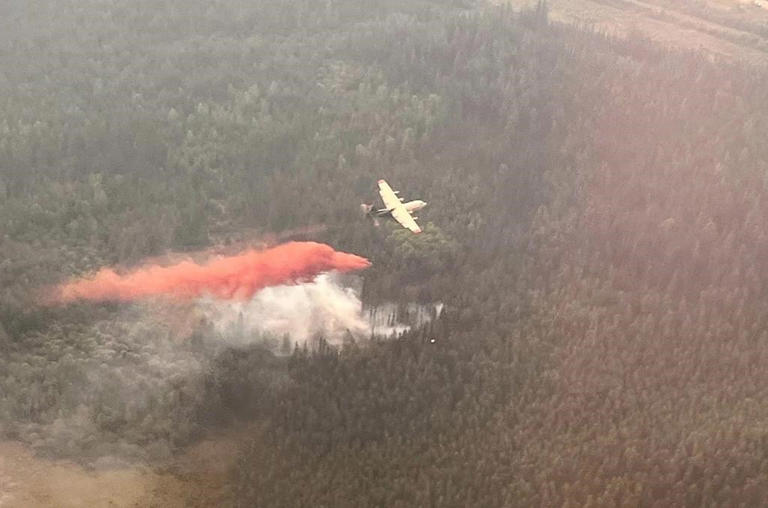
Airtankers work on a wildfire near Edson, Alta., in a Friday, June 9, 2023, handout photo. A town in northwestern Alberta is being evacuated due to an out-of-control wildfire. An evacuation order has been issued for the town of Edson and parts of Yellowhead County.
THE CANADIAN PRESS/HO-Government of Alberta Fire Service.© JFJ

Alberta hasn't been able to catch a break since wildfires burned through the province in May and June. Since then, there have been floods — some even in the same places affected by wildfires.

This year has also seen one of the strongest tornadoes in Alberta's history — it touched downtown between Didsbury and Carstairs Saturday.

The province is still adding up totals of all the natural disasters, but said so far this year wildfires alone have cost $700 million. Public safety minister Mike Ellis stressed the Alberta government is not focused on cost, but just getting through the season.

"We know that it's the worst alberta wildfire event in Alberta's history we are closing in on 1.5 million hectares burnt," Ellis said.

"We will do whatever it takes to keep Alberta safe."

The Insurance Bureau of Canada's Craig Stewart said natural disasters have been on the rise. He points to 15-years-ago when payouts averaged $400 million across the country. In the last five years, it's grown to five times that amount.

"Last year was $3 billion," he said. "We are going to be in that range again of $2 to 3 billion."

Stewart said these trends have led insurance premiums across the country to jump by 14 per cent — a hit that's been felt more in western provinces.

"Alberta and British Columbia are the two riskiest places in the country based on natural disasters that we've seen in recent years. So unfortunately premiums are going to go up more," Stewart said.


He added no single event makes premiums rise, rather, extreme weather events over time create trends and as it gets worseit will cost taxpayers, homeowners and governments more combined.

This is echoed by the Canadian Climate Institute's Dave Sawyer.

"In the long run taxes have to rise to cover the damages that government are backing. There are hits on productivity (in industry) so there are direct hits on households and there's these indirect impacts," Sawyer said.

He said the government can help by climate-proofing housing and working with homeowners to install equipment to help reduce floods and help with fire breaks in communities.

"There's income hits for people and then supply chain disruptions. Costs rise, inventories are hard to get, so it has this ripple impact through the economy," Stewart said.

Stewart said Alberta has been prone to natural disasters dating back to data bases from the 1970s. He said Alberta accounts for 50 per cent of insured losses associated with an extreme weather event like floods, hail storm and the like.

"Alberta gets the lion's share of economic damage in the country."
Why the Canadian wildfires are still burning — and sending smoke across the U.S.


Ben Adler
·Senior Editor
Mon, July 3, 2023 

A wildfire burns near Fort St. John, British Columbia, Canada. July 2 on Monday. 
(Noah Berger/AP)

With hundreds of Canadian wildfires sending smoke across the northern United States, many Americans are wondering how long the bad air quality will continue and whether Prime Minister Justin Trudeau’s government can do more to put out the flames.

While Canada does have a policy of letting fires in some remote areas burn out on their own, the government has also simply been overmatched by this year’s record-breaking fire season, which has so far burned more than 32,000 square miles.

Canada is also contending with other limitations and challenges — some of which are of its own making. Here’s a rundown:

The fires are incredibly widespread and constantly starting anew


Smoke rises from the Big Creek wildfire, about 110 kilometres (68 miles) northwest of Mackenzie, British Columbia, Canada June 29, 2023
(BC Wildfire Service/Handout via Reuters)

As of Monday, there are 584 active fires in Canada, including three that started today, up from 501 last Thursday, according to the Canadian Interagency Forest Fire Center. Of those, 285 are considered “out of control,” 195 and are “under control,” and 104 are “being held.”

As fires get put out, new ones keep starting. The country has seen a total of 3,255 fires so far this year, and have burned an area roughly as large as the state of South Carolina — making this already the worst fire season in Canadian history — and summer has just begun.

Some of the fires hard to reach, and resources are limited


Trees scorched by the Donnie Creek wildfire in British Columbia. 
(Noah Berger/AP)

With a landmass second only to Russia, but with a population just one-ninth that of the U.S., Canada finds itself short of the manpower, money and equipment needed to effectively counter the extent of this summer’s wildfires.

“Massive fires burning in remote areas — like some of those currently burning in northwestern Quebec — are often too out of control to do anything about,” CNN reported on Saturday.

“With so many fires across the whole country, resources are scarce,” Dustan Mueller, a U.S. Forest Service deputy fire chief who has been in Canada assisting with its firefighting effort, told the Guardian.

“If you have limited resources, and you have a lot of fires, what you do is you protect human life and property first,” Robert Gray, a Canadian wildland fire ecologist, told CNN. “You protect people, infrastructure, watersheds, so there’s a prioritization system.”
The weather, and climate change, are a factor


French firefighters battle fires north of Chibugamau, Quebec.
 (Quentin Tyberghien/AFP via Getty Images)

“Scientists say that climate change is making weather conditions like heat and drought that lead to wildfires more likely,” the BBC reported in June. “Spring in Canada has been much warmer and drier than usual, creating a tinder-dry environment for these vast fires.”

“Given how much energy these fires have while they burn, it is pretty much impossible for them to stop unless large swaths of heavy rains come their way,” Apostolos Voulgarakis, a professor of climate change at Imperial College London, told Newsweek.

Unfortunately, the forecast for the rest of the summer in Canada “is for hot and mostly dry” weather, Canadian fire scientist Mike Flannigan told the Associated Press last Thursday. “It’s a crazy year and I’m not sure where it’s going to end.”
Lack of federal coordination

Each Canadian province is responsible for fighting wildfires within its borders, so, for example, the neighboring provinces of Quebec and Ontario have no coordination to their responses to fires that may even span their border.

“It has been an issue because we don’t have a strong federal government and it’s left us in this mess right now,” Gray told ABC News.

The good news


Firefighters from the organization Working On Fire in Mbombela, South Africa train in preparation for being sent to Alberta, Canada, June 13
(Shiraaz Mohamed/AFP via Getty Images)

Canada is getting a little help from its friends. “U.S., Australian, New Zealand, South African, French, Spanish, Portuguese, Mexican, Chilean and Costa Rican firefighters have joined the struggle in Canada,” the Guardian reported last Thursday. “But Canadian policies, determined by each individual province, required some shifts in strategy.”

American firefighters were surprised to find that in Canada they are expected to stop after a 12-hour shift, and that protecting timber on private land is not considered a priority north of the border, given limited resources.

Doing better next time


Smoke billows upwards from a planned ignition by firefighters tackling the Donnie Creek Complex wildfire south of Fort Nelson, British Columbia, Canada June 3, 2023.
 (B.C. Wildfire Service/Handout via Reuters)

Experts say that eastern Canadian provinces such as Quebec should start imitating their western counterparts and start deliberately burning out the underbrush every year before fire season starts, as Indigenous communities did for millennia.

“In the wildlands of the Quebec forests there is no prescribed program to clean up the forest floor,” John Gradek, a lecturer at McGill University in Montreal, told ABC News.