Long-Range Ukrainian Strike Hits ICBM Plant 800 Miles Inside Russia
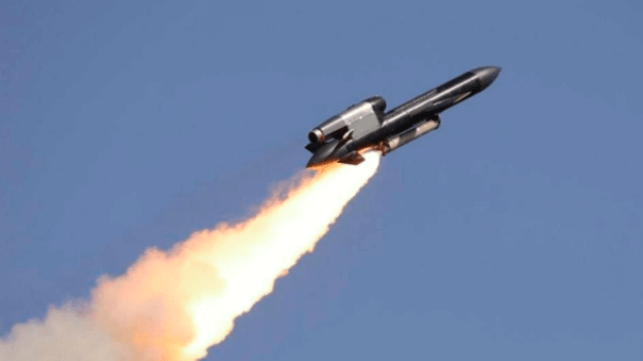
A Ukrainian strike on the Votkinsk ballistic missile plant in Russia’s Udmurt Republic on February 21 indicates that they have been able to extend the range of their attacks on targets deep in Russia using Flamingo cruise missiles.
The Votkinsk plant is one of Russia’s major production facilties for the manufacture of Iskander and Oreshnik ballistic missiles. These are currently Russia’s most effective ballistic missile systems, largely because of the shortage of uniquely-capable Patriot air defense missiles. For the Ukrainians, the shortage of Patriots can be counteracted by destroying the Iskanders and Oreshniks while they are in production.
The Votkinsk Plant also produces the full range of ballistic missiles facing off against the West, from the heavy-weight intercontinental ballistic missiles such as the RS-24 Yars, RT-2PM2 Topol-M missiles and RSM-56 Bulava submarine launched ballistic missile, through to a family of intermediate ballistic missiles, including Scud-A/Bs, SS20s and SS23s.
The accuracy and success of the raid is not yet clear. Social media reports indicate casualties, black smoke above the factory and blast-blown windows in neighboring buildings. Flamingo missiles appear to have reached their target – many more than if the attack had been launched with the converted light aircraft drones which the Ukrainians have previously had to rely on. It appears therefore that the production problems affecting the manufacture of Flamingo missiles may be over, and that the numbers emerging out of the factories is increasing. Flamingos will in due course be supplemented by ballistic missiles, such as those being developed for Ukraine under the United Kingdom’s Project Nightfall program.
The Votkinsk Plant lies 800 miles from the Ukrainian border, implying the Flamingo's range is on the order of 1,000 miles. This puts all of Russia’s western oil-exporting ports in range, plus Kaliningrad, Caspian seaports (through which Iranian arms exports are reaching Russia), the Kerch Bridge to Crimea and also the highly-developed Russian internal sea canal network. Close by the Votkinsk Plant is the factory in the Alabuga Special Economic Zone producing Iranian-derived drones.
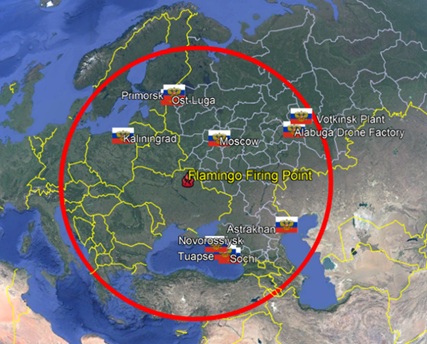
Flamingo range radius from an optimal firing point in northeastern Ukraine (Landsat/Google Earth/CJRC)
After a year in which the front line has barely changed, with Russian control of Pokrovsk still not consolidated, there have been greater dynamics in recent weeks, both on land and at sea. Ukraine is reporting to have consolidated its hold this month over 115 square miles of territory in the south-east. Russia has continued with very damaging mass missile and drone attacks on Ukrainian infrastructure, designed to exploit the harsh winter weather.
Russian oil exports, which are critical to Russia’s financing of the war, fell from an estimated 3.8 million bpd in December and are currently running at 2.8 million bpd, with interceptions at sea on the increase. There is no early end in sight to the war, with neither a sign of a Russian breakthrough nor a Ukrainian collapse of will.
Ukrainian Drones Hit Russian Patrol Boats
and Maritime Patrol Aircraft

Published Feb 22, 2026 5:18 PM by The Maritime Executive
On Saturday, Ukraine's armed forces renewed their campaign of drone strikes on the naval harbor at Sevastopol, hitting two patrol ships - and proving that the port remains high-risk for Russian assets.
In a statement, Ukraine's general staff said that its drone forces hit two border guard ships moored near the town of Inkerman in Crimea, at the easternmost end of Sevastopol Bay. The vessels damaged were Project 22460 Rubin-class fast patrol boats, a vessel class previously targeted in the Caspian in December. Battle damage assessments were not released.
In addition, the drone operation hit two Be-12 turboprop aircraft at a repair plant in Yevptoria. The Be-12 is an amphibious maritime patrol aircraft fitted for antisubmarine warfare, and has been used by Russian forces to find and track Ukrainian drone boats for interception. Open-source intelligence analysts note that the Yevptoria repair site had a small collection of defunct Be-12 airframes that have been used for parts, and it is unclear whether the example struck Saturday was in airworthy condition. Even if a mothballed plane were destroyed, its elimination could assist in keeping the few other surviving examples of the aircraft on the ground.
Ukraine previously targeted and destroyed two Be-12s in September 2025, likely a world-first for a drone strike. The amphibious aircraft are a priority target for Ukraine, as they are a rare, irreplaceable asset and a key part of Russia's defenses against maritime attack - particularly unmanned-sub attack. Ukraine is transitioning to submersible attack drones for top-priority missions, and the Be-12 is one of the few Russian platforms capable of detecting and combating submersibles in the Black Sea region.
The strikes highlight the Crimean region's vulnerability to attack, which is the reason why Russia's naval forces have largely abandoned Sevastopol, the Soviet-era home of the Black Sea Fleet. Previous strikes have hit a Kilo-class sub, several tank landing ships, and the fleet's headquarters building, among other assets at the port. The Russian Navy has pulled back to the relative safety of the port of Novorossiysk, further from Ukraine's shores - but it remains vulnerable to long-range drones.


No comments:
Post a Comment