Canada’s Port of Churchill Looks into Year-Round Shipping
With Canada now prioritizing investment in its Arctic infrastructure, Churchill has been identified as a critical part of the logistical supply chain in the North.
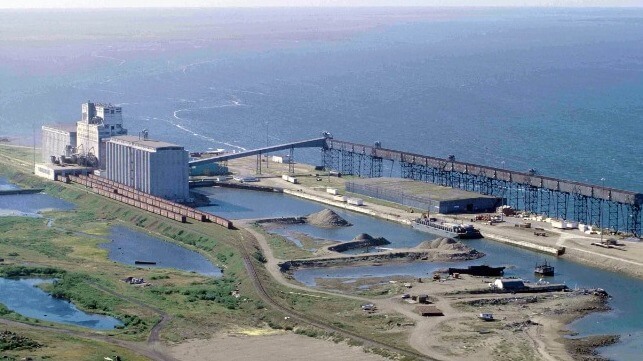
With expansion plans for Port of Churchill gaining momentum, Canada’s federal government has launched a study to look into year-round shipping on Hudson Bay. The study - announced last week by the Minister for Prairies Economic Development Canada (PrairiesCan) Eleanor Olszewski - will gather industry input on the long-term growth potential of the Port of Churchill.
The study will complement the ongoing business development campaign being led by the Arctic Gateway Group (AGG), which owns and operates Churchill's port. The target is to grow import and export activity, especially with Western Canadian agricultural and mining companies.
The provincial government of Manitoba recently confirmed that one Canadian energy giant has expressed interest in the Churchill corridor for its oil and gas exports. The company is yet to be named, as Manitoba has signed a non-disclosure agreement, according to Premier Wab Kinew.
The Premier said that an energy corridor through Churchill would include a pipeline, transmission line, fiber optic connections and a shipping terminal. “I am particularly interested in the possibility of LNG exports and an associated liquefaction terminal in the Churchill area,” Kinew told local media. “But a successful port expansion would need to work for a mix of products, including critical minerals, agricultural products and northern re-supply for Nunavut.”
It is on this basis that the federal government’s market sounding study will help the private sector identify areas of interest. The study intends to engage senior executives across key sectors such as mining, energy, potash and grain. In particular, the study will explore how extended or year-round shipping supported by icebreaking, a modernized Class 1 railway and an all-season road connection could influence future import and export strategies as well as supply chain decisions. The government said the study would cost around $180,000, with the results expected by spring
With Canada now prioritizing investment in its Arctic infrastructure, Churchill has been identified as a critical part of the logistical supply chain in the North. This has seen the federal and Manitoba governments commit over $190 million since November, which will facilitate the port’s expansion.
AGG, a business partnership consisting of 41 First Nations and northern communities, has also announced collaboration with Fednav Shipping to examine operational needs for year-round shipping in the Port of Churchill. The port has a short shipping season owing to the Hudson Bay being frozen for about eight months of the year. Fednav is Canada’s largest dry bulk shipping company and has deep expertise in Arctic and Great Lakes navigation.
New partnership to keep Thompson mine
open, eyes expansion after partial sale
New owners say no layoffs — they plan to double operations in northern Manitoba
Eric Westhaver · CBC News ·

A partial sale has been announced for a nickel mine in Thompson, Man., Vale Base Metals and three new partners announced Thursday morning.
The new ownership group will invest up to $280 million in operations and keep the mine operating long-term, they said.
The new partners — Toronto-based Exiro Minerals, New York City-based Orion Resource Partners and the Canada Growth Fund, a federal investment fund operated at arm's length from the government — will invest in the mine in Thompson, about 650 kilometres north of Winnipeg.
The newly created Exiro Nickel Company will operate the mine. The new company will be incorporated and based in Canada, while using some starting investment from the U.S.
Exiro Minerals, Orion Resource Partners and the Canada Growth Fund will have a combined 81.1 per cent ownership in the new company. Vale will have the remaining 18.9 per cent, a minority stake.
"Together, we'll become a new company, with new leadership and a new name," said Vale Base Metals CEO Shaun Usmar.
"Today marks the launch of a new Canadian nickel company. Our team is honoured and excited to have acquired the Thompson nickel belt from Vale Base Metals — not only one of the biggest nickel camps in the world, but one that has historical significance to Canada," said Shastri Ramnath, Exiro's CEO.
Expansion plan
Ramnath said there are no plans for layoffs at the mine, which employs about 700 staff and 300 contractors.
They hope to expand operations and hire more workers.

The deal includes buying exploration properties near Thompson and the plan is to double production, Ramnath said.
"We have a plan that ramps up production, a plan that sees growth and opportunity," she said.
"We are actually more concerned about being able to ramp up. We're more concerned about being able to attract people to the operations, because we are going to need them."
The sale came after Vale announced last year it would do a strategic review of its Thompson operations, including looking at a possible sale.
There were fears a sale could mean layoffs or even a mine closure or reduction in service.
Thompson Mayor Colleen Smook said the new deal is a good one for the community and northern Manitoba.
"It's a great opportunity. We've been partners — that's why Thompson was built, was for the nickel industry. I've been here for 54 years, through the highs and lows, and this is definitely one of the highs that is happening in Thompson," she said.
"It brings just peace of mind, stability. We know that we have the nickel. We know we have the product here. It was just to get a company coming to work with us so that they could get that ore out of the ground."
Premier Wab Kinew told reporters at a news conference on Thursday that extending the life of the mine is important as the future of the economy has more to do with natural resources and engaging the private sector.
He attributed the purchase of the mine to its large nickel reserves and the expertise of workers in Thompson to extract it, all as market values for the metal remain down.
"When that super cycle bounces back and commodity prices go up again in the future, they'll make money off of it," Kinew said.
"The Thompson community will be able to still see their housing values and incomes maintained … it's a really good news story."
A promise to develop
United Steelworks Local 6166 president Warren Luky says he's pleased that workers won't be losing jobs.
"A lot of people were starting to wonder what they should do — whether to stay or whether they start looking for another job," he said.
"With this announcement, there's a promise to go and do the development work that will see the deeper ore body getting mined, which means work for everybody."

The deal is set to close by the end of 2026. Vale will maintain day-to-day operations at the mine until the deal closes.
Ramnath said current mine resources indicate there is plenty of nickel still left to be mined in Thompson, and the mine could keep running for decades.
"What is outstanding to us is the amount of nickel that is in the ground that hasn't been mined yet. There is currently 20 years in the life-of-mine plan that we believe we can mine profitably, and that's going to be our goal," she said.
Critical mineral
Mining in Thompson began with a nickel discovery in 1956. Several mines have operated in and around the area since.
Inco operated most of the operations until 2006, when Vale, a multinational mining company, bought Inco. It has run the local mine ever since.
The project is part of an ongoing strategy to promote investment in Canadian critical minerals.
Mostafa Fayek, the acting department head of earth sciences at the University of Manitoba, says Manitoba is a possible hotbed for critical mineral development.
"The federal government listed 34 critical minerals for the Canadian inventory. Thirty-one of them are in the province of Manitoba," he said.
"There's a list of priority minerals and that includes lithium, graphite, nickel, cobalt, copper and rare earth elements. All of those are are in Manitoba."
"Nickel is a critical mineral. It is essential for batteries, manufacturing and clean technology. The world needs it, and it needs Manitobans to produce it responsibly, with a skilled workforce and strong environmental standards," said Manitoba Northern Relations Minister Glen Simard.
Ramnath said expanding nickel production in Thompson fits well within federal economic goals.
"There is a shift happening to look domestically for our own nickel. Canada and our allies will be turning to us to supply those metals. Our shared vision is to emerge as the next great Canadian nickel producer," she said.
WATCH | Partnership plans to invest millions in Thompson mine:
February 19, 2026 Duration 1:34
Plans are underway to kickstart investment in nickel production in Thompson. A partnership, including existing owners Vale, an American financing company, Toronto-based Exiro Minerals and the federal Canada Growth Fund, plans to invest up to $280 million in the operation while keeping workers on the job.

No comments:
Post a Comment