Sunday, December 17, 2023

Moldova and Georgia celebrate as their aspirations for EU membership take crucial steps forward

EMMA BURROWS
Updated Fri, December 15, 2023 a


Georgia EU
Georgian gather to celebrate Georgia's EU candidacy at European Square in Tbilisi, Georgia, on Friday, Dec. 15, 2023. Several thousand people attend a march in support of Georgia's EU candidacy. European Union flags waved across Georgia Friday after the European Council took a step forward along the long road towards granting Georgia and Moldova as EU membership. 
(AP Photo/Zurab Tsertsvadze)


LONDON (AP) — Moldova and Georgia celebrated after European Union leaders buoyed their aspirations to join the 27 member nation bloc by removing key hurdles on their long path toward membership.

Lawmakers in both the Moldovan and Georgian parliaments waved EU flags and played the bloc's anthem at Friday's opening of their parliamentary sessions, following Thursday's surprise announcement to open membership negotiations with Ukraine and Moldova and to grant candidacy status to Georgia. The announcement came despite strong opposition from Hungary and the fact that Ukraine and Georgia are partially occupied by Russia which also has troops deployed in Moldova's Transnistria region.

Thousands of Georgians gathered in the country’s capital Tbilisi to celebrate.

“The EU and integration with Europe is important for us. Not only will it be a security guarantee for us and enable the country to get stronger economically, but it is important for other values too including sports and culture, among others," said Erekle Sarishvili, a student who took part in the rally. "We, the young generation, have fought for this result but we also need to remember the older generations that have brought Georgia here.”

Moldova’s President Maia Sandu invited citizens to a pro-European gathering scheduled for Sunday in the capital Chisinau to herald what she described as a “historic step for the destiny of our country.”

Moldova's pro-Western Prime Minister Dorin Recean echoed Sandu, saying “Moldova is European" and "our future is in the EU.”

Georgia's Prime Minister Irakli Gharibashvili congratulated the nation, saying that “this historic victory belongs to you, to our undefeated, unbroken, freedom loving Georgian people.”

By opening membership talks with Ukraine and Moldova and by offering Georgia candidate status, the EU has sent “a very important message to Russia,” Natia Seskuria, director of the Regional Institute of Security Studies in the Georgian capital Tbilisi said.

Although the path to full membership could take decades, the move “has a lot of symbolism," she said, because if the countries had been rejected “it would be another sign for Russia that they can basically do whatever they want.”

Both Moldova and Georgia were part of the Soviet Union for decades and both have struggled to emerge from Moscow's shadow. On Friday, the Kremlin responded with irritation to the news.

Kremlin spokesman Dmitry Peskov said the move was “absolutely politicized” and that it was driven by the bloc’s “desire to annoy Russia further and antagonize these countries towards Russia."

Peskov said membership talks could take “years and decades," adding “such new members could destabilize the EU.”

Since Russia’s full-scale invasion of Ukraine, Moldova has faced a long string of crises, including a severe energy shortage after Moscow dramatically reduced gas supplies last winter, skyrocketing inflation, and anti-government protests by a Russia-friendly political party.

In February, Moldovan President Maia Sandu also accused Moscow of plotting to overthrow the government to put the nation “at the disposal of Russia,” and to derail it from its course toward EU membership. Russia denied the accusations.

Debris from rocket fire has also landed several times in Moldova as a result of fighting in neighboring Ukraine. Tensions also soared in the country in April last year after a string of explosions in Transnistria — a Russia-backed separatist region of Moldova where Russia bases about 1,500 troops.

Russia also has forces in Georgia after the two countries fought a short war in 2008 that ended with Georgia losing control of two Russia-friendly separatist regions. In November, Russian troops shot and killed a Georgian civilian in South Ossetia, one of the breakaway regions, prompting condemnation from Georgian authorities.

Seskuria, from the Regional Institute of Security Studies, said EU membership has been a “generational dream for Georgians.” Although it's Georgia's “biggest success” so far toward EU membership, Seskuria cautioned that there's still a “long way ahead” and warned Georgia needs to deliver on the kind of progress the EU is seeking for the country to fulfill strict membership criteria.

That applies for all three countries which need to tackle corruption and organized crime while strengthening the rule of law.

Membership talks could also heighten tensions in Georgia where Salome Zourabichvili, Georgia’s pro-EU president, has long been a vocal supporter of joining the bloc, putting her at odds with the ruling Georgian Dream party which is widely seen as being pro-Russian by the Georgian opposition.

Speaking shortly after the EU leaders’ meeting, Zourabichvili said “Ukraine, Georgia, Moldova are the examples of what it means to fight for freedom, to fight for Europe, for those common values that we share with Europe and stay true to them.”

Zourabichvili has criticized a foreign agent registration bill which protesters in Tbilisi earlier this year said was inspired by a similar law in Russia used to silence critics of the Kremlin.

Opponents of Georgian Dream say the party’s founder, former Prime Minister Bidzina Ivanishvili, a billionaire who amassed a fortune in Russia, has continued calling the shots in the former Soviet republic of 3.7 million people even though he currently doesn’t hold a government job.

Georgian Dream has repeatedly denied any links to Russia or that it leans toward Moscow.

—-

Sophiko Megrelidze in Tbilisi, Georgia and Stephen McGrath in Kidderminster, United Kingdom, contributed to this report.


EU to open membership talks with Ukraine and Moldova

Jessica Parker in Kyiv & Paul Kirby in London - BBC News
Thu, December 14, 2023 

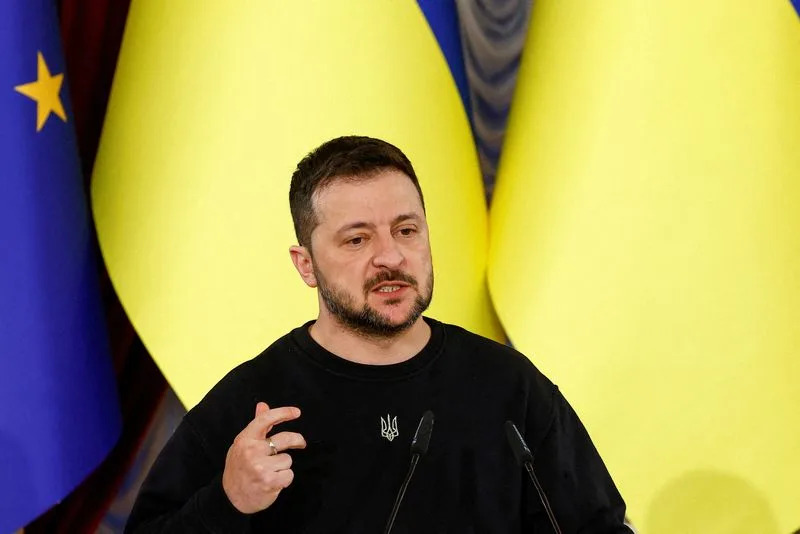
Ukraine's President Zelensky called the vote a "victory" for his country and for Europe

European leaders have decided to open EU membership talks with Ukraine and Moldova and to grant candidate status to Georgia.

Ukraine's President Volodymyr Zelensky hailed the decision, made at a summit in Brussels, as "a victory" for his country and Europe.

A spokesperson for Charles Michel, the President of the European Council, said that agreement was unanimous.

Hungary has long opposed talks starting with Kyiv, but did not veto the move.

Prime Minister Viktor Orban left the room momentarily in what officials described as a pre-agreed and constructive manner, while the other 26 leaders went ahead with the vote.

He then distanced himself from his colleagues with a video message on Facebook: "EU membership of Ukraine is a bad decision. Hungary does not want to participate in this bad decision, and therefore stayed away from the decision today."

Mr Zelensky was delighted by the EU's announcement: "This is a victory for Ukraine. A victory for all of Europe. A victory that motivates, inspires and strengthens," he said on X.

Ukraine and Moldova applied to join the EU after Russia launched its full-scale invasion of Ukraine in February 2022. They were both given candidate status last June, while Georgia was passed over at the time.

Moldovan President Maia Sandu said it was an honour to share the path to EU accession with Ukraine. "We wouldn't be here today without Ukraine's brave resistance against Russia's brutal invasion," she wrote.

Earlier this year, Moldova warned that Russia was seeking to seize power in Chisinau. Ms Sandu said Moldovans were now feeling Europe's "warm embrace" and congratulated her compatriots on what she called "an award for all of society, all those who choose democracy and prosperity".

Moldova's President Maia Sandu said the decision to start talks opened a "new page"

White House National Security Adviser Jake Sullivan welcomed the EU's "historic" move to open accession talks with Ukraine and Moldova, calling it a "crucial step toward fulfilling their Euro-Atlantic aspirations".

Talks on joining the European Union can take years, so Thursday's decision will not guarantee Ukraine membership.

People in Ukraine know that the path to full membership is a long one, but this decision in Brussels will be a boost for morale.

EU candidate countries have to pass a series of reforms to adhere to standards ranging from the rule of law to the economy, although the EU's executive has already praised Kyiv for completing more than 90% of the steps taken so far on justice and tackling corruption.

German Chancellor Olaf Scholz praised his fellow leaders for showing a "strong sign of support", adding that it was clear that both Ukraine and Moldova belonged to "the European family". A diplomat at the summit said it was Mr Scholz's idea for Mr Orban to leave the room to enable the vote to go through.

This was some much-needed good news for Ukraine, after almost 22 months of Russia's war and a continuing struggle to secure Western military and financial aid.

Finnish Prime Minister Petteri Orpo said it was a historic moment and an "important message of hope" for the citizens of Ukraine and Moldova.

Mr Zelensky travelled to the US earlier this week in a vain attempt to persuade the US Congress to push through $61bn in military funding, blocked by Republican lawmakers.

Ukraine's counter-offensive against Russia's occupying force has ground to a halt at the start of winter.

Earlier on Thursday, President Vladimir Putin mocked Ukraine and claimed Western support was running out: "Excuse my vulgarity, but everything is being brought in as a freebie. But those freebies could run out at some point."

But President Zelensky will at least now be able to point to this political win as proof that Ukraine is not steadily being abandoned by its partners.

The European Council president said it was a "very powerful signal... to the people of Ukraine we are on their side".

Many in Kyiv see their fight against Russia's invasion as a defence of European values and they firmly view their future as an active and effective member of the European Union.

Ukraine's 2014 "Revolution of Dignity", toppling its pro-Kremlin president, was rooted in a desire to move away from Russia's political orbit and towards Europe.

President Putin reacted by sending troops into eastern Ukraine and Crimea and then staging a far wider invasion in 2022.

For Georgia too, invaded by Russia in 2008, the EU vote was a "monumental milestone", said pro-EU President Salome Zurabishvili.

Georgia has a broadly pro-EU population, its government has a complex relationship with Moscow and has refrained from imposing sanctions on Russia since its invasion of Ukraine began.

Asked if President Putin had ambitions to do to Georgia what he was doing to Ukraine, pro-Putin Russian lawmaker and TV host Yevgeny Popov told BBC Newsnight, "We are not going to."

"We have enough territory," he said. "We are the biggest country in the world and we don't need any other territories. But all we need is security guarantees."

On Thursday, Mr Michel said the EU also intended to open negotiations with Bosnia-Herzegovina once it met criteria for membership. Bosnia was given candidate status a year ago but a progress report last month has listed further steps Sarajevo needs to take on electoral and judicial reforms.

Bosnia has the added issue of the leader of its majority-Serb area, Republika Srpska, thre
atening to secede.


European Union leaders agree to open membership talks with Ukraine, Moldova

Ehren Wynder
Thu, December 14, 2023 

U.S. President Joe Biden and Ukrainian President Volodymyr Zelensky participate in a news conference in Washington on Tuesday. Photo by Chris Kleponis/UPI

Dec. 14 (UPI) -- European leaders agreed Thursday to open European Union membership talks with Ukraine and Moldova, over dissent from Hungary.

Ukrainian President Volodymyr Zelensky said in a post on X he was glad to receive news of the EU's decision at the Brussels summit and congratulated Moldovan President Maia Sandu on the joint victory.

"I thank everyone who worked for this to happen and everyone who helped," Zelensky said. "I congratulate every Ukrainian on this day ... History is made by those who don't get tired of fighting for freedom."

Sandu also expressed her gratitude for the decision and congratulated the Ukrainian president.

"We wouldn't be here today without Ukraine's brave resistance against Russia's brutal invasion," she said.

U.S. President Joe Biden and Ukrainian President Volodymyr Zelensky speak to the media in Washington on Tuesday. Photo by Julia Nikhinson/UPI

The unanimous decision marks a major milestone for Ukraine, which seeks to join the EU once the war with Russia is over. Hungarian Prime Minister Viktor Orban opposed the decision but did not veto the move. He instead left the room while the other 26 leaders went ahead with the vote.

He later said in a video the decision was "senseless," "irrational" and "incorrect" and added, "Hungary does not want to share in this bad decision."

Ukrainian President Volodymyr Zelensky speaks t the media in Washington on Tuesday. Photo by Julia Nikhinson/UPI

The EU's decision to open talks does not guarantee the countries membership, but it's a small victory for Ukraine as the U.S. Congress continues to battle over $60 billion in aid to the country.

Zelensky met with U.S. President Joe Biden in Washington as Biden urged Congress to pass a comprehensive Ukraine-Israel aid package or give Russian President Vladimir Putin "the greatest Christmas gift they could possibly give him."

European Council President Charles Michel (L) and President of Moldova Maia Sandu (R) shake hands after a joint press conference in Chisinau, Moldova in 2022. File Photo by Dumitru Doru/EPA-EFE

Widespread support for Ukraine is popular in Europe, according to data from the European Commission. Sixty-one percent of EU citizens surveyed in October and November approved of the EU granting candidate status to Ukraine, and 60% approved of the EU financing the purchase of military equipment for Ukraine.


US State Department: Opening EU accession negotiations with Ukraine, Moldova 'historic moment'

Nate Ostiller, The Kyiv Independent news desk
Fri, December 15, 2023 


The European Union's decision to begin negotiations on the accession of Ukraine and Moldova to the bloc is a "powerful affirmation" of their respective "European future" and a "historic moment" for Europe, State Department spokesperson Matthew Miller said on Dec. 14.

The European Council agreed on Dec. 14 to open accession talks with Ukraine and Moldova and grant candidate status to Georgia. Ukraine and Moldova were granted candidate status last June, after which Kyiv was presented with seven criteria that need to be fulfilled to start accession talks with the EU.

The U.S. "continues to strongly support the EU’s enlargement process, and we look forward to supporting EU candidate and prospective candidate countries as they continue critical reforms on the path to EU membership," said Miller.

The council's decision will "offer hope and incentive to these countries and their people to continue reforms needed to advance their EU ambitions."

According to the European Commission's report from Nov. 8, Ukraine has fulfilled four of the seven criteria pertaining to two judicial reforms, the alignment of anti-money laundering legislation, and media reform.

In the intervening weeks, Ukraine passed further legislation in line with the three unfulfilled reform obligations.

President Volodymyr Zelensky signed into law on Dec. 8 three bills related to Ukraine's fight against corruption and the updated law on national minorities.

Read also: BREAKING: European Council agrees to open accession talks with Ukraine, Moldova


Georgia will fail as independent state outside EU: jailed ex-leader
Irakli METREVELI
Fri, December 15, 2023 at 2:18 AM MST·3 min read
9


Mikheil Saakashvili appeared at a court hearing in October 2023 via videolink from a clinic (IRAKLI GEDENIDZE)

Georgia's imprisoned opposition leader and former president Mikheil Saakashvili has warned that Tbilisi's failure to secure European Union membership would put at risk its very existence as an independent nation.

EU leaders announced Thursday that they decided to grant Georgia formal candidate status and while approving the opening of accession talks with Ukraine and Moldova.

The three ex-Soviet countries applied to join the bloc after the Kremlin unleashed its all-out war on Ukraine last year.

For Georgia, EU membership "is a matter of survival as an independent state", Saakashvili said in written remarks submitted to AFP on Thursday via his representative.

"Georgia could vanish as an independent state if it stays or is left behind in a grey zone," he wrote in English.

In 2022, the EU granted candidate status to Kyiv and Chisinau but told Tbilisi it had to first implement judicial and electoral reforms, improve press freedom and curtail the power of oligarchs.

Georgia, which was annexed by Russia in the 19th century and again -- after a short-lived period of independence -- in 1921, last saw Russian troops invade in 2008, during Saakashvili's time as president.

The five-day war 15 years ago marked the culmination of tensions with Moscow over Tbilisi's bid to forge closer ties with the West.

After France's president Nicolas Sarkozy mediated a ceasefire on behalf of the EU, Russia recognised as independent two breakaway regions in Georgia, Abkhazia and South Ossetia, and stationed permanent miliary bases there.

Many in Georgia believe that EU membership would shield the Caucasian country from a new Russian aggression, fears of which grew after Moscow's invasion of Ukraine.

- 'Enhance democracy' -

In November, the European Commission recommended that EU leaders grant Georgia official candidate status -- with the caveat that the Tbilisi government introduces reforms.

According to Saakashvili, the main obstacle on Georgia's path to joining the 27-nation EU is its backsliding on democracy under the government run by the Georgian Dream party.

The party was founded by Georgia's richest man, Bidzina Ivanishvili, who made his fortune in Russia and is widely seen as the man in charge in the country, despite having no official political role.

"Georgia exists in the situation of state seizure by a Russian oligarch," Saakashvili said. "Every single state institution is controlled by him and influenced by Russia through him."

Critics have accused the Georgian Dream government of covertly cooperating with the Kremlin and of derailing Georgia from its EU membership path, a claim rejected by Georgia's authorities.

They say membership in the European Union and NATO -- which is supported by around 80 percent of the population -- has been enshrined in the country's constitution under the Georgian Dream government.

- 'Putin must lose' -

Saakashvili said the EU realised that turning a blind eye to the nature of the oligarch-controlled regime in Tbilisi would backfire, so offering Georgia candidate status "may be used as an instrument to enhance democracy" there.

Georgia's integration into the EU would mean Russian President Vladimir Putin "loses", he said.

"Europe is getting on the other side of the Black Sea into what was traditionally regarded as Russia's backyard."

"If we want Europe to have a future, Putin must lose," he said.

Saakashvili, a flamboyant pro-Western reformer, was president of Georgia from 2004 to 2013 and subsequently went into exile in Ukraine, where he had served as a top advisor on reforms to President Volodymyr Zelensky.

He was sentenced in absentia by a Georgian court to six years in prison on abuse of power charges that rights groups say were politically motivated, and was arrested on his return to his home country in 2021.

The 55-year-old has accused Georgian prison guards of mistreatment, and doctors have raised serious concerns over his health after he staged a 50-day hunger strike.

Zelensky has accused the Tbilisi government of "slowly killing" Saakashvili on Putin's orders and -- along with Poland and several European capitals -- demanded his release.

im/jbr/gil/js

EU approves Ukraine membership talks after Hungary's Orbán steps outside for coffee

Peter Weber, The Week US
Fri, December 15, 2023 

Hungary's Viktor Orban.

The European Union agreed Thursday to open accession talks with Ukraine, in a boost to Kyiv and a blow to Russian President Vladimir Putin, but failed to approve 50 billion euros ($54 billion) in aid to Ukraine after Hungarian Prime Minister Viktor Orbán vetoed the money. The EU also approved membership talks for Ukraine's neighbor Moldova and accepted Georgia as a candidate for joining the bloc.

Orbán, Putin's closest ally inside the EU, had threatened to block Ukraine's membership bid from advancing as well. But in a surprise move, he stepped outside the room to allow the other 26 EU leaders to approve Kyiv's upgrade to accession talks unanimously, as required under EU rules. That was German Chancellor Olaf Scholz's idea, Politico reported. "About three hours into deadlocked discussions," Scholz suggested that Orbán "grab a coffee outside the room, perhaps," and the Hungarian leader, already wavering in his opposition, agreed.

Orbán said on social media Thursday night that he had vetoed the funds to Ukraine and still disagreed with "this bad decision" on membership negotiations.

Ukrainian President Volodymyr Zelenskyy — fresh off a disappointing trip to Washington, where Republicans refused to relent on blocking military aid without domestic concessions — celebrated the vote. "This is a victory for Ukraine. A victory for all of Europe. A victory that motivates, inspires and strengthens," he said on X, formerly Twitter. "History is made by those who don't get tired of fighting for freedom."

Ukraine and Moldova applied for EU membership after Russia invaded Ukraine. Putin has reacted poorly to previous efforts by Ukraine to move closer to Europe.

Ukraine is years away from gaining EU membership, and Orbán's advisers suggested he will throw up roadblocks later in the process. European Council President Charles Michel hailed the "historic moment" at an early Friday news conference and said the leaders would reconvene in "early January" to try again on the EU budget and Ukraine aid. If Hungary continues to stand in the way, "we have various tools in our toolbox to ensure that we deliver on our political promises," he added.

Ukraine, which is running low on ammunition and other military tools to continue fighting Russian invaders, "can withstand a small delay in the approval of the funds," The New York Times reports. The Senate still plans to work toward an agreement for aid to Ukraine and Israel, but the House has adjourned for the rest of the year.


EU approves start of Ukraine accession negotiations

The New Voice of Ukraine
Thu, December 14, 2023 


EU]

The European Council has voted to begin negotiations on Ukraine’s accession to the EU, while also granting Georgia EU candidate status, European Council President Charles Michel announced via Twitter on Dec. 14.

“The European Council has decided to open accession negotiations with Ukraine & Moldova,” said Michel.

Read also: Slovak PM Fico says Ukraine is not ready for EU negotiations

“A clear signal of hope for their people and for our continent.”

Read also: Austrian Chancellor opposes ‘preferential treatment’ for Kyiv in EU accession negotiations

Additionally, the president announced that the EU will start discussing membership with Bosnia and Herzegovina once the country the necessary criteria, with the European Commission expected to produce a report on the matter in March 2024.

Read also: Republicans will not support aid to Ukraine without national security package

Several media sources also said that Hungarian PM Viktor Orban abstained during the decision-making process, reportedly leaving the room when opening membership talks with Ukraine was discussed. Ahead of the summit, several leaders met with Orban. The European Commission also unlocked EUR 10 billion for Hungary, funds previously withheld due to concerns over the rule of law in the country.

During a briefing, Michel mentioned that negotiations over a financial aid package of EUR 50 billion ($55 billion) for Ukraine are still ongoing, NV's correspondent reported

The New Voice of Ukraine

Ukraine's Zelenskiy hails 'victory' after EU decision to open accession talks

Tom Balmforth and Yuliia Dysa
Updated Thu, December 14, 2023
Ukraine's Zelenskiy hails 'victory' after EU decision to open accession talks

By Tom Balmforth and Yuliia Dysa

(Reuters) - President Volodymyr Zelenskiy hailed a "victory" for Ukraine and the European continent on Thursday after European Union leaders agreed to open membership talks for Ukraine and Moldova despite months of opposition from Hungary about Kyiv joining.

The decision announced by European Council President Charles Michel on the first day of a summit in Brussels is a much-needed morale boost for Kyiv, which fears vital Western support has been waning as its war with Russia rages on with no end in sight.

"I thank everyone who worked for this to happen and everyone who helped. I congratulate every Ukrainian on this day... History is made by those who don't get tired of fighting for freedom," Zelenskiy wrote in a post on social media platform X.

In a separate post on X, the president added: "This is a victory for Ukraine. A victory for all of Europe. A victory that motivates, inspires, and strengthens."

Zelenskiy later issued a series of messages on Telegram, thanking Council President Michel for communicating the result personally and expressing gratitude to European leaders.

These included French President Emmanuel Macron and German Chancellor Olaf Scholz, who met Hungarian Prime Minister Viktor Orban before the result was announced.

He congratulated Moldovan President Maia Sandu on her country winning the right to launch talks and President Salome Zourabichvili on Georgia becoming a candidate for EU membership.

Kyiv residents were delighted at the EU summit outcome.

"Ukraine showed that it has qualities that make it different from our enemy," said Volodymyr, 63.

"When people don't like something, they express their will and change presidents. This movement is ceaseless since 2004, Ukraine was and is heading towards Europe."

It was not immediately clear what the fate was of a four-year 50 billion euro aid package that Kyiv hopes will also be agreed by EU leaders at the summit this week.

WARTIME MEMBERSHIP BID

Ukraine announced its wartime bid to join the EU days after Russia launched its full-scale invasion in February 2022.

"This is an extremely important milestone on our common path to the unification of Europe... When we started it, no one believed we'd succeed. But we didn't care," Zelenskiy's chief of staff Andriy Yermak said.

Kyiv has been racing to adopt legislative reforms in recent weeks to meet the criteria for launching talks, but had faced staunch opposition from Hungary's Orban.

Ukrainian Foreign Minister Dmytro Kuleba said: "What a historic day! One emotion dominates: everything was not in vain."

Deputy Prime Minister Olha Stefanishyna said: "(This) became possible only thanks to the strong will of all Ukrainians, our soldiers standing on the frontline."

Russia, which has occupied more than a sixth of Ukraine's territory, is a fierce opponent of Ukraine's push to join Western institutions like the NATO military alliance.

Moscow's troops seized and annexed the Ukrainian peninsula of Crimea in 2014 following mass protests in Kyiv that toppled a Russian-backed leader who had abandoned a push to sign an association agreement with the European Union.

Moldova, which lies between Ukraine and Romania, hailed the EU decision to open formal accession talks with it. Pro-Western President Sandu said Moldova would rise to the challenge and was committed to the "hard work" that lay ahead.

"Moldova turns a new page today with the EU's go-ahead for accession talks. We're feeling Europe's warm embrace today. Thank you for your support and faith in our journey," Sandu wrote on X.

(Reporting by Yuliia Dysa and Anna Voitenko; writing by Tom Balmforth; editing by Mark Heinrich and Rosalba O'Brien)
Conservationists, tribes say deal with Biden administration is a road map to breach Snake River dams

GENE JOHNSON
Thu, December 14, 2023 

Water moves through a spillway of the Lower Granite Dam on the Snake River near Almota, Wash., April 11, 2018. The U.S. government said Thursday, Dec. 14, 2023, that it plans to spend more than $1 billion over the next decade to help recover depleted populations of salmon in the Pacific Northwest. It also committed to helping figure out how to offset the hydropower, transportation and other benefits provided by four controversial dams on the Snake River, should Congress ever agree to breach them.
 (AP Photo/Nicholas K. Geranios, File)More

SEATTLE (AP) — The U.S. government said Thursday it plans to spend more than $1 billion over the next decade to help recover depleted populations of salmon in the Pacific Northwest, and that it will help figure out how to offset the hydropower, transportation and other benefits provided by four controversial dams on the Snake River, should Congress ever agree to breach them.

President Joe Biden's administration stopped short of calling for the removal of the dams to save the fish, but Northwest tribes and conservationists who have long sought that called the agreement a road map for dismantling them. Filed in U.S. District Court in Oregon, it pauses long-running litigation over federal operation of the dams and represents the most significant step yet toward breaching them.

“Today’s historic agreement marks a new direction for the Pacific Northwest," senior White House adviser John Podesta said in a written statement. "Today, the Biden-Harris Administration and state and Tribal governments are agreeing to work together to protect salmon and other native fish, honor our obligations to Tribal nations, and recognize the important services the Columbia River System provides to the economy of the Pacific Northwest.”

The Columbia River Basin, an area roughly the size of Texas, was once the world's greatest salmon-producing river system, with at least 16 stocks of salmon and steelhead. Today, four are extinct and seven are listed under the Endangered Species Act. Another iconic but endangered Northwest species, a population of killer whales, also depend on the salmon.

Dams are a main culprit behind the salmon's decline, and federal fisheries scientists have concluded that breaching the dams in eastern Washington on the Snake River, the largest tributary of the Columbia, would be the best hope for recovering them, providing the fish with access to hundreds of miles of pristine habitat and spawning grounds in Idaho.

Conservation groups sued the federal government more than two decades ago in an effort to save the fish. They have argued that the continued operation of the dams violates the Endangered Species Act as well as treaties dating to the mid-19th century ensuring the tribes' right to harvest fish.

Republicans in Congress who oppose the breaching of the dams released a leaked copy of the draft agreement late last month.

“I have serious concerns about what this agreement means for the future of our region," Rep. Cathy McMorris Rodgers, a Republican from Washington, said in an emailed statement Thursday. “It jeopardizes the energy, irrigation, and navigation benefits that support our entire way of life, and it makes commitments on behalf of Congress without engaging us."

Under the agreement, the U.S. government will build enough new clean energy projects in the Pacific Northwest to replace the hydropower generated by the dams — the Ice Harbor, Little Goose, Lower Monumental and Lower Granite.

The agreement includes a compromise regarding dam operations — providing for additional water to be spilled in the spring, fall and winter to help some salmon runs such as spring and summer Chinook, while reducing the spill required in late summer, when energy demand is high and production is especially profitable. That could harm fall Chinook, said the environmental law firm Earthjustice, which is representing environmental, fishing and renewable energy groups in the litigation.

The federal Bonneville Power Administration, which operates the dams, will spend $300 million over 10 years to restore native fish and their habitats throughout the Columbia River Basin, though it said the agreement would result in rate increases of only 0.7%. Two-thirds of that money will go toward hatchery improvements and operations, and the rest will go to what the agreement refers to as the “six sovereigns” — Oregon, Washington and the four tribes involved: the Yakama Nation, the Nez Perce Tribe, the Confederated Tribes of the Umatilla Indian Reservation and the Confederated Tribes of the Warm Springs.

Combined with other fish-restoration funding, the federal government will be spending more than $1 billion over the next decade, the White House said.

The U.S. will also conduct or pay for studies of how the transportation, irrigation and recreation provided by the dams could be replaced. The dams made the town of Lewiston, Idaho, the most inland seaport on the West Coast, and many farmers in the region rely on barges to ship their crops, though rail is also available.

The agreement "lays out a pathway to breaching,” said Shannon Wheeler, chairman of the Nez Perce Tribe. “When these things are replaced, and the Pacific Northwest is transforming into a stronger, more resilient, better place, then there’s a responsibility ... to make the decisions that are necessary to make sure these treaty promises are kept.”

Utility and business groups Northwest RiverPartners, the Public Power Council and the Pacific Northwest Waterways Association have opposed the agreement.

“This settlement undermines the future of achieving clean energy goals and will raise the rates of electricity customers across the region while exacerbating the greatest threat to salmon that NOAA scientists have identified – the warming, acidifying ocean,” Northwest RiverPartners said in a news release Thursday.

There has been growing recognition that the harms some dams cause to fish outweigh their usefulness, but only a few lawmakers in the region have embraced the idea. Dams on the Elwha River in Washington state and the Klamath River along the Oregon-California border have been or are being removed.

In 2021 Republican Rep. Mike Simpson of Idaho proposed removing the earthen berms on either side of the four Lower Snake River dams to let the river flow freely, and to spend $33 billion to replace the benefits of the dams.

Last year, Washington Gov. Jay Inslee and Washington U.S. Sen. Patty Murray, both Democrats, released a report saying carbon-free electricity produced by the dams must be replaced before they are breached. Inslee declined to endorse breaching the dams during a conference call with reporters on Thursday, but he said figuring out how to replace their benefits would enable Congress to make a better decision.

“I don’t think this agreement makes anything inevitable, but it does make it much more likely that we’ll have the information we need to make the decision,” he said.

In October, Biden directed federal agencies to use all available resources to restore abundant salmon runs in the Columbia River Basin, but that memo too stopped short of calling for the removal of the dams.

“The energy needs of the Pacific Northwest should not rest on the backs of salmon,” said Donella Miller, fisheries science manager with the Columbia River Inter-Tribal Fish Commission. “What's good for the salmon is good for the environment, and what's good for the environment is good for the people.”

___

Associated Press writer Matthew Daly in Washington, D.C., contributed.


White House orders studies of Snake River dam removal to restore salmon populations


Zack Budryk
THE HILL
Thu, December 14, 2023


The White House on Thursday announced a 10-year plan to restore salmon populations in the Columbia River basin, including studies into the possibility of removing the Snake River basin’s four dams.

The Biden administration announced it has reached an agreement with state and tribal leaders in the Pacific Northwest, which will contribute more than $1 billion to restoration along with previously allocated funding.

The White House earlier in September directed agencies to take steps to restore salmon populations in the basin. This includes $300 million over 10 years, with a third of the money going to the Washington and Oregon officials and the four Lower River Treaty Tribes to restore salmon habitats. The remaining $200 million will be used to upgrade and modernize hatcheries.

The Biden administration will also support the development of 1 to 3 gigawatts of tribal clean energy infrastructure through the Energy Department to replace the power generated by dams in the lower Snake River basin, should the government remove them. The White House has not announced the removal of the dams yet, but activists said in September that they hope restoration efforts will eventually lead to removal.

In the Thursday announcement, the administration said it will “undertake or help fund studies of how the transportation, irrigation, and recreation services provided by the four Lower Snake River dams could be replaced.”

“The science is clear, for salmon populations to thrive, the Snake River dams must come down. We thank President Biden for presenting a plan that moves dam breaching forward by replacing their services with clean energy Pacific Northwest communities can rely on, and restores this vital way of life for local Tribes,” Sierra Club President Ben Jealous said in a statement Thursday.

“We urge the administration to continue to work with elected officials, community stakeholders, and Tribes to finish the job and put this plan into action with the urgency that is needed.”
What would happen if you drilled all the way through Earth?

Hannah Loss
Sat, December 16, 2023 

Mine, tunnel front, silhouette of a standing worker.

Earth's many layers are hidden from view. But what if we could drill through the center of the planet to the other side? What extreme forces and temperatures would we encounter deep within the planet?

Even though drilling through Earth remains science fiction, scientists have some ideas about what might occur based on experience from other drilling projects.

Earth's diameter is 7,926 miles (12,756 kilometers), so drilling all the way through the planet would require a gargantuan drill and decades of work.


The first layer to drill through is the crust, which is about 60 miles (100 km) thick, according to the U.S. Geological Survey. The atmospheric pressure would increase as the drill traveled farther underground. Every 10 feet (3 meters) of rock is equal to about 1 atmospheric pressure, the pressure at sea level, Doug Wilson, a research geophysicist at the University of California, Santa Barbara, told Live Science. "That adds up really quick when you're talking about a large number of kilometers," he said.

The deepest human-made hole today is the Kola Superdeep Borehole in Russia, which is 7.6 miles (12.2 km) deep. At its bottom, the pressure is 4,000 times that at sea level. It took scientists nearly 20 years to reach this depth, according to World Atlas. And that's still over 50 miles (80 km) away from the next layer, the mantle, according to Earth layer data from the USGS. The mantle is a 1,740-mile-thick (2,800 km) layer of dark, dense rock that drives plate tectonics.

Related: How many tectonic plates does Earth have?

Layers of the earth, showing the earth's core and other structures. The core, mantle, crust, and asthenosphere, lithosphere, troposphere, stratosphere, mesosphere, thermosphere, and exosphere.

The boundary between the mantle and the core is called the "Moho" (short for "Mohorovičić discontinuity"). Scientists first attempted to dig here through the deep seafloor in the 1950s and 1960s with Project Mohole, but they were unsuccessful.

The hole made in the quest to drill through the planet would cave in unless we continuously pumped drilling fluid into the hole. In deep-sea and oil-well drilling, that fluid is a mix of mud that includes heavy minerals, like barium. The weight of the fluid balances the pressure inside the hole with the pressure of the surrounding rock and prevents the hole from collapsing, Wilson explained.

The drilling fluid serves two additional roles: It cleans the drill bit to prevent sand and gravel from gunking up the machinery, and it helps lower the temperature, although it would become nearly impossible to keep the drill cool in Earth's innermost layers.

For instance, the temperature in the mantle is a searing 2,570 degrees Fahrenheit (1,410 degrees Celsius). Stainless steel would melt, so this drill would need to be made of an expensive specialized alloy, like titanium, Wilson said.

Once through the mantle, the drill would finally reach Earth's core at about 1,800 miles (2,896 km) down. The outer core is made mostly of liquid iron and nickel and is extremely hot, with temperatures ranging from 7,200 to 9,000 F (4,000 to 5,000 C), according to the California Academy of Sciences. Drilling through this hot, molten iron-nickel alloy would be especially difficult.

"That would cause a whole range of issues," Damon Teagle, a professor of geochemistry at the University of Southampton in the U.K., told Live Science. The fiery outer core would be like drilling through a liquid, and it would likely melt the drill unless cold water was pumped down.

Then, after 3,000 miles (5,000 km), the drill would reach the inner core, where the pressure is so intense that, despite the scorching temperatures, the nickel and iron core remains solid. "You'd really be at indescribable pressures," Teagle said — about 350 gigapascals, or 350 million times atmospheric pressure.

RELATED MYSTERIES

What's the deepest-occurring gemstone on Earth?

Is anything harder than a diamond?

Why are rare earth elements so rare?

This whole time the drill would be pulled down to the core by Earth's gravity. In the center of the core the gravity would be similar to being in orbit — effectively weightless. That's because the pull of Earth's mass would be equal in all directions, Wilson said.

Then as the drill continues toward the other side of the planet, the pull of gravity will switch relative to the position of the drill, effectively pulling it "down" toward the core again. The drill will have to work against gravity as it pushes "up" toward the surface, back through the outer core, mantle and crust to reverse the downward journey.

If all these obstacles are overcome, the biggest problem once you reach the midpoint is that you'd still have "a long way to go" to reach the other side, Teagle said.

DeepMind Says Its AI Solved a Math Problem That Humans Were Stumped By


Noor Al-Sibai
Sat, December 16, 2023 


Fun Times

DeepMind claims that for the first time, an AI has solved a famously difficult math problem with a solution that eluded human mathematicians — which could be huge if it holds up to scrutiny.

In interviews with MIT Technology Review and The Guardian, Google DeepMind researchers waxed prolific about their new AI tool, which they claim has generated a brand new solution to what's known as the "cap set problem," which involves plotting more and more dots without any of them ever forming a straight line.

The novel findings, which the researchers announced in a paper published in the journal Nature, would mark the first time AI has made a unique scientific discovery which, because it was previously unknown, was not part of its training data. That would be a pretty big deal considering that AI is known for conjuring up nonsense and made-up junk even when its training data has the right answers.

DeepMind built the tool in question, called "FunSearch" in reference to mathematical functions (and not the other kind of fun) on the back of its AlphaZero AI, which solves math problems as if it were playing a game. The LLM it uses is called Codey, which is trained and honed on computer code and programmed to reject incorrect answers and feed correct ones back into its model.
No Known Answer

Feeding code into an AI is one thing, but having it spit out a brand-new solution to a famous puzzle — even though it took a few days, as MIT Tech points out — is a different thing entirely.

"It’s not in the training data," DeepMind research VP Pushmeet Kohli told the website. "It wasn’t even known."

There is something of a mystical quality to what the DeepMind scientists are claiming: that the LLM managed to — just maybe — think for itself.

"To be very honest with you, we have hypotheses, but we don’t know exactly why this works," DeepMind researcher scientist Alhussein Fawzi told MIT Tech. "In the beginning of the project, we didn’t know whether this would work at all."

While there will obviously need to be lots more research to verify the claims and try to figure out exactly how FunSearch generated its novel solution to the cap set problem, its creators are clearly stoked.

"When we started the project there was no indication that it would produce something that’s genuinely new," Kohli told The Guardian. "As far as we know, this is the first time that a genuine, new scientific discovery has been made by a large language model."

More on AI breakthroughs: Bizarre Theory Claims ChatGPT Is Suffering From Seasonal Depression

Aerial before-and-after illusion reveals ‘depressing’ reality of urban development: ‘This looks so surrealistic to me’


Leo Collis
Sat, December 16, 2023 
433

If you get fooled when you see this image on first glance, you probably won’t be the only one.

One Redditor took to the platform to share an apparent before-and-after aerial picture of an urban development in the middle of a desert.

Photo Credit: u/TownPro / Reddit

But upon closer inspection — and after a quick reveal from the Redditor in the caption — it turns out to be an image of a real community in Arizona, with one long road separating the desert on the left from the housing on the right.

“This looks so surrealistic to me,” said one commenter. “It’s weird how there’s only houses and no businesses/downtown area. Looks almost like something out of a dream.”

“God the American burbs are so depressing,” commented another.

Upon expanding the picture, the original image came from r/CityPorn, which explained it’s the border between the Salt River Pima-Maricopa Indian Community and the city of Scottsdale in Arizona.

So while the planning might seem a little unusual, there is a good reason for the lack of development on one side of the border.

Interestingly, the symbol of the Salt River Pima-Maricopa Indian Community is the “Man in the Maze.” The Inter Tribal Council of Arizona describes how the legend “depicts the experiences which occur during the journey through the maze of life.”

But as the council noted, it’s also “an apt design for an Indian Community caught in the web of burgeoning metropolitan pressures.”

Of the 52,600 acres of land, 19,000 remains as natural preserve. The community was established in 1879 following an executive order from President Rutherford B. Hayes, and it is home to over 10,000 members from the American Sovereign Indian Tribes of Pima (“Akimel Au-authm,” or river people) and Maricopa (“Xalychidom Pipaash,” or people who live toward the water).

So, in a sense, it is a before-and-after picture. The scenery on the left remains relatively untouched, whereas the right shows what happens when urban developers create housing communities that seem incongruous with the history and traditions of what had been there for centuries before.
Mysterious Signals From Space Are Getting Stranger, Scientists Say

Victor Tangermann
Sat, December 16, 2023 


Blipped Out

Ever since the first fast radio burst was discovered in 2007, scientists have been racing to understand the unusual flashes of radio waves emanating from extremely distant locations.

Some of these signals blip at astonishingly regular intervals, while some blast out extremely powerful flashes all at once, lighting up ground-based radio dishes like a Christmas tree for mere milliseconds.

Some FRBs emit as much energy in a fraction of a second as the Sun does in a few days. One signal that astonished astronomers earlier this year had been pulsing every 20 minutes since at least 1988.


And while scientists can still only hazard a guess as to what's behind them, the latest fast radio burst that was just discovered is only adding to the mystery — and highlighting just how much we still have to learn about the celestial phenomenon.
Ready SETI Go

As detailed in a new study published in the Monthly Notices of the Royal Astronomical Society this week, researchers spotted a "never-before-seen" burst dubbed FRB 20220912A using the SETI Institute's Allen Telescope Array, a collection of 42 antennae stretching out across the Cascade Mountains in California.

Over two months, the team detected 35 bursts from a single source. Unlike previous FRBs that repeated over time, the team noticed that the signal dropped in the center frequency of the bursts, kind of like a "celestial slide whistle," as CNN put it.

Despite their best efforts, the team wasn't able to detect a regular timing between each of the bursts.

Strange as that is, the findings could still help scientists get a better sense of where to look for more signals like it.

"This work is exciting because it provides both confirmation of known FRB properties and the discovery of some new ones," said SETI Institute researcher and lead study author Sofia Sheikh in a statement.

Scientists are still hunting for a source behind these FRBs. One popular theory that some have since put forth is that these signals could be released by the extremely magnetized remains of a collapsed star that might be emitting these radio waves like a cosmic lighthouse.

"We’re narrowing down the source of FRBs, for example, to extreme objects such as magnetars, but no existing model can explain all of the properties that have been observed so far," Sheikh added.

More on FRBs: Scientists Intercept Signal That Took 8 Billion Years to Reach Earth


Mysterious never-before-seen deep space radio signal found beyond Milky Way

Chris Oberholtz
Sat, December 16, 2023 

Mysterious never-before-seen deep space radio signal found beyond Milky Way

A team of astronomers says they have detected a never-before-heard radio signal that offers insights into the mystery of uncharted deep space.

This signal is known as a Fast Radio Burst (FRB), a bright flash of radio light lasting for a few milliseconds and originating from beyond the Milky Way.

Some FRBs repeat themselves, and a new study published in the Monthly Notices of the Royal Astronomical Society has shed new light. The study has detected a highly active repeating FRB signal behaving differently than anything previously detected.

"This work is exciting because it provides both confirmation of known FRB properties and the discovery of some new ones," said lead author Sofia Sheikh, of the SETI Institute in California.

Over a two-month period, Sheikh and other scientists observed 35 FRBs from a single source, FRB 20220912A. They discovered a fascinating pattern emerging from their observations.

Most repeating FRBs gradually get lower in pitch as they go on, according to astronomers. However, FRB 20220912A is different. It has a never-before-seen change in pitch that sounds like a cosmic slide-whistle which can be heard when the data is converted into a sound clip using a xylophone.

Dynamic spectra (or "waterfall" plots) for all the bursts from FRB 20220912A detected using the Allen Telescope Array, the frequency-averaged pulse profiles, and the time-averaged spectra.

The high-pitched notes are at the beginning of the clip, while the low-pitched notes are at the end, like someone playing a xylophone and repeatedly hitting the lowest note, scientists at the SETI Institute report.

Astronomers believe some FRBs are caused by a type of neutron star called a magnetar. These neutron stars have very strong magnetic fields and are the cores of dead stars.

"We’re narrowing down the source of FRBs, for example, to extreme objects such as magnetars, but no existing model can explain all of the properties that have been observed so far," Sheikh said.

Other ideas suggest that FRBs could also be produced by colliding neutron stars or merging white dwarfs.

The latest research is another step forward in the quest to unlock the secrets of FRBs, Sheikh said, which generate as much energy in a thousandth of a second as our Sun does in an entire year.

Original article source: Mysterious never-before-seen deep space radio signal found beyond Milky Way
Tang Xiao'ou, the CUHK professor and founder of the artificial intelligence giant SenseTime, dies at age 55

South China Morning Post
Sat, December 16, 2023 

Tang Xiao'ou, the Chinese University of Hong Kong professor who turned his computer science laboratory into a multibillion dollar business and leader in artificial intelligence called SenseTime, has died. He was 55.

Tang passed away at close to midnight on December 15 after succumbing to an illness, according to a Saturday announcement by SenseTime in its official WeChat account, without disclosing the nature of his illness.

As a "pioneer in China's AI industry", Tang will continue to serve as an inspiration for others, the company said, turning its corporate website including its red logo into a black-and-white colour scheme as a sign of mourning.

Do you have questions about the biggest topics and trends from around the world? Get the answers with SCMP Knowledge, our new platform of curated content with explainers, FAQs, analyses and infographics brought to you by our award-winning team.

SenseTime's corporate mission - set out by Tang - to create a better AI-empowered future through innovation "will inspire everybody to ascend to the top and complete his unfinished business", the company added.

\ Photo: Reuters.>

Tang, who taught information engineering at CUHK, founded SenseTime in 2014 with a group of computer scientists including Xu Li, an alumnus of the university and the company's current CEO.

He was born in Liaoning province in northeastern China in 1968. He received his bachelor's degree in 1990 from the University of Science and Technology of China, located in the Anhui provincial capital of Hefei in eastern China. He moved to the US to further his education, receiving a master's degree from the University of Rochester in 1991 and a Ph.D. from the Massachusetts Institute of Technology (MIT) in 1996.

With research interests spanning computer vision, pattern recognition and video processing, Tang worked as the group manager of the Visual Computing Group at the Microsoft Research Asia from 2005 to 2008.

His academic career at the Chinese University (CUHK) began in 1998. During his tenure, he mentored many accomplished engineers and computer scientists who would go on to spur China's lead in facial recognition, pattern recognition and many applications in artificial intelligence.

One of his students, Wang Xiaogang, was so taken by Tang's demonstration of a computer algorithm that mimicked artistic styles, that he embarked on a career path that would turn him into a SenseTime co-founder and one of China's foremost experts on AI, he said during a 2021 interview with the Post.

SenseTime's rapid growth over the past decade led to it being referred to as one of China's "four little dragons" of AI, along with Cloudwalk Technology, Megvii and Yitu.

It went public in Hong Kong in December 2021. The company's Chinese name Shangtang is an amalgam of the character representing China's earliest imperial dynasty, with Tang's surname.

Tang was SenseTime's largest shareholder, holding 20.63 per cent of the company with 68.28 per cent of its voting rights, according to SenseTime's interim report in September. With a net worth of US$2.5 billion, he was listed by Forbes as the 33rd richest person in Hong Kong in February.

SenseTime develops AI technology for applications ranging from autonomous driving to augmented reality and medical imaging. The company has also been doubling down on the development and application of large language models, the technology underpinning OpenAI's ChatGPT, amid a heated race among Chinese tech giants to come up with their own generative AI products.

SenseTime's meteoric rise ran into trouble in 2019 when the US Commerce Department placed the company on its Entity List, alongside more than 20 other Chinese firms, for its alleged role in human rights abuses in China's northwestern region of Xinjiang, where a United Nations committee has said as many as 1 million members of the predominantly Muslim Uygur ethnic group were detained in "re-education centres".

Companies on the blacklist are prohibited from doing business with American companies without a licence.

SenseTime shares rose 3.3 per cent to close at HK$1.26 (16 US cents) on Friday in Hong Kong. It has lost nearly two-thirds of its price since its shares were listed in 2021 through an initial public offering.

Copyright (c) 2023. South China Morning Post Publishers Ltd. All rights reserved.
China hits back at economic war of words as 'some people with ulterior motives' fabricate threats

South China Morning Post
Fri, December 15, 2023

China's national security apparatus vowed on Friday to fight back against a narrative war over its economic condition, elevating the issue about how to describe the status quo and outlook of the Chinese economy to the level of economic security.

The statement from the Ministry of State Security came three days after the tone-setting central economic work conference, during which President Xi Jinping pledged to maintain economic stability, guide public opinion and play up China's "bright prospects" in 2024.

The economic domain has become a "battlefield" of superpower rivalry, and dealing with various cliches denigrating China's economy has become an external challenge, the ministry said on its WeChat account.

Do you have questions about the biggest topics and trends from around the world? Get the answers with SCMP Knowledge, our new platform of curated content with explainers, FAQs, analyses and infographics brought to you by our award-winning team.

"Talk concerning China's decline is in essence an intention to create a 'narrative trap' or a 'cognitive distortion'," it said.

"It aims to doubt or deny China's socialist system and attempts to strategically contain China's development.

"There are some people with ulterior motives. They are fabricating a China threat again ... with the intention to disrupt market expectations and economic growth momentum."

In the statement that followed the two-day central economic work conference, which concluded on Tuesday, Beijing's top leadership claimed China had "withstood the external pressure and overcome domestic difficulties" this year, with the world's second-largest economy set to hit its 2023 growth target of "around 5 per cent".

It also placed a focus on economic construction and listed development as China's "biggest political priority".

The growth rate would be higher than most developed nations, including the United States and European countries.

But analysts point to the crisis involving Evergrande, Country Garden and other property developers, the debt mountain facing local government financing vehicles, high youth unemployment, a demographic crisis and faltering investor confidence, as potential problems for future growth.

"The national security ministry must echo the top leadership's mandate and we know the backdrop of intensifying rivalry with America," said a Shanghai-based scholar, who asked not to be identified due to the sensitivity of the issue.

"We still wonder if normal discussions about the problems of the economy will inadvertently cross the vague red line, now that Beijing clearly wants us to focus on the bright prospects."

It is not the first time that the state security ministry has touched economic topics, having warned about the security of strategic minerals overseas at the end of November.

Earlier this month, it also defended Beijing's high-profile investigation into foreign firms on national security grounds.

The moves against the likes of Capvision, Bain & Company and Mintz Group were seen to contrast with widespread efforts by Beijing to lure both foreign and private investors with a promise of equal treatment and wider market access.

On Friday, the Beijing-based semi-official China Chamber of International Commerce set up a work committee to help solve complaints and problems raised by foreign-funded firms.

Copyright (c) 2023. South China Morning Post Publishers Ltd. All rights reserved.
Christians living at the Lebanon border see Israel-Hamas war igniting hostilities with Hezbollah

Melanie Lidman
Fri, December 15, 2023 

Maryam Younnes, left, and Shadi Khaloul walk through ruins of homes last month in an ancient Maronite village that is now a national park in Baram, Israel. 
(Marcus Yam / Los Angeles Times)

Birds swoop across a valley separating Lebanon and Israel as olive and pomegranate trees rustle in the wind.

The flash of light from an opposing hillside looks small from a distance — until a boom cracks across the landscape, announcing another Hezbollah rocket launched toward Israel. Minutes later, more explosions peal through the air, as the Israeli military responds to the source of the fire.

Since the start of the Israel-Hamas war in Gaza Strip, hostilities have spread north to these hills, where Lebanon-based Hezbollah fighters have launched hundreds of missiles toward Israeli border communities, and Israeli forces have shelled targets to the north.

“This is happening every day,” said Shadi Khaloul, a Christian Aramaean activist, as he stands in a pastoral orchard in the northern Israeli town of Jish.


Aramaeans are a community of native Christians who trace their lineage to the time of Jesus. Khaloul has been instrumental in reviving spoken Aramaic, believed to be the language of Jesus and one used in portions of the Bible.


Shadi Khaloul stands in an ancient Maronite Church in Baram, Israel. A Christian Aramaean activist, he has been instrumental in helping gain recognition within Israel for Aramaean Christians.
 (Marcus Yam / Los Angeles Times)

Like many Aramaeans in Israel, Khaloul has distant family in Lebanon. “I am worried both for my Christian community here in Israel, and for our brothers across the border,” he said, looking over the valley toward the southern Lebanese village of Maroun el Ras.

For Maryam Younnes, the conflict is wrenchingly personal.

She was born in a small, rural Lebanese village called Debel. Her father was a commander in the Christian-dominated militia South Lebanon Army, which cooperated with the Israeli army during Israel’s 18-year occupation of southern Lebanon.

Many in Lebanon viewed members of the SLA as traitors and collaborators for fighting alongside Israel and against Hezbollah. Human rights groups accused the SLA of systematic torture and abuse of Lebanese prisoners at a facility it controlled.

When Israel withdrew from Lebanon in 2000, the SLA collapsed and many members and their relatives fled to Israel. Younnes and her family hoped to stay only a few days, until hostilities calmed down.

Twenty-three years later, her family is still there. The SLA members and their families were eventually offered and accepted full Israeli citizenship.

Read more: 'The Bedouins are being whipped from both sides' in the Israel-Hamas war

She said she has been completely cut off from her extended family in Lebanon, with no communication since they left.

“The fact that my family is on the other side of the border, it’s not easy, because I know that they will get hurt if a broader war will happen,” Younnes said. “The southern Lebanese never wanted this war .... And then when the war is over, we are the ones who pay the price.”

Younnes said the villagers in southern Lebanon — many of whom are Christians — have little choice when Hezbollah militants set up military infrastructure, including rocket launchers, on their property, which puts them at risk for retaliation from Israel.

She blames Iran-backed Hezbollah — the militant group and Islamist political party with representatives in Lebanon’s government — for forcing her to stay in Israel. “For me, and for many Lebanese, Hezbollah is occupying Lebanon."

Of the roughly 7,000 SLA members and their families who came to Israel, about 3,000 remain, Younnes said.

The others resettled in third countries or went back to Lebanon. Returning SLA officials faced prison sentences, though many family members were not prosecuted. They have struggled to reintegrate into Lebanese society.

Maryam Younnes lived in Lebanon until age 5. Her father was a commander in the South Lebanon Army, which cooperated with Israel during its occupation of southern Lebanon, and the family fled to Israel in 2000, where she has lived since, part of a tiny group of Lebanese refugees in Israel. 
(Marcus Yam / Los Angeles Times)

In October, the Israeli government directed citizens living within 2½ miles of the Lebanese border to evacuate, including more than 30 towns and the city of Kiryat Shmona. At least 63,000 residents from the north are living in temporary accommodations in the center of the country, funded by the government at least until the end of the year. Nearly 70,000 additional Israelis were evacuated from their homes near the Gaza border.

Both Younnes and Khaloul live outside the evacuation zones and have stayed put. But the booms from the exchanges of fire shake their homes, providing a constant reminder of the threats in the north, even though the fighting in the south in Gaza captures most of the daily headlines.

Israel’s Iron Dome air-defense system intercepts most missiles from Lebanon, though they have killed 10 people in Israel in the last two months. In Lebanon, at least 100 civilians and Hezbollah militants have died due to Israeli artillery fire, according to media reports.

Khaloul said that people in northern Israel fear that Hezbollah will carry out a similar strike to the one on Oct. 7, when Hamas militants in Gaza burst through the border fence and attacked Israeli communities, army bases and a music festival, killing about 1,200 people and taking about 240 hostages back to Gaza.

“If the [Hezbollah] terrorists will stay on the border with no solution, a lot of people will not return in the border line communities,” he said.

In Israel, the Aramaean Christian minority is concentrated in the north, in isolated, rural communities that often do not have adequate shelters from rocket fire. About 3,000 South Lebanon Army soldiers and their families live in Israel, many of whom are Aramaean Christians as well. They live mostly clustered along the northern towns, “as close to Lebanon as possible,” Younnes said.

The Aramaean Christian community numbers just 15,000 in Israel; there are thought to be more than a million Aramaean Christians in Lebanon, and more than 15 million worldwide.

Aramaeans such as Younnes and Khaloul struggle to find their place in the complex tapestry of identities that make up northern Israel. Younnes and Khaloul speak Arabic, but do not identify as Arab Israelis.

Khaloul led a long legal battle to recognize the community as a distinct official minority group, and in 2014 his son became the first to receive an Israeli identity card listing him as “Aramaean.”

Still, many don’t feel fully accepted by the Jewish majority, despite speaking Hebrew and often attending Jewish schools.

“Minorities like the native Christians and Druze, especially Aramaic-speaking Christians ... have no one that can protect them,” Khaloul said.

To foster greater acceptance in Israel, he has advocated for members of his community to serve in the Israeli army. Khaloul, who works at the Alma Research and Education Center think tank, helped start a preparatory program that brings together young Christians and Jews for a year of study and leadership training ahead of their conscription into the military.

Serving in the army helps his community integrate into Israeli society and connect them with better economic and educational opportunities, Khaloul said.

Read more: How the U.S. has fueled Israel's decades-long war on Palestinians

Many worry that the tit-for-tat hostilities on the northern front will expand into a major regional war, roping in Iran, Syria, Lebanon and possibly the U.S. and other international powers.

“People are asking me all the time if we will be in a wider war, and what we’re saying is that right now we are below the threshold of war,” said Orna Mizrahi, a researcher with the Israel-based Institute for National Security Studies who served for 12 years with the National Security Council of the prime minister’s office.

So far, Hezbollah is showing its presence with rockets aimed at targets very close to the border, but not utilizing the organization’s full arsenal by sending missiles deeper into Israel. Hezbollah is believed to have an arsenal of at least 150,000 rockets with high-precision capabilities that can target the entirety of Israel.

Father Sandi Habib leads a Sunday prayer service in a makeshift worship area in the basement of the Mar Maroun Maronite Church in Jish, Israel. Books during a prayer service. Georgette Sliman, 75, prays during the service. 
Marcus Yam / Los Angeles Times

During Israel's weeklong cease-fire with Hamas in November, when 110 hostages were freed, Hezbollah mostly honored the truce, renewing rocket attacks only after the deal collapsed.

“Neither Hezbollah nor Iran are interested in a wider war," Mizrahi said.

For its part, the Israeli army is “ready at any moment to go on the offensive in the north,” Israeli army chief of staff Lt. Gen. Herzi Halevi said during a Dec. 5 news conference. Halevi added that Israel was exploring both diplomatic and military options to deal with the Hezbollah threat.

Hezbollah leader Hassan Nasrallah boasted in a November speech that its attacks in the north have forced Israel to divert a large amount of its army, navy, and air force resources away from Gaza, which has helped the Palestinians there.

The group has also sought to pressure the international community into intervening in the Gaza conflict by demonstrating how violence could spread into a regional war.

Congregants raise their hands during prayer service at Mar Maroun Maronite Church. Shadi Khaloul lights a candle in an ancient Maronite church in a national park in Bar'am, Israel. Father Bishara Sliman offers sacramental bread to the congregation at Mar Maroun Maronite Church in Jish, Israel. 
Marcus Yam / Los Angeles TimesMore

Both Mizrahi and Khaloul said that for Israelis to regain their sense of security in the north, Hezbollah fighters must be pushed back from their footholds along the border, creating a buffer zone controlled by United Nations forces and the Lebanese army.

Evacuated families from the north have railed against the Israeli government, fearful they will be forced to return to a reality where they are living just a couple of miles from a militant group that is better funded, better organized and better armed than Hamas.

Mizrahi cited the Litani River, whose western branch runs parallel to the border about 13 miles north, as a psychological boundary for Israelis. If Hezbollah were contained north of the Litani River, that would restore some feeling of safety for Israelis, she said.

This is also the boundary that was agreed upon in United Nations Resolution 1701, which helped end the 2006 war between Israel and Lebanon.

But Resolution 1701 has been mostly ignored as Hezbollah has crept closer to the border in recent years. Militants now operate so close to the border that Israelis can see them with their bare eyes.

Hezbollah "is just one mile from our homes, maybe two miles from our homes," Khaloul said. "We don't need another Oct. 7 to happen here."

Lidman is a special correspondent. Times staff writer Nabih Bulos in Beirut contributed to this report.
Israel's Gen Z conscientious objectors are being shunned and are even going to prison for refusing to join the army

Joshua Zitser
Fri, December 15, 2023 

Israel's Gen Z faces backlash and potential imprisonment for refusing to join the Israeli army.

BI spoke to four "refuseniks" — including one who went to prison, and another awaiting sentencing.

All four said social media played a major role in helping them form their anti-war ideologies.


As a child, Tal Mitnick thought it was inevitable that he would end up in the Israel Defense Forces.

It wasn't out of any particular desire to serve — it just felt inevitable.

Conscription is mandatory for most Jewish Israelis, though some exemptions are granted on humanitarian, medical, religious, and legal grounds.

It's a constant source of conversation among Mitnick's friends.

"The first question we ask when we meet each other is: 'Where are you going in the military?' From what I hear, it stays this conversation, throughout your 20s and 30s," he told Business Insider.

Conversations about national duty have surged since October 7, when Hamas launched a surprise terrorist attack on Israel, killing more than 1,200 people.

And emotions are heightened on all sides, with ubiquitous footage of Israel's air campaign and ground invasion of Gaza, which the Hamas-run Ministry of Health says has killed more than 18,000 people.

For Mitnick, it was this sort of footage that ultimately made him resolve to reject IDF service of any kind.

More than that, he decided to boldly out himself as a so-called "refusenik" — a controversial position in a militaristic nation.

That position may ultimately land the 18-year-old behind bars.


Tal Mitnick stands with a raised fist next to an anti-fascism sign.
Tal Mitnick

Growing up in a liberal-minded household, Mitnick had considered signing up for a non-combat role, which he hoped would prevent him from, in his words, contributing to the "cycle of violence" with Palestinians.

But his perspective shifted during the COVID-19 pandemic as he spent time browsing YouTube, TikTok, and Twitter, like many other Gen-Z kids during the lockdowns.

Encountering footage of settler violence from anti-occupation organizations profoundly changed him, he said, resulting in him taking his current stance.

Mitnick recognizes that he might lose friends in the process, and is now preparing for even harsher repercussions.

He's awaiting sentencing by a military tribunal, which could result in him serving time in an army prison.
Refuse to serve, go to prison

Somebody who knows all too well what this is like is Yuval Dag, who spent 64 days in a military prison earlier this year for refusing to serve in the Israeli army.

"It's not a good time, obviously," the 21-year-old told BI of this experience. But "I managed and I pushed through," he said.

Dag's journey from growing up in a staunchly Zionist home to becoming a vocal critic of the IDF, and now the Gaza campaign, was also heavily influenced by social media.

"Instagram is my news application," he said.

Yuval Dag, who served time in a military prison, poses for a photo.
Tali Nachshon Dag

Around the time he received his first draft notice, about four years ago, Dag started coming across material from international left-wing news organizations on Instagram.

He said that the exposure helped him see beyond Israeli propaganda.

"Always when somebody asks me about how I developed my ideas, social media is one of the biggest parts of this," he said.

Dag believes that social media offers Gen Z Israelis unprecedented and direct access to the realities of life in Gaza and the West Bank, facilitated by footage from Palestinian citizen journalists and on-the-ground activists.

Dag says that Gen Z Israelis now have the opportunity, if they are willing, to be exposed to alternative views, particularly those that oppose Israel's policy toward Gaza.
Feeling like an outsider

Social media has allowed Israeli conscientious objectors to go public with their refusals, rather than refusing quietly or seeking an exemption.

Sofia Orr and Iddo Elam are among those who now intend to publicly reject the draft.

And they say that being vocal online may convince other young Israelis to reconsider serving.

A headshot image of Sofia Orr, who intends to refuse to serve in the IDF.
Yevgenia Belfer

Orr said she is due to be conscripted in February, and will refuse.

She said her decision was made easier by her "very left-leaning" family and her tendency to avoid reading social media comments.

The 18-year-old told BI that "it wasn't ever really an option not to be vocal about it."

Nevertheless, she said outing herself as a conscientious objector is a "scary process," and she anticipates other Gen Z Israelis will label her a traitor.

Orr said she has already been made to feel like an "outsider" by other young Israelis for not wanting to enlist.

Iddo Elam, 17, has plans to become a "refusenik" next summer.
Mesarvot

Elam, 17, said he will refuse sometime next summer. He agreed that there is a huge social cost to marking yourself out as a refusenik.

Skipping the army in a society built around military service ultimately leads to some level of ostracization, he said.

"You do feel like an outsider a lot of the time, even in a place like Tel Aviv, which has more people that don't enlist," Elam told BI. "People view you differently."

But despite facing discouragement from friends and family, who have urged him to fulfill his national duty, Elam said he remains steadfast in his desire to reject the system.

He hopes, in turn, that this will encourage others to follow suit.

For Mitnick, inspiring others to follow his example is worth potentially going to military prison for.

He said: "If there's one person that I get to not join the army for political reasons, I will always stay optimistic."

Read the original article on Business Insider