It’s possible that I shall make an ass of myself. But in that case one can always get out of it with a little dialectic. I have, of course, so worded my proposition as to be right either way (K.Marx, Letter to F.Engels on the Indian Mutiny)
Thursday, January 18, 2024
Bomb Blast Causes Light Damage at ZIM's Piraeus Office
Pro-Palestinian activists have detonated a small bomb outside the Piraeus office of ZIM, Israel's quasi-national shipping line.
The explosive device consisted of gas canisters, and the blast caused minor damage to the exterior of the building. The explosion occurred at 0200 hours in the morning, well outside of business hours, and no injuries were reported.
The building also houses the offices of the Diaplous Group, a Greek maritime security company.
Leaflets bearing pro-Palestine messaging were scattered at the scene, according to local police. No one has yet claimed responsibility for the bombing, but Palestine-linked activists are strongly suspected. Six people were briefly arrested, questioned and then released. An investigation into the identity of the perpetrators is under way.
ZIM has come in for tough treatment since the beginning of the Israel-Hamas conflict in October. It has been banned in Malaysia, barricaded in Fremantle and Halifax, and threatened by Houthi rebels in the Red Sea. Like other Israeli firms, it has also seen staff called up for Israel's army reserve units to serve in the ongoing operation.
The firm has prioritized cargo for the Israeli government, in line with its partial government-owned status.
Wednesday's blast was the second at a shipping office in Piraeus in little more than a month. In December 2023, a bomb went off near the front entrance of an office building at Filonos 61-65, home to several smaller shipping companies, a maritime satcom provider, a freight forwarder and the Greek office of a leading P&I club, among others. The damage appeared restricted to the ground floor and lobby of the seven-story building.
In 2020, an unknown perpetrator set off an explosive device at 13 Leof. Al. Papanastiasiou, home of the offices of ship management firm Vita Management S.A. The exterior of the building was heavily damaged, but no injuries were reported.
Hanwha Ocean Resumes Work at Shipyard After Fatal Accident
Work was stopped after an explosion in the workshop devoted to rudders (Hanwha Ocean file photo)
Hanwha Ocean reported that it has resumed production at its shipyard in South Korea after a fatal accident last Friday that prompted an investigation and efforts to develop preventative measures for the future. In a stock exchange filing, South Korea’s third largest shipbuilder reported work was resuming in most parts of the yard except for the area covered by a government order received on January 16.
“The company decided to resume work after receiving an official document from the Ministry of Employment and Labor,” Hanwha Ocean said in the filing. Work they reported would be resuming at the Okpo Shipyard, including manufacturing plants 1 and 2 as well as the workshops.
The company, however, reports it received an official order from the Ministry to stop work at other parts of the manufacturing plant. The impact from this order they said would be minimal to sales.
According to media reports, a subcontractor was grinding in the workshop devoted to rudder assemblies on January 12 when the explosion occurred. The 28-year-old man was reportedly hit by debris and blasted across the workshop. He had been working in the yard since March and succumbed to his injuries at the hospital later in the day. It was the first fatal accident at the shipyard since Hanwha Ocean completed the acquisition of Daewoo Shipbuilding and Marine Engineering (DSME) in 2023.
The investigation is looking at the possibility of a gas leak in the workshop. Hanwha Ocean has said the workshop would remain closed until the cause of the accident was determined and steps taken to prevent a similar incident in the future.
Union leaders have been calling for a full investigation. Under South Korean law, the executives of the company can be held accountable for the accident. The Korean Times reports that Hanwha Ocean’s unionized workers are calling for the authorities to arrest the executive who is managing the company. Since the beginning of 2022, they contend there have been five fatal accidents at DSME and now Hanwha Ocean. They want a more thorough investigation of the labor practices of the company arguing that safety precautions can not be overlooked for the sake of production.
Hanwha Ocean said that it had immediately notified the authorities after the accident occurred and that it is cooperating with them while the investigation is ongoing.
Fatal Accident Causes Hanwha Ocean to Suspend Production
Hanwha Ocean is building LNG carriers and Hapag-Lloyd's new large containerships (Hanwha Ocean file photo)
South Korea’s third-largest shipbuilder, Hanwha Ocean, reports work was suspended at its shipyard facility in Okpo after a fatal accident. An investigation is underway with the yard expected to remain closed until government officials determine the cause and prescribe preventative steps to be taken at the facility.
According to the reports, there was an explosion in one of the fabrication shops at the shipyard on Friday, January 12. At approximately 3:20 p.m. there was an explosion in the facility working on manufacturing rudder. A subcontractor in the facility, a 28-year old man, whose name and nationality were not released, was hit by debris from the explosion. His body was knocked across the shop. The individual was taken to the hospital for treatment but succumbed to his injuries.
Hanwha Ocean reported this morning, January 15, that production at the Okpo yard has been suspended and that the resumption date will be determined based on the results of the investigation and only after it receives permission from the Ministry of Employment and Labor.
Immediately after the incident, the company says it informed the police and the Ministry of Employment and Labor. It is believed to have been a gas explosion possibly from a ruptured line, but the investigation will determine the cause and what steps the shipyard is required to take to prevent another similar incident.
Hanwha Ocean advised in a stock exchange filing that it expects “some production disruptions.”
The shipyard reportedly missed its 2023 order target as the company transitions from the former Daewoo Shipbuilding & Marine Engineering to Hanwha Ocean after a controlling interest and management of the company were sold by the government-controlled banks which were the creditors and largest investors in the former DSME. Korea Development Bank had said at the time of the sale that it believed investments were required in the yard’s operations to maintain its competitiveness.
Hanwha Ocean and Samsung Heavy Industries recently entered into a cooperation agreement. The unusual agreement between competitors will have Hanwha Ocean produce blocks for containerships being built at the Samsung yard. Recent reports denied by Hanwha Ocean said the shipyard is focusing on high-value contracts deciding to forego containerships that have lower margins. Hanwha Ocean emphasized that it has a large backlog while its new parent company looks to increase naval work and realize opportunities with its work in military systems.
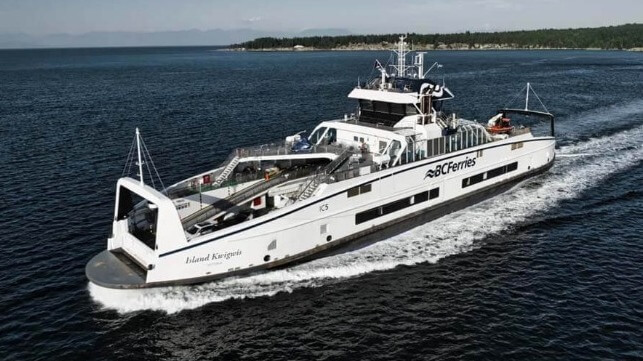
BC Ferries Contracts Damen to Build Its First Fully-Electric RoRos
The four new ferries will use the RoRo design and add hybrid electric power (Damen)
Canada’s BC Ferries, which bills itself as one of the largest ferry operators in the world, awarded the shipbuilding contract for four unique hybrid electric vessels to the Damen Shipyards Group. Due to enter service in 2027, the company reports it plans to operate these new vessels exclusively in battery-electric mode, using renewable BC Hydro electricity to power the charging stations.
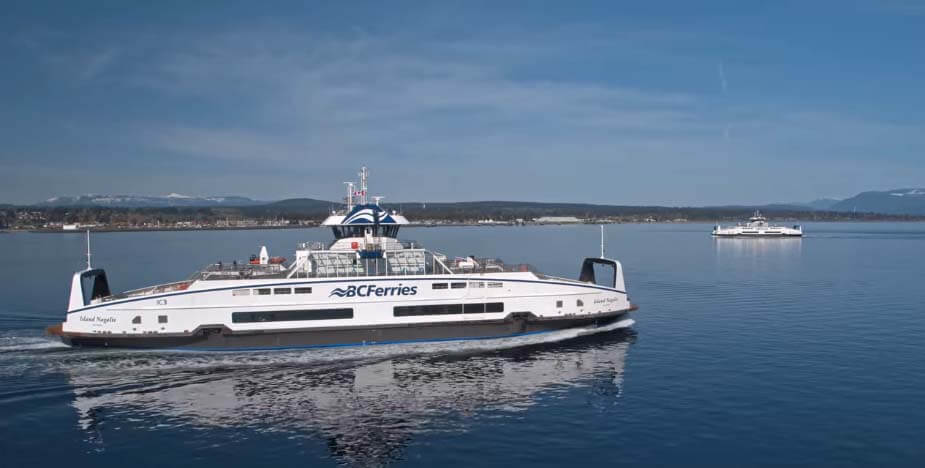
The design for the vessels is based on the Island Class which Damen delivered to BC Ferries between 2020 and 2022. They currently operate six of the vessels and with the addition of the four new ferries it will become the single largest class of vessels in the company’s fleet. Each vessel will have the capacity for up to 390 passengers and crew and will carry at least 47 vehicles. The ferries are double-ended RoRos with a twin propeller design.
The battery packs for the four new ferries will have a capacity of 2,000 kilowatts that will supply the electricity for the power trains. Rapid recharging using renewable electricity will take place while the ferries disembark and embark their passengers and vehicles at each end of the route. Each vessel will also have auxiliary diesel engines installed for backup and general redundancy and an exhaust system with selective catalytic reduction to reduce nitrogen oxide emissions.
Other environmental systems include heat recovery which uses waste thermal energy to heat the vessel. They will also use a low-friction, biofouling-resistant hull coating to reduce power consumption. Light will be entirely LED onboard.
Damen built six earlier ferries of the class between 2020 and 2022 for BC Ferries (BC Ferries)
The project was begun in 2022 with the first requests released by BC Ferries. Several bids were received from various shipyards around the world, but no Canadian companies submitted a bid. Damen, based in the Netherlands, was selected with BC Ferries highlighting the advantages of compatibility and flexibility with its current fleet of conventionally-powered ferries from Damen.
This agreement with Damen is a design-build, fixed-priced contract that provides BC Ferries with substantial guarantees related to delivery dates, performance criteria, cost certainty, and quality construction. The vessels will be built in Romania. Damen also has an agreement with Point Hope Shipyards in Victoria to provide technical and warranty support for the new vessels, ensuring repair and maintenance activities will be performed in British Columbia.
BC Ferries reports it will also initiate corresponding electrical upgrades for shore-based rapid charging at the four terminals on the routes which will connect Nanaimo Harbour and Gabriola Island (two vessels) and Campbell River and Quadra Island (two vessels).
The shoreside charging equipment will also be supplied by Damen with the necessary upgrades being completed in time for the delivery of the ships. Damen highlights that it will be the fourth time it has provided the shore charging capabilities, with the first also being in Canada, in 2021, to support two hybrid Damen ferries delivered to the Ministry of Transportation, Ontario. The company has also supplied charging for projects in Copenhagen, Denmark, and Dordrecht, the Netherlands.
Research Partners Find Six Million Acres of Deep-Sea Coral off Florida
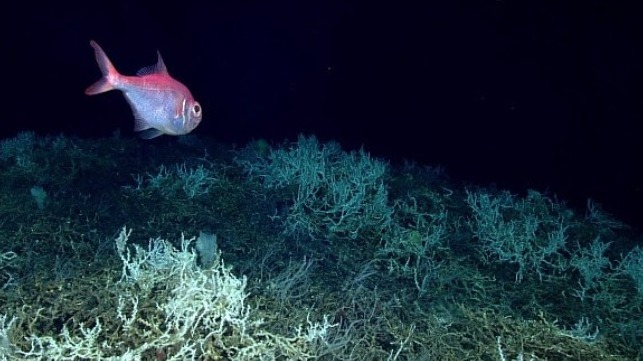
NOAA and a consortium of research partners have discovered and mapped a vast deep-sea coral reef off the east coast of the United States. It is the likeliest habitat of its kind ever found, according to the consortium's newly-published study.
The team used three different multibeam sonar surveys to map the extent of the reef system. NOAA contributed the largest share of the data. Together, these survey campaigns covered almost all of the Blake Plateau, a rise located about 90 nautical miles off Florida, Georgia and South Carolina.
The total area surveyed is about the size of Florida, and the reef covered about 6.4 million acres - an area about the size of Vermont. They used an automated classification system to identify coral mounds in the survey data and found 83,000 probable hits. These mounds are distributed over an area about 280 nautical miles long and 60 nautical miles wide. The surveys were backed up and validated using 23 submersible dives.
Scientists dubbed the densest area of coral "Million Mounds" for its dense accumulation of the stony coral desmophyllum pertusum. These corals form large mounds that provide an important habitat for fish, including shelter for rearing young hatchlings. Some of these fish are commercially important for East Coast fisheries.
“For years we thought much of the Blake Plateau was sparsely inhabited, soft sediment, but after more than 10 years of systematic mapping and exploration, we have revealed one of the largest deep-sea coral reef habitats found to date anywhere in the world,” said Kasey Cantwell, operations chief for NOAA Ocean Exploration.
In a statement, study lead author Derek Sowers, Ph.D. said that the result showed how interagency partnerships could help the quest to map the 50 percent of U.S. waters that have yet to be mapped in high resolution.
NOAA added that the results will help guide policy on sustainable use and management of ocean resources in this area.
Salvors Will Dismantle Trawler That Ran Aground Near Portland, Maine
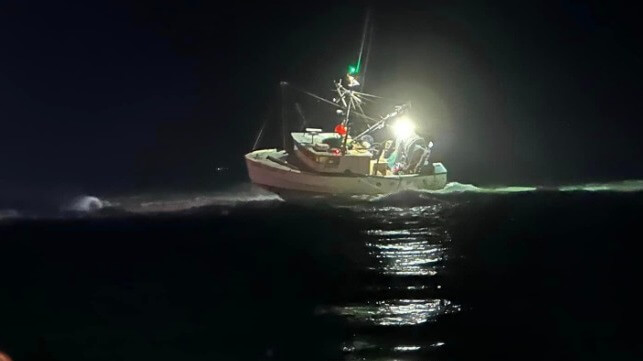
The U.S. Coast Guard has approved a plan to dismantle a trawler that ran aground near Portland, Maine over the weekend, according to local media.
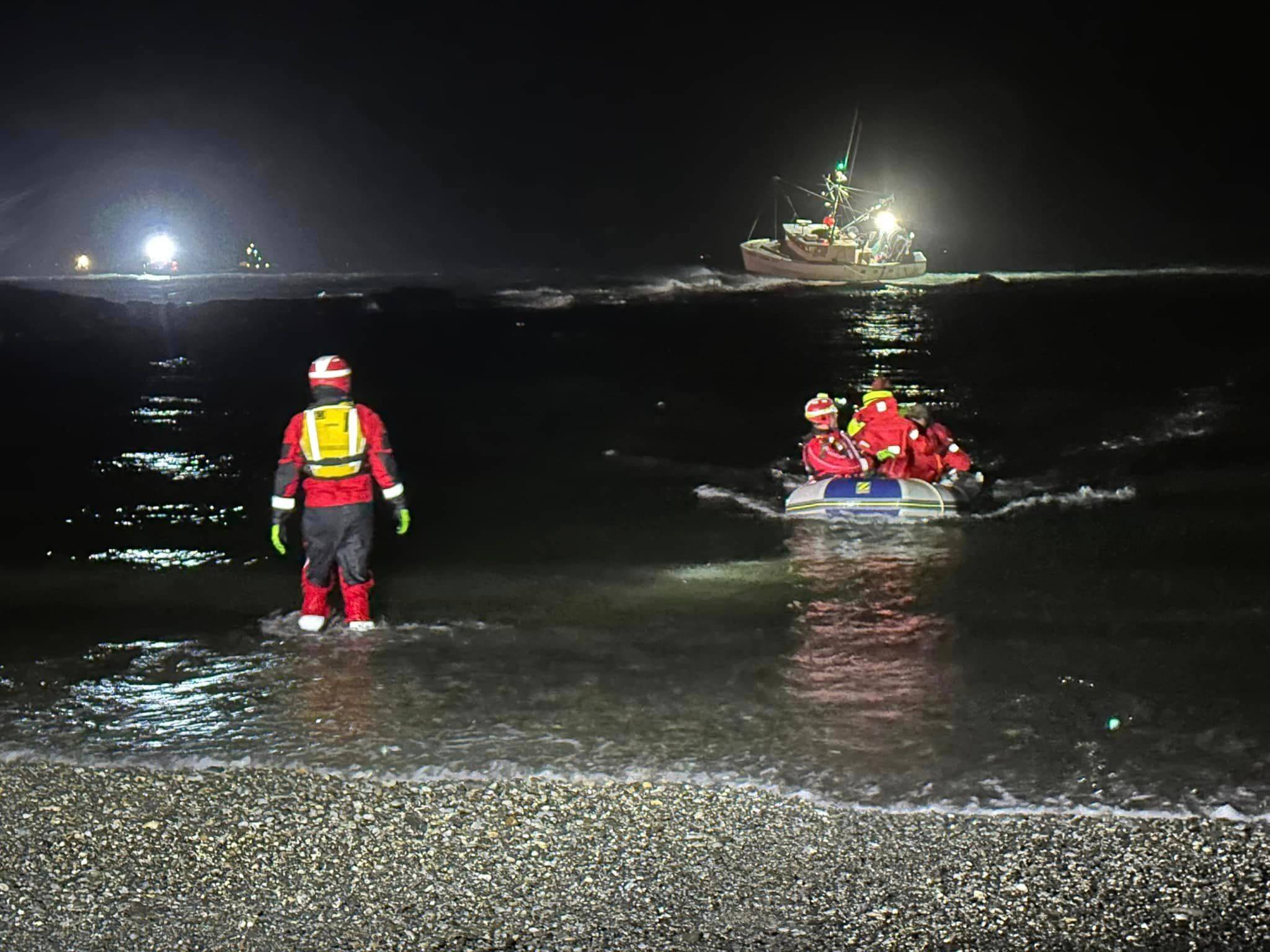
The trawler Tara Lynn II grounded in the early hours of Saturday morning near Trundy Point, a headland located about five nautical miles southeast of Portland. Conditions on scene were difficult, with winds blowing to 45 knots and waves of about six feet. The area was so shallow that first responders had difficulty reaching the boat by water, and had to use the local fire department's 10-foot inflatable boat to rescue the crewmembers. Despite the hazards, the four fishermen on the boat were ferried the short distance to shore, two at a time.
Courtesy Cape Elizabeth Fire/Rescue
"We got washed past the spot where we wanted to extricate the people off the boat two times," said local fireman Lt. Nate Perry, speaking to Spectrum News. The small-boat team had to maneuver around the trawler's rigging, which was dangling in the water, and hold the boat steady alongside in rough conditions.
The site is well above water at low tide, and the wreck of the Tara Lynn II sits far up towards the shoreline. Parker Poole, a local salvor and tug operator, told the AP that he plans to drive excavators out on the flat to demolish the boat in place.
Researchers make links between woolly mammoths and colonization of the Americas
uOttawa professor and team go back 14,000 years to show links between mammoths and early hunter-gatherer communities
“THE NEW TOOLS DEVELOPED IN THIS RESEARCH WILL HELP WITH EFFORTS TO CONSERVE BIODIVERSITY, PROVIDING AN ANALOGUE TO MODERN TIMES". CLÉMENT BATAILLE — ASSOCIATE PROFESSOR, DEPARTMENT OF EARTH AND ENVIRONMENTAL SCIENCES, FACULTY OF SCIENCE
Imagine journeying back in time to the era of woolly mammoths, some 14,000 years ago. That’s what a team of international researchers from the University of Ottawa, the University of Alaska Fairbanks, McMaster University and Adelphi University, and Indigenous scholars, managed to do. Using novel high-resolution isotope profiling (a sort of “paleo-GPS”), they were able to connect the dots between the wanderings of a woolly mammoth and the earliest known human settlements in the remote expanses of eastern Beringia (the land and maritime area between the Lena River in Russia and Canada’s Mackenzie River).
The paper, published in Science Advances, sheds light on the relationship between mammoths and early hunter-gatherer communities in the region. Through a detailed analysis of the mammoth’s remains and genetic connections, the researchers were able to reconstruct the life history and movements of this iconic species, providing evidence of overlapping mammoth/human habitats and of the possible role mammoths played in facilitating the peopling of the Americas.
This study focuses on a female woolly mammoth, “Élmayuujey’eh” (Elma), named by the Healy Lake (Alaska) Village Council, whose remains were discovered at Swan Point, the earliest archeological site in Alaska. Alongside the mammoth, the site also contained remains of a juvenile and a baby mammoth, indicating the presence of a herd in the area. This finding intrigued researchers and prompted further investigations into the movements and interactions between mammoths and early humans.
Clément Bataille (associate professor, Department of Earth and Environmental Sciences, Faculty of Science, University of Ottawa), lead author and PhD student Audrey Rowe (University of Alaska Fairbanks) and co-author Matthew Wooller (University of Alaska Fairbanks) conducted a detailed isotopic analysis of Élmayuujey’eh’s complete tusk. This allowed them to retrace the mammoth’s movements through her lifetime.
“Elma roamed extensively within the densest region of archaeological sites in Alaska,” says Rowe. “This suggests a close association between mammoths and early human hunting camps.”
Meanwhile, Hendrik Poinar and his team at McMaster University conducted genetic analyses of the remains of eight other individual mammoths found in the region. They determined that the Swan Point area likely served as a meeting ground for at least two closely related herds. This suggests that mammoths had social structures and exhibited herd behavior.
Solving the mystery of human-mammoth coexistence
“This research gives new insights into how humans and mammoths interacted when humans first came to the Americas,” says Bataille. “It seems that mammoths, which were plentiful in eastern Beringia and an important food source, attracted humans to the area.”
It’s not the first time that this geolocation technique has been used to retrace the mobility of a mammoth. The team created it for a study of a 17,000 year old male named Kik, who lived in a colder period when humans hadn’t yet arrived, unlike Elma.
Interestingly, Kik and Elma showed very different mobility behaviours. Kik moved freely over long distances across large valleys and tundra plains using regular core areas, whereas Elma, while still using similar core areas, moved shorter distances, maintaining a high elevation. This raises questions about the role of humans and climate change in influencing the mobility of this ancient species.
This high-resolution isotope profiling technique can be applied to uncover the ecology of many other extinct species. Used with genetic analysis, it’s an innovative way to learn about how ancient species responded to climate change and human pressures, and what ultimately caused their extinction.
By shedding light on mammoth ecology and lifeways and mammoths’ long-term interactions with climate change and humans, the study can help us predict how animals will respond to climate and human pressures in the future. “The new tools developed in this research, along with the insights into the ecology of extinct species, will help with efforts to conserve biodiversity, providing an analogue to modern times, where many large mammals are in danger of going extinct with human and climate perturbations,” says Bataille.
This study was funded in part by the NSERC Discovery Grants program and was published in Science Advances on January 17.
Hamilton, ON, Jan. 17, 2024 – An international team of researchers from McMaster University, University of Alaska Fairbanks and the University of Ottawa has tracked and documented the movements and genetic connections of a female woolly mammoth that roamed the earth more than 14,000 years ago.
She travelled hundreds of kilometres through northwestern Canada and Alaska over the course of her lifetime, which ended when she encountered some of the earliest people to have traveled across the Bering Land Bridge.
The last remaining woolly mammoths lived alongside the region’s first peoples for at least 1,000 years, but little is known about how the mammoths moved across a landscape increasingly populated by people and whether those movements made them more vulnerable to hunting.
The mammoth at the centre of this study, named Élmayuujey’eh by the Healy Lake Village Council, was discovered at Swan Point, the earliest archaeological site in Alaska, which also contained remains of a juvenile and a baby mammoth. Mammoth remains have also been found at three other archaeological sites within 10 km of Swan Point.
Researchers conducted a detailed isotopic analysis of a complete tusk and genetic analyses of remains of many other individual mammoths to piece together their subject’s movements and relationships to other mammoths at the same site and in the vicinity. They determined that the Swan Point area was likely a meeting ground for at least two closely related, but distinct matriarchal herds.
The findings are published today in the journal Science Advances.
“This is a fascinating story that shows the complexity of life and behaviour of mammoths, for which we have very little insight,” says evolutionary geneticist Hendrik Poinar, director of the McMaster Ancient DNA Centre who led the team that sequenced the mitochondrial genomes of eight woolly mammoths found at Swan Point and other nearby sites to determine if and how they were related.
Researchers from the University of Alaska Fairbanks performed isotopic analyses of the tusk. Mammoth tusks grew like tree trunks, with thin layers marking steady growth and isotopes from different elements—oxygen and strontium, for example—provided information about the subject’s movement.
The female mammoth was approximately 20 years old when she died, having spent much of her life in a relatively small area of the Yukon. Researchers report that as she grew older, she travelled over 1000 km in just three years, settling in interior Alaska and dying near a closely related baby and juvenile, for which she may have been the matriarchal lead.
Mammoths are presumed to behave much like modern elephants, with females and juveniles living in close-knit matriarchal herds and mature males traveling alone or in looser male groups, often with larger home ranges than the females.
Researchers say using multiple forms of analysis, as in this study, allows them to make inferences about the behaviour of extinct mammoths.
The McMaster team extracted and analyzed ancient DNA from the tusk of Élmayuujey’eh, which revealed the mammoth was closely related to the other mammoths from the same site and more distantly related to others from a nearby site called Holzman.
Early human populations, with a deep understanding of mammoths and the technology to hunt them, took advantage of mammoth habitats, using scavenged and hunted remains as raw materials for tools, the researchers report.
In addition to the direct impact of hunting on mammoth populations, human activity and settlements may have also indirectly affected mammoth populations by curtailing their movements and their access to preferred grazing areas.
“For early people in Alaska, those localities were important for observation and appreciation, and also a source of potential food,” says Poinar.
The collected data suggests that people structured their seasonal hunting camps based on where mammoths gathered and may have played an indirect role in their local extinction in Alaska, which was compounded by a rapidly changing climate and changing vegetation.
Such deprivations did not appear to have affected the subject mammoth, though.
“She was a young adult in the prime of life. Her isotopes showed she was not malnourished and that she died in the same season as the seasonal hunting camp at Swan Point where her tusk was found,” said senior author Matthew Wooller, who is director of the Alaska Stable Isotope Facility and a professor at UAF’s College of Fisheries and Ocean Sciences.
“This is more than looking at stone tools or remains and trying to speculate. This analysis of lifetime movements can really help with our understanding of how people and mammoths lived in these areas,” says Tyler Murchie, a recent postdoctoral researcher at McMaster who conducted the ancient DNA analysis with Sina Baleka. “We can continue to significantly expand our genetic understanding of the past, and to address more nuanced questions of how mammoths moved, how they were related to one another and how that all connects to ancient people.”
The research was funded in part by the National Sciences and Engineering Research Council of Canada (NSERC).
CREDIT: YIWEN WANG , LEI CHEN , KAIHANG ZHU , CHENXI GUO , YU PU , ZHENYAO SHEN
Globally, non-point source pollution is an important source of water quality deterioration in rivers and lakes. A ditch-pond system, consisting of ditches and ponds, is considered to be similar to free-surface wetlands, linking pollution sources to the receiving water bodies. The ditch-pond system includes vegetation, microorganisms and sediment, which can slow down the flow velocity and promote the precipitation of particulate matter carried by running water. At the same time, ditch and pond systems reduces nitrogen and phosphorus concentrations, and those of other nutrients entering the downstream water by means of plant absorption, sediment adsorption and microbial degradation, so as to reduce agricultural non-point source pollution. As an important farming area in southern China, the Three Gorges Reservoir area covers a wide area of hills and serious soil erosion, which further exacerbates the problem of agricultural non-point source pollution. In China, ponds are mainly distributed in the eastern and southern regions. However, most of the studies on ditches and ponds have been conducted in the lowland areas, and there are few studies with field observations in upland areas. What kind of function the ditch-pond system plays in the water environment in the mountain catchment is worth studying deeply.
Large water bodies, especially lakes and wetlands, have been given more attention as important geographical features of global terrestrial systems. Compared with large water bodies, small water bodies such as ponds are common, but receive limited attention and are often ignored. Prof. Lei Chen and his team used high-resolution remote sensing data to analyze changes in ditches and ponds within the catchment. The results showed that over the past 15 years the length of ditches in the catchment and the number of small ponds (< 500 m2) have increased by 32% and 75%, respectively. The concentration of pollutants in the ditch and pond system was much higher than that in the mainstream in the catchment, indicating that dense ditch-pond network not only increases the confluence time, but also is more conducive to the interception of pollutants. By comparing the pollutant concentrations at the inlet and outlet of different ditches and ponds, it was found that the change rate of nutrient concentration in ditch-pond is mostly between –20% and 20%, indicating ditches and ponds can be both sources and sinks for agricultural pollutants. Although ditches and ponds are sometimes a source of pollutants, they help regulate the hydrology and water quality of catchment. In addition, this study also compared the effects of different texture ditches on pollutant interception. It was found that the interception effect of concrete ditch on particulate phosphorus is better than that of soil ditch in dry season. Based on the research results, we think that retaining the sediment in the ditch in dry season and cleaning the sediment in time in rainy season can help the ditch-pond system to transform from source to sink effectively. Therefore, the function of balancing the drainage and interception functions of the ditch-pond system can maximize its ecological role in the catchment.
This study has been published on the Journal of Frontiers of Agricultural Science and Engineering in 2023, DOI: 10.15302/J-FASE-2023517.