Wednesday, January 29, 2025

France rejects bid to move two killer whales to proposed refuge in Nova Scotia

Story by Michael MacDonald
• JANUARY 28, 2025
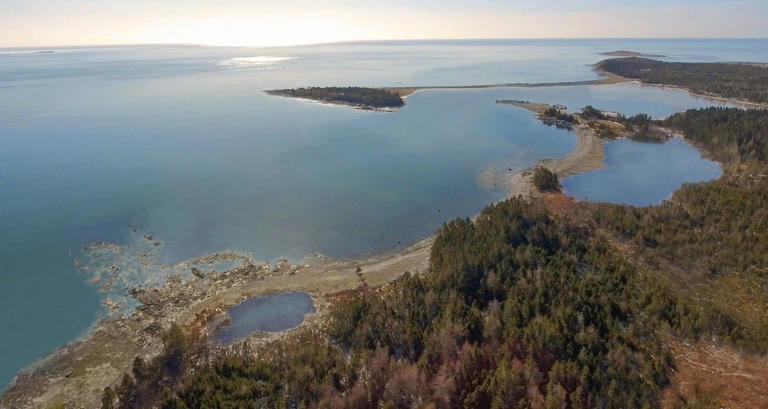

The site for a proposed whale sanctuary is seen in an area south of Port Hilford, N.S., in an undated handout photo. THE CANADIAN PRESS/HO-Whale Sanctuary Project, *MANDATORY CREDIT*© The Canadian Press

HALIFAX — The group behind a plan to build a coastal refuge in Nova Scotia for captive whales says its bid to provide sanctuary for two orcas from a marine park in France has been rejected by the French government.

Lori Marino, president of the U.S.-based Whale Sanctuary Project, issued a statement Tuesday saying her group received a letter last week from the Department of Ecological Diversity saying experts had turned down the proposal to build an oceanside pen for Wikie and Keijo, the two surviving killer whales at Marineland Antibes.

"Not one member of this (expert) panel ever reached out to us to discuss any concerns they might have had," Marino's statement says. "We cannot help but question why the ministry would reject the relocation of Wikie and Keijo to a natural … sanctuary without discussing any of this panel’s concerns with us."

Wikie and Keijo are France's last two captive, performing killer whales.

Marino said the non-profit group's proposal, submitted last April, was rejected because French experts were concerned about water temperatures in Nova Scotia, saying there could be a problem if the whales did not acclimatize quickly. As well, a department director said the plan wouldn't meet the scheduling requirements of the marine park on the French Riviera, which was closed earlier this month to comply with a French law that bans performances using killer whales and dolphins.

The 2021 law says the two whales must be moved outside France by the end of this year, but the Whale Sanctuary Project has yet to start construction in a bay near the small town of Port Hilford on Nova Scotia's eastern shore.

Still, the project’s executive director, Charles Vinick, has said that a smaller version of what is planned could have been built before the deadline.

Marino said much could have been accomplished during the time it took the French government to respond to her group's bid.

"This nine-month delay in responding to our expression of interest foreclosed the option of retiring Wikie and Keijo to the sanctuary," said Marino, a neuroscientist and expert in animal behaviour who has studied marine mammals for 25 years.

Her statement goes on to say the fundraising needed to prepare for the whales' arrival could have been completed in time.

"We also welcomed the opportunity for some of Wikie and Keijo’s current caregivers to travel with them and to continue their caregiving work as part of our team in Nova Scotia."

Meanwhile, the French government's decision means Wikie and Keijo will likely be sent to Spain's Loro Parque zoo in the Canary Islands off the northwest coast of Africa. French officials should reconsider that move because the zoo has a checkered history, Marino said.

"We have asked the French government to consider organizing a meeting with the owners of Marineland Antibes, or even Loro Parque, so that together we can all identify a solution that best serves the welfare of Wikie and Keijo," her statement says. "In the best interests of Wikie and Keijo, we urge the ministry to reconsider its decision."

The Whale Sanctuary Project also offered to cover the costs of care for Wikie and Keijo to remain in Antibes while fundraising and construction ramped up in Nova Scotia.

Marino and Vinick started looking for a place to establish North America's first coastal sanctuary for retired performing whales and dolphins in 2016. They turned their attention to Nova Scotia in 2018.

"The writing is on the wall for all of these (marine parks and aquariums) that hold cetaceans — dolphins, whales and porpoises,” Marino said at the time. “They are really going to need to phase this practice out if they want to win favour with the public.”

The project, announced in February 2020, calls for construction of a 40-hectare enclosure for orcas, belugas and dolphins. As large as 50 football fields, it would include a ring of floating nets extending from the land.

Whales and dolphins raised in captivity can’t be returned to the wild because they don’t have the necessary survival skills.

Organizers originally predicted the site would be ready to receive whales in 2022. But the COVID-19 pandemic, regulatory hurdles and environmental concerns slowed the project’s progress. The $20-million project is relying on private donations. Another $2 million would be needed annually for operations.

The world’s first whale sanctuary opened in southern Iceland in 2019. The Sea Life Trust has two belugas from China — Little Grey and Little White.

This report by The Canadian Press was first published Jan. 28, 2025.

Michael MacDonald, The Canadian Press
Disaster Capitalism 101 comes to Nova Scotia

Also: wind; cleaners approve contract; Dartmouth Cove; pedestrian killed; Black community members in Halifax encouraged to participate in focus groups

by Tim Bousquet
January 28, 2025
HALIFAX EXAMINER

One of St Barbara's "non-core" assets is its Touquoy open pit gold mine in Moose River, Nova Scotia. Credit: Raymond Plourde / Ecology Action Centre


NEWS
1. Wind

Nova Scotia’s 2030 Clean Power Plan graphic. Credit: Nova Scotia Department of Natural Resources and Renewables

“Calling it ‘a great day’ for clean energy, on Monday Nova Scotia’s Energy Minister Trevor Boudreau announced contracts for six new onshore wind farms,” reports Jennifer Henderson:


Together, the provincial government expects this procurement to deliver 625 megawatts of renewable energy by the end of 2028. If successful, this would reduce the province’s dependence on coal and fossil fuels by 19% and cut carbon emissions by at least 8%.


At the present time, as indicated by the graphic [above], 42% to 43% of the province’s electricity is generated from renewable sources, including hydro imported from Muskrat Falls. New wind projects – both onshore and eventually offshore – are key to the province being able to meet its renewable energy goals and to shutter coal-fired plants between 2030 and 2040.

When it comes to fuel costs, Nova Scotia Power is paying $63.62 per megawatt hour for the Green Choice wind, compared to about $100 per megawatt hour for coal, natural gas, and oil.

Click or tap here to read “Nova Scotia announces major wind projects to wean off coal.”

Wind is obviously a good strategy for meeting greenhouse gas reduction goals, and with battery projects in the works, increasing reliability of the grid. And even with significant capital costs, wind is the more affordable fuel option. This was the good part of the announcement (the bad part is in the next item).

But if we are to meet the lofty goals outlined yesterday, several things have to not happen.

First, the power from new wind projects can’t be siphoned for the Rube Goldberg machinery of so-called green hydrogen. It does Nova Scotia no good if, thanks to an oligarch-friendly set of tax rebates and subsidies, the economics of renewable power favour the inefficient and wasteful export plan of super-cooled ammonia to Europe over powering domestic homes and businesses.

Second, the Canadian oil and gas industry can’t dictate power policies federally or provincially. We are now witnessing the abandonment of government support for renewable power south of the border. It’s an open question as to whether the renewable industry in the United States is developed enough to carry on without that support.

However, as demonstrated by the provincial announcement yesterday, here in Nova Scotia, government financing is still needed to jump-start the renewable industry. I very much fear a change in federal leadership could undercut that financing.

Third, our consumption of electricity can’t increase at an uncontrollable rate. We’re necessarily adding a lot of electrical demand to the system, by electrifying lots of things that used to be oil powered.

Heat pumps are an example. This is not an argument against heat pumps, which are absolutely more energy efficient than oil furnaces, drastically lower greenhouse gas emissions, and are more affordable to residents. (I’m having a heat pump system installed in my own house right now). But it also is undeniable that they add demand to the electrical grid.

My real worry is not heat pumps, but electric vehicles. If our ‘green’ future is just a one-for-one swap out of internal combustion engines for electric engines on the same (and growing) number of private single-passenger cars, corporate fleets, and commercial vehicles, the added demand to the grid will be enormous, and I don’t see how yesterday’s wind announcement is up to the challenge. It’s entirely possible that all the wind power promised yesterday comes on line, but the electrical demand from electric vehicles grows so great that the percentage targets of wind as part of the grid can’t be met.

The solution for this is to change the “modal split” — that is, the percentage of people who drive single-passenger cars decreases while the percentage of people who take transit (and cycle and walk) increases. But none of the various provincial energy, environmental, or housing plans include any meaningful strategy for changing the modal split. In fact, the same government celebrating the wind power announcement has recently tabled a half-billion dollar highway plan just as it provides no meaningful money to transit systems. (It has promised $65 million for the Bedford ferry, and we’ll see if that ever becomes a reality).

All of which is to say: yes, yesterday’s wind announcement is good news. But we don’t get the promised wind future without also being clear-headed about ‘green hydrogen,’ being politically active so as to ward off a government captured by the oil and gas industry, and instituting a significant re-work of our transportation system.
2. Disaster Capitalism and the mining industry

The open pit at the Touquoy gold mine in Moose River in November 2022. Credit: Raymond Plourde / Ecology Action Centre

Henderson’s report (above) continues:


Environment Minister Tim Halman lauded the announcement of more wind farms, saying it ushers in “a new energy era that is sustainable, green, and will advance reconciliation.” Halman said the province is “unwavering” in its focus to achieve net-zero emissions by 2050.


If we are serious about addressing climate change and greening our grid, we need to build faster. To do that we need to get our natural resources out of the ground faster and more efficiently without compromising our environment.

In short, we cannot have wind energy, solar panels, and EVs without having critical minerals. So we are going to use our natural resources to our full advantage to help people of this province.

The environment minister said he recognizes this is “a shift,” but the government’s environmental assessment process will ensure mining is carried out “safely, responsibly, and ethically” and that “no company will get a pass on following our environmental laws.”

The Halifax Examiner asked Halman how opening up the province to the mining of critical minerals like lithium and uranium – as proposed by Premier Tim Houston last week – would have any impact on the construction of new wind farms that are needed by 2030 to comply with legislated renewable energy targets. Halman replied:


There are a lot of moving parts with climate change and energy policy. We now know that if we wish to have more wind farms, onshore and offshore, the responsible use of critical minerals is going to be an absolute necessity as we move forward because it’s going to be an intricate part of our economy. We are talking about a transformation, and a transformation takes time.

This comes just a few days after Premier Tim Houston announced that the Nova Scotia response to Trump’s threatened tariffs is to, yep, cut regulations on mining, and Houston said he was prepared to lift bans on uranium mining and fracking for methane, and left open the possibility of ending the moratorium on offshore drilling near Georges Bank.

In the process, Houston railed against “special interests” (but the mining industry isn’t a special interest, evidently) and the carbon tax.

This is Disaster Capitalism 101.

The term “Disaster Capitalism” was coined by Naomi Klein in her 2007 book, The Shock Doctrine: The Rise of Disaster Capitalism. She defines it as a form of extreme capitalism that advocates privatization and deregulation in the wake of war or natural catastrophe.

Donald Trump is Disaster Capitalism personified. He is a chaos agent, creating so much confusion and disorder that the powerful can bulldoze through an exploitive agenda for their own profit.

And here in Nova Scotia, Houston is using the excuse of Trump’s chaotic tariffs to bulldoze through a similar exploitive agenda.

(Send this item as a separate article: right click and copy this link)


3. Cleaners approve contract SEIU LOCAL 2

Cleaners who work with GDI Integrated Facility Services review a new collective agreement. Credit: SEIU Local 2/Justice for Janitors

“Three hundred Halifax cleaners who work for a North American facilities maintenance and commercial cleaning service have ratified a contract with their employer,” reports Suzanne Rent:


As the Examiner reported on Friday, the cleaners, who all work with GDI Integrated Facility Services, reached a tentative agreement at a final conciliation meeting on Thursday. The cleaners had been without a contract since September, and in November they voted for strike action.

The cleaners were looking for better wages, improvements in benefits, retirement security, and language in their contracts that would prevent them from unfair workloads and their work being subcontracted.

The cleaners work at 50 properties across Halifax Regional Municipality (HRM), including the ferry terminals, Halifax Shopping Centre, and the RCMP headquarters in Dartmouth.

According to a press release from SEIU Local 2, the union representing the cleaners, the members overwhelmingly voted in favour of the agreement.

Members were set to strike on Monday, with a rally set for the Halifax waterfront. All job action has been called off. If the cleaners had gone on strike, it would have been the largest strike ever by janitors in HRM.

Click or tap here to read “Halifax cleaners win wage increases, improved benefits in new collective agreement.”

4. Dartmouth Cove

King’s Wharf from Dartmouth Cove. Credit: Suzanne Rent

“The founder of a group that wants to save Dartmouth Cove called a recent letter from the company that wants to infill the cove disingenuous and said the group is concerned about the silence from Mayor Andy Fillmore on the ongoing battle,” reports Suzanne Rent:


Jill Brogan, one of the founders of Save Dartmouth Cove, spoke at a public meeting on Monday night at the Mic Mac Amateur Aquatic Club…

Brogan also addressed the silence from Mayor Andy Fillmore on the issue of Dartmouth Cove. She noted that Fillmore received campaign contributions from Brad and Tom Hickey, who are the co-founders of ARCP. The Examiner wrote about that here.

Brogan said she she hopes Fillmore recuses himself from any discussions around the cove. She said Save Dartmouth Cove also contacted Fillmore several times during his election campaign to ask to meet or make a public statement on the issue.

“The silence was deafening, absolutely deafening. I don’t even think he poked his head down in our neighbourhood,” Brogan said. “His actions, or lack thereof, speak volumes.”

“It seems like the wealthy on the [Northwest] Arm have Fillmore’s attention, but we on the Dartmouth side don’t.”

Click or tap here to read “Mayor Andy Fillmore isn’t talking about Dartmouth Cove.”

(Send this item: right click and copy this link)
5. Pedestrian killed

Monday evening, Halifax Police issued this release:


Police Investigate Vehicle & Pedestrian Collision

At 5:47 p.m., Halifax Regional Police responded to a vehicle & pedestrian collision at Robie Street / Veterans Memorial Lane Halifax. The pedestrian sustained life-threating injuries and has been transported to the hospital. Police received reports that the same vehicle was involved in another collision near Beech Steet / Jubilee Road. The driver, an adult male, has been arrested for Dangerous Operation of a Conveyance. Investigators with Patrol, Accident Investigation Section and Forensic Identification Section are conducting the investigation, which is in the early stages.

I’m told that the pedestrian, a young woman, has died.


6. Black community members in Halifax encouraged to participate in focus groups

From the ‘Reporting in Black Communities’ research project’s invitation to participate. Credit: Reporting in Black Communities/Professors Eternity Martis and Nana aba Duncan

This item is written by Yvette d’Entremont:

Researchers studying news coverage of Black communities are looking for people in Halifax to participate in focus groups this Friday and Saturday.

A pre-screen questionnaire for the ‘Reporting in Black Communities’ project explains that it aims to explore how anti-Black racism affects the coverage of Black communities in Canadian news, and how coverage of these communities can become more equitable.

The online invitation to participate notes the research is being led by two Black journalism professors, Toronto Metropolitan University assistant professor Eternity Martis, and Carleton University associate professor Nana aba Duncan.

Martis and Duncan are looking for Black community members who are 18 or older, are news consumers, and who have an understanding of the effects of negative media representation in Canada. Potential participants must speak English or French, and are asked to fill out the pre-screen questionnaire found here.

“Your insights and experiences are invaluable to this study and will allow researchers to better understand journalist’s level of preparedness to report on Black communities,” the researchers wrote.

Halifax is one of four cities where in-person focus groups are taking place. Other participating cities include Montreal, Toronto, and Edmonton.

Each session is estimated to last about two hours. During the focus groups, researchers aim to discuss how Black community members perceive the impacts of negative news reports about predominantly Black neighbourhoods.

Both Halifax sessions will be conducted in English and will take place at New Horizons Baptist Church on Nora Bernard Street in Halifax. Friday’s session runs from 5:30pm to 7:30pm, while Saturday’s focus group is from 1:30pm to 3:30pm.

‘Reporting in Black Communities’ is part of a larger initiative on equity in journalism at the Mary Ann Shadd Cary Centre for Journalism and Belonging, established at Carleton University’s School of Journalism and Communication.


7. Sure, why not?

Nothing more swells the heart of a true Newfoundland and Labadourian than seeing an AI-generated image of the provincial flag waving next to a rocket that will go to space and beyond. Why, it’s enough to drop all environmental regulations and review, and open the treasury to the backer of the firm. Credit: Nordspace

“The CEO behind the company proposing to launch rockets from St. Lawrence calls the proposed spaceport a project of national importance,” reports Juanita Mercer for the St. John’s Telegram:

NordSpace founder and CEO Rahul Goel says it will create about 200 local jobs.

He spoke to The Telegram on Wednesday, Jan. 22, about his plans. They include a demonstration launch on the Burin Peninsula later this year.

Fishing industry worried by N.S. premier’s musings over lifting oil-exploration moratorium

Houston said that while citizens have the right to be concerned, proposals to reopen fossil fuel exploration are "discussions to have"


Author of the article:
The Canadian Press
Published Jan 23, 2025 •
Fishing industry advocates say that Houston's proposal to reverse the ban on drilling would be a potential disaster because of the risk of a spill. 
Photo by Sean Kilpatrick/The Canadian Press files

Article content

Nova Scotia’s seafood industry is concerned by comments from the premier that he’s open to ending a moratorium on fossil fuel drilling in the rich Georges Bank fishing grounds.

Premier Tim Houston said Wednesday the province needs to reconsider bans on various industries, including uranium mining and onshore fracking, because of tariff threats from United States President Donald Trump.

Reporters pressed the premier on whether that included the moratorium on drilling in the Georges Bank grounds off southern Nova Scotia, which is currently in place until the end of 2032.

Houston responded that while he realizes that citizens have the right to be concerned about industry operating safely, proposals to reopen the area to fossil fuel exploration are “discussions to have.”

Richard d’Entremont, president of Acadian Fish Processors Ltd. in Lower West Pubnico, N.S., says reversing the ban on drilling would be a potential disaster for fishers because of the risk of a spill.

Kris Vascotto, executive director of the Nova Scotia Seafood Alliance, says the possibility of losing any harvesting from the Georges Bank is “highly concerning,” and says his group would like some clear statements from the province about “what exactly their plans are.

Miners praise N.S. premier's call to lift uranium ban but environmentalist calls it a 'dead end'

'We need to embrace opportunities in this province,' says Mining Association of Nova Scotia official

Richard Woodbury · CBC News · Posted: Jan 23, 2025

When Karen McKendry heard Nova Scotia Premier Tim Houston's comments that "We must take the 'no' out of Nova Scotia" and pursue more natural resource development, she had a different interpretation of the premier's phrasing.

Houston made the comments Wednesday, announcing the provincial government's shifting focus could include re-examining long-standing bans in Nova Scotia, including on uranium mining, fracking for natural gas and the moratorium on oil and gas exploration on the lucrative fishing grounds of Georges Bank.

McKendry, the wilderness outreach co-ordinator with the Ecology Action Centre in Halifax, said we should keep the Nova in Nova Scotia.

"Nova means New Scotland," she said. "It means we need to go in new directions and be progressive. And I don't think there's anything progressive about revisiting a dead end that we already went down when we looked at uranium mining in the past."

McKendry said that mining is one of the most polluting industries in the world, and as the world deals with a climate crisis it's not an industry Nova Scotia should be looking toward.

"When we hear that Nova Scotia's environmental regulations are the best in the world, they are not, and they are not always followed, so it doesn't seem like Nova Scotians want to delve more into that and take more of those risks," she said.

Karen McKendry of the Ecology Action Centre and Sean Kirby of the Mining Association of Nova Scotia had different opinions on the Nova Scotia government's interest in pursuing more natural resource development. (Dan Jardine/CBC)
VIDEO    Not everyone is pleased with Premier Tim Houston's announcement this week that he plans to make it easier for resource industries to operate in Nova Scotia.

McKendry pointed to a mining company that's fighting the Nova Scotia government in court over how to clean up a site it used to operate.

McKendry said the province should focus on growing natural resource industries such as fishing, farming and forestry and making them "more resilient and more niche and more competitive, as opposed to putting them at risk."

Sean Kirby, the executive director of the Mining Association of Nova Scotia, echoed the premier's comments.

"We need to embrace opportunities in this province. And I think that's really what the premier was getting at when he talked about the importance of taking the no out of Nova Scotia, right?" he said.

"There is huge need globally for uranium and Nova Scotia has potential to provide it. So we should lift the ban and allow exploration for it to start again so we can see whether we're actually able to have economically viable mines."

Kirby said the modern mining industry does an excellent job of taking care of the environment and operates with the highest standards.

'Too much red tape,' says mining industry

He said more than 3,000 Nova Scotians work in the industry, and said the average compensation is $102,000 per year.

But Kirby said it's a tough environment to work in, calling the process for getting permits for modern mines and quarries extraordinarily complex.

"Nova Scotia has for many years simply had too much red tape," he said. "It's simply been unnecessarily difficult to work in the province and we need the provincial government to help us fix that so that we absolutely are held to the highest standards environmentally and in terms of safety and everything else that's operational."

WAR IS CRIMINAL CAPITALI$M
Congo rebel gains to boost illicit mineral trade through Rwanda, analysts say

Reuters | January 28, 2025 |


M23 troops in Bunagana, Democratic Republic of the Congo. Credit: Wikimedia Commons

A lightning advance in Congo’s mineral-rich eastern borderlands is set to boost the M23 rebellion’s illegal mining revenues, with analysts predicting a further surge in illicit trade in minerals including coltan and gold through neighbouring Rwanda.


The Rwanda-backed insurgency entered Goma, eastern Democratic Republic of Congo’s largest city, this week, marking a major turning point in a conflict with government forces that has raised fears of a spillover into a broader regional war.

The rebels, which Rwanda denies supporting, have long been funded at least in part by the illicit mineral trade. Those revenue flows intensified after M23 – the latest in a long line of Tutsi-led rebellions – seized the coltan-rich Rubaya area in April, UN experts found.

Congo is the world’s top producer of tantalum and cobalt, a key component in batteries for electric vehicles and mobile phones, and is also home to significant coltan and gold deposits.

“Mineral exports from Rwanda are now over a billion dollars a year,” said Jason Stearns, a political scientist at Simon Fraser University and former UN investigator.

“That’s about double what they were two years ago. And we don’t know how much, but a fair chunk of that is from the DRC.”

Rwanda’s ambassador-at-large for the Great Lakes region Vincent Karega rejected the idea that M23 was trafficking Congolese minerals. He did not directly address allegations that his government is involved in their illicit trade.

“Do you think it’s possible to fight and still have time to mine natural resources and refine them?” said Karega, who has been sent to the border with Congo to oversee the crisis.
Lack of transparency

Rebels recently captured the mining town Lumbishi in South Kivu province. Numbi, an eastern mining area in South Kivu rich in gold, tourmaline, and tin, tantalum and tungsten – so-called 3T minerals used in computers and mobile phones – is also under threat.

“Lumbishi and its gold mines are likely to prove a significant source of revenue for M23, in part because gold is much easier to monetise than coltan and tin,” said Gregory Mthembu-Salter, director of Phuzumoya Consulting.

He said gold was likely to make its way to Dubai via Rwanda and possibly Kenya.

In 2023, UAE declared importing about $885 million in gold from Rwanda, a 75% jump from the previous five-year average, according to a Reuters analysis of UN Comtrade data. Rwanda is not a major gold producer.

In addition to exerting administrative control over Rubaya, M23 has also created a monopoly for the export of coltan to Rwanda from the nearby Bibatama mine, UN experts said in a December report. The mine is one of the world’s largest deposits of coltan, used in cellphones and laptops.

The group collected at least $800,000 per month in taxes on coltan production and trade, according to the report, with Congolese output mixed in with Rwandan production.

Jean Pierre Okenda, a Congo-based rights lawyer specialized in extractive industries, said Rwanda was not a member of any international transparency initiatives, making it hard to track its minerals.

“There is a lack of transparency of the mining operations and… a lack of transparency of the geological information,” he said.

(By Sonia Rolley, Felix Njini, David Lewis, Joe Bavier and Reade Levinson; Editing by Jan Harvey; Writing by Sofia Christensen)

Tin miner Alphamin slumps after rebels take Congolese city

Bloomberg News | January 27, 2025 |


Bisie tin mine. Image from Alphamin Resources.

Alphamin Resources Corp. shares fell the most in nine years after Rwanda-backed rebels overran the eastern Congolese city of Goma, the capital of North Kivu province where the company’s tin mines are located.


The stock sank by as much as a third earlier Monday, then pared losses to trade down 9.4% at 97 Canadian cents as of 12:27 p.m. in Toronto.

After a rapid advance, so-called M23 rebels are now patrolling Goma, a trading hub for the Democratic Republic of Congo’s mineral exports to neighboring Rwanda. It’s not, however, a transit point for Alphamin’s tin, which comes from mines about 120 miles west of the city and is sent northeast to Uganda.

Chief executive officer Maritz Smith declined to comment when emailed Monday.

Congo’s east has been wracked by conflict for three decades, a drag on investment in Alphamin, which is listed in both Toronto and Johannesburg. The company started output in the Central African country in 2019 and produced a record 17,324 tons of tin last year. It plans to ramp up to 20,000 tons — about 6% to 7% of global production.

(By Michael J. Kavanagh and William Clowes)

Read More: Abu Dhabi’s IRH explores investing in Alphamin’s Congo tin mines


Codelco plans 25% cut in indirect emissions by 2030

Reuters | January 28, 2025 | 


(Image courtesy of Codelco via Flickr)

Chilean state-owned miner Codelco said on Tuesday it is planning a 25% cut in its indirect emissions by 2030, as part of a larger decarbonization plan and as industry demands grow for more traceable copper.


Codelco is the world’s largest copper producer, and mining is a heavily polluting industry. Studies point to mining as responsible for 4% to 7% of greenhouse gas emissions globally.


Codelco plans to cut its so-called Scope 3 emissions, which are indirect emissions put out by its suppliers and the most difficult to reduce. These polluting “inputs” include explosives, refractories and lubricants, Codelco said.

Scope 3 emissions account for more than 60% of Codelco’s total emissions. The miner is also working to transition the 250 buses it uses to bring workers to their job sites into an all-electric fleet. By 2030, the transition should be 40% complete, and 100% complete by 2040.

Codelco’s plan, part of a bid to slash its overall carbon footprint by 70% by 2030, is ambitious compared to its competitors’. Last year, Antofagasta Minerals committed to trimming its emissions by 10% over the same time frame, while BHP and Teck are working to completely eliminate them by 2050.

(By Fabian Cambero and Kylie Madry; Editing by Paul Simao)
Sweden’s LKAB says it could meet 18% of Europe’s rare earth needs with Per Geijer mine


Reuters | January 28, 2025 


Credit: LKAB

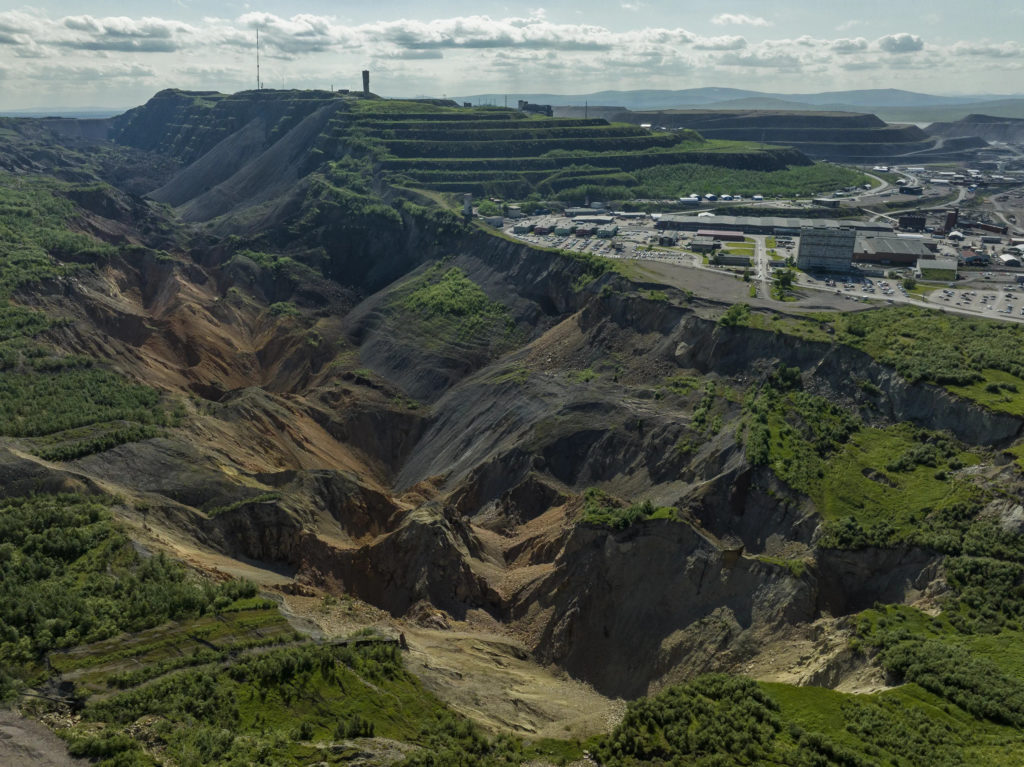
Sweden’s LKAB could supply around 18% of Europe’s rare earth metal demand in the long term if its north Arctic Per Geijer mine enters production, the company said on Tuesday as it began construction of a related processing facility.


Rare earths are a group of 17 metals critical to products from lasers to iPhones and green technology key to meeting Europe’s climate goals.

State-owned LKAB broke ground on Tuesday on its 800 million crown ($73 million) Lulea plant in northern Sweden, which will process mining waste, including potentially from Per Geijer, into rare earth concentrate, phosphoric acid – used in many fertilizers – and gypsum.

“We see our first stage for phosphates at around 6% (of European demand) and rare earths about 2.5%,” Darren Wilson, senior vice president of the LKAB special products business area, said.

“When we expand fully and exploit the potential of Per Geijer, we see that being up to around 18% (of rare earths).”

The Lulea facility will initially process waste from LKAB’s Malmberget mine in Gallivare, northern Sweden, with commercial production starting in late 2029 or early 2030.

Lulea’s development is not dependent on whether LKAB develops the Per Geijer find, which has resources of around 1.7 million tonnes of rare earth oxides. That could take a decade.

LKAB has submitted an application for a processing license which will give it exclusive rights to develop the deposit. But it still needs an environmental permit and other regulatory approvals before it can start commercial operations.

The strategic importance of rare earths has been highlighted by increasing trade tensions with China, Russia’s war in Ukraine and US President Donald Trump’s desire to get control of mineral-rich Greenland.

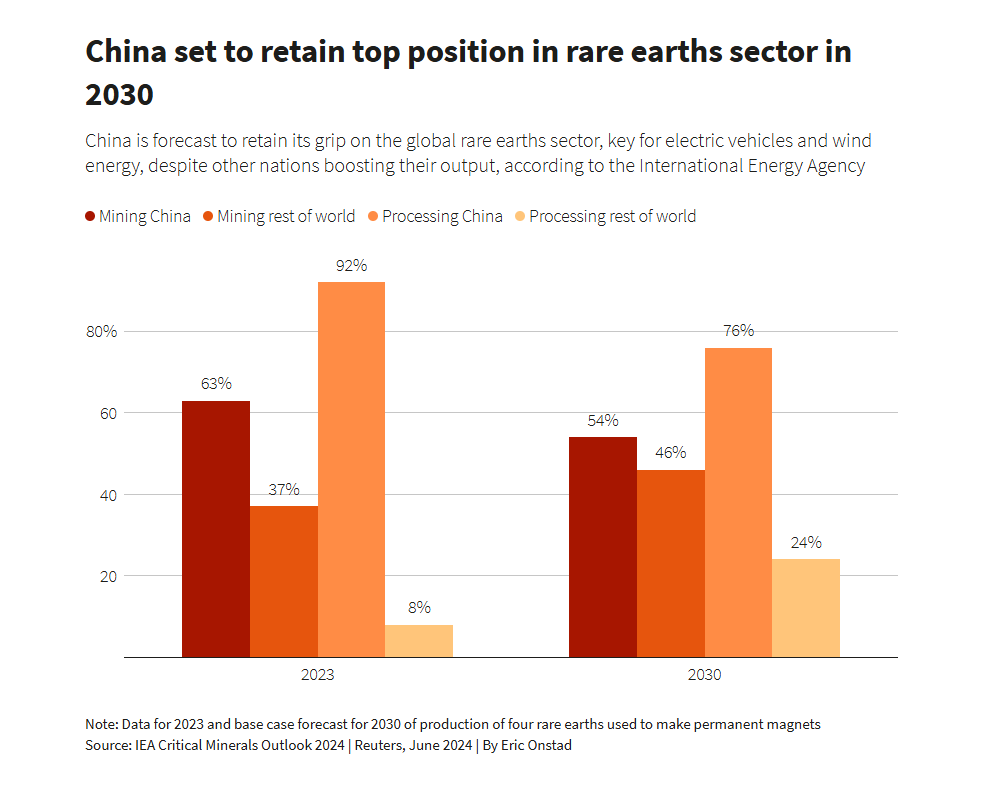
In 2023, the European Union adopted the Critical Raw Materials Act which aims to reduce EU reliance on other countries for minerals like rare earths neodymium, dysprosium and praseodymium which are used permanent magnets for wind turbines and electric motors.


($1 = 11.0130 Swedish crowns)

(By Simon Johnson)
Liberia anticipates new minerals discovery will draw $3 billion

Bloomberg News | January 28, 2025 |


Mining in Liberia. Image from Raw Material Radar.

Liberia expects to attract $3 billion in investment after the discovery of new minerals, President Joseph Boakai said.


Studies conducted over five decades and funded by the Chinese show the iron ore and rubber exporter also has uranium, lithium, cobalt, manganese and neodymium deposits, among others, Boakai said in a state of the nation address late Monday.


Talks are currently underway with major multinational companies and local investors to mine the new minerals and invest in other related sectors such as energy, infrastructure and technology, he said.

The government projects economic growth to accelerate to 5.8% this year, supported by the new investments, from an estimated 5.1% in 2024, he said.

Inflation, which the central bank expects to quicken to as high as 12.3% by the end of March, will moderate to 6% by the end of 2025, Boakai said.

Boakai beat former football star George Weah to become president more than a year ago after campaigning to address high food and transportation costs and unemployment in the economy of 5.5 million people.

The faster growth could reduce the poverty rate in one of the world’s poorest countries to 27.8% this year from 31% in 2023, World Bank data shows.

(By Festus Poquie)


London gold market queues up to borrow central bank gold after big shipments to US

COSTCO SELLS GOLD BARS OFF SHELF

Reuters | January 29, 2025 | 


The Bank of England’s gold vaults. (File image)

London bullion market players are racing to borrow gold from central banks, which store bullion in London, following a surge in gold deliveries to the United States on speculation of potential import tariffs there, two sources familiar with the matter said.


The minimum waiting time to load gold out of the Bank of England, which stores gold for central banks, has reached four weeks, one of the sources said. In normal times, the release time is a few days or a week.

The BoE declined to comment when asked about the queue.

US President Donald Trump has not mentioned precious metals in his tariff plans, but the risk has been enough to boost gold deliveries to New York as part of the market sought to hedge its positions on the US COMEX exchange and part sought to benefit from a jump in the price premium of COMEX futures over London spot prices.

London is home to the world’s largest over-the-counter gold trading hub, where market players trade directly with each other rather than via an exchange.

“The key with the BoE is that they are not a commercial vault so not prepared to handle the onslaught of gold borrowing banks are requesting from the central banks,” said Robert Gottlieb, an industry expert and former head of precious metals at Koch Supply and Trading.

The size of so-called Loco London free float, the amount of gold readily available to the London OTC market stored in London, has fallen after the jump in supplies to New York.

Over the last two months, 12.2 million troy ounces of gold were delivered to COMEX-approved warehouses, raising stocks there by 70% to 29.8 million ounces, the highest since August 2022.

Reports of the flow of gold to New York attracted the attention of the British parliament’s Treasury Committee, one of whose members asked BoE Governor Andrew Bailey on Wednesday whether he saw any risks in this development.

“We are not in the gold standard anymore, it doesn’t have significance for policy in that sense,” Bailey replied, referring to an extinct monetary system where gold backed the value of a currency.

However, London remained a major gold market, and “if you want to be involved in that market and you want to trade and use your gold, you really need to have it in London,” Bailey added.

Deliveries to the US left less free-float metal in London vaults, the metal that is not owned by central banks or holdings of physically-backed gold exchange-traded funds. This in turn boosted demand from players in London who are ready to lease their gold and make it available to the OTC market.

Liquidity challenges in other large trading hubs are less pronounced than in London but are being felt globally, said Alexander Zumpfe, a precious metals trader at Heraeus Metals.

“The logistical complexities of moving large quantities of gold, particularly from Europe to the US, are amplifying these stresses. Asia has also seen some knock-on effects, particularly in markets like Singapore and Hong Kong,” Zumpfe added.

(By Polina Devitt, Pratima Desai and David Milliken; Editing by Mark Potter and Chris Reese)


Ghana plans gold board to increase earnings and curb smuggling

Reuters | January 27, 2025 | 


Stock image.

Ghana plans to launch a Gold Board to streamline gold purchases from small-scale miners, increase earnings and reduce smuggling, the west African country’s newly appointed finance minister Cassiel Ato Forson said on Monday.


The Gold Board will allow Africa’s leading gold producer to increase its benefits from the precious metal’s sales and help maintain the national currency’s stability.

Data from Ghana’s central bank showed that total gold exports for 2024 stood at $11.64 billion, a 53.2% year-on-year increase which helped nearly double Ghana’s trade surplus to $4.98 billion in 2024.

The minister said nearly $5 billion worth of gold exported last year was from legal small-scale miners.

“The time has come for Ghana to expand beyond royalties and taxes by harnessing the entire value chain of gold … from extraction to refinery, value addition and marketing, both locally and internationally,” Forson said.

The board will be launched in early March, he added.

The gold program will be implemented with the aim of pursuing the stringent London Bullion Market Association certification, which prohibits refiners from handling gold from sources contributing to human rights abuses, conflict, crime or environmental degradation.

“Currently, the chaos in the Ghana’s gold purchasing sector prevents the nation from fully benefiting from its gold resources,” Forson said.

The board will act as the sole buyer of gold through licence aggregators and local traders, shifting away from the system where Ghanaians and foreign companies with export licences could purchase it without going through the approved rules.

“This fragmented, uncoordinated, and unregulated system has led to a widespread gold smuggling and deprived the state of much-needed foreign exchange,” Forson said.

(By Christian Akorlie and Anait Miridzhanian; Editing by David Evans)
De Beers sees India as a bright spot, notes early recovery signs in US

Reuters | January 29, 2025 | 


Diamond polishing in India. (Image courtesy of De Beers Group)

India has been emerging as a bright spot for the cut and polished diamonds amidst a slowdown in key markets such as the US and China, Amit Pratihari, managing director, De Beers India told Reuters on Wednesday.


India is the world’s largest centre for cutting and polishing diamonds, accounting for nine out of 10 diamonds polished globally, according to Indian government data.

However, the country’s cut and polished diamond exports fell this year because of weak demand from China and the US, forcing the industry to focus on the growing domestic market that surpassed China last year to become the world’s second-largest.

De Beers sitting on largest diamond inventory since 2008, FT reports

“China has completely slowed down in the luxury segment … We see India growing very strongly,” Pratihari said in an interview.

De Beers, a unit of Anglo American, is the world’s top diamond producer by value and India’s number one supplier of rough diamonds.

However, there were some early signs of recovery in the US and “big growth” in the Middle East, Pratihari said.

“In next couple of months, we expect recovery,” he said.

Weak exports demand for polished diamonds forced Indian processors to trim imports of rough diamonds by 22% to $7.9 billion during April to December, according to India’s Gem and Jewellery Export Promotion Council (GJEPC).

De Beers is adjusting prices of rough diamonds to support the midstream industry – companies that buy rough diamonds from miners and sell them after cutting and polishing to retailers – in the face of polished diamond prices falling more than those of rough diamonds, he said.

“Miners are controlling the supply so more rough does not come into the market that would put additional pressure on the polished prices. But the pressure on polished prices is in midstream as in retail there is no change,” he said.

India’s cut and polished diamond exports fell by 8.3% to $9.76 billion in April-December compared with the 2023 period, according to GJEPC.

(By Neha Arora and Rajendra Jadhav; Editing by Tomasz Janowski)


Botswana’s leader says diamond deal reached with De Beers

Bloomberg News | January 28, 2025 | 


Botswana President Duma Boko. Image source: Duma Gideon Boko’s official X account

Botswana’s president Duma Boko, who swept to power in October elections, said his government has reached a diamond extraction and sales agreement with De Beers that will bring certainty to the gem-dependent economy.


Terms were finalized by midnight on Jan. 24 and will be announced soon, Boko said in an interview on Tuesday. The southern African nation is the world’s biggest producer of rough diamonds by value and the industry generates the bulk of its income. Most of Botswana’s gems are mined by Debswana, a venture between Anglo American Plc’s De Beers unit and the government.

“The issue with De Beers has been settled,” Boko said in Dar es Salaam, Tanzania, where he is attending an energy conference. He indicated last week at the World Economic Forum in Davos, Switzerland, that an agreement was imminent, and said he had followed through on his commitment to conclude it.

During his election campaign, Boko was critical of his predecessor Mokgweetsi Masisi’s handling of talks with De Beers to renew the more than half century alliance between Botswana and the world’s largest diamond firm. Masisi had caused De Beers to consider walking away from the deal, Boko said, and he sought to reopen talks.

Boko’s Umbrella for Democratic Change coalition unseated Masisi’s Botswana Democratic Party, which had led the country since independence from the UK in 1966.

The new agreement had not resulted in “any major changes, just a little tweaking of things here and there,” he said.

Under the provisional terms of a 10-year accord announced by Botswana’s previous administration in July, the state-owned diamond trader was to get 30% of Debswana’s output, while the government would secure 10 billion pula ($720 million) in development funding.

De Beers didn’t immediately respond to a request for comment.

An arid, underdeveloped nation at independence, Botswana has leveraged the discovery of diamonds in 1967 to build itself into the richest country per capita on Africa’s mainland, according to the World Bank.
Lab threat

Still, a prolonged slump in the global diamond market and a challenge from lab-grown gems has hurt its economy. Boko said the agreement will restore certainty and economic growth will follow.

The country will focus on promoting its gems as natural and charging a premium for their provenance, marking them to show they have been mined in the country and their sale promotes development, he said. Diamond revenues in some other parts of Africa have been used to finance conflict.

“We appreciate the threat posed by lab-grown diamonds. I don’t want to give them the privilege of calling them diamonds. Diamonds are natural,” he said. “We will then market our diamonds in terms of their provenance and of the story behind the diamond.”

(By Antony Sguazzin)