Wednesday, January 29, 2025


Blood-powered toes give salamanders an arboreal edge


Washington State University
WanderingSalamanderfoot 

image: 

Still frame image showing the hindfoot of a live Wandering Salamander (Aneides vagrans) from a ventral perspective just before the salamander takes a step forward. This image shows the large digital blood sinuses and the points at which they connect near the distal-most joint.

view more 

Credit: Photo by William P. Goldenberg


PULLMAN, Wash. — Wandering salamanders are known for gliding high through the canopies of coastal redwood forests, but how the small amphibians stick their landing and take-off with ease remains something of a mystery.

new study in the Journal of Morphology reveals the answer may have a lot to do with a surprising mechanism: blood-powered toes. The Washington State University-led research team discovered that wandering salamanders (Aneides vagrans) can rapidly fill, trap, and drain the blood in their toe tips to optimize attachment, detachment and general locomotion through their arboreal environment.

The research not only uncovers a previously unknown physiological mechanism in salamanders but also has implications for bioinspired designed. Insights into salamander toe mechanics could ultimately inform the development of adhesives, prosthetics, and even robotic appendages.

“Gecko-inspired adhesives already allow surfaces to be reused without losing stickiness,” said Christian Brown, lead author of the study and an integrative physiology and neuroscience postdoctoral researcher at WSU. “Understanding salamander toes could lead to similar breakthroughs in attachment technologies.”

Discovery sparked by a documentary shoot

Salamanders of the Aneides genus have long puzzled scientists with their square-shaped toe tips and bright red blood “lakes” that can be seen just beneath their translucent skin. Historically, these features were thought to aid oxygenation, but no evidence supported that claim.

Brown’s interest in the topic traces back to an unexpected observation during the filming of the documentary, “The Americas,” which airs on Feb. 23 on NBC and Peacock. While assisting on set as the resident salamander expert, Brown had the opportunity to observe through the production team’s high-powered camera lenses how the amphibians move around.

He noticed something strange. Blood was rushing into the small creatures’ translucent toe tips moments before they took a step. Brown and camera assistant William Goldenberg repeatedly observed the phenomenon. “We looked at each other like, ‘Did you see that?’” Brown said.

Though the producers moved on, Brown’s curiosity didn’t. After the shoot, he reached out to Goldenberg and asked if he was interested in using his film equipment to investigate what they had observed in a scientific and repeatable way.

Through high-resolution video trials and corroborating analysis in WSU’s Franceschi Microscopy & Imaging Center, Brown, Goldenberg and colleagues at WSU and Gonzaga University uncovered that wandering salamanders can finely control and regulate blood flow to each side of their toe tips.

This allows them to adjust pressure asymmetrically, improving grip on irregular surfaces like tree bark. Surprisingly, the blood rushing in before “toe off” appears to help salamanders detach rather than attach. By slightly inflating the toe tip, the salamanders reduce the surface area in contact with the surface they are on, minimizing the energy required to let go. This dexterity is crucial for navigating the uneven and slippery surfaces of the redwood canopy—and for sticking safe landings when parachuting between branches.

“If you’re climbing a redwood and have 18 toes gripping bark, being able to detach efficiently without damaging your toe tips makes a huge difference,” Brown said.

The implications of the research could extend beyond Aneides vagrans. Similar vascularized structures are found in other salamander species, including aquatic ones, suggesting a universal mechanism for toe stiffness regulation that may serve different purposes depending on the salamander’s environment. Moving forward, Brown and colleagues plan to expand the research to look at how the mechanism works in other salamander species and habitats.

“This could redefine our understanding of how salamanders move across diverse habitats,” Brown said.


Salamanderoncamera

Wanderingsalamander2 


Race is On to Save World's Third-Oldest Warship

HMS Unicorn (Royal Navy)

Published Jan 29, 2025 10:18 PM by The Maritime Executive


In a historic Scottish port city, preservationists are mounting an urgent campaign to rescue the 200-year-old HMS Unicorn, one of the world's last surviving warships from the age of sail.

HMS Unicorn, the third oldest warship still afloat, has received a $1 million lifeline from Britain's National Lottery, jumpstarting an ambitious $12 million preservation project. But the clock is ticking for this maritime treasure.

"Unicorn is a symbol of Dundee's rich maritime history and without support may not survive," said Matthew Bellhouse Moran, executive director of the preservation society overseeing the vessel's restoration. "We urgently need the support of individuals, businesses, and organizations."

The Unicorn presents a unique window into naval history. Built in the aftermath of the Napoleonic Wars, she never received her masts or rigging, instead serving her entire career as a naval training and depot ship. For much of the 20th century, she was home to reservists before retiring from naval service in the late 1960s.

Now a floating museum in Dundee's harbor, the ship requires extensive restoration work as part of a broader waterfront revitalization project. The preservation society faces an April deadline to raise an additional $820,000 to unlock the full $12 million in project funding.

The restoration plan calls for relocating the Unicorn to Dundee's East Graving Dock, where she would rest in a specially designed cradle. But significant work remains: the dock must be emptied and repaired, and a new caisson installed. The National Lottery has indicated the possibility of an additional $4 million grant later this year.

The Unicorn is surpassed in age only by HMS Trincomalee, now a museum in Hartlepool, England, and the USS Constitution in Boston.  

"This is a national treasure," Mr. Moran emphasized, noting the vessel's importance to British maritime heritage and to the local identity of Dundee, a city whose fortunes have long been tied to the sea.


ATSB: Complex Interaction Forces Can Cause Breakaways in Fast Currents

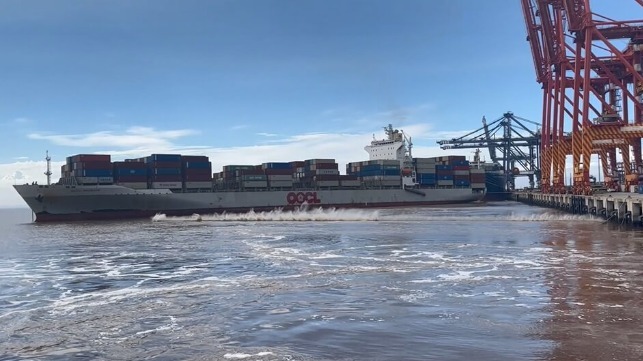
 OOCL Brisbane breaks away from the pier at Port of Brisbane (Maritime Safety Queensland)
OOCL Brisbane breaks away from the pier at Port of Brisbane (Maritime Safety Queensland)

Published Jan 29, 2025 10:05 PM by The Maritime Executive


Pilots and port officials at Brisbane have revised their rules for ship movements after two dangerous breakaways, caused by a combination of extreme river currents and hydrodynamic forces from passing ships. 

In May 2022, during an unprecented high rainfall event, a series of controlled dam releases upstream on the Brisbane River caused strong currents at the Port of Brisbane's container terminal. The currents put extra strain on the mooring lines on the boxships that were berthed alongside at the port. 

On May 16, the container ship OOCL Brisbane broke away from its berth at the port, just as it was passed by the container ship Delos Wave. All of Brisbane's mooring lines parted or paid out, and it drifted off into the Brisbane River before it was corralled and brought under control by harbor tugs. 

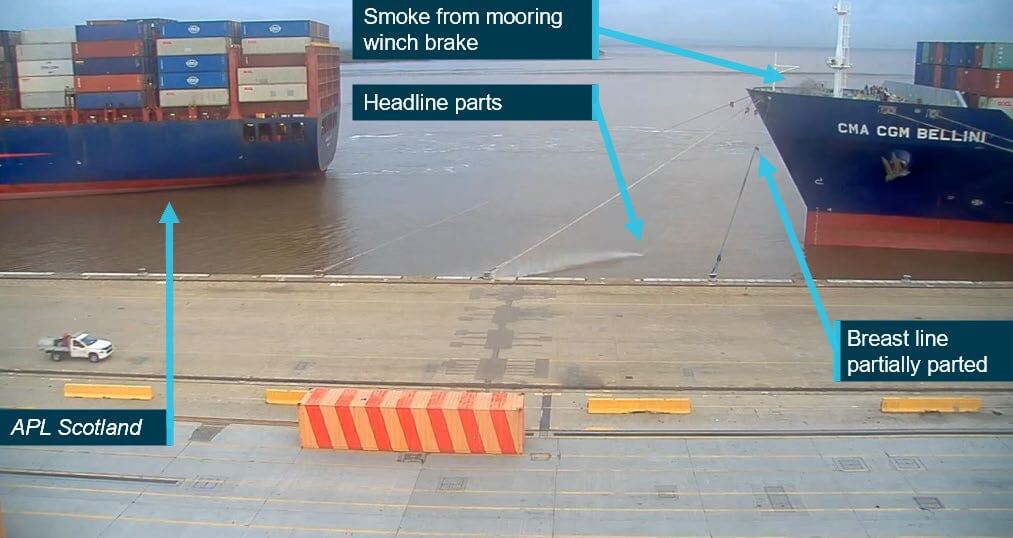
Four days later, CMA CGM Bellini's forward mooring lines parted just as it was passed by the APL Scotland, and its bow drifted off the wharf before tugs brought it safely back to the pier. 

CMA CGM Bellini breaks away (Maritime Safety Queensland / ATSB)

In both incidents, the ships were moored uneventfully for more than 20 hours without issue, then broke away as soon as a second container ship pulled alongside and berthed just ahead. Suspecting interaction forces, the Australian Transp Safety Board (ATSB) commissioned a hydrodynamic study to examine the currents and the effects of the nearby moving ships. The expert study found that the currents alone should not have exceeded the holding power of the Brisbane and Bellini's mooring arrangements, indicating that interaction forces created by the second vessel were at play. 

Delos Wave and APL Scotland both transited to their berths at normal operating speed over ground - but with the high current, they were moving faster than normal through the water. This created a larger surface displacement wave than usual, and this enhanced wave caused the moored container ships to surge and yaw at the pier - much like a moored dinghy hit by an excessive wake. 

When the approaching boxships moored just ahead, the complex current flow around their hulls and against the pier structure, combined with the wash from their propellers, added to the forces on Brisbane and Bellini until their mooring systems failed. 

“Fortunately, the ships were brought under control in both cases, and there were no injuries or substantial damage in either incident,” ATSB Chief Commissioner Angus Mitchell said. “But breakaways can have serious outcomes. These breakaways highlight the importance of robust, properly structured and clearly defined emergency and risk management arrangements for managing port shipping movements outside of normal operating conditions."

Brisbane's pilots and port authorities have adjusted their operating procedures to account for flood events, and advised that ship movements may be restricted for safety when necessary during extreme environmental conditions. 


Trump: U.S. Will Order 40 Big Icebreakers for the Coast Guard

Polar Security Cutter (illustration courtesy Bollinger)

Published Jan 29, 2025 7:24 PM by The Maritime Executive


In a speech last week in North Carolina, President Donald Trump suggested that the U.S. would soon be ordering 40 big icebreakers for the Coast Guard, and that Canada wants in on the deal. 

Asked about U.S. trade relations with Britain, Trump gave his thoughts on why Canada should become the 51st U.S. state. The U.S. is losing too much money to Canada on trade deficits, he said, and joining the U.S. would mean lower taxes (and no U.S. tariffs) for Canadians.

"Why are we paying all of that money to Canada when, you know, we — we could use it ourselves, right? You know, we ordered — we’re going to order about 40 Coast Guard big icebreakers. Big ones. And all of a sudden, Canada wants a piece of the deal. I say, 'Why are we doing that?'" Trump said. "I mean, I like doing that if they’re a state, but I don’t like doing that if they’re a nation. . . . I would love to see Canada be the 51st state."

The U.S. Coast Guard currently has funds from Congress for a planned three-vessel order for the Polar Security Cutter program, built by Bollinger. The first was approved in late December after years of delay, and the program faces cost overruns. The service's last icebreaker study suggested a need for at least three more medium icebreakers in addition to the current program of record, and its regional icebreaker fleet for the Great Lakes is also advancing in age. 

At present, the service's seagoing fleet has one heavy icebreaker and one medium icebreaker - both aging - and one "bridging strategy" icebreaker, a commercial conversion that will fill gaps until delivery of the first Polar Security Cutter. 

Canada has had prior involvement with America's icebreaker ambitions. Last year, under the previous administration, the U.S., Canada and Finland announced an icebreaker technology-transfer initiative called the ICE Pact (Icebreaker Collaboration Effort). Finland's Helsinki Shipyard is the recognized leader in icebreaker construction outside of Russia, and it was recently purchased by Davie, the Canadian shipyard that holds Canada's "program icebreaker" contract. Davie has pledged to invest in a U.S. facility to build icebreakers for the international market, once it secures the right shipyard partner. 

"It is about providing the capability for like-minded nations to uphold international rules, norms, and standards to sustain peace and stability in the Arctic and Antarctic regions for generations to come," the three nations said in a statement at the time. 

IRONIC

Japanese Coal Carrier Completes First Trip with Retrofitted Rotor Sail

bulker with rotor sail
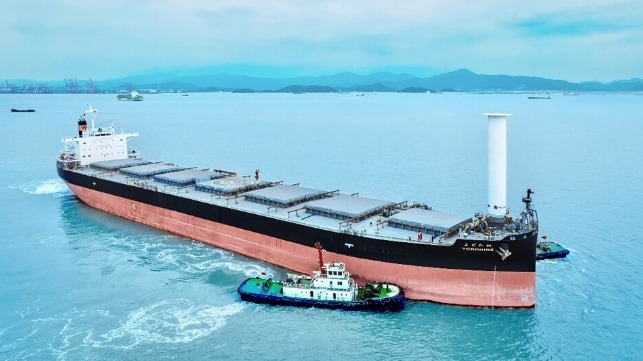
Large bulker made its first trip with the retrofitted rotor sail (Norsepower)

Published Jan 29, 2025 6:53 PM by The Maritime Executive


A coal carrier operating for Japan’s Iino Lines and power company J-Power completed its first voyage after the installation of a rotor sail manufactured by Norsepower. It is part of an effort by the Japanese shipping industry to accelerate the use of technologies to cut emissions and it was also one of the first large bulkers to be fitted with a rotor sail.

The companies announced the plans to fit the rotor sail on the bulker Yodohmie in July 2023 reporting at the time it was the first application of the rotor sail on a dedicated coal carrier. As the technology has gained greater acceptance, others including Mitsui O.S.K. Lines, Tufton, U-Ming, Vale, BHP, and Berge Bulk each moved forward with projects employing rotor sails.

The Yodohmie (85,000 dwt) was built in Japan in 2016 and the rotor sail installation took place in December 2024. The vessel, which is 757 feet (229 meters) in length, was fitted with a single rotor sail placed near the bow. Norsepower reports it is 24 x 4 meters (79 x 13 feet) and is expected to reduce fuel consumption and CO2 emissions by approximately 6 to 10 percent. The first trip was completed in January 2025 deploying the rotor sail.

The Norsepower Rotor Sail is a modern adaptation capturing the Magnus effect generated when wind meets the rotating cylinder to produce propulsive force. Nortsepower highlights it utilizes AI technology to automatically control the rotation, direction, and speed of the rotor while incorporating real-time meteorological information, such as wind direction and wind speed. The data is fed to the system with sensors that measure the wind while a small amount of power from the ship slowly revolves the rotor.

Iino Lines highlights this is the second vessel the company has equipped with a Norsepower Rotor Sail. Last November, it fitted a rotor on a very large gas carrier, Oceanus Aurora (58,495 dwt). This is the first application of wind-assisted propulsion for J-Power. The company is pursuing other wind-assisted propulsion applications with MOL and its rigid sail as well as the “K” Lines and the sail concept. 

Norsepower highlights the growing support for wind-assisted propulsion in the commercial shipping industry. The company, which started in 2012, reports it has completed 30 rotor installations on 17 vessels. Within the next 18 months, the company reports 42 additional units are scheduled to be installed on 15 ships. 

HEARD IT ALL BEFORE

Tesla Reassures Investors With Growth Pledge, Robotaxi Rollout

By Kara Carlson, 
Bloomberg News
January 29, 2025

(Bloomberg) -- Tesla Inc. revealed plans to begin robotaxi operations and forecast a sales recovery this year, fueling what Elon Musk predicted would be an “epic” period of growth for the electric vehicle maker.

The chief executive officer cited advancements in vehicle autonomy and new model plans, and in its earnings report the company predicted a “return to growth in 2025.” Musk described a future that focused on driverless cars, humanoid robots and artificial intelligence. The comments largely sidestepped the actual sales and profit results, which missed Wall Street’s expectations for the final three months of a tumultuous 2024.

Tesla plans to launch its autonomous ride-hailing service in Austin in June and then in other cities by the end of the year.

“This is not some far off mythical situation,” Musk said on the company’s call with analysts. “It’s literally five months away.”

The shares rose 4.4% at 6:54 p.m. in extended New York trading. The stock’s value has climbed more than 80% since the last time Tesla reported earnings, highlighting how investors are looking past financial results and are using the company as a vehicle to invest in the prospects of Musk himself.

Tesla offered few new details on key questions, such as the impending launch of a more-affordable vehicle or specifics on the company’s sales forecasts. Musk spent much of the call talking about Optimus, Tesla’s humanoid robot, while downplaying the impact of costly manufacturing changes and last year’s first annual decline in vehicle sales in over a decade.

“We’re building the manufacturing lines and I think setting up for what I think will be an epic 2026 and a ridiculous ’27 and ’28,” Musk said. “Ridiculously good. That is my prediction.”

Musk steered clear of US politics, a marked change from previous earnings calls that waded into inflation, industrial policy and the US election. Musk donated more than $250 million to support President Donald Trump’s election and other Republican causes, making him the largest private donor and vaulting him into prime position as a key adviser to Trump and the leader of a new cost-cutting initiative named the Department of Government Efficiency, or DOGE.

Minutes before the earnings call started, Musk was rapidly firing off X posts on his social media service about President Trump’s recent moves to cut the federal workforce and deport undocumented immigrants. Musk paused posting on X for the duration of the call, but started again minutes after it ended with a post about Trump’s executive order cutting federal funding in K-12 schools that teach topics related to race, sex, gender or politics.

Despite Musk’s support for Trump, Tesla said it’s bracing for tariffs from the new administration.

“The imposition of tariffs, which is very likely, will have an impact on our business and our profitability,” Chief Financial Officer Vaibhav Taneja said.

The company didn’t mention Trump’s moves to overhaul US fuel-efficiency standards that give consumers incentives to buy electric and hybrid vehicles.

FSD Plans

Musk said Tesla will start offering “unsupervised Full Self-Driving” in Austin in June, adding he’s confident the service, which he described as “autonomous ride hailing for money,” will arrive in California and “many regions” of the US by the end of this year.

Related: Tesla Sounds Out Austin Officials About Driverless Fleets

Musk predicted Tesla owners would eventually be able to add their cars to the fleet unsupervised, Airbnb-style.


Tesla previously said in October it aimed to launch both unsupervised FSD and autonomous ride-hailing in California and Texas this year.

Musk pointed to regulations as a potential constraint for the service.

Tesla has long sold a suite of features that it calls Full Self-Driving, or FSD, which requires constant driver supervision and isn’t considered fully autonomous. Musk also has a track record of blowing past product timelines, particularly for self-driving technology.

Autonomous vehicles face a number of regulatory hurdles, and Tesla’s Cybercab, which lacks pedals or a steering wheel, would require an exemption from existing rules. It would be limited to 2,500 vehicles under current federal standards. Musk has previously called for a national pathway for federal approval.

States also have their own patchwork of rules for regulating autonomous vehicles, including California, where Tesla has a permit to test them with a driver. The state could be a more challenging environment than places such as Texas, which has fewer hurdles.

Tesla has given little details on how it aims to roll out the service. The Texas Department of Licensing and Regulation doesn’t currently list Tesla as a rideshare licensee. Musk said Tesla wants the service to be “way safer” than human drivers.

Tesla’s plan to sell more affordable vehicles remains on track, the company said, with production set to start in the first half of this year. The Cybercab also is on track for 2026.

The company said it plans to make the new vehicles using a mix of current production methods and a next-generation platform. The strategy will lead to higher costs than previously expected but will allow Tesla to expand vehicle volumes more efficiently during “uncertain times.”

Lowered Bar

Garrett Nelson, an analyst with CFRA, said Tesla’s outlook for vehicle sales growth this year resonated with investors because it appeared more realistic than Musk’s earlier pledge of growth for growth of as much as 30%.

“The bar has been lowered to much more achievable levels, so therefore they are much more likely to hit it going forward,” Nelson said.

He added that Musk’s relationship with Trump is also seen as a positive as Tesla focuses on autonomy and the potential for changes to federal regulations.

“Musk has the president’s ear,” Nelson said. “He’s going to have a major place at the table as far as what the regulatory framework looks like — and we think it will be favorable to Tesla.”

In other data from the company’s fourth quarter, the company reported $692 million in revenue from the sale of regulatory credits to car manufacturers that need to comply with strict pollution standards. That’s below the $739 million it reported in the previous quarter.

Adjusted earnings were 73 cents a share for the quarter, missing analysts’ average estimates of 75 cents.

Taneja said that the net income was impacted by a $600 million mark-to-market benefit from Bitcoin due to the adoption of new accounting standards for digital assets.

--With assistance from Dana Hull and Richard Clough.

©2025 Bloomberg L.P.
Amazon closures a ‘slap in the face’ to Quebec workers, union says

More than 1,700 full-time employees will lose their jobs as the e-commerce giant is to close all operations in the province, including its warehouses

Author of the article:Jane Switzer
Published Jan 22, 2025 •
FINANCIAL POST

An Amazon warehouse in Montreal's Lachine borough,
 on Wednesday January 22, 2025. 
Photo by John Mahoney/Postmedia

Amazon.com Inc. announced on Wednesday that it will close all its Quebec warehouses and lay off about 1,700 full-time employees — a move the union representing workers at the e-commerce behemoth’s only unionized Canadian facility called a “slap in the face for all workers in Quebec.”


“Following a recent review of our Quebec operations, we’ve seen that returning to a third-party delivery model supported by local small businesses, similar to what we had until 2020, will allow us to provide the same great service and even more savings to our customers over the long run,” Amazon spokesperson Barbara Agrait said in a statement via email. “This decision wasn’t made lightly, and we’re offering impacted employees a package that includes up to 14 weeks’ pay after facilities close and transitional benefits, like job placement resources.”


Bank of Canada cuts interest rate to 3% amid trade uncertainty with the United States

Amazon opened its first Quebec warehouse in 2020, expanding to a total of seven facilities in the province: one fulfillment centre, two sorting centres, three delivery centres and one AMXL fulfilment centre that handles large and heavy items.

The closures will also affect about 250 temporary seasonal employees whose contracts already specified end dates. Temporary seasonal employees will be compensated until the last day of their contract, Amazon said.

Amazon employs more than 46,000 full-time and part-time workers across Canada in its warehouses, technology hubs and corporate offices, according to its website.


Recommended from Editorial
l
Unions organizing Amazon warehouses in Canada face uphill battle: experts

Quebec Amazon warehouse workers union application certified


The DXT4 warehouse in Laval is the only unionized Amazon facility in Canada and received accreditation in May after two years of organizing with the Confédération des syndicats nationaux (CSN). Since July, the union had been working to negotiate a collective agreement.

CSN said in a statement that it learned about the closures on Wednesday morning via email from one of Amazon’s lawyers, and that “there is no doubt that the closures announced today are part of an anti-union campaign against the CSN and against Amazon employees.”

Amazon to close Quebec facilities, insists it's not because of new union

Nearly 2,000 employees will lose their jobs
Amazon has announced it will close all of its operations in Quebec, resulting in nearly 2,000 people losing their jobs. The decision has some questioning the timing of the closure because one of the facilities had recently unionized.

Amazon announced on Wednesday it will shutter its facilities in Quebec in the coming weeks and cut nearly 2,000 jobs, 1,700 of which are permanent positions.

A company spokesperson said Amazon will outsource deliveries to smaller contractors. The spokesperson insisted that the decision was tied to cost savings — not the recent unionization of about 300 employees at a Laval, Que., warehouse.

"Following a recent review of our Quebec operations," the spokesperson said in an emailed statement, "we found that returning to a third-party delivery model supported by local small businesses, similar to the one we had until 2020, will enable us to offer the same excellent service and deliver even greater savings to our customers in the long term."

It was not immediately clear when Amazon would close its facilities, but the spokesperson told Radio-Canada it would happen in the "next two months."

A Quebec Employment Ministry spokesperson said Wednesday that Amazon Canada issued a notice of collective layoff affecting 1,997 employees across seven locations. Amazon also shared the layoff dates, which are as follows:Laval (DXT4): 287 employees, Feb. 8.
Saint-Hubert (HYU1): 38 employees, Feb. 8.
Lachine (DXT6): 319 employees, Feb. 8.
Laval (DXT5): 268 employees, Feb. 8.
Saint-Hubert (YUL5): 371 employees, Feb. 15.
Lachine (YUL2): 358 employees, March 15.
Coteau-du-Lac (YUL9): 356 employees, March 22.

Dozens of unionized Amazon employees in Laval, Que., participated in a demonstration of solidarity in December as talks continued between CSN and the company for the first collective agreement. (Rowan Kennedy/CBC)

Quebec is home to Amazon's only unionized workforce in Canada. Workers in Laval unionized last year, saying they were dissatisfied with what they described as a hectic work pace, low wages and inadequate health and safety measures.
Union denounces decision

The CSN, the union federation that represents the workers, released a statement denouncing the closures.

The union said it had learned of Amazon's decision to close its Quebec facilities early Wednesday when it received an email from an Amazon lawyer.

"This decision makes no sense whatsoever," CSN president Caroline Senneville said in a statement. "Neither from a business point of view, nor from an operational point of view. Amazon, one of the most integrated companies between the click of a mouse and home delivery, would entrust all its warehousing and distribution operations throughout Quebec to a third party?"

The Amazon distribution facility in the Montreal borough of Lachine. 2024-02-19 (Charles Contant/CBC)

At the Amazon facility in Laval where workers had unionized, Nedim Sab, a supervisor, said workers were crying.

"What are we going to do now? We have to start over," he said. "I was a driver. Now I am a supervisor. Now they're going to erase everything for me."

He blamed the union for the closure. He said Amazon had been very unhappy about the unionization efforts and he said he didn't see the need for a union. His salary, he said, was over $23 per hour.

"I don't think this job needs to get unionized," he said. "Amazon is really not happy with the union. I don't know, it's so sad."

TimelineA brief history of Amazon in Quebec: A rapid expansion, and a union forms


Mahzad Shayegan, a dispatcher, said he and his colleagues had been told they were going to lose their jobs in two weeks. He said he would have to go on welfare.

"Looking for a job is not good now. It's not a good time," he said.

At a recent demonstration, the Laval workers said they were demanding $26 per hour, a $6 pay increase.

Amazon had said it was negotiating with the workers, but they had not yet reached a collective agreement.

The company opened its first facility in Quebec in 2020 in the borough of Lachine. It now has seven sites in Quebec, including sorting centres and warehouses. Most of them are in the Montreal area. One is in Coteau-du-Lac, about 60 kilometres west of the city.

WATCH | Here was the scene at a warehouse a month ago during contract negotiations:

Canada’s only Amazon workers’ union braces for 1st offer from employer
1 month ago
Duration1:45
After successfully unionizing in May of 2024, workers at an Amazon facility in Laval, Que., are expecting a first offer from the company in January after six months of negotiations and demands for wage increases.

In 2021, when Amazon announced five new facilities in Quebec, the company had said it was eager to expand its operations in the province, touting the need to respond to greater demand and speed up delivery times.

On Wednesday morning, workers at the facility in Lachine expressed shock and disappointment after learning of the company's decision.

"Nobody saw this coming," one worker said. "No idea what I'm going to do. I need time to digest this."

The spokesperson said the scaling back of its Quebec operations would result in the closure of all seven of its sites.

Employees will be given as much as 14 weeks' salary in severance, the company said.

Amazon became a $2 trillion company last year. It has facilities and thousands of employees across Canada.
Quebec labour laws possibly to blame, prof says

Mélanie Laroche, a professor at the Université de Montréal who specializes in the relationships between employers and unions, said Amazon's decision was not a surprise.

She said Quebec's labour laws are more restrictive on businesses than elsewhere.

Amazon currently recognizes one other union, in Staten Island, N.Y. But it has not yet reached a collective agreement with them.

In Quebec, by contrast, labour law would have obliged the two parties to negotiate a collective agreement and could have imposed arbitration on them.

"Amazon was probably confronted with that imminent arbitration demand for a first collective agreement and wouldn't have had a choice but to conclude a collective agreement," she said.

"They're deciding to close facilities in a province where, perhaps the labour laws are much more restrictive for management."

Amazon workers strike at seven U.S. locations, alleging unfair treatment

Quebec Labour Minister Jean Boulet told reporters the government will provide support to the workers who lost their jobs to help them re-enter the labour market as quickly as possible. He said there are still labour shortages in some sectors and expressed optimism that the workers would be able to find new jobs.

He declined to comment on the reasons Amazon gave for closing its Quebec facilities.

Intelcom, a Montreal-based courier and package delivery company that Amazon subcontracts for deliveries, released a statement saying only that it would continue working with Amazon to "respond to their delivery needs in Quebec."

Federal Innovation Minister François-Philippe Champagne expressed "dismay and frustration" in a post on X on Wednesday.

"This is not the way business is done in Canada," he wrote.

Amazon's shares were up on Wednesday afternoon.


Amazon Cuts Dozens of Corporate Jobs in Latest Round of Layoffs

By Spencer Soper and Vinicy Chan,
 Bloomberg News
January 29, 2025 


Caroline Senneville, president of the Federation of National Trade Unions, talks about Amazon Quebec warehouses closing.


(Bloomberg) -- Amazon.com Inc. is laying off dozens of people in its communications department, the latest culling of the corporate workforce amid executives’ efforts to cut costs and reduce bureaucracy.

“Following a recent review, we’re making some changes to the Communications & Corporate Responsibility organization to help us move faster, increase ownership, strengthen our culture, and bring teams closer to customers,” Amazon spokesperson Brad Glasser said in an emailed statement. “As part of these changes, we’ve made the difficult decision to eliminate a small number of roles. We don’t make these decisions lightly, and we’re committed to supporting affected employees through their transitions.”

Chief Executive Officer Andy Jassy has axed tens of thousands of corporate jobs and killed a variety of moonshot projects since succeeding founder Jeff Bezos in 2021.

Amazon initiated its biggest-ever corporate job cuts in 2022, which ultimately affected 27,000 positions across the company. There has since been a series of smaller rounds of layoffs targeting particular departments and roles.

A mandate for corporate workers to report to the office five days a week this year was seen by many employees as a way to force resignations without going through the expense of layoffs despite Jassy’s assertions that the effort was about reinforcing the company’s culture.


When Jassy announced the RTO mandate in September, he also set a goal for executives to reorganize their business units to reduce the ratio of managers to “individual contributors” by the end of March.

©2025 Bloomberg L.P.
Chinese Companies Set New Records in Overseas Renewable Deployment

By Irina Slav - Jan 28, 2025

Wood Mackenzie reported this week that Chinese power generation capacity developers completed some 24 GW of new capacity across more than 150 countries.

Even though it added a record amount of new wind and solar capacity at home and built a lot of new wind and solar capacity abroad, China last year booked a record in coal-powered generation.

Despite the large renewable capacity additions, coal and gas fired capacity will be hard to phase out.


China installed a record amount of wind and solar capacity at home last year, data showed earlier this month. Yet, the country did not stop there. Chinese companies also installed record power generation capacity abroad as well—and half of it was neither wind nor solar.

Wood Mackenzie reported this week that Chinese power generation capacity developers completed some 24 GW of new capacity across more than 150 countries that are part of China’s Belt and Road Initiative. The number compared with just 10 GW installed in 2023 and 22 GW installed in 2022, Wood Mac said.

A little more than 50% of that total was wind and solar, which must have made climate activists happy—but not too happy because the rest of this new capacity will run on coal, gas, and crude oil. The combined Belt and Road countries’ new generation capacity fired by hydrocarbons rose from 3 GW in 2023 to 12 GW last year. China also installed 8 GW of new solar capacity in Belt and Road Initiative countries last year, as well as 5 GW of new hydropower capacity.

These figures reflect a trend that is also evident in transition-oriented Western countries: gas generation will be hard to shake off, and so will coal generation. The latter was recently demonstrated by Germany, where the chief executive of grid operator Amprion said this month coal plants will need to be kept on standby for longer than previously expected.

“Some of these plants currently only have an operating perspective until 2026, the vast majority until 2031,” Christoph Mueller said, referring to the coal plants on standby. “We should do a proper analysis now in case we need these power plants for longer,” the executive added.

Related: China Breaks Nuclear Fusion Record, Again

Coal, gas, and nuclear remain the only kind of baseload capacity that can balance the grid when demand and supply from wind and solar do not match—because the grid must be matched every second of every hour every day. Clearly, Chinese power plant operators know this, and they are exporting that knowledge to Belt and Road Initiative countries after applying it at home as well.

Even so, China has been prioritizing gas over coal since President Xi Jinping vowed in 2021 to end funding for coal-powered facilities. Indeed, many projects have been canceled since then, but by no means all. China has continued building coal-fired power plants both at home and abroad, and, according to Wood Mackenzie, there are still some 19 GW of future coal capacity in the pipeline. Since the pledge, however, a total of 42.8 GWS of new coal capacity has been canceled, according to the Centre for Research on Energy and Clean Air, which tracks these projects.

However, Chinese companies are investing a lot more in wind and solar energy abroad—hardly a wonder given that China is the total dominant power in both solar and wind technology on a global level. “Chinese companies are heavily prioritizing greener technologies overseas,” Alex Whitworth, vice-president and head of Asia-Pacific power and renewables research at Wood Mac, said, as quoted by the South China Morning Post. With costs declining, “[they] are leading its deployment in many developing markets that could not previously afford it,” Whitworth added.

Interestingly, even though it added a record amount of new wind and solar capacity at home and built a lot of new wind and solar capacity abroad, China last year booked a record in coal-powered generation. The total for 2024 stood at 6.34 trillion kWh, which was 1.5% higher than the total for 2023. Although the growth rate was the weakest in close to ten years, the fact of the record stands, reinforcing the perception that coal is going nowhere despite forecasts that consumption of the hydrocarbon fuel was nearing its peak in China.


By Irina Slav for Oilprice.com
China's Search for a New Economic Engine

By City A.M - Jan 29, 2025, 

China is shifting its economic focus away from real estate towards new core industries like electric vehicles, robotics, and semiconductors.

Despite US tariffs and a property market collapse, Chinese equities outperformed other emerging markets in 2024 and are expected to grow further.

Government stimulus and subsidies are aimed at boosting domestic demand and transforming China into a high-income country.


As China welcomes in the new year today, markets are hopeful that the government’s strategy of ‘short term pain for long term gain’ is enough to push the Chinese economy to a new stage of development.

In traditional Chinese culture, the Year of the Snake embodies qualities of introspection, transformation and adaptability.

That year seems fitting for 2025, as after three years of decline, the Chinese equity market delivered a positive return in 2024 and outperformed the majority of other emerging markets. It hopes to achieve even more this year.

Turning things around is the core message out of the mouths of China analysts, with the government abandoning support for the country’s real estate market in the hope that new industries will emerge.

Meanwhile, Chinese equities still trade at a 30-40 per cent discount comparing to other emerging markets (and more than 50 per cent discount to the US) on a price-to-earnings basis, leaving stockpickers eager to scoop up cheap shares.

Real estate in China

The primary focus of Western investors for China has been its unstable property market that is currently in the midst of collapse.

Naturally, markets are obviously concerned over a government willingly letting a property bubble pop, and analysts credited China’s low prices in part to the crisis.

“At its peak, real estate accounted for 20 to 30 per cent of GDP, and that’s coming down quite significantly, so that’s going to have a big drag on the economy,” explained Sharukh Malik, manager of the Guinness Greater China Fund.

In response to the rapid fall, the Chinese government has walked back some policies that caused the property bubble collapse, and monthly property sales data saw positive rebound in the autumn.

Since then, sales growth started to moderate and many cities, especially in the lower-tier, have turned negative again this month.

“The sense is that policy easing released some pent-up real demand, but it hasn’t been sustained as consumer confidence remains weak,” explained Xin-Yao Ng, co-manager of Abrdn’s Asia Focus trust.

However, a significant amount of the credit that was being extended to the real estate sector is now being diverted towards new core industries, with the aim of pushing China up from a middle-income country to a rich country.

“From a policymaker’s perspective, China’s GDP is $12,000 per person. What will take that to $30,000 and make China rich?,” asked Malik.

“It’s not real estate, because no country in history has become wealthy that way. It’s not other areas which investors have traditionally liked, like video games or e-commerce.”

Instead, Chinese policymakers are targeting subsidies at key areas up the value chain, such as electric vehicles, low to mid-end robots, the chip sector and the pharmaceutical industry, in the hope that the country can endure short term pain for long term gain.


New industries


“Chinese companies are becoming increasingly competitive at a global scale. They are transforming from producers of cheap, low-quality goods to leaders in a number of globally critical industries,” explained Qian Zhang, investment specialist at Baillie Gifford China Growth Trust.

Zhang pointed to a variety of Chinese firms competing with western companies, from white goods producer Midea and battery giant CATL, to the world’s largest electric car maker BYD.

“Western semiconductor restrictions have also forced a new collaboration mechanism among Chinese semiconductor companies and some domestic leaders are starting to emerge,” she added.

As a result, Malik predicted that these areas would slowly increase in productivity, eventually overtaking the real estate market in value by as soon as the end of next year.

Analysts were confident that the government was planning to introduce wider fiscal stimulus for these industries, primarily to boost domestic demand.

“What is encouraging for us is there have been clear signs of a policy pivot from Beijing since last September, with a coordinated ‘pro-growth’ push from both monetary and fiscal sides,” said Baillie Gifford’s Zhang.

“Policymakers recognise the risk of geopolitics on export growth, which had been the only bright spot for the economy last year,” added Abrdn’s Ng.

“I expect actions to be more responsive to measures by Trump however, in the sense that stimulus will be stronger if US measures are tougher, and lighter if Trump remains more measured than expected,” he added.

Trump’s tariffs


Despite strong words from re-elected US president Donald Trump on China, most analysts were sceptical that the tariffs will be as radical as he’s making out.

Trump has pledged to install 10 per cent tariffs on all goods from China as soon as the end of this week, but analysts expect the tough talk to be used as a negotiation tactic.

“If [Trump] does go very aggressive on tariffs, that is going to have a massive impact on the American consumer, and I think he knows that,” said Malik.

“The Americans also don’t want to cripple to Chinese economy, because that would have massive negative implications for global growth”.

Even if a trade war erupted, Malik noted that many firms in China had been preparing for this event for years, with factories and businesses moved out of China over the last decade.

In fact, despite the initial impact of the first trade war in 2018, Chinese markets rallied from 2018 to mid-2021, until radical Covid policies and regulatory crackdowns eventually scared off investors.


By City AM