Hindustan Shipyard Limited (HSL) stand
November 2, 2025
By Aritra Banerjee
When Hindustan Shipyard Limited (HSL) — India’s oldest shipyard and a Mini Ratna public sector undertaking under the Ministry of Defence (MoD) — unveiled a string of new partnerships at India Maritime Week (IMW) 2025 in Mumbai, the announcement went far beyond corporate collaboration. It reflected a strategic realignment in how India views its shipbuilding industry: not merely as an industrial base, but as an instrument of diplomacy and power projection.
For a nation with a 7,500-kilometre coastline and an expanding blue-water navy, shipyards like HSL represent the industrial backbone of maritime strategy. Their evolution from purely naval contractors into globally engaged entities marks a quiet transformation in India’s approach to state-owned defence enterprises — from inward-looking service providers to outward-facing partners in regional capacity-building.
From Industrial Legacy to Strategic Asset
Founded in 1941 and later brought under MoD control, HSL in Visakhapatnam has long been synonymous with India’s naval support infrastructure — known for submarine refits, fleet repairs, and auxiliary vessel construction.
Yet, what makes its participation in IMW 2025 significant is the shift in narrative: HSL is no longer projecting itself as an isolated yard but as a state-owned bridge between India’s defence industry and the wider Indo-Pacific commercial maritime network.
Its new agreement with MCI World LLC, Dubai, to extend ship-repair operations across the Middle East and North Africa (MENA) region, opens a strategic corridor between Visakhapatnam and the western Indian Ocean. The partnership is not simply commercial — it strengthens India’s position in a region that has long been dominated by European and East Asian ship-repair hubs.
By situating an MoD-run enterprise in that competitive geography, India is signalling its readiness to participate in the global repair and refit economy — an area increasingly shaped by green mandates, digital systems, and rising fleet renewal costs.
Green Technologies and Digital Skilling
At the same event, HSL signed multiple MoUs that emphasise the direction of India’s maritime policy. Collaborations with the Indian Ports Association and Lotus Wireless India Pvt. Ltd. under the Green Tug Transition Programme will see the development of hydrogen- and electric-propelled tugs. A partnership with the Centre of Excellence in Maritime and Shipbuilding (CEMS) will deliver training in artificial intelligence, robotics, and additive manufacturing — embedding Industry 4.0 practices into maritime engineering.
These are not peripheral add-ons; they indicate how India’s public-sector shipyards are being retooled for a carbon-neutral and digitally networked future, aligning with global decarbonisation trends while building domestic skill capital. In a sector once defined by manual labour and legacy design, this digital shift carries strategic weight: it turns industrial capability into a form of soft power, one that can be exported through joint ventures and technology partnerships.
Public-Sector Modernisation and Policy Integration
HSL’s modernisation programme — including a proposed greenfield yard in Andhra Pradesh — mirrors a broader transformation within India’s defence PSUs. For decades, these entities functioned in silos, tethered to domestic procurement cycles. Now, guided by Atmanirbhar Bharat and the Maritime Amrit Kaal Vision 2047, they are being repositioned as globally competitive institutions capable of contributing to both defence exports and commercial markets.
Participation in DG Shipping deliberations on financial-assistance and credit-risk schemes further demonstrates the MoD’s willingness to let its enterprises shape policy, not merely implement it. The message is subtle but clear: India’s maritime statecraft increasingly depends on industrial coherence between civilian and defence agencies.
Maritime Diplomacy in Action
The MENA partnership has particular geopolitical resonance. The Gulf region, home to some of the world’s busiest ports — from Jeddah to Fujairah — sits astride India’s critical energy and trade lifelines. By inserting a government-owned Indian entity into this ecosystem, New Delhi is quietly extending its industrial diplomacy into the same spaces where it already practices naval diplomacy through exercises, logistics pacts, and humanitarian missions.
This dual-track approach — where the same geography is engaged through both ships of war and yards of work — embodies India’s maturing Indo-Pacific strategy. It demonstrates that maritime influence can be exercised not only through presence and patrols but also through production, repair, and partnership.
A Regional Maritime Power in the Making
Globally, ship repair and retrofitting have become high-margin segments, with rising demand as fleets modernise to meet new emissions and automation standards. India’s cost-effective engineering, its skilled technical workforce, and its expanding network of defence PSUs position it to capture a share of this market. According to the government’s Maritime Vision 2047, the country aims to triple its ship-repair capacity within the next decade and create green corridors linking domestic and overseas operations.
HSL’s foray into the MENA corridor therefore represents a microcosm of this ambition — using a defence enterprise to enter a civilian market while maintaining strategic oversight.
For nations across the Global South seeking reliable partners in maintenance, refit, and training, India’s state-run model offers an alternative to the heavily subsidised Chinese shipyard complex.
At a time when the Indo-Pacific’s maritime balance is being reshaped by technology, logistics, and climate imperatives, India’s public sector shipyards have become the quiet workhorses of strategic influence. Hindustan Shipyard Limited exemplifies that evolution — from a wartime builder in the 1940s to a 21st-century node of industrial diplomacy under the Ministry of Defence.
Its participation in India Maritime Week 2025 captured a pivotal truth: India’s rise as a maritime power will depend as much on the yards that build and repair ships as on the fleets that sail them. From Visakhapatnam’s docks to Dubai’s drydocks, a state-run enterprise is carrying forward India’s maritime ambitions — one partnership, one innovation, and one green vessel at a time.

Aritra Banerjee
Aritra Banerjee is a Contributing Editor, South Asia at Eurasia Review with a focus on Defence, Strategic Affairs, and Indo-Pacific geopolitics. He is also the co-author of The Indian Navy @75: Reminiscing the Voyage. Having spent his formative years in the United States before returning to India, he brings a global perspective combined with on-the-ground insight to his reporting. He holds a Master's in International Relations, Security & Strategy from O.P. Jindal Global University, a Bachelor's in Mass Media from the University of Mumbai, and Professional Education in Strategic Communications from King's College London (King's Institute for Applied Security Studies).
The West Needs to Draw a Line on Russian and Chinese Gray-Zone Provocations
[By Jake Thrupp]
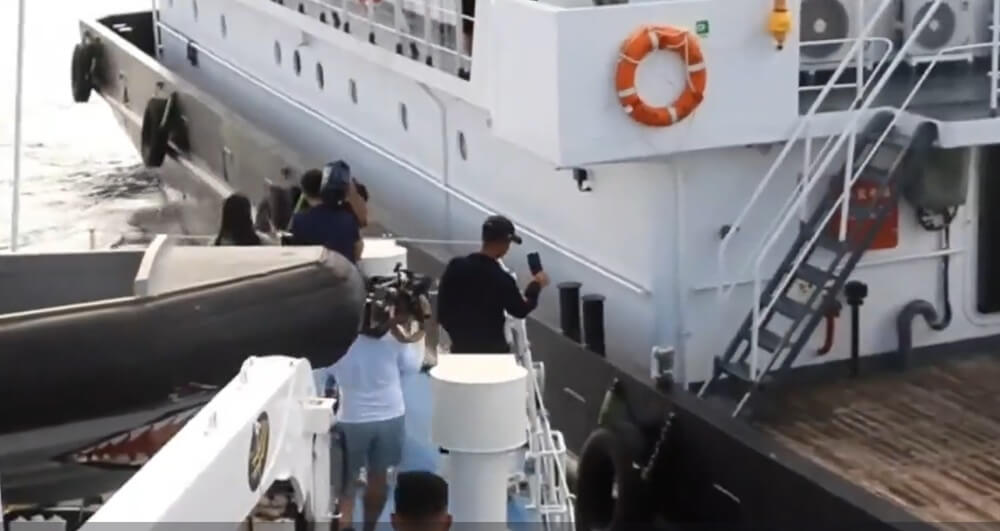
The West must draw clear red lines for responding to gray-zone aggression by China and Russia. Both adversaries have mastered operating below the threshold of open conflict to achieve their strategic aims with little consequence from Western governments. This ambiguity has eroded Western deterrence and emboldened authoritarian states to keep testing the limits of restraint.
Western leaders must define where provocation ends and aggression begins. And they must match that clarity with credible deterrent capability. Until the West decides where its red line lies, Russia and China will continue to draw it for us, as is currently the case in Europe, the Indo-Pacific and elsewhere.
ASPI’s report Unconventional deterrence in Australian strategy shines a light on this challenge, urging Australia to adopt new tools of deterrence suited to unconventional threats. The report highlights that gray-zone tactics—low-intensity actions designed to intimidate, coerce or collect intelligence—sit deliberately below the threshold of a conventional military response.
Such tactics are firmly embedded in Chinese and Russian warfare doctrine, yet Western governments have still not defined a threshold for when a response is required to such threats. As a result, authoritarian states exploit, almost daily, the West’s instinct for restraint.
Definition of a threshold is long overdue. Armed incursions into NATO airspace, deliberate interference with undersea cables, or even state-directed attacks on Western soil, such as Russia’s 2018 Salisbury poisoning, illustrate the kind of actions that should no longer be treated as ambiguous.
Strategic ambiguity is tying the West in knots. In recent months, Russian drones have repeatedly entered NATO airspace—a totally brazen act. Poland even invoked NATO’s Article 4, which allows member states to bring an issue to the organization’s council for discussion and potentially resulting in allied decision or action. It was just the eighth time the article had been invoked in the organization’s history. Yet little has followed.
Since then, drones have crossed into Belgium, Germany, Denmark, Norway and Romania. The crescendo came when three Russian fighter jets entered Estonian airspace for 12 minutes, before retreating when Italian jets scrambled to intercept them. Again, what has NATO’s formal response been?
China and Russia also use other gray-zone tactics to target undersea cables, threatening vital global connectivity. Damaging or cutting a cable can disable communication lines between entire continents. An accidental cut would not only disrupt data traffic but would leave the West vulnerable during any conflict.
At present, Russian vessels are loitering near Taiwan, and Chinese vessels are in the Baltic Sea. In December 2024, a Chinese vessel severed subsea cables in the Baltic while dragging its anchor along the seabed. It is not cynical to think China and Russia are colluding. More troubling still, the British government concedes it has only ‘limited capabilities’ to monitor seabed traffic.
So again, where do Western governments stand on responding robustly to such tactics? At the very least they should be developing an urgent civilian-military plan for round-the-clock maritime surveillance of vulnerable undersea cable networks. This could include naval drones to monitor and guard the seabed, as well as pre-positioned cable-repair ships ready to restore connectivity.
ASPI’s report also highlights China’s growing use of maritime militia—fishing vessels operating under direct government control—to conduct what Beijing calls the ‘people’s war at sea’. Since taking power, Chinese President Xi Jinping has subsidized provincial and local governments to significantly increase local fleets. These vessels are deployed in the South China Sea, alongside Chinese navy and China Coast Guard vessels, to promote Chinese expansionism.
This sea power is a serious regional threat, to Australia and many East and Southeast Asian states whose maritime trading routes could be easily disrupted. Australian Director-General of National Intelligence Andrew Shearer has warned that we are already engaged in gray-zone warfare with our adversaries. The task now for Western governments is to set the rules of engagement and build a deterrence that is immediate, integrated, and unconventional.
Jake Thrupp is a senior communications adviser in the UK Parliament. He holds an MA in National Security Studies from King’s College London and currently reads international relations at the University of Cambridge.
This article appears courtesy of ASPI and may be found in its original form here.
Maritime Statecraft and its Future
[By Steve Brock and Hunter Stires]
With shipping and shipbuilding receiving high-level political and diplomatic attention across two administrations after decades of neglect, the United States has the chance to realize a much-needed maritime revival. Having initiated a change in course from the past forty years of stagnation, Washington should double down on its winning bipartisan strategy to build maritime power through allied investments in U.S. shipping and shipbuilding—and keep off the rocks and shoals that could run the nascent American maritime renaissance aground.
History demonstrates that no great naval power has long endured without also being a great commercial maritime power. Yet for the past four decades, America has attempted to defy this maxim, starting in 1981 with the choice to cut off government support for American commercial shipping and shipbuilding, allowing those industries to wither at home and ultimately move abroad. Since that decision, successive administrations of both parties have lulled themselves into the false reassurance that in this latest era of globalization the United States did not need a vibrant commercial maritime industry, and that America would still be able to affordably field a dominant Navy without one. Similarly, the outcome of the Cold War seemed to have rendered a conclusive verdict that the American-style capitalist economy—one characterized by robust marketplace competition—was superior to the Soviet-style planned economy. Yet starting with the infamous “Last Supper” in 1993, the U.S. government and industry have effectively engineered competition out of the defense industrial base. Successive administrations of both parties have since assured themselves that real competition is unnecessary and even counterproductive to national defense, and that monopolies across most individual ship classes, aircraft types, and weapon systems would in fact be more efficient for the government to manage than a competitive business environment with multiple rival vendors.
It is now clear that these two calculations were wrong. The past thirty years of ballooning costs and delays in Navy shipbuilding programs, the growing gaps in the U.S. Merchant Marine’s capacity to support wartime contingencies, and the domestic industrial base’s inability to affordably recapitalize the reserve sealift fleet all point to the same conclusion. The twin experiments in attempting to field a blue water Navy without a commercial maritime industry to support it, and concurrently eliminating competition from the defense procurement landscape, have failed. As Colin Gray writes, “tactical mistakes may kill you today, while operational error may prove fatal in days or perhaps weeks…. A strategic error in statecraft or strategy may take years to reveal itself in its full horror.” Today the United States is experiencing the compounding consequences of two such strategic errors committed decades ago.
Over the same period that the sinews of American seapower have atrophied, China has systematically expanded its own seapower, creating globally dominant, state-backed commercial shipping and shipbuilding industries. China has used this industrial base to rapidly build the People’s Liberation Army Navy from humble coastal origins into a blue water force capable of credibly threatening the U.S. Navy at sea. Those concerned by China’s rapidly expanding navy should be even more alarmed by its ability to set the terms for the global movement of goods in peacetime or crisis using its levers in global maritime finance, shipbuilding, shipping, bunkering, port ownership, and shoreside logistics.
Washington’s decades-long run of political seablindness has not changed America’s immutable geographic relationship to the world’s oceans. The United States remains inherently dependent on the sea for political, economic, and military access to the world’s population and markets, the overwhelming majority of which reside outside North America. China’s emergence as a full spectrum maritime power – and not just a naval power – means that the United States can no longer indulge its longstanding strategic errors to mortgage its maritime future.
To address this critical national strategic vulnerability, the authors formulated and began implementing under the leadership of Secretary of the Navy Carlos Del Toro an innovative new strategy to build and apply American seapower. This approach, now known as Maritime Statecraft, begins from the recognition that naval shipbuilding, commercial shipbuilding, and commercial shipping are not distinct problem sets as they have been treated for many years, but are in fact inextricably linked parts of a national seapower ecosystem. Many of the solutions to the Navy’s most pressing challenges lie outside the Department’s own lifelines, demanding a creative, multi-pronged approach to solve them, leveraging the unique position of the Secretary of the Navy to drive results only possible through collaboration at the highest levels of government and industry. Maritime Statecraft has proven durable, with notable bipartisan continuity through the transition into the new administration.
From the perspective of naval shipbuilding, the primary objective of the Maritime Statecraft strategy is to disrupt the current broken paradigm by reinjecting real competition and best-in-class practices into the U.S. naval shipbuilding marketplace. The most effective way of doing this is to attract new market entrants in the form of world-class shipbuilders from overseas allies, incentivizing these firms to open modern dual-use commercial and naval shipyards in the United States. Introducing the integrated naval and commercial model which has proven so successful abroad necessitates creating demand among global shipping firms for U.S.-built commercial ships. Accordingly, the architects of the Maritime Statecraft strategy worked extensively with partners across the Executive Branch and in Congress to broaden government support of U.S. commercial shipping and shipbuilding on the basis of economic security rather than strictly national defense, structuring this government support to make the U.S. shipbuilding industry and the U.S. Merchant Marine economically competitive on the open international market. This expanded approach will create a broader market demand and order volume that will increase overall capacity and health across the industrial base and design enterprise. Re-creating a vibrant commercial shipbuilding industry in America will accrue significant direct benefits to the Navy, driving long term improvement and lower costs across the Naval shipbuilding portfolio. This will create an opening to invigorate and reimagine key alliance relationships at a moment of strain, offering new opportunities to strengthen the common defense while rebalancing the burdens of its maintenance to a more politically sustainable equilibrium.
Standing Into Danger
In a healthy seapower ecosystem, a national navy draws on a relatively small portion of a nation’s overall physical and human maritime resources—shipyards, suppliers, industry workers, and mariners. The majority of those resources are typically devoted to building prosperity through domestic and overseas commerce, creating both the taxable wealth and competitive industrial base that also pays for and builds the Navy. From the Navy’s perspective, such a healthy system enables construction and maintenance of warships at much lower cost, since shipyards and suppliers would distribute their overhead costs to both civilian and government customers, as opposed to just the government.
At present, the American seapower ecosystem is out of balance. The U.S. Navy is the nation’s primary buyer of large ships, with a fleet of 297 battle force warships plus another 130 Military Sealift Command auxiliaries. By contrast, the U.S. Merchant Marine has just 177 commercial ships out of more than 60,000 merchant ships on the world’s oceans today. This reduces the United States to being a strictly naval power and a maritime consumer—dependent on foreign-built and foreign-controlled commercial fleets to move American trade.
A key factor in creating these conditions has been the elimination of internationally competitive U.S.-built and U.S.-flagged commercial shipping over the past forty years. While it has long been more expensive to build commercial ships in the United States and operate them under the U.S. flag, for most of the 20th century an interlocking system of imperfect but intelligent government interventions in the commercial shipping and shipbuilding sectors served to fully offset the higher cost of U.S. ships and mariners relative to foreign counterparts, either through construction and operational differentials in peacetime, or direct government construction of standardized commercial ships during the World Wars. These measures enabled U.S. shipping companies to compete for cargo on the international market at prevailing rates.
Unfortunately, flaws in the subsidy system’s structure, particularly its lack of competitive incentives and its reliance on inaccurate government estimates of foreign ship construction and operating costs, contributed to a loss of effectiveness, and eventually a collapse in political support for the program. In 1981, the Reagan Administration repealed the Operational Differential Subsidy and defunded the Construction Differential Subsidy under the belief that a free-market approach would produce better results and inspire other nations to drop their subsidies. No other country followed suit, and so this policy choice led most of the U.S. commercial shipping sector to either close or move abroad, particularly to countries which continued subsidizing their shipping and shipbuilding industries. This in turn resulted in a wholesale collapse of demand for the U.S. shipbuilding industry, apart from the naval and relatively small domestic commercial Jones Act markets.
While the Clinton Administration created the Maritime Security Program (MSP) in the 1990s to provide a stopgap source of militarily useful commercial sealift in international trade, this program has proved a poor substitute for the prior method of fostering development of a healthy U.S. Merchant Marine. MSP supports a hodgepodge of used, foreign-built ships lacking fleetwide standardization, with the fleet sized to support strictly military requirements for a 1990s-era regional contingency in a permissive maritime environment. MSP’s model of a partial operational subsidy supplemented in peacetime by government preference cargo effectively caps the size of the U.S.-flag merchant fleet at however many ships U.S. government preference and military cargo can economically support in peacetime. It does not factor in the larger requirements for assured sealift for U.S. economic security in either peace or war. MSP is not structured to incentivize U.S. shipping firms to become more competitive over time and, most damaging of all, does nothing to create demand for a competitive U.S. shipbuilding industry.
The resulting situation presents a number of troubling implications for Navy shipbuilding. To begin with, the Navy bears the brunt of virtually all the overhead costs of the shipyards that build and maintain warships, since the Navy is those companies’ primary, if not only customer. Accordingly, the remaining naval-focused shipbuilding industry has sized itself based on what the Navy’s peacetime steady-state procurement budget can economically support. As a result, even though threat-informed studies and Congress consistently signal support for a bigger Navy, the national industrial base lacks the commercial capacity that a healthier ecosystem would be able to draw upon to surge to meet an influx of new naval demand.
The loss of the commercial shipbuilding sector has been compounded by the consolidation of the defense industrial base after the Cold War. These two developments have had the combined effect of all but eliminating real competition between shipyards. The U.S. naval shipbuilding sector has become an uncompetitive series of monopoly-monopsony relationships, with only one yard building a given ship class (the sole exceptions being destroyers and attack submarines, which have duopolies) and the U.S. government as their sole customer. This lack of competition allows shipyards to drive up the prices they charge the Navy while also reducing those companies’ incentives to find efficiencies or make needed capital investments, such as facility modernization.
“We Must Bring Our Shipbuilding Allies to us”
By contrast, South Korean and Japanese yards are engaged in a commercial deathmatch with China’s state-backed juggernaut for control of the global commercial shipbuilding market. This unrelenting competitive environment forces yards to invest in state-of-the-art technology and production processes. Intense commercial competition has compelled such a high degree of effectiveness that these three countries now produce 90 percent of the world’s commercial ships. Importantly, their broad international customer bases and integrated naval and commercial facilities allow Chinese, South Korean, and Japanese shipbuilders to effectively subsidize their national naval production with the profits from their commercial work, increasing the purchasing power of their respective national navies. Using their robust dual-use yards, Korean and Japanese shipbuilders are able to construct high-end Aegis surface combatants of respected quality for a fraction of the cost of U.S. equivalents.
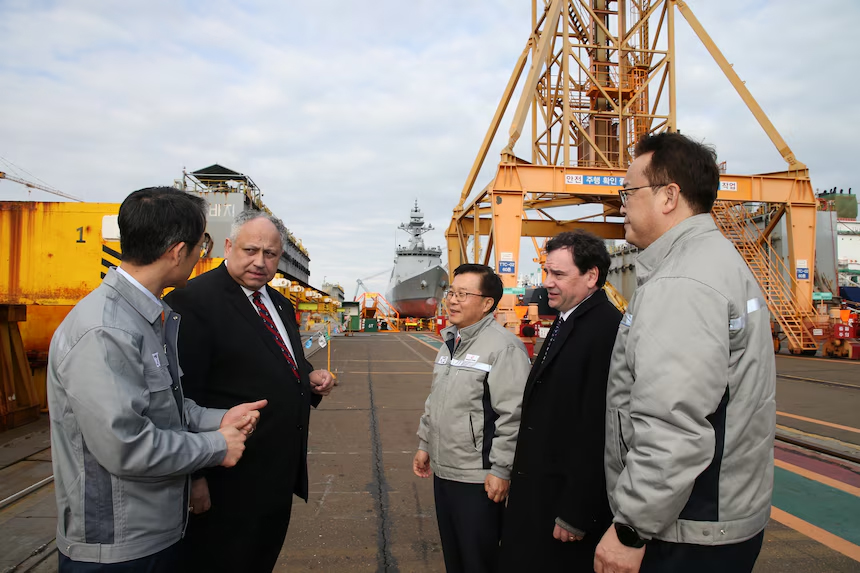
The competition in Asia has technological implications as well. Many U.S. shipyards are decades behind the global technological standard set by Korean and Japanese shipbuilders, which was clearly evidenced during a firsthand visit to the facilities of HD Hyundai and Hanwha Ocean by Secretary Del Toro in February 2024. The highly automated shipbuilding and sea trial technologies in use at these facilities are more advanced than anything now in operation in the United States. Unlike their American counterparts, these yards also consistently make substantial, self-funded investments in both production processes and worker quality of life, including housing and training facilities for employees and the crews of visiting ships. Both Hyundai and Hanwha reported near-perfect on-time performance—even during COVID—and can tell customers when their ships will be delivered to the day. This is a far cry from the PowerPoint slides that American shipbuilders often present in the Pentagon, explaining that a given vessel is going to be somewhere between one and three years late.
Given the cutthroat competition among shipbuilders in Asia and the lack of a competitive shipbuilding marketplace in the United States, this result should be unsurprising. At its best, capitalism demands that firms continually invest in innovation and adaptation to find a new competitive edge over their opponents in a Darwinian evolutionary arms race. In the U.S. shipbuilding sector, that process of rivalry, adaptation, and renewal has mostly ground to a halt. U.S. shipbuilders demand the government pay for new infrastructure investments and workforce salary increases—while too often investing their profits into stock buybacks and dividends rather than into improving their core businesses, which are falling behind on their contractual obligations to the Navy. Building the world’s best warships in 1960s-era shipyards is unaffordable and slow, and is unacceptable if the United States is to prevail in the increasingly tense geopolitical competition for the 21st century.
It should be emphasized that outsourcing U.S. government shipbuilding overseas remains—and should remain—a non-starter. Beyond the legal requirement and political imperative to build U.S. government ships in U.S. shipyards, outsourcing new construction to yards in East Asia would be strategic malpractice, not least because the Korean and Japanese shipyards capable of producing U.S.-equivalent combatants are ranged by thousands of Chinese short and medium range missiles. In the course of the implementation of the Maritime Statecraft strategy, Asian shipbuilders and their customers around the world have increasingly come to recognize the value of “defense in depth” and geostrategic diversification of ship production and repair provided by the strategic sanctuary of the United States. One cannot discount the possibility that China could destroy the shipbuilding infrastructure of U.S. allies during a Pacific war to set the stage for even greater PRC maritime dominance in the postwar world.
Additionally, suggestions that the U.S. government might outsource shipbuilding overseas in the future—even temporarily while U.S. production ramps up—surrenders valuable negotiating leverage with major shipbuilders, reducing their incentive to open critically needed shipyards in America, which is a primary objective of the strategy. This led us to a similar approach as drove the inception of the Mulberry Harbors used in the Allied landings at Normandy in World War II. Just as the chief naval planner of D-Day recognized that “if we cannot capture a port, we must take one with us,” the Maritime Statecraft strategy is derived from the similar insight that “if we cannot build ships in the world-class shipyards of our allies, then we must bring our allies to us.” An American maritime revival requires the help of allies, but is only possible if they invest in the alliance by investing in America.
Creating a Better Paradigm
After Secretary Del Toro articulated the vision of Maritime Statecraft in a series of speeches at Columbia, Harvard, and several major naval conferences, the first step in executing this new strategy to restart competition in U.S. shipbuilding was to make contact with the leaders of the foremost Korean and Japanese shipbuilders who build both commercial and naval vessels. This began in February 2024 via meetings in Seoul led by Secretary Del Toro with the Vice Chairmen and CEOs of Hanwha and HD Hyundai, followed by tours of their respective shipyards. Our central message going into each of these engagements in Seoul and Tokyo was a simple, yet profound opportunity – invest in America.
The response has been remarkable and swift. Just over three months after engaging with the Secretary in South Korea, Hanwha announced that it had reached a deal to acquire the Philly Shipyard, a former naval facility now building commercial ships, and successfully closed this transaction in December 2024. Hanwha has since announced plans to invest $5 billion to expand the yard’s facilities, update its technology and production processes, and create more than 7,000 new jobs in order to multiply output tenfold over the next decade and compete for both commercial and naval shipbuilding contracts. Since the Philly Shipyard has not built a naval vessel since 1970, restoring this facility to the naval-facing industrial base will be a significant capacity expansion and value-add for Navy shipbuilding.
HD Hyundai has also taken steps to engage. A major accomplishment was brokering a partnership between HD Hyundai, Seoul National University, and the University of Michigan to create academic and professional exchange opportunities in the education of naval architects, a foundational element of a healthy white collar shipbuilding workforce. HD Hyundai has since signed agreements to collaborate with several U.S. shipyards serving both the naval and commercial markets, and has now publicly announced its intent to acquire of a U.S. yard of its own. Seeing the growing momentum and opportunity of Maritime Statecraft, Davie Shipbuilding of Canada and Finland reached out and met with Secretary Del Toro on multiple occasions, and in July 2024 announced intentions to purchase a U.S. shipyard (subsequently announced to be Gulf Copper and Manufacturing Corporation in Texas) to bring the firm’s world-class icebreaker capabilities to bear on U.S. government programs. Bringing the advanced technologies, production processes, and dual-use commercial and naval business model that have been so successful abroad to American shores heralds a paradigm shift that will transform the U.S. competitive marketplace and incentivize modernization investments by legacy players.
Creating a business case for dual-use shipbuilding in the United States also requires incentivizing commercial demand. The first step on this line of effort was to leverage existing government programs to create favorable options both for dual-use shipbuilders looking to finance investments in their businesses as well as prospective ship buyers looking to finance purchases of U.S.-built vessels. In the spring of 2024, after a year of collaborative engagement and negotiation, the Department of Energy’s Loan Programs Office expanded the eligibility of its multibillion-dollar Title 17 Clean Energy Financing and Advanced Technology Vehicle Manufacturing Programs to include the maritime industry. Title 17 Clean Energy Financing allows for commercial ship buyers to secure Treasury rate loans and loan guarantees to purchase U.S.-built ships that achieve a 10 percent improvement in carbon emissions over legacy single-fuel diesel ships. The Advanced Technology Vehicle Manufacturing Program enables dual-use shipbuilders and secondary suppliers to secure financing at Treasury rates for technology improvements, plant expansions, and other investments in their production facilities.
At home, another important line of effort was recruiting unions as critical partners and stakeholders to advance the strategy across multiple lines of effort. The United Steelworkers led the way in catalyzing the Section 301 investigation of anticompetitive Chinese shipbuilding practices, a key offensive step to push back directly on Chinese dominance of the global maritime industry while also stimulating demand for American steel at a moment when most U.S. steel plate facilities are producing at less than 50 percent of their designed capacity. Domestically, unions have also championed innovative solutions to fill blue collar workforce gaps in many American shipyards. An illustrative example is a partnership with the International Brotherhood of Boilermakers which recruits itinerant welders in the construction trades and provides them with the requisite training and certification to work on Navy shipbuilding programs during lulls in construction demand ashore. After launching a pilot program recruiting skilled welders across five midwestern states in 2024, this rotational expeditionary workforce program was quickly oversubscribed, and cohorts are now working in Newport News to deliver new aircraft carriers.
On the legislative front, the Maritime Statecraft strategy’s implementation took the form of significant technical assistance on the SHIPS for America Act co-sponsored by Senator Mark Kelly, Senator Todd Young, Representative John Garamendi, and Representative Trent Kelly, with Representative Mike Waltz and a large cross-functional working group from government, industry, and academia providing invaluable input to the drafting process. This legislation revitalizes the Title 46 authority for the Secretary of the Navy and the Secretary of Transportation to grant shipbuilding construction differentials on a competitive basis. The bill also creates a new Strategic Commercial Fleet of 250 U.S.-built, U.S.-flagged, U.S.-crewed ships in international trade that would compete for a stipend that would fully offset the higher cost of U.S. construction and operation, to be resourced through a dedicated new Maritime Trust Fund. These and other measures will help prime the pump to incentivize shipping firms to begin buying U.S. ships built by world-class shipbuilders in U.S. yards.
The next phase of the strategy was to directly engage the leaders of the world’s foremost shipowners, beginning with Secretary Del Toro’s visit to the CEO of A.P. Moller-Maersk in Copenhagen. Going into this meeting, we were aware that Maersk and a number of its European peers were discounting the strategic risk of dependence on Chinese shipbuilding and were directing disproportionate shares of their newbuild orderbooks to Chinese shipyards, which continually seek to undercut their Korean and Japanese rivals on price. At the same time, we were aware that European shipping giants were beginning to find themselves under increasing direct pressure from Chinese competitors in the shipping market, with Chinese lines the fastest growing players in the global container trade.
A key objective of our engagements with the European shipping firms was to help them better understand the connection between these two phenomena: whatever discount Chinese yards offer a European ship buyer relative to Korean and Japanese builders, Chinese yards almost certainly offer Chinese shipping firms a far steeper discount. With every new order the European firms place with Chinese shipyards, they directly subsidize the growth of their new biggest competitor in the global shipping market while placing their own companies at geopolitical risk without a fallback shipbuilding alternative outside Northeast Asia. This message is resonating. Indeed, within days of the Secretary’s meeting with Maersk, the CEO of France’s CMA CGM, the world’s third largest shipping firm, reached out to discuss expanding their U.S. footprint, beginning months of productive discussion and collaboration. In March, CMA CGM announced that they would be investing $20 billion into the United States, tripling the size of their U.S.-flag commercial fleet, and creating 10,000 new jobs.
What Must Happen Next
Maritime Statecraft has demonstrated remarkable intellectual staying power through the political transition, with its central pillars publicly embraced by President Trump, Secretary of the Navy John Phelan, and the new White House Office of Shipbuilding in engagements with South Korea and in the April 2025 executive order on Restoring America’s Maritime Dominance. The new administration’s focus on expanding on the blueprint created by its predecessor presages a lasting commitment to a long-overdue national maritime revival that will endure across future administrations of either party.
Going forward, Washington should focus its efforts on supporting and expanding the U.S. investments and commitments already made by players like Hanwha and CMA CGM, and encouraging additional dual-use shipbuilders from Korea, Japan, and Europe to follow through on contemplated U.S. investments. Congressional approval of the SHIPS for America Act and appropriations for the Strategic Commercial Fleet and the Maritime Trust Fund will provide a concrete demand signal for the long-term development of internationally competitive U.S. commercial shipping and shipbuilding. This Fall, the United States Trade Representative and the Department of Commerce must ensure effective and timely enforcement of Section 301 remedies levied on Chinese vessels calling on U.S. ports and must work to ensure that these proceeds directly accrue to U.S. shipbuilding investment needs. Once passed into law, the Maritime Trust Fund should serve as the primary vehicle for transferring the Chinese 301 duties to the build-out of U.S maritime power.
Maritime Statecraft presents an opening for the United States and its maritime partners to strengthen the foundations of coalition seapower and rebalance defense burden sharing at the same time. Investments by allies in shipbuilding in the United States is one now-proven avenue. The South Korean government in particular leveraged our engagement with its shipbuilders and trade ministry to develop its Make American Shipbuilding Great Again proposal, which proved instrumental to Seoul’s success in recent tariff negotiations. The Asia Pacific Economic Community (APEC) summit in Korea this year presents further opportunity to build on the accomplishments to date through deeper investment in shipyards and secondary shipbuilding suppliers in the United States, translating the Korea Development Bank’s promised $150 billion in shipbuilding loans and loan guarantees from paper promises into steel and concrete on American waterfronts. A presidential visit to a shipyard in Korea on the sidelines of APEC, like President Lee’s visit to the Hanwha Philly Shipyard in July, would offer a firsthand view of what Korean investment can do to revitalize the U.S. shipbuilding industry and workforce. It would also showcase the tremendous talent that the United States should incentivize to come to American shipyards with their skills and best practices. There are several steps the administration can take on devising more effective and collaborative visa and immigration programs to facilitate the entry of the managers and technical experts needed to train the U.S. shipbuilding workforce.
Beware the Rocks and Shoals
There are nevertheless challenges ahead. The biggest immediate risk is the continuing allure of foreign outsourcing that some in the national security establishment see as a quick fix to the nation’s naval shipbuilding woes. An attempt by the administration to go around Congress’s clear wishes, either now or in the future, would derail a shipbuilding strategy embraced by both political parties and instead put a restoration of American seapower out of reach. Outsourcing U.S. government shipbuilding abroad, even temporarily, as the administration has indicated it plans to do with U.S. Coast Guard icebreakers, would surrender the United States’s most powerful source of leverage for a negligible short term gain while undermining the business incentive for world-class shipyards to follow through on investing in America.
A related outsourcing challenge that can be quickly corrected with executive action are the loopholes that allow U.S.-flagged vessels receiving MSP stipends and carrying government preference cargo to be maintained and repaired in China, instead of at underutilized U.S. repair yards. This corrosive practice aids the Chinese maritime industry and introduces a security risk to vessels that the Department of Defense depends on while denying U.S. based shipyards critically needed contracts.
Over the medium to long term, a new and growing risk to the administration’s ability to carry forward the shipbuilding priorities it shares with its predecessor is its increasingly coercive approach to trade and foreign investment, as well as its aggressive immigration enforcement actions. The recent immigration raid on Hyundai Motor’s electric vehicle plant in Georgia could frighten off firms from making new investments in U.S. shipbuilding or completing previously-pledged commitments. Its brusque treatment of South Korean engineers, who had entered the country legally to support domestic American electric car manufacturing, damaged South Korean popular perceptions of the United States as a safe place to work. Indeed, the Hyundai Motor action was starkly incongruous with successful Administration efforts just weeks prior to obtain major South Korean commitments to help revive the American maritime industry. Perceptions matter, as those much needed and welcome commitments will ultimately require the recruitment of large numbers of skilled South Korean managers and engineers to move to the United States.
During our engagements with global shipbuilding executives on investing in America, the Koreans in particular asked whether they would be treated fairly on a level playing field as their prospective U.S. competitors, or if instead they would be regarded as foreigners and treated as second-class citizens. We assured them, as we did others, that by investing in the United States and setting up fully compliant U.S. subsidiaries, they would indeed be treated as any other U.S. company according to the rule of law, with access to the same certifications, security clearances, and opportunities to compete fully and fairly for Navy contracts. This was a key catalyst for their decision to enter the U.S. market as forcefully as they have.
The American tradition of a welcoming business climate under the rule of law that values direct foreign investment and participation must continue. Strategic industries such as the maritime sector must be supported by Administration policies that do not dissuade but rather incentivize world-class corporations, experts, and workers to come to America—particularly from long-standing allies that share our democratic values such as South Korea, Japan, Canada, Italy, Australia and Finland. If the administration can keep off these clearly marked rocks and shoals, it has the opportunity to follow through on achieving the rewards for the U.S. Navy and maritime industry that Maritime Statecraft can make possible.
For too long, policymakers of all political stripes have neglected the cornerstone of American power, which is its seapower. Through diligent effort, Maritime Statecraft has become a bipartisan movement, and has created the largest market opportunity in the U.S. maritime sector in half a century. America’s maritime renaissance is just getting started. Its success depends on a sustained, long-term recognition that for the United States, maritime strategy is grand strategy.
Steven V. Brock was appointed by the White House as the Senior Advisor to the 78th Secretary of the Navy, where from 2022 to 2025 he served as a chief strategist and key implementor of the Secretary’s highest priorities, including as a principal architect of Maritime Statecraft. A former member of the Senior Executive Service and retired U.S. Navy Captain, he currently is the Co-Founder and Managing Partner of Del Toro Global Associates.
Hunter Stires served as the Maritime Strategist to the 78th Secretary of the Navy, where he was recognized for his work as one of the principal architects of the Maritime Statecraft strategy. He serves as the Project Director of the U.S. Naval Institute’s Maritime Counterinsurgency Project, a Non-Resident Fellow with the Navy League’s Center for Maritime Strategy, and the Founder and CEO of The Maritime Strategy Group.
This article appears courtesy of CIMSEC and may be found in its original form here.
The opinions expressed herein are the author's and not necessarily those of The Maritime Executive.