Leaked CIA Analysis Shows Trump and Hegseth ‘Lied Through Their Teeth’ About Iran War, Says Murphy
White House officials “just straight up fabricated shit,” said the Democratic senator from Connecticut.
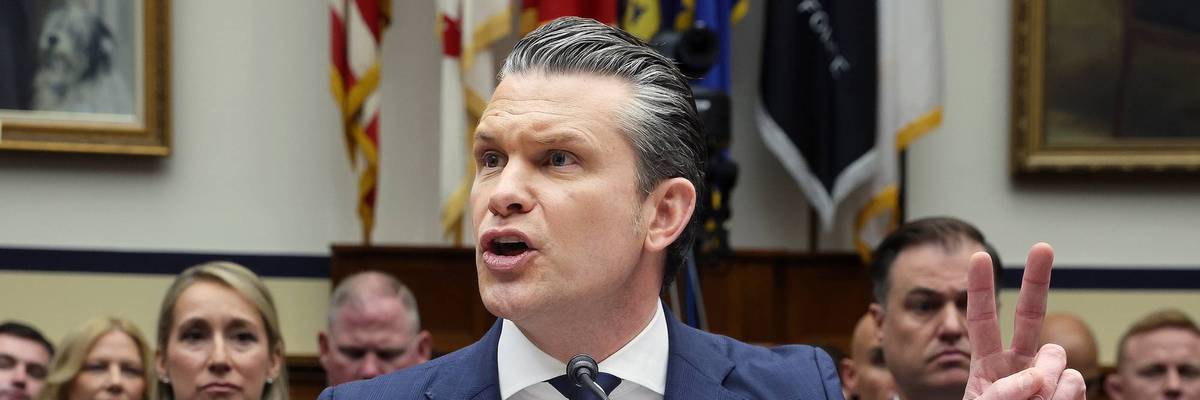
US Secretary of Defense Pete Hegseth testifies before the House Armed Services Committee on April 29, 2026 in Washington, DC.
(Photo by Kevin Dietsch/Getty Images)
Jessica Corbett
May 07, 2026
COMMON DREAMS
Just hours before the Trump administration conducted what it claimed were “self-defense strikes” against “Iranian military facilities,” The Washington Post reported Thursday that the Central Intelligence Agency concluded that “Iran can survive the US naval blockade for at least three to four months before facing more severe economic hardship.”
Citing four unnamed officials familiar with the analysis, the newspaper highlighted that “the CIA analysis might even be underestimating Iran’s economic resilience if Tehran is able to smuggle oil via overland routes.”
Militarily, “Iran retains about 75% of its prewar inventories of mobile launchers and about 70% of its prewar stockpiles of missiles,” the Post added. “There is evidence that the regime has been able to recover and reopen almost all of its underground storage facilities, repair some damaged missiles, and even assemble some new missiles that were nearly complete when the war began.”
Drop Site News’ Murtaza Hussain responded that if this assessment along with a previous one from the Center for Strategic and International Studies about “remaining US munitions and interceptor capacity are even approximately correct, it goes a long way to explaining why Trump seems so eager to end the war whereas the Iranians have either dug in or escalated their negotiating positions. The missile math of continuing the conflict would be much more favorable to the Iranians, especially if the war continued for a significant time.”
“Prior to the war, interceptor capacity compared to the size of the Iranian missile stockpile seemed like the most rationally incontrovertible reason to avoid fighting such a conflict, even for people who found it politically desirable,” he added. “This also might explain why the US and Israel pivoted towards the end to threatening countervalue strikes against civilian targets if attempts to destroy the underground missile cities by air were ineffective.”
The Post’s reporting came one month into a fragile ceasefire and starkly contrasts the recent framing of conditions in Iran from President Donald Trump and others in his administration, including Defense Secretary Pete Hesgeth.
Sen. Chris Murphy (D-Conn.) responded to the Post’s reporting by quoting Hegseth, who said in March that “never before has a modern, capable military, which Iran used to have, been so quickly destroyed and made combat ineffective.”
Murphy declared: “They lied through their teeth. Just straight up fabricated shit.”
Still, White House spokesperson Anna Kelly stuck to the administration’s framing in a Thursday statement to the Post.
“During Operation Epic Fury, Iran was crushed militarily,” Kelly said. “Now, they are being strangled economically by Operation Economic Fury and losing $500 million per day thanks to the United States military’s successful blockade of Iranian ports. The Iranian regime knows full well their current reality is not sustainable, and President Trump holds all the cards as negotiators work to make a deal.”
Meanwhile, some experts were unsurprised that the CIA privately delivered a “sober” assessment contradicting the administration’s public commentary on the conflict—which it now claims is no longer an active “war,” seemingly to dodge a key congressional deadline.
“Nice to know that a confidential CIA analysis is confirming what close observers of the Iranian economy have been saying publicly for weeks! Intelligent policymakers rely on intelligence. But Trump jeopardized diplomacy by instigating a blockade that was never going to work,” said Esfandyar Batmanghelidj, an adjunct professor at Johns Hopkins University’s School of Advanced International Studies in Europe and founder of the think tank Bourse & Bazaar Foundation.
Sharing the reporting on social media, Jennifer Kavanagh, a senior fellow and director of military analysis at the think tank Defense Priorities, wrote: “As I argued a week into the U.S. blockade, Iran can hold out for months without economic collapse. The costs for the US and the world are increasingly unsustainable, however.”
Earlier this week, Stephen Semler, a senior fellow at the Center for International Policy, estimated that the US government spent $71.8 billion on the Iran War during its first 60 days, an average of $1.2 billion daily. The International Monetary Fund warned last month that the conflict could cause a global recession.
Last Friday, Trump responded to the War Powers Act’s 60-day deadline by claiming to Congress that his war—which already violated US and international law—had been “terminated.” The White House said at the time that no fire had been exchanged since April 7, when a ceasefire deal was reached just hours after the president issued a genocidal threat against the Iranian people.
However, on Thursday evening, United States Central Command announced that Iran “launched multiple missiles, drones, and small boats” at American warships. CENTCOM added that it “eliminated inbound threats and targeted Iranian military facilities responsible for attacking US forces, including missile and drone launch sites; command and control locations; and intelligence, surveillance, and reconnaissance nodes.”
White House officials “just straight up fabricated shit,” said the Democratic senator from Connecticut.
US Secretary of Defense Pete Hegseth testifies before the House Armed Services Committee on April 29, 2026 in Washington, DC.
(Photo by Kevin Dietsch/Getty Images)
Jessica Corbett
May 07, 2026
COMMON DREAMS
Just hours before the Trump administration conducted what it claimed were “self-defense strikes” against “Iranian military facilities,” The Washington Post reported Thursday that the Central Intelligence Agency concluded that “Iran can survive the US naval blockade for at least three to four months before facing more severe economic hardship.”
Citing four unnamed officials familiar with the analysis, the newspaper highlighted that “the CIA analysis might even be underestimating Iran’s economic resilience if Tehran is able to smuggle oil via overland routes.”
Militarily, “Iran retains about 75% of its prewar inventories of mobile launchers and about 70% of its prewar stockpiles of missiles,” the Post added. “There is evidence that the regime has been able to recover and reopen almost all of its underground storage facilities, repair some damaged missiles, and even assemble some new missiles that were nearly complete when the war began.”
Drop Site News’ Murtaza Hussain responded that if this assessment along with a previous one from the Center for Strategic and International Studies about “remaining US munitions and interceptor capacity are even approximately correct, it goes a long way to explaining why Trump seems so eager to end the war whereas the Iranians have either dug in or escalated their negotiating positions. The missile math of continuing the conflict would be much more favorable to the Iranians, especially if the war continued for a significant time.”
“Prior to the war, interceptor capacity compared to the size of the Iranian missile stockpile seemed like the most rationally incontrovertible reason to avoid fighting such a conflict, even for people who found it politically desirable,” he added. “This also might explain why the US and Israel pivoted towards the end to threatening countervalue strikes against civilian targets if attempts to destroy the underground missile cities by air were ineffective.”
The Post’s reporting came one month into a fragile ceasefire and starkly contrasts the recent framing of conditions in Iran from President Donald Trump and others in his administration, including Defense Secretary Pete Hesgeth.
Sen. Chris Murphy (D-Conn.) responded to the Post’s reporting by quoting Hegseth, who said in March that “never before has a modern, capable military, which Iran used to have, been so quickly destroyed and made combat ineffective.”
Murphy declared: “They lied through their teeth. Just straight up fabricated shit.”
Still, White House spokesperson Anna Kelly stuck to the administration’s framing in a Thursday statement to the Post.
“During Operation Epic Fury, Iran was crushed militarily,” Kelly said. “Now, they are being strangled economically by Operation Economic Fury and losing $500 million per day thanks to the United States military’s successful blockade of Iranian ports. The Iranian regime knows full well their current reality is not sustainable, and President Trump holds all the cards as negotiators work to make a deal.”
Meanwhile, some experts were unsurprised that the CIA privately delivered a “sober” assessment contradicting the administration’s public commentary on the conflict—which it now claims is no longer an active “war,” seemingly to dodge a key congressional deadline.
“Nice to know that a confidential CIA analysis is confirming what close observers of the Iranian economy have been saying publicly for weeks! Intelligent policymakers rely on intelligence. But Trump jeopardized diplomacy by instigating a blockade that was never going to work,” said Esfandyar Batmanghelidj, an adjunct professor at Johns Hopkins University’s School of Advanced International Studies in Europe and founder of the think tank Bourse & Bazaar Foundation.
Sharing the reporting on social media, Jennifer Kavanagh, a senior fellow and director of military analysis at the think tank Defense Priorities, wrote: “As I argued a week into the U.S. blockade, Iran can hold out for months without economic collapse. The costs for the US and the world are increasingly unsustainable, however.”
Earlier this week, Stephen Semler, a senior fellow at the Center for International Policy, estimated that the US government spent $71.8 billion on the Iran War during its first 60 days, an average of $1.2 billion daily. The International Monetary Fund warned last month that the conflict could cause a global recession.
Last Friday, Trump responded to the War Powers Act’s 60-day deadline by claiming to Congress that his war—which already violated US and international law—had been “terminated.” The White House said at the time that no fire had been exchanged since April 7, when a ceasefire deal was reached just hours after the president issued a genocidal threat against the Iranian people.
However, on Thursday evening, United States Central Command announced that Iran “launched multiple missiles, drones, and small boats” at American warships. CENTCOM added that it “eliminated inbound threats and targeted Iranian military facilities responsible for attacking US forces, including missile and drone launch sites; command and control locations; and intelligence, surveillance, and reconnaissance nodes.”
Trump’s Iran War Will Cost US Families $1,753 Extra at the Pump This Year: Analysis
“Instead of swindling taxpayers to pay for his gilded ballroom and finding new ways to give CEO billionaires tax breaks, Trump should focus on ending his war on Iran,” said Sen. Ed Markey.
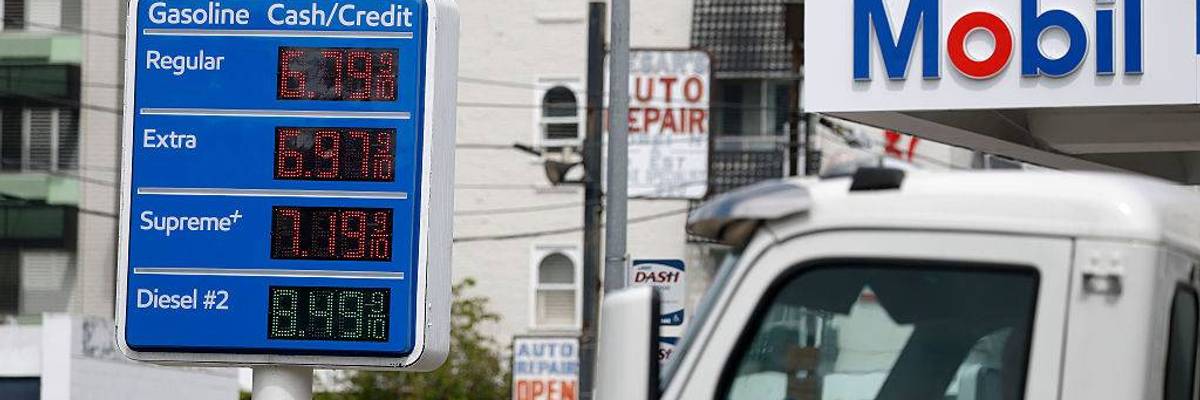
Gas prices at more than $6 a gallon are displayed at a Mobil station on May 4, 2026 in Los Angeles, California.
(Photo by Justin Sullivan/Getty Images)
Brad Reed
May 07, 2026
COMMON DREAMS
An updated analysis released Thursday finds that President Donald Trump’s illegal war with Iran will cost Americans significant money at the gas pump this year.
The report, released by the office of Sen. Ed Markey (D-Mass.), projects that if gas prices remain at their current level of over $4.50 per gallon, it will cost a US drivers an extra $73.06 per month—or $876 per year—to fill up their cars compared to what they were paying before Trump attacked Iran in late February.
For a family with two cars, this would mean forking over an extra $1,753 for gas this year.
The analysis also notes this projection is “likely an underestimate” since “many analysts predict gasoline prices will rise higher without a permanent end to the war.”
The report highlights how Trump’s Iran war is likely to bolster Big Oil’s profits, which had been steadily declining since 2022, when they exploded in the wake of Russia’s invasion of Ukraine.
Climate and renewable energy organizations have repeatedly called on the US Congress to pass a windfall tax on Big Oil profits for the duration of the war, which they said could be used to provide relief to consumers and invest in clean energy infrastructure.
In a statement accompanying the report, Markey blasted Trump for both the Iran war and his broader economic mismanagement.
“American small businesses and families cannot afford Trump’s crushing bump at the pump—all thanks to the President’s illegal war on Iran,” said Markey, the top Democrat on the Senate Small Business Committee. “Americans have to figure out how to make ends meet while Trump slashes affordable healthcare, dismantles clean energy networks, and doubles down on his tariff taxes.”
“Instead of swindling taxpayers to pay for his gilded ballroom and finding new ways to give CEO billionaires tax breaks,” Markey added, “Trump should focus on ending his war on Iran and ending the pain on Main Street.”
“Instead of swindling taxpayers to pay for his gilded ballroom and finding new ways to give CEO billionaires tax breaks, Trump should focus on ending his war on Iran,” said Sen. Ed Markey.
Gas prices at more than $6 a gallon are displayed at a Mobil station on May 4, 2026 in Los Angeles, California.
(Photo by Justin Sullivan/Getty Images)
Brad Reed
May 07, 2026
COMMON DREAMS
An updated analysis released Thursday finds that President Donald Trump’s illegal war with Iran will cost Americans significant money at the gas pump this year.
The report, released by the office of Sen. Ed Markey (D-Mass.), projects that if gas prices remain at their current level of over $4.50 per gallon, it will cost a US drivers an extra $73.06 per month—or $876 per year—to fill up their cars compared to what they were paying before Trump attacked Iran in late February.
For a family with two cars, this would mean forking over an extra $1,753 for gas this year.
The analysis also notes this projection is “likely an underestimate” since “many analysts predict gasoline prices will rise higher without a permanent end to the war.”
The report highlights how Trump’s Iran war is likely to bolster Big Oil’s profits, which had been steadily declining since 2022, when they exploded in the wake of Russia’s invasion of Ukraine.
Climate and renewable energy organizations have repeatedly called on the US Congress to pass a windfall tax on Big Oil profits for the duration of the war, which they said could be used to provide relief to consumers and invest in clean energy infrastructure.
In a statement accompanying the report, Markey blasted Trump for both the Iran war and his broader economic mismanagement.
“American small businesses and families cannot afford Trump’s crushing bump at the pump—all thanks to the President’s illegal war on Iran,” said Markey, the top Democrat on the Senate Small Business Committee. “Americans have to figure out how to make ends meet while Trump slashes affordable healthcare, dismantles clean energy networks, and doubles down on his tariff taxes.”
“Instead of swindling taxpayers to pay for his gilded ballroom and finding new ways to give CEO billionaires tax breaks,” Markey added, “Trump should focus on ending his war on Iran and ending the pain on Main Street.”
“The $25 billion war cost given by Pentagon Secretary Hegseth and acting Comptroller Hurst before Congress was a lie. It was a denial of the Iran war’s spiraling costs.”

Acting Pentagon Comptroller Jules Hurst and Pentagon Secretary Pete Hegseth testify during a Senate hearing on April 30, 2026.
(Photo by Graeme Sloan/Getty Images)
Jake Johnson
May 06, 2026
COMMON DREAMS
The Pentagon’s official estimate of the direct financial cost of the US war on Iran is a nearly threefold undercount of the actual price tag of the war, according to an expert analysis published Wednesday.
Stephen Semler, a senior fellow at the Center for International Policy, produced the new cost estimate for the Popular Information newsletter. Accounting for armament use, troop deployments, and other factors, Semler estimated that the US government spent $71.8 billion on the Iran war over the course of 60 days—an average of $1.2 billion per day.
“Like the estimates from Pentagon leadership and unnamed officials, this figure refers only to direct war costs—near-term expenses for military operations, munitions, and the like—and not indirect costs, which include broader economic impacts, interest on the national debt, and longer-term expenses like veterans’ care,” explained Semler, who argued that the Pentagon’s $25 billion cost estimate suffers from “incomplete accounting of damaged or destroyed military assets, the exclusion of costs outside the department (including billions of dollars in State Department-funded military aid to Israel), and a flawed method for tracking munition expenditures.”
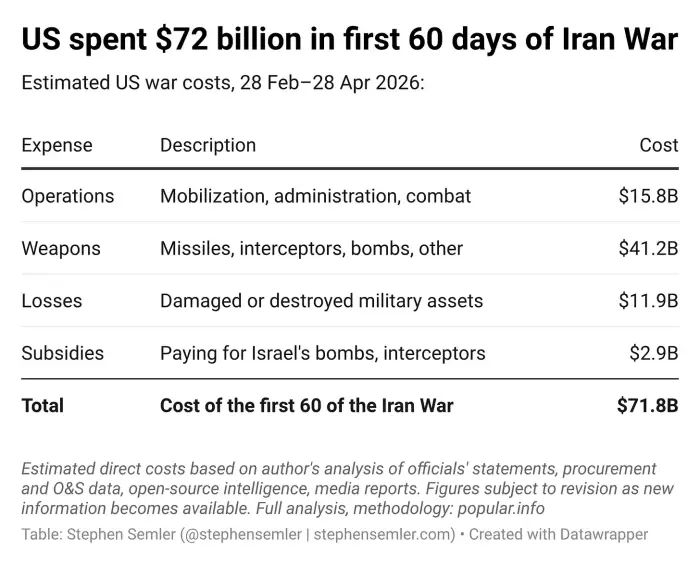
Semler, who detailed his methodology in a separate post, accused top Pentagon officials of attempting to deliberately mislead lawmakers and the American public about the true cost of the war, which is historically unpopular.
“The $25 billion war cost given by Pentagon Secretary [Pete] Hegseth and acting Comptroller [Jules] Hurst before Congress was a lie,” Semler wrote Wednesday. “It was a denial of the Iran war’s spiraling costs, one of several foreseen consequences of the Trump administration’s decision to go to war. The closing of the Strait of Hormuz is another predictable consequence.”
Semler’s analysis was released days after unnamed Trump administration officials told CBS News that they believe the actual US cost of the Iran war is roughly double the estimate offered under oath by Pentagon leaders.
“US officials familiar with internal assessments suggested the war’s price tag is closer to $50 billion so far,” CBS News reported. “Much of the gap is accounted for by munitions that have been used and need to be replaced. For instance, the Pentagon has lost 24 MQ-9 Reaper drones—sophisticated unmanned aircraft that can cost $30 million or more apiece—underscoring how quickly the financial toll has mounted. Taken together, the higher estimate reflects not only the tempo of operations but also the often unseen costs of attrition, as material lost in the field reshapes the ledger.”
Ongoing efforts to calculate the costs of US-Israeli war—which has killed thousands, displaced millions, sent global energy markets into chaos, and sparked fears of a worldwide food crisis—come as Trump continues to threaten Iran with an even more aggressive bombing campaign, which would send the conflict’s price tag soaring further.
In a Truth Social post early Wednesday, Trump said that if Iran doesn’t agree to US terms to end the war, “the bombing starts, and it will be, sadly, at a much higher level and intensity than it was before.”

No comments:
Post a Comment