Thursday, November 06, 2025


US Army removes food bank guidance for its soldiers after Euronews report

US soldiers
Copyright Stephen B. Morton /Atlanta Journal-Constitution via AP


By Laura Fleischmann
Published on 

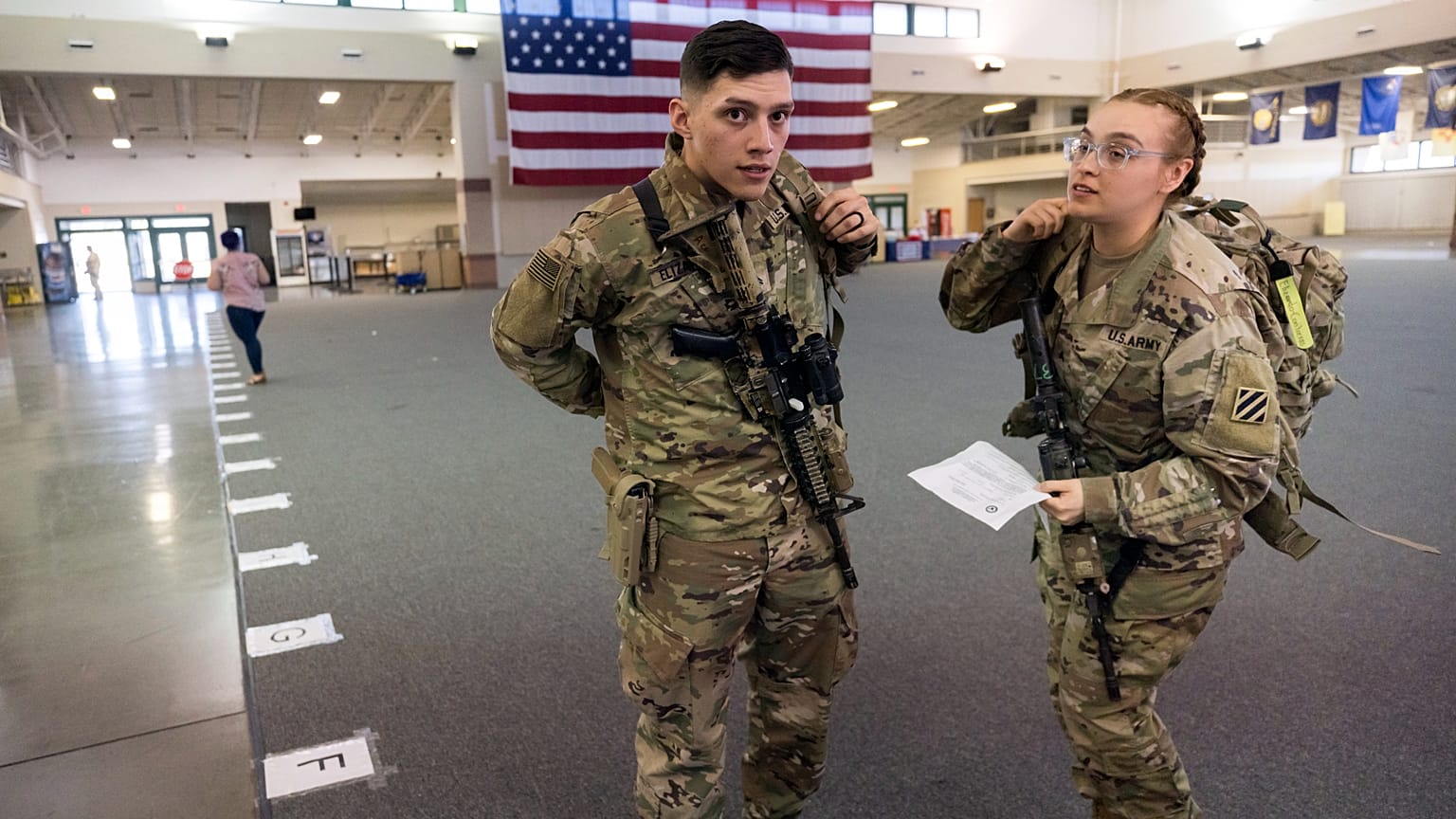
The US Army removed guidance directing soldiers to food banks during the government shutdown after Euronews reported it. Soldiers await mid-November pay.

The US Army removed website guidance directing soldiers to food banks and food-sharing facilities during the government shutdown after Euronews first reported the case, which caused social media controversy.

US military publication Stars and Stripes published a US Army Europe and Africa statement explaining that "the list of local food assistance offers was created several weeks ago when the US Army was concerned that its German personnel might not receive pay during the shutdown, which could make them temporarily dependent on aid."

The army claimed the advice was meant for civilian employees rather than soldiers, though the website section heading referenced "kit bags," a military term. The guidance can still be seen in archived versions after it was removed from the active site.

Screenshot
Screenshot U.S. Army Garrison Bavaria

US soldiers continue awaiting mid-November salary payments as the most extended shutdown in US history persists. Treasury Secretary Scott Bessent told CBS News that "as of 15 November, soldiers who are willing to risk their lives will no longer be able to receive a paycheck."

October salary payments came from multiple sources: $2.5 billion from summer tax cut legislation, $1.4 billion from military procurement accounts and $1.4 billion from research and development, according to US media reports.

Blue Star Families, a military-founded initiative, warned at the beginning of October that "less than one in three military families have savings of $3,000."

Meanwhile, Senate Democrats are using momentum from recent electoral victories — including New York City's mayoral race and gubernatorial elections in New Jersey and Virginia — to pressure Republican colleagues toward a budget compromise, according to US media reports.

Democrats and Republicans have been fiercely debating over the budget since 1 October. Although Republicans control both the Senate and the House of Representatives, they require Democratic votes to resolve the impasse.

The shutdown eliminated salaries for civil servants or placed them on compulsory leave. The German government temporarily stepped in financially to pay civilian US military employees in Germany.

US military personnel receive pay fortnightly, which can intensify financial pressure during payment gaps. Approximately 37,000 US soldiers stationed in Germany, including those at Ramstein Air Base and Bavarian garrisons, face continued uncertainty about November wages as congressional negotiations continue.


Joint Expeditionary Force launches enhanced partnership with Ukraine

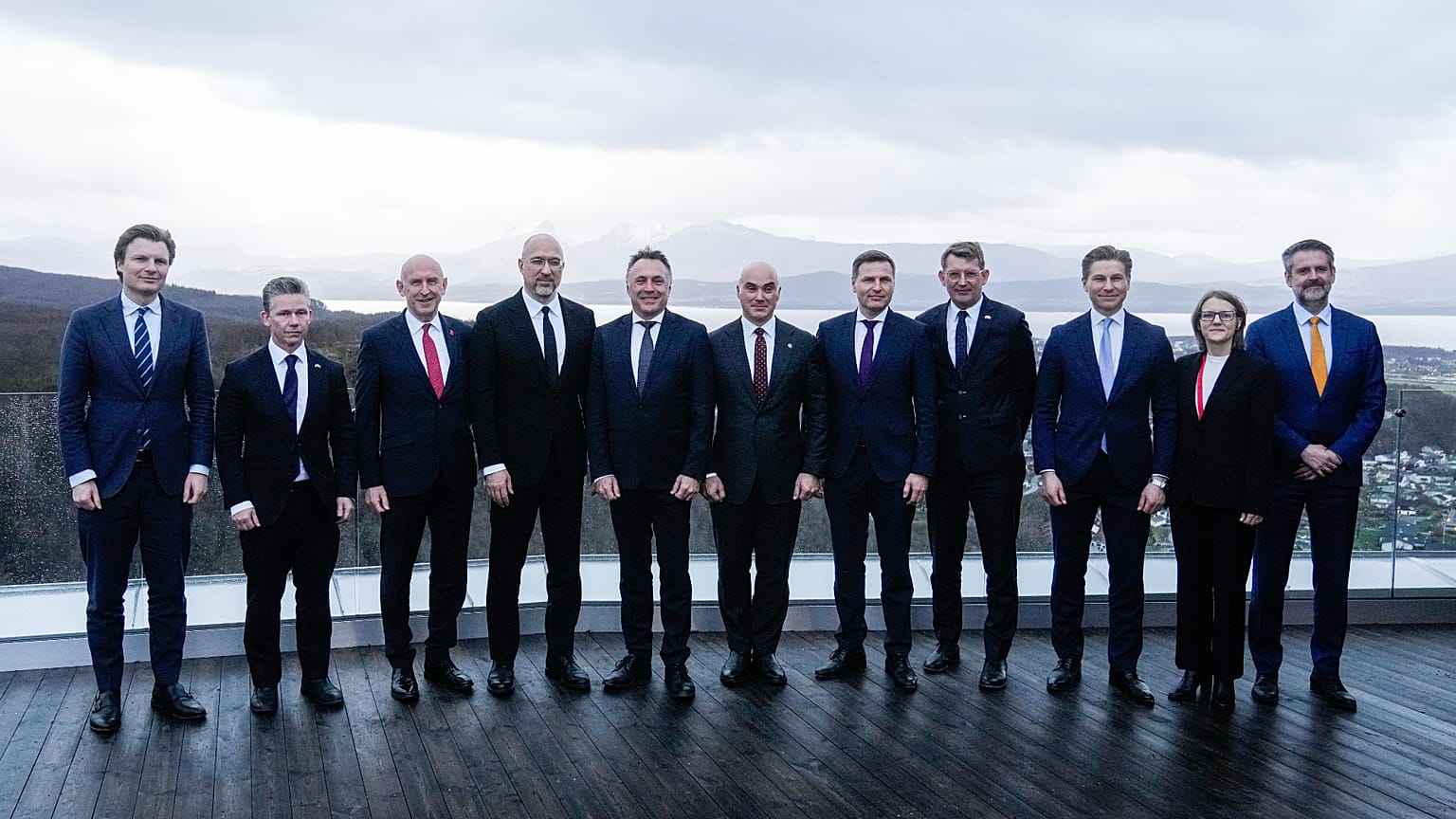
Defense ministers' meeting of the Joint Expeditionary Force (JEF) in Bodo, Norway, Wednesday Nov. 5, 2025.
Copyright AP Photo


By Amandine Hess
Published on 

Defence ministers of the UK-led coalition met with their Ukrainian counterparts in Bodø in Norway to deepen their collaboration and strengthen security in the Nordic-Baltic region.

Defence ministers of the northern European multinational Joint Expeditionary Force have met with their Ukrainian counterparts in Norway to launch an enhanced partnership with Ukraine.

The partnership with Ukraine is seen as a milestone in strengthening Euro-Atlantic security in the Nordic-Baltic region.

"This is a powerful signal to Putin and any other would-be aggressors that JEF is stronger than ever. More united than ever, more innovative than ever, more flexible in our operational responses than ever," UK Defence Secretary John Healey said.

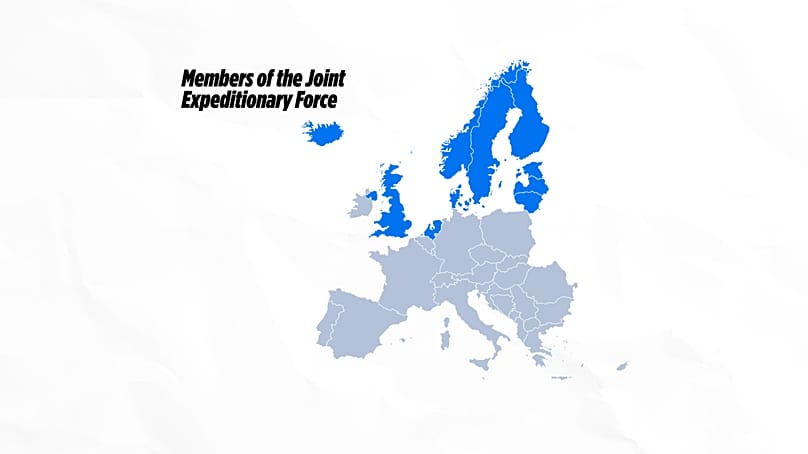
Established in 2014, JEF is a UK-led multinational force comprising 10 European countries.

Members of the Joint Expeditionary Force (JEF)
Members of the Joint Expeditionary Force (JEF) Euronews

Seeking to learn from Ukraine's battlefield experience, the coalition will deliver training to the Ukrainian armed forces and collaborate on protecting critical underwater infrastructure, drones, battlefield medicine, and methods to counter disinformation.

"From partners including JEF countries, Ukraine seeks access to European technologies and production capacities on the basis of which we could launch joint manufacturing", Ukrainian Defence Minister Denys Shmyhal said.

"This modern weaponry will not only defend Ukraine now, it will guarantee Europe's security for years to come and reliably protect its eastern flank from permanent Russian aggression," Shmyhal added.

Defense ministers' meeting of the Joint Expeditionary Force (JEF) in Bodo, Norway, Wednesday Nov. 5, 2025.
Defense ministers' meeting of the Joint Expeditionary Force (JEF) in Bodo, Norway, Wednesday Nov. 5, 2025. AP Photo

The meeting follows the conclusion last week of Tarassis, the coalition's largest-ever military operation. The two-month-long operation across the Nordic-Baltic region mobilised more than 1,700 British personnel alongside JEF allies.

Following reports of undersea cable damage in the Baltic Sea earlier this year, the multinational defence force activated a reaction system called Nordic Warden to track potential threats to undersea infrastructure and monitor the Russian shadow fleet.


THE ORIGINAL JOINT EXPEDITIONARY FORCE WAS UK, CANADA, AND EURO COUNTRIES AGAINST THE BOLSHEVIK REVOLUTIONARIES


'Saint or Sinner'? British artist Mason Storm crucifies Donald Trump in sculpture on show in Basel

'Saint or Sinner?': British artist crucifies Donald Trump in new sculpture
Copyright X screenshot - Basler Kunstmeile / Mason Storm

By David Mouriquand
Published on 

Hero or villain? Martyr or criminal? “Saint or Sinner”?

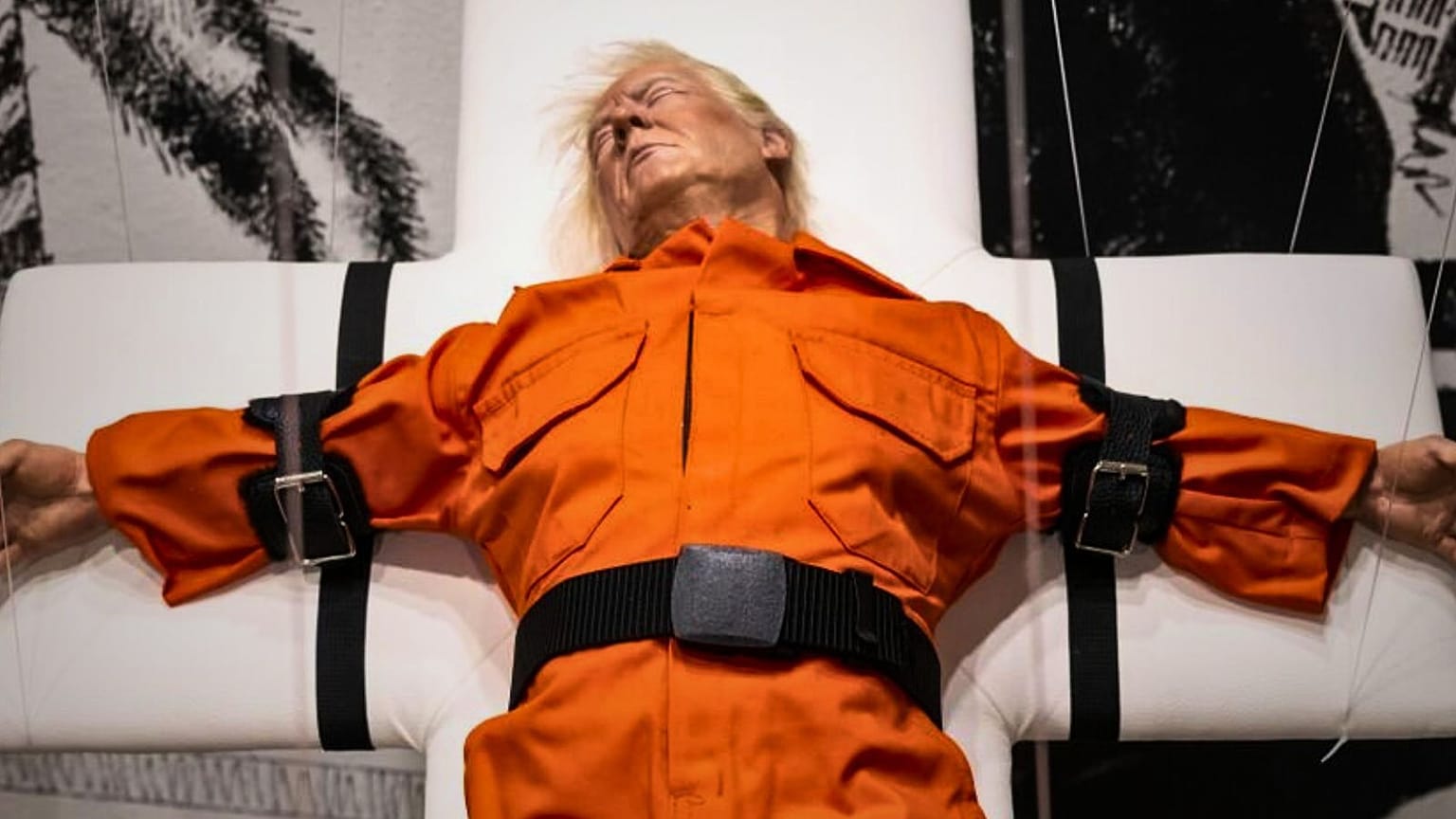
A hyperrealistic sculpture depicting Donald Trump nailed to a cross while wearing an orange prison jumpsuit has gone on display at the Basler Kunstmeile in Switzerland, weeks after its debut near Basel Central Station was postponed over fears of public backlash.

The sculpture, titled “Saint or Sinner”, is by British artist Mason Storm, who is celebrated for his satirical and often politically charged art. And like Banksy, he cultivates a sense of anonymity by wearing masks and balaclavas.

Here, he plays on the dichotomy between a vertical crucifixion and a horizontal execution gurney, leaving a provocative space where religion and politics mix to better question whether the current US president deserves entry to heaven or a lethal injection.

The sculpture is eerily realistic – something which Konrad Breznik, owner of the Gleis 4 gallery, marvels at

“You can see every wrinkle, the skin is so realistic, it's really disturbing,” he told AFP.

Breznik even said he believed that Trump might actually appreciate the piece.

“I do absolutely think that Mr Trump might see himself very well in the role of a modern Jesus,” he said. “I’m pretty sure he is very much convinced that he is doing the right thing.”

Appropriately, Trump himself said last month, aboard Air Force One: "I don't think there's anything that's going to get me into heaven. I think I'm not maybe heaven-bound."

Well, there we have it, folks.

Whether or not the artwork could be exhibited in the US remains another matter... It has already sold to an “internationally renowned” European collector, whose name remains confidential, according to the gallery.

Mushroom Clouds On The Horizon? What Trump’s Threat Means For Global Nuclear Testing – Analysis

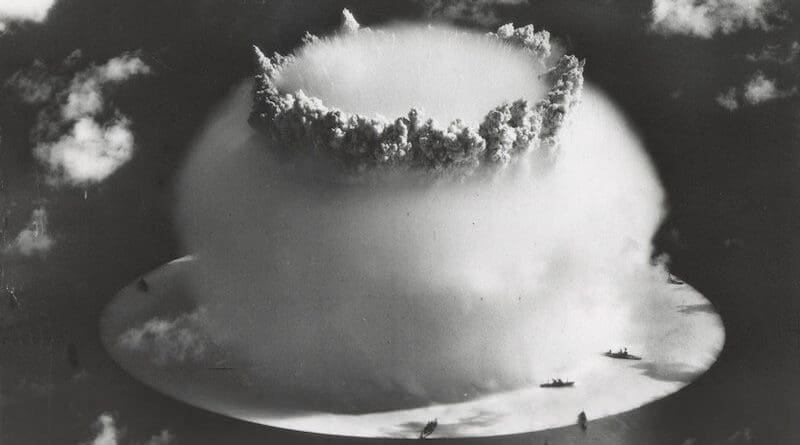
The Wilson cloud from test Baker, situated just offshore from Bikini Island. 
Photo Credit: U.S. Army Photographic Signal Corps, Wikipedia Commons

November 6, 2025 

RFE RL
By Mike Eckel

In June 2019, the director of the Pentagon’s main intelligence agency made an eyebrow-raising allegation about Russia and its nuclear programs: Moscow is testing its atomic weapons.

“The U.S. government, including the Intelligence Community, has assessed that Russia has conducted nuclear weapons tests that have created nuclear yield,” Lieutenant General Robert Ashley said.

China may also be conducting its own tests, Ashley added, possibly by using “zero-yield” methods in which no actual atomic explosion — a fission chain reaction — takes place.

Fast forward six years. The United States and Russia are on the verge of a new arms race. The Kremlin is boasting that it is developing new, nuclear-capable superweapons. And President Donald Trump is threatening to resume US nuclear tests.

“Russia’s testing and China’s testing, but they don’t talk about it,” Trump said in an interview with CBS News recorded on October 31. “No, we’re gonna test, because they test and others test.”

On November 5 he reiterated that “because of other countries testing programs, I have instructed the Department of War to start testing our Nuclear Weapons on an equal basis.”

The claim Russia and China are testing is subject to debate.

Regardless, the threat has drawn criticism from Moscow and cheers from US national security hawks, not to mention handwringing among arms control advocates.

After years of collapsed or eroded arms control agreements — the Intermediate-Range Nuclear Forces Treaty, the Anti-Ballistic Missile Treaty, the Open Skies, New START — advocates worry that the global pact banning nuclear tests may be next.

At a meeting of Russia’s Security Council on November 5, Defense Minister Andrei Belousov called for preparations to resume nuclear testing — at ranges on the Arctic archipelago of Novaya Zemlya.

The last time the United States used explosives in its weapons arsenal to split a uranium or plutonium isotope and spark the nuclear chain-reaction known as fission was in the dusty landscape of Nevada in 1992. It wasn’t a mushroom cloud like you see in the movies — those went out of favor in the 1960s, with a treaty — but an underground blast.

Moscow’s last fission test of a weapon? That was in 1990, a year before the Soviet collapse, on Novaya Zemlya. Beijing’s was in 1996 at Lop Nur, in the windswept reaches of the far western Xinjiang province.

That same year, the Comprehensive Nuclear-Test-Ban Treaty (CTBT) came into being. Since that time, only Pakistan and India have conducted similar critical tests — and North Korea has conducted half a dozen, most recently in 2017.

Generally speaking, nuclear tests that involve actual explosions of fissile material are relatively easy to detect.

Highly sensitive seismic monitoring devices, like those that monitor earthquakes, can pick up shock waves from a blast underground, where all tests have occurred for decades. Aircraft equipped with sophisticated “sniffing” equipment can register radioactive isotopes floating into the atmosphere, telltale signs of a nuclear detonation.

Noncritical. Critical. Supercritical.

The end of the Cold War, and of the Soviet-US arms race, meant major cuts to nuclear arsenals and a downgrade of budgets and investments into the infrastructure needed to plan the bombs and build them.

All nuclear-armed countries need to ensure that their arsenals can devastate as they’re expected to, so testing continues — just not in a mushroom-cloud sort of way. Noncritical tests, in which explosives and fissile material are used but not detonated to cause fission, are allowed under the CTBT. Researchers use supercomputers and powerful lasers to test or mimic fission reactions.

Trump first suggested the possibility of new tests in a social media post just before meeting with Chinese President Xi Jinping in South Korea. He expanded on that later in his CBS News interview.

US officials have maintained a test site in Nevada where subcritical experiments have continued. However, doing a full-blown fissile explosion could not happen right away.

“The US could not conduct a test in days or weeks but, depending on the details of the test and the diagnostics, we could resume testing in months to a few years,” said Jill Hruby, a former director of the Sandia National Laboratories in New Mexico and former head of the National Nuclear Security Administration (NNSA), which manages storage and tests of the US nuclear arsenal.

Energy Secretary Christopher Wright, whose department oversees the NNSA, later clarified Trump’s comments.

“I think the tests we’re talking about right now are system tests,” Wright said in an interview with Fox News on November 2. “These are not nuclear explosions. These are what we call noncritical explosions.”

US authorities have ample data from previous underground testing, plus laboratory testing and subcritical experiments, according to Hruby — one argument, she said, for not resuming full tests.

“Additionally, if we start testing it is clear others would resume or start testing,” she said. “Once testing is resumed, it is highly likely in my opinion that new types of devices will be explored, fueling more arms racing.

“Finally, while testing can be safe, accidents can occur. I think most people would agree that large-scale nuclear testing is not something that environmentally benefits our planet and humanity,” she said.

Real World Testing

In April, the US State Department released its annual report on countries complying with arms control treaties. The report said Russia had conducted “supercritical” nuclear weapons tests in past years, but failed to notify the US or other countries as required under a 1974 treaty that also put a cap on the size of underground explosive blasts.

“Concerns remain due to these past activities and the uncertainty and lack of transparency relating to Russia’s activities at Novaya Zemlya,” the report said.

Broadly speaking, the term “supercritical” refers to a fission reaction, when an isotope is split and causes a full-blown chain reaction. “Noncritical” or ‘subcritical” do not.

For national security hawks — in Washington or Moscow or even Beijing — the world has changed. China, which is not constrained by the soon-expiring New START Treaty between Washington and Moscow, is expanding its arsenal. The Kremlin is modernizing its arsenal and rolling out new intercontinental ballistic missiles like the Sarmat and other nuclear-capable weapons like the Burevestnik and the Poseidon, an unmistakable signal.

Days after Trump’s comments, CIA Director John Ratcliffe said in a post on X that Trump “was right” about Chinese and Russian testing.

“The United States has to maintain technical and numerical superiority to the combined Chinese and Russian nuclear stockpiles,” Robert O’Brien, who served as White House national-security adviser during Trump’s first term, wrote in a Foreign Affairs article last year. “To do so, Washington must test new nuclear weapons for reliability and safety in the real world for the first time since 1992 — not just by using computer models.”

“If China and Russia continue to refuse to engage in good-faith arms control talks, the United States should also resume production of uranium-235 and plutonium-239, the primary fissile isotopes of nuclear weapons,” he wrote.

O’Brien did not respond to a request for comment sent to his Washington firm.

In Moscow, Russian officials have criticized Trump’s pledge to resume testing and denied the accusation that they had conducted actual nuclear tests.

At a televised Security Council meeting at the Kremlin on November 5, President Vladimir Putin echoed Belousov’s remarks and ordered officials to make proposals for the “possible start of work to prepare for nuclear weapons testing.” But he also said Moscow had no intention of violating the CTBT.

If the Trump administration does move forward with full testing, it would likely spark its own race, as other nations — China first and foremost — move to resume testing. That would push the CTBT agreement toward outright collapse. Russia “de-ratified” the treaty in 2023; Washington has signed it but not ratified it. Some administration officials have called for “un-signing” it. China has signed but not ratified the pact.

“Explosive testing would open the way for other nations to do the same. They have not done as many tests as the US has and would benefit more from explosive testing,” said Cheryl Rofer, a retired nuclear scientist at the Los Alamos National Laboratory, where US researchers developed the first nuclear weapons in the 1940s.

A return to full-scale testing would also likely doom the New START treaty, which caps the size of the Russian and American nuclear arsenals, experts say. That treaty is due to expire next year, and no negotiations are under way to replace it.

In September, Putin proposed adhering to the treaty’s requirements for a year after it expires in early February, something the White House signaled openness to.


Mike Eckel is a senior international correspondent reporting on political and economic developments in Russia, Ukraine, and around the former Soviet Union, as well as news involving cybercrime and espionage. He’s reported on the ground on Russia’s invasion of Ukraine, the wars in Chechnya and Georgia, and the 2004 Beslan hostage crisis, as well as the annexation of Crimea in 2014.


RFE RL

RFE/RL journalists report the news in 21 countries where a free press is banned by the government or not fully established.


What Should Countries Do With Their Nuclear Waste?


November 6, 2025 

By Eurasia Review

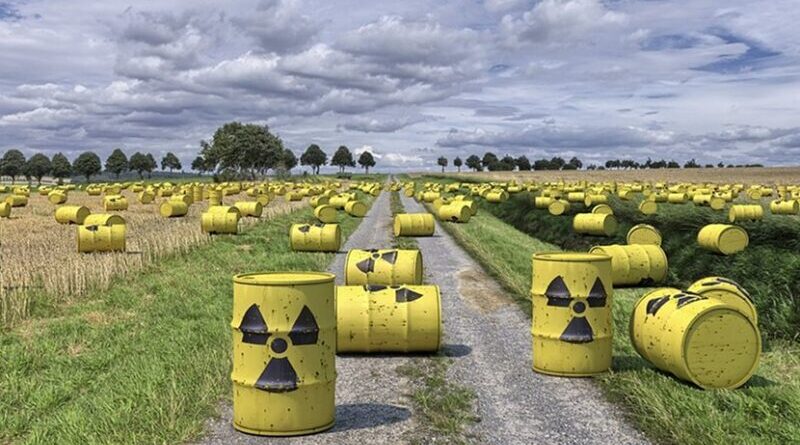
One of the highest-risk components of nuclear waste is iodine-129 (I-129), which stays radioactive for millions of years and accumulates in human thyroids when ingested. In the U.S., nuclear waste containing I-129 is scheduled to be disposed of in deep underground repositories, which scientists say will sufficiently isolate it.

Meanwhile, across the globe, France routinely releases low-level radioactive effluents containing iodine-129 and other radionuclides into the ocean. France recycles its spent nuclear fuel, and the reprocessing plant discharges about 153 kilograms of iodine-129 each year, under the French regulatory limit.

Is dilution a good solution? What’s the best way to handle spent nuclear fuel? A new study by MIT researchers and their collaborators at national laboratories quantifies I-129 release under three different scenarios: the U.S. approach of disposing spent fuel directly in deep underground repositories, the French approach of dilution and release, and an approach that uses filters to capture I-129 and disposes of them in shallow underground waste repositories.

The researchers found France’s current practice of reprocessing releases about 90 percent of the waste’s I-129 into the biosphere. They found low levels of I-129 in ocean water around France and the U.K.’s former reprocessing sites, including the English Channel and North Sea. Although the low level of I-129 in the water in Europe is not considered to pose health risks, the U.S. approach of deep underground disposal leads to far less I-129 being released, the researchers found.

The researchers also investigated the effect of environmental regulations and technologies related to I-129 management, to illuminate the tradeoffs associated with different approaches around the world.

“Putting these pieces together to provide a comprehensive view of Iodine-129 is important,” says MIT Assistant Professor Haruko Wainwright, a first author on the paper who holds a joint appointment in the departments of Nuclear Science and Engineering and of Civil and Environmental Engineering. “There are scientists that spend their lives trying to clean up iodine-129 at contaminated sites. These scientists are sometimes shocked to learn some countries are releasing so much iodine-129. This work also provides a life-cycle perspective. We’re not just looking at final disposal and solid waste, but also when and where release is happening. It puts all the pieces together.”

MIT graduate student Kate Whiteaker SM ’24 led many of the analyses with Wainwright. Their co-authors are Hansell Gonzalez-Raymat, Miles Denham, Ian Pegg, Daniel Kaplan, Nikolla Qafoku, David Wilson, Shelly Wilson, and Carol Eddy-Dilek. The study appears today in Nature Sustainability.

Managing waste

Iodine-129 is often a key focus for scientists and engineers as they conduct safety assessments of nuclear waste disposal sites around the world. It has a half-life of 15.7 million years, high environmental mobility, and could potentially cause cancers if ingested. The U.S. sets a strict limit on how much I-129 can be released and how much I-129 can be in drinking water — 5.66 nanograms per liter, the lowest such level of any radionuclides.

“Iodine-129 is very mobile, so it is usually the highest-dose contributor in safety assessments,” Wainwright says.

For the study, the researchers calculated the release of I-129 across three different waste management strategies by combining data from current and former reprocessing sites as well as repository assessment models and simulations.

The authors defined the environmental impact as the release of I-129 into the biosphere that humans could be exposed to, as well as its concentrations in surface water. They measured I-129 release per the total electrical energy generated by a 1-gigawatt power plant over one year, denoted as kg/GWe.y.

Under the U.S. approach of deep underground disposal with barrier systems, assuming the barrier canisters fail at 1,000 years (a conservative estimate), the researchers found 2.14 x 10⁻⁸ kg/GWe.y of I-129 would be released between 1,000 and 1 million years from today.

They estimate that 4.51 kg/GWe.y of I-129, or 91 percent of the total, would be released into the biosphere in the scenario where fuel is reprocessed and the effluents are diluted and released. About 3.3 percent of I-129 is captured by gas filters, which are then disposed of in shallow subsurfaces as low-level radioactive waste. A further 5.2 percent remains in the waste stream of the reprocessing plant, which is then disposed of as high-level radioactive waste.

If the waste is recycled with gas filters to directly capture I-129, 0.05 kg/GWe.y of the I-129 is released, while 94 percent is disposed of in the low-level disposal sites. For shallow disposal, some kind of human disruption and intrusion is assumed to occur after government or institutional control expires (typically 100-1,000 years). That results in a potential release of the disposed amount to the environment after the control period.

Overall, the current practice of recycling spent nuclear fuel releases the majority of I-129 into the environment today, while the direct disposal of spent fuel releases around 1/100,000,000 that amount over 1 million years. When the gas filters are used to capture I-129, the majority of I-129 goes to shallow underground repositories, which could be accidentally released through human intrusion down the line.

The researchers also quantified the concentration of I-129 in different surface waters near current and former fuel reprocessing facilities, including the English Channel and the North Sea near reprocessing plants in France and U.K. They also analyzed the U.S. Columbia River downstream of a site in Washington state where material for nuclear weapons was produced during the Cold War, and they studied a similar site in South Carolina. The researchers found far higher concentrations of I-129 within the South Carolina site, where the low-level radioactive effluents were released far from major rivers and hence resulted in less dilution in the environment.

“We wanted to quantify the environmental factors and the impact of dilution, which in this case affected concentrations more than discharge amounts,” Wainwright says. “Someone might take our results to say dilution still works: It’s reducing the contaminant concentration and spreading it over a large area. On the other hand, in the U.S., imperfect disposal has led to locally higher surface water concentrations. This provides a cautionary tale that disposal could concentrate contaminants, and should be carefully designed to protect local communities.”

Fuel cycles and policy

Wainwright doesn’t want her findings to dissuade countries from recycling nuclear fuel. She says countries like Japan plan to use increased filtration to capture I-129 when they reprocess spent fuel. Filters with I-129 can be disposed of as low-level waste under U.S. regulations.

“Since I-129 is an internal carcinogen without strong penetrating radiation, shallow underground disposal would be appropriate in line with other hazardous waste,” Wainwright says. “The history of environmental protection since the 1960s is shifting from waste dumping and release to isolation. But there are still industries that release waste into the air and water. We have seen that they often end up causing issues in our daily life — such as CO2, mercury, PFAS and others — especially when there are many sources or when bioaccumulation happens. The nuclear community has been leading in waste isolation strategies and technologies since the 1950s. These efforts should be further enhanced and accelerated. But at the same time, if someone does not choose nuclear energy because of waste issues, it would encourage other industries with much lower environmental standards.”

The work was supported by MIT’s Climate Fast Forward Faculty Fund and the U.S. Department of Energy
SLOWER THAN MOLASSES IN JANUARY

Secretary Noem Approves $1 Million In Expedited Funding For Alaska To Assist With October Storm Recovery Efforts

A MONTH LATE


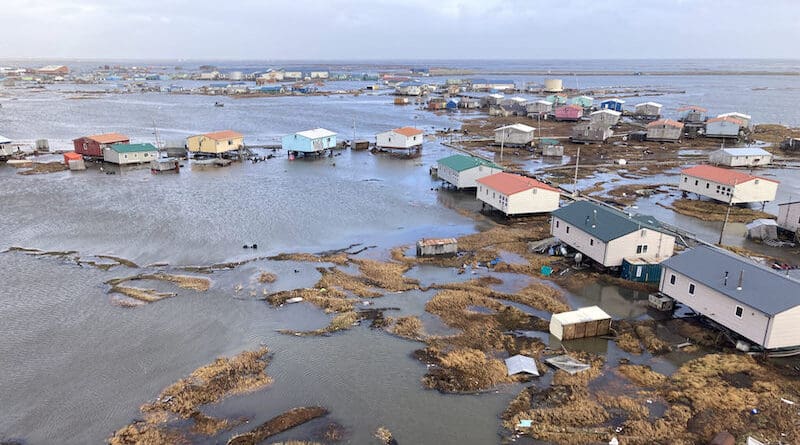
The village of Kipnuk, largely submerged by the remnants of Typhoon Halong, is seen from the air on Oct. 12, 2025. Alaska Air National Guard rescue personnel conducted search and rescue operations there, and the Alaska Division of Homeland Security and Emergency Management has worked with the Alaska Organized Militia and the U.S. Coast Guard in the response. The storm displaced at least 1,500 people and resulted in at least one death.
(Photo provided by the Alaska National Guard)


November 6, 2025 
By Eurasia Review


Secretary Kristi Noem announced Wednesday that the Department of Homeland Security is expediting $1 million in up-front FEMA funding to help Alaska recover from the devastation of Typhoon Halong in early October.

“Under President Trump and Secretary Noem’s leadership, FEMA is moving at an unprecedented speed to provide Alaska with immediate support that it needs to recover from this tragedy,” said Assistant Secretary Tricia McLaughlin. “Disasters are best managed when they’re state managed, locally executed, and federally supported. From FEMA’s on-the-ground efforts to the U.S. Coast Guard’s successful rescue operations, DHS is ensuring that Alaskans are getting the help they need.”

This funding, which will be immediately accessible, will be used to stabilize dangerous conditions and help communities stay safe. This work includes making temporary repairs to critical infrastructure or utilities and staffing emergency operations to coordinate response. Additional funding for recovery efforts will follow.

As of November 3, 147 FEMA staff are deployed to Bothell and Anchorage to support disaster relief operations. In the immediate aftermath of the flooding, the U.S. Coast Guard air crews rescued 34 people and successfully helped evacuate an additional 28 people from a temporary shelter. Coast Guard crews conducted a total of 8.5 hours of aerial searches and searched a total of 88 square miles.

Public Assistance is FEMA’s disaster assistance program to reimburse state, tribes and local governments for eligible debris removal, emergency protective measures, and other permanent work. FEMA will continue providing technical assistance, oversight and best practices to help Alaska accelerate recovery and protect public safety and health.
Targeting Palantir And Nvidia: Profits, Prophets And Overvalued AI Stocks – OpEd


November 6, 2025 
By Binoy Kampmark

In an industry of seedy soothsayers, cocksure charlatans and resourceful rogues, honest and accurate appraisals are exquisitely rare. When it comes to economics, investments and finance, this is particularly so. Certitude, however, tends to be in abundance for those predicting the next financial crash, the sort that will singe earnings and strafe savings. Take, for instance, hedge fund investor Michael Burry, a man of sufficient notoriety to warrant a celluloid depiction of himself by Christian Bale in the 2015 film The Big Short.
Financial software

On that occasion, Burry’s hunch, albeit an educated one, was that the US housing bubble would implode in what became the Great Recession of 2007-9. The buccaneering investor shorted mortgage-backed securities ahead of the collapse, raking in profits as the subprime mortgage sundered. But his record is by no means immaculate, seeing falls when they have not eventuated, especially on tech stocks. For him, the language of catastrophe is never far away. An April 7 post on X this year is fabulously bleak: “Millennials going through 9/11, two economic recessions, a pandemic, the looming threat of WW3, AI job automation, and now facing the ‘biggest crash in history’.”

Towards the end of October, he felt in an oracular mood: “Sometimes we see bubbles,” he wrote in another post. “Sometimes, there is something to do about it. Sometimes, the only winning move is not to play.” His Scion Asset Management hedge fund subsequently moved 80% of its US$1.1 billion portfolio to place options against Palantir (PTLR) and Nvidia (NVDA). These will pay handsomely should shares in these AI-linked companies fall. Burry remains convinced that technology stocks, certainly when it comes to artificial intelligence, are overvalued and set for the precipitous plummet. Whether this is due to growing scepticism about the herd-like rush to adopt AI, the debate about necessary regulation, or that broader sensibility that what rises or swells so rapidly must fall or puncture, is impossible to know. Certainly, the incestuous circular financing tech companies have been engaging in is crying out for a stinging correction. But it is precisely moves of this nature by Scion Asset Management that send jitters through the market, turning preaching prophets into market saboteurs.

Surely enough, Palantir’s shares fell by 8% on November 4 despite exceeding Wall Street estimates of returns for the third quarter. The stocks had risen to skyscraper levels – 173% for the year heading into trading that day. Nvidia’s fell by 4% after having improved by 50% this year. “It seems fatigue over AI and the current earnings run has investors questioning the sustainability of the AI hype,” reasoned financial analyst Farhan Badami. “That’s dragged down AI companies overnight in markets.”

Sympathy for such companies is bound to be in short supply. Palantir is the sort of data analytics company any half-decent minded individual would wish to fail. In April this year, 404 Media revealed that US Immigration and Customs Enforcement (ICE) had paid the company millions of dollars to modify the ICE database to enable it to “complete target analysis of known populations” and spruce up the targeting of that tool and enforcement priorities. The database gives ICM agents the means to sort individuals using hundreds of specific categories covering physical attributes, administrative background and mobility. ICE Director Todd Lyons has fantasies of running the agency’s crude, clumsy deportation policy “like [Amazon] Prime, but with human beings” in an effort to treat the matter “like a business”.

This charming dystopian thought is a good pairing with the sinister propaganda Palantir enjoys promoting, including a campaign on college campuses that echoes the stirrings of a Nuremberg rally cry: “Our culture has fallen into shallow consumerism while abandoning national purpose. Too few in Silicon Valley have asked what ought to be built – and why.” Palantir, to that end, was built to conquer such flabby complacency. “On the factory floor, in the operating room, across the battlefield – we build to dominate.”


The company CEO, Alex Karp, has been less than impressed by Burry’s short selling efforts. “The two companies he’s shorting are the ones making all the money, which is super weird,” he told CNBC’s Squawk Box in sheer bafflement. “The idea that chips and ontology is what you want to short is batshit crazy.” He is confident that any damage will be minimal. “I do think this behaviour is egregious and I’m going to be dancing around when it’s proven wrong.”

The latest fall is being taken with a grain of salt among some investors, though you can hardly trust them. Take the tepid assessment from equity trading strategist at Citi, Vishal Vivek. “A little bit of risk is not going to take the sheen off what’s been a pretty remarkable year, in fact, a pretty remarkable three-year stretch,” he tells Reuters on whether AI stocks were proving less attractive. “If anything, there’s a reasonable chance that you’re going to pause your buying maybe, but you’re not going to necessarily sell your big positions into year-end because you’re worried about one or two companies that have underperformed.”

Leaving aside such babble and bloviation, if there is a crash in overvalued AI stocks likely to rival the market falls that took place in the Great Recession, a similar government program used for the banks and banksters will be sought by Karp and company. In the private sector, foolish losses and unscrupulous conduct regarding investments often turns its members into temporary socialists. Profit, on the hand, is the sort of thing that rests firmly and assuredly in the clasping hands of the corporate sector, the result of purported intelligence and industry. That’s private enterprise for you.


Binoy Kampmark

Binoy Kampmark was a Commonwealth Scholar at Selwyn College, Cambridge. He lectures at RMIT University, Melbourne. Email: bkampmark@gmail.com
Armenia: Festering Conflict Between Church And Government – Analysis


Armenia's Prime Minister Nikol Pashinyan and his wife Anna Hakobyan at the St. Gregory Church in Aruch on June 1. (Photo: primeminister.am)


November 6, 2025 
IDN
By Benoit Lannoo

While President Ilham Aliyev of Azerbaijan is ramping up his claim to the neighbouring country again, the conflict in Armenia between the government of Nikol Pashinyan and the Armenian Apostolic Church continues to fester.

In recent weeks, Garegin II celebrated the 26th anniversary of his election as Catholicos of All Armenians by the Synod of the Armenian Apostolic Church (on October 27, 1999) and of his enthronement in Etchmiadzin, the ‘Vatican’ of the Armenian Apostolic Church (on November 4, 1999). But it was a celebration in a dire circumstance, since the Armenian Prime Minister, Nikol Padhinyan, openly advocates for the removal of the Catholicos. Moreover, Garegin’s brother and two of his nephews are behind bars, as are several other Armenian apostolic prelates and priests and many political opponents of PM Pashinyan.

The prosecutors find different charges for each arrest that occurs. Businessperson Samvel Karapetyan was arrested in mid-June because his words “[intervene] in our way ” used during an interview would indicate a “hybrid operation [with the support of Russia]” against Armenia. The Karapetyan family meanwhile has started a political movement under the name ‘Our way’, aiming to weigh in on the parliamentary elections of June next year. Vice chairperson and nephew Narek Karapetyan of Tashir Group, the family’s business empire, was recently questioned about it by the American television ghost Carlson Tucker in an interview that is available on Facebook since Tuesday, November 4.
Archbishops

Archbishop Bagrat Galstanyan, Primate of Tavush, has often spoken out against the government’s policy of giving up the Armenian enclave of Artsakh. That enclave in Azerbaijan was ethnically cleansed by the Azerbaijanis two years ago; there are no Armenians left anymore. Galstanyan’s ‘Tavush for our Fatherland’ movement refuses to accept this: “In Artsakh there is, among other things, the Amaras monastery, which was founded by Gregory the Illuminator and where the holy monk Mesrop Mashtots invented the Armenian alphabet in the early fifth century,” Galstanyan reminded us in November 2023. “Artsakh is ours!” Result: Galstanyan nowadays remains behind bars.

The same goes for the Primate of Shirak, Archbishop Mikael Ażapahjan: the prelate had himself filmed in the courtroom while he was found guilty of an attempted coup and he was sentenced to two years in prison. But Ażapahjan did not give in to the intimidation by Pashinyan & Co. “I don’t understand what makes you participate in such a sham,” he snapped at his judges. “One day, I will be justified. And you will remain guilty. Your children will be ashamed.” In the meantime, Mkrtich Proshyan, Primate of the diocese of Aragatsotn and a nephew of the Catholicos, was also arrested on charges of “obstructing the exercise of the right to vote by abusing an official position”.


Opposition

A brother and another nephew of Catholicos Garegin II were recently arrested with similar accusations. They are no clerics, but politicians in Vagharshapat, the city where Etchmiadzin is located. The number of politicians in jail on the basis of fantasized accusations can no longer be counted on a single hand. Among them, the mayor of Armenia’s second largest city, Gyumri, Vartan Ghukasyan, imprisoned on charges of corruption. His fellow mayor of the smaller town Masis south of Yerevan, Davit Hambardzumjan, was also arrested last month for allegedly attacking protesters against the government in… 2018 (sic).

All those detentions are part of the same clash in Armenian society. What about the loss of Artsakh? What with the so-called peace agreement with Azerbaijan and the so-called thaw in relations with Türkiye? What with the Washington deal of US President Donald Trump of August 8, 2025? And what with the relations with Armenia’s traditional ally, Russia? The former journalist Nikol Pashinyan, who took power with the ‘Velvet Revolution’ in the spring of 2018, was very popular among European neoliberal politicians, such as Boris Johnston in the United Kingdom, Emmanuel Macron in France, or Charles Michel in Belgium. But what has its turn to the West brought to Armenia?
The Artsakh issue

When Pashinyan was re-elected in 2021, he explicitly promised to watch over Armenian territorial sovereignty, including the enclave of Artsakh. As far as the latter is concerned, the PM has not succeeded. Baku did not do what was agreed on with the ceasefire imposed by Russian President Vladimir Putin after the 44-day war, on November 10, 2020. The Azeris had the Laçin corridor, the only access to the enclave, blocked by so-called environmental activists in December 2022. And after nine months of blockade, they suddenly attacked Artsakh again. Putin was already occupying Ukraine at that time; the Russian peacekeepers on the ground in the Caucasus did nothing.

End of September 2023, the last hundred thousand Artsakhis fled the enclave; Azerbaijan had made it sufficiently clear to them that they were no longer safe in their homeland. Meanwhile, international bodies – the European Parliament and many others – explicitly pleaded for their return, but did no more than issuing declarations. However, speaking about Artsakh is annoying of Pashinyan, because the Artsakh issue threatens to complicate his re-election in June 2026. That is why Pashinyan is trying to silence anyone who stirs up the issue. And he shifts attention through deals with his new allies, even though those deals contain de facto the complete surrender of Armenia.
Business deal

Pashinyan indeed surrendered to the American President Donald Trump, who is keen to do business in the region without being disturbed by Russia in the north nor by Iran in the south. That is the purpose of the so-called Zangezur corridor; note that the dealmakers are not even picky enough to name it in Armenian, but that the Azerbaijani name of the southern Armenian province of Syunik is used. In a mood of modesty, the connection from the mainland to the Azerbaijani exclave of Nakhchivan in Washington was also called the Trump Route for International Peace and Prosperity (Tripp).

The American president is not interested in peace, but only in transporting resources from Azerbaijan to the West via Türkeye. The day after the Washington Memorandum of understanding was signed at the White House, Trump was even not able to pronounce correctly the names of the two countries where he had forced ‘peace’: he called them “Albania and Azer-bian”. When in the Oval Office Pashinyan pointed out to him that there are still more than twenty political prisoners from Artsakh in prison in Baku, Trump promised that he would address this issue to his Azerbaijani colleague Ilham Aliyev – “a great leader” because in power for 22 years. Nothing has been heard about it since then.
Coca-Cola

What very well can be heard, is that Aliyev is not at all inclined to curb his aggression towards Armenia, since he was rewarded for that aggression by Donald Trump at the White House. In a speech for the 80th anniversary of the Azerbaijani Academy of Sciences, last Monday, the Baku dictator again called his neighbour “West Azerbaijan” and pretended that “Lake Sevan must become Lake Goycha, because this name figures at an early twelfth-century map from Tsarist Russia”. Aliyev also announced his intention to promote “the return of Azeris to their historic homeland”.

One has to admit that throughout the South Caucasus, Christian Armenians have lived together for a long time with the various Islamic peoples who now make up Azerbaijan. But to claim that Etchmiadzin is on Azeri land – as recently did Sheikh Allahshukur Pashazade of the Muslim Council on the Caucasus – or that even the 2800-year-old Yerevan is an Azeri city – as Aliyev claims it all the time – is of course utter nonsense. The Armenian quip that “Coca-Cola is older than Azerbaijan” is more in line with reality: Azerbaijan was created when the empire of the Tsars fell apart in the early 20th century.
Aliyev

But anti-Armenian resentment is a pillar of the Aliyev regime. Father Heydar Aliyev – a former local Soviet politician – seized power after Azerbaijan was defeated during a previous war with Armenia (1988-94) followed the collapse of the Soviet Union. If the Armenian politicians at that time had concluded a peace agreement in which Azerbaijan is not humiliated, a lot of suffering in the South Caucasus might have been avoided. Since then, however, the Aliyev family has built a strong Azerbaijan with the money they earned with the extraction of the mineral resources under the Caspian Sea, with a ruthless repression of any opposition and with a vehement anti-Armenian rhetoric.

Baku’s superiority is so impressive that Armenia did not stand a chance when Azerbaijan attacked Artsakh in 2020. And without international support, Pashinyan could not make any fist when the Laçin corridor was blocked from December 2022 on, nor when the Azeris attacked the enclave again in September 2023. But you do not win elections by admitting that you are powerless. That explains why Pashinyan tries to sweep the entire Artsakh issue off the table, and why he is totally capitulating for the stronger Presidents Trump in Washington, Aliyev in Baku and Recep Tayyib ErdoÄŸan in Ankara, hoping that economic prosperity can soon satisfy the Armenian electorate.
Ararat

However, the Armenian Apostolic Church continues to bother him. The Church and politicians who lean towards the Church, refuse to forget the past, continue to stand up for the right of return of the hundred thousand refugees from Artsakh, and do not trust at all the neighbouring countries Azerbaijan nor Türkeye. I can understand them, because neither Ankara nor Baku have ever given an inch to the Armenians. In Türkeye, the Armenian genocide of a hundred years ago is still invariably denied. Just as Aliyev continues to claim that the Artsakhis fled the enclave of their own free will two years ago…

But I do not understand why Prime Minister Pashinyan is bringing this conflict to such a head. Why on earth suddenly his government announces that Mount Ararat – the symbol par excellence of Armenian identity, even it is on Turkish territory – will disappear from the visa stamps of those entering Armenia? Why on earth is PM Pashinyan ostentatiously attending the liturgy presided over by a priest who openly apostatizes the Catholicos and who has therefore been suspended by the Armenian apostolic hierarchy? Pashinyan apparently counts on growing popularity by daring to say that Garegin II is not taking his celibacy promise too seriously.
Apathy

“But those rumours about the hypocrisy and luxurious lifestyle of many church leaders are nothing new,” an Armenian language student tells me in Gyumri. “Why rekindle them now, unless to discredit the Armenian Apostolic Church?” And why discredit the Church now? Perhaps because the Church is the only stabilizing and connecting factor in Armenian history, with all the drama that this history entails. To Medz Yeghern (the ‘Great Crime’) of 1915, in which one and a half million Armenians were put to the sword by Turkish extremists, to the ethnic cleansing of Artsakh, is now added… the apathy of most of the ordinary Armenian men and women.

The capital Yerevan, where a third of the Armenian population lives, is known for its bling and selfies. Ordinary Armenians try to live an everyday life, far away from nationalist stories about war and humiliation, far away also from the message of the Gospel or from Church institutions. Christianity in Armenia is an identity more than a practice. The PM nowadays seduces only one Armenian voter in five, but the apathy among Armenians is immeasurably greater. And since the opposition remains divided, Pashinyan’s strategy has a chance of success: he spreads division and reinforces the apathy that keeps disappointed people at home when it comes to going to the urns.


Benoit Lannoo is an expert in Communication, Ecumenical, Interfaith & Interreligious Dialogue & Policy Strategies bases in Antwerp (Belgium). He is travelling regularly in Armenia.


IDN

IDN-InDepthNews offers news analyses, features, reports and viewpoints that impact the world and its peoples. It has been online since 2009. Its network spans countries around the world.


God being master, man is the slave." No less than the state, then, religion is the negation of freedom and equality. Thus if God really exists, Bakunin ...

Belgian Court Convicts Two For EU Funds Misuse Linked To Nigel Farage’s Brexit Group


Nigel Farage Photo Credit: Nigel Farage, X

November 6, 2025
EurActiv
By Elisa Braun

(EurActiv) — The UK may have long ago left the European Union, but the legal fallout from Brexit is still rumbling on inside Belgium’s legal machinery.

A criminal court in Brussels on Wednesday convicted two Polish nationals – including a current European Parliament assistant – of misusing EU funds tied to political entities associated with Brexit-backer Nigel Farage.

The verdict marks the culmination of a ten-year case that started in a fierce political battle within the Parliament in the run-up to Brexit, and follows joint efforts by Parliament auditors, the EU’s anti-fraud office (OLAF), and Belgian authorities to probe allegations of misuse of EU funds in support of the campaign for the UK to exit the bloc or alleged personal agenda.

The court said transfers totalling €119,960 lacked any EU-related justification, with one of the defendants using the proceeds to purchase property, two people familiar with the case said.

The two men were ordered to repay a combined sum of more than €100,000 to the Parliament, to pay fines of €90.000 and €72.000 and received suspended prison sentences of 18 and 15 months on charges of money laundering, breach of trust and forgery, the Belgian court said.

One of the convicted, the economist Marian Szolucha, has acted as a financial consultant for a Farage-linked political group, his lawyer Michal Drab said.

The other, Daniel Pawlowiec, was working as a parliamentary assistant for far-right Polish MEP Robert JarosÅ‚aw Iwaszkiewicz, who had joined Farage’s parliamentary group in 2014.

Pawlowiec is currently listed as an aide to far-right MEP Anna Bryłka, but was suspended in September after prosecutors sought a prison sentence, his lawyer Guillaume Lys said.

It remains unclear whether Pawlowiec will be allowed to return to his role. Both lawyers told Euractiv they are considering an appeal.
Brexit background

The Belgian probe traces back more than a decade to an anonymous tip that triggered a far-reaching probe into the Brussels-based networks orbiting Farage’s UK Independence Party and other populist movements active ahead of Brexit.

In 2014, Belgian authorities received a letter alleging financial wrongdoing by Mischaël Modrikamen, a far-right Belgian lawyer closely linked to Farage through two entities that had received close to €2 million in EU funding.

These were the Alliance for Direct Democracy in Europe (ADDE) – a pan-European political party of Eurosceptic MEPs, of which Farage’s party was the biggest party – and its affiliated think tank, the Institute for Direct Democracy in Europe (IDDE).

After the Parliament’s auditors raised concerns in 2016 and referred the case to the EU’s anti-fraud office, OLAF, funding for both organisations was frozen because of orders from top members of the institution. ADDE challenged the decision in front of the EU’s general court and won, while IDDE lost its case.

At the same time, the Belgian federal prosecutor’s office opened its own probe.

While Modrikamen and his wife were later cleared, Belgian investigators found about €100,000 had been channelled through UK and Cypriot firms connected to the two groups before reaching the two Polish defendants. Both withdrew the amount in cash in 2015 and 2016, but the Court said they failed to explain why they had chosen to borrow money from these entities and why they still haven’t paid it back in its entirety.

Laure Ferrari, the partner of Nigel Farrage, also appeared in the case because of her role within IDDE, where she first served as a day-to-day manager and later as an executive director beforeresigning.

The case against her was also dismissed, a spokesperson for the Belgian criminal court told Euractiv. Ferrari declined to comment.
Long time coming

“This is a mountain that gave birth to a mouse,” said Lys, the lawyer for Pawlowiec, criticising the length of the investigation.

The defence also noted that no MEPs at the time had their parliamentary immunity lifted during the proceedings, which would have allowed investigators to ask if the withdrawals were part of a potential kick-back scheme.

“This judgment marks the conclusion of a long and complex procedure aimed at protecting the integrity of European public funds and the transparency of political financing,” a spokesperson for the Belgian criminal court said.

Nicolas Lissenko, a lawyer representing the Parliament, however, welcomed the ruling, saying it opened the door for the recovery of misused funds.

OLAF declined to comment on their investigation. A spokesperson for Farage did not comment.


EurActiv

EurActiv publishes free, independent policy news and facilitates open policy debates in 12 languages.

Demographic Crime: How Russia Is Repopulating Occupied Territories – Analysis

IMPERIALISM BY ANY OTHER NAME


November 6, 2025

 IWPR
By Anastasiia Hrubryna


Experts believe that – beginning with the 2014 annexation of Crimea and the seizure of parts of Donetsk and Luhansk regions – Russia is engaging in a systematic campaign to change the demographic composition of Ukraine’s occupied territories.

This policy involves forcibly deporting Ukrainians to distant parts of Russia while repopulating seized lands with other ethnic groups. Such actions are a flagrant violation of international law, particularly the Fourth Geneva Convention, which protects civilians in wartime.

“We are able to document these cases thanks to our active, concerned citizens in the temporarily occupied territories who provide us with this information,” explained a spokesperson from The National Resistance Centre (NRC), a body created by the Special Operations Forces immediately after the full-scale invasion to support training and coordinating efforts against the occupation of Ukraine.

The spokesperson, who uses the alias Lypa for security reasons, said that most of the investigations into forced demographic changes in the Donetsk, Luhansk, Zaporizhzhia and Kherson regions remained in the pre-trial phase. However, a few cases were now proceeding to court.

Two Russian citizens have been sentenced in absentia to ten years in prison for deporting Ukrainians from the occupied part of the Zaporizhzhia region. Another trial is also underwayagainst Russian officials and collaborators for the deportation of Ukrainian children from the Kherson and Mykolaiv regions.

The main concern is that Russian nationals, brought into Ukraine’s occupied territories, are moving into the homes of Ukrainians whose fates remain unknown. Lypa said that while legal proceedings were underway regarding the settlement of Russians in Ukrainian homes, no court decisions have been made public yet.

“Cities along the Sea of Azov are the most affected by this resettlement,” she continued. “The Russian authorities are marketing this housing and the region as a whole as luxury seaside property, even in places where the buildings are nothing but ruins.”

Lypa highlighted Mariupol as effectively a propaganda tool for the Kremlin, which first claimed to be liberating the city and is now supposedly rebuilding it.

“This is also happening in other cities like Berdiansk, Henichesk, Donetsk and Luhansk. Demographic changes are still underway in these areas, as Ukrainians who have fled the occupied territories find it extremely difficult to prove their property rights to the Russian authorities.”

According to Lypa, Russian authorities frequently declare the homes of Ukrainians ownerless and then seized them for their own purposes.

In other cases, Ukrainians are declared to be enemies of the people, saboteurs or spies for the Armed Forces of Ukraine. They may also be told that an attack on the area is imminent and that leaving is necessary.

Lypa said that the largest groups moved into the occupied territories were indigenous peoples of the Russian Federation including Buryats, Ossetians and Dagestanis. Russia uses them as a labour force to rebuild cities.

Russian authorities are also encouraging the so-called educated elite – teachers and doctors – to relocate to the occupied territories.

“There are substantial payments for teachers,” said Lypa. “At first, it was a one-time bonus of one million roubles (12,500 US dollars), which later became two million (25,000 dollars). The salaries are high. They were even given a status equivalent to combat participants with corresponding social benefits packages.”

Cases of repopulation are documented using various information sources, primarily, from the testimonies of Ukrainians living in these areas. Concerned citizens send information about Russian activities to a chatbot for the National Resistance Centre. This information is then verified by units of the Armed Forces of Ukraine, intelligence services and Special Operations Forces.

“We have a very large network of our own people and resistance members in the temporarily occupied territories. They check and confirm the information. This is how we document these crimes,” said Lypa.

Crimes involving Ukrainians who collaborate with the Russians are investigated as a separate category. Cases where this cooperation was forced and necessary for survival are also taken into consideration.

Holding Russia Accountable

Human rights advocate Serhii Lankin explained that Russia was violating international humanitarian law by moving its own citizens into occupied Ukrainian territories. This action breaches numerous international agreements, including the Fourth Geneva Convention (Article 49), Additional Protocol I (Article 85), the 1907 Hague Convention (IV) and the Rome Statute.

While evicting Russian settlers may appear legally straightforward – as Ukrainian and international law support the restitution of property – the process of holding the Russian occupiers accountable is a much greater challenge.

A precedent can be found in the case of the Yugoslav People’s Army (JNA) and Serbian paramilitary forces during the ethnic cleansing in Croatia and Bosnia and Herzegovina in the early 1990s. At that time, thousands of Croats and Muslims were forcibly displaced from their homes. The act was classified as a war crime under Article 49 of the Fourth Geneva Convention.

“Ukraine has already submitted a referral to the International Criminal Court regarding the deportations, particularly of Ukrainian children, and the pressure on Ukrainians in Crimea and other regions as a war crime,” Lankin explained.

Challenges in cooperation extend to the International Criminal Court (ICC). Prior to 2022, the ICC had not opened a single case concerning deportations from Crimea, despite

The Prosecutor’s Office of the Autonomous Republic of Crimea is investigating Russia’s forced demographic changes as a war crime. However, Ukrainian law currently lacks specific statutes addressing crimes such as deportation, changing the ethnic composition of a region or repopulation.

Vitalii Sekretar, the first deputy head of the Prosecutor’s Office for the Autonomous Republic of Crimea, said that investigators were searching for eyewitnesses and victims of repopulation, but that in most cases people who left the occupied territories were afraid to testify about what they have witnessed. These Ukrainian victims primarily fear reprisals from the Russians, either against themselves or their relatives who remain under occupation.

Sekretar said his office’s work was currently focused on deportation cases, adding, “The crime of deportation is unique in that the deportation of even a single person is considered a war crime.”

Investigators have established that 12,000 people were deported from Crimea through court rulings.

“This is a situation where a person was in Crimea but refused to obtain Russian citizenship,” Sekretar said. “Currently, a team of just five prosecutors with specialised experience is handling the investigation into the deportation of Ukrainians from the peninsula.”

To date, they have identified 18 suspects accused of forcing Ukrainians to leave by applying Russian occupation laws, with 15 of these cases sent to court. The Prosecutor’s Office for the Autonomous Republic of Crimea has already secured six convictions for war crimes related to deportation and repopulation – the first such verdicts for Russian crimes in Crimea. All convicted individuals remain at large in the occupied territories or in Russia itself. Most of the suspects are judges – both Ukrainian collaborators who sided with the occupation authorities and Russian nationals appointed to courts in Crimea. Three more suspects were identified in late September 2025.

For the crime of deportation, Russian citizens and Ukrainian collaborators face sentences of ten to 12 years in prison. However, all verdicts issued to date have been in absentia.


About the author: Anastasiia Hrubryna is a journalist at the Vikna-Novyny STB website, focusing on social and political issues, Ukrainian servicemen, and survivors of Russian crimes.


Source: This article was published by IWPR


IWPR

The Institute for War & Peace Reporting is headquartered in London with coordinating offices in Washington, DC and The Hague, IWPR works in over 30 countries worldwide. It is registered as a charity in the UK, as an organisation with tax-exempt status under Section 501(c)(3) in the United States, and as a charitable foundation in The Netherlands. The articles are originally produced by the Institute for War and Peace Reporting.