Tuesday, November 25, 2025

Li

OP-ED: Lithium’s next decade – from “white gold” to “everyday metal”
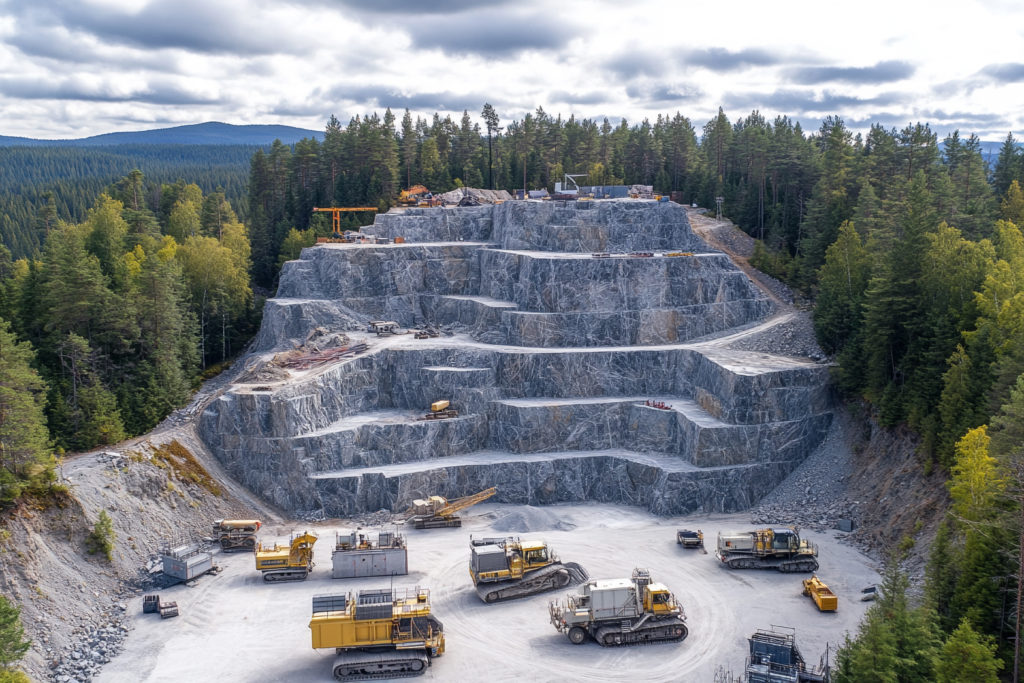
Aerial view of the earth mover in a quarry in Ukraine. AI-generated stock image by Mantas Žiličius.

I recently wrote a column on Ukraine’s potential in the titanium value chain with an analysis on the current geopolitical situation and geographic concentration. My key message was to consider Ukraine’s strong legacy and expertise in the industry, Ukraine’s active role in the global supply chain in chloride process feedstock, Ukraine’s recent presence in titanium sponge manufacturing (Ukraine stopped producing titanium sponge in 2021) and overall high quality of the local resource base, when planning diversification options for Western titanium supply.  

Today, in light of Ukraine’s push to rekindle its mining and processing industry and considering Ukraine’s ambitious plans to build a critical minerals sector while reanimating its geological exploration program, I would like to tackle a very important metal – lithium. As Ukraine will close the application window for its first ever Product Sharing Agreement in lithium on December 12 (the PSA tender for the “Dobra” site), it is vital to discuss the opportunities, the problematics, the key market factors and the geopolitical situation around this highly important metal.  

Over the last five years, lithium has gone through a dramatic transformation. It moved from a niche commodity to an important “everyday” metal. We have managed to witness one full “boom – bust” cycle already, a number of countries have felt firsthand what disturbances and dangers geographic concentration of supply chains hold, EV manufacturers have discovered what “raw material risk” really means, and many governments and institutions are now actively writing industrial strategies around battery metals. The bankruptcy of Northvolt, the care and maintenance of production assets in Australia, the unfaltering dominance of Chinese value chains, and the rise of lithium brines in South America shaped today’s new reality.  

The spectacular price spike of 2022 and the equally dramatic crash of 2023-2024 are now behind us. And right now, the more important question is: who will actually dominate lithium supply, processing and technology in the next decade and what will it spell for the global critical minerals and related sectors?  

Three things are absolutely evident. Demand is structural and will increase twofold, threefold and even fourfold. Supply looks adequate on paper, but in reality, it will be constrained. Positions of power shift from geology and resource base domination to a complex mix of costs, politics and industrial capability.  

All of this has serious and systemic implications for any new entrant into the market, Demand is not a story of “if”, but “how fast”  

If you look at various forecasts and scenarios out there, you will see that the vast majority are well aligned. Depending on the source that you prefer (IEA, Fastmarkets, Benchmark Mineral Intelligence, BloombergNEF, Goldman Sachs, Morgan Stanley), we can expect global lithium demand in 2035 to be somewhere between 3.5 and 4 million tons of LCE, roughly three to four times current levels.  

The driving factors are logical. Electric vehicles still dominate demand growth. On top of that we have a quiet but explosive rise of energy storage. The rise of AI, data centers and high-tech digital infrastructure significantly contribute to the growth of demand in grid-scale storage.  

Yes, chemistry is evolving. LFP has already taken significant share from nickel-heavy cathodes; sodium-ion is entering the low-cost segment; solid-state may take a slice of premium EVs in the mid to late 2030s. Yet, there are no factors that would remove lithium from the picture. All the factors mentioned change the nuances like where and how much lithium is used per kilowatt-hour. The need for large volumes of reliable, reasonably priced supply is as relevant as ever.  

In other words, nobody can deny that demand will grow significantly in the next 10 years.  

Supply: plenty on paper, much tighter in reality  

On paper, the global project pipeline looks incredibly impressive. If you add up every announced brine, hard-rock and clay project, plus DLE (direct lithium extraction) and oilfield brine concepts, you can easily get to nameplate capacity of over 3.5 million tons LCE by 2035.  

In practice, it’s all very different.  

It is important to understand that usually lithium projects fail, slow down or scale down for three key reasons:  

Costs:  

The last two years were a brutal reminder. When lithium prices collapsed from the $70,000-$80,000 per ton level of 2022 to around $10,000-15,000 per ton, the first casualties were high-cost operators. As global prices continued falling, operators who could not cope with an adequate cost curve and projects with “over the top” CAPEX went into total breakdown.  

Permitting: 

Lithium projects are facing similar challenges that copper and nickel projects faced before. Time becomes a major problem. The path from geological exploration to industrial operation with product in the market can take a decade.  

Technology and execution risk: 

Direct lithium extraction, clay leaching and complex hybrid flowsheets are highly promising but not plug-and-play. Moving from pilot to commercial scale without losing recovery or blowing out operating costs is quite a challenge.  

As a result, on paper, the global market looks comfortably supplied, but in reality, availability in any given year is much tighter. This logic underpins the long-term forecasts of $15,000-$20,000  per ton LCE price, as regular shocks, shifts and supply constrain affect prices.  

The anatomy of the cost curve  

The lithium industry is governed by a very simple, very unforgiving factor: the cost curve.  

If you analyze global production, you can formulate three separate groups by cost curve.  

Tier-1 Cost Curve: structural winners (5,000-7,000 US Dollars per ton of LCE)  

These are the best South American brines, the most efficient hard-rock operations, and a handful of DLE projects. These operators have strong margins even at $10,000-$12,000 per ton prices. Such operators cn survive almost any down-cycle. In time of crisis, these operators cut CAPEX and comfortably play “the waiting game.”  

Tier-2 Cost Curve: competitive, but cyclical ($7,000-$10,000 per ton of LCE)  

This is where a lot of decent hard-rock projects, as well as some clay and maturing DLE projects sit. At prices of $15,000-$20,000 per ton, these operators generate very respectable returns. At prices of $10,000-$12,000 per ton, business is manageable, as long as debt is well managed and production plants perform according to design.  

Tier-3 and Tier-4 Cost Curves: marginal and speculative players ($10,000-$11,000 per ton of LCE)  

High-cost lepidolite, complex clays, poorly located or power-hungry projects. These operations are effectively leveraged options on high prices. They switch on during price spikes, then shut down as soon as the market normalizes. They are the first casualties in any downturn and the last to get financing when sentiment is cautious.  

So, why do prices overshoot and break expected long-term averages (into the $25,000 US per ton and higher range)?  

As more expensive projects are needed to cover the demand during tight years or when extreme disruptions happen, the market will gravitate towards the right-hand side of the curve. It’s not because the world runs out of lithium, but because the needed supply comes from very expensive projects.  

In practical terms, if long-term average prices settle in the $15,000-$20,000 per ton range, Tier-1 and Tier-2 projects will be perfectly positioned; Tier-3 will swing in and out of existence; Tier-4 will live mostly in investor presentations. For new countries and companies entering the market, the single most important question is: which tier do you want to live in?  

The answer is simple: every country or economy that wants to enter the lithium industry must do everything in its powers to create competitive advantages and investment conditions for investors and operators to come in and develop projects in the Tier-1 and Tier-2 domains. At the same time, it falls to the operators and investors to implement sound business models, use good engineering and manage debt wisely.  

China’s midstream  

No discussion of lithium’s future can ignore China. Right now, Chinese companies refine roughly two thirds of global lithium chemicals and produce well over 70% of battery cells. Two Chinese giants – CATL and BYD dominate the EV and battery industries.  

By 2035, three things are likely to come true:  

  • China’s share of refining physically located in China will likely decrease as new plants are built in Australia, Korea, the US, the EU and the Gulf.  
  • Chinese-controlled capacity, however, will remain enormous. Chinese capital, technology and equipment are already embedded in emerging refineries from Indonesia to Saudi Arabia.  
  • Beijing will continue to tolerate low margins and selective losses in parts of the value chain when this serves strategic goals—securing offtake, supporting national champions, or squeezing higher-cost competitors.  

In the long-term, we can expect that China will slow down its subsidizing of everyone and everything in the value chain. Domestic regulators are already pushing back against “blind expansion.” Over time, we should expect a consolidation of capacity inside China: weaker, dirtier, high-cost plants shut or absorbed; larger, more efficient complexes strengthened. Something that we witnessed in the Chinese Rare-Earth industry.  

For new entrants, that means two things. First, you are not competing against a single Chinese operator or against a single “Chinese price,” but against a portfolio of Chinese cost positions, from ultra-competitive Tier-1 capacity to fragile Tier-4 operations. Second, you must assume that in any serious downturn, China will move faster, closing capacity, cutting deals, redirecting flows, because the state, the banks and the companies are all part of one system.  

Western governments need to understand this and that is why fostering home-grown industries, strengthening Western supply chains and integrating such players as Ukraine is vital to supply diversification and long-term de-risking. For Ukraine, it means, creating and implementing stable conditions for the development of Tier-2 projects.  

Success for new entrants: the seven key factors  

What does success look like for a new country or company trying to enter the lithium race?  

1. Cost position (tight, proven flowsheets, good resource quality and mineralogy, effective technology, positioning in the right Tier, sound debt management, competitive price of key inputs)  

2. A guaranteed route to market and effective logistics (long-erm offtake contracts, JVs with chemical operators, conversion capacity aligned with local policy and economy).  

3. Fast and predictable permitting (time is everything, speed is a competitive advantage, moving from PFS to production ASAP is a vital success factor).  

4. Governance and ESG as commercial assets.  

5. Integration into a larger industrial or geopolitical bloc (here the US-Ukraine Reconstruction Investment Fund and other Western strategic investment initiatives will play a major role for Ukraine’s entry into critical minerals).  

6. R&D support and integration into strategic alliances not only in terms of supply chains, but also in terms of technology sharing and joint R&D efforts (science and tech play major roles in critical minerals).  

7. Development of human capital.  

Barriers: why many will fail  

We have to understand that many new entrants will not make it to 2035 as serious players. Such factors as capital constraints (don’t forget that lithium is cyclical), policy volatility, market volatility, and over-promising on unconventional technologies.  

This also means that projects with good fundamentals like hard-rock spodumene will have their definitive segment for many years to come and Ukraine can leverage its hard-rock deposits, like the “Dobra” PSA, and the by-products (the rare metals involved) to gain market position, especially in the European market.  

From being a resource holder to becoming strategic partner  

The next decade will be under the “New Age of Electricity” flag and lithium, graphite, copper, nickel and uranium will all play leading roles. At the same time, strategic metals and materials like titanium, zirconium, hafnium, germanium, gallium. Ukraine is an ideal power-play in this light, especially in its proximity to Europe and its well-developed logistical network and infrastructure.  

We must understand that lithium is not a simple resource story. It is about who can turn geology into strategic capability: well-positioned in the cost curve, reliable, technological lithium volumes that feed into trusted midstream and downstream hubs and industrial clusters.  

For new countries, the choice is stark. Either they remain price-taking exporters of raw material, forever exposed to the shocks and swings of the market. Or they deliberately build the conditions, cost structure, governance, speed, and partnerships to become indispensable partners in a world that badly needs secure, sustainable lithium, critical minerals and other strategic metals and materials.  

The resource base is very important, but in the next decade, those who can combine it with policy, speed, discipline and alliance integration will triumph. 

Yegor Perelygin is Deputy Minister, Ministry of Economy, Environment and Agriculture of Ukraine 

AU

Barrick to pay Mali $430M to settle mine dispute


Loulo-Gounkoto gold mining complex. Credit: Barrick

Barrick Mining (NYSE: B; TSX: ABX) is said to have agreed to pay 244 billion CFA francs ($430 million) in its settlement with Mali, as part of the company’s deal to end a two-year dispute that shuttered the Loulo-Gounkoto gold complex, Bloomberg reported Tuesday.

The payment would be done within six days of signing the agreement with Mali’s government. Another 50-billion CFA francs will come via VAT-credit offsets, while an installment of the same size was already paid last year, the report said.

The news comes as Barrick reached an agreement with Mali’s government to end their dispute, removing uncertainty surrounding the operation of its Loulo-Gounkoto complex in the African nation. Its stock surged.

In a press release Monday, the Toronto-based gold miner confirmed that the Malian state has dropped all charges against the company and its affiliates and will return operational control of Loulo-Gounkoto to Barrick. The Mali government will also arrange for the release of four Barrick employees that have been detained for a year.

In exchange, Barrick said it will withdraw its arbitration case against Mali, which it brought to the World Bank dispute tribunal in December after Mali’s junta-led government blocked gold shipments from the Loulo-Gounkoto site.

The announcement follows an earlier report by Reuters that the two sides had reached a verbal agreement to resolve their issues.

The agreement officially ends a protracted two-year fight over one of Africa’s largest mining assets. Last year, Loulo-Gounkoto produced 723,000 oz. of gold, ranking it amongst the top 10 producers globally. Ownership of the mine complex is held 80% by Barrick, with Mali retaining 20%.

Analysts at Jefferies said the mine restart and ramp-up could take around six to 12 months.

Shares of Barrick soared to a new 52-week high of $39.02 in New York after announcing the dispute resolution. By noon ET, it traded at $38.76 apiece with a market capitalization of nearly $62 billion. Year to date, the stock has gained over 143%, outperforming that of rivals Newmont (NYSE: NEM; TSX: TGT) and Agnico Eagle Mines (NYSE, TSX: AEM).

The dispute dates back to 2023 when Mali imposed a new mining code and demanded millions from Barrick in economic benefits and taxes. The situation escalated earlier this year when the Malian state seized Barrick’s gold, forcing it to suspend operations, and later placed it under provisional administration.

Amid the Malian dispute, Barrick had to write off $1 billion in revenue from the Malian operation and experience a significant leadership change with the departure of former CEO Mark Bristow, who played an instrumental role in the development of Loulo-Gounkoto.


Caledonia bets big on Bilboes as Zimbabwe’s next major gold mine


Bilboes gold project in Zimbabwe. (Image courtesy of Caledonia Mining.)

Caledonia Mining (LON: CMCL) has approved full development of its Bilboes gold project in Zimbabwe after a feasibility study projected strong returns for what is expected to become the country’s largest gold mine.

The company, which acquired Bilboes in 2023, estimates peak funding at $484 million and total capital costs at $584 million. The study identified a single-phase development plan as the most economic path forward. Caledonia plans to finance construction mainly through debt and equity generated from its Blanket gold mine in Matabeleland South.

Chief executive Mark Learmonth said the decision marks a milestone for a project “decades in the making,” adding that Bilboes could help Zimbabwe reclaim its position as a leading gold producer.

The project covers 2,731.6 hectares in Matabeleland North, about 80km north of Bulawayo. Proven and probable reserves stand at 1.75 million ounces of gold grading 2.26g/t. Measured and indicated resources, excluding reserves, total 532,000oz at 1.37g/t, while inferred resources are estimated at 984,000 ounces at 1.62g/t.

Online by late 2028

Bilboes will use Metso’s BIOX technology to process refractory ore by oxidizing sulphide minerals and improving gold recovery. The feasibility study outlines plant throughput of 240,000 tonnes per month during the first six years, tapering to 180,000 tonnes per month for the remainder of the nearly 11-year mine life. Metallurgical recovery is forecast to range from 83.6% to 88.9%.

Caledonia expects output to begin in late 2028, ramping up to roughly 200,000 ounces in 2029. Over the life of the mine, Bilboes is projected to produce 1.55 million ounces at an all-in sustaining cost of $1,061 per ounce.

Supported by investors including Allan Gray and BlackRock, Caledonia plans a phased financing strategy designed to accelerate development while limiting equity issuance to protect the project’s net present value per share.


Bolivia plans gold bank to bring order to unruly mining boom

Credit: Dan Lundberg | Flickr, under Creative Commons licence CC BY-SA 2.0.

Bolivia’s new government plans to create a gold bank with public and private capital to ensure sustainable mining and marketing practices, Finance Minister José Gabriel Espinoza said.

The administration of centrist President Rodrigo Paz, who took office this month following two decades of socialist rule, plans to continue state buying of locally mined gold but with different mechanisms from those in place since 2023, Espinoza said in an interview.

The new gold bank would help improve oversight, he said, without offering details on how it would operate.

“We’re going to create the gold bank, and what we need to do is set mechanisms that ensure traceability, development of the gold sector and respect for environmental standards,” Espinoza said.

Bolivia initiated a central bank gold purchasing program in mid-2023, raising billions of dollars to help pay back international bondholders amid a hard currency crisis exacerbated by fuel subsidies. But the buying program has lacked transparency and has helped fuel an unruly gold rush characterized by environmentally harmful practices and opaque trading.

Informal and illegal gold mining and trafficking in South America is surging along with bullion prices, which are up more than 50% this year due to central bank purchases and as investors seek havens from mounting government debt.

Through August of this year, Bolivia’s central bank had bought 28.5 metric tons of locally produced gold and monetized 48 tons. But it also sold gold in advance and still must deliver 6.7 tons next year. It paid producers in local currency, indirectly fueling inflation and encouraging smuggling.

The program’s sole purpose was “to feed dollars to a monetary-management system that was absolutely pernicious,” Espinoza said. Gold bought by the bank “very likely does not meet environmental standards, child labor standards, for example, and obviously it would not meet any of the traceability standards established today.”

Without offering details, Espinoza said the new administration intends to keep buying gold but would “reorder” its instruments, ensure environmental compliance, remove gold as a payment method in illegal sectors, and offer cooperative miners better labor conditions by promoting formalization.

“We will intervene there, but this will be coordinated with the central bank, which also has its own ideas,” he said.

(By Sergio Mendoza)

CRIMINAL CAPITALI$M

Trafigura staff raised nickel concerns years before fraud claim

Credit: Trafigura Group

Trafigura Group’s trade finance desk raised questions as early as 2020 over the company’s nickel-financing deals with firms run by Prateek Gupta, which would later lose the trading house around $600 million.

Trafigura’s lawyers last week described the situation as “a sort of Ponzi scheme,” with the trading house as the sole victim. The risks of those deals with Gupta were highlighted by Thibaut Barthelme, a member of Trafigura’s trade finance desk.

“Main concern is that we have become the bank of this company and that if we stop doing this, they have no other way to finance that business,” Barthelme said in a September 2020 email to his department bosses, Stephan Jansma and Camille Treujou.

The email was submitted to a court in London on Monday as Gupta’s lawyers questioned Socrates Economou, the former Trafigura nickel head who oversaw the trades.

A person close to Trafigura said that the company did seek to limit its exposure to Gupta after the warnings that were raised in September 2020. But the emails nonetheless highlight that senior figures in the trading house were aware of concerns about the relationship more than two years before its eventual collapse. Jansma is now Trafigura’s chief financial officer.

The world’s biggest metals trader shocked financial markets in early 2023 when it revealed it had been the victim of the alleged fraud. The company said it found that over half a billion dollars of metal in containers that it bought didn’t contain the nickel they were supposed to, but were filled with with stainless steel, aluminum and worthless iron briquettes.

Gupta denies the allegations against him.

Despite the concerns raised by its trade finance department, by 2021, the business with Gupta was almost 70,000 tons, or $1.2 billion worth of annual trading, according to a presentation submitted as evidence on Monday.

A person close to Trafigura said that raising concerns to management was a normal part of the role of the company’s trade finance team. Trafigura was reassured because it believed the trade with Gupta was secured by physical cargoes of nickel, the person said.

Trafigura refers to the deals with Gupta, where the Indian businessman’s firms would sell the trading house cargoes already onboard vessels before later buying them back at a premium, as “transit financing.” Gupta’s lawyers call them “circular buy-back trades.”

Gupta says that Trafigura executives were aware that the cargoes didn’t contain LME brand nickel, something the company has always denied.

The prices of the sale and the purchase were set so that Trafigura earned a fixed fee on the deal, as if it were simply lending money — typically equivalent to an interest rate of 4% to 6%. The trading house used financing from Citigroup Inc.

The trade began to unravel when Trafigura investigators arrived at the port of Rotterdam just before Christmas in 2022 to check the contents of a container that was meant to hold nickel. When they cracked it open, it was full of much lower-value materials.

Evidence submitted to court on Monday shows that developing a large-scale business relationship with Gupta rang alarm bells for some at Trafigura at an earlier stage.

“It’s a strange business strategy, long voyage times, high interest costs, irregular sales,” according to the email from Barthelme, who noted that both Credit Suisse and Deutsche Bank AG were unwilling to process payments to Gupta’s companies.

In skeleton arguments and documents submitted to the courts last week, the dealings seem to have also had a mixed reception among senior Trafigura metals staff. Co-heads of metals Kostas Bintas and Gonzalo de Olazaval “did not like it,” according to a June 2022 email from a Trafigura trade finance executive, which was cited by Gupta’s lawyers.

(By Archie Hunter, Jonathan Browning and Jack Farchy)


Op-Ed: Arctic States Have Less Than Two Weeks to Act on Polar Fuels

Arctic melting ice
NASA file image

Published Nov 24, 2025 12:54 PM by Dr. Sean Prior


The Arctic is warming four times faster than anywhere else on Earth, and this is a warning sign for elsewhere on the planet. The shipping sector has been gifted an opportunity to cut black carbon emissions from shipping in the region, which would have a near-immediate positive impact. But time is tight.

December 5th is the deadline for countries to submit a crucial proposal for polar fuels, ahead of next February’s meeting of the International Maritime Organization’s Pollution Prevention and Response subcommittee (PPR13). With the clock ticking, Arctic states must act without further delay to make cleaner fuels mandatory for shipping in a unique region already seriously impacted by climate change. Arctic states can demonstrate joint leadership on this issue, as they have vessels operating in polar waters, but they must be joined by other non-Arctic states.


The momentum and support for this important decision is building: the Nordic Council of Ministers has just made a recommendation for the Nordic governments to work towards the recognition of polar fuels by the IMO and the MARPOL Convention.

The International Maritime Organization (IMO) has spent more than a decade prevaricating over scientific analysis and discussions, yet black carbon emissions from Arctic shipping remain unregulated. February’s PPR meeting provides an opportunity to change this - with the deadline fast approaching, Arctic governments must put forward a concrete proposal to avoid squandering this chance. By acting now, Arctic countries can demonstrate a unique opportunity for joint leadership on cutting black carbon emissions. They can do this by championing - and making a robust proposal for a regulation on polar fuels.

Black carbon is a short-lived climate super-pollutant produced when fossil fuels are burned. It has a disproportionate impact because it both heats the atmosphere - and when released from ship exhausts near to the Arctic settles onto snow and ice, speeding up the melting and exposing darker land and sea beneath, which in turn absorbs more heat. This loss of the planet’s reflectivity - or albedo - is contributing to the fast pace of warming seen in the Arctic.

Black carbon emissions from ships burning oil-based fuels have more than doubled in the last decade, yet a simple and easy solution is to require shipping to use widely available distillate fuels with lower black carbon emissions and new zero-emission fuels when operating in and near to the Arctic. Defining which fuels should be used in the polar regions, and in particular in the Arctic, this coming February is crucial, and Arctic countries must be a driving force in ensuring that regulations on these ‘polar fuels’ are put in place.

But first, they must meet the looming December 5th deadline.

Dr Sian Prior is Lead Advisor to the Clean Arctic Alliance.

The opinions expressed herein are the author's and not necessarily those of The Maritime Executive.


IDsure & Bahamas Maritime Authority to Deliver First Seafarer Record Book

IDsure

Published Nov 24, 2025 8:29 AM by The Maritime Executive


[By: IDsure]

IDsure is honored to announce its strategic partnership with the Bahamas Maritime Authority (BMA) to introduce the world’s first fully digital, mobile-ready, and tamper-proof Seafarer Record Book, issued directly to seafarers in a secure, identity-verified manner. This breakthrough sets a new global benchmark for trust, speed, and transparency in maritime credentialing.

Through a seamless integration between BMA’s BORIS enterprise system and the secure IDsure platform, seafarers will now receive their credentials instantly after identity verification- eliminating delays, manual submissions, and paper-based administration. Shipowners, crew managers, and training institutions will also benefit from significantly streamlined processes and automatic data exchange.

“We are extremely proud that the Bahamas Maritime Authority has chosen IDsure for this pioneering initiative,” said Jesper Holmgren, CEO, IDsure. “Together, we are delivering a secure, verifiable digital Seafarer Record Book - available on the go, issued in minutes, and protected by advanced identity assurance. This partnership brings the maritime world into a new era of digital trust.”

“The Bahamas Maritime Authority is committed to continuous improvement and the responsible use of technology to enhance the services we provide to our seafarers and industry partners,” said Capt. Kapila Malawwethanthri, Deputy Director, Seafarers & Manning Department, BMA.

The integration also connects BMA-approved training centers directly to the authority. When a center issues a certificate via IDsure, BMA receives it instantly through BORIS, strengthening regulatory oversight and reducing the administrative burden on institutions managing thousands of records annually.

Development work between IDsure and BMA is progressing as planned, and BMA has begun informing shipowners, managers, and training providers about the upcoming digital issuance process. A separate launch announcement will follow once the new service goes live.

The products and services herein described in this press release are not endorsed by The Maritime Executive.


Sanctioned Iranian Tanker Caught in STS to be Auctioned in Indonesia

illegal tanker oil transfer
Arman 114 (left) which Indonesia says was involved in an illegal STS is to be auctioned off with its cargo (Bakamla)

Published Nov 24, 2025 2:00 PM by The Maritime Executive


The Indonesian Attorney General’s Office is auctioning an Iran-flagged vessel it detained two and a half years ago when it was caught conducting an illegal ship-to-ship oil transfer to a shadowy second tanker. An Indonesian official said the online auction is to proceed under the authority of the Batan District Court and is an effort to dispose of the tanker and its cargo, which will be sold in a single lot.

The online auction shows a minimum bid of approximately $70.5 million for the vessel and its cargo, which is estimated at nearly 167,000 metric tons (1.24 million barrels) of light crude. A guaranty of $7 million is required to enter the auction, and the buyer will have 30 days to take control and move the tanker from the Batu Ampar Waters anchorage near the Riau Islands.

The vessel named Arman 114 was built in South Korea in 1997 and has been operating under the Iranian flag since 2019. The owner is listed as a company incorporated in Panama. The ship is 300,579 dwt. Its condition is unclear since it was detained in July 2023, and databases do not list an inspection since 2017.

Indonesian officials detected the ship alongside a second tanker in July 2023 and reported that a drone survey showed hoses strung between the two tankers.  They also accused the Arman 114 of causing pollution with leaks from the transfer. The reports said the vessels were spoofing their AIS signal and failed to display a flag, even after they were detected and later challenged.

When the vessels were confronted by the Indonesian authorities, they attempted to run. The second tanker was displaying the name S Tinos, which was later determined to be false. A vessel with that identity had been scrapped in 2018. It, however, alluded to capture. 

The Arman 114 also attempted to run but was apprehended when it entered Malaysian waters. It was returned to Indonesia.

The captain of the vessel was put on trial in July 2024, although he claimed to be only a security guard aboard the vessel. An Egyptian, the master disappeared days before the verdict was to be read. He was convicted in absentia and sentenced to seven years in prison and a $300,000 fine for intentional water pollution. Since he repeatedly failed to appear, the Batam District Court concluded that the master had likely fled.

The court, however, also ordered the vessel and its cargo seized and has now cleared the path for the auction. Indonesia conducted a briefing today, November 24, to prepare for the auction. The sale is scheduled for December 2.

The Arman 114 has been sanctioned by the United States, which also linked the vessel to other illegal STS operations to support Iran’s oil sales. Iranian officials, however, in July 2023, denied ownership of the oil. Without providing details on the ownership of the oil, Iran contended that news reports linking it to the cargo “lacks any credibility.”


Sanctioned Tanker Reaches Venezuela After Being Tracked by US Destroyer

tankers arriving in Venezuela
Iranian tankers arriving in Venezuela in 2020 (Venezuela on X)

Published Nov 24, 2025 3:31 PM by The Maritime Executive


A sanctioned tanker reached the anchorage in Venezuela on Sunday, November 23, after having turned away several times when a U.S. destroyer appeared on its route. Maritime AI data analytics firm Windward reports it is part of a continuing growth in Russian imports supporting Venezuela’s oil operations.

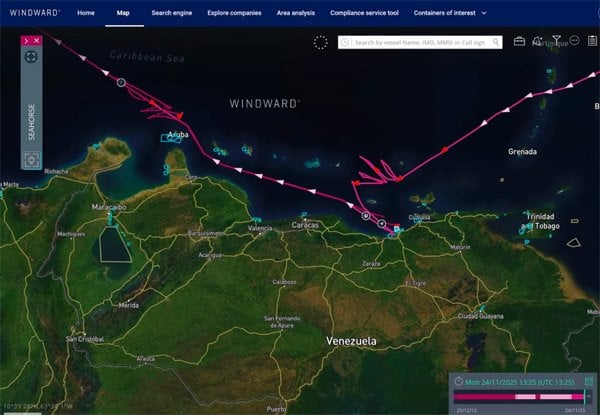
The Seahorse, a 70,246-dwt tanker which was built in 2004, has been in the Caribbean since October, and last week Bloomberg reported it had three times turned away as it appeared bound to Venezuela. Each time, the American destroyer USS Stockdale had been spotted in the path of the vessel, although it does not appear they had any direct interaction. It is unclear if the U.S. was intentionally blocking the vessel or not, but it appears to have spooked the crew on the sanctioned tanker.

The tanker claims a flag of Comoros, which Equasis reports as false, and it was listed in 2025 by both the EU and UK for sanction violations. The vessel is considered to be part of the shadow fleet, having reported multiple name changes and flags. In the past, United Against Nuclear Iran (UANI) has also reported that the vessel was being used in the Iran to Venezuela trade, with both Russia and Iran supporting Venezuela’s need for distillate products to maintain its oil operations.


Seahorse's erratic routing (courtesy of Windward)


Windward points to an irregular sailing pattern of the vessel for a week. They report it showed multiple course changes and had been acting erratically since October. It had gone to Cuba and turned back to Venezuela only to briefly reverse course at one point in November. 

The vessel had been holding off Aruba at the end of last week and then turned for its approach to Venezuela. It anchored in the Puerto La Cruz anchorage without further incident.

The ship followed a second sanctioned tanker that also arrived in Venezuela over the weekend. The Russian-flagged product tanker Vasily Lanovoy (49,999 dwt) had departed Russia’s Ust Luga on October 28 and arrived at Venezuela’s Jose Terminal on November 23 without incident. The vessel, which was built in 2016, has been in the Russian registry since 2023 and is reported to be owned by the Russian construction company TransStory and managed by Gazprom. It was sanctioned by the U.S. in May 2024 and in the third quarter of 2025 by both the EU and the UK. It was also transporting a Russian light oil to be used as a distillate. 

Windward highlights that Venezuela turned to Russia in 2025 for its deliveries after the Trump administration cut it off. The U.S. had been permitting deliveries of the oil, which is used to thin Venezuela’s crude. Iran has also supplied Venezuela. Windward reports Venezuela has tripled the amount of Russian imports in 2025.

Officials in the U.S. declined to comment on the incident and whether there had been an attempt to block the vessel. 
 

OUTLAW LIVESTOCK CARRIERS

Livestock Carrier Accused of MARPOL Violations as it Tries to Unload Cattle

livestock carrier
AWF is tracking the situation to highlight the need to end live animal exports (AWF file photo)

Published Nov 24, 2025 4:12 PM by The Maritime Executive


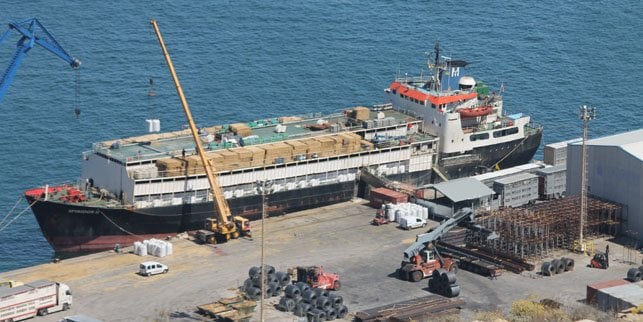
Animal advocacy groups are again sounding the alarm about a livestock carrier that appears to be roaming the Mediterranean seeking ports to unload its cargo after it was turned away from Turkey. The Animal Welfare Foundation is calling attention to the situation aboard the Togo-flagged vessel Spiridon II as it continues to advocate for a ban on live animal transport on the high seas.

The vessel has been at sea since September 20 with an initial load of 2,901 cattle, which had been destined for Turkey coming from Uruguay. After reaching Turkey on October 22, the vessel was stopped from unloading after the Turks reportedly found irregularities in the paperwork, including a mismatch between the papers and the animal’s tags. The ship was briefly permitted to dock to load additional supplies, but set sail again on November 14, reporting the cargo was being returned to Uruguay, where it was expected on December 14.

The Animal Welfare Foundation has been tracking the vessel and reports it has gone dark on several occasions in the past few days. The ship turned up off the coast of Tunisia and then arrived in Benghazi, Libya, on November 22. Eyewitnesses and satellite images showed trucks at the vessel, and loaded animal transporters were seen leaving the port area on Sunday, November 23.

It is unclear how many of the animals were offloaded and what the status is aboard the vessel. AWF reports that the veterinarian who accompanied the animals on the trip from Uruguay left the ship in Turkey. They also speculate that the feed loaded in Turkey on November 9 is depleted.


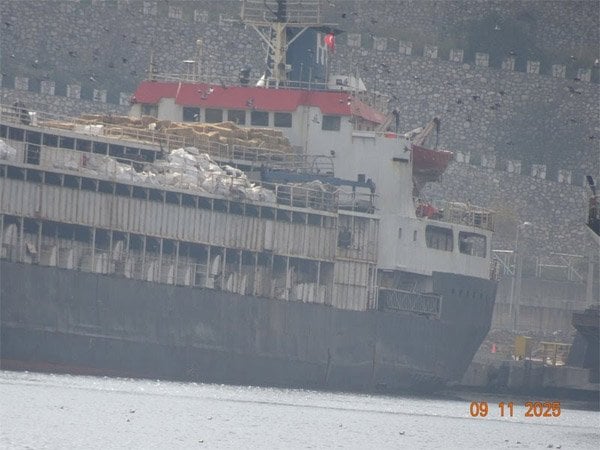
Spiridon II in the port of Bandarma © Animal Welfare Foundation/Animal Save Movement Türkiye


Also, unclear is what has happened to the carcasses of the animals that died aboard. Veterinary authorities in Turkey had reported that at least 58 animals had died, and AWF fears far more died, as well as the pregnant cows that were aboard and due to give birth. 

“We assume the dead animals were thrown overboard,” AWF writes, “and that the sewage accumulated over two months was illegally discharged.” They had noted white sacks on the deck of the vessel, which were missing when it reached Libya.  Observers also said they did not notice “any smell of manure or dead animals.”

“We are witnessing one of the most serious violations of animal welfare and marine conservation in recent years – and yet another example of the structural failure of the live animal trade by sea,” says Maria Boada Saña, veterinarian at AWF. “The authorities must now immediately clarify whether there are still animals on board, where the animals are being taken, and what happened during the signal shutdowns.”

AWF is calling for an international investigation into the ship as well as a medical examination of any animals still onboard. It is also demanding an investigation into possible MARPOL violations.

The Spiridon II, according to its AIS signal, departed Benghazi on November 24. It reports a destination of Alexandria, Egypt, where it is due on November 27. AWF highlights that the vessel had previously indicated a destination of Lebanon. Databases indicated the ship is managed from Lebanon and owned by a company in Honduras.

Built in 1973, the vessel is 4,000-dwt and is listed as having 4,000 square meters of space for animals. It was converted to a livestock carrier in 2011 and has been registered in Togo since 2018.


UK Tracks Two Years of Increased Russian Naval Activity

UK tracking Russian spy ship
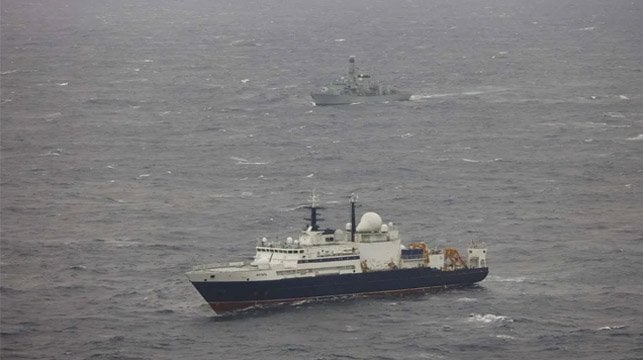
UK is highlighting a large increase in Russian vessels tracked in its waters over the past two years (Royal Navy)

Published Nov 24, 2025 5:57 PM by The Maritime Executive


The UK’s Ministry of Defence reported details on additional sightings of Russian vessels in its waters after reporting a recent incident with a Russian spy ship. It says the UK has seen a 30 percent increase in Russian vessels in UK waters in the past two years.

The Royal Navy maintains regular patrols and has frequently reported dispatching vessels to shadow Russian vessels primarily transiting the English Channel. The most recent incident, which took place in the last two weeks, involved a Russian corvette and a tanker as they sailed through the Dover Strait and westward through the English Channel.

RFN Stoikiy was observed off the UK Coast traveling with the tanker Yelnya (7,230 dwt), which is part of a class of replenishment oiler built for the Soviet Navy between 1967 and 1972. The tanker is reported to have been commissioned in 1969 and remains active, supporting the Russian fleet. Stoikiy is newer, a 2,200-ton displacement warship commissioned in 2014.

HMS Severn was dispatched to shadow the movements of the Russian vessels. The 1,700-ton displacement offshore patrol vessel was operational for the Royal Navy between 2003 to 2017 and recommissioned for duty in 2021, based in Portsmouth. The Ministry and Royal Navy report that the vessel tracked the Russian vessels and later handed them off to a NATO vessel off the coast of Brittany, but continued to observe from a distance. Despite the extensive media coverage, the Royal Navy did confirm the Russian vessels followed recognized maritime routes.

The incident also drew more interest because it came days after the Ministry accused a Russian spy ship of lingering near the UK and directing lasers at RAF planes. They said HMS Somerset and other civilian ships experienced GPS jamming in the area around the Russian vessel Yantar. The Ministry called the Russian vessel's behavior “unprofessional,” saying it intended to be “disruptive and a nuisance.”


“The Royal Navy always has a ship held at notice to conduct these missions, and HMS Somerset has been called upon to shadow the Yantar on two occasions this year as it entered UK waters,” said Commanding Officer, Commander Matt Millyard. “In the most recent operation, HMS Somerset, working alongside RAF maritime patrol aircraft, maintained 24-hour surveillance of the Yantar to provide evidence of their activities.”

Yantar, they report, was tracked for eight days. The vessel finally moved northward towards the Faroe Islands. In January, HMS Somerset and HMS Tyne also shadowed the “research ship” through the English Channel and Dover Strait.

HMS Somerset, the report has spent the last year operating in the North Atlantic as part of the ongoing patrol efforts. They also noted that three P-8 Poseidon aircraft from the RAF have been deployed to Keflavik Air Base in Iceland in the latest overseas deployment so far of the RAF P-8 fleet. They are supporting NATO and have been used for patrolling for Russian ships and submarines in the North Atlantic and Arctic.

Less than a month ago, the Royal Navy reported HMS Duncan had tracked the movements of the Russian destroyer Vice Admiral Kulakov. Along with the frigate HMS Iron Duke, they were also dispatched to monitor the Russian Kilo-class submarine Novorossiysk.

The Ministry of Defence used the incidents to highlight that the UK is stepping up on defense and security. They said it is backed by the UK’s biggest sustained increase in defense spending since the Cold War, including £4 billion on boosting drone capabilities and over £1 billion on strengthening air and missile defenses.

FEMICIDE AT SEA

Teen's Death on Carnival Cruise Ship Ruled a Homicide

Carnival Horizon
Carnival Horizon (file image courtesy Carnival)

Published Nov 24, 2025 6:03 PM by The Maritime Executive


The teenager who died under mysterious circumstances on cruise ship Carnival Horizon earlier this month was killed by asphyxiation, and her death has been ruled a homicide, according to a death certificate released by her family. A medical examiner in Miami concluded that Anna Kepner, 18, "was mechanically asphyxiated by other person(s)" at about 1117 hours on November 7. The document confirms previously-reported preliminary conclusions of FBI investigators. 

Kepner was a straight-A student, a varsity cheerleader, and had planned to enlist in the military after graduation, according to her family. 

A security source has informed ABC News that Kepner's body was discovered underneath a bed, concealed with a blanket and life vests. The body was discovered on November 7 by a crewmember who was cleaning Kepner's cabin, Florida Today reported. 

The FBI is investigating the case under "special maritime jurisdiction," which applies when specific criteria about the vessel, the victim or the voyage are met. Carnival Cruise Line is fully cooperating in the inquiry.  

Kepner's stepbrother - who was co-occupying the cabin with her, Kepner's grandmother told ABC - could face charges in connection with the death, according to court documents from an unrelated child-custody case. No arrests or charges have yet been made. 

In a memorial earlier this month, Kepner's friends and associates remembered her for her positive outlook and her involvement in her community. "When she walked into a room, she would light it up. If you were sad, she’d make you laugh. She would joke around and be the funniest little person in school," Kepner's parents told ABC News.