Wednesday, November 26, 2025


Why are shiny colours rare yet widespread in nature?


University of Groningen
shininess across the tree of life 

image: 

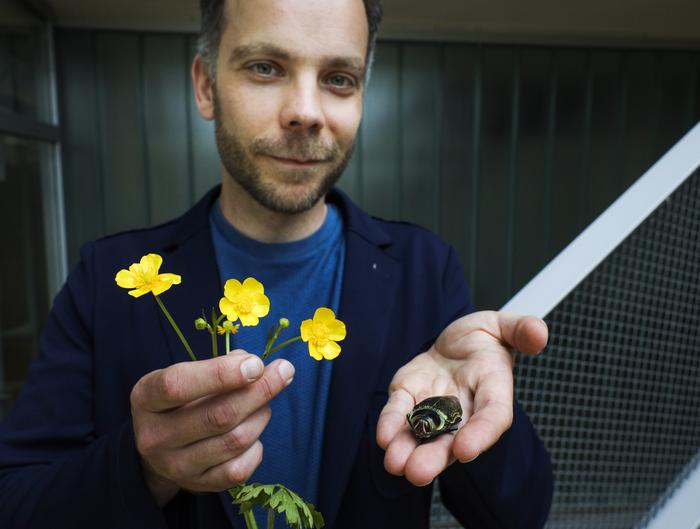
This image shows dhiney colours in different animal species. Casper van der Kooi and colleagues investigated how shiny colours are perceived by bumblebees.

view more 

Credit: University of Groningen


Nature is brimming with colour in almost every season. While the majority of colours are matte, some are shiny. Evolutionary biologist Casper van der Kooi wondered why shiny colours are so rare. He researched how bees perceive glossy colours by using artificial flowers. The experiment showed that shiny objects can be easily seen from afar, but are more difficult to discern up close. ‘It’s a visual trade-off.’

Biologists do not merely admire the colours in nature, they also develop theories to explain them. Most colours, such as the feathers of a great tit, the petals of a daisy, or the skin of a frog, are matte. These colours look the same from every angle. ‘Many colours serve as signals, for example, to attract pollinators or a mate,’ explains Van der Kooi. ‘These signals are most effective when they remain consistent in both time and space.’

Better traps for pest insects

However, there are also examples of shiny colours throughout nature, such as the glossy petals of a buttercup, or the metallic blue hue of certain butterflies. Van der Kooi: ‘These shiny colours have a dynamic quality: how you perceive them depends on the angle of observation, the level of illumination, and the time of day.’ He tested the effect of artificial flowers of different colours on bumblebees in large cages. The result shows that shiny colours are more conspicuous from a large distance, akin to a flashing lighthouse or the blue lights of an emergency vehicle.

‘At close range, their shininess will make them more difficult to see in detail. It’s similar to reading a glossy magazine in the sun: the letters will be hard to discern because of the shiny surface. So, there is a trade-off, which explains why dynamic, shiny colours are rarer than static, matte ones,’ explains Van der Kooi. ‘We could use this new knowledge to build better traps for pest insects, and advise engineers on how to prevent bees from flying to solar panels instead of flowers.’

Reference: Alexander Dietz, Johannes Spaethe, Casper J. van der Kooi: Dynamic visual effects enhance flower conspicuousness but compromise color perception.  Science Advances, 26 November 2025.


New study reveals spatial patterns of crime rates and media coverage across Chicago


Findings could help inform efforts to boost safety and keep the public accurately informed


PLOS

Advancing urban management: Integrating GIS, LLMs, and media narratives into environmental and socio-economic analyses for enhanced urban crime analysis 

image: 

Most frequently reported crime from major media sources, and the spatial distribution of media reports and three crimes.

view more 

Credit: Cai et al., 2025, PLOS One, CC-BY 4.0 (https://creativecommons.org/licenses/by/4.0/)


A spatial analysis of crime in Chicago suggests that certain environmental and socioeconomic factors, such as building density, are linked with crime rates, but these relationships differ between neighborhoods. The study also reveals discrepancies between media coverage and actual crime patterns, with coverage disproportionately concentrated in certain areas. Yuxuan Cai of the University of Chicago, U.S., and colleagues present these findings in the open-access journal PLOS One on November 26, 2025.

Numerous prior studies have investigated factors associated with crime in Chicago and other cities. In addition, evidence suggests that media coverage strongly influences public perceptions of crime in urban areas.

However, most prior studies of crime in Chicago have been limited in scope, such as by focusing on only a few socioeconomic factors at a time, or not distinguishing between different crime types. To gain a more comprehensive view, Cai and colleagues used computational tools to analyze associations between rates of different crime types and various environmental and socioeconomic factors in different parts of Chicago, as well as spatial patterns in media coverage of crime. Their dataset included 234,918 crime incidents that occurred from 2017 to 2023.

Using the natural language model GPT-3.5-Turbo, the researchers analyzed 3,507 local news reports on crime in Chicago from 2023 to 2024. They found that the most frequent crimes—theft, criminal damage, and battery—were significantly underrepresented in news reports, while homicides and assaults were overrepresented. Media coverage tended to focus more on downtown and certain north and south side areas, while neglecting other neighborhoods.

The analysis also uncovered links between certain spatial factors and crime. For instance, more walkable areas had higher rates of theft but lower rates of criminal damage and battery. Dense road networks and higher building density were associated with higher rates of all crime types. In downtown and northern areas of the city, higher housing density and economic activity were associated with lower crime rates, but this pattern was not seen for south side areas.

These findings could inform efforts to improve safety and media crime coverage. However, further research is needed to determine the mechanisms underlying these spatial patterns.

The authors add: "Our analysis shows a troubling disconnect between media crime coverage and actual crime patterns in Chicago. While the most common crimes include theft, criminal damage, and battery, media outlets disproportionately focus on homicides and assaults. This bias not only distorts public perception but may also influence policy decisions in ways that don't address the most prevalent public safety concerns."

"What makes this study unique is our integration of large language models with traditional spatial analysis methods. By using GPT-3.5 to analyze over 3,500 news articles, we were able to systematically compare media narratives against actual crime data on a large scale. This computational approach opens new possibilities for understanding how media shapes public perception of urban safety."

"Our geographically weighted regression analysis shows that the same environmental factors, such as road density or vacant buildings, can have completely different relationships with crime across neighborhoods. This means one-size-fits-all urban planning solutions won't work. Policymakers need spatially-targeted interventions that account for local conditions, and the media needs to report more balanced stories."


In your coverage, please use this URL to provide access to the freely available article in PLOS Onehttps://plos.io/49YJ8Eq

Citation: Cai Y, Chen A, Tang Z, Wang Y, Song Y (2025) Advancing urban management: Integrating GIS, LLMs, and media narratives into environmental and socio-economic analyses for enhanced urban crime analysis. PLoS One 20(11): e0331788. https://doi.org/10.1371/journal.pone.0331788

Author countries: U.S.

Funding: The author(s) received no specific funding for this work.


Expanding seasonal immunization access could minimize off-season RSV epidemics


Researchers found differences in how respiratory syncytial virus spreads among children in rural versus urban communities and concluded that year-round immunizations would minimize risks of large seasonal outbreaks.


Brown University


PROVIDENCE, R.I. [Brown University] — Providing year-round access to RSV immunization would minimize the risk of large seasonal outbreaks across the nation, including in both urban and rural areas.

That’s according to a new study, published in Science Advances, which examined differences in viral spread in areas with different population density. The study showed that in urban areas, higher rates of interpersonal contact led to a higher proportion of hospitalizations in infants under age 1 and a more prolonged, lower-intensity RSV outbreak. Rural areas, on the other hand, saw shorter, spikier outbreaks.

The researchers used those insights to create mathematical models that ultimately showed providing year-round access to RSV immunization would minimize the risk of large seasonal outbreaks across the country, regardless of population density.

Understanding outbreaks of infectious disease requires exploring different variables, said study author Rachel Baker, an assistant professor of epidemiology and environment and society at Brown.

“There's what happens within a country, and then what happens within a state, and what happens within a city, and it's important to examine all of those situations and the involved factors to really understand what's happening in terms of the outbreaks that we observe so that we can develop effective protections,” Baker said.

Respiratory syncytial virus (RSV) is a leading cause of lower respiratory tract infections in infants, accounting for approximately 80,000 hospitalizations in the U.S. annually for children under age 5. In recent years, a new RSV vaccine for pregnant women and an antibody infusion for infants have been offered seasonally. To inform national immunization strategies, the researchers examined transmission patterns of RSV among children in rural and urban communities.

The study builds on previous work by Baker, who has a joint academic appointment with Brown’s School of Public Health and the Institute at Brown for Environment and Society. One prior study, focused on geography and climate, showed that RSV outbreak patterns range from a large biennial epidemic peak every two years in northern U.S. states to annual or year-round in southern parts of the country and the tropics. Another study predicted that easing pandemic-era disease transmission measures like masking would lead to RSV outbreak spikes — which is what happened in 2023 and 2024.

For the new analysis, the research team analyzed hospital records to learn how population density affected how the virus spread among young children.

“We saw a higher proportion of infants under the age of 1 going to the hospital in urban areas compared to rural areas,” Baker said. “The urban environment seems to be amplifying the risk because kids there are more likely to get their first infection at an age when their respiratory system is less developed.”

The observed transmission patterns of RSV (year-round persistence in cities, with more concentrated intense outbreaks in the countryside) are consistent with those of the influenza virus, Baker said. Yet unlike flu, RSV is mainly transmitted among very young children.

“The hypothesis for why flu is more persistent year-round in urban environments is because people consistently have more contact with one another — in crowds, on public transportation, in communal spaces,” Baker said. “But very young children aren’t out socializing and mixing in the same way as adults.”

However, city families are more likely to use daycare, Baker said, which brings many young children in contact with one another and provides ample opportunities for viral transmission. 

With that explanation for urban and rural differences, researchers led by study author Presley Kimball, a Ph.D. candidate in applied mathematics at Brown, modeled how RSV outbreak dynamics could change under two types of immunization schedules: seasonal and year-round.

They found that while any level of additional vaccine coverage lowers RSV hospitalizations, a seasonal implementation may actually increase the risk of a summertime RSV outbreak.

“A phased vaccine can lead to a net reduction in hospitalizations, which is a good thing, but we predict that we could also see infection rates creep up when those vaccine protections are not in place,” Baker said.

The timing of RSV varies quite a bit across the United States, Baker said, and therefore it doesn't make sense to think of the virus as having a fixed season with an optimal vaccination window.

“To fully minimize the risk of a large seasonal outbreak, our results suggest that access to RSV immunizations be provided year-round,” Baker said. “It seems from our analysis that it would be more risk-averse to offer the RSV vaccine at any time of the year to women who are within the recommended gestational window, and to young children in the appropriate age group, in any location.”

The study received funding from the National Institute of General Medical Sciences (R35GM156856) and the National Science Foundation (DMS-2038039).