Rep. Ilhan Omar said that the president “fails to realize how deeply Somali Americans love this country.”
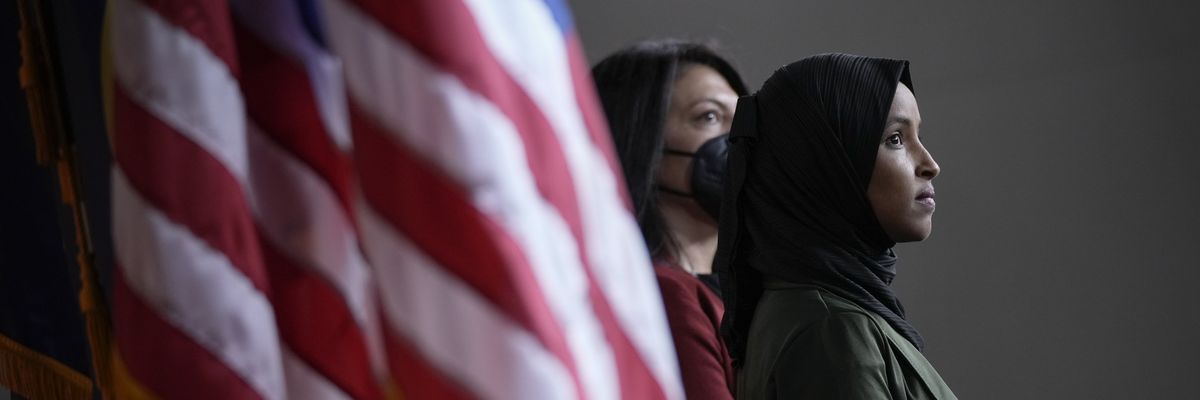
Rep. Ilhan Omar (D-Minn.) attends a news conference about Islamophobia on Capitol Hill on November 30, 2021 in Washington, DC.
(Photo by Drew Angerer/Getty Images)
Brad Reed
Dec 04, 2025
COMMON DREAMS
President Donald Trump is being roundly condemned for making bigoted attacks on Somalis, whom he referred to collectively as “garbage” earlier this week.
During a Tuesday Cabinet meeting at the White House, Trump unleashed a racist tirade against Somali Americans living in Minnesota, whom he falsely portrayed as layabouts who sponge up welfare money.
.
In ‘Political Attack,’ Trump Revokes Protected Status for Minnesota Somalis

After Trump’s Latest Racist Rant, Ilhan Omar Hopes ‘He Gets the Help He Desperately Needs’
“I don’t want ‘em in our country, I’ll be honest with you,” Trump said. “Their country’s no good for a reason. Their country stinks, and we don’t want ‘em in our country. I can say that about other countries too... We’re going to go the wrong way if we keep taking in garbage into our country.”
Trump then singled out Rep. Ilhan Omar (D-Minn.), a refugee from Somalia, as being “garbage,” and then added that “her friends are garbage.”
Omar fired back at Trump in an op-ed published Thursday in the New York Times in which she said the president was resorting to overt bigotry against her community because he is rapidly losing popularity as his major policy initiatives fall apart.
Omar also defended her community against the false stereotypes deployed by Trump to disparage it.
“[Trump] fails to realize how deeply Somali Americans love this country,” she wrote. “We are doctors, teachers, police officers, and elected leaders working to make our country better. Over 90% of Somalis living in my home state, Minnesota, are American citizens by birth or naturalization.”
Speaking on behalf of the Congressional Progressive Caucus, Rep. Chuy García (D-Ill.) defended Omar and the Somali community, and called Trump’s attacks on them “unacceptable and un-American.”
“Not only does Trump’s dehumanizing language put a target on her back and put her family at risk, it endangers so many across our country who share her identities and heritage,” García added. “We know just how dangerous this racist and inflammatory rhetoric is in an already polarized country.”
In an interview with Al-Jazeera, Minnesota state Sen. Omar Fateh (D-62), who is also of Somali descent, said Trump’s attacks were “hurtful” and “flat-out wrong” given what many Somalis in the US have accomplished.
“It is a community that has been resilient, that has produced so much,” he said. “We are teachers and doctors and lawyers and even politicians taking part in every part of Minnesota’s economy and the nation’s economy.”
He also emphasized that Trump’s rhetoric was putting the entire Somali community in danger.
“We’ve had our mosques be targeted,” he said. “Myself, I had a campaign office vandalized earlier this year, and so we want to make sure that our neighbors understand that we’re standing up for one another, showing up in this time in which we have a hostile federal government.”
Trump’s bigoted attacks on Somalis are also making waves overseas. Al-Jazeera also spoke with a resident of Mogadishu named Abdisalan Ahmed, who described Trump’s remarks as “intolerable.”
“Trump insults Somalis several times every day, calling us garbage and other derogatory names we can no longer tolerate,” he said. “Our leaders should address his remarks.”
Somalis arrested in Minneapolis immigration operation, officials say

Kristi Noem claims 50% of Minnesota visas and programs are fraudulent. Here's what data shows
Laerke Christensen
Recent investigation did support Noem's claim
The most recent data about immigration fraud in Minnesota appeared to come from a September USCIS investigation that the agency carried out in Minneapolis-St. Paul and surrounding areas.
That investigation reportedly found "evidence of fraud, non-compliance, or public safety or national security concerns" in 275 out of more than 1,000 cases it looked into, meaning no more than 27.5%. USCIS said agents found evidence of fraud in 44% of the cases they interviewed, though the agency did not say how many interviews it carried out in the investigation.
In total, "Operation Twin Shield" led to 42 referrals to Immigration and Customs Enforcement and four arrests. That data did not directly support Noem's claim.
Noem's and the DHS' reluctance to comment on the exact evidence for Noem's claim meant it was not possible to independently verify its accuracy.
One former immigration attorney, Professor Ana Pottratz Acosta, a visiting fellow at the University of Minnesota, told Minneapolis news station WCCO she would need "more specific data" from the DHS before "giving any credence" to Noem's claim.
Sources:
Our History | USCIS. 21 July 2025, https://www.uscis.gov/about-us/our-history.
Prof. Ana Pottratz Acosta Interviewed by WCCO News About DHS' Claim of 50% Fraudulent Visas in Minnesota | University of Minnesota Law School. https://law.umn.edu/news/2025-12-03-prof-ana-pottratz-acosta-interviewed-wcco-news-about-dhs-claim-50-fraudulent-visas. Accessed 5 Dec. 2025.
The White House. "President Trump Hosts a Cabinet Meeting, Dec. 2, 2025." YouTube, 2 Dec. 2025, https://www.youtube.com/live/pZSd7jn9CSc?t=5085s.
USCIS Announces Results of Operation Twin Shield, a Large-Scale Immigration Fraud Investigation | USCIS. 30 Sept. 2025, https://www.uscis.gov/newsroom/news-releases/uscis-announces-results-of-operation-twin-shield-a-large-scale-immigration-fraud-investigation.
By Heather Schlitz and Andrew Hay
Thu, December 4, 2025
MINNEAPOLIS - People of Somali origin are among those arrested in an immigration crackdown in Minneapolis, federal officials said on Thursday, two days after President Donald Trump hurled insults at immigrants from the Horn of Africa country and said he wanted them out of the United States.
The Minneapolis arrests began on Monday, the Department of Homeland Security said in its first statement on the operation. Officials did not give a total arrest figure but gave profiles of 12 people apprehended, five of them from Somalia, the rest from Mexico and El Salvador.
In the statement, Homeland Security Assistant Secretary Tricia McLaughlin portrayed them all as dangerous criminals with convictions ranging from fraud and vehicle theft to criminal sexual conduct and driving under the influence.
Minneapolis Mayor Jacob Frey, a Democrat, has strongly criticized Trump’s attacks on the city's Somali population and on Thursday called on Americans to "love and respect" Minnesota's Somali immigrant community, which is the largest in North America.
Trump's racist rhetoric against Somalis, and attacks on Minnesota politicians who defend them, has been applauded by his allies. On Tuesday, during a televised cabinet meeting, he reacted to reports of government fraud among pockets of Minnesota's large Somali population by calling immigrants there "garbage" and saying he wanted them sent "back to where they came from."
Anti-immigration rhetoric was a major part of Trump's campaign. Since taking office in January he has overseen aggressive operations by masked federal agents across the country in a bid to drive deportations to record levels. Along the way, Trump's public language when speaking about immigrants has grown harsher.
CRACKDOWN IN NEW ORLEANS
Also on Thursday, federal officials said they had arrested dozens of people in New Orleans, another Democratic-run city.
On day two of the New Orleans operation, protesters disrupted a city council meeting to demand councillors declare city property "ICE Free" zones where federal immigration agents could not stage operations.
Protesters accused federal agents of indiscriminately targeting people of color, including U.S. citizens, with no criminal record, an allegation the Department of Homeland Security denies.
New Orleans Mayor-elect Helena Moreno said in a statement on Wednesday the operation had created a culture of fear among the city's most vulnerable residents.
"We must do what we can to protect New Orleans and ensure due process is followed for all of our residents," she said, announcing an online portal for citizens to report abuse from federal immigration officers.
Louisiana Governor Jeff Landry, a Republican, has supported federal immigration enforcement efforts.
(Reporting by Andrew Hay; Editing by Donna Bryson and Stephen Coates)
Thu, December 4, 2025
MINNEAPOLIS - People of Somali origin are among those arrested in an immigration crackdown in Minneapolis, federal officials said on Thursday, two days after President Donald Trump hurled insults at immigrants from the Horn of Africa country and said he wanted them out of the United States.
The Minneapolis arrests began on Monday, the Department of Homeland Security said in its first statement on the operation. Officials did not give a total arrest figure but gave profiles of 12 people apprehended, five of them from Somalia, the rest from Mexico and El Salvador.
In the statement, Homeland Security Assistant Secretary Tricia McLaughlin portrayed them all as dangerous criminals with convictions ranging from fraud and vehicle theft to criminal sexual conduct and driving under the influence.
Minneapolis Mayor Jacob Frey, a Democrat, has strongly criticized Trump’s attacks on the city's Somali population and on Thursday called on Americans to "love and respect" Minnesota's Somali immigrant community, which is the largest in North America.
Trump's racist rhetoric against Somalis, and attacks on Minnesota politicians who defend them, has been applauded by his allies. On Tuesday, during a televised cabinet meeting, he reacted to reports of government fraud among pockets of Minnesota's large Somali population by calling immigrants there "garbage" and saying he wanted them sent "back to where they came from."
Anti-immigration rhetoric was a major part of Trump's campaign. Since taking office in January he has overseen aggressive operations by masked federal agents across the country in a bid to drive deportations to record levels. Along the way, Trump's public language when speaking about immigrants has grown harsher.
CRACKDOWN IN NEW ORLEANS
Also on Thursday, federal officials said they had arrested dozens of people in New Orleans, another Democratic-run city.
On day two of the New Orleans operation, protesters disrupted a city council meeting to demand councillors declare city property "ICE Free" zones where federal immigration agents could not stage operations.
Protesters accused federal agents of indiscriminately targeting people of color, including U.S. citizens, with no criminal record, an allegation the Department of Homeland Security denies.
New Orleans Mayor-elect Helena Moreno said in a statement on Wednesday the operation had created a culture of fear among the city's most vulnerable residents.
"We must do what we can to protect New Orleans and ensure due process is followed for all of our residents," she said, announcing an online portal for citizens to report abuse from federal immigration officers.
Louisiana Governor Jeff Landry, a Republican, has supported federal immigration enforcement efforts.
(Reporting by Andrew Hay; Editing by Donna Bryson and Stephen Coates)
Kristi Noem claims 50% of Minnesota visas and programs are fraudulent. Here's what data shows
Laerke Christensen
Fri, December 5, 2025

Getty Images
A claim circulated online in December 2025 that 50% of visas in Minnesota were fraudulent. It came from U.S. Secretary of Homeland Security Kristi Noem, who said at a Dec. 2 Cabinet meeting, "You told me to look into Minnesota and their fraud on visas and their programs. Fifty percent of them are fraudulent."
Neither Noem nor the DHS established exactly which of the many lawful ways to enter the U.S. the secretary included in the "visas" and "programs" that allegedly had a 50% fraud rate.
A U.S. Citizenship and Immigration Services investigation in Minneapolis-St. Paul in September 2025 reportedly found "evidence of fraud, non-compliance, or public safety or national security concerns" in 275 out of more than 1,000 cases it looked into, meaning no more than 27.5%. That data did not support Noem's claim.
USCIS, which oversees immigration in the U.S. and whose Fraud Detection and National Security Directorate investigates immigration-related fraud, referred Snopes' query to the DHS. Noem's and the DHS' reluctance to comment on the evidence for Noem's claim meant it was not possible to independently verify its accuracy.
In December 2025, a claim circulated online that 50% of visas in Minnesota were fraudulent.
The claim spread after U.S. Secretary of Homeland Security Kristi Noem said at a Cabinet meeting on Dec. 2, "You told me to look into Minnesota and their fraud on visas and their programs. Fifty percent of them are fraudulent.
The news aggregator NewsWire wrote on X (archived) that day, "NOEM: 50% OF VISAS IN MINNESOTA ARE FRAUDULENT"
The claim also circulated on Facebook (archived), Instagram (archived), Threads (archived) and Bluesky (archived).
Noem's claim was difficult to independently verify.
It was unclear exactly which of the many lawful ways to enter the U.S. Noem included in "visas" and "programs" that allegedly had a 50% fraud rate. Noem did not cite any data to back her claim during the Cabinet meeting, nor did a spokesperson for the Department of Homeland Security leads reply to clarifying questions when Snopes asked via email.
U.S. Citizenship and Immigration Services, which oversees immigration in the U.S. and whose Fraud Detection and National Security Directorate investigates immigration-related fraud, referred Snopes' query to the DHS.
Given that we could not establish what Noem based her claim on or even to which types of "visas" and "programs" it pertained, we leave this claim unrated.
We also reached out to the State Department, which issues visas, to ask if the agency knew what data Noem used to back her claim and await a reply.
Noem blamed Walz for fraudulent visas
During the Dec. 2 Cabinet meeting, Noem appeared to blame the high rate of perceived visa fraud on Minnesota's Democratic Gov. Tim Walz. Noem said Walz "brought people in there illegally that never should have been in this country."
The spokesperson added: "We don't lead immigration investigations and we do not track fraud in immigration cases or federal run programs."
It is true that states generally do not regulate immigration or issue visas. The USCIS, part of DHS, has overseen immigration since 2003. The federal government has been responsible for immigration since 1891. The State Department issues visas to people wishing to enter the U.S.
Getty Images
A claim circulated online in December 2025 that 50% of visas in Minnesota were fraudulent. It came from U.S. Secretary of Homeland Security Kristi Noem, who said at a Dec. 2 Cabinet meeting, "You told me to look into Minnesota and their fraud on visas and their programs. Fifty percent of them are fraudulent."
Neither Noem nor the DHS established exactly which of the many lawful ways to enter the U.S. the secretary included in the "visas" and "programs" that allegedly had a 50% fraud rate.
A U.S. Citizenship and Immigration Services investigation in Minneapolis-St. Paul in September 2025 reportedly found "evidence of fraud, non-compliance, or public safety or national security concerns" in 275 out of more than 1,000 cases it looked into, meaning no more than 27.5%. That data did not support Noem's claim.
USCIS, which oversees immigration in the U.S. and whose Fraud Detection and National Security Directorate investigates immigration-related fraud, referred Snopes' query to the DHS. Noem's and the DHS' reluctance to comment on the evidence for Noem's claim meant it was not possible to independently verify its accuracy.
In December 2025, a claim circulated online that 50% of visas in Minnesota were fraudulent.
The claim spread after U.S. Secretary of Homeland Security Kristi Noem said at a Cabinet meeting on Dec. 2, "You told me to look into Minnesota and their fraud on visas and their programs. Fifty percent of them are fraudulent.
The news aggregator NewsWire wrote on X (archived) that day, "NOEM: 50% OF VISAS IN MINNESOTA ARE FRAUDULENT"
The claim also circulated on Facebook (archived), Instagram (archived), Threads (archived) and Bluesky (archived).
Noem's claim was difficult to independently verify.
It was unclear exactly which of the many lawful ways to enter the U.S. Noem included in "visas" and "programs" that allegedly had a 50% fraud rate. Noem did not cite any data to back her claim during the Cabinet meeting, nor did a spokesperson for the Department of Homeland Security leads reply to clarifying questions when Snopes asked via email.
U.S. Citizenship and Immigration Services, which oversees immigration in the U.S. and whose Fraud Detection and National Security Directorate investigates immigration-related fraud, referred Snopes' query to the DHS.
Given that we could not establish what Noem based her claim on or even to which types of "visas" and "programs" it pertained, we leave this claim unrated.
We also reached out to the State Department, which issues visas, to ask if the agency knew what data Noem used to back her claim and await a reply.
Noem blamed Walz for fraudulent visas
During the Dec. 2 Cabinet meeting, Noem appeared to blame the high rate of perceived visa fraud on Minnesota's Democratic Gov. Tim Walz. Noem said Walz "brought people in there illegally that never should have been in this country."
The spokesperson added: "We don't lead immigration investigations and we do not track fraud in immigration cases or federal run programs."
It is true that states generally do not regulate immigration or issue visas. The USCIS, part of DHS, has overseen immigration since 2003. The federal government has been responsible for immigration since 1891. The State Department issues visas to people wishing to enter the U.S.
Recent investigation did support Noem's claim
The most recent data about immigration fraud in Minnesota appeared to come from a September USCIS investigation that the agency carried out in Minneapolis-St. Paul and surrounding areas.
That investigation reportedly found "evidence of fraud, non-compliance, or public safety or national security concerns" in 275 out of more than 1,000 cases it looked into, meaning no more than 27.5%. USCIS said agents found evidence of fraud in 44% of the cases they interviewed, though the agency did not say how many interviews it carried out in the investigation.
In total, "Operation Twin Shield" led to 42 referrals to Immigration and Customs Enforcement and four arrests. That data did not directly support Noem's claim.
Noem's and the DHS' reluctance to comment on the exact evidence for Noem's claim meant it was not possible to independently verify its accuracy.
One former immigration attorney, Professor Ana Pottratz Acosta, a visiting fellow at the University of Minnesota, told Minneapolis news station WCCO she would need "more specific data" from the DHS before "giving any credence" to Noem's claim.
Sources:
Our History | USCIS. 21 July 2025, https://www.uscis.gov/about-us/our-history.
Prof. Ana Pottratz Acosta Interviewed by WCCO News About DHS' Claim of 50% Fraudulent Visas in Minnesota | University of Minnesota Law School. https://law.umn.edu/news/2025-12-03-prof-ana-pottratz-acosta-interviewed-wcco-news-about-dhs-claim-50-fraudulent-visas. Accessed 5 Dec. 2025.
The White House. "President Trump Hosts a Cabinet Meeting, Dec. 2, 2025." YouTube, 2 Dec. 2025, https://www.youtube.com/live/pZSd7jn9CSc?t=5085s.
USCIS Announces Results of Operation Twin Shield, a Large-Scale Immigration Fraud Investigation | USCIS. 30 Sept. 2025, https://www.uscis.gov/newsroom/news-releases/uscis-announces-results-of-operation-twin-shield-a-large-scale-immigration-fraud-investigation.