Friday, December 05, 2025


Wind Farm to Power Amazon and Google Sends First Power to German Grid
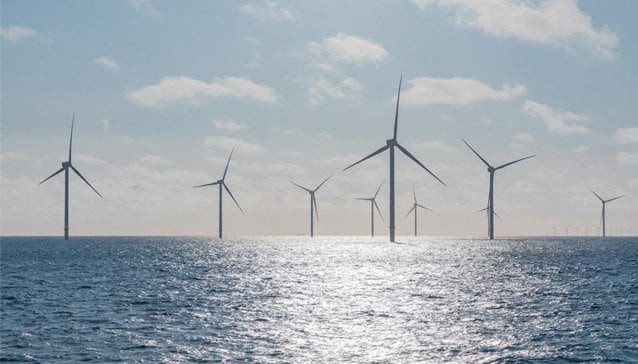
German offshore wind farm
Germany's Borkum Riffgrund 3 started feeding power and when completed it will send power to major corporations including Amazon and Google (Orsted)

Published Dec 4, 2025 9:47 PM by The Maritime Executive


The Borkum Riffgrund 3 offshore wind farm started feeding its first power to the German grid on December 3. The wind farm marks another milestone both for Germany and the EU, becoming the largest offshore wind farm in Ørsted’s German portfolio and one that has contracted more than four-fifths of its power with long-term corporate power purchase agreements.

Located about 45 miles off the German coast in the North Sea, the project is being developed in a partnership between Ørsted and Nuveen Infrastructure.  When it is fully commissioned in the first quarter of 2026, it will have a total capacity of 913 MW, making it just slightly smaller than EnBW’s He Dreith (currently Germany’s largest) and among a crop of new large offshore wind farms that are planned to reinvigorate the EU’s drive to renewable energy.

“The generation of the first power at Borkum Riffgrund 3 is both a significant landmark for German offshore wind and our commitment to accelerating the EU energy transition,” said Jordi Francesch, Managing Director, Renewable Energy Investments at Nuveen Infrastructure.

The companies note that the project illustrates the depth of the EU supply chain for renewable energy. The wind turbines and foundations came from Germany and Denmark, cables from Germany and France, and installation vessels from the Netherlands and Belgium. Operation and maintenance for all Ørsted’s German offshore wind farms is carried out from Norden-Norddeich and Emden in East Frisia.

The project will consist of a total of 83 wind turbines, each with a rated capacity of 11 MW. The companies note that when it is fully operational, it will produce the same amount of electricity that a large city uses every year.

Borkum Riffgrund 3 is supported by several long-term corporate power purchase agreements (CPPA), which they highlight create long-term price security for the project developer and for the customers. Offtake agreements ranging between 10 to 25 years and totalling 786 MW have been entered into with Amazon (350 MW), BASF (186 MW), Covestro (100 MW), Energie-Handels-Gesellschaft/REWE Group (100 MW), and Google (50 MW). 

The project is also the first offshore wind farm to be built by Ørsted in Germany without an offshore substation (OSS). The new connection concept provides a direct connection between the wind turbines via a 66 kV connection to the DolWin epsilon offshore converter platform, installed and operated by the German transmission system operator, TenneT.

As it completes commissioning, Borkum Riffgrund 3 joins a growing portfolio of German offshore projects. Earlier this year, Ørsted and Nuveen Infrastructure’s other jointly owned offshore wind farm, Gode Wind 3, was fully commissioned. The project is located close to Ørsted’s existing wind farms: Borkum Riffgrund 1 and 2 and Gode Wind 1 and 2. With these recent additions, Ørsted's installed offshore wind power capacity in Germany increases to around 2.5 GW in early 2026, making the company the market leader in Germany, operating over 20 percent of the country’s total offshore wind capacity.

Germany’s largest offshore wind farm to date, EnBW’s He Dreith, generated and delivered its first kilowatt-hour of electricity on November 25 as it started the commissioning process for its turbines. It is expected to be completed during the summer of 2026, making another major addition to Germany’s renewable energy supply.

Germany's current offshore wind power capacity is just over nine gigawatts. The country has set ambitious targets to reach 30 GW by 2030, 40 GW by 2035, and 70 GW by 2045. It has not been immune to the pressures on the industry, and in August, for the first time, reported it had received no bids in its latest leasing round. The commissioning of the two large wind farms in 2026 will be a boost as the government explores future policies to encourage the next phase of development.


U.S. Data Center Demand Could Hit 106 GW by 2035

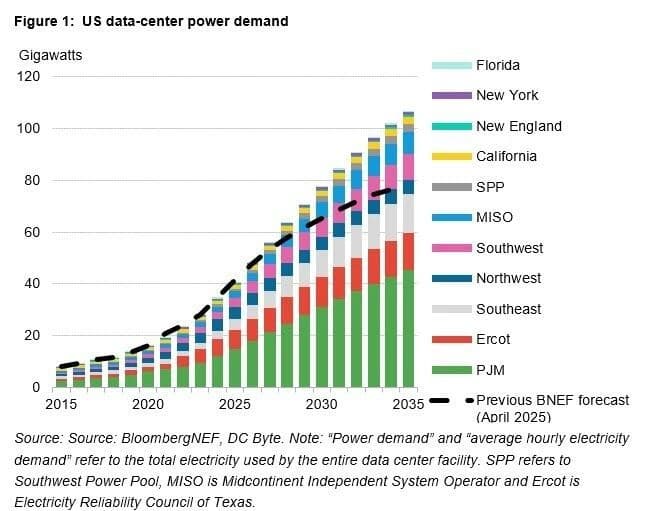
  • BNEF estimates U.S. data center demand could reach 106 GW by 2035, far above other recent forecasts.

  • Many analysts warn that speculative projects, chip constraints, and overlapping permits may deflate current projections.

  • Major U.S. grid operators face rising reliability risks as data center proposals cluster across PJM, MISO, and ERCOT.

U.S. data center power demand could reach 106 GW in 2035, BloombergNEF said Monday in one of the more aggressive load growth estimates to date. The report comes as some energy industry analysts and executives warn that an artificial intelligence bubble or speculative data center proposals could be fueling excessive load growth projections. 

Grid

A report from Grid Strategies released last month said utility forecasts of 90 GW additional data center load by 2030 were likely overstated; market analysis indicates load growth in that time frame is likely closer to 65 GW, it said. 

July report from the Department of Energy estimated an additional 100 GW of new peak capacity is needed by 2030, of which 50 GW is attributable to data centers. Those facilities could account for as much as 12% of peak demand by 2028, according to Lawrence Berkeley National Laboratory.

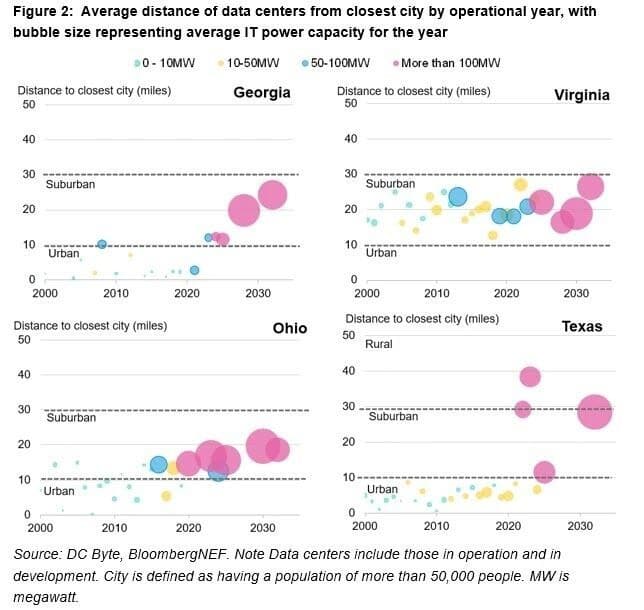
BNEF’s data center project tracker shows the industry diversifying beyond traditional data center hubs like Northern Virginia, metro Atlanta and central Ohio into exurban and rural regions served by existing fiber-optic trunk lines for data traffic.

A map of under-construction, committed and early-stage projects shows gigawatts of planned data center capacity spreading south through Virginia and the Carolinas, up through eastern Pennsylvania and outward from Chicago along the Lake Michigan shore. More data centers are also planned for Texas and the Gulf Coast states.

Fig 2

Much of the capacity is poised to materialize on grids overseen by the PJM Interconnection, the Midcontinent Independent System Operator and the Electric Reliability Council of Texas. BNEF predicts PJM alone could add 31 GW of data center load over the next five years, about 3 GW more than expected capacity additions from new generation. 

With the expected surge, the North American Electric Reliability Corp. warned late last year of “elevated risk” of summer electricity shortfalls this year, in 2026 and onward in all three regions. 

Some experts disputed NERC’s methodology, however. MISO’s independent market monitor said in June that the group’s analysis was flawed and that MISO was in a better position than grid regions not expected to see exponential data center growth, like ISO New England and the New York Independent System Operator. 

Other technology and energy system analysts expect a significant amount of proposed data center capacity to dissipate in the coming years due to chip shortages, duplicative permit requests and other factors. 

In July, London Economics International said in a report prepared for the Southern Environmental Law Center that meeting projections for U.S. data center load in 2030 would require 90% of global chip supply — a scenario it called “unrealistic.” 

Patricia Taylor, director of policy and research at the American Public Power Association, told Utility Dive earlier this year that it’s common for data center developers to “shop around” the same project across neighboring jurisdictions. 

Still, U.S. grid operators face an “inflection moment” as they balance the desire to accommodate large-scale data centers with the obligation to ensure reliable service for all customers, BNEF said.

By Brian Martucci of Utility Drive via Zerohedge


U.S. Eyes Warehouse Generators for Massive Grid Capacity Boost

  • Energy Secretary Chris Wright has proposed an innovative plan to quickly expand US grid capacity by leveraging idled industrial diesel generators at commercial sites like data centers and big-box retailers.

  • The plan aims to unleash approximately 35 gigawatts of electricity capacity, which is described as the equivalent of about 35 nuclear power plants, to serve as a short-term bridge until new natural-gas and nuclear generation is available.

  • The proposal is a direct response to the explosive power demand from the data-center boom, offering a short-term solution for the missing power needed to support the massive buildout and mitigate the strain on regional power grids.

Energy Secretary Chris Wright has floated an unusual but very creative plan to quickly expand U.S. grid capacity: tapping the industrial diesel generators already sitting at data centers, big-box retailers, and other commercial sites. The proposal comes as multiple regional grids strain under the explosive power demand driven by the data-center boom. Leveraging these idled generators could serve as a short-term bridge until new generation comes online.

Bloomberg quoted Wright on Tuesday morning at the North American Gas Forum in Washington, where he said that tapping the nation's idled fleet of industrial diesel generators could add the equivalent of about 35 nuclear power plants' worth of electricity and help bridge the country until new natural-gas and nuclear generation comes online in the coming years.

Wright emphasized the scale of the opportunity, saying, "We're going to unleash that 35 gigawatts of capacity that sits there today," though he noted that pollution rules have historically limited generator use.

He argued that the massive data-center buildout over the next few years could be primarily supported by these existing generators, avoiding the need for dozens of new power plants.

These generators, he said, are already deployed at data centers and commercial sites nationwide. "They're all around the country. It's going to start with communicating to everyone that these assets exist."

Wright and the Trump administration understand that power grids are stretched thin in the era of data centers. The push for dispatchable backup generation is a short-term solution for all the missing power needed for the AI boom...

Perhaps by the time the 2030s arrive, new natural-gas generators and other reliable sources will finally add enough capacity to meet booming demand. Nuclear remains more of a next-decade story. And now, Wright may truly be onto something.

By Zerohedge

From Soaring Energy Prices to Climate Threat to AI Bubble, Experts Warn Against Data Center Buildout

“Tech giants are cutting backroom deals with utilities and government officials to build massive data centers at breakneck speed, while passing the costs onto working families,” said the author of a new Public Citizen report.


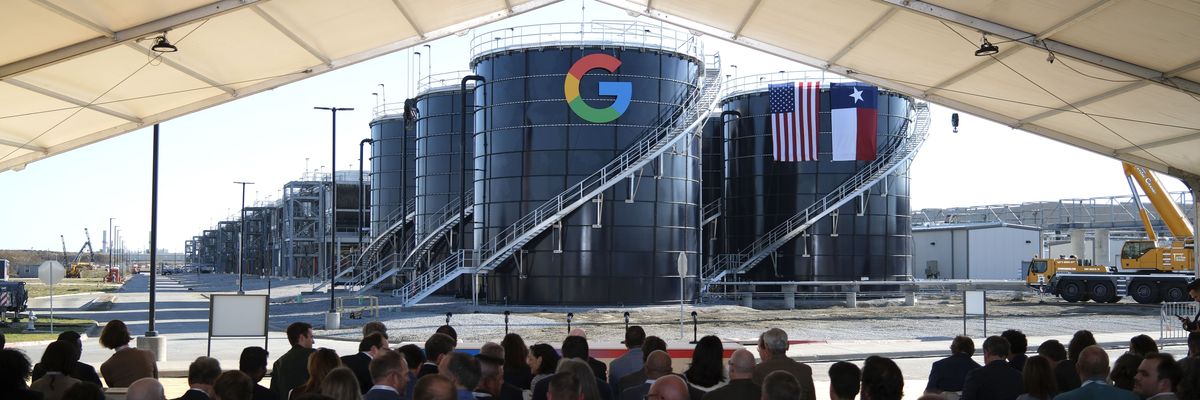
Attendees await the arrival of Texas Gov. Greg Abbott and Alphabet and Google CEO Sundar Pichai at the Google Midlothian Data Center on November 14, 2025, in Midlothian, Texas.
(Photo by Ron Jenkins/Getty Images)


Stephen Prager
Dec 04, 2025
COMMON DREAMS

As the construction of artificial intelligence data centers expands across the nation largely unregulated, experts warn that the unrestrained buildup of these facilities is causing electricity costs to skyrocket, accelerating the climate crisis, and putting the economy at risk.

A new report out Thursday from the consumer advocacy group Public Citizen highlights the “unchecked expansion” of these data centers, often with little oversight, input from communities, or even financial responsibility on the part of the Big Tech firms profiting.
RECOMMENDED...


Warnings of AI Bubble Grow Louder as Big Investors Dump Nvidia Stock


More Americans Fall Behind on Utility Bills as AI Data Centers, Trump Attacks on Renewables Raise Costs

“We’re watching Big Tech overlords write their own rules in real time,” said Deanna Noël, Public Citizen’s climate campaigns director and one of the report’s authors. “Tech giants are cutting backroom deals with utilities and government officials to build massive data centers at breakneck speed, while passing the costs onto working families through higher electricity bills, polluted air and water, and false claims about job creation.”

A forecast published earlier this week by Bloomberg New Energy Finance projected that the power demand for AI facilities will hit 106 gigawatts by 2035—a 36% jump from what it predicted back in April.

That dramatic increase, it said, can be attributed not just to the more rapid buildup of AI facilities, but also to the size of the ones being constructed: “Of the nearly 150 new data center projects BNEF added to its tracker in the last year, nearly a quarter exceed 500 megawatts,” it found.


This faster-than-expected expansion has come with massive consequences for the people living near the power-sucking behemoths. Public Citizen’s report found:
Residents’ electricity costs in some data center-dense areas have surged over 250% in just five years. At PJM—the world’s largest power market—capacity auction prices spiked 800% in 2024, in part due to data center growth. That same year, consumers across seven PJM states paid $4.3 billion more in electricity costs to cover data centers’ new transmission infrastructure.

On Wednesday, CNBC reported on findings from a watchdog report that PJM’s 65 million consumers will pay a total of $16.6 billion to secure future power supplies needed to meet demand from AI data centers from now until 2027, approximately $255 per person on average.

In some of the states with the most data centers, residential electricity prices have spiked considerably over the past year. In September, they were up 20% in Illinois, 12% in Ohio, and 9% in Virginia, according to data from the federal Energy Information Administration.

The massive surge in electricity usage is also fueling the climate crisis. As of March 2025, 56% of the electricity used to power data centers came from fossil fuels, a share that is likely to increase now that the Trump administration has pushed to expand the extraction of coal and other planet-heating energy sources in order to power them.

“At the very moment we must rapidly phase out fossil fuels,” Noël said, “the Trump administration is doing the opposite—fast-tracking data center development powered by coal, oil, and gas.”

Tech companies like Amazon, Meta, and Google that benefit from these projects rarely have to bear the full economic cost, instead passing some of it onto taxpayers, often without public debate due to nondisclosure agreements that keep the details of proposals under wraps until deals are finalized.

“In the race to attract large data centers, states are forfeiting hundreds of millions of dollars in tax revenue,” a June CNBC investigation found. The report determined that 42 states provide full or partial sales tax exemptions to data centers or have no sales tax at all. Thirty-seven of those states have legislation specifically granting sales tax exemptions for data centers.

While these exemptions are often granted following promises of economic growth and job creation, as the Public Citizen report argues: “They rarely deliver on these promises. Data centers create few permanent, high-paying jobs, and generous tax breaks deprive communities of critical revenue needed to fund schools, infrastructure, and other public services.”

Data centers have increasingly faced pushback from local communities. On Wednesday night in Howell, Michigan, over 150 people assembled at a town hall in opposition to a proposed $1 billion “hyperscale” data center project backed by Meta, following days of protest.


“Already we have started to see many regions (across the country) realizing that the huge spike in electricity demand from data centers is straining the grid, and this is only going to get worse as the growth of data centers increases based on the projected and planned investments,” said one of the panelists, Ben Green, an assistant professor of information and public policy at the University of Michigan.

Economic analysts, meanwhile, remain skeptical about whether the rapid buildup of AI infrastructure will be sustainable in the long term, given the extraordinary energy demand.

In November, Morgan Stanley projected AI-related data center spending will total $2.9 trillion cumulatively from 2025 to 2028, with roughly half requiring external financing.

Abe Silverman, general counsel for the public utility board in New Jersey, pointed out to CNBC the unease communities are feeling about “paying money today for a data center tomorrow.”

“We’re in a bit of a bubble,” he warned. “There is no question that data center developers are coming out of the woodwork, putting in massive numbers of new requests. It’s impossible to say exactly how many of them are speculative versus real.”

Cathy Kunkel, a consultant at the Institute for Energy Economics and Financial Analysis, said, “It does tend to be consumers—residential, commercial, and other industrial ratepayers—that end up paying for overbuilt electrical infrastructure.”

The health of the entire US economy, it turns out, may be hitched to this “bubble.” As the Wall Street Journal reported in late November, “business investment in AI might have accounted for as much as half of the growth in gross domestic product, adjusted for inflation, in the first six months of the year.”

OpenAI founder Sam Altman raised eyebrows last month when he suggested that if the bubble bursts, his company is too big to fail, and would likely receive a large taxpayer-funded federal bailout: “When something gets sufficiently huge... the federal government is kind of the insurer of last resort as we’ve seen in various financial crises,” Altman said. “So I guess given the magnitude of what I expect AI economic impact to look like, sort of I do think the government ends up as like the insurer of last resort.”

A looming financial bubble related to AI’s rapid growth, alongside the various other concerns related to the data center buildout, is why Public Citizen says policymakers must understand the gravity the situation and be willing to push back against an industry that has built an army of lobbyists to press its interests on Capitol Hill.

“Policymakers at all levels of government must act with urgency to rein in Big Tech’s unchecked expansion,” Noël said. “By demanding transparency and accountability, enforcing strong community protections, and requiring clean and cheap renewable energy, policymakers can shield consumers from soaring electricity costs, reduce emissions to protect public health, and align this buildout with the clean energy transition.

“Without urgent intervention,” she said, “Big Tech will continue getting a free ride while more neighborhoods are turned into sacrifice zones for Silicon Valley’s tech tycoons—fueled by the fossil fuel industry.”
THE GREAT REPLACEMENT THEORY

White House claims Europe facing "civilizational erasure" in 2 decades


Haley Ott
Fri, December 5, 2025 

The Trump administration claims in its new National Security Strategy, published early Friday morning, that some of America's oldest allies in Europe face "the real and more stark prospect of civilizational erasure" due to immigration and the purported erosion of democratic principles.

Accusing the European Union and other unnamed transnational bodies of allowing unchecked immigration and curbing free speech, the document claims that, "should present trends continue, the continent will be unrecognizable in 20 years or less," and that "it is far from obvious whether certain European countries will have economies and militaries strong enough to remain reliable allies" to the United States.

The document claims Europe suffers from a "lack of self-confidence" that "is most evident in Europe's relationship with Russia."

It says that European countries have a "significant hard power advantage" over Russia, but because of Russia's war in Ukraine, they now "regard Russia as an existential threat."

President Trump recently proposed a plan to end the brutal war sparked by Russia's February 2022 full-scale invasion of Ukraine, which was drafted without Ukrainian or European involvement and largely reflected Russian demands.

The plan drew a careful diplomatic response from Ukraine's President Volodymyr Zelenskyy, and from America's NATO allies, which have been trying to show a united front and continue supporting Kyiv's defensive efforts.

The National Security Strategy attacks the positions of some European governments on Ukraine, accusing unspecified officials of holding "unrealistic expectations for the war" as they lead "unstable minority governments" in their own countries.

The White House strategy makes the unsubstantiated claim that the populations of some European countries want an end to the war, but that their governments are subverting democratic processes and not delivering it.

The document says "it is more than plausible that within a few decades at the latest, certain NATO members will become majority non-European. As such, it is an open question whether they will view their place in the world, or their alliance with the United States, in the same way as those who signed the NATO charter."

Some of the sentiments in the strategy document, particularly on the purported erosion of free speech rights in Europe, echo remarks delivered by Vice President JD Vance at a security conference in Germany early this year. He berated European leaders and accused some American allies of politically censoring right-wing ideas within their own nations.

The 33-page document breaks down American foreign policy for five broad regions: the Western Hemisphere, Asia, Europe, the Middle East and Africa.

The strategy notes the reestablishment of strategic stability with Russia, enabling Europe to take primary responsibility for its own defense, and "ending the perception, and preventing the reality, of NATO as a perpetually expanding alliance" among other U.S. priorities.

The document does say Europe remains "strategically and culturally vital to the United States," and that America's "goal should be to help Europe correct its current trajectory."


Trump’s Denaturalization Rhetoric Violates the Laws and Spirit of America

Stripping citizens of their citizenship in the name of making the electorate more “American” is arguably one of the most un-American acts imaginable.


Hector Barajas shows his US citizen document with Nathan Fletcher and Congressman Mark Takano after a swear-in ceremony at the immigration office in Downtown San Diego, California on Friday, April 13, 2018.
(Photo by Sandy Huffaker/AFP via Getty Images)

Michael Waldman
Dec 05, 2025
Brennan Center for Justice


You might think that when you are a US citizen, you cannot have that status taken away. You would be wrong, it turns out. And behind that fact is a long and often ugly history.

On Sunday, President Donald Trump said that he would “absolutely” denaturalize American citizens if he could. It comes after a wave of harsh rhetoric directed toward immigrants after the tragic shooting of two National Guard members last week.

Yes, the words that the president says have been discounted. But there’s policy behind the rhetorical provocation.

Denaturalization is the process of stripping citizenship from someone who obtained it illegally, such as by not meeting the requirements or by committing fraud or lying during the application process. At first, government interpreted that standard loosely, leading to years of abuse.

As my colleagues Faiza Patel, Margy O’Herron, and Kendall Verhovek explain:
More than 22,000 Americans lost their citizenship between 1907 and 1967 based on political affiliations, race, and gender, according to denaturalization scholar Patrick Weil. President Woodrow Wilson’s administration began denaturalizing German- and Asian-born citizens during World War I, along with anarchists and people who spoke out against the war. During World War II, a push for denaturalization of naturalized citizens from Germany, Italy, and Japan intensified. A primary target included members of the pro-Nazi German-American Bund for disloyalty and insufficient attachment to the principles of the Constitution.

After the war, the Second Red Scare took hold of a country fearful of domestic communism amid its emergence abroad. Sen. Joseph McCarthy of Wisconsin led witch hunts, with denaturalization often used as a tool against accused communists or sympathizers. Among those targets was Harry Bridges, an Australian-born, nationally known labor leader accused of being a communist, who faced an ultimately unsuccessful campaign to revoke his citizenship. The Supreme Court ruled in his favor, not once, but twice.

As Weil puts it, a process that was intended to redress fraud and illegality in the naturalization process became used to “expel from the body politic ‘un-American’ citizens.” But even during wartime, the Supreme Court responded, limiting its use.

Throughout the 20th century, the court issued several rulings setting a high bar for denaturalization. In 1943, the court struck down a move to denaturalize Russian-born William Schneiderman over ties to the Communist Party, requiring a “heavy burden” for rescinding citizenship. And in 1946, the court warned against the use of denaturalization as a “ready instrument for political persecutions.” It’s why in recent decades, denaturalization attempts have been appropriately rare... until now.

Over the summer, Trump directed Justice Department lawyers to “maximally pursue denaturalization proceedings.” At the time, a spokesperson said that “denaturalization proceedings will only be pursued as permitted by law and supported by evidence against individuals who illegally procured or misrepresented facts in the naturalization process.” Trump’s parameters seem to be much broader. In his Thanksgiving Truth Social post, he said he would “denaturalize migrants who undermine domestic tranquility.”

Among his targets? Trump has repeatedly suggested that he is open to denaturalizing New York City Mayor-elect Zohran Mamdani and Rep. Ilhan Omar (D-Minn.). When asked about Elon Musk, he told the press, “We’ll have to take a look.” It appears that crime isn’t so much a motivation as disloyalty; the law isn’t so much a motivation as impulse.

But we shouldn’t mistake impulse for foolishness.

It’s all part of a broader effort to target the rights of immigrants and redefine who is an American. That started on Inauguration Day with the effort to eliminate birthright citizenship, a right that is explicitly in the Constitution. And it’s part of efforts to reverse what top administration officials have called a conspiracy to alter the makeup of the electorate. In an interview, the director of US Citizenship and Immigration Services, Joseph Edlow, accused previous administrations of admitting immigrants to “make them all citizens and then spread them out to try to change demographics elsewhere in the country.” And on the campaign trail last year, Trump adviser Stephen Miller declared, “America is for Americans and Americans only.”

Stripping citizens of their citizenship in the name of making the electorate more “American” is arguably one of the most un-American acts imaginable. More than a century ago, the Supreme Court held that naturalized citizens are on the same footing as those born in the country, and for decades, the Supreme Court has made clear that stripping citizens of their citizenship due to their views or expressions “would run counter to our traditions.”

We are a nation of immigrants and also a nation of laws. The courts must continue to ensure that those laws protect naturalized citizens from being punished for speaking out.


© 2023 Brennan Center for Justice


Michael Waldman
Michael Waldman is President of the Brennan Center for Justice at NYU School of Law, a nonpartisan law and policy institute that focuses on improving the systems of democracy and justice.
Full Bio >
Humiliating ICE Data Blows Up Trump’s Crackdown Excuse

Tom Latchem
Fri, December 5, 2025
DAILY BEAST


ADAM GRAY / Adam GRAY / AFP


Aggressive federal immigration raids touted by the Trump administration as crime-busting victories have mostly swept up people with no criminal record, according to a new analysis of publicly available data.

President Donald Trump and Department of Homeland Security Secretary Kristi Noem have justified the deployment of armed masked officers in big Democrat-run cities by claiming local “sanctuary” policies shield criminal immigrants—repeatedly insisting they are targeting the “worst of the worst.”

But in headline operations across Los Angeles, Chicago, Massachusetts, and Washington, D.C., more than half of those arrested, often in brutal fashion, had no prior convictions at all—compared with roughly a third nationwide, the New York Times found.

The outlet analyzed a trove of arrest and detention records released by the Deportation Data Project that runs through Oct. 15, 2025.

It found that, ironically, the highest-profile sweeps proved the least effective at finding people with criminal histories, especially violent ones.


Border Patrol this week started an operation in New Orleans, Louisiana. / Ryan Murphy / Ryan Murphy/Getty Images

In the D.C. surge, the Times found 84 percent of arrestees had no previous convictions, and just 2 percent had convictions for violence.

In Illinois’s controversial “Operation Midway Blitz”—which was beset by allegations of Border Patrol brutality and legal wranglings—two-thirds of those rounded up had no convictions.

Massachusetts and the Los Angeles area showed similarly lopsided shares. Less than 30 percent of the people arrested in any of these operations had been convicted of a crime, the Times analysis found, and only a sliver had a violent conviction.

The most common non-violent priors were DUIs and traffic offenses, the paper found.

The Times also tracked the national picture. Since January, the share of detainees with criminal convictions has fallen to about 28 percent by mid-October, while arrests of people with no criminal history rose faster than any other category.

More in U.S.


Boat Attack Commander Says He Had To Kill 2 Survivors Because They Were Still Trying To Smuggle Cocaine
Reason.com5.2K


The portion with violent convictions fell to about 5 percent by mid-October, down from 15 percent in 2024, the newspaper reported.

Under President Joe Biden last year, 63 percent of ICE arrestees had prior convictions, and 24 percent faced pending charges.

The Trump administration has argued that aggressive city deployments are needed because “sanctuary” policies thwart efforts to target criminals, combining ICE with Border Patrol and National Guard units.

Border Patrol, led by controversial Commander Gregory Bovino, pictured here in New Orleans flanked by his armed officers, is in the ascendancy over ICE. / Anadolu / Madison Thorn/Anadolu via Getty Image

Traditionally, ICE relied on local jails and prisons—taking custody after people finished their sentences or were released

DHS spokeswoman Tricia McLaughlin told the Times: “Seventy percent of illegal aliens ICE arrested across the country have criminal convictions or pending criminal charges just in the United States.”

The Daily Beast has approached DHS for comment


Trump’s Bigoted Attack on Somalis Denounced From Minneapolis to DC to Mogadishu

Rep. Ilhan Omar said that the president “fails to realize how deeply Somali Americans love this country.”


Rep. Ilhan Omar (D-Minn.) attends a news conference about Islamophobia on Capitol Hill on November 30, 2021 in Washington, DC.

(Photo by Drew Angerer/Getty Images)


Brad Reed
Dec 04, 2025
COMMON DREAMS

President Donald Trump is being roundly condemned for making bigoted attacks on Somalis, whom he referred to collectively as “garbage” earlier this week.

During a Tuesday Cabinet meeting at the White House, Trump unleashed a racist tirade against Somali Americans living in Minnesota, whom he falsely portrayed as layabouts who sponge up welfare money.
.


In ‘Political Attack,’ Trump Revokes Protected Status for Minnesota Somalis


After Trump’s Latest Racist Rant, Ilhan Omar Hopes ‘He Gets the Help He Desperately Needs’

“I don’t want ‘em in our country, I’ll be honest with you,” Trump said. “Their country’s no good for a reason. Their country stinks, and we don’t want ‘em in our country. I can say that about other countries too... We’re going to go the wrong way if we keep taking in garbage into our country.”

Trump then singled out Rep. Ilhan Omar (D-Minn.), a refugee from Somalia, as being “garbage,” and then added that “her friends are garbage.”


Omar fired back at Trump in an op-ed published Thursday in the New York Times in which she said the president was resorting to overt bigotry against her community because he is rapidly losing popularity as his major policy initiatives fall apart.

Omar also defended her community against the false stereotypes deployed by Trump to disparage it.

“[Trump] fails to realize how deeply Somali Americans love this country,” she wrote. “We are doctors, teachers, police officers, and elected leaders working to make our country better. Over 90% of Somalis living in my home state, Minnesota, are American citizens by birth or naturalization.”

Speaking on behalf of the Congressional Progressive Caucus, Rep. Chuy García (D-Ill.) defended Omar and the Somali community, and called Trump’s attacks on them “unacceptable and un-American.”

“Not only does Trump’s dehumanizing language put a target on her back and put her family at risk, it endangers so many across our country who share her identities and heritage,” García added. “We know just how dangerous this racist and inflammatory rhetoric is in an already polarized country.”

In an interview with Al-Jazeera, Minnesota state Sen. Omar Fateh (D-62), who is also of Somali descent, said Trump’s attacks were “hurtful” and “flat-out wrong” given what many Somalis in the US have accomplished.

“It is a community that has been resilient, that has produced so much,” he said. “We are teachers and doctors and lawyers and even politicians taking part in every part of Minnesota’s economy and the nation’s economy.”

He also emphasized that Trump’s rhetoric was putting the entire Somali community in danger.

“We’ve had our mosques be targeted,” he said. “Myself, I had a campaign office vandalized earlier this year, and so we want to make sure that our neighbors understand that we’re standing up for one another, showing up in this time in which we have a hostile federal government.”

Trump’s bigoted attacks on Somalis are also making waves overseas. Al-Jazeera also spoke with a resident of Mogadishu named Abdisalan Ahmed, who described Trump’s remarks as “intolerable.”

“Trump insults Somalis several times every day, calling us garbage and other derogatory names we can no longer tolerate,” he said. “Our leaders should address his remarks.”


Somalis arrested in Minneapolis immigration operation, officials say

By Heather Schlitz and Andrew Hay
Thu, December 4, 2025 


MINNEAPOLIS - People of Somali origin are among those arrested in an immigration crackdown in Minneapolis, federal officials said on Thursday, two days after President ​Donald Trump hurled insults at immigrants from the Horn of Africa country and said he ‌wanted them out of the United States.

The Minneapolis arrests began on Monday, the Department of Homeland Security said in its first statement ‌on the operation. Officials did not give a total arrest figure but gave profiles of 12 people apprehended, five of them from Somalia, the rest from Mexico and El Salvador.

In the statement, Homeland Security Assistant Secretary Tricia McLaughlin portrayed them all as dangerous criminals with convictions ranging from fraud and vehicle theft to criminal sexual conduct ⁠and driving under the influence.

Minneapolis Mayor ‌Jacob Frey, a Democrat, has strongly criticized Trump’s attacks on the city's Somali population and on Thursday called on Americans to "love and respect" Minnesota's Somali immigrant community, which ‍is the largest in North America.

Trump's racist rhetoric against Somalis, and attacks on Minnesota politicians who defend them, has been applauded by his allies. On Tuesday, during a televised cabinet meeting, he reacted to reports of government fraud among ​pockets of Minnesota's large Somali population by calling immigrants there "garbage" and saying he wanted them sent "back to ‌where they came from."

Anti-immigration rhetoric was a major part of Trump's campaign. Since taking office in January he has overseen aggressive operations by masked federal agents across the country in a bid to drive deportations to record levels. Along the way, Trump's public language when speaking about immigrants has grown harsher.

CRACKDOWN IN NEW ORLEANS

Also on Thursday, federal officials said they had arrested dozens of people in New Orleans, another Democratic-run city.

On day ⁠two of the New Orleans operation, protesters disrupted a city ​council meeting to demand councillors declare city property "ICE Free" zones where ​federal immigration agents could not stage operations.

Protesters accused federal agents of indiscriminately targeting people of color, including U.S. citizens, with no criminal record, an allegation the Department of Homeland ‍Security denies.

New Orleans Mayor-elect Helena ⁠Moreno said in a statement on Wednesday the operation had created a culture of fear among the city's most vulnerable residents.

"We must do what we can to protect New Orleans and ensure ⁠due process is followed for all of our residents," she said, announcing an online portal for citizens to report abuse from ‌federal immigration officers.

Louisiana Governor Jeff Landry, a Republican, has supported federal immigration enforcement efforts.

(Reporting by ‌Andrew Hay; Editing by Donna Bryson and Stephen Coates)


Kristi Noem claims 50% of Minnesota visas and programs are fraudulent. Here's what data shows

Laerke Christensen
Fri, December 5, 2025 


Getty Images


A claim circulated online in December 2025 that 50% of visas in Minnesota were fraudulent. It came from U.S. Secretary of Homeland Security Kristi Noem, who said at a Dec. 2 Cabinet meeting, "You told me to look into Minnesota and their fraud on visas and their programs. Fifty percent of them are fraudulent."


Neither Noem nor the DHS established exactly which of the many lawful ways to enter the U.S. the secretary included in the "visas" and "programs" that allegedly had a 50% fraud rate.


A U.S. Citizenship and Immigration Services investigation in Minneapolis-St. Paul in September 2025 reportedly found "evidence of fraud, non-compliance, or public safety or national security concerns" in 275 out of more than 1,000 cases it looked into, meaning no more than 27.5%. That data did not support Noem's claim.


USCIS, which oversees immigration in the U.S. and whose Fraud Detection and National Security Directorate investigates immigration-related fraud, referred Snopes' query to the DHS. Noem's and the DHS' reluctance to comment on the evidence for Noem's claim meant it was not possible to independently verify its accuracy.

In December 2025, a claim circulated online that 50% of visas in Minnesota were fraudulent.

The claim spread after U.S. Secretary of Homeland Security Kristi Noem said at a Cabinet meeting on Dec. 2, "You told me to look into Minnesota and their fraud on visas and their programs. Fifty percent of them are fraudulent.

The news aggregator NewsWire wrote on X (archived) that day, "NOEM: 50% OF VISAS IN MINNESOTA ARE FRAUDULENT"


The claim also circulated on Facebook (archived), Instagram (archived), Threads (archived) and Bluesky (archived).

Noem's claim was difficult to independently verify.

It was unclear exactly which of the many lawful ways to enter the U.S. Noem included in "visas" and "programs" that allegedly had a 50% fraud rate. Noem did not cite any data to back her claim during the Cabinet meeting, nor did a spokesperson for the Department of Homeland Security leads reply to clarifying questions when Snopes asked via email.

U.S. Citizenship and Immigration Services, which oversees immigration in the U.S. and whose Fraud Detection and National Security Directorate investigates immigration-related fraud, referred Snopes' query to the DHS.

Given that we could not establish what Noem based her claim on or even to which types of "visas" and "programs" it pertained, we leave this claim unrated.

We also reached out to the State Department, which issues visas, to ask if the agency knew what data Noem used to back her claim and await a reply.
Noem blamed Walz for fraudulent visas

During the Dec. 2 Cabinet meeting, Noem appeared to blame the high rate of perceived visa fraud on Minnesota's Democratic Gov. Tim Walz. Noem said Walz "brought people in there illegally that never should have been in this country."

The spokesperson added: "We don't lead immigration investigations and we do not track fraud in immigration cases or federal run programs."

It is true that states generally do not regulate immigration or issue visas. The USCIS, part of DHS, has overseen immigration since 2003. The federal government has been responsible for immigration since 1891. The State Department issues visas to people wishing to enter the U.S.

Recent investigation did support Noem's claim


The most recent data about immigration fraud in Minnesota appeared to come from a September USCIS investigation that the agency carried out in Minneapolis-St. Paul and surrounding areas.

That investigation reportedly found "evidence of fraud, non-compliance, or public safety or national security concerns" in 275 out of more than 1,000 cases it looked into, meaning no more than 27.5%. USCIS said agents found evidence of fraud in 44% of the cases they interviewed, though the agency did not say how many interviews it carried out in the investigation.

In total, "Operation Twin Shield" led to 42 referrals to Immigration and Customs Enforcement and four arrests. That data did not directly support Noem's claim.

Noem's and the DHS' reluctance to comment on the exact evidence for Noem's claim meant it was not possible to independently verify its accuracy.

One former immigration attorney, Professor Ana Pottratz Acosta, a visiting fellow at the University of Minnesota, told Minneapolis news station WCCO she would need "more specific data" from the DHS before "giving any credence" to Noem's claim.
Sources:

Our History | USCIS. 21 July 2025, https://www.uscis.gov/about-us/our-history.


Prof. Ana Pottratz Acosta Interviewed by WCCO News About DHS' Claim of 50% Fraudulent Visas in Minnesota | University of Minnesota Law School. https://law.umn.edu/news/2025-12-03-prof-ana-pottratz-acosta-interviewed-wcco-news-about-dhs-claim-50-fraudulent-visas. Accessed 5 Dec. 2025.

The White House. "President Trump Hosts a Cabinet Meeting, Dec. 2, 2025." YouTube, 2 Dec. 2025, https://www.youtube.com/live/pZSd7jn9CSc?t=5085s.

USCIS Announces Results of Operation Twin Shield, a Large-Scale Immigration Fraud Investigation | USCIS. 30 Sept. 2025, https://www.uscis.gov/newsroom/news-releases/uscis-announces-results-of-operation-twin-shield-a-large-scale-immigration-fraud-investigation.