Sunday, December 14, 2025

Can Psychotherapy Challenge Capitalism?
12.11.2025
TRIBUNE

While psychotherapy is often viewed as an exclusive, individualistic preserve, it also incorporates a strong element of social critique — and its modern history contains startling examples of therapy rooted in radical democratic principles.
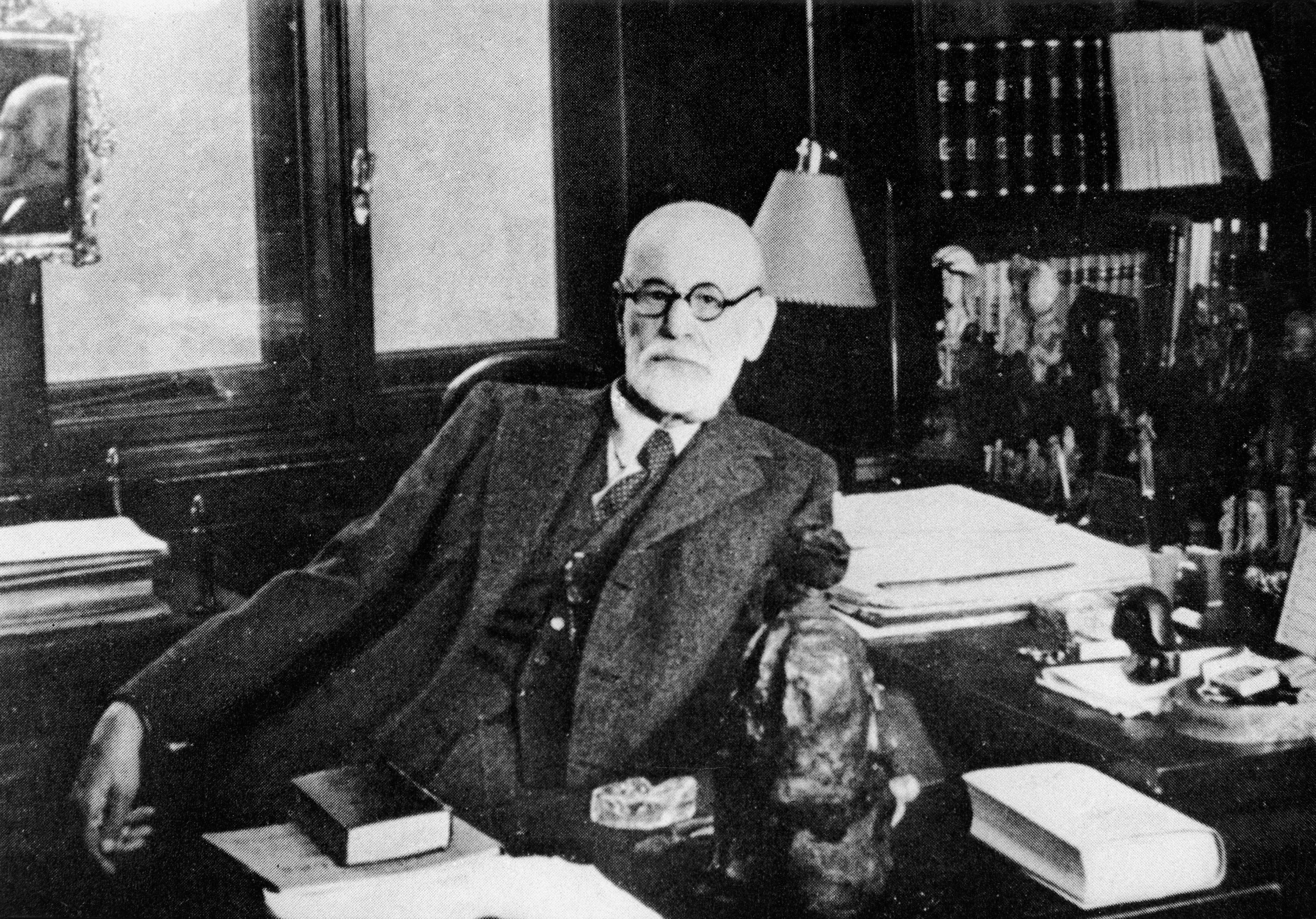


Portrait of Austrian psychologist Sigmund Freud (1856 - 1939) as he sits behind his desk in his study, Vienna, Austria, 1930s. (Credit: Authenticated News via Getty Images.)

If I were to ask you to free-associate on the term ‘psychotherapy’, you might not make it beyond a miasma of imagined jargon. Perhaps, for some of you, the term conjures images of philodendrons dangling from bookshelves lined with titles such as Atomic Habits. You might imagine jute rugs bathed in soft light pinned under a coffee table, upon which sits a box of tissues, invoking the solemnity of a votive.

All of which is to say that in the popular conception of psychotherapy, everything is contained in one, private room. It would be fair to say that psychotherapy is largely regarded as a private service for individuals to lay out all manner of experiences, so that they can explore their personal inner tumult.

However, looked at another way, we can see how, in fact, these experiences are substantially social in nature, and that psychotherapy is, in some ways, a reduction of these social experiences to personal events in the psyche. This all serves to illustrate the multitudes of the form — primarily the individual, private position of the client, but also the wider socio-political slant that cannot help but inform their life.

If one traces a line back to the Enlightenment, from thinkers like Descartes up to Freud, and through various paradigms like Behaviourism and modern-day Relational approaches, one can see how the private has become more and more interconnected with the social and the political in psychoanalytical models. Descartes placed human experience inside the vacuum of individual interiority; I think, therefore I am. Danish philosopher Soren Kierkegaard developed ideas about an ethical stage via his ‘stages of becoming’, wherein the individual progresses to a way of life in step with societal expectations (and the existential struggle of adapting to these expectations).

Though Freud’s is primarily a psychology of constitutional factors such as sexual desires and drives, as early as 1908, in ‘“Civilized” Sexual Morality and Modern Nervous Illness’, he considered the socio-political factors of repressive societal demands, and the psychological effects upon the individual. While Freud developed his theories, Structuralists like Ferdinand de Saussure challenged Cartesian assertions about the individual, proposing that one cannot simply extract the individual from their environment in order to understand them.

I work in a primary school (not just with young children, but also with private clients, whose ages range from the teens up to the fifties and beyond). Having trained with a specialism in child psychotherapy, I learned early on of developmental theories, such as the Attachment Theory of Ainsworth and Bowlby, and Bandura’s Learning Theory. Underpinning these theories are the interactions between biology and the environment — the intrinsic and extrinsic, development as a social process: a process of becoming through a matrix of relationships, to others and to the environment.

In the 1960s, English Psychoanalyst Wilfred Bion developed his ideas around containment. This is a process imperative to the child’s primary caregiver, but also to the therapist — and it returns us to the containment of the solitary therapeutic room, which, along with the therapist, is itself a container for the client and their feelings, thoughts, and emotions. The primary challenge I find in psychotherapeutic work is in this sense of containment.

While I can offer up myself and this private room as a receptacle for the client, in order to help to ‘transform’ intolerable psychic material (as it were), the client will of course leave this containment once our fifty minutes is up, and return to the many other containing spaces that constitute the social framework of life. That is to say, I might very well sit with a client in a private space and receive their most painful projections — and if things go extremely well I might assist in helping the client to re-process and integrate these feelings and emotions. But they still have to go home afterwards, potentially to a household where trauma and abuse are prevalent, or at the very least go back out into a world built upon the cold steel transoms and ledgers of capitalism.

My work in schools makes the political very much tangible and makes it clear that psychotherapy is battened to the socio-political. In 2017, a national policy was published called ‘Transforming Children and Young People’s Mental Health Provision’. The paper addressed what I am only too familiar with: the lack of accessibility to mental health services for children and young people; inequalities that help to create mental health issues, which are then perpetuated by other mental health issues; waiting lists for services such as CAMHS being incredibly long, and, as in the case of my school, staff who are overworked and often under-appreciated.

Griffin et al., (2022) analyse this paper and consider how policies are often tantamount to ‘political interventions’, serving to justify and embed certain healthcare ‘pathways’ as a means to an end of justifying a political agenda. For instance, early intervention sounds almost commonsensical when you think of it as a set of programmes to help children to improve their lives at a crucial point in their physical, cognitive, and emotional development. However, it has been argued that such policies lay blame at the feet of the parents rather than the social forces that help to create inequality in the first place. ‘Rather than undermining neoliberal philosophy, social investment approaches sustained and intensified it’, as Gillies et al., (2017) assert.

Looking back over the modern history of psychotherapy will be helpful at this point. There may not have been the exact same concerns back in the 1950s, when Eric Berne — the founder of the Transactional Analysis (TA) method of psychotherapy, and a key influence on my own practice — was writing. But Berne was driven by an ethos of equality, and a desire to make therapy accessible to all.

So why did Berne distance his method from the political, at least outwardly? Claude Steiner, a French-born psychologist, was a friend of Berne’s, and collaborated with him in the development of his theories. In 2010, Steiner wrote of his lifelong assumption that Berne was avowedly apolitical (Steiner himself had studied physics at Berkeley, but made a decision ‘not to make bombs’ and transferred to the study of child development). Berne passed away in 1970, but it wasn’t until 2004 that it was revealed to Steiner through Berne’s son, Terry, that Berne had been investigated by the House of Representatives’ Select Committee on Un-American Activities. Steiner mentions the ‘severe persecution’ Berne was subjected to as he was interrogated, and how Berne lost his government job and had his passport rescinded. What had Berne done? In 1952, he had signed a petition that questioned the treatment of leftist scientists in government.

The nuances of Berne’s narrative cast a long shadow. While authoritative cultural voices today persist in placing the burden on the individual, I spend a good deal of my time worried that I am enabling the continuation of the status quo by helping clients to simply endure their lot. Capitalism induces anxiety in us and then demands that we privately do something about it, as if health is not even slightly socially-determined. This is ‘deliberately induced to block political action’ (Frosh, 2017).

Then I remember the tenets of TA. That Berne sought to strip away hierarchies of power, starting at an interpersonal level. Berne advocated for an accessible therapy for all, free of isolating vernacular and the power-dynamic of the almighty therapist/healer. Berne was anti-elitist and proposed that we all had the ability, through analysis of our communication, to clear the way through game playing into intimacy, and an undertaking of a ‘redecision’ about who we are and how we relate to the world. Via Ego States, he revealed how we not only internalise parental messages but how dominant forces in the world exact their parental force on us. TA shows us that we have the personal potency to change how we engage with this world and from which private position we do so (how we are affected by the world and how we wish to affect the world).

Berne understandably distanced himself from politics during the Red Scare, but there is much for us to take from his commitment to continuing his work regardless, and developing a sociopolitical theory rooted in democratic principles — all despite this very real fear of reprisal from oppressive, authoritative voices seeking to discount his very existence. As we seek to understand the complex interplay between the individual and the social in contemporary psychotherapy, we could do a lot worse than heed his example.

Contributor
Mark Hammond is a Psychotherapist from Gateshead and the author of Victims, Aren't We All?


May 19, 2022 ... 1937, Victor Gollancz, London. Addeddate: 2022-05-19 09:50:42. Identifier: osborn-1937-freud-marx.

In addition to. Hegel, Marx, and Weber, Freud became one of the foundation stones on which their interdisciplinary program for a critical theory of soci- ety ...

Irish Labour goes “Connollyite”?

 3 December, 2025 -  By Micheál MacEoin


The election of Independent candidate Catherine Connolly as President of Ireland on 24 October both opens up space for left-wing and socialist ideas and is indicative of some underlying shifts in Irish politics.

The 68-year-old former barrister and Labour Party politician might seem a more unlikely figurehead than New York Mayor-elect Zohran Mamdani, but there are some similarities. Both started with negligible support and chances and went on to outstrip the establishment candidates.

In Connolly’s case, she defeated Fine Gael’s Heather Humphreys, a particularly poor and uncharismatic candidate who was on record defending fox-hunting as a rural pursuit and who ran a negative and graceless campaign. One former Fine Gael minister suggested that, for want of a positive programme, his party should “smear the bejaysus” out of Connolly. Its attempt to do so largely backfired.

Unlike Mamdani, whose focus was on domestic cost-of-living issues such as childcare, grocery prices and rents, Connolly’s campaign was marked by her outspoken support for the Palestinians and suspicion of NATO. She was also clear in her support for Irish reunification and made a point of visiting Belfast during the campaign.

This partly reflects Connolly’s political priorities as a candidate, as well as Irish popular opinion which has been strongly critical of Israel’s war on Gaza and supports the maintenance of “neutrality”, i.e. non-membership of formal international military alliances. It is also symptomatic of how Connolly’s outspoken predecessor, Labour’s Michael D Higgins, used the office of President to comment on global affairs.

Some of Connolly’s wider politics and political acquaintances are questionable, at best. Although condemning Russia’s invasion of Ukraine, Connolly has also described NATO’s attitude toward Russia as “warmongering”. She attracted criticism for a 2018 trip to Syria with former MEPs Mick Wallace and Clare Daly. Connolly denies that she supported the Assad regime, which she described during the campaign as a “dictatorship” which “committed countless atrocities and human rights abuses, all of which I have criticised”.

When Fianna Fáil’s candidate Jim Gavin withdrew — after it emerged that he had failed to pay back €3,300 to a former tenant — the scene was set, however, for a straight left-right polarisation between Connolly and Humphreys.

Spectrum

Connolly was backed by a spectrum of left-wing and centre-left parties, from People Before Profit and the Socialist Party on the far-left (as well as the Stalinists in the Communist Party and the Workers’ Party), through to the Social Democrats, Labour, the Green Party and, finally, Sinn Féin.

This unity around a left-wing candidate was the product of agitation from People Before Profit and others. Sinn Féin came under particular pressure and backed Connolly when it was clear she could win and that running their own candidate would be a highly risky move.

Connolly won, too, because she was backed by an enthusiastic grassroots campaign, given organisational weight by the existing left but inspiring wider involvement, including through self-organised groups of artists and Irish-speakers, as well as through attractive social media messaging.

The call to back Connolly has had interesting political effects and indicates one potential realignment in Irish politics.

Although the Presidential election has different dynamics to elections to the Dáil, the election shows that unity of parties broadly to the left can, through mutual support and transfers, unseat candidates of the two main establishment parties.

How “left” this alliance is can be criticised and there is definitely an element of political calculation and opportunism from some of the players.

After 2020, the Green Party propped up a coalition of the two main parties. At the 2024 general election the party retained only one of their twelve seats. Similarly, the Labour Party has historically been a prop for the centre-right Fine Gael.

Now, sensing a leftward shift among some sections of the electorate, both the Greens and Labour backed Connolly. Labour leader Ivana Bacik has even gone so far as to describe the party recently in a speech as “Connollyite Republican” in the tradition of James Connolly, name-check Mamdani and criticising the attacks on accommodation centres for asylum seekers

Tensions

In both cases, this has led to tensions. The Green Party lost a former TD and an ex-Senator in October due to its decision to back Connolly. Right-wing Labour TD Alan Kelly, too, publicly backed Humphreys in the Presidential campaign.

The Connolly campaign clearly created opportunities for co-operation on the left and the involvement of new layers of people in political campaigning.

A measure of its ongoing success will be the extent to which this campaigning can continue and be turned outwards, towards campaigns for housing, support for strikes, solidarity with asylum seekers and migrants and opposition to the growing racism in Irish society.

It will also be necessary for socialists to go beyond a broadly-defined “left”, raising the banner of democratic working-class socialist politics.


The largest archive of the works of James Connolly on the Internet. Other Marxist writers, documents of interest to socialists and Marxists are also ...


James Connely age: 4. parents father John Connely age: 58 mother: Mary ... There is no James Connolly archive as such. There is a valuable discussion ...

James Connolly was a Marxist, a revolutionary socialist and an internationalist. On the ninetieth anniversary of his execution, PETER HADDEN reviews his ...


"Bathroom ban" has increased harassment in UK

 10 November, 2025 - Author: Will Roberts


Pic: ACLU. Florida has by far the harshest "bathroom ban" among the right-wing states in the USA which have enacted such bans, but still milder than proposed by the EHRC in the UK.


Campaigning group TransActual have produced a report tracking the effect of the EHRC's now-withdrawn “interim update” in the first few months after the Supreme Court ruling in April.

The report is based on a survey TransActual carried out among trans people in the UK and other “gender non-conforming” people – in this context, that largely means cis people whose appearance differs in some way from the norm (for example, butch lesbians).

Despite all necessary reservations due to only one survey being done, and the survey being opt-in, and for that reason self-selecting, the findings are clear: the knock-on effect of the EHRC’s "interim update" has been an increase in harassment and abuse across the spectrum, and significantly more so for trans people.

The focus on the EHRC’s update, rather than the Supreme Court ruling itself, is for a simple reason: the Supreme Court did not rule on toilet access, only on membership of official committees in Scotland, and maintained that trans people should be free from harassment and discrimination under the 2010 Equality Act. The focus on toilets came from the EHRC’s later "interim update", which fuelled much of the media coverage (papers were keen to frame the case as “a victory for women’s rights” in the specific domain of “single sex” or “women’s” spaces).

Trans people and gender non-conforming cis people alike report being confronted in public toilets and changing rooms. That happened before, but people have felt particularly bolstered to do so thanks to the EHRC.

The following is a report from a cis woman:

“The most recent is that I went to the ladies’ loo at Victoria station. A group of young women gathered around me and told me I should get out, saying ‘don’t you know you’re not allowed in here anymore’. I … locked myself in a loo. They stood outside and were banging on the door and shouting that they were going to call the police and that I was ‘disgusting’ and had no right to be born and all sorts of horrible things …I’m a cis woman and just happen to be tall and quite flat chested and wear my hair short. Before the ruling any challenges had been gentle, like ‘oh by the way this is the ladies’ and people were embarrassed or apologetic when I said ‘it’s okay I’m a girl’, but now it’s aggressive and horrible…”

As we said at the time of the ruling, this was an inevitable result of the backlash around the Supreme Court case: anyone who is deemed not to “fit in” will be on the receiving end of hatred that has been whipped up by transphobic campaigners and the right-wing press.

The effect on trans people (who have experienced a much more significant jump in incidents than cis respondents, according to the report) is also enormous. Many report opting to use no “gendered spaces” at all, restricting the amount they drink and where they go out in public to accommodate this. Such choices, in deference to prejudice, were common enough before, but they have increased; and they have been linked to dehydration and urinary health issues, as well as just being plain humiliating and degrading.

TransActual’s survey received a large number of “malicious” responses from transphobes looking to skew or make fun of the results. This is no surprise – the same has been true of any open consultation or survey regarding trans people in the last several years.

Rather than just discard them, TransActual incorporate some findings based on analysing these responses, and plan to release a separate report in the future. Commonalities between the malicious responses are: justificatory language (“can now”, “allowed to”, “the law is clear”), suggesting that the ruling has bolstered and lent credence to anti-trans opinions; misinterpretations celebrating things that the Supreme Court ruling did not rule on, such as removing protections for trans people or saying that blanket exclusions of trans people are somehow “required”; and perhaps most significantly, “media mirroring” – language taken directly from reports in the right-wing press that has filtered down into general conversation, particularly phrases like “a win for women”, and “common sense prevails”.

More research will follow, and unless the EHRC "interim update" is overruled rather than just withdrawn, the uptick in harassment and discrimination will continue. It is vital that socialists join the fight against the current reactionary wave targeting trans people in the UK and beyond.
Hong Kongers demand truth on Wang Fuk fire


3 December, 2025 
Author: Chan Ying


The horrendous fire in Wang Fuk Court, Tai Po is the worst in living memory for Hong Kong residents. Videos show flames rapidly sweeping up inflammable external netting, with winds spreading the fire across the blocks. The death toll so far is 156, with more yet to be accounted for. Nearly 40% of around 4,800 people in the complex are aged 65 or above.

The eight 31-storey tower blocks were built in 1983 under the then colonial government’s subsidised purchase scheme for low income families. There are 2,000-odd densely packed apartments (8 apartments per floor, about 450 sq ft each). Hundreds of similar blocks were built in the 80s, no doubt inspired by the Thatcher government’s “Right to Buy” 1980 Housing Act. Typically, they had narrow corridors, thin glass windows and lacked modern safety features such as sprinkler systems and refuge floors. Like Wang Fuk Court, many are now undergoing extensive renovation.

The authorities first attributed the styrofoam covering thin windows as the most likely cause of the fire rapidly entering the inside of the blocks, generating lethal toxic fumes and extreme high temperatures. Fire services reported that all the fire alarms had malfunctioned. This is so unusual that residents are speculating that they were switched off during renovation.

Although the HK government arrested a number of people connected with the renovation programme, it is struggling to control the narrative against a public outcry over the causes of this man-made tragedy. Citizens are expressing widespread frustrations, built up over the decades, about the construction industry’s corrupt practices, use of cheap sub-standard materials, as well as the government’s ineffective regulatory oversight. E.g. fire-retardant netting is legally required but is twice as expensive, and can only be used once because it deteriorates under strong sunlight, making it an obvious target for cost-cutting and corruption.

Government

People accuse the government’s subsequent announcements about its policy to replace bamboo with iron scaffolding as a diversion from the real causes of the disaster. Bamboo scaffolding is part of Hong Kong’s cultural heritage, it is sustainable, highly flexible and has served Hong Kong well for many decades.

Anticipating government inspections, many contractors are hurriedly removing netting and foam from building renovations, while angry residents are seizing samples of these materials to conduct tests.

Colonial Hong Kong used to follow the UK practice of using judge-led commissions of inquiry, but not any more. There was no public inquiry over Covid. On this occasion, it has announced an internal inter-departmental inquiry.

After listening to a government official announcing they would press on with phasing out bamboo scaffolding, University student Miles Kwan launched a petition calling for accommodation for displaced residents and an independent investigation to probe regulatory neglect, potential conflicts of interest and to review the supervision system for construction as well as to hold government officials accountable. The next day Kwan was arrested on suspicion of sedition. His online petition is no longer accessible, but a second petition has since been started by a former Tai Po resident living overseas.

Imran Khan, who represented the bereaved and survivors of Grenfell, said that Hong Kong now needs a public inquiry with court-like powers because “an internal investigation will not get to the truth and there will be no faith in it…” Based on his experience with Grenfell residents, he said “without justice they cannot grieve.” HK’s Chief Executive John Lee Ka-chiu has ordered an “independent review committee”, which however lacks the powers that a Commission of Inquiry would bring.

In Hong Kong, the heroic fire service does not have independent trade union representation. In the UK, the FBU has a strong track record of defending fire fighters and the public. Its recent publication,Culpable: Deregulation, Austerity and the Causes of the Grenfell Tower Fire, written by Paul Hampton, contains key lessons not just for the UK but for Hong Kong and many cities across the world.
New report exposes MI5 role in "dirty war"


 11 December, 2025 -
 Author: Micheál MacEoin


Pic: MI5 headquarters

A nine-year police investigation, known as Operation Kenova, has uncovered much new detail about the British Army agent "Stakeknife", who has been linked to 14 murders and 15 abductions.

"Stakeknife" is widely believed to be Belfast man Freddie Scappaticci, a former member of the Provisional IRA, who died in 2023. Scappatici operated within the IRA's notorious internal security unit - or "nutting squad" - which was tasked with uncovering, interrogating and ultimately executing alleged informers.

However, absurdly, the Report itself was not allowed by the British Government and the security services to name Scappaticci, in deference to the policy of “Neither Confirm Nor Deny”. This approach was defended by the Secretary of State for Northern Ireland in the House of Commons in the wake of the Report’s publication.

The “nutting squad’s” victims were often tortured and dumped at the side of roads, as a warning to others; taped “confessions” were played to their families, who were forced to live for decades with stigma.

In a horrible irony, the man who led the brutal unit was himself an army intelligence asset from the late 1970s to the 1990s, working primarily with the Force Research Unit (FRU), a covert military intelligence unit of the British Army's Intelligence Corps.

The FRU were able to use their “golden egg” within the IRA to steer the group’s own internal security, protect assets and provide intelligence into the IRA’s inner workings.

An interim report, published last year, found that "Stakeknife" had probably cost more lives than he saved. Operation Kenova discovered 3,517 intelligence reports from “Stakeknife” but these were not used to protect lives. Quite the opposite. The Report does not, at times, pull its punches: "Time and again, it would appear that protecting the agent outweighed protecting the life of a victim or protecting the right of their families to see justice for the crimes committed against their loved ones."

Worse than this, army intelligence handlers twice took “Stakeknife” out of Northern Ireland on holiday when police began to suspect his involvement in serious criminality. The Report also found that when the resettlement of Stakeknife was originally being considered in the 1990s, “there was communication within the Army about arranging a ‘Farewell Dinner’, including a list of those who would attend and a likely venue.”

When “Stakeknife” was ultimately exposed in 2003 by journalists, he was set up in a series of large and comfortable houses in England and allowed to live on the generous proceeds of his “work”.

The report was authored by former Police Scotland chief constable Sir Iain Livingstone. Current Police Service of Northern Ireland chief constable John Boutcher previously led the investigation.

It accuses MI5 of “serious organisational failure” in trying to restrict the investigation. Documents about the agency’s involvement with Stakeknife were passed to the investigation only last year, after the interim report was published. MI5 even broke into a safe used by Kenova investigators based in its London headquarters in Thames House and accessed restricted material.

The Report states that: “The further material revealed MI5 had earlier and greater knowledge of the agent than previously stated” and that the “revelation of the MI5 material was the culmination of several incidents capable of being negatively construed as attempts by MI5 to restrict the investigation, run down the clock, avoid any prosecutions relating to Stakeknife and conceal the truth.”

Many victims are angry that the Report was prevented from naming "Stakeknife". That is justified.

At the same time, the Report is nevertheless a step forward in exposing the role of British military intelligence and the security services in Britain's "dirty war" in the North of Ireland.

‘The UK government’s workers’ rights agenda must include self-employed people too’


© nrqemi/Shutterstock.com

The Employment Rights Bill will be one of this government’s most significant achievements, improving the rights of millions of employees. Trade unions fought hard for it, and thankfully it is now back in its final stages, after the Lords held it up. 

Now though, the government must improve protections for those whose working conditions this Bill doesn’t include – the self-employed. 

The self-employed make up more than four million people in the UK, 13 per cent of those in work. They dominate important sectors, from the creative industries to construction. Their full-time average net income is 12 per cent lower than for full-time employees. 

The government is taking forward important reforms that will benefit self-employed people. Theseinclude the right to a written contract; tackling late payments; extending health and safety and blacklisting protections; reforms to employment status; and creating a ‘Freelance Champion’. But this important part of the workforce needs more, and there is a risk of a widening ‘rights gap’ between employees and the rest of the workforce.

Income protection is particularly important for self-employed people. They get sick, have children and retire just like employees. But when they do, their income drops off a cliff. Inadequate sick pay means the average full-time self-employed worker loses 81 per cent of their income if they don’t work. This thenincreases the likelihood they will come to work sick –working less productively, while spreading viruses to others. 

Self-employed parents get a particularly raw deal. The maximum maternity allowance is just £187 per week for 39 weeks. And with just 10 ‘keeping in touch days’, many self-employed people struggle to maintain crucial client relationships. Paternity leave is non-existent – meaning only 31 per cent of self-employed fathers took time off following their child’s birth, according to TUC research. The upheaval in their working lives is stark. Just 24 per cent of mothers who were self-employed before their child’s birth remained so three years later (compared with , 56 per cent of fathers).  and 26 per cent were out of work. Pensions are another area where self-employed people need support. The vast majority of self-employed people are not on track to meet the income they need in retirement. This is storing up a huge problem for the state pension – which will come under pressure to prevent looming pensioner poverty among the previously self-employed.The NHS too will face increased pressures due to poverty related conditions being exacerbated for this group.

Subscribe here to our daily newsletter roundup of Labour news, analysis and comment– and follow us on BlueskyWhatsAppX and Facebook.

Income protection is clearly important, but the self-employed need a different kind of support. They work very differently – usually with greater freedoms over how and when they work, and they pay lower national insurance. But that doesn’t mean the government should wash their hands of responsibility for them. They are still workers and many are in precarious circumstances and on low incomes. 

In our new Fabian Society report, we set out some options the government should consider. For sick pay, the government could learn from Canada, and back an opt-out sickness insurance scheme – funded both by the self-employed and the organisations they work for. For parental leave, the government can learn from European countries and provide an income related maternity allowance for longer; create a new paternity allowance; and increase the number and flexibility of vital ‘keeping in touch’ days. And to increase pension contributions, the government could look at the auto-enrolment policies of countries like Lithuania or Chile, and create new savings products to replace Lifetime ISAs and promote pensions and savings uptake too.

Thankfully, most of these measures don’t cost other taxpayers much at all. These options are mostly funded by self-employed people themselves. Parental leave would cost a relatively small amount, but it is such an important benefit for the welfare of children and new parents that it is surely justified.

When the Employment Rights Bill is finally passed, the government will need to follow through and deliver the rights it promises for employees. This will demand the time and continued hard work of trade unions and politicians. Alongside this, the government must also start improving income protections for self-employed people too. If they want to make progress by the next election, that work must start now.

Workers Deserve Dignity
12.08.2025
TRIBUNE

Labour’s Employment Rights Bill promised to enhance much-needed workers’ rights in the UK, but the legislation has become a shadow of itself. Now unions must lead the fight to get it back on track.


A member of the bar staff pours a pint of beer at the Westminster Arms, London.
 (Photo by Jack Taylor/Getty Images)

Working in the hospitality industry this summer was an interesting experience. Like bartenders the world over, I readied myself for the seasonal rush, made jokes about this with my colleagues, and looked forward to the inevitable increase in pay that would come with more hours of work. But the high season never came. A heady mixture of a cost-of living-crisis and a general decline in ‘out out’ culture made sure of this. Instead, I spent this summer experiencing (once again) the struggle of collectivising staff in a sector that is structurally designed to prevent organising.

Along with about twenty other workers, I was brought in on a short-term contract to pull pints and shake cocktails on Brighton Beach. We were met with the usual conditions: poor pay, insecure hours, and absent safety standards. The deepest felt issue, however, was ongoing bullying and discrimination, which twice tipped over to physical assault. The biggest barrier to collectivising workers, as it often is, was the fear of losing our jobs.

Increasingly, workers spend their lives in industries marked by precarity. To rebuild the union movement and empower our class, we must organise in such conditions — this precarity will not stop with any one industry, but will infect more and more if it is left to fester. A ‘day one’ unfair dismissal policy would have been a powerful tool in this fight, which is why big bosses and right-wing politicians have opposed it.

Those MPs who stood on our picket lines when it was politically convenient now conflate ‘day one rights’ with the abolition of probation periods. However, probation periods are entirely possible under the bill. Some have suggested the policy would result in the use of fixed-term contracts in place of probation periods, but this is a misunderstanding of the rules. These rights are not for permanent workers; they are for all workers. Unfair dismissal claims are possible at the end of fixed-term contracts — unless there is a case of genuine redundancy, expiry by agreement, or other fair reason. Put simply, under a system of ‘day one rights’, using fixed-term contracts in place of probationary periods could put employers in breach of employment law.

It is clear what this manifesto breaking U-turn means for workers: a continuation of the status quo. If you face abuse at work, your first thought will not be your well-being, but whether your boss will sack you for causing a fuss. For the first five months and twenty-nine days of your employment, your likelihood of paying rent is based on the whims of your superior. This is not hyperbole or exaggeration. It is the everyday reality for tens of thousands of workers up and down the UK.

Labour argues that the U-turn is justified because, as a result, other provisions of the employment rights bill will end up as law sooner. The government claims that workers will quickly be able to find improved dignity in the workplace through the few protections available in the Employment Rights Bill. But this is not the first pushback on workers’ rights from Labour, and very few union reps believe it will be the last. When in opposition, the party negotiated and consulted with unions on its proposals for workers’ rights. The motion was not perfect — and did not go as far as most of us wanted — but unions got around the table and agreed. Since then, however, the hallmarks of policies aimed at a generational improvement for workers have been slowly eroded, and now, the Employment Rights Bill lives in the shadow of its ambition. Though bosses will be mandated to tell their workers they have a right to join a union, zero-hour contracts and ‘fire and rehire’ are still legal.

This aversion to workers’ rights has been sold to us on the basis of economic good sense. How can businesses operate in such an environment?! Surely, economic growth would be stifled, and the tax base to pay for public services would continue to shrink?! We’ve heard it all before. Relying on the logic of the same business lobby that failed to bring growth to our economy in any meaningful way for the last fourteen years only reinforces establishments across the country.

If the concern is growth, there is a solution: improve workers’ rights and strengthen and expand collective bargaining. When protections are implemented, and there is scope for negotiation, more money goes into the pockets of workers. Those workers do not sit on it, nor siphon it overseas. Those workers spend it in our local economies; they keep the bars where I pour pints open, they buy the produce our agricultural sector grows, and they keep our economy moving while shareholders let it stagnate. More than anything, Labour’s ongoing debacle shows that when workers’ voices are silenced, society as a whole suffers. Thankfully, Unite (my union) has criticised the U-turn, describing it as ‘a betrayal of working people’. Now, members and reps need to demand their unions also join the call — or else we will all lose out.

Contributor
Meg De Meo is a hospitality worker, organising with Unite the Union, and an Executive Council member representing Unite members in the South East.

‘Violence against women and girls can be prevented. The UK can help lead the way’

Gurgaon resident protest over sexual violence against women in Manipur,
©Shutterstock/Sudarshan Jha

Speak to frontline gender-based violence service providers in Rotherham or Halesowen, and then to women’s rights advocates in Lilongwe or Lahore, and the similarities are unsettlingly consistent. The risks and realities are not identical, and the scale can differ dramatically, but the underlying dynamics barely shift: unequal power, social norms that excuse harm, institutions that act only after the damage has been done, and the relentless resilience demanded of women and girls simply to live and lead without fear.

What we often treat as separate domestic or global struggles is, in practice, one connected fight. The drive for change travels across borders too – the organising, the courage and the refusal to be silent.

This is why the Foreign Secretary’s renewed focus on preventing violence against women and girls (VAWG) globally is so important. It recognises that no country can move towards prosperity, democracy or peace when those calling for change must first negotiate their own safety. Gender equality needs to be at the centre of foreign policy, rather than at its margins. 

The UK has played a central role in building a global evidence base for what works in tackling VAWG. Over the past decade, the UK’s flagship ‘What Works to Prevent Violence’ initiative has been a landmark investment to understand how violence can be prevented before it occurs: the world’s first multi-country study to pilot and rigorously evaluate a range of approaches to preventing VAWG across 12 countries in Africa and Asia. Its conclusions are both clear and profoundly hopeful: violence is not inevitable. In fact, What Works’ evidence shows that well-designed programmes, implemented consistently over 2-3 years, can halve rates of violence. It recedes when communities challenge harmful norms; when men and boys are engaged as allies; when economic inequalities are reduced; and when interventions are shaped through the lived experience of the communities they’re meant to serve.

Another global study points to a deeper finding that holds across cultures and continents: the strongest predictor of whether a country passes robust laws to end violence against women and girls is not its national wealth, the ideological leaning of a government, or even the number of women in parliament. It is the strength of its independent women’s movement. These movements and organisations – sometimes small, rarely well-resourced, and often operating in challenging political climates – are the engine rooms of progress. They drive legislation, shift norms and demand accountability. They are, in effect, the most powerful catalysts for change we have and should be celebrated as such.

This evidence should guide the UK’s choices at a time of tightening budgets and rising global pressures. Investment has to reach the places where impact is deepest and most durable: tackling the root causes of gender inequality and enabling women’s rights organisations to lead that work. That means funding that is direct, flexible and long-term, and a genuine partnership with civil society – drawing on the insight of organisations that understand the dynamics of violence, backlash and change from within their own communities. Civil society leadership strengthens prevention, sharpens policy, and protects the gains that are most at risk.

If the Foreign Secretary wants British foreign policy to reflect the UK’s values and extend its influence, she has chosen the right place to begin. Tackling violence against women is both foundational and transformative. It is also an area where the UK can act as a committed partner, particularly as it advances its own ambitions to halve violence against women and girls at home. Violence is one of the sharpest edges of gender inequality, but it is also a point from which a more ambitious vision for change can grow – one that treats women’s rights not as an accessory to foreign policy, but as foreign policy itself; recognising that global security without women’s safety is no security at all. Our responsibility, as parliamentarians, is to keep the UK on that path. That means scrutiny of budgets, attention to delivery, and a consistent commitment to the principles the UK has long championed. It also means recognising that the fight against violence is not only a matter of rights but of stability, development, and the credibility of our foreign policy.

The women and organisations driving this work have shown what is possible. The UK can play a meaningful role by giving them the long-term support required to protect that progress.