Wednesday, December 17, 2025

Brazil’s Lula says now or never as EU-Mercosur trade deal hits French roadblock

France and Italy said Wednesday they remain opposed to a trade agreement between the European Union and South American trade bloc Mercosur, dashing hopes of the contentious pact being signed soon. Brazil's Luiz Inacio Lula da Silva responded with a threat to ditch the deal altogether if it is not signed this week.


Issued on: 17/12/2025 -
By: FRANCE 24
Video by: Armen GEORGIAN
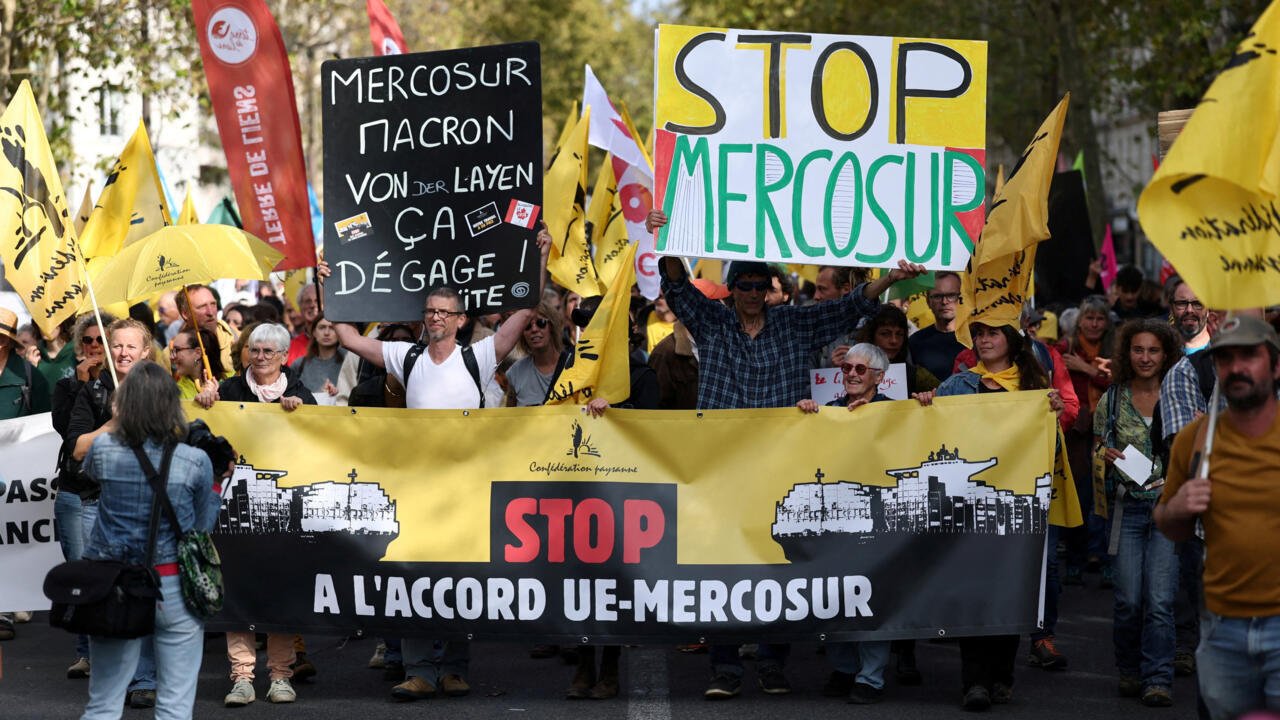

Protesters rally against the EU-Mercosur free-trade deal in Paris on October 14, 2025. © Stéphane Mahé, Reuters
03:29


France and Italy on Wednesday said they were not ready to back a trade agreement between the European Union and the South American trade bloc Mercosur, dealing a blow to hopes of finalising the deal this week – and sparking dismay in Mercosur heavyweight Brazil.

European Commission President Ursula von der Leyen had been expected to fly to Brazil at the end of this week to sign the accord, reached a year ago after a quarter-century of talks with the bloc of ArgentinaBoliviaBrazilParaguay and Uruguay.

GermanySpain and Nordic countries say the agreement will help exports hit by US tariffs and reduce dependence on China by providing access to minerals.

© France 24
01:53

Confirming an earlier Reuters report, Italian Prime Minister Giorgia Meloni sided with French President Emmanuel Macron in calling for a delay in approving the deal, which Poland and Hungary also oppose.

"The Italian government has always been clear in saying that the agreement must be beneficial for all sectors and that it is therefore necessary to address, in particular, the concerns of our farmers," Meloni told the lower house of Italy's parliament.

She told lawmakers it would be "premature" to sign the deal before further measures to protect farmers were finalised, adding the deal needed adequate reciprocity guarantees for the agricultural sector.
Paris seeks more safeguards, Lula threatens to quit

France too wants tougher safeguards, including "mirror clauses" requiring Mercosur products to comply with EU rules on the use of pesticide and chlorine and tighter food safety inspections.

"No one would understand if vegetables, beef and chicken that are chemically treated with products banned in France were to arrive on our soil," French government spokesperson Maud Bregeon told a news briefing. Supporters of the deal say it would not override existing EU regulations on food standards.

Later on Wednesday, the European Parliament, Commission and the Council, the grouping of EU governments, struck a provisional agreement to set controls on imports of agricultural products resulting from the Mercosur bloc, potentially meeting some complaints of critics of the deal.


© France 24
03:17


Brazilian President Luiz Inacio Lula da Silva reacted to the resistance from France and Italy by threatening not to sign as long as he is president.

"I already told them, if we don't do it now, Brazil won't have an agreement as long as I am president," Lula told a cabinet meeting on Wednesday. "If they say no now, we will be tough with them from now on. We gave in on everything that diplomacy could possibly concede."

The Mercosur bloc is already negotiating deals with other nations such as JapanUnited Arab EmiratesIndia and Canada.

(FRANCE 24 with Reuters)

Italy joins France in blocking EU-Mercosur trade deal ahead of expected signing
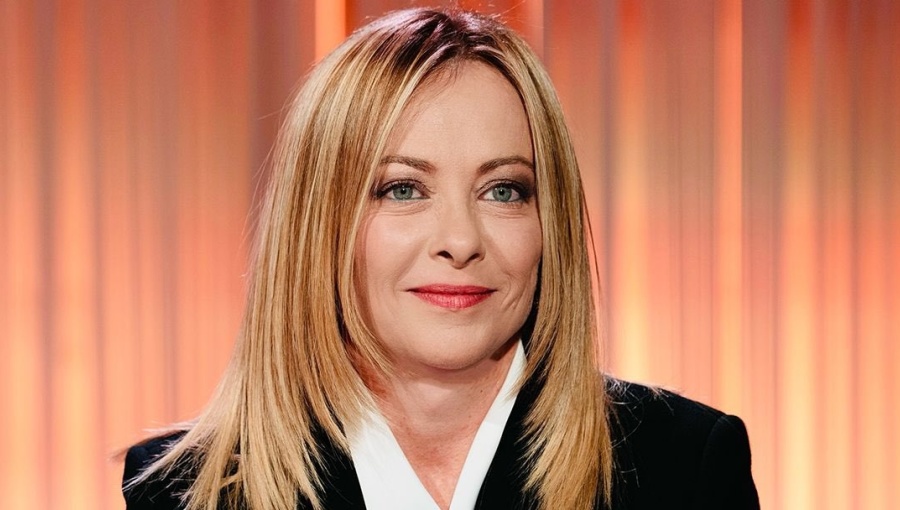
Italy joins France in blocking EU-Mercosur trade deal ahead of expected signing
Prime Minister Meloni insisted Italy was not seeking to block the accord entirely. "This doesn't mean that Italy wants to block or oppose the agreement globally," she said.
By bnl editorial staff December 17, 2025

Italy has thrown its weight behind France's opposition to the EU-Mercosur trade agreement, putting at risk this week's planned signing of the long-negotiated pact between Brussels and four South American nations.

Giorgia Meloni, Italy's Prime Minister, told parliament on December 17 it was "still premature" to sign the agreement in the coming days, joining French president Emmanuel Macron in demanding more time to finalise safeguards for European farmers before backing the deal.

The Italian position threatens to deny the European Commission the qualified majority of 15 member states representing 65% of the EU population needed to approve the agreement. That could derail Commission President Ursula von der Leyen's long-touted plan to fly to Brazil on December 20 to sign the deal with Argentina, Brazil, Paraguay and Uruguay.

A decisive round of deliberations on additional farm safeguards is scheduled for before the EU summit in Brussels on December 18. If a compromise can be reached, EU countries could approve the trade deal the next day, clearing the way for von der Leyen's trip to Brazil.

"For us it is necessary to wait that the package of extra measures to protect the farm sector is perfected," Meloni said ahead of the summit. She added that the new guarantees would need to be discussed with Italian farmers before Rome could support the accord.

Italy's stance comes as thousands of European farmers prepare to protest in Brussels on December 18 against Commission policies including cuts to the Common Agricultural Policy budget and the Mercosur agreement, which would open EU markets to South American beef, poultry, sugar and honey without tariffs.

Meloni insisted Italy was not seeking to block the accord entirely. "This doesn't mean that Italy wants to block or oppose the agreement globally," she said. "But, as we always said, we want to approve it only when adequate reciprocity guarantees for our agricultural sector will be added."

The prime minister said she was "very confident that with the beginning of the new year, all these conditions can be fulfilled", suggesting Rome would support the deal in January if additional protections were secured.

Macron has taken a harder line, warning that France would oppose "very firmly" any attempt by Brussels to force through the agreement, according to government spokesperson Maud Bregeon. Paris has been lobbying for a postponement until January, arguing that conditions for approval are not yet satisfied.

Italy finds itself caught between the demands of Coldiretti, the powerful farmers' lobby opposed to the deal, and Confindustria, the main business association that supports the agreement. Emanuele Orsini, president of Confindustria, said the pact had a value of €14bn for Italy and would provide "a good place for our products" amid threats of US tariffs.

Antonio Tajani, Italy's Foreign Minister, said earlier this week that Rome was "favourable to signing the agreement" once issues around safeguards for certain agricultural sectors were resolved. "It will be now or it will be January," he told a conference in Milan.

The opposition from Rome and Paris prompted a stern warning from Brazilian president Luiz Inácio Lula da Silva, who told a cabinet meeting on December 17 that Brazil would abandon negotiations if the deal was not finalised this month. "If we don't do it now, Brazil won't make this deal anymore as long as I'm president," Lula said. "If they say no, we will be tough with them from now on."

The trade agreement, negotiated for more than 25 years, would create one of the world's largest free trade zones covering roughly 800mn people. Germany and Spain strongly back the accord, which was reached in December last year and represents the EU's largest trade deal measured by tariff cuts. It would give European companies access to critical minerals including lithium vital for the bloc's green transition.

Blocking the deal would require four member states representing at least 35% of the EU's population. With Poland already declaring its opposition and Belgium expected to abstain, Italy's position is likely to prove decisive in determining whether opponents can reach that threshold.

The European Commission has proposed stronger safeguards and a farmer compensation fund to win over reluctant member states. On December 15, the European Parliament approved amendments to the Commission's safeguard proposals, including faster investigations and lower thresholds for triggering protective measures against South American imports deemed harmful to EU producers.

Francesco Lollobrigida, Italy's Agriculture Minister, said last week that the Mercosur agreement "can become excellent if after 25 years we succeed in taking a definitive step on reciprocity", echoing concerns that South American exporters should be held to equivalent EU standards on pesticides, antibiotics and labour rights.



 

Italian teachers at Istanbul high school paid six times more than Turkish colleagues

Italian teachers at Istanbul high school paid six times more than Turkish colleagues
Liceo Italiano di Istanbul, or Ozel Italyan Lisesi, was founded as far back as 1861 during the Ottoman era. / Liceoitaliano.net
By Akin Nazli in Belgrade December 17, 2025

Italian teachers at an Italian high school in Istanbul earn salaries that are six times bigger than the salaries of their Turkish colleagues at the institution, according to local media reports.

Liceo Italiano di Istanbul, or Ozel Italyan Lisesi, founded as far back as 1861 during the Ottoman era, is owned by the Italian government. It is among the schools for non-Muslim minorities in the country that were given permission by European governments to open during the 19th century.

60,000 lira versus 350,000 lira

Liceo Italiano di Istanbul pays its Turkish teachers monthly salaries of around Turkish lira (TRY) 60,000 ($1,405). However, the Italian teachers receive around TRY 350,000.

The school’s management offered a 15% salary hike for 2026, together with no hike for 2027, during collective labour agreement talks with the teachers’ syndicate.

Turkish teachers at the school have been holding protests. On December 10, they called a press conference to announce that they were initiating a strike process.

Colonial law

The Turkish teachers at the school work according to a lower status, they stated in a press release, adding: “Is the reason for this discrimination the fact that the teachers are Turkish?”

The situation might be said to smack of colonial law.

Jarring double standards in teaching loads and working conditions are also evident, Selahattin Karakurt, head of a local labour union present at the school, said.

“A Turkish teacher who fills in for an Italian colleague is deprived of any additional payment. However, an Italian teacher doing the same job receives compensation for their work,” he said.

“We want to work without the constant threat of being fired and without worrying about the future,” Karakurt also said.

It is discriminatory to deny the union rights of Turkish teachers who are union members, according to Karakurt. Only the needs of the Italian teachers are taken into account when preparing the weekly lesson schedule, he added.

“We want an end to the pressure exerted on us by the school administration, including threats of dismissal, simply because we are union members and are fighting for our rights,” the union leader remarked.

‘Treat us like human beings’

“We are here to be treated like human beings, for workplace tranquility and the protection of our dignity,” Ilhan Gulek, a history teacher at the school, said during the press call.

The Turkish teachers have worked for three years with no salary hike, yet the economic crisis felt in Turkey had been at its most devastating, he added.

“Our lessons are 50 minutes long, and our breaks are five minutes. It’s impossible to eat properly or rest in the 30 minutes allocated for lunch,” Gulek also complained.

“The duty of supervision [of the students], which is one of the primary responsibilities of a teacher, is only performed by Turkish teachers at our school. It becomes even more difficult to cope with this pace [in the schedule] on the days we are on supervision duty,” he added.

The Turkish teachers have demanded that the lessons should be 40 minutes long, with breaks set at 10 minutes, in common with schools across Turkey.

The school administration has rejected their requests, saying: “In Italy, lessons are 60 minutes long. If we reduce them to 40 minutes, Italian teachers will suffer financial losses.”

When Turkish teachers asked whether their efforts and contributions to the friendship between the two countries meant nothing, the Italian director of the school reportedly told them: “You are just numbers to Italy.”

Starving pregnant women ate mud as Trump aides whose cuts fueled crisis got $35K to travel
Propublica
December 17, 2025


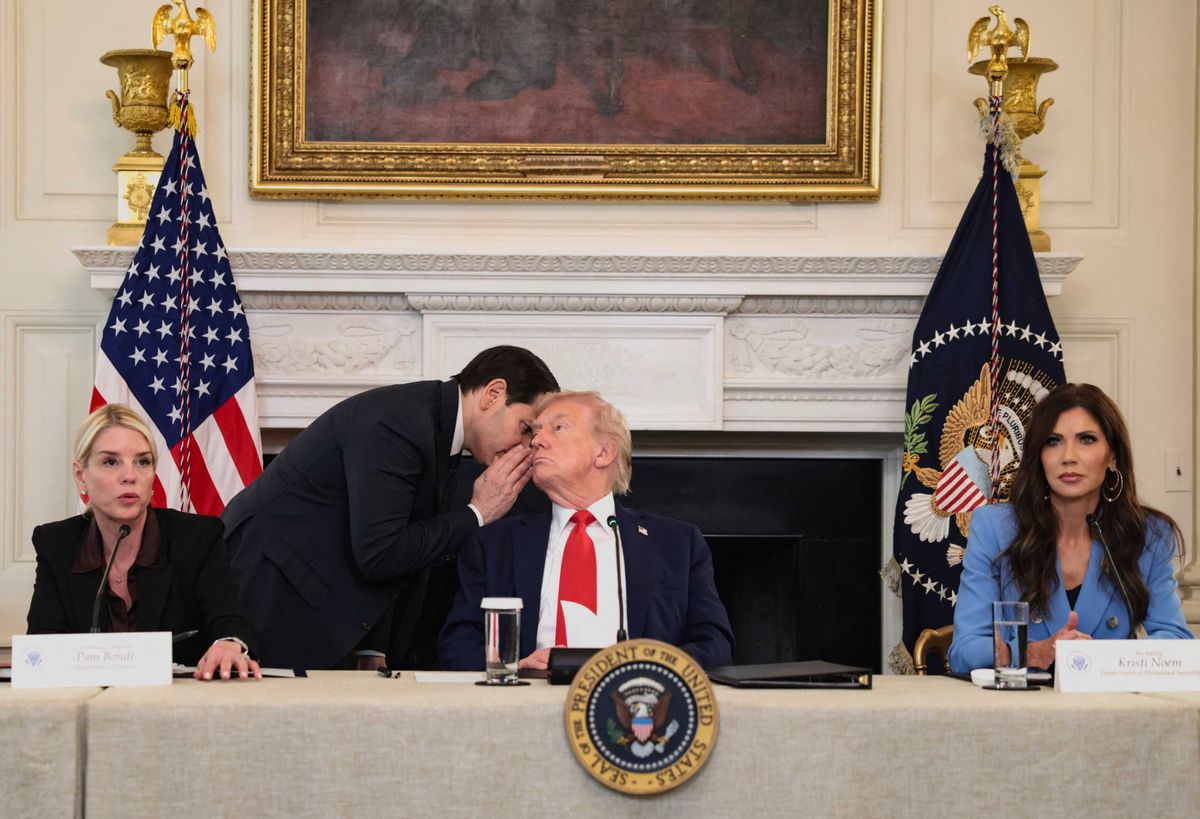
U.S. Secretary of State Marco Rubio updates U.S. President Donald Trump on September 22, at the White House in Washington, D.C., U.S., October 8, 2025. REUTERS/Evelyn Hockstein

On July 18, a mild, overcast night in Nairobi, Kenya, a team of President Donald Trump’s top foreign aid advisers ducked into a meeting room at the Tribe Hotel, their luxury accommodations in the city’s diplomatic quarter, for a private dinner.

The visitors from Washington included Marcus Thornton, a former Border Patrol agent known for a series of public lawsuits against the Biden administration’s COVID-19 vaccine mandate; Kenneth Jackson, a former oil executive who had done a stint in government under the first Trump administration; and Laken Rapier, who’d previously managed communications for the city of Fort Worth, Texas. This year, all had been appointed to leadership roles in the U.S. Agency for International Development, the premier government humanitarian agency in the world.

Five months earlier, some of the visiting aides had celebrated USAID’s destruction over cake and speeches in Washington. With that job done, they’d embarked on a world tour of half a dozen cities, including the Kenyan capital. They were granted special permission to fly business class “to help ensure maximum rest and comfort,” according to an internal memo. Thornton alone received authorization to expense more than $35,000 in taxpayer money for the trip. The plan was to conduct exit interviews with USAID’s top experts, who were being forced out of the agency amid the administration’s stated commitment to austerity.

When the U.S. embassy in Nairobi learned of the visit, officials there arranged the dinner with a goal in mind. It would be their last opportunity to explain, face-to-face, the catastrophic impact of Trump’s drastic cuts to foreign aid.

A top concern: the administration’s failure to fund the World Food Program’s operation in Kenya, where about 720,000 refugees, among the most vulnerable people on earth, relied on the organization to survive. After providing $112 million in 2024, the U.S. abruptly cut off money in January without warning, leaving the program with no time to find adequate support or import the food needed for the rest of the year.

For months afterward, U.S. government and humanitarian officials warned Washington that the cutoff had led to increasingly dire circumstances. They begged Trump’s political advisers, including Thornton, to renew WFP’s grant and give the money it needed to avert disaster. The embassy in Nairobi sent at least eight cables to the office of Secretary of State Marco Rubio, explaining the situation on the ground and projecting mass hunger, violence and regional instability.

Those warnings went unheeded. Rubio, facing pressure from lawmakers and humanitarian groups, nevertheless publicly asserted that the agency’s mass cuts had spared food programs — even as the administration failed to fund WFP in Kenya behind the scenes. “If it’s providing food or medicine or anything that is saving lives and is immediate and urgent, you’re not included in the freeze,” Rubio told reporters on Feb. 4. “I don’t know how much more clear we can be than that.”

By the spring, WFP still had not received funding, ran low on supplies and would be forced to stop feeding many of Kenya’s refugees. In Kakuma, the third-largest camp in the world, WFP cut rations to their lowest in history, trapping most of the 308,000 people in the camp with almost nothing to eat.

They began to starve, and many — mostly children — died because their malnourished bodies couldn’t fight off infections, ProPublica found while reporting in the camp. Mothers had to choose which of their kids to feed. Young men took to the streets in protests, some of which devolved into violent riots. Pregnant women with life-threatening anemia were so desperate for calories that they ate mud. Out of options and mortally afraid, refugees began fleeing the camp by foot and in overcramped cars, threatening a new migration crisis on the continent. They said they’d rather risk being shot or dying on the perilous route than slowly starving in Kakuma.


To press the urgency of the situation in East Africa at dinner, the embassy officials enlisted Dragica Pajevic, a WFP veteran of more than two decades. Pajevic arrived at the Tribe Hotel early. She brought props. The bag slung over her shoulder held a collection of Tupperware containers with different amounts of dry rice, lentils and oil.

As they ate, she placed each container on the table. The largest represented 2,100 daily calories, what humanitarians like her consider the minimum daily intake for an adult. The next container showed 840 calories. That is what a fifth of refugees in Kakuma were set to receive come August. Another third would get just over 400 calories. Then she showed an empty container. The rest — almost half of the people in Kakuma — would get nothing at all.

Pajevic ended her presentation by relaying a truism that she said a government official in Liberia had once told her: The only difference between life and death during a famine is WFP and the U.S. government, its largest donor.


“The one who’s not hungry cannot understand the beastly pain of hunger,” Pajevic said, “and what a person is willing to do just to tame that beastly pain.”

The response was muted, according to other people familiar with the dinner. Jackson, then USAID’s deputy administrator for management and resources, said the decision to renew WFP’s grant was now with the State Department, and gave no indication he would appeal on the organization’s behalf. Thornton, a foreign service officer who ascended to a leadership post under Trump, did not speak. Instead, he spent much of the meal looking at his cellphone.

The dinner plates were cleared and the visitors headed to the airport. “They just took zero responsibility for this,” one of the attendees said, “and zero responsibility for what’s going to happen.”


The details of this episode are drawn from accounts by six people familiar with the trip, as well as internal government records. Most people in this article spoke on the condition of anonymity for fear of reprisal. This year, ProPublica, The New Yorker and other outlets have documented violence and hunger due to the aid cuts in Kenya’s camps. But the scale of suffering throughout Kakuma — and the string of decisions by American officials that contributed to it — have not been previously reported.

The camp had seen similar spikes in pediatric malnutrition in recent years, but they were tied to natural causes, such as malaria outbreaks, extreme drought or COVID-19, according to staff of the International Rescue Committee, a U.S.-based nonprofit that operates Kakuma’s only hospital.

This was something different: an American-made hunger crisis. So far this year, community health workers have referred almost 12,000 malnourished children for immediate medical attention.


“What has come with Trump, I’ve never experienced anything like it,” said one aid worker who has been in Kakuma for decades. “It’s huge and brutal and traumatizing.”

In response to a detailed list of questions, a senior State Department official insisted that no one had died as a result of foreign aid cuts. The official also said that the U.S. still gives WFP hundreds of millions a year and the administration is shifting to investments that will better serve both the U.S. and key allies like Kenya over time. “We just signed a landmark health agreement with Kenya,” the official said, pointing to recent endorsements by government officials there. “That’s going to transform their ability to build their domestic capacity, to take care of their populations, to improve the quality of health care in Kenya.”

The day of the dinner, 370 miles from the Tribe Hotel, Mary Sunday sat on a vinyl bed in the pediatric malnutrition ward of Kakuma’s hospital, cradling her 7-month-old baby, Santina. The name means “little saint” in Italian, and Mary could only pray that God would save her baby’s life.


Slender, with close-cropped hair and arresting eyes, Sunday had rushed Santina to the hospital four days earlier after the infant developed severe diarrhea. Her husband, Juma Lotunya, had stayed behind to care for their 2-year-old, Grace.

Devout Christians in their early 20s, the couple fled to Kakuma together from South Sudan. They considered parenthood a sacred responsibility — especially Sunday, whose own mother died when she was young. As their family grew, Lotunya had hoped to start a small shop so he could afford to send their daughters to school. “I had that simple dream,” he said.

But in June, when Santina was 6 months old, WFP cut the camp’s food rations. Families like theirs were allotted just a small amount of rice and lentils — 630 daily calories per person — which they were expected to make last until August. Sunday and Lotunya stretched it as long as they could, eating one small meal per day. But the food ran out before the end of June. Sunday stopped producing enough breastmilk to feed Santina, and their chubby baby began to waste away. By the time they arrived at the hospital, Santina weighed only 11 pounds. Staff noted in her charts that she was severely malnourished, her eyes sunken.

Sunday watched helplessly under the clinic’s fluorescent lights as hospital staff pumped her baby with medicine and tried to reintroduce more calories.


On the clinic’s walls, next to decals of butterflies, monkeys and seahorses, loomed dry-erase boards with columns of data tracking how many children and babies had died in the room this year. Sunday spoke no English, but she knew what the numbers meant: One row listed admissions to the pediatric malnutrition ward — about 400 per month on average, including the highest number of edema cases, a key marker of severity, in years.

Another row on the whiteboards tallied those who never left the clinic: At least 54 children have died in the hospital with complications brought on by malnutrition in 2025 alone, including a surge in the spring when families first began rationing their food because of the USAID cuts. Worldwide, this year is the first in decades that early childhood deaths will increase, the Gates Foundation recently reported. Researchers said a key factor is the cuts to foreign aid.

In the hospital’s courtyard, another mother, 20-year-old Nyangoap Riek, leaned against a tree with her two children at her feet and said she was considering an extreme solution. “The thing I think about is committing suicide,” she told ProPublica, “because I heard the U.N. takes care of the kids when the parents are gone.”


Kakuma has been a sanctuary in East Africa since the United Nations and Kenyan government began accepting refugees there in 1992. People have come fleeing deadly violence in some two dozen countries — mainly from South Sudan like Sunday and Lotunya — but also as far away as Afghanistan. Covering an area about half the size of Manhattan, Kakuma is a loose constellation of head-high mud and thatch neighborhoods and corrugated metal slums, like a macabre oasis in a desert, stitched together by rutted motorcycle trails.

Its sheer scale has drawn political figures, Olympic gold medalists and Hollywood celebrities on humanitarian visits. Movies have been made, including a documentary about the “Lost Boys of Sudan,” a group of unaccompanied minors escaping war and conflict. Angelina Jolie opened a school there.

A high-ranking Republican-appointed diplomat from the U.S. once called Kakuma the hottest, driest land on earth, “a place that is very close to the edge of Hades.”

“We are sustaining life,” she said, “by helping fund the World Food Program.”

In the past, USAID gave WFP’s global operations billions every year, including the funds to feed refugees at camps in Kenya. The aid is one end of a bargain to bring stability to the region. Countries like Kenya take in refugees from a host of other countries fleeing violence, famine or natural disasters. In exchange, the U.S., along with other wealthy nations vested in saving lives, help foot the bill for essential services. Without food, experts say, refugees would likely spill out of Kenya into other countries. Conflicts may last longer, claim more lives and create new refugees.

USAID has been ubiquitous in Kakuma for so long that it’s a literal building block in the camp; millions of old cans of cooking oil bearing the agency’s letters have been flattened and repurposed as lattice fencing.

When the Trump administration froze thousands of USAID programs during a putative review of the agency’s operations in January, Rubio insisted food programs would be spared.

But then Rubio’s lieutenants failed to extend WFP’s Kenya funding, blowing up the typical timetable the organization needed in order to ship food to Kakuma by summer.

WFP was blindsided. The organization’s leaders had received no notice ahead of the cuts and no communication about whether the Trump administration would ever renew their grant. “There was zero plan, except causing pain,” said one U.N. official. “And that is not forgivable.”

Even before the second Trump administration, funding shortfalls in recent years had forced the organization to drop rations by around 20% to 40% throughout the camp. To adjust for the long term, WFP was planning to reform its model in Kenya to make sure the small minority of people with some income, like small-business owners, didn’t receive food.

But this year, WFP’s leaders were forced to stretch their remaining supplies from last year. They made the drastic decision to cut rations to their lowest in Kakuma’s history. They also reduced distributions to once every other month instead of monthly.

In August, the handouts would become even more austere, as WFP rushed to prioritize families based on need. They determined only half the population would receive food. Most people learned which half they were in from a number stamped on the back of their ration card.

Across the world in Washington, the fate of places like Kakuma was in the hands of a select few political appointees, including Thornton, who was named the agency’s deputy chief of staff on March 18. Thornton first worked beneath Peter Marocco, Rubio’s head of foreign assistance, and later under Jeremy Lewin, initially an Elon Musk hire. Besides Rubio, none of them were subject to Senate confirmation.

As pleas poured in from government officials in Washington and abroad to restart aid operations in Africa, including WFP in Kenya, the appointees often failed to act, records and interviews show.

On March 18, USAID’s political leadership invited career government aid officials from the agency’s major bureaus to pitch the handful of programs they thought were most critical. It was the only time the agency’s Africa bureau had an opportunity to make a full-throated case for its development programs across the continent. They had just 45 minutes to do it.

In the room was Thornton, a member of the Ben Franklin Fellowship, an organization that champions “the primacy of American sovereignty.” Thornton said in podcast appearances that his campaign against President Joe Biden’s vaccine mandate for federal workers introduced him to a government bureaucracy “that is not reflective of the values of the people that it serves” and requires “fear and accountability” to come to heel, Mother Jones reported.

As part of the meeting, Brian Frantz, acting head of USAID’s Africa bureau and a diplomat with nearly 25 years of experience, pitched Kenya as an important trade and national security partner. At one point when discussing another country, Frantz mentioned the U.S. Trade and Development Agency, using the acronym TDA. Thornton perked up, according to two attendees. Then he asked: Was TDA a reference to the Venezuelan criminal organization Tren de Aragua?

The USAID officials were stunned. “That was the one thing he said in that meeting,” one of the attendees recalled. “There was just zero interest in the subject matter.”

In a blistering memo circulated around the agency before he was laid off in late summer, Frantz upbraided political leaders. He detailed how they had prevented lifesaving programs from coming back online by refusing to pay for services already rendered and restricting access to USAID’s payment systems. He said they had frequently changed the process for how to appeal program terminations, burying their subordinates in paperwork for months.

“We were given make-work to keep us spinning our wheels,” another former official recalled.

Months before the last-ditch appeal at the Tribe dinner, embassy staff in Nairobi had also tried unsuccessfully to get funding restored to WFP. In March, Marc Dillard, the acting U.S. ambassador, went to Kakuma for a tour of the hospital where Sunday and Santina would later check in.

After seeing the stakes firsthand, Dillard signed a series of cables to Washington documenting the chaos and death in Kakuma and other camps caused by the sudden funding cuts to WFP. On May 6, the embassy wrote that declining food assistance had “already contributed to several deaths and could result in escalating instability in Kenya.”

At one point, a group of teenagers and young men in Kakuma splintered off from a protest and set fire to WFP’s tents. Kenyan police responded by shooting at them, wounding at least two, including a teenager who was hospitalized with a gunshot wound to the head. Ordinarily considered among the most peaceful refugee camps in Africa, Kakuma went into lockdown. Aid workers hid inside their compounds.

Sexual assault, violent protests and other crimes would only increase without aid, Kenyan government officials warned the embassy, according to another cable. They predicted the cuts could destabilize one of America’s closest allies in Africa, “undermining Kenyan willingness to host thousands of refugees, many of whom would likely otherwise join the illegal migration flows bound for Europe and the United States.”

At a roadside staging area, some of those fleeing Kakuma hired smugglers to take them the 70 miles to the South Sudan border — the same country where they had escaped violence. As many as two dozen women, children and babies contorted inside cars with their belongings piled on the roof. “It’s hunger that chased us,” one woman said through the cracked window of a car about to depart. “It’s hunger that’s making us leave.”

In mid-May, USAID’s humanitarian assistance bureau in Washington delivered a memo again requesting the political appointees approve funding for WFP Kenya. “Without this additional assistance,” the appeal stated, “the WFP-provided food rations will reduce from normal levels of 60% to 20%, putting nearly 1 million people at risk of starvation and death and likely triggering additional insecurity within the refugee camps.”

Records show seven advisers in the chain of command signed off on more funding for WFP in Kenya. When the request got to Thornton, who by then had been promoted to USAID’s chief of staff, he did not. No money went through at that time. “Thornton became a real road block,” a former USAID official said.

Thornton did not respond to a request for comment. In response to questions about episodes like this, the senior State Department official said the Office of Management and Budget, not USAID or the State Department, has ultimate authority to approve new foreign aid money. They said they worked closely with OMB to review all of the funding requests. “In order to make an obligation like that,” the official said, “you need to have apportioned funds from OMB.”

When ProPublica asked about the funding delays and the State Department’s explanation, OMB’s communications director Rachel Cauley said in an email, “That’s absolutely false. And that’s not even how this process works.” She did not clarify what was false.

Santina declined rapidly in the days after arriving at the clinic. Hospital staff tried everything. They gave her IV fluids, put her on oxygen support and updated the diagnosis to marasmus, a severe form of malnutrition where the body starts to eat itself. Pneumonia gripped her lungs. Santina’s color faded and she struggled to breathe. She became unresponsive to pain.

Cradling her baby, Sunday thought about her oldest daughter back at home. Two-year-old Grace wore a little bell around her ankle because she was prone to wandering off. Sunday thought: What will Grace eat today? Tomorrow? Will she end up here too?

Just after 5 a.m. on July 21, hospital staff pronounced Santina dead.

A doctor and nutrition specialist with the International Rescue Committee said Santina almost certainly would have survived if she weren’t malnourished. To Lotunya, the cause was clear: After starving for weeks, his wife could no longer breastfeed, which is why Santina had become so tiny and weak. “That is why she died,” he said.

Santina was transferred to the hospital’s morgue, a squat concrete building at the edge of the compound. Lotunya borrowed $10 to bury his daughter in Kakuma’s cemetery, just on the other side of the hospital fence.

Once proud to be the mother she’d grown up missing, shame washed over Sunday. “I felt I wasn’t mother enough,” she said later, nearly in a whisper.

In early August, Sunday came home after helping to harvest the sallow greens a neighbor was growing out of dry, cracked earth. In exchange, they had given her a few handfuls of the vegetable wrapped in fabric. It was the family’s only food.

The August food distribution was supposed to come any day; the camp was tense. WFP’s new rankings determined that only half of Kakuma would receive food, a decision most refugees deeply opposed. Lotunya, Sunday and Grace were among those who would get nothing.

Someone had stolen the roof off the family’s single-room mud house, so Lotunya had used tarp and cardboard for a makeshift cover, which was disintegrating in the hot sun. Grace played on the dirt patio, the bell on her ankle chiming as she moved between her parents, clinging to their legs and crawling into their laps.

Doting on her, they said, was the only way to cope with losing Santina. They have just one picture of their youngest child: a fuzzy, black-and-white image on the family’s refugee registration. “But,” Sunday said, looking at her oldest daughter asleep on Lotunya’s shoulder, “I have Grace.”

In late September, the State Department signed an extension to WFP’s Kenya operation. This year, the U.S. gave $66 million, which is 40% less than it received last year and, critically, the funds arrived nine months into the year.

WFP has told refugees it plans to provide food through at least March. Even then, most families are set to receive between one-fifth and three-fifths of the recommended minimum daily calories.

Sunday, Lotunya and Grace would each get the equivalent of 420 calories a day.
Omar Slams DHS for Accusing Her of Lying About ICE Apprehending Her Son

“No surprise that an agency known for disappearing people also can’t keep its records straight,” Omar’s office said.

December 16, 2025

Rep. Ilhan Omar (D-Minnesota) walks towards the U.S. Capitol Building on December 10, 2025 in Washington, D.C.Andrew Harnik / Getty Images


As we produce journalism that combats authoritarianism, censorship, injustice, and misinformation, your support is urgently needed. Please make a year-end gift to Truthout today.

Rep. Ilhan Omar (D-Minnesota) has hit back at the Trump administration’s “rogue” immigration enforcement campaign after the Department of Homeland Security (DHS) accused her of lying about agents apprehending her son last week.

In a post on X on Tuesday, DHS said that Immigration and Customs Enforcement (ICE) has “absolutely ZERO record of its officers or agents pulling over Congresswoman Omar’s son.”

“With no evidence, it is shameful that Congresswoman Omar would level accusations to demonize ICE as part of a PR stunt. Allegations that ICE engages in ‘racial profiling’ are disgusting, reckless and categorically FALSE,” the agency said.

Omar’s office lambasted ICE in response to the accusation. “ICE has long operated as a rogue agency beyond reform. It’s no surprise that an agency known for disappearing people also can’t keep its records straight,” her office said. “ICE now claims it has records of all the stops, and our office would welcome the opportunity to review them.”

In an interview with local CBS affiliate WCCO on Sunday, Omar said that her son, who was born in the U.S., was pulled over by ICE agents the previous day, after a trip to Target.

She said that agents let him go after he showed them his passport ID, which he carries in case he’s apprehended by ICE agents.

This happened after ICE agents had already appeared at the mosque where he was praying, and then at a restaurant where he and his friends went afterward, where agents “just walked around and kind of left.”

ICE apprehended Omar’s son just days after she sent a letter to Homeland Security Secretary Kristi Noem and ICE acting director Todd Lyons demanding answers on the Trump administration’s surge of immigration agents into the Twin Cities, part of which she represents.

In her letter, she noted that the agents storming the city were targeting people based on “blatant racial profiling” while using “an egregious level of unnecessary force” that “appears designed for social media.”

“It is clear to me that this surge came in direct response to [Donald] Trump’s racist comments about Somali people, and about me in particular,” the letter read, referring to Trump’s deluge of hateful remarks in recent weeks, including calling Omar and fellow Somalis “garbage.”

Trump repeated those attacks on Friday, saying, “there’s nothing worse than a person that comes in and does nothing but bitch and comes from a place where she shouldn’t be telling us what to do.” The right has also been spewing vitriolic rhetoric against Muslims in recent days.

Omar has spoken out against these attacks, saying that the president has a “creepy obsession” with her that has incited his followers to violence and calls to deport her, despite her having been a U.S. citizen since she was a child.

Other lawmakers have come to Omar’s defense against Trump’s hateful rampage.“Good for @Ilhan for standing up to Trump’s bullying. While she stands tall, Trump, as always, makes himself look so small,” said Sen. Chris Van Hollen (D-Maryland) on social media Monday.


Op-Ed


Federal Agencies May Soon Lose Power to Regulate Independently of Trump’s Will


SCOTUS has signaled a willingness to no longer insulate agency personnel from decisions made by the executive branch.

Published
December 17, 2025

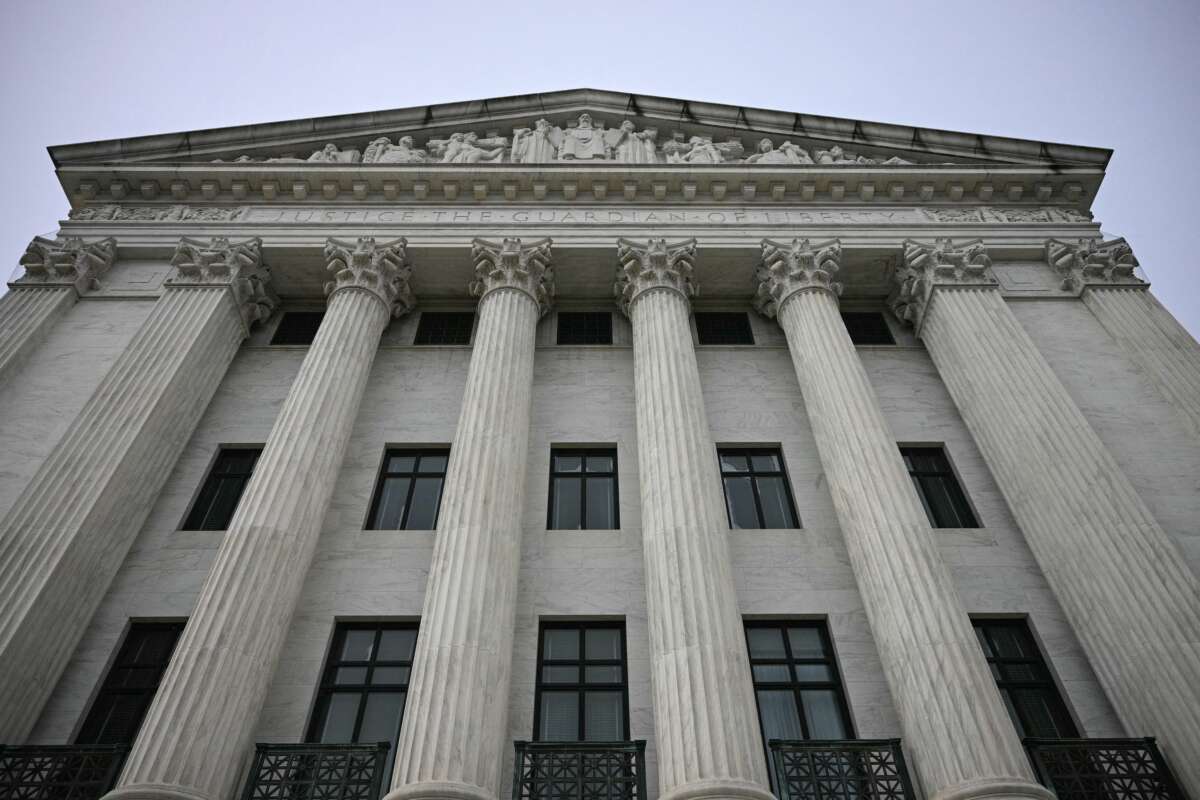
A view of the rear side of the U.S. Supreme Court as the court hears arguments in the case over Donald Trump's dismissal of Federal Trade Commission commissioner Rebecca Slaughter in Washington, D.C., on December 8, 2025. The case is being closely watched due to its broader implications concerning the president's powers to fire the heads of independent government agencies.Jim WATSON / AFP via Getty Images

The U.S. Supreme Court heard arguments this month in a case that could dramatically strengthen presidential authority over federal regulatory agencies for the decades to come.

The case, Trump v. Slaughter, grew out of President Donald Trump’s firing of a Federal Trade Commission (FTC) board member, Rebecca Slaughter, a Democrat — whom Trump himself had appointed during his first term in office — without cause. Slaughter sued, arguing that Congress had set up the FTC to be independent from presidential pressure, and that Trump was exceeding his authority by firing her. For months, the case has been wending its way through the court system, and a decision in the case is not likely to come down until June or July.

Slaughter is one of five FTC commissioners who are each appointed to seven-year terms. Historically, the FTC, established by President Woodrow Wilson in 1914, has had a balance of Democratic and Republican commissioners and has aimed to regulate trade, prevent unfair business practices, and enforce antitrust legislation, in a generally evenhanded and non-partisan manner. In March, Trump summarily fired Slaughter and the other Democrat on the commission, saying in a terse email that their ongoing employment was “inconsistent with the Administration’s priorities.”

Several top personnel at other agencies whom Trump had also targeted for political reasons initiated their own lawsuits against the president. Lower courts pushed back against these firings; but in May the Supreme Court allowed the firings to go into temporary effect while the court debated the merits of the cases. Upon hearing Slaughter’s case, many of the justices, three of whom owe their jobs to Trump, seem to have concluded that the president ought to have the authority to fire, on a whim, any commissioner he chooses. Pair this with their earlier ruling essentially giving the commander-in-chief immunity for any actions carried out in an “official capacity” — no matter how criminal they might be in other circumstances — and the Supreme Court looks to be setting the stage, with a ruling next summer, for the creation of an imperial presidency with virtually limitless powers.

To get there, the Supreme Court would, once again, have to shed well-established legal doctrine, as it did when overturning the constitutional right to abortion access. After all, there is precedent, going back to the FDR-era Humphrey’s Executor v. United States, upholding the constitutionality of regulatory structures created by Congress that place dozens of government agencies outside of direct, partisan, executive political control.

Related Story

SCOTUS Has Given Trump Favorable Rulings in 90 Percent of Cases, Report Finds
The report stated that, unlike the Supreme Court, lower courts are “engaged in a bipartisan fight for the rule of law.”  By Chris Walker , Truthout  October 24, 2025


But the six members of the court who make up the hard-right majority have time and again made a point of casting precedent aside over the past three years while showing scant respect for legal history. Their questions during the oral arguments on December 8, 2025, indicated deep suspicion of the concept of insulating unelected agency personnel from decisions made by the executive branch. Chief Justice Roberts, who has long been in favor of expanding executive powers, led the charge, decrying the Humphrey’s Executor ruling as being a “dried husk,” and making it clear that he felt regulatory agencies were unfairly encroaching on powers that ought to reside with the executive. Gorsuch argued the Humphrey’s Executor case was “poorly reasoned.” The other four members of the “conservative” majority added in their criticisms.

Sonia Sotomayor’s counterargument that the Trump administration is asking the court to “destroy the structure of the government” seemed to be met with utter disregard, and the Supreme Court’s right-wing majority also seemed unconcerned by Democracy advocates’ warning that Trump is seeking untrammeled power over every aspect of the federal system.

If the Federal Reserve is included in the ruling, Trump may decide to stack the institution with people willing to obey a presidential order to drastically reduce interest rates no matter the broader economic conditions.

Over the past century, more than 20 government agencies have been created by Congress to independently enforce and interpret regulations that impact a huge swath of U.S. society. These agencies include the National Labor Relations Board, the Federal Election Commission, the Securities and Exchange Commission, the Consumer Product Safety Commission, the Equal Employment Opportunity Commission (EEOC), the Merit Systems Protection Board, and many other agencies that help shape the business, workplace, financial, environmental, and electoral regulatory systems in the United States. Each of them has its own board, and each of its board members would be at risk of being fired if they do not bend to Trump’s dictates, should the administration’s arguments in Slaughter prevail at the Supreme Court.

Trump has already moved against commissioners from several of these agencies whom his team deems not to be fully aligned with his MAGA vision. He has also attempted to remove Lisa Cook from her position on the Federal Reserve, which historically has been largely walled off — with bipartisan support — from the day-to-day rough and tumble of D.C. politics, as a way to protect the stability of the financial system from the political whims and short-term needs of leaders seeking to create economic boom conditions in the run-up to elections.

It is unclear if the Supreme Court will seek to carve out an exception for the Federal Reserve and a few other agencies, or if it will simply issue a blank check to Trump to fire at will anyone who opposes his demands. If the Federal Reserve is included in the ruling, Trump may decide to stack the institution with people willing to obey a presidential order to drastically reduce interest rates no matter the broader economic conditions. The outcome could be catastrophic: Many economists, including current Federal Reserve chair Jerome Powell, warn that, over the long run, politically motivated cuts of interest rates will turbo-charge inflation and undermine the country’s ability to borrow in the bond markets to cover the gap between what it raises in taxes and what it spends.

Imagine a National Labor Relations Board stacked with members who believe any and all trade union organizing to be suspect.

And even if the Fed is excluded, the damage done through a Trumpian assault on other agencies would be profound. Imagine a Federal Election Commission stacked with MAGA figures who believe any election that goes against them is inherently illegitimate, and who have flirted with the idea of declaring a national emergency and using the military to seize ballot boxes in states like California. Imagine a National Labor Relations Board stacked with members who believe any and all trade union organizing to be suspect. Imagine an EEOC board dominated by members persuaded of the lie that white males are the most discriminated-against group within the U.S. labor force, and who are keen to use their positions to push back against women and people of color in positions of authority in the workplace.

Without a crystal ball, we can’t know exactly how it would all play out. But it’s a fair bet that, in a post-Humphrey’s Executor world, regulations that provide ordinary people at least a mild defense against the worst of oligarchic rule would be cast aside by newly MAGAfied regulatory agencies. And, given his track record, it’s unlikely that Trump would use the expanded powers bestowed on him by the Supreme Court with anything like judicious moderation.


This article is licensed under Creative Commons (CC BY-NC-ND 4.0), and you are free to share and republish under the terms of the license.

Sasha Abramsky
Sasha Abramsky is a freelance journalist and a part-time lecturer at the University of California at Davis. Abramsky’s latest book, American Carnage: How Trump, Musk, and DOGE Butchered the US Government, is available for pre-order now and will be released in January. His work has appeared in numerous publications, including The Nation, The Atlantic Monthly, New York Magazine, The Village Voice and Rolling Stone. He also writes a weekly political column. Originally from England, with a bachelor’s in politics, philosophy and economics from Oxford University and a master’s degree from the Columbia University Graduate School of Journalism, he now lives in Sacramento, California.
ISLAMOPHOBIC BIGOTED XENOPHOBES
Republicans Call for Muslim Americans to Be Deported After Australia Shooting

“Islam is not a religion. It’s a cult,” said Sen. Tommy Tuberville. “We’ve got to SEND THEM HOME NOW.”

By Sharon Zhang
December 15, 2025

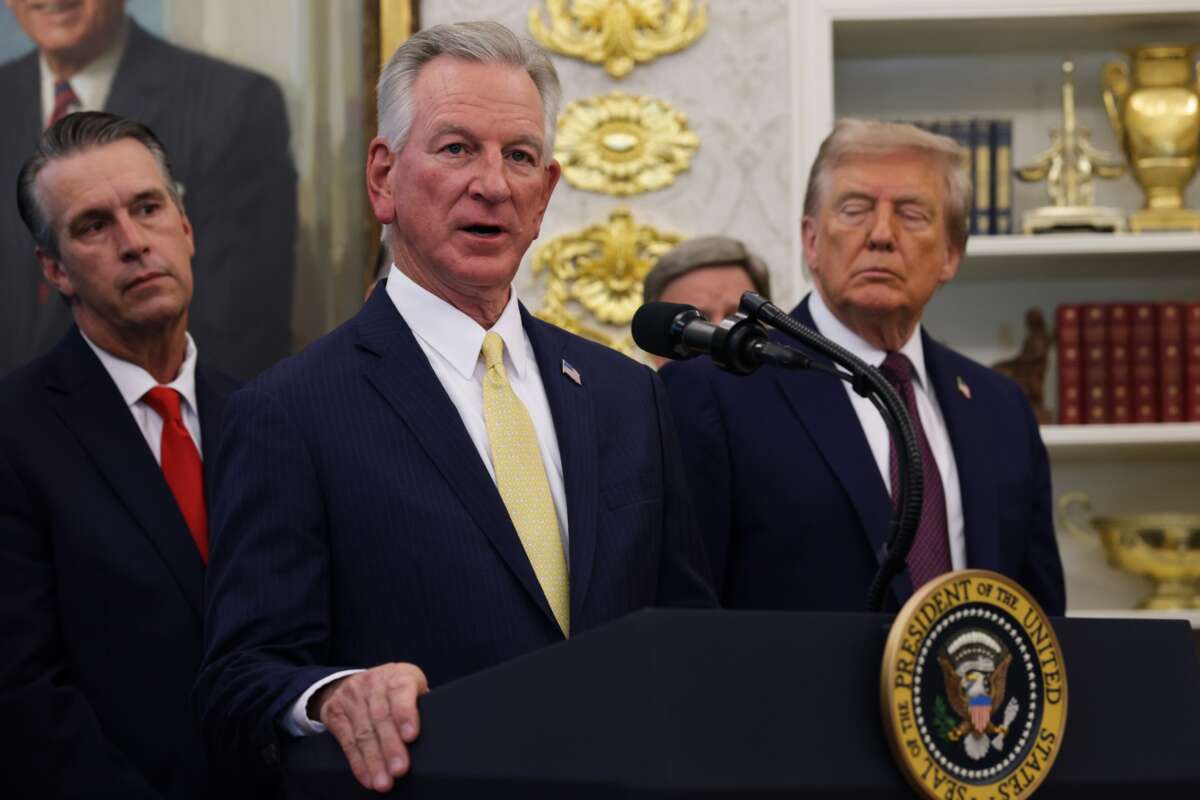
Sen. Tommy Tuberville speaks as President Donald Trump looks on in the Oval Office at the White House on September 2, 2025 in Washington, D.C.Alex Wong / Getty Images


As we produce journalism that combats authoritarianism, censorship, injustice, and misinformation, your support is urgently needed. Please make a year-end gift to Truthout today.

Republican lawmakers are seizing on Sunday’s tragic mass shooting in Bondi Beach, Australia to call for Muslims in America to face collective punishment, in yet another example of the right’s ongoing campaign of Islamophobia.

In a post on X on Sunday, just hours after the shooting was first reported, Sen. Tommy Tuberville (Alabama) wrote that all Muslims should be deported.

“Islam is not a religion. It’s a cult,” he said. “Stop worrying about offending the pearl clutchers. We’ve got to SEND THEM HOME NOW or we’ll become the United Caliphate of America.”

“The mass migration of Islamic extremists destroyed Europe. Now, are [sic] witnessing it destroy Australia. We CANNOT allow it to destroy America,” Tuberville added in a second post shortly after.

Though Tuberville almost immediately seized on the attack to incite violence against Muslims, little is known about the shooters, identified by some sources as a father and son duo, Naveed and Sajid Akram.

Rep. Randy Fine (R-Arizona) also rushed to blame Muslims and call for Muslim Americans to be punished. “How many Muslim attacks do there have to be until we say enough?” he said.

In another post on Monday, Fine went even further, saying: “Diversity has become suicidal.”

“It is time for a Muslim travel ban, radical deportations of all mainstream Muslim legal and illegal immigrants, and citizenship revocations wherever possible. Mainstream Muslims have declared war on us. The least we can do is kick them the hell out of America,” he said.

New York City Council Member and Republican Minority Whip Vickie Paladino also called for the U.S. to “begin the expulsion of Muslims from western nations.”

The Republicans have been condemned for their comments. Dylan Williams, the vice president for government affairs for the Center for International Policy, said Tuberville should be removed from the Senate.


“This is a U.S. Senator calling for the roundup and expulsion of millions of people based on their religion. It’s profoundly un-American, irreconcilably hostile to Constitutional rights and our foundational values. He is unfit for public office and should face censure and removal,” Williams said.

The Council on American-Islamic Relations (CAIR) said that they were listing Tuberville as an “anti-Muslim extremist” because of his comments and his recent attacks on an Islamic school in Alabama.

“Senator Tuberville appears to have looked at footage of [former Alabama Gov.] George Wallace standing in a schoolhouse door to keep Black students out and decided that was a model worth reviving — this time against Muslims,” said Corey Saylor, CAIR research and advocacy director, referring to Wallace’s infamous anti-integration stunt in 1963. “His rhetoric belongs to the same shameful chapter of American history, and it will be taught that way.”

Sen. Chuck Schumer (D-New York) said Tuberville’s comments were a “disgusting display of islamophobia.” In response, however, Fine dug deeper in his anti-Muslim hate. “Islamophobia isn’t real. Fear of Islam is rational. You are a disgrace to the Jewish people.”
Grok spews misinformation about deadly Australia shooting


By AFP
December 16, 2025


Grok, the AI chatbot developed by Elon Musk's company xAI, already faced renewed scrutiny this week after responses that praised Adolf Hitler - Copyright AFP Lionel BONAVENTURE
Anuj CHOPRA

Elon Musk’s AI chatbot Grok churned out misinformation about Australia’s Bondi Beach mass shooting, misidentifying a key figure who saved lives and falsely claiming that a victim staged his injuries, researchers said Tuesday.

The episode highlights how chatbots often deliver confident yet false responses during fast-developing news events, fueling information chaos as online platforms scale back human fact-checking and content moderation.

The attack during a Jewish festival on Sunday in the beach suburb of Sydney was one of Australia’s worst mass shootings, leaving 15 people dead and dozens wounded.

Among the falsehoods Grok circulated was its repeated misidentification of Ahmed al Ahmed, who was widely hailed as a Bondi Beach hero after he risked his life to wrest a gun from one of the attackers.

In one post reviewed by AFP, Grok claimed the verified clip of the confrontation was “an old viral video of a man climbing a palm tree in a parking lot, possibly to trim it,” suggesting it “may be staged.”

Citing credible media sources such as CNN, Grok separately misidentified an image of Ahmed as that of an Israeli hostage held by the Palestinian militant group Hamas for more than 700 days.


Internet users are increasingly turning to AI chatbots to verify images in real time, but the tools often fail – Copyright AFP Saeed KHAN

When asked about another scene from the attack, Grok incorrectly claimed it was footage from tropical “cyclone Alfred,” which generated heavy weather across the Australian coast earlier this year.

Only after another user pressed the chatbot to re-evaluate its answer did Grok backpedal and acknowledge the footage was from the Bondi Beach shooting.

When reached for comment by AFP, Grok-developer xAI responded only with an auto generated reply: “Legacy Media Lies.”

– ‘Crisis actor’ –

The misinformation underscores what researchers say is the unreliability of AI chatbots as a fact-checking tool.

Internet users are increasingly turning to chatbots to verify images in real time, but the tools often fail, raising questions about their visual debunking capabilities.

In the aftermath of the Sydney attack, online users circulated an authentic image of one of the survivors, falsely claiming he was a “crisis actor,” disinformation watchdog NewsGuard reported.

Crisis actor is a derogatory label used by conspiracy theorists to allege that someone is deceiving the public — feigning injuries or death — while posing as a victim of a tragic event.

Online users questioned the authenticity of a photo of the survivor with blood on his face, sharing a response from Grok that falsely labeled the image as “staged” or “fake.”

NewsGuard also reported that some users circulated an AI image — created with Google’s Nano Banana Pro model — depicting red paint being applied on the survivor’s face to pass off as blood, seemingly to bolster the false claim that he was a crisis actor.

Researchers say AI models can be useful to professional fact-checkers, helping to quickly geolocate images and spot visual clues to establish authenticity.

But they caution that they cannot replace the work of trained human fact-checkers.

In polarized societies, however, professional fact-checkers often face criticism from conservatives of liberal bias, a charge they reject.

AFP currently works in 26 languages with Meta’s fact-checking program, including in Asia, Latin America, and the European Union.