Liberal Christian denominations condemn US actions in Venezuela, call for peace
(RNS) — Four days after the raid that extracted the Venezuelan leader and his wife and brought them to face federal charges in New York, nearly every mainline Protestant group has condemned the US actions.
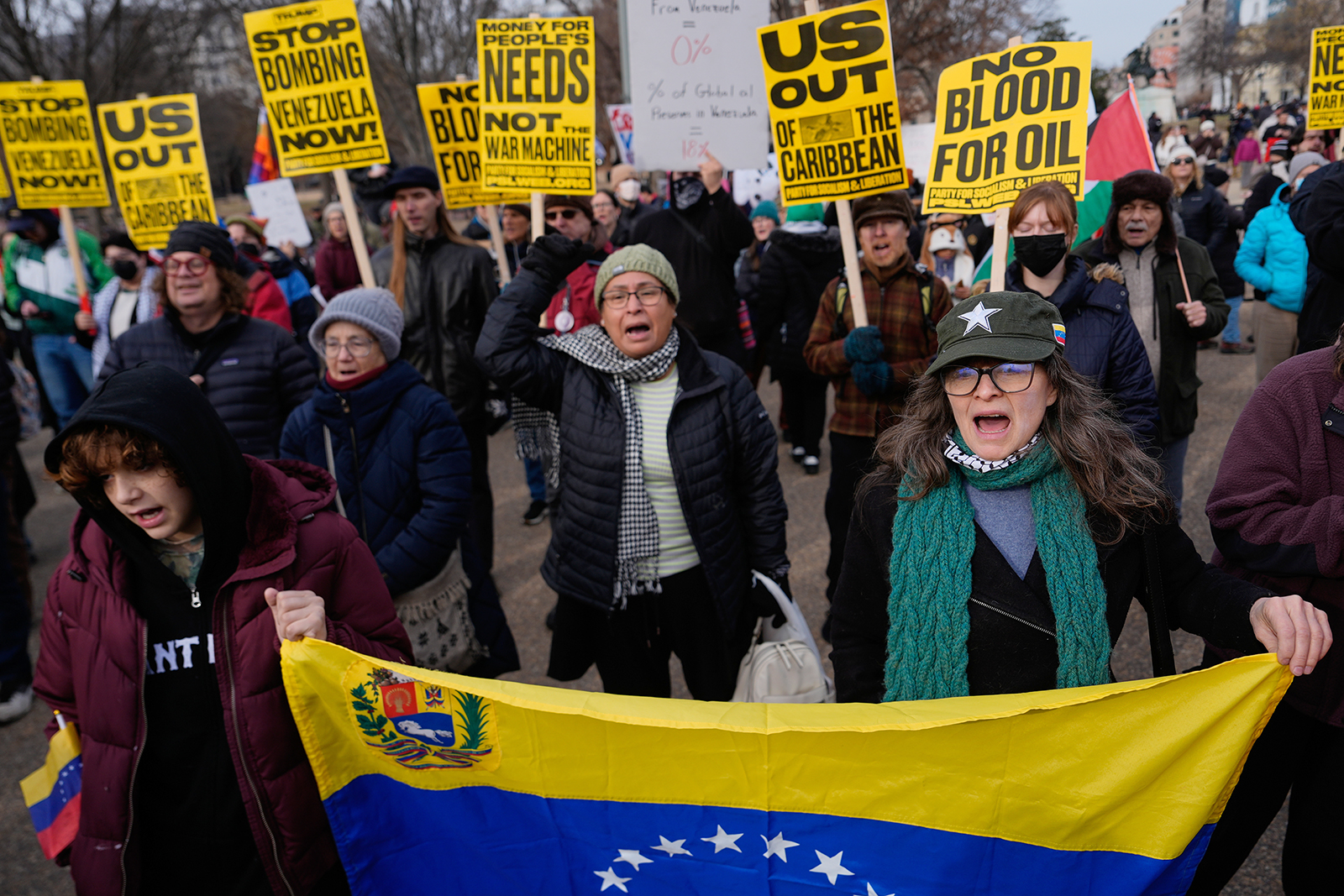
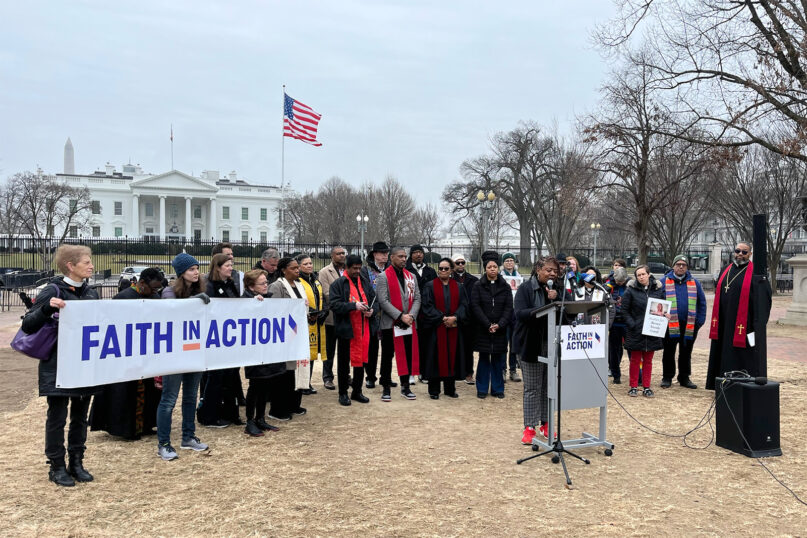
Protesters demonstrate outside the White House, Jan. 3, 2026, in Washington, after the U.S. captured Venezuelan President Nicolás Maduro and his wife in a military operation. (AP Photo/Julia Demaree Nikhinson)
Yonat Shimron
January 7, 2026
RNS
(RNS) — Four days after the U.S. military seized Venezuelan President Nicolás Maduro and his wife in a strike on Caracas that took nearly everyone by surprise, liberal Christian denominations have begun to criticize the raid.
The bishops of the United Methodist Church on Wednesday (Jan. 7) issued a statement “condemning all acts of violence, military aggression, and violations of national sovereignty” and urging its members to pray for the Venezuelan people.
The United Methodist Church does not have churches in Venezuela, a mostly Catholic country with growing numbers of Protestants and other faiths, but it does have autonomous Methodist churches.
In the letter, the United Methodist bishops pointed to their social principles that oppose war and violence. It did not mention the deposed Venezuelan leader by name. Neither did it mention President Donald Trump, who ordered the raid that extracted Maduro from the country and brought him to a New York City jail. On Tuesday, he pleaded not guilty to federal drug and weapons charges.
The Episcopal Church was quicker to respond. An Action Alert released Saturday — the same day as the raid — by its Office of Government Relations condemned the use of military force “aimed at disrupting a non-imminent, uncertain military threat.” It also called on Congress to investigate the operation, which it said “marks a striking and unprecedented escalation of conflict.”
RELATED: Vatican faces ‘complicated’ balancing act in responding to US arrest of Maduro
The Episcopal Church has more skin in the game. The denomination has a diocese in Venezuela with 17 congregations and several more missions. The diocese’s provisional bishop, Cristóbal Olmedo León Lozano, is stationed in Ecuador.
“The Episcopal Church called for an investigation and accountability, first because of our 2009 resolution condemning ‘the first use of armed force in the form of a preventive or preemptive strike that is aimed at disrupting a non-imminent, uncertain military threat.,” said Rebecca Linder Blachly, chief of public policy and witness for the Episcopal Church. “Also, we are firm supporters of the United Nations, and this operation lacked legal authorization under international law, per the UN charter. Additionally, there was no congressional authorization for the use of military force nor advance notice to all required members of Congress.”
The Rev. Canon David Ulloa Chavez, the Episcopal Church’s partnership officer for Latin America and the Caribbean, said he has spoken via phone with the provisional bishop and has been assured that no church members have been injured so far.
“From what I understand, everyone is safe,” Chavez told RNS. “There is this sort of ambiguity around what is actually taking place. There’s sort of a nervous calm at this stage.”
Secretary of State Marco Rubio told members of Congress on Wednesday that the Trump administration has plans for a prolonged mission in the country that included taking control of its vast oil reserves.
Many Venezuelan migrants to the U.S. celebrated Maduro’s capture. Political and economic insecurity under Maduro’s authoritarian rule has led to an exodus of some 7.9 million Venezuelans as of December 2024, according to the Migration Policy Institute. As of 2023, some 770,000 Venezuelan immigrants had entered the U.S. In 2021, the Biden administration designated Venezuela for Temporary Protected Status, which grants legal immigration status to people fleeing countries facing armed conflict or humanitarian crises. Trump ended the program last year.
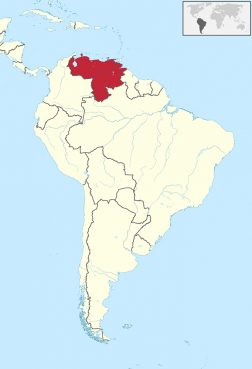
Venezuela, red, is located on the northern coast of South America. (Map courtesy of Wikimedia/Creative Commons)
But inside the country, some have described an uneasy quiet and deep fears about what might come next.
Chavez said he and leaders in the Episcopal Church’s province that covers Venezuela, Colombia, Ecuador, the Dominican Republic and Honduras, are talking about how to better support Venezuelans who are leaving via its long western border with Colombia. “How do we partner for the sake of our migrating neighbors that are coming into not only our province, but throughout the region?” Chavez said.
Other liberal Protestant denominations have also condemned the U.S. action. The United Church of Christ and the Christian Church (Disciples of Christ) released a joint statement condemning the attack, saying it posed a “troubling pattern of unlawful U.S. military activity, including the December 25, 2025, airstrikes in Nigeria.”
The World Council of Churches also condemned the raid and Maduro’s capture, saying the U.S. actions constituted “stunningly flagrant violations of international law.”
And Pope Leo XIV voiced “deep concern” over the situation. “The good of the beloved Venezuelan people must prevail over every other consideration,” he said in a Sunday address, with an appeal to end the violence and guarantee the country’s sovereignty.
(RNS) — Four days after the raid that extracted the Venezuelan leader and his wife and brought them to face federal charges in New York, nearly every mainline Protestant group has condemned the US actions.
Protesters demonstrate outside the White House, Jan. 3, 2026, in Washington, after the U.S. captured Venezuelan President Nicolás Maduro and his wife in a military operation. (AP Photo/Julia Demaree Nikhinson)
Yonat Shimron
January 7, 2026
RNS
(RNS) — Four days after the U.S. military seized Venezuelan President Nicolás Maduro and his wife in a strike on Caracas that took nearly everyone by surprise, liberal Christian denominations have begun to criticize the raid.
The bishops of the United Methodist Church on Wednesday (Jan. 7) issued a statement “condemning all acts of violence, military aggression, and violations of national sovereignty” and urging its members to pray for the Venezuelan people.
The United Methodist Church does not have churches in Venezuela, a mostly Catholic country with growing numbers of Protestants and other faiths, but it does have autonomous Methodist churches.
In the letter, the United Methodist bishops pointed to their social principles that oppose war and violence. It did not mention the deposed Venezuelan leader by name. Neither did it mention President Donald Trump, who ordered the raid that extracted Maduro from the country and brought him to a New York City jail. On Tuesday, he pleaded not guilty to federal drug and weapons charges.
The Episcopal Church was quicker to respond. An Action Alert released Saturday — the same day as the raid — by its Office of Government Relations condemned the use of military force “aimed at disrupting a non-imminent, uncertain military threat.” It also called on Congress to investigate the operation, which it said “marks a striking and unprecedented escalation of conflict.”
RELATED: Vatican faces ‘complicated’ balancing act in responding to US arrest of Maduro
The Episcopal Church has more skin in the game. The denomination has a diocese in Venezuela with 17 congregations and several more missions. The diocese’s provisional bishop, Cristóbal Olmedo León Lozano, is stationed in Ecuador.
“The Episcopal Church called for an investigation and accountability, first because of our 2009 resolution condemning ‘the first use of armed force in the form of a preventive or preemptive strike that is aimed at disrupting a non-imminent, uncertain military threat.,” said Rebecca Linder Blachly, chief of public policy and witness for the Episcopal Church. “Also, we are firm supporters of the United Nations, and this operation lacked legal authorization under international law, per the UN charter. Additionally, there was no congressional authorization for the use of military force nor advance notice to all required members of Congress.”
The Rev. Canon David Ulloa Chavez, the Episcopal Church’s partnership officer for Latin America and the Caribbean, said he has spoken via phone with the provisional bishop and has been assured that no church members have been injured so far.
“From what I understand, everyone is safe,” Chavez told RNS. “There is this sort of ambiguity around what is actually taking place. There’s sort of a nervous calm at this stage.”
Secretary of State Marco Rubio told members of Congress on Wednesday that the Trump administration has plans for a prolonged mission in the country that included taking control of its vast oil reserves.
Many Venezuelan migrants to the U.S. celebrated Maduro’s capture. Political and economic insecurity under Maduro’s authoritarian rule has led to an exodus of some 7.9 million Venezuelans as of December 2024, according to the Migration Policy Institute. As of 2023, some 770,000 Venezuelan immigrants had entered the U.S. In 2021, the Biden administration designated Venezuela for Temporary Protected Status, which grants legal immigration status to people fleeing countries facing armed conflict or humanitarian crises. Trump ended the program last year.
Venezuela, red, is located on the northern coast of South America. (Map courtesy of Wikimedia/Creative Commons)
But inside the country, some have described an uneasy quiet and deep fears about what might come next.
Chavez said he and leaders in the Episcopal Church’s province that covers Venezuela, Colombia, Ecuador, the Dominican Republic and Honduras, are talking about how to better support Venezuelans who are leaving via its long western border with Colombia. “How do we partner for the sake of our migrating neighbors that are coming into not only our province, but throughout the region?” Chavez said.
Other liberal Protestant denominations have also condemned the U.S. action. The United Church of Christ and the Christian Church (Disciples of Christ) released a joint statement condemning the attack, saying it posed a “troubling pattern of unlawful U.S. military activity, including the December 25, 2025, airstrikes in Nigeria.”
The World Council of Churches also condemned the raid and Maduro’s capture, saying the U.S. actions constituted “stunningly flagrant violations of international law.”
And Pope Leo XIV voiced “deep concern” over the situation. “The good of the beloved Venezuelan people must prevail over every other consideration,” he said in a Sunday address, with an appeal to end the violence and guarantee the country’s sovereignty.
“It was a massacre against defenseless people,” a mother of three said of the US operation to abduct Maduro.
By Rodrigo Acuña ,
January 9, 2026

A woman attends a march to demand the release of kidnapped Venezuelan President Nicolás Maduro and his wife Cilia Flores, in Caracas, Venezuela, on January 8, 2026.Federico PARRA / AFP via Getty Images
“Several helicopters were dropping bombs, and the windows shattered from the shockwaves,” Caracas resident Paola Rosal told Truthout, describing her experience of the U.S. attack on Venezuela on January 3.
Rosal, a mother of three who lives in Ciudad Tiuna, a massive government-built housing project located in the Fuerte Tiuna military complex in Caracas, said she was alone getting ready to take a shower when “the power went out, and the first bomb fell near my building.” Feeling a sense of terror and panic, Rosal describes how she fled and, for a while, was alone in a carpark. Her mother, who was in her own apartment with her daughters, witnessed a bomb drop in front of her apartment which shattered all of the windows.
“When we went outside to take cover, the next bomb fell,” Rosal told Truthout. “People didn’t know where to go for shelter. It was so awful that my daughter doesn’t want to go back, and like her, many other people feel the same way.” Rosal, a married 40-year-old owner of a bodega, has long voted for the leaders of the Bolivarian revolution: first President Hugo Chávez (1999-2013), and then President Nicolás Maduro, who won his first election by a narrow margin in early 2013.
Rosal said she has concrete criticisms of Maduro’s government: For example, she is concerned that the government’s decision to distribute weapons to citizens in preparation for a full-scale U.S. invasion could result in pro-government civilian armed groups (colectivos) gaining more power, and that worries her.
But Rosal was vehement in her outrage and fury in response to the U.S. attack.
“Several helicopters were dropping bombs, and the windows shattered from the shockwaves,” Caracas resident Paola Rosal told Truthout, describing her experience of the U.S. attack on Venezuela on January 3.
Rosal, a mother of three who lives in Ciudad Tiuna, a massive government-built housing project located in the Fuerte Tiuna military complex in Caracas, said she was alone getting ready to take a shower when “the power went out, and the first bomb fell near my building.” Feeling a sense of terror and panic, Rosal describes how she fled and, for a while, was alone in a carpark. Her mother, who was in her own apartment with her daughters, witnessed a bomb drop in front of her apartment which shattered all of the windows.
“When we went outside to take cover, the next bomb fell,” Rosal told Truthout. “People didn’t know where to go for shelter. It was so awful that my daughter doesn’t want to go back, and like her, many other people feel the same way.” Rosal, a married 40-year-old owner of a bodega, has long voted for the leaders of the Bolivarian revolution: first President Hugo Chávez (1999-2013), and then President Nicolás Maduro, who won his first election by a narrow margin in early 2013.
Rosal said she has concrete criticisms of Maduro’s government: For example, she is concerned that the government’s decision to distribute weapons to citizens in preparation for a full-scale U.S. invasion could result in pro-government civilian armed groups (colectivos) gaining more power, and that worries her.
But Rosal was vehement in her outrage and fury in response to the U.S. attack.
Experts Say Even Average Venezuelans Critical of Maduro Won’t Back Regime Change
A US military attack “would bring more chaos, more poverty,” one Caracas resident said.
By Rodrigo Acuña , Truthout December 16, 2025
“It was a massacre against defenseless people,” Rosal told Truthout, expressing that she is still frightened, angry and uncertain about the future and adding that the U.S. military attack “damaged the infrastructure, the buildings where we live, and killed civilians,” including “the elderly.” Full data has yet to come out on the ages of all the people killed in the strike, but The New York Times confirms that 80-year-old Rosa González was among the dead.
“The way the helicopters attacked indiscriminately is unacceptable,” Rosal added, calling Trump a “violator of all rights,” and decrying how Trump “enters our country as if nothing is wrong, and no one says a word to him.”
The Trump Administration’s Attack on Caracas
At around 2 am on January 3, the bombs ordered by U.S. President Donald Trump commenced falling on Venezuela. The bombs hit the country’s largest military complex, Fuerte Tiuna, whose perimeter contains the civilian Ciudad Tiuna housing project, which is far larger than the military facilities and which is home to tens of thousands of people. The capital’s electricity was also cut off for several hours in sectors of the south, center, and west of Caracas.
Near the capital, the Generalissimo Francisco de Miranda Air Base (La Carlota) was hit, as was the Port of La Guaira — the primary maritime gateway for the Caracas. According to the Venezuelan News Agency, in La Guaira, warehouses of the Venezuelan Institute of Social Security, which holds supplies for dialysis and nephrology programs, were also bombed. Outside of the capital, the Barquisimeto F-16 Base was reportedly hit, as was the Charallave Private Airport and the Higuerote Military Helicopter Base in the state of Miranda.
On January 7, DW News (the international news branch of Germany’s public media outlet) said 24 members of Venezuela’s Bolivarian National Armed Forces were killed, as were 32 members of the Revolutionary Armed Forces of Cuba and the Ministry of the Interior who were serving an international security mission in a sister Latin American nation. (Due to several agreements between Caracas and Havana, since 1999 thousands of Cuban doctors, nurses, teachers, and sports trainers have been working in Venezuela. By 2009, the number stood at 42,000 Cubans, several of whom have been on military missions.)
Officially, on January 8, the Venezuelan government said 100 people were killed with a similar number injured. On January 3, The New York Times reported that, on the U.S. side, “about half a dozen soldiers were injured” in the operation.
Roughly two-and-a-half hours after the bombing commenced, Trump publicly declared that the United States had “successfully carried out a large-scale strike against Venezuela and its leader, President Nicolás Maduro, who has been, along with his wife, captured and flown out of the country.” The first image to be released of 63-year-old Maduro showed him in a Nike tracksuit, handcuffed and wearing blackout goggles, with his ears covered. On January 5 it was noted that Maduro’s 69-year-old-wife, Cilia Flores, in a New York court, had a bandage on her head, bruises on her face, and was suffering “significant injuries,” according to her lawyer.
Venezuela Residents and Political Analysts Express Fears for the Future
Jessica Falcon, a Caracas state employee in her late thirties, is deeply worried about the future of Venezuela and the actions of the Trump administration. Asked by Truthout what she thought about the act of war by the United States toward her homeland, Falcon said:
Once again, the U.S. is doing whatever it pleases with the complicit gaze of the rest of the world and multilateral organizations. Venezuela is experiencing a period of great tension, and this violation of our sovereignty seems outrageous. Archaic colonialism in the 21st century — a true step backward.
Corporate media outlets in the United States, Britain, and Australia have focused on the military details of Washington’s illegal actions in Venezuela, using words like “capture” or “arrest” rather than “kidnapping” to describe what the U.S. did to Maduro and Flores.
In contrast, within Venezuela state media have focused on interviewing injured soldiers and civilians. Venezuelan media have also covered Delcy Rodríguez, formally the vice president, being sworn in as the acting president of Venezuela, saying, “I come with pain for the suffering that has been caused to the Venezuelan people after an illegitimate military aggression against our homeland.”
On the streets and online, two key questions are repeatedly asked: How was the U.S. military able to completely disable Venezuela’s air defense systems? And were there people inside Maduro’s inner security circle that betrayed him?
Speaking to Truthout, Clinton Fernandes, a professor at the University of New South Wales in Australia who assess the threats, risks and opportunities that military forces face in the future, said: “Over the past 10 years, there has been a revolution in sensing and precision technologies, eroding the survivability of air defenses and the targets they seek to protect.” Fernandes claims that “new sensors in all domains, including air, space, and cyberspace, have increased enemy transparency.” This development, he said, shaped the course of events last year when Iran’s nuclear facilities were bombed in June 2025, and also shaped the outcome of the U.S. attack on Venezuela.
Fernandes added:
The U.S. has been at the cutting edge of technological advances in stealth, sensing, and precision. Stealth allows it to approach targets undetected. It has guidance systems with advanced inertial sensors relying on stellar updates, sensors, data processing, communication, artificial intelligence, and a host of other products of the computer revolution. Its advantages allow it to create openings for disarming strikes against enemy positions and forces.
Caracas-based Ricardo Vaz, who is a writer and editor at Venezuelanalysis.com, told Truthout that the outcome of the U.S. strike is forcing analysts to reassess previous “expectations concerning Venezuela’s military capabilities and readiness.” Vaz added:
There was an assortment of Russian-supplied short-, medium- and long-range surface-to-air weapons which failed to offer much deterrence to the invading U.S. forces. It is possible that U.S. air power, including bombers and electronic warfare planes, managed to completely neutralize air defences.
Meanwhile, speaking recently to journalist Jeremy Scahill, Venezuela’s ex-Deputy Minister of Foreign Affairs for North America Carlos Ron said that while he did not want to speculate that someone inside Maduro’s security detail betrayed him, “you can’t rule out that something to that effect happened.”
What Comes Next for Venezuela?
Back in Washington, during his first press conference after Maduro and Flores’s kidnapping, a gloating Trump declared: “We are going to run the country,” in reference to Venezuela. He added: “We’ll have the greatest oil companies in the world going in, invest billions and billions of dollars. … And the biggest beneficiary are going to be the people of Venezuela.” When asked about installing opposition leader María Corina Machado, who claimed the 2024 presidential election was stolen from Edmundo González, who ran on her behalf, Trump replied: “She doesn’t have the support within or the respect within the country.” On January 9, Trump claimed he would meet with Machado in the next week.
Asked to comment on the ramification of Washington’s actions in Venezuela, Luis F. Angosto-Ferrández — a scholar at Sydney University and the author of the book Venezuela Reframed — predicted that the Trump administration “will use the kidnapping of President Maduro (and the forthcoming theatralisation of his trial) as another mechanism of destabilisation and pressure on the Venezuelan government.” Still, Angosto-Ferrández argued, “it is evident that they continue to fail in their attempts at making the government collapse.”
While a clearer picture will develop as future events unfold under the pressure of the current U.S. economic blockade on Venezuela, Angosto-Ferrández says:
What is clear is that the U.S. government’s expectations of an immediate collapse of Venezuelan governance and institutionality are not going to happen even with the kidnapping of Maduro. Other than that, the U.S. may decide to continue with its illegal attacks, and perhaps even invade the country with the goal of controlling it in part — basically, enclaves that give access to oil and perhaps minerals.
Constantly paraded in front of the global media in a humiliating manner as he is being transported (it is illegal to publicly degrade prisoners of war under the Third Geneva Convention), Maduro has shown himself to be cordial with his captors while making a two-handed symbol — one hand forming a “V,” the other pointing toward it — meaning “Nosotros venceremos,” or “Together we will win”.
In front of a judge in New York on January 5, President Maduro in Spanish declared: “I am innocent. I am not guilty. I am a decent man.” He described himself a “prisoner of war” and said he was illegally captured.
The four charges that the U.S. has made against Maduro are narcoterrorism conspiracy, cocaine importation conspiracy, possession of machine guns and destructive devices, and conspiracy to possess machineguns and destructive devices.
Maduro has hired Barry Pollack — the distinguished U.S. trial lawyer who spent years representing Australian WikiLeaks editor Julian Assange — to join his legal team.
Meanwhile, with Maduro’s next court appearance set for March 17, the U.S. armada continues to sit off the coast of Venezuela while crushing economic sanctions are imposed on the Latin American country.
This article is licensed under Creative Commons (CC BY-NC-ND 4.0), and you are free to share and republish under the terms of the license.
Rodrigo Acuña
Rodrigo Acuña holds a PhD on Venezuelan foreign policy from Macquarie University. Together with journalist Nicolas Ford, last year he released his first documentary Venezuela: The Cost of Challenging an Empire. Rodrigo has been writing on Latin American politics for close to 20 years and publishes a newsletter on Latin America. He works the NSW Department of Education and can be followed on X (Twitter) @rodrigoac7.








.jpg)