Monday, January 12, 2026


Seafarers Killed and Injured as Russia Strikes Two Ships Near Ukraine
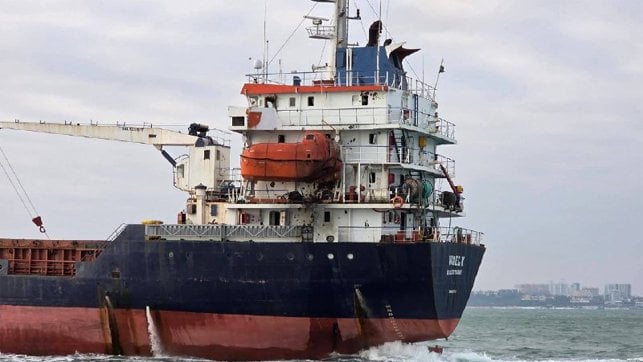
cargo ship struck by drone
A Turkish-owned cargo ship was struck while underway in the Ukrainian Sea Corridor (Oleksiy Kuleba on Telegram)

Published Jan 9, 2026 2:03 PM by The Maritime Executive


Russian forces struck two cargo ships on Friday, January 9, killing one seafarer and injuring a second crewmember, according to Ukrainian officials. It comes as Ukraine continues to accuse Russia of “deliberately targeting civilian facilities, international shipping, and food logistics.”

The attack on civilian shipping came after an overnight barrage, which was one of the largest in the four-year war, and only the second time Russia has used its Oreshnik hypersonic missiles. The hypersonic missile was first deployed in November 2024 and is seen as an attempt at intimidation and a message to Ukraine’s western allies.

Reports said hundreds of drones and missiles were launched against Ukraine, with Kyiv being one of the primary targets. Ukrainian emergency services are reporting four people were killed, and at least 25 were injured in Kyiv. Nearly 6,000 apartment buildings were reportedly left without electricity and heating, and emergency services had brought in portable boilers to restore services at hospitals and public facilities. The Qatari Embassy in Kyiv was also reportedly damaged.
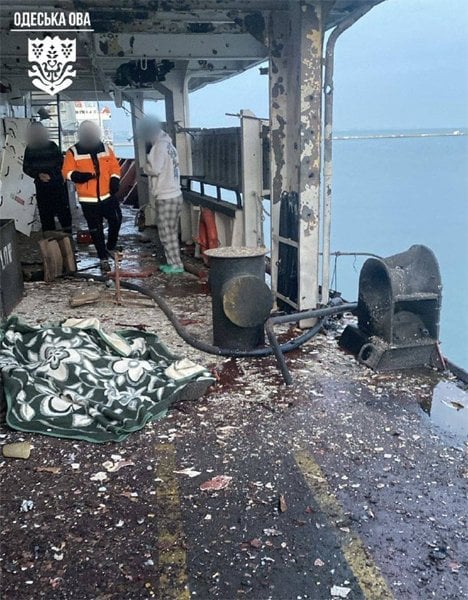
 

Two cargo ships were damaged with one crewmember killed and another injured on the ships (ODA)


The general cargo ship Wael K, owned by Turkish interests, was reportedly struck on its way to the port of Chornomorsk. The vessel, built in 1994, is 8,000 dwt and registered in St. Kitts and Nevis. It was inbound to load a cargo of grain.

The cargo ship was reportedly in the Ukrainian Sea Corridor when it was struck in its upperworks by a Russian drone. The vessel’s second mate, a Syrian citizen, was reportedly injured and receiving medical attention. The ship was able to continue under its own power and was reported to be heading to the nearest port.

A second vessel, a dry bulk carrier, was also hit while docked in the Great Odesa port complex. Reports said the Ladonna was loading soybeans. The vessel registered in Comoros is also owned by Turkish interests and managed from China. It was built in 1995 and is 22,000 dwt.

Ukraine’s Deputy Prime Minister, Oleksiy Kuleba, announced that one crewmember, a Syrian citizen, had died as a result of the attack. He called it a war crime.

Turkish officials have already called for a de-escalation and a stop to targeting commercial vessels after the earlier attacks on Black Sea shipping. Russia intensified its campaign against Ukraine’s seaports and port infrastructure after attacks on the shadow fleet. Reuters reports the Ukrainian Seaport Authority said attacks on the Greater Odesa seaport complex had almost tripled in 2025 versus 2024 to 96 reports.


Shadow Fleet Tanker Diverts to Turkey After Reporting Drone Attack

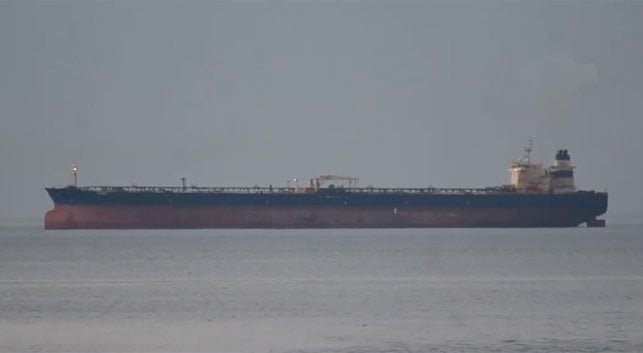
tanker off Turkey
Elbus diverted to a Turkisj port after reporting it had been attacked (Turkish TV)

Published Jan 8, 2026 1:45 PM by The Maritime Executive


A Chinese-owned and managed crude oil tanker is reporting that it was attacked by a suspected drone while sailing in the Black Sea. The tanker Elbus (159,000 dwt) was traveling only with ballast along the Turkish coast, reportedly bound for the Russian terminal at Novorossiysk.

The vessel called for assistance on Wednesday, January 7, reporting it had been hit and sustained some damage. The reports are conflicting, and an apparently fake photo is circulating online showing smoke billowing from a tanker. Turkish TV captured pictures of the vessel after it arrived at the Black Sea port of Inebolu on Thursday.

The Turkish Coast Guard reportedly responded to the call for assistance. The media said no crewmembers were injured and there was no pollution from the vessel. Early reports said the Coast Guard was arranging for the vessel to be towed to Turkey, but later reports seem to indicate that it arrived at Inebolu under its own power. A Coast Guard vessel can be seen standing by in the TV footage.


Local officials said they would be conducting a detailed inspection of the vessel. They said they would clarify the extent of the damage and seek to identify the source of the attack. Some reports said it appears the engine room was targeted, but others said the ship was struck in the upper works.

Built in 2005, the Elbus is sailing under the flag of Palau. It was acquired by a Chinese company in November 2025. The vessel does not appear in the lists of vessels sanctioned by the United States, the United Kingdom, or the European Union. The ship’s AIS signal shows it was coming from Singapore.

AI marine analytics firm Windward highlights that tankers have been attempting to hug the Turkish coast since the dual attacks in November, which damaged two other shadow fleet tankers. Ukraine took credit for those two attacks, reporting it had used a modified version of its Sea Baby maritime drones. However, Ukraine denied subsequent attacks and has not acknowledged the current incident. Turkish media highlights that five tankers have reported drone attacks since November.

Bulgaria Seeks Reimbursement from Owners of Salvaged Shadow Fleet Tanker

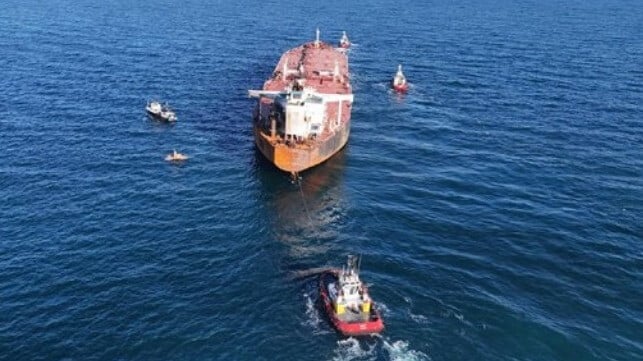
salvage of tanker
Bulgaria has been reimbursed for the costs of salvage the shadow fleet tanker (Ministry of Transport)

Published Jan 7, 2026 3:03 PM by The Maritime Executive


Bulgaria’s Maritime Administration presented a bill to the representatives of the Chinese-owned shadow fleet tanker that it was forced to salvage last month after it washed up on the shores of Bulgaria. The vessel had been attacked by Ukrainian forces while it was in the Black Sea heading to Russia to load crude oil.

The Ministry of Transport and Communications announced on Wednesday, January 7, that it had presented a bill for €270,371 ($315,802) using a private bailiff to deliver the notarized summons. It said the Maritime Administration had incurred the expenses, which included securing three tugs and a specialized generator that was used to power the ship’s hydraulic system to raise the anchor. The summons demanded payment by January 12.

Before day’s end, the Ministry reported it had received the funds from the shipowner’s agent in Bulgaria. It said payment in full was received and would be refunded to the state treasury.

The tanker Kairos had washed up near the Bulgarian seaport of Ahtopol on the afternoon of December 5, with the Bulgarian authorities accusing a salvage tug of releasing the hulk after having brought it from Turkish waters. Ukraine attacked the vessel near the coast of Turkey on November 28 using its Sea Baby drones, setting the empty tanker on fire. Turkish authorities aided in the evacuation of the crew and the firefight.

Bulgaria has continued to demand an explanation over the circumstances of the tow and where the tanker was headed before it drifted toward the port. An emergency operation airlifted some of the crewmembers off the ship and provided supplies as well as an electrical generator. Bulgaria had said it would seek a full reimbursement for its costs, including the tow on December 15 to place the hulk in a more secure location in the Gulf of Burgas.

Because the ship is under EU sanctions, Bulgaria reports that it cannot provide repair services to the vessel. It was permitted to provide emergency services and a port of refuge under the sanctions, but no further assistance is permitted. The Ministry reports that it expects the shipowner will take the necessary actions to prepare and remove the tanker from Bulgarian territorial waters.


NTSB: Overlooking Degrading Steer System Caused 2024 Collision

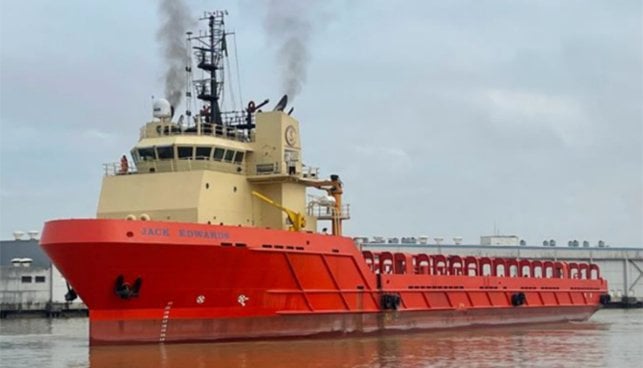
OSV involved in collision
Degrading steering problems on the OSV led up to the collision (Edison Chouset photo from NTSB)

Published Jan 8, 2026 5:51 PM by The Maritime Executive


The National Transport Safety Board finds that the “normalization of degradations” to a vessel’s steering system and crew inexperience with bridge controls resulted in a collision that caused more than $1 million in damage to an OSV and a cargo ship and injuries to two crewmembers. It is warning about complacency, the need to properly report maintenance issues and conditions impacting a vessel’s operations, and adhering to written procedures.

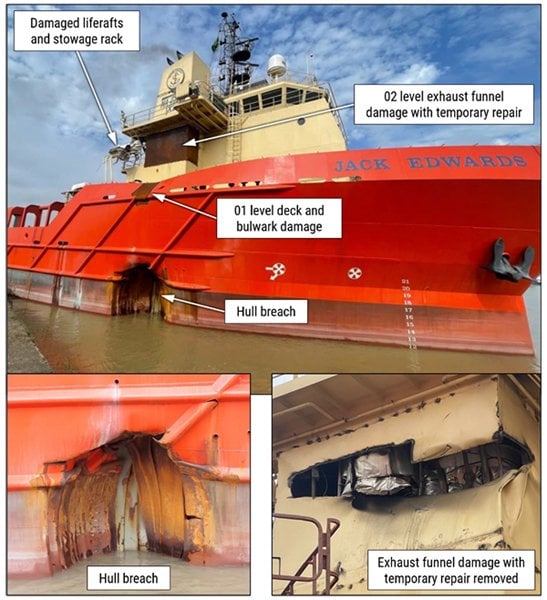
The NTSB released a report on a March 17, 2024, collision between the two vessels as they were transiting at the port of Georgetown, Guyana. The U.S.-flagged OSV Jack Edwards (278-foot vessel) was inbound to Georgetown when the vessel veered off course, moving out of its traffic lane. It resulted in a collision with the outbound UK-flagged cargo ship Julie C (453-foot vessel). The OS’s hull plating was breached, letting seawater enter multiple tanks, as well as damage to deck and bulwarks plating. The cargo ship’s bulbous bow was punctured, as well as damage to the shell plating and internal structure members.


Damage to the OSV from the NTSB report


In reconstructing the sequence of events, the NTSB report finds that the OSV had gotten underway two weeks before the incident, with a crew of nine traveling from Louisiana to Guyana. It had completed a major drydock maintenance period. 

The chief mate and second mate told investigators that during the trip to Guyana, they had been frequent steering system alarms. The issue had started while at the shipyard, and they were told the alarms were “something normal.” The vessel’s systems were not logging the steering alarms, so they were not available to be reviewed.

The officers standing watch said they had noticed the vessel’s steering had become erratic and that the autopilot appeared to be “working harder” to maintain the course. The chief mate said the master told him that “steering issues were normal” on the OSV.

On the night of the incident, they were warned by the pilots over the VHF radio that the vessel had traveled out of the entrance channel. The vessel was also “shuddering” and had a “serious vibration.” They also noted the handling was sluggish, possibly because it had contracted the soft mud bottom or had been in shallow waters. The second mate, who was the officer of the watch, said he struggled to keep the vessel on a consistent heading, and finally, the master instructed the chief mate to take over the navigation because of the second mate’s inexperience with the vessel.

The chief mate also experienced problems with the navigation and ordered the tunnel thrusters to be brought online. Although the operations manual said all thrusters should have been turned on in standby during port navigation, the second mate had not turned them on. He went to turn them on from the aft navigation panel, but admitted his lack of familiarity with the controls and inadvertently took navigation control away from the chief mate for 57 seconds.

The pilot from the cargo ship made repeated calls to the OSV, but finally the cargo ship struck the OSV at a near-perpendicular angle on the starboard side forward to midship. Two crewmembers, including the chief engineer, were injured on the OSV, but the vessel remained seaworthy and ultimately would be able to reach a berth.

After the collision, the master and chief engineer began an inspection and reported that the starboard steering gear on the OSV was “out of commission.” It was covered in “black-colored oil,” and “black mud” was coming out of the rudder stock. The NTSB concludes the damage to the steering system was unlikely to have been a result of the collision because it was well aft of the point of contact. Later, when technicians broke down the system, they found a “bad wiper seal, along with a bad upper low-pressure void seal.” They believed a “damaged dust ring” had allowed a buildup of trash in the system, which could have affected other seals and valves

The NTSB concludes “the normalization of degradations to the vessel’s steering system” had reduced the ability to effectively steer. It cascaded into the other problems that precipitated the mistake that resulted in the loss of vessel control just before the collision.

They warn that maintenance and operating issues should be promptly reported. They also point to the hazards of failing to follow the written procedures for maintenance and operations. All this, they believe, increased the risk of a casualty.


Dead Whale on Boxship's Bow Prompts Investigation

Whale
Courtesy NOAA

Published Jan 8, 2026 11:12 PM by The Maritime Executive


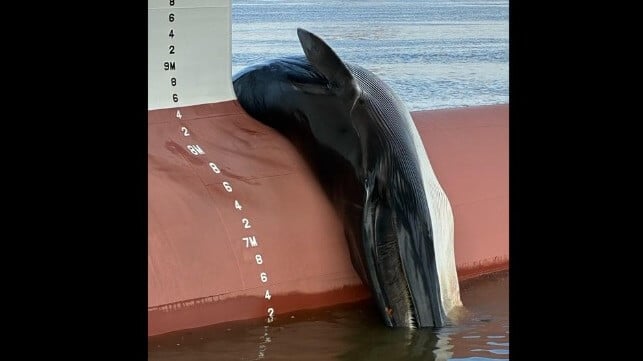
A small container ship arrived in Camden, New Jersey last week with a dead fin whale on the bulbous bow, and an investigation into the cause of death is under way. 

Late Sunday night, Coast Guard Sector Delaware Bay reported a deceased whale on the bow of a reefer boxship at the north end of the Gloucester City Marine Terminal, next to the Walt Whitman Bridge. NOAA and the nonprofit Marine Mammal Stranding Center (MMSC) were alerted, and MMSC tentatively identified it as a fin whale of about 25-30 feet in length.

On Tuesday, personnel from the MMSC worked with contractors to remove the whale's carcass from the bow and tow it away to a secure site on the shoreline for a necropsy. However, on Thursday, the agency said that it was still looking for an approved place to bury the 13-ton whale after the work is done. Once the logistics for disposal are arranged, its team can begin. 

Identified using image geolocation and AIS traffic records, the ship appears to be a Bahamas-flagged reefer boxship of about 14,000 dwt capacity. The vessel departed Peru in mid-December, AIS data provided by Pole Star Global shows, and it transited northbound for the Panama Canal, Caribbean and U.S. eastern seaboard, making 10-14 knots. It departed Camden on January 5 and headed back south towards the Panama Canal.

It is not yet been determined whether the whale died by ship strike. Fin whales are listed as endangered in the United States, but the global population is more robust. They are vulnerable to ship strikes, and statistics suggest that they are hit more often than other species. In some regions, ship strikes are the greatest risk to their survival.

Ship speed is a key factor for whale mortality, researchers say. NOAA implements seasonal vessel speed restriction zones on the U.S. East Coast to protect the North Atlantic right whale, another endangered species. The regulation requires slowing to less than 10 knots in specific areas and date ranges, and is enforced using AIS.


UAE Joins in an Exercise With the Iranian Navy for the First Time

Makran
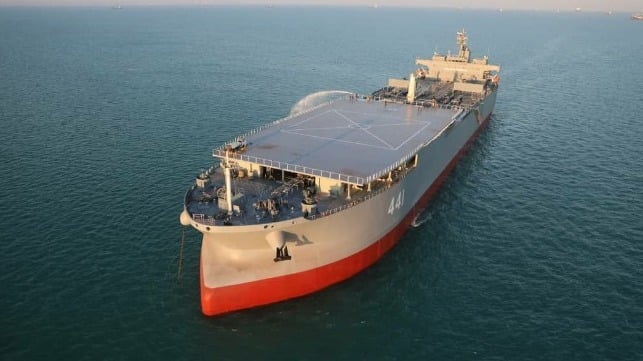
The Iranian Navy base ship Makran (Iranian Navy)

Published Jan 11, 2026 1:55 PM by The Maritime Executive


With Exercise Mosi-3 - now renamed Exercise Will for Peace 2026 - scheduled to start with a dockside parade on January 10, naval participants have begun arriving in False Bay near Cape Town in South Africa, home of the Simon’s Town Naval Base.

As predicted, Russian Steregushchiy-class corvette Stoykiy (F545) and its escorting Altay-class oiler Yelnya (A168) have been seen in harbor, having completed a port call to Walvis Bay. The Chinese People Liberation Army (PLA) Navy Type 052DL guided-missile destroyer Tangshan (D122) and the Type 903A replenishment ship Taihu (K889), from the PLAN’s 48th Flotilla, have joined following their port visit to Mombasa.

The first Iranian Navy vessel (Nedaja) vessel to arrive in Simon’s Town was the converted tanker and forward base ship IRINS Makran (K441). As a converted oil tanker, IRINS Makran could be particularly useful during the exercise if drills are to be practiced on how to fend off boarding attempts on dark fleet vessels. It was later joined by the Bayandor Class corvette IRINS Naghdi (F82) and Islamic Revolutionary Guard Corps Navy's own converted oil tanker, IRIS Shahid Mahdavi (L110-3), which serves as an expeditionary sea base.

A surprise participant is from the United Arab Emirates is the French-built Gowind-2500 Class corvette Bani Yas (P110). The Emirati participation marks the first time the UAE Navy has exercised with Iranian naval forces.

The South African Navy participant appears to be the Blohm+Voss-built Valour-class frigate SAS Amatola (F145), but additional South African vessels are also likely to join

A South African defense spokesman has said that observers will attend from Indonesia, Ethiopia and Brazil. There is no indication that the remaining countries of the eleven nation BRICS group - India, Egypt and Saudi Arabia – will either participate or observe.

The aim of the exercise is to practice naval drills supporting the protection of commercial shipping in shipping lanes, including counter-terrorism rescue and maritime strike operations. Exercise Will for Peace 2026 is scheduled to last until January 16, and is the first naval exercise to be held under the auspices of BRICS, hitherto seen as an economic bloc. The exercise director is from the PLAN.


Piracy Surged in 2025 Around Singapore, but ReCAAP Sees Positive Indicators

South East Asia pirates
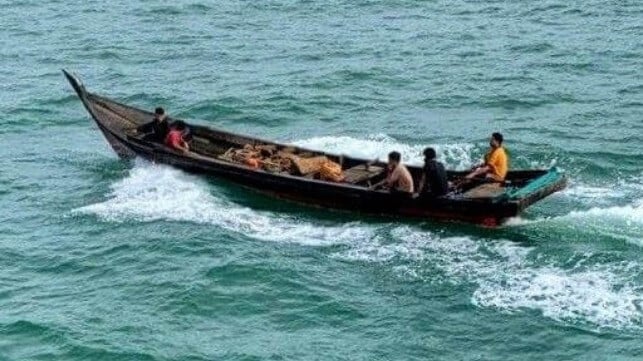
Piracy in the area around Singapore surged in the first half of 2025 before arrests by the Indonesians

Published Jan 9, 2026 6:27 PM by The Maritime Executive


After multiple warnings throughout the year about the dramatic increase in piracy around Singapore, the monitoring operation ReCAAP Information Sharing Centre, in its year-end report, highlights that the surge peaked at mid-year with the arrest of some perpetrators. It cautions that the rate remains high, however, while it is mostly low-level thefts.

Overall, there was a 74 percent increase in reports of piracy and robbery in the area around the Singapore Strait and the Straits of Malacca (SOMS), according to ReCAAP’s 2025 data. It says the 108 incidents reported (104 actual and four attempted) were concerning, noting that it is “the highest number of incidents recorded” for the area in the 19-year period that began tracking incidents in 2007.

Across the tracking region in South East Asia, ReCAAP recorded a total of 132 incidents of piracy and robbery in 2025. That was up 23 percent from 2024, but most of the increases were in the area of the Singapore Strait and the Straits of Malacca.

The report highlights fewer incidents in ports and anchorages in Bangladesh, Indonesia, and the Philippines. There was a marginal increase in India’s anchorages. It also emphasizes that for the fifth consecutive year, there were no reports of abductions of crew in the Sulu-Celebes Seas and off Eastern Sabah. The last abductions were reported in January 2020.

“While the increase in sea robbery incidents in the SOMS highlights the continuing security challenges faced by ships transiting the busy waterway, the decline in incidents following the arrest of perpetrators by the Riau Islands Regional Police illustrates the deterrent effect of effective enforcement,” said ReCAAP ISC Executive Director Vijay D. Chafekar.

ReCAAP also highlights that 87 percent of the incidents reported in the Singapore-Straits of Malacca area happened in the first seven months of 2025. It recorded a significant decline frm August to December following the arrests of perpetrators by the Indonesian authorities.

Most of the incidents are low-level crimes and specifically attempts at stealing items such as engine spare parts, scrap metal, and ship stores. In half the reports, ReCAAP reflects that nothing was reported stolen. Most of the perpetrators are unarmed, and frequently they flee when discovered. Interactions with crew are low, and there were no serious reports in 2025 of injuries to crewmembers by armed perpetrators. It notes that the proportion of the lowest level crimes increased to 53 percent versus 44 percent in 2024.

It says, however, the declines in the second half of 2025 do not indicate the end of the dangers in the region. Ships continue to be warned to take measures to protect their crews and prevent boardings. They also urge prompt reporting and call on local authorities to respond quickly.


Taiwan Refocuses Offshore Wind Tenders to Maximize Viability

iStock
iStock

Published Jan 11, 2026 3:14 PM by The Maritime Executive


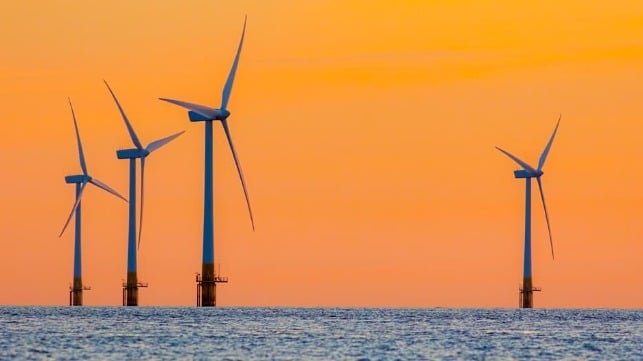
For the upcoming Round 3.3 offshore wind auction, Taiwan has proposed a raft of measures geared towards improving project viability. In 2025, the offshore wind sector proved rather turbulent, with multiple projects globally failing to reach final investment decision. To counter these challenges, Taiwan has signaled a change in policy guiding allocation of offshore wind capacity going forward.

Last week, the Ministry of Economic Affairs (MOEA) held a public consultation on draft rules for Round 3.3. Although a consensus is yet to be reached, the government highlighted the need for a shift in the country’s renewable energy strategy. The proposed rules prioritize execution and delivery capability of a developer. Previously, offshore wind auctions were price-led and strict on localization rules.

One of the major changes in the proposed updates is the removal of Taiwan's localization regulations, satisfying a cost-control priority for developers. In its place, developer track record and financial capacity will become a key focus, accounting for 35 points of the total evaluation score. Again, the track record will incorporate a “negative list,” evaluating issues such as past delays by a developer, early termination and failure to sign administrative contracts.

“This effectively screens out speculative players and those who have damaged credibility in earlier rounds. Only a limited number of developers can independently meet both execution and financial requirements. The likely market response will be more joint-development partnerships, allowing capital-strong investors and technically capable developers to complement one another in order to participate,” commented Will Liu, Senior Consultant at the global engineering and management consulting firm, AFRY.

Most importantly, the new guidelines have introduced ESG requirements, which will account for 10-15% of the total evaluation score. Conventionally, ESG assessments are carried out during financing stage. The need to incorporate ESG in the early planning stages appears to be an effort aimed at reducing project delays. ESG assessments carried out after capacity is awarded have led to additional baseline surveys, increasing costs and project timelines.

The awarded wind farms must complete grid connection between 2030-2031. The minimum application capacity is 300 MW, with a maximum cap of 1 GW. MOEA plans the new rules will be finalized by this Q1, with a selection mechanism issued during the same period. The target capacity for this round is 3.6 GW, closing in on the goal to have 60% renewably sourced power by 2050. To date, Taiwan has installed around 4GW of offshore wind capacity.

Maersk Offshore Wind’s Installation Vessel Completes Sea Trials

Maersk WTIV
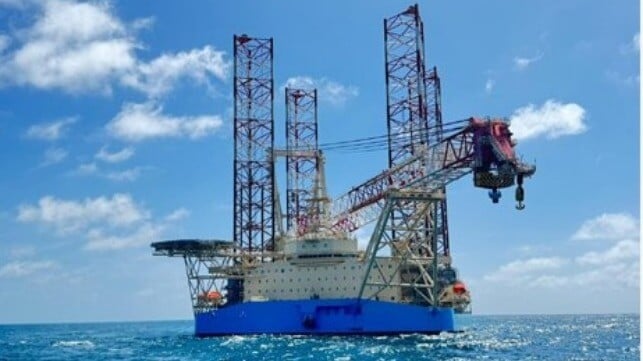
Maersk Offshore Wind's WTIV on sea trials (Seatrium)

Published Jan 9, 2026 3:38 PM by The Maritime Executive


Maersk Offshore Wind and Seatrium reported that their under-construction massive offshore wind installation vessel has completed sea trials. The vessel’s delivery, however, is approaching as the future of the U.S. offshore wind industry for which it was designed remains uncertain.

Seatrium reports that the vessel, which is approximately 475 feet (145 meters) in length, successfully completed its trials in the South China Sea. Both Maersk Offshore Wind and the vessel’s classification society participated in the trials. They are continuing to work towards the agreed delivery of the vessel by the end of February.

The ship was designed with a coordinated feeder system using barges to transport materials from shore. The barges interlock with the installation vessel, making it possible for the ship to remain on site and speed installation times. The largest of the WTIV’s cranes will have a lifting capacity of 1,900 tonnes and the ability to reach up to 590 feet (180 meters) above the deck. Maersk has highlighted in the past that the vessel would be capable of handling the largest offshore wind turbines. It will have 100 cabins and a walk-to-work gangway. In late December, Seatrium had reported the vessel was approximately 99.8 percent completed.


The project appears to be back on track after a dispute between the customer and shipbuilder last fall. Citing problems with the construction, Maersk Offshore Wind had announced it was canceling the contract, and both companies invoked arbitration. The dispute was settled in December with Seatrium agreeing to finance $250 million of the $360 million contract price, giving Maersk Offshore Wind an interest-bearing credit arrangement good for up to 10 years. Seatrium will have a mortgage on the vessel as well as first priority rights, with the financing to be paid through the cash generated by the vessel.

The installation vessel is contracted to Equinor for the Empire Wind offshore project located south of New York’s Long Island. It is one of the five projects that were ordered in December by the Trump administration to stop offshore work. Equinor has filed suit seeking a preliminary injunction to resume offshore work, but the company has said in court filings that if work does not resume by January 16, “cascading effects” could result in the project’s cancellation. Heerema’s heavy-lift vessel Sleipnir is currently transporting the project’s topside and is scheduled to install it in late January. If that cannot proceed as scheduled, Equinor warns the topside might have to be sent to Europe, as it doubts a storage site and crane could be secured in the United States.

Maersk Offshore Wind has not commented on its outlook. The company was launched several years ago, shedding its oil service work to focus on wind energy. Owned by AP Moller Holdings, the company had emphasized the strong opportunities in the business. Its website says a second, XL conventional jack-up installation vessel was designed in collaboration with GustoMSC, but the vessel has not been reported as ordered,

The first WTIV was ordered in 2023 to be built at what is now Seatrium’s yard in Singapore for delivery to the United States by 2025. In 2024, they announced a partnership with Edison Chouest Offshore, saying the U.S. shipyard would build the tugs and barges for the installation system at the Bollinger Shipyards.


Taiwan Fines and Deports Fishing Boat Captain Who Damaged Subsea Cables

Taiwan Coast Guard Administration
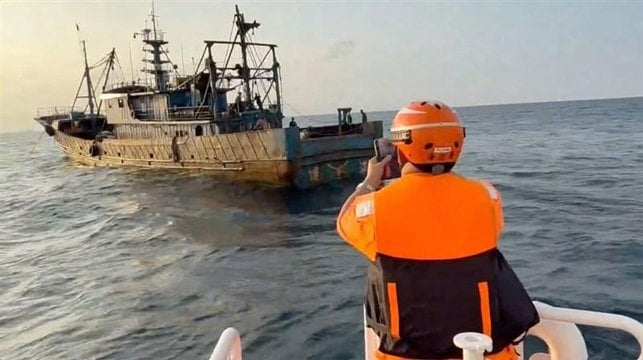
Taiwan's Coast Guard detained the fishing boat shortly after the cable damage was reported (Coast Guard Administration)

Published Jan 9, 2026 4:18 PM by The Maritime Executive


Taiwan continues to carefully monitor its subsea communications cables and other connections after a series of incidents involving ships. In the latest case, the Coast Guard Administration reports Chinese national fishing boat captain has been deported after paying a fine and admitting to his guilt in damaging a cable.

The incident took place in October 2025 and began with Chunghwa Telecom reporting an outage on its Taiwan-Malaysia Submarine cable. Several hours later, the Coast Guard located a Chinese fishing vessel that was approximately 4.2 nautical miles offshore. They took the captain, a Chinese national identified as Wu, into custody for questioning. The captain reportedly later confessed to causing the damage to the subsea cable. 

During an appearance in court, the Taiwanese officials argued the captain was experienced and should have been aware of the location of the submarine cables. They said the cables were clearly marked on electronic nautical charts and in a no-anchor zone.

The fishing boat named Minlianyu 60138 reported however, proceeded to deploy its nets in the area. They became entangled in an abandoned anchor and then damaged the submarine cable. 

The court determined the captain to be negligent in the incident. Taking into consideration his admissions, the court sentenced him in December to three months in jail. The jail time, however, could be commuted with the payment of fines and restitution to the telecom company.

Captain Wu reported arranged for the payment of approximately $2,850 to the court. In addition, a payment of approximately $7,900 was made to Chunghwa Telecom. The Mainland Affairs Council approved the immediate deportation of Captain Wu, which was carried out on January 8.

The Coast Guard Administration says the law was being followed, and recognized Wu’s admission of guilt. The Chinese captain of another cargo ship, which damaged a subsea cable in February 2025, however, has been sentenced to three years in prison after the court determined he had intentionally damaged another subsea cable.

Taiwan officials highlighted last year that they were increasing the monitoring and patrols of critical offshore infrastructure after several incidents. Of particular concern, they said, were old Chinese-owned ships that are registered in international flag of convenience states.


Rough Weather is Putting the Irish Coast Guard to the Test

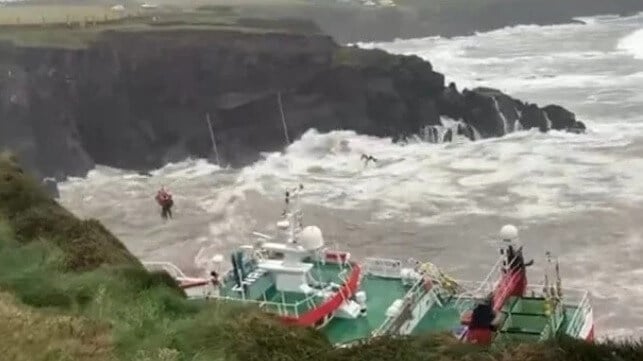
An Irish Coast Guard rescue swimmer hoists a crewmember from the grounded fishing vessel Fastnet, December 2025 (IRCG)

Published Jan 11, 2026 8:03 PM by The Maritime Executive


Ireland is recording an increase in the number of marine incidents in its vast coastline, and this reality is testing the resilience and capability of the Irish Coast Guard (IRCG), particularly for its core search and rescue mission. 

In yet another indication of how perilous the country’s rugged coast and harsh weather can be, the IRCG responded to 2,793 incidents in 2025. This was an increase from the 2,554 incidents recorded in 2024. Most of the response missions were carried out under extreme weather and unpredictable conditions, situations that demanded rapid and coordinated responses.

The agency, which has 44 units spread across the country, also deployed nearly 1,200 times for missions that served shoreside communities. This included 933 helicopter missions, including medical support for offshore island communities.

During the year, the Coast Guard provided life-saving assistance to more than 1,900 people. This was a significant increase considering the agency provided care or medical transport to 537 people in 2024.

The year also witnessed Royal National Lifeboat Institution lifeboats being launched on 798 occasions, compared to 699 in the previous year.

Among the notable incidents, in October the IRCG rescued 12 crewmembers from the Spanish-owned trawler Radoche Tercero, which was operating off the southcoast west of Cork. The crew sent a mayday after the vessel started taking on water. In December, IRCG also rescued the crew of French trawler Fastnet after the vessel started drifting onto the rocks near Dingle.

The rising numbers of incidents has forced the Irish government to increase the budget for the Coast Guard and invest in improving the agency’s assets. For the current financial year, a budget of $190 million has been allocated to the IRCG and maritime services.

Last year, the agency reached a major milestone in its aviation capability after taking delivery of four AW189 helicopters, bringing the total of new helicopters that have been acquired in the recent past to six. The expansion has enhanced the IRCG’s ability to respond more effectively to emergencies, ensuring rapid deployment and improved coverage across the country’s coastline and inland areas.


Severe Winter Storm Hits UK Shipping, Sends Containers Overboard

English Channel satellite image
Shipping near the Isle of Wight and elsewhere in the English Channel was impacted by a severe winter storm (European Space Agency file photo)

Published Jan 9, 2026 7:37 PM by The Maritime Executive


The UK’s Maritime & Coastguard Agency is reporting a busy night and efforts on Friday, January 9, to track containers after a severe winter storm crossed the region around the English Channel overnight. Warnings were posted for shipping as containers went overboard near the Isle of Wight.

In meteorological terms, the storm became what is known as a bomb cyclone, where the storm rapidly intensifies. It, however, left local areas surprised by the ferocity. There were reports of wind gusts of 73 mph at Needles on the western side of the Isle of Wight. At Portland, the winds were measured at approximately 65 mph, while in parts of Devon and Cornwall the winds reached 99 mph.

There were widespread reports of flooding, with the Portland Beach Road closed for hours due to high waves, while parts of the region reported sleet and even snow. Elsewhere, 22 mm of rain was recorded in the Channel Islands.

The storm grew in intensity in the evening, peaking around 2300 local time.  The winds and waves, however, continued much of the night.

It was around the peak of the storm that the MCA reported it received a call about containers going overboard. Around 2310, it was informed that an unnamed ship had lost 17 containers near Nab Tower and the Isle of Wight. While the first report was being processed, a second vessel reported it had lost seven containers about 16 nautical miles south of St. Catherine’s Point.

The MCA said it had fixed-wing aircraft searching on Friday for a total of 24 containers believed to be in the water. Ships were being warned of the danger. 

The MCA was working with the shipping companies to determine the contents of the boxes. Some reports said the first lot was believed to be reefers. The second lot was thought to be empties, and the MCA said there was a good chance that some of the boxes sank in the high seas. 

It emphasized that it is the responsibility of the shipping companies to locate and retrieve the overboard containers.

These losses come just a month after another reefer vessel lost 16 containers in the same general area. Boxes washed ashore and on the beaches, and inland, people were finding bananas. At last account, 13 of the 16 containers were located, and the others were thought to have sunk in the waterway.

The MCA launched an investigation, noting that one concern was improperly secured containers, or it said that crews sometimes started to remove restraints in anticipation of reaching port to speed the handling. 

While the search was continuing for the overboard containers, the weather was also impacting other shipping operations. Hovertravel to the Isle of Wight was entirely canceled. DFDS was warning of disruptions and delays due to winds and waves for its cross-channel service between Dover and France.


Union Condemns Pace of Investigation Into P&O Ferries' 2022 Ferry Layoffs

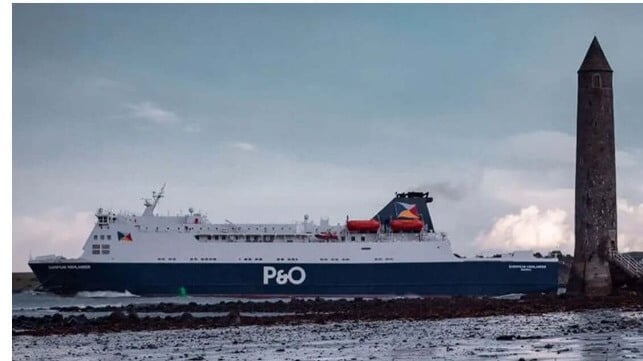
File image courtesy P&O Ferries

Published Jan 11, 2026 8:13 PM by The Maritime Executive


A trade union in the United Kingdom is reawakening the ghosts of the 2022 unilateral sacking of about 800 seafarers by P&O Ferries after condemning a government agency for delays in concluding civil investigations against the company’s bosses.

The National Union of Rail, Maritime and Transport Workers (RMT) has criticized the Insolvency Service over delays in launching a civil trial against P&O Ferries. RMT believes the delayed civil investigation is eroding confidence and allowing senior figures involved in the layoffs to escape accountability.

In 2022, P&O Ferries declared 786 seafarers redundant, without prior notice or consultations with workers’ unions. The company, owned by Dubai-based DP World, announced plans to substitute foreign agency workers to crew its ships, who would be paid far less.

The move sparked protests from the UK government and workers’ unions, prompting the Insolvency Service to carry out a criminal investigation into the circumstances. Britain has consultation requirements for layoffs, and at the time, then-Transport Secretary Grant Shapps said that if the law was not followed, it would be "a matter for criminal prosecution and unlimited fines" for P&O. The agency decided not to file criminal charges after coming to the conclusion that there was no realistic prospect of a conviction.

While the government agency opted out of any criminal proceedings, RMT says that a civil probe into potential misconduct by the ferry operator’s directors remains unresolved.

The trade union is now warning that the failure to reach a conclusion risks sending a signal that law-breaking can go unpunished, particularly since senior executives have already departed with bonus payments. 

“Almost four years on from one of the most disgraceful acts of corporate law-breaking in modern British industrial history, workers are still waiting for answers. This situation raises serious questions about whether company law is being enforced in the public interest or quietly shelved when powerful employers are involved,” said Eddie Dempsey, RMT General Secretary.

RMT highlighted that it has written to the Insolvency Service demanding an update on the investigation, saying that further delay will make the agency look "opaque and ineffective."

Since the mass layoffs, the UK has implemented measures to protect seafarers. It requires shipping lines to pay seafarers higher wages and prohibits fire and rehire practices.

Currently operating 11 ro-pax and ro-ro cargo ships, P&O Ferries offers services from UK ports to Belgium, France, Ireland and the Netherlands.