Sunday, January 25, 2026

Northwest Europe Doubles Down on Offshore Wind despite Trump’s Jab

Nine northwest European countries are set to commit to speeding up the deployment of offshore wind capacity on Monday, days after U.S. President Donald Trump criticized “money-losing windmills”, which, he said, were partly to blame for Europe’s economic decline.

The UK, Ireland, Germany, France, Belgium, Luxembourg, the Netherlands, Denmark, and Norway will pledge on Monday at the international North Sea Summit in Hamburg, Germany, to accelerate offshore wind power via large-scale cross-border projects, according to a draft declaration of the summit seen by Reuters.

These countries plan to have as much as 300 gigawatts (GW) of offshore wind capacity by 2050, of which 100 GW are expected to come from cross-border projects.  

The pledge will come days after President Trump told the audience in Davos “Because of my landslide election victory, the United States avoided the catastrophic energy collapse which befell every European nation that pursued the Green New Scam – perhaps the greatest hoax in history.”

President Trump also said “There are windmills all over Europe. There are windmills all over the place, and they are losers. One thing I've noticed is that the more windmills a country has, the more money that country loses, and the worst that country is doing.”

Earlier this month, the UK awarded a record-breaking 8.4 GW capacity of offshore wind in its latest auction round, which puts Britain “firmly on track to achieve its clean power mission by 2030,” the government said.

The Contracts for Difference AR7 auction secured offshore wind capacity capable of generating enough clean electricity to power the equivalent of 12 million UK homes.

Germany, for its part, is trying to get its offshore wind auctions back on track, following a disastrous flop in the latest auction last year without a single bid made.

The German Parliament has approved legislation narrowing the capacity in the 2026 tender to just 2.5 GW to 5 GW, compared with an earlier plan of auctioning off 6 GW of offshore wind capacity and with as much as 10 GW offered in the auction in August.

By Charles Kennedy for Oilprice.com

First Towers and Turbines Installing for Virginia Offshore Wind Farm
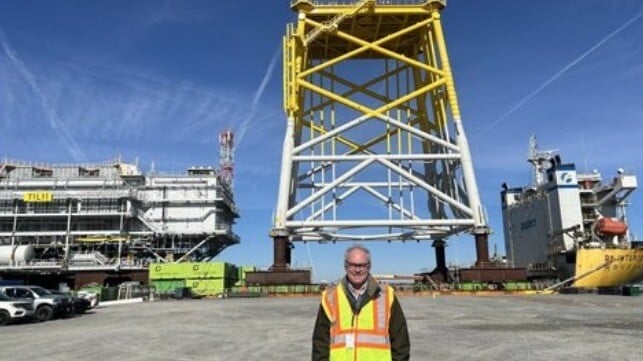
offshore wind farm components prepared for installation
Senator Kaine with the towers being staged in Portsmouth for the project (Senator Kaine)

Published Jan 22, 2026 4:35 PM by The Maritime Executive


Just days after a U.S. District Court judge agreed to issue a temporary injunction to let work resume on Virginia’s offshore wind farm, work is underway with the first towers and wind turbines being installed. Dominion Energy’s Coastal Virginia Offshore Wind is the largest project in the United States and is using the only U.S.-built wind turbine installation vessel.

Virginia’s Senator Tim Kaine reported the process on January 21 after having toured the Portsmouth Marine Terminal and received an update on the progress made on the wind farm project. He told local news outlet WAVY, “Number one of 176” had been installed.

The development is being hailed as a milestone on the project, which was expected to generate its first power early this year. It will continue commissioning in 2026 and will reach a rated capacity of 2.6 GW when finished. It is located at least 30 miles east of Virginia Beach.

The report said the first installation was near the two pilot wind turbines Dominion Energy installed in 2020. The pilot turbines are smaller, standing 630 feet, while the Siemens Gamesa 14 MW turbines for the wind farm will stand about 830 feet.

WAVY’s coverage showed images of the massive wind turbine installation vessel Charybdis in operation. Dominion Energy ordered the vessel from Seatrium AmFELS in Texas, which was delivered last year. It had been undergoing additional commissioning and U.S. Coast Guard certifications in Virginia.


Dominion Energy issued a statement on January 16 after its request for a preliminary injunction was granted by the court. Work on the project was stopped about a month after the Trump administration issued a stop-work order for all five of the offshore wind farms under construction on the U.S. East Coast. Three of the projects have each received preliminary injunctions, while the other two have filed with the courts. The merits of the case, which challenges the assertion that new information shows a national security risk from radar clutter caused by the wind turbines is yet to be decided.

The company had told the court the project, which is expected to cost $11.2 billion, was 70 percent completed and that its team would focus on safely restarting work for CVOW. The company reports it has spent approximately $9 billion to date on the project and told the court each day of the stop-work order was costing it $5 million. Estimates are month’s long delay added $130 million to the cost of the project.

Dominion Energy argues that the project is critical to meeting the growing power demands of the region. It asserts that not completing the project would be a challenge to national security as its service region includes the navy’s largest shipbuilder and critical military installations, as well as the state having the largest concentration of data centers supporting the growth of AI.

The company did not comment on the work underway, but Senator Kaine called it an “incredible project will bolster offshore wind in VA, lower costs, and grow the local economy.”


China Installs First 20 MW Offshore Wind Turbine
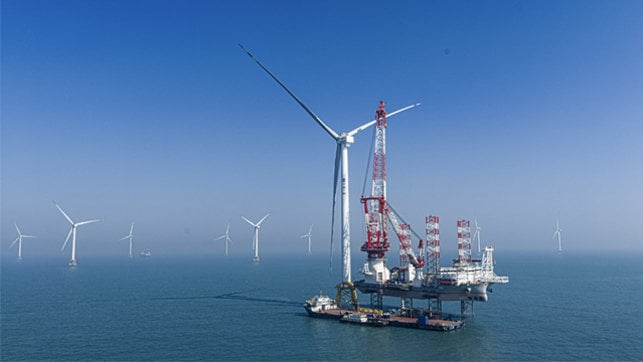
20 MW offshore wind turbine
China installed the world's first 20 MW offshore wind turbine (Goldwin)

Published Jan 23, 2026 8:44 PM by The Maritime Executive


China continues to build its global lead in offshore wind energy. In the latest development, a national research and development project has successfully installed the first 20 MW offshore wind turbine.

The massive turbine was recently installed in the southern Fujian Province, which is located north of Hong Kong and borders the Taiwan Strait. The turbine was installed on water depth of 130 feet (40 km) at a position approximately 18 miles (30 km) offshore. The turbine, built by Goldwind, is part of a project managed by the Three Gorges Group.

Chinese officials highlighted that it was just three years ago, in 2023, that they installed a 16 MW turbine also in Fujian. It was followed by an 18 MW turbine, and they continue to explore larger capacity turbines.

A key advantage of the 20 MW turbine is that it benefits from higher power generation per unit and lower cost. It increases the yield, enhancing productivity in the sea area usage.
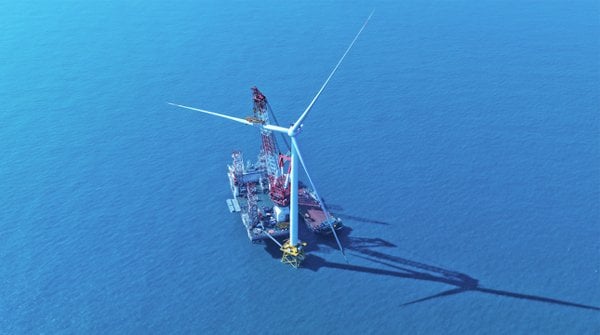
 

(Goldwind)


Building and installing the turbine, which stands at the equivalent of a 58-story building, required addressing unique challenges. Goldwind developed a new lightweight design, which they said reduces the weight per megawatt for the unit, including the nacelle, hub, and blades. It weighs less than 40 tons, reducing its weight by more than 20 percent compared to the industry average. 

Hoisting the turbine to its position, approximately 174 meters (570 feet) to the hub, required a fourth-generation wind installation vessel. It had a 2,000-ton lifting capacity. It also required high-precision in placing the three blades. Each of the blades is 147 meters (482 feet) in length. The companies report that the sweep area is equivalent to 10 standard football fields.

The system integrates lidar and blade root sensors to ensure safe operations. It is also designed to withstand strong typhoons. They report it unit’s airfoil blades have a wind energy utilization coefficient of .49, which significantly improves wind power capture and generation efficiency. After being connected to the grid, they report the unit is expected to generate over 80 million kWh annually.

The new turbine project is being called a “flagship of China’s energy goals.” China was expected to surpass 40 GW of installed offshore wind capacity by the end of 2025, far ahead of the UK, which is the largest in Europe. They report a generating capacity of over 600 million kilowatts, up 22.4 percent year-on-year.

Three Gorges last month reported the completion of the farthest offshore wind farm. It is located 85.5 km (53 miles) from the shore in Jiangsu province, north of Shanghai. The project features 98 turbines with a total capacity of 800 MW. It is expected to generate over 2.8 billion kWh of electricity.

China’s current Five-year Plan calls for installing 15 GW of offshore wind power capacity annually. Its goal is to reach 1.3 TW total wind capacity by 2030, 2 TW by 2035, and 5 TW by 2060.

Trump Claims UK Has 500 Years Of Oil Reserves Left In The North Sea

  • Donald Trump softened threats over Greenland and ruled out military action, while oil prices fell nearly 2% on Thursday amid de-escalation and headlines from the World Economic Forum.

  • Trump’s North Sea claims were widely disputed, as regulators like the North Sea Transition Authority say the basin is mature.

  • Experts note that most reserves already extracted, and remaining supplies may last decades or even years.

The U.S. stock market has pared back heavy losses it posted earlier in the week after U.S. President Donald Trump relented on his threat to slap European and NATO nations with tariffs for opposing his push to acquire Greenland. Trump also ruled out the use of military force to take over the semi-autonomous Danish territory, but said the U.S. will still pursue ownership of the country.

In contrast, oil prices have reversed course, slipping nearly 2% after Trump softened threats against Greenland and Iran. While President Trump dominated headlines and discussions at the World Economic Forum (WEF) in Davos 2026 with his Greenland push and concerns over globalism, his controversial claims about renewable energy also drew attention. To wit, Trump claimed that the North Sea has 500 years of Oil & Gas reserves left, and dismissed Europe’s green energy policies as a “scam”. Trump also renewed his criticism of the UK government for restricting oil and gas drilling in the North Sea, as well as its decision to retain the energy profits levy (EPL). 

The United Kingdom produces just one-third of the total energy from all sources that it did in 1999 – think of that, one-third – and they’re sitting on top of the North Sea, one of the greatest reserves anywhere in the world, but they don’t use it, and that’s one reason why their energy has reached catastrophically low levels, with equally high prices,” Trump said.


There are windmills all over Europe. There are windmills all over the place, and they are losers. One thing I’ve noticed is that the more windmills a country has, the more money that country loses and the worse that country is doing,” Trump said, also claiming that China manufactures windmills and sells them at huge profits but never installs them itself.

However, many of Trump’s claims are verifiably false. The North Sea is a mature oil and gas province, meaning much of the easily accessible oil and gas has already been produced, with over 90% of recoverable reserves extracted in the UK sector. 

According to the North Sea Transition Authority (NSTA), the UK's energy regulator, the North Sea has ~2.9 billion barrels of oil equivalent at the end of 2024, suggesting only decades of supply, not hundreds of years as Trump claims.

Indeed, at current production rates, some analyses suggest the remaining reserves might last only about seven years, not centuries, highlighting the extreme overestimation in Trump's claim. The UK’s indigenous crude oil production in 2024 clocked in at ~320,000 barrels per day, enough for just 20% of the country’s consumption. To exacerbate matters, only 13% of that oil is refined in the country, a figure the ECIU has projected will fall to 1% by 2030 as North Sea production continues to decline. 

After more than fifty years, the UK has burned most of its gas and what’s left of the oil is increasingly difficult and expensive to extract,’’ Tessa Khan, executive director at environmental campaign group Uplift, said. “Regardless of any new drilling, the UK will be dependent on gas imports for nearly two-thirds of its gas in just five years time and almost 100 per cent by 2050.”

Trump’s claims about wind energy in Europe and China are also erroneous. An analysis by University College London has revealed that wind energy has lowered UK energy imports by 12% via interconnectors into the country and saved British consumers ~£104 billion ($140 billion) on their energy bills between 2010 and 2023. Wind energy is generally cheaper than most other power sources in Europe, particularly when compared to fossil fuel alternatives. 

Despite recent inflationary pressures causing a temporary pause in cost reductions, onshore wind remains one of the most affordable sources of new electricity, frequently undercutting new coal and gas plants. The Levelized Cost of Electricity (LCOE) for wind dropped dramatically by over 60% between 2010 and 2021. While costs plateaued or rose slightly around 2022–2023 due to supply chain issues and rising interest rates, they are expected to fall again as inflation eases and turbine prices recover. High gas prices, which exceeded €50/MWh in 2024, make renewable energy like wind a much cheaper alternative.

And finally, Trump’s claims about wind energy in China appear to be only partly true. According to a report by Ember, China spent $625 billion on clean energy investments in 2024, good for 31% of the global total, making it the biggest investor in renewable energy worldwide. Contrary to Trump’s claims, data indicates that China leads the world in wind power deployment, with installed capacity exceeding 600 GW by early 2026, and with the country accelerating deployment in recent years (around 100 GW in 2025 alone). China operates almost half of the world's offshore wind capacity, reaching 52 GW in 2025, more than the EU and UK combined.

By Alex Kimani for Oilprice.com


Wood Mackenzie Sees Sharp Pullback in UK North Sea Capex

  • UK North Sea investment is set to slump sharply, with Wood Mackenzie forecasting UK upstream capex to fall below $3.5 billion in 2026.

  • Claims of vast remaining reserves are overstated, as regulators like the North Sea Transition Authority estimate just ~2.9 billion boe left, with Wood Mackenzie warning this could be the last year UK production exceeds 1 million boe/d.

  • A widening UK–Norway divide is emerging, with Norway maintaining strong spending and exploration under stable policies, while the UK sees falling activity

Recently, U.S. President Donald Trump claimed that the UK has 500 years of oil reserves left in the North Sea, and blamed the country’s high energy prices on the government’s unwillingness to drill. However, the unfortunate fact is that the North Sea oil and gas sector has been in a significant and prolonged decline due to the basin's aging oil fields, with production falling sharply since its peak in the early 2000s. According to the North Sea Transition Authority (NSTA), the UK's energy regulator, the North Sea had ~2.9 billion barrels of oil equivalent at the end of 2024, suggesting only decades of supply, not hundreds of years as Trump claims.

Indeed, WoodMac has predicted that the current year could be the last time the UK will produce over 1 million boe/d from the North Sea.

The North Sea decline has led to reduced investment, job losses, and increased UK reliance on imports, despite ongoing efforts to manage the energy transition. Meanwhile, high taxes and policy uncertainty, particularly the Energy Profits Levy, have been deterring new projects, accelerating consolidation, and shifting focus towards offshore wind. The UK Energy Profits Levy (EPL) is a temporary "windfall tax" with a headline rate of 78% on exceptional profits on UK oil and gas producers that was introduced in 2022 during the global energy crisis. EPL is set to end by March 2030, but will be replaced by a permanent, revenue-based Oil and Gas Price Mechanism (OGPM) from 2030, applying a 35% charge when prices are high, using thresholds like $90/barrel oil and 90p/therm gas. The EPL has been a point of contention for the industry due to its negative impact on investment.

According to a new report by  Wood Mackenzie, the North Sea upstream oil and gas sector in 2026 will be shaped by falling investment (particularly in the UK), continued M&A activity, regional divergence in Norway and the UK, ongoing energy transition pressures, and a strong focus on capital discipline as well as improved operational efficiency.

Here are five key North Sea upstream themes to look out for in 2026:

#1. Diverging Investment and Activity Levels 

Investment in the North Sea upstream sector is projected to fall overall in 2026, driven by a significant decline in UK investment to less than $3.5 billion, its lowest real terms level since the 1970s. In contrast, Norway will maintain momentum with sustained development spending of around $20 billion, focusing on bringing major projects online quickly to maintain production plateaus and ensure European gas supply security. The UK's decline is linked to a tough fiscal and regulatory environment, while Norway will benefit from more stable policies and a robust project pipeline.

However, Woodmac has predicted that North Sea production will remain steady at ~5.3 million boe/d despite the spending pullback, thanks to new start-ups in both Norway and the UK. Norway’s production will plateau at around 4.1 million boe/d with Equinor's (NYSE:EQNR) Johan Castberg and Var Energi's Balder re-development accounting for over 50% of this new volume, while new  projects will contribute another 500 000 boe/d. Norway is projected to bring six new start-ups online in the current year, with Equinor's 136 million boe Irpa gas field being a key highlight.

#2. Continued Mergers and Acquisitions (M&A) and Corporate Restructuring

Uncertainty in the market will drive further M&A opportunities, especially in the UK, where consolidation of weaker players will continue. The UK landscape is expected to consolidate as companies with strong balance sheets acquire non-core assets, leveraging tax losses and decommissioning relief. Norway, meanwhile, is expected to see more limited, smaller asset deals. New business models and strategic joint ventures (such as the NEO NEXT+ collaboration) are also emerging as solutions to capital constraints and a way to manage risk and basin exposure.

#3. Intensified Focus on Capital Discipline and Efficiency

Amid expectations of lower oil prices (Brent is forecast to average around $57-$59/bbl) and an oversupplied market, North Sea companies will prioritize capital discipline amid financial constraints. Operators will concentrate investment on high-return, quick-return projects such as brownfield expansions and near-field tie-backs to existing infrastructure. This focus on efficiency is crucial for profitability in a challenging price environment.

#4. Energy Transition and Decarbonization Pressures

The industry remains under intense scrutiny to address climate concerns. Key themes include the mainstreaming of Carbon Capture, Utilisation, and Storage (CCUS) projects and the potential for new policies regarding Scope 3 emissions reporting in Norway following legal challenges. The electrification of offshore operations and integrating renewable energy sources are also gaining traction as companies seek to reduce their carbon footprint and meet environmental, social, and governance (ESG) metrics.

#5. Targeted Exploration, Primarily in Norway

According to WoodMac, exploration activity in the North Sea will be almost exclusively a Norwegian endeavor in 2026, with operators planning to drill over 30 exploration wells. This contrasts sharply with the UK Continental Shelf, which saw no exploration wells drilled in 2025. Norwegian exploration is focused on high-impact prospects with clear paths to development, and appraisal wells on existing discoveries such as Afrodite, Carmen and Norma, which could unlock significant gas supplies for Europe.

By Alex Kimani for Oilprice.com

Europe's Aluminum Production Collapse Sparks Crisis for Key Industries

  • The high-strength aluminum alloys market is projected to reach $115.29 billion by 2030, but the industry currently faces structural scarcity due to a massive gap between supply and demand.

  • European primary aluminum production has collapsed by over 25% since 2010, resulting in a 93% structural deficit, primarily because high energy prices have forced smelters like Slovalco to shut down.

  • Western supply chains for essential aerospace and defense alloys are vulnerable to Chinese export controls on critical "vitamins" like magnesium and face challenges in using recycled scrap due to chemical limitations.

The global high-strength aluminum alloys market is projected to surge from $66.01 billion in 2025 to $115.29 billion by 2030, according to new data. While this 11.8% compound annual growth rate suggests a smooth trajectory for the green transition, a widening gap between downstream demand and upstream reality is creating a period of structural scarcity. 

As of January 2026, the industry faces a fundamental "grind" characterized by shuttered European smelters, Chinese export controls on critical minerals, and the implementation of the European Union's Carbon Border Adjustment Mechanism (CBAM).

The European Production Collapse

The European Union (EU) currently consumes 13.5 million tons of aluminum annually to feed its automotive, aerospace, and construction sectors. However, domestic primary production has collapsed to just 950,000 tons—a 93% structural deficit.

Since 2010, primary aluminum production in Western and Central Europe has fallen by over 25%, leaving the continent effectively de-industrialized in terms of upstream capacity.

"Europe needs roughly six to seven million tons of production; everything else is imported," said Slovak Prime Minister Robert Fico, who is currently pushing for the restart of the Slovalco smelter. "This [Slovalco] plant was one of the technical and environmental leaders in Europe.”

The Slovalco facility, which once produced 175,000 tons annually, remains a symbol of the energy crisis. Norsk Hydro ASA shuttered the plant because high electricity prices made smelting, which requires 13 to 15 megawatt-hours (MWh) per ton, mathematically impossible. 

While Fico has proposed a 10-year support framework and a €100 million investment to restart the pots, the technical reality is daunting. Once a potline freezes, the electrolyte bath hardens like granite, requiring a massive capital expenditure to reline the pots.

The Critical Mineral Chokehold

The growth of high-strength alloys is tied to the 7xxx and 5xxx series, which are essential for aerospace and defense. These alloys require "vitamins" like magnesium and zinc. 

China currently controls approximately 95% of global magnesium production, creating a single point of failure for Western supply chains. Without magnesium, the production of Aluminum 5083 armor plate for military vehicles ceases.

Zinc, the primary strengthening agent for the 7xxx series, is also under pressure. London Metal Exchange (LME) stocks dropped to critically low levels in late 2025, representing less than one day of global coverage. While a surplus is projected for later in 2026 as new mines in Portugal and Idaho come online, the market remains volatile.

Aerospace Backlogs and the "Buy-to-Fly" Ratio

Despite the shift toward carbon-fiber composites in models like the Boeing 787, the aerospace industry remains a primary floor for aluminum demand. The current backlog for Airbus and Boeing exceeds 14,000 aircraft. At current rates, Airbus has 11 years of production already sold.

Every narrow-body wing requires massive plates of 7150 or 7055 aluminum. This creates extreme pricing power for converters like Constellium SE, which recently reported a 61% increase in profitability per unit of metal

Unlike upstream producers like Alcoa Corporation, which is cutting capital expenditures to $625 million, downstream converters are insulated from raw energy costs and are successfully capturing margins from the aerospace backlog.

Regulatory Arbitrage and the Green Ledger

The industry is now navigating a two-tier market of "dirty" versus "green" aluminum. As of Jan. 1, 2026, the EU’s CBAM began imposing a carbon levy on imported metals. This creates a paradox: Europe has shut down its own low-carbon smelters due to energy costs, but it will now tax the carbon-intensive imports required to replace that lost production.

While recycling is often cited as a solution, high-strength alloys face a chemical limit. Scrap often contains iron, which forms brittle needles in the metal. This makes most recycled aluminum unsuitable for critical aerospace components, leaving the industry dependent on primary smelting.

The transition to a $115 billion market is not just a matter of demand, but a challenge of conversion capacity and clean energy. Until the gap between European consumption and production is addressed, the sector’s "strategic autonomy" remains precarious.

By Charles Kennedy for Oilprice.com

Column: US aluminum consumers pay the spiraling cost of tariffs


Stock image.

American aluminum buyers are now paying an eye-watering 68% premium over the London Metal Exchange (LME) price to get physical metal.

This is of course a direct of result of US President Donald Trump hiking import tariffs from 10% to 25% in March and again to 50% in June.

But the premium for physical delivery in the US Midwest is trading another $560 per metric ton over any implied tariff cost, propelling the “all-in” price of aluminum above $5,000 per ton.

The country is clearly running short of a metal used across a wide array of industries from automotive and aerospace to construction and packaging.

On paper, the record premium for US delivery should attract much-needed supply. In reality, however, things may not be that simple.

US aluminium price by component
US aluminum price by component

Imports down, stocks shrink


Tariffs were meant to stimulate domestic primary aluminum production after a prolonged period of decline which left just four operating smelters.

The immediate impact has been limited to Century Aluminum’s restart of 50,000 tons of idled capacity at its Mt. Holly plant in South Carolina. The smelter will return to full capacity by June.

There are a handful of greenfield projects but these are several years away from producing first metal, even assuming they can compete with Big Tech for long-term power supplies.

In the interim, the US remains dependent on imports of primary metal and these have been falling. Volumes were down by 14% in the first 10 months of 2025 relative to 2024.

Canada, historically the largest supplier to the US market, started diverting shipments to Europe around May last year.

It exported 225,000 tons to the Netherlands, 89,000 tons to Italy and 29,000 tons to Poland between May and October, according to the World Bureau of Metal Statistics.

US stocks of primary metal have been sliding.

The short time-lag between tariff hikes didn’t allow for much preemptive stockpiling and in-country inventory has shrunk from 750,000 tons at the start of 2025 to below 300,000 tons, according to consultancies Harbor Aluminum and Wittsend Commodity Advisors.

The elevated US premium is a red warning light that the country needs more aluminum.

US imports of primary aluminium
US imports of primary aluminum

Cross-Atlantic competition


The problem for US buyers, however, is that Europe is also short of aluminum. European duty-paid premiums have surged from under $200 per ton over LME cash in June to over $340 per ton.

The region is being squeezed by a triple supply hit.

South32’s decision to mothball the Mozal aluminum smelter in Mozambique due to high power prices removes a key supplier to the European market.

Another core supplier, the Grundartangi smelter in Iceland, owned by Century Aluminum, cut production by two-thirds in late October due to equipment failure. It will take an estimated 11-12 months to recover fully.

Meanwhile, imports of Russian metal are set to be fully switched off this year in line with the European Union’s 16th sanctions package. European buyers were granted a one-year phase-out grace period which expires next month.

Rising local premiums are also being underpinned by Europe’s Carbon Border Adjustment Mechanism (CBAM), which came into effect this month, lifting the price of imports with higher carbon footprint.

Capped supply

In times gone by, traders would simply have bought up LME stocks and shipped them to the United States to profit from the premium spike.

However, Russian metal accounts for a significant part of LME registered tonnage, 58% as of the close of December, and cannot be imported to the US because of sanctions.

Moreover, there is much less aluminum sitting in LME warehouses than in the past, when the global market was characterized by persistent oversupply.

Total LME inventory, both registered and stored in the off-warrant shadows, closed 2025 at 669,000 tons, down by 331,000 tons on the start of the year.

That speaks to the structural shifts that are playing out in the global market.

Chinese operators are now running close to the government’s mandated capacity cap, meaning the world’s largest producer is at or very close to peak output

Chinese production growth slowed from 4% in 2024 to 2% last year, according to the International Aluminium Institute.

Yet smelter margins have been highly profitable. While the aluminum price has been rising, that of intermediate product alumina has cratered. It’s the sort of combination that would once have triggered a rush of new and restarted capacity but not any more.

China is also importing ever more primary metal. Inbound volumes rose by 19% year-on-year in the first 11 months of 2025. A significant portion came from Russia, which has pivoted away from Western buyers due to sanctions.

China’s exports of semi-manufactured products, by contrast, fell by 11% over the same period, reflecting the removal of the tax rebate on outbound shipments in December 2024.

The global market is tightening, a process that is complicated by the simultaneous fracturing of pricing between regions.

Flow-through

Were the tariff impact on US pricing playing out in isolation, it would be quickly resolved by physical arbitrage.

But it’s not. There are multiple moving parts in the physical aluminum market and right now they are serving to tighten supply just about everywhere.

The elevated cost of aluminum in the US could prove sticky, which is bad news for the ultimate consumer.

The Trump administration’s extension of 50% tariffs to a wide spectrum of aluminum products in August has kept midstream processors onside but serves to accelerate the flow-through of higher primary metal pricing to the ultimate buyer.

US consumers are in for a shock unless imports pick up soon.

(The opinions expressed here are those of the author, Andy Home, a columnist for Reuters.)

(Editing by Marguerita Choy)

Europe’s Gas Storage Is Draining at the Fastest Pace in Five Years

Below-average winter temperatures are driving the fastest pace of withdrawals from natural gas storage in Europe in five years, as heating demand is rising.

EU gas storage sites were only 47% full as of January 21, according to the latest data from Gas Infrastructure Europe.  

That’s well below the average for the past few years, signaling that Europe will have to import more gas in the summer to replenish storage supplies.


Gas withdrawals have accelerated this month amid colder-than-normal temperatures in most of Europe, and the pace of withdrawals has been the fasters in five years, according to Bloomberg’s estimates.

LNG cargo arrivals have been at less than half of the daily volumes withdrawn from storage.

The cold weather has driven immediate gas demand higher, while the unfavorable price spread between winter and summer prices is not encouraging for stockpiling.

In addition, global gas benchmark prices have jumped in recent weeks as Arctic weather has gripped most of the northern hemisphere, including the United States and Asia.

As a result, prices have spiked, making LNG imports costlier for any customer in Europe and Asia.

The front-month Dutch TTF Natural Gas Futures, the benchmark for Europe’s gas trading, have jumped by 30% since the start of January, from $34 (29 euros) per megawatt-hour (MWh) on January 2 to as much as $45.40 (38.65 euros) per MWh on January 23.

“With heating demand firm and storage withdrawals accelerating, European buyers have been forced to pay up to secure supply,” Ole Hansen, Head of Commodity Strategy at Saxo Bank, said this week, noting that the extreme cold has driven a sharp rise in heating demand just as supply flexibility has diminished.   

Traders have sharply turned bullish on European gas, with funds aggressively buying the market, shifting from a net short of 55.1 TWh to a net long of 57.7 TWh over the last reporting week, Warren Patterson, head of commodities strategy at ING, wrote in a Thursday note.

“This move was driven fairly equally by short covering and fresh longs entering the market,” Patterson said.

By Charles Kennedy for Oilprice.com