Monday, February 02, 2026

TACO Time or Wartime? Examining Trump’s Latest Threats


 February 2, 2026

Donald Trump is on the warpath again, threatening Greenland, Iran, Canada, and Cuba. Will he be TACO—Trump Always Chickens Out—or will he carry through on the threats—seizing Greenland, seeking to overthrow the Iran and Cuba regimes, destabilizing Canada? Let’s take a look.

Greenland: A “Core National Security Interest”

Jeff Landry, the Trump administration’s envoy to Greenland—he’s also governor of Louisiana—has written an op-ed for the New York Times January 29 that tells us the US intends to dominate the island.

“When President Trump took office last year, he recognized an uncomfortable fact that many others have avoided: America must guarantee its own unfettered and uninterrupted access to key strategic territories in the Western Hemisphere, including both Greenland and the Panama Canal.”

Pairing those two locations is revealing, since Landry proposes that “Greenland fits squarely within” the idea behind the Monroe Doctrine for Latin America. Now that Trump believes he has a “framework for a future deal” on Greenland, the US will use it to (in Landry’s words) “set the rules in one of the world’s most strategically consequential regions in perpetuity.”

“American dominance in the Arctic is nonnegotiable,” writes Landry. “Greenland is a core national security interest for the United States,” repeating what Trump said at Davos. That’s an extraordinary statement: It elevates Greenland to the level of Europe’s or the US homeland’s defense, among other national interests.

And it’s wrong. Chinese and Russian activities in and around Greenland hardly amount to a national security threat. Contrary to Trump’s statement in a January 9 press conference, there are no Chinese and Russian destroyers circling Greenland, nor “Russian submarines all over the place.” Nor, finally, are there any indications that Russia or China plans to “occupy” Greenland. All we see are Russian and Chinese fishing boats.

Nevertheless, the US is going to build more bases in Greenland, establish a “Golden Dome” missile defense, build more icebreakers, and vigorously patrol the Arctic waters to prevent a Russian or Chinese takeover. These plans may conceal a long-term design on Greenland and its mineral resources. After all, governments typically are prepared to go to war over “core national security interests.”

Iran: Make a Deal or Perish

Once again, President Trump is threatening to attack Iran. Just a few weeks ago, the threat turned on Iran’s reaction to massive protests and the possible execution of protesters. The US was “locked and loaded”; protesters could count on the US. But Trump was evidently persuaded by Arab countries and the US military not to attack.

Now Trump, having failed to back up his promises as thousands of protesters were killed or jailed, is saying Iran has revitalized its nuclear weapon capability. That’s the capability he had claimed was “obliterated” in US attacks last June. Trump has ordered US military vessels to the Middle East, saying that “like with Venezuela, it is ready, willing, and able to rapidly fulfill its mission, with speed and violence, if necessary.”

News reports indicate Trump is considering various options, including putting US troops into Iran. Evidently, Trump has become so enamored with the successful seizure of Venezuela’s leader that he thinks Iran can be as easily dealt with. Yet Trump also says he hopes to avoid the use of force. In short, more gunboat diplomacy.

Iran is responding, as in the past, with threats of its own and offers to talk. If the US attacks, Iran says it will spark a regional war and that Israel and US bases in the region will be targets.

But Iran’s foreign minister, Abbas Araghchi, has also said Iran was “ready to begin negotiations if they take place on an equal footing, based on mutual interests and mutual respect.” He said there were no immediate plans to meet with US officials, adding: “I want to state firmly that Iran’s defensive and missile capabilities will never be subject to negotiation.”

In the past, Iran has also said its nuclear enrichment program is off the bargaining table. That point collides with the demand made by Steve Witkoff, Trump’s special Middle East envoy, that Iran stop its enrichment program and transfer all its enriched uranium out of the country.

Will Trump order another attack on Iran? More bombing is certainly possible, whereas a direct intervention in Iran would invite disaster. Trump’s war threats have activated some in the Senate to craft a resolution that would remove US military forces “from hostilities within or against the Islamic Republic of Iran” unless authorized by Congress. Prospects for stopping Trump by resolution or the War Powers Act seem dim considering that these measures were not enacted to prevent his Venezuela adventure.

Canada: Squeezing with Separatism and Tariffs

Angered by Prime Minister Mark Carney’s upstaging him at Davos, Canada’s trade deal with China, and Canada’s supposed refusal to certify Gulfstream business jets, Trump’s team has looked for ways besides high tariffs to pressure Carney’s government. US treasury secretary Scott Bessent recently suggested US support for a separatist group in Alberta, arguing that the province is a “natural partner” of the US.

That support apparently extends to the highest level of the US government, according to an account in The Daily Beast. “Very, very senior” officials in the Trump administration have had secret meetings with far-right Canadian separatists trying to shake the foundations of the country. The covert meetings between high-ranking U.S. officials and the Alberta Prosperity Project,” says the report, “have met U.S. State Department officials in Washington, D.C. three times in the last nine months.”

One member of that project who attended the meetings claimed: “The US is extremely enthusiastic about a free and independent Alberta. We’re meeting very, very senior people leaving our meetings to go directly to the Oval Office.” The group is hoping to place a referendum on independence on the ballot.

US officials deny supporting this movement, but the State Department acknowledges that meetings did take place. The US officials’ denials ring hollow. The very fact that US officials would engage with Canadian separatists is a shocking level of interference in Canadian affairs. It shows that if Trump cannot fulfill his dream of making Canada the 51st state, he may still try to pry off one province.

Cuba: Economic Warfare or Regime Change?

Following up on Marco Rubio’s threats to Cuba, the island’s oil imports are drying up. Trump has made sure Venezuelan oil is no longer available, threatening to raise tariffs on any country that might provide it. Cuba’s usual sources of oil, Mexico and Angola among them, are being closed down, almost certainly under US pressure.

Mexico’s President Claudia Scheinbaum insists the decision is a sovereign one, and that Mexico will continue to provide oil as humanitarian assistance. But when we consider that Trump has threatened to go after drug cartels in Mexico, and that the US-Mexico-Canada free trade agreement is up for renewal shortly, it is hard to credit Scheinbaum’s claim.

Trump has made clear the US strategy for regime change: an economic blockade. “Cuba will be failing pretty soon,” he boasted. Indeed, by some estimates, Cuba has only about 3 weeks of oil, after which a humanitarian crisis is being predicted. Diesel is essential to producing electricity and for transportation, water delivery, and agriculture.

During the Cold War, the US embargo of Cuba was justified by Cuba’s support of revolutionary movements in Latin America and Africa. Now the pretext is that Cuba is a national security threat because it provides “a safe haven for transnational terrorist groups, such as Hezbollah and Hamas”. No evidence has been offered in support of this charge—and I doubt any evidence exists.

TACO Time?

A president who began his second term riveted on dismantling democracy and doing away with the rule of law has now become an imperialist, with military interventions and weaponizing tariffs the main instruments for accomplishing US goals. How far will he go in each of the four cases?

Trump has a history of backing off from threats, but the Venezuela experience has clearly made him think he has license to intervene abroad with impunity, especially in Latin America where weak regimes are in no position to resist. There’s a good chance he will overreach, as imperialists do, facing pushback that he and his advisers had not foreseen in Greenland and NATO, in Iran, and in Canada.

He will also face domestic political costs as independents and even some MAGA supporters resent his overseas adventures for taking money and attention away from a corroding economy. So, TACO time or wartime?

Either way, Trump will threaten world peace and stability, alienate traditional friends, and possibly spark new wars. Increasingly unpopular at home, he may just be desperate enough to authorize more outrageous actions abroad.

Mel Gurtov is Professor Emeritus of Political Science at Portland State University, Editor-in-Chief of Asian Perspective, an international affairs quarterly and blogs at In the Human Interest.

Trump Lawsuits: The Most Efficient Grift Ever


February 2, 2026

Photograph Source: rob walsh – CC BY 0

You have to give Donald Trump some credit. He was making plenty of money selling pardons, ripping off Venezuela’s oil, and selling seats on his “Board of Peace,” but all of these required something resembling work. In the case of Venezuelan oil, he even had to invade a country and kill 80 people.

But Trump’s latest grift is far simpler. He just sues the government and then orders Attorney General Pam Bondi to give him the money. He already did this several months back when he filed a $230 million suit because the government tried to prosecute him for the crimes he committed.

As a practical matter, Trump’s lawsuit was a total joke. Since he almost certainly would have been found guilty if he had allowed the prosecution to continue, there is not even the beginning of a case. Imagine Jeffrey Esptein, if he was still alive, suing the government for prosecuting him. I doubt the Justice Department would be handing over $230 million.

But the Trump case was even worse. Even when acquitted, a defendant can only under extraordinary circumstances, like a racially motivated prosecution, even get through the door with a suit against the government. And in such cases, the defendant’s attorney fees would be the bulk of the damages.

That might get Trump into the single-digit millions even if the facts had been completely different and he was totally innocent. That might come to 2 or 3 percent of the taxpayer dollars he told Bondi to give to him.

But now Trump has decided he needs more money, so he’s demanding more than 40 times as much, suing the Internal Revenue Service for $10 billion for releasing information from his tax returns. One of the ironies of this story is that the leak took place in Trump’s first term, so ostensibly, as president, he is responsible for the harm for which he is suing the government. No matter, this is Donald Trump’s America.

I often point out that the sums the right yells about are relatively trivial when put in any sort of context. Trump’s theft is moving into the not all together trivial category even in the context of the federal budget.

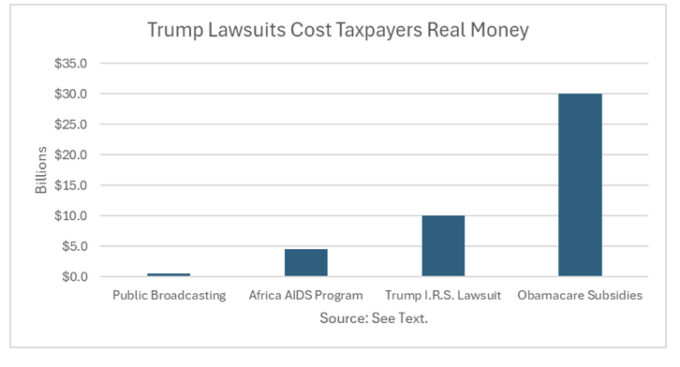
For some comparisons, the annual appropriation to support public broadcasting was around $550 million. Donald Trump is demanding almost 20 times as much because of his hurt feelings over some of his tax returns being made public.

The Africa AIDS program that Elon Musk nixed with his little chainsaw got $4.5 billion a year. This program has saved tens of millions of lives. Donald Trump wants taxpayers to give him more than twice as much because the I.R.S. embarrassed him by releasing his tax returns, something every president has done.

The enhanced subsidies in the Obamacare exchanges, that the Republicans let expire at the start of this year, would cost about $30 billion a year to extend. These subsidies would benefit around 22 million people. This means that Donald Trump is asking taxpayers to hand him one-third of the money needed to make healthcare affordable to 22 million people.

Here’s the picture.

As bad as it is to steal $10 billion from the taxpayers, the worse part is that Trump now realizes that the federal Treasury is an open piggy bank for him. He can file a lawsuit about literally anything, no matter how crazy, for any amount, and then tell Attorney General Bondi or the relevant agency head to hand him the cash.

Who knows, maybe he’ll direct some lackey to misspell his name on the Trump Gold Visa or any of the other crazy things he puts his name on. Then he can sue for $50 billion for emotional harm. Maybe he’ll tell Bondi to drive a hard bargain and only settle $40 billion.

This is a patently absurd clown show, but that is where we are as a country. Trump can steal as much as he wants from the taxpayers and the Republicans in Congress will do some mixture of “I don’t know anything about it” and “Trump deserves it.”

The majority in the country are clearly disgusted by Trump’s corruption, his incompetence, his contempt for democracy, and his vicious attacks on American cities. The real question is whether we still have enough of a democracy that the majority opinion matters.

This first appeared on Dean Baker’s Beat the Press blog.

Dean Baker is the senior economist at the Center for Economic and Policy Research in Washington, DC. 

Acts of Revisionism: Hitler, Stalin and Trump


 February 2, 2026

Photograph Source: p. klashorst – CC BY 2.0

Authoritarian leaders typically attempt a radical reshaping of civic life.  Every area of life—from culture and the arts to education and science—becomes subordinated to the preferences of the leader.  Hitler was unusually successful, reordering every aspect of German society and gradually winning the acceptance of the German people.  Stalin created an atmosphere of terror and fear, and more were killed in his purges in Russia than were killed at the hands of the Gestapo and Nazis in Germany.  Trump’s villainy and retributions are designed to intimidate political opponents, particularly liberals and progressives in the states that voted against him in 2016, 2020, and 2024.

These three authoritarians engaged in acts of historical revisionism, which are designed to alter presumed historical facts and rewrite existing historiography.    In 1933, Stalin restored history to a prominent place in the academic curriculum, giving prominence to the achievements of the tsars and the goal of teaching devotion to the motherland.  Hitler made sure that his photograph was displayed prominently in every classroom in the country, and that reading primers included a picture of the Fuhrer.  The teaching of biology was revamped to emphasize the laws of heredity and racial teaching.

Trump’s revisionism is not yet as threatening as the actions of Hitler and Stalin, but is similarly centered on higher education, libraries, and cultural institutions. The New York Times reported last month that the “National Park Service was taking a crowbar to U.S. history.”  On Trump’s orders, Philadelphia’s Independence National Park, visited by several million people annually, took down an exhibit on the contradictions between George Washington’s ownership of enslaved people and the Declaration Of Independence’s promise of liberty.  A plaque at the Muir Woods National Monument in California was dismantled because it noted that the tallest trees on the planet could store carbon dioxide and slow the Earth’s dangerous warming.

In 2025 and 2026, Trump pressured the Smithsonian Institution to pivot away from what he called “divisive,” race-focused narratives toward a more “celebratory” version of American history.  He is using executive orders and funding threats to demand a review of museum content for “improper ideology.”  In renaming the Kennedy Center, he installed a new board of directors and emphasized that traditional and patriotic performances would replace “woke” programming.  White supremacists are being placed in key positions, including the Equal Employment Opportunity Commission, which was created to protect our civil rights infrastructure.

All three authoritarians tried to take advantage of perceived international weakness.  Hitler made incremental challenges in Europe, and decided that England and France were not willing to challenge him.  Stalin used terror to establish his basis of power.  Trump perceived a European Union weakened by Brexit in England; the support of right-wing populists in Hungary, France, and Italy; and weak responses from a divided Democratic Party at home and the Western powers in general abroad.  He’s giving freer rein to Vladimir Putin and Xi Jinping, and beating up on neighbors in the Western Hemisphere.

As Timothy Snyder warned, “ history does not repeat, but it does instruct.”  Trump is using ugly and dangerous words to describe two American citizens who were executed in Minneapolis (e.g., “urban terrorists,” “insurrectionists”), which suggests that martial law could be forthcoming.  He has sent the director of national intelligence to Georgia in support of voting records from the 2020 election, which he believes was stolen. Trump’s FBI is now arresting journalists.  As Garrison Keillor warned in the past, events will get worse before they get worse.

Melvin A. Goodman is a senior fellow at the Center for International Policy and a professor of government at Johns Hopkins University.  A former CIA analyst, Goodman is the author of Failure of Intelligence: The Decline and Fall of the CIA and National Insecurity: The Cost of American Militarism. and A Whistleblower at the CIA. His most recent books are “American Carnage: The Wars of Donald Trump” (Opus Publishing, 2019) and “Containing the National Security State” (Opus Publishing, 2021). Goodman is the national security columnist for counterpunch.org.