Monday, February 02, 2026

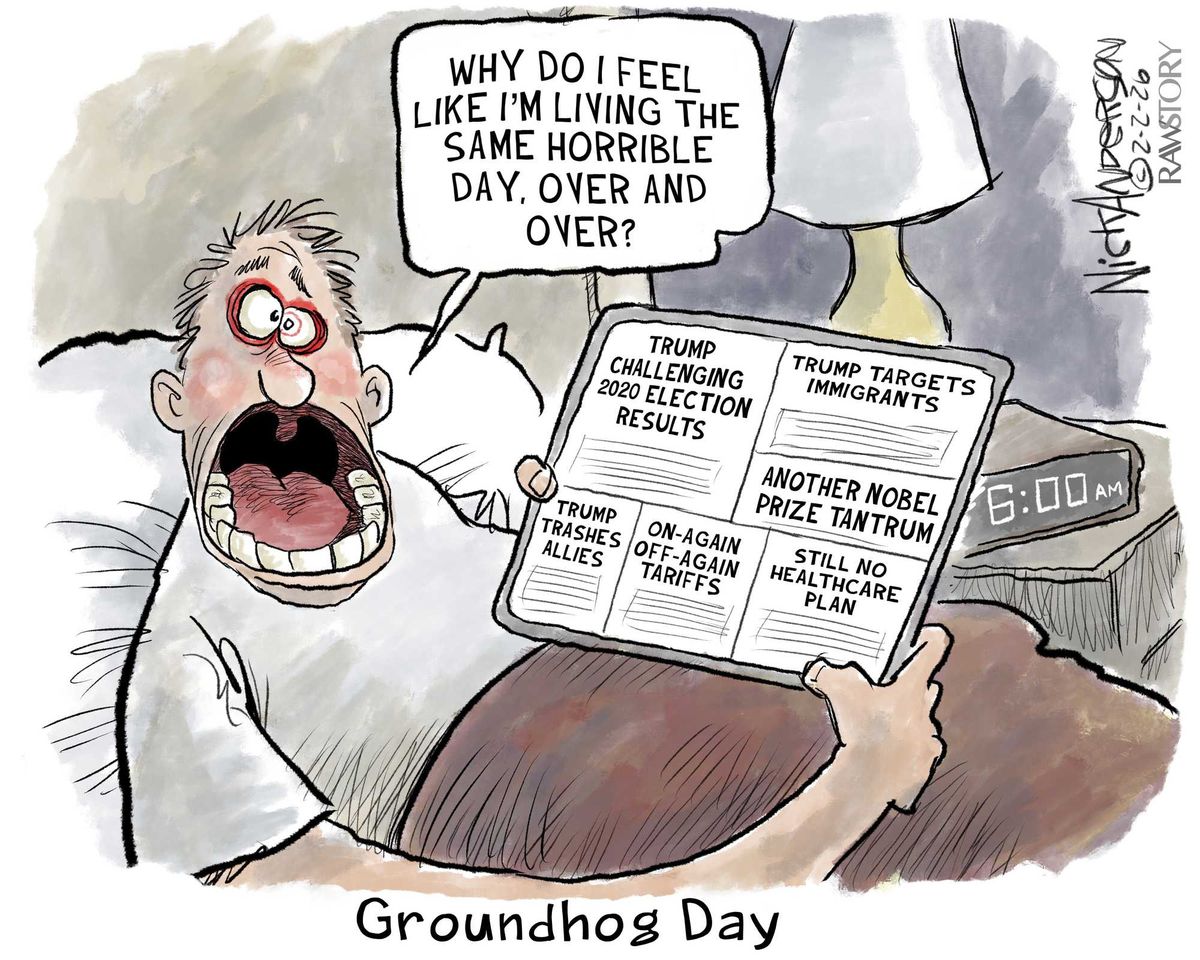
Trump's Groundhog Day nightmare
 Raw Story
February 2, 2026


Nick Anderson/Raw Story

Nick Anderson is a Pulitzer Prize-winning editorial cartoonist.
Thousands join Danish war vets’ silent march after Trump ‘insult’


By AFP
January 31, 2026


The protest was held under the banner 'No Words' -- describing how many felt about US President Donald Trump's dismissal of Danish soldiers' sacrifice

 - Copyright Ritzau Scanpix/AFP Emil Helms
Camille BAS-WOHLERT

Between 8,000 and 10,000 people joined an emotional silent march in Copenhagen on Saturday organised by Denmark’s Veterans’ Association to protest Donald Trump’s comments downplaying the role of non-US NATO troops in Afghanistan.

The association had expected well over a thousand people to take part, and Danes braved subzero temperatures en masse to support their veterans and the 44 Danes who died in Afghanistan.

Police told AFP they estimated the number of demonstrators were “at least 10,000”, while organisers put the turnout at between 8,000 and 10,000.

Trump sparked outrage in Denmark and across Europe on January 22 when he said European NATO troops “stayed a little back, a little off the front lines” during the 20-year conflict in Afghanistan.

The Scandinavian country fought alongside US forces during the Gulf War as well as Afghanistan and Iraq.

Gathering in Copenhagen’s Kastellet, or citadel, a brief ceremony was held at the monument to fallen soldiers before the procession began.

“The demonstration is called #NoWords because that really describes how we feel. We have no words,” the vice president of the association, Soren Knudsen, told AFP.

“Obviously, we also want to tell Americans that what Trump said is an insult to us and the values that we defended together.”

Some demonstrators waved red-and-white Danish flags and others were dressed in military uniform, as they marched quietly — no slogans or chanting — to the US embassy about two kilometres (1.2 miles) away.

Most were sombre, others were visibly emotional with tears streaming down their cheeks.

“We’re very happy that so many people turned out,” Knudsen told AFP outside the US embassy, pleased that veterans from the US and across Europe had also joined in.

“What Trump said was very insulting,” Henning Andersen, who served as a Danish UN soldier in Cyprus, told AFP.

“I have friends who were down there. Some of them were wounded, and they carry the war with them even today,” the 64-year-old said, four military medals pinned to his black veterans’ jacket.

“He’s saying things he doesn’t know the full truth about.”

One 58-year-old member of Denmark’s home guard, who gave her name only as Orum, also expressed anger over Trump’s remarks.

“How can he even say that? It’s insulting,” she said, clad in khaki fatigues and green beret.


– 44 flags –


Protesters at the front of the march carried a large red banner reading “NoWords”, while others carried hand-drawn signs. One said “Trump is so dumb”, while another held by a child read “Say sorry, Trump”.

In response to Trump’s claim, 44 Danish flags, which carried the names of the 44 Danish soldiers killed in Afghanistan, were placed on Tuesday in planters outside the US embassy in Copenhagen.

The embassy removed the flags, before apologising and replacing them.

“We have nothing but the deepest respect for Danish veterans and the sacrifices Danish soldiers have made for our shared security. There was no ill intent behind the removal of the flags,” the embassy said in a post on its Facebook page.

It noted that the planters were embassy property and not in the public domain, and the initial planting of the flags had not been coordinated with the embassy.

On Friday, the US ambassador placed 44 Danish flags in the flowerbeds.

On Saturday, 52 additional Danish flags were added, with names inscribed on them: 44 for the Danes who died in Afghanistan, and eight others for those killed in Iraq.

A minute of silence was also observed outside the embassy. One person laid down a wreath of red and white flowers.

Denmark has traditionally been an ardent US ally, and continues to call Washington its “closest ally” despite tensions over Trump’s recent interest in taking over Greenland, an autonomous Danish territory.


Trump revises Greenland plot with scheme to take it by 2029: insider


Ewan Gleadow
February 2, 2026
RAW STORY


Donald Trump has not let up on his plan to subsume Greenland into US territory, according to an insider.

Though the president has cooled off his rhetoric over taking the sovereign nation into U.S. control, an administration official speaking to Zeteo confirmed there is still an active interest in the country.

"He still wants it," the insider told Asawin Suebsaeng, who reported there is a plan in place to take Greenland into American control by 2029.

Writing in First Draft, Suebsaeng claimed, "But the damage has already been done – and the threat has not actually gone away. It, like Trump at a meeting, is only napping.

"Additionally, one Trump administration official relays that the president is willing to negotiate, but that Trump has recently expressed some wariness that the Europeans are trying to placate him with the military-base status quo that the Americans already enjoy on the territory.

"Other Trump advisers tell me that, when it comes to Greenland, the president is willing to take his foot off the MAGA-imperialism gas for now, but that little has changed with Trump’s desire.

"In recent conversations, since the crisis temporarily cooled, Trump has said he still believes Greenland should be an American territory, no one else’s, and that he wants it figured out by the end of this term in office, his advisers recount."

Jacob Funk Kirkegaard of the Peterson Institute for International Economics repeated claims that Trump wants Greenland for reasons of national security and raw mineral resources.

Speaking to CNN, he said, "If there was a ‘pot of gold’ waiting at the end of the rainbow in Greenland, private businesses would have gone there already.

"If given enough taxpayer dollars, private business would be willing to do almost anything. But is that a good foundation on which to purchase a territory? The answer is no in Greenland, just as it’s no in Venezuela."

Suebsaeng also claimed U.S. and European officials are "making nice again in public" though it appears to be more a chance for Trump to back down from bad publicity rather than anything else.

He wrote, "NATO gift-wrapped Trump a temporary, face-saving reprieve from his own blundering imperialism.


Once Again, the Cuban People Bear the Brunt of US Economic Warfare

The US embargo, as well as new sanctions ordered by Trump, is partly rooted in leftover Cold War ideology and geopolitical posturing, but largely appears to reflect personal vendetta and financial gain.


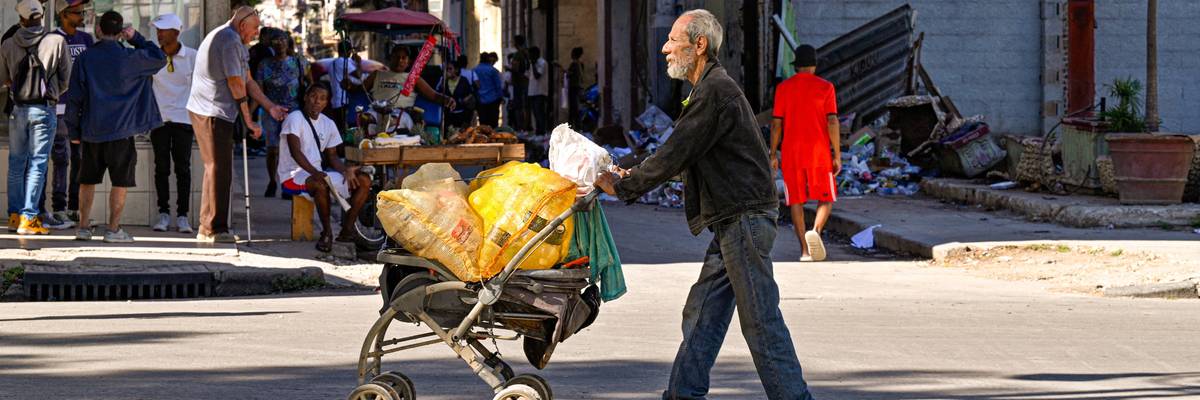
An elderly man transports recyclable material on a cart in Havana on January 6, 2026.
(Photo by Adalberto Roque / AFP via Getty Images)

Julia Norman
Feb 02, 2026
Common Dreams


The Trump administration’s latest threat to impose secondary tariffs on any nation selling oil to Cuba represents a dramatic and catastrophic tightening of the six-decade-long, deliberate chokehold the United States has maintained on Cuba’s access to essential resources. This act of collective punishment against the Cuban people, for alleged crimes the US government has scarcely attempted to substantiate, will be felt across every aspect of daily life.

According to Trump’s January 29 executive order, this latest escalation in economic warfare is framed as a response to the “unusual and extraordinary threat” the Cuban government allegedly poses to US national security. The order revives familiar Cold War language, including references to an obsolete Soviet-era listening station outside Havana, alongside sweeping allegations of harboring terrorism, fomenting regional instability, and engaging in hostile activity. While these all-too-familiar claims remain largely unfounded, debating the rhetoric is ultimately beside the point when the underlying policy objective is stated plainly by the Administration. “We would love to see the regime there [in Cuba] change,” Secretary of State Marco Rubio told the Senate Foreign Relations Committee last week, dispelling whatever ambiguity might have remained.


Cuba Vows to Defend Itself Against Trump to ‘The Last Drop of Blood’


‘Terrorists in Imperial Uniform’: US Forces Kill 32 Cubans During Venezuela Invasion

Sanctions have been a blunt, heavy-handed, and ultimately unsuccessful weapon of US policy toward Cuba. As the State Department admitted in 1960, they were intended to “bring about hunger, desperation, and the overthrow of government.” Enforced unilaterally and extraterritorially, US sanctions restrict not only Cuba’s ability to import and export goods, but also the willingness and feasibility of third countries to engage in trade with the island nation. In practice, sanctions function as a blockade encompassing food, medicine, and life-saving medical equipment.

Cuba’s remaining energy access has rapidly unraveled amid the US government’s latest military escalation in the region. Following the US kidnapping of Venezuelan President Nicolás Maduro and the Trump administration’s effective seizure of Venezuela’s oil sector, President Trump declared on Truth Social that “there will be NO MORE OIL OR MONEY GOING TO CUBA—ZERO.”

While restrictions on oil are often portrayed through images of rolling blackouts and hours-long diesel lines, the full humanitarian and economic consequences are far more severe.

In the weeks since Venezuelan supplies were abruptly cut off, Mexico became Cuba’s last remaining external source of fuel. In 2025, Mexico had already surpassed Venezuela as Cuba’s main oil supplier, exporting roughly 12,300 barrels per day, or about 44 percent of the island’s crude imports. Following the imposition of the tariff, Trump has effectively cut off that lifeline. Mexican President Claudia Sheinbaum has neither denied reports that shipments were halted amid fears of reprisals nor downplayed her government’s efforts to explore alternatives to support the island. Beneath the geopolitical headlines, Cubans already living with the cascading impacts of prolonged blackouts now face an acute energy crisis. Estimates suggest the country has no more than two weeks of oil reserves at current demand, making widespread power outages inevitable and pushing essential services to the brink of collapse.

The international community has long condemned the United States’ cruel and anachronistic policies toward Cuba. For more than 33 years, the United Nations General Assembly has overwhelmingly voted to call for an end to the US economic embargo. In November 2025, Alena Douhan, UN Special Rapporteur on the negative impact of unilateral coercive measures, likewise urged the US government to end sanctions and economic restrictions that isolate Cuba from international cooperation and financial systems, and instead to “settle disputes in accordance with the principles and norms of international law.” In the formal report, Douhan underscored the human toll on Cubans: shortages of fuel, electricity, water, food, medicine, and essential machinery, combined with the emigration of skilled workers, are inflicting “severe consequences for the enjoyment of human rights, including the rights to life, food, health, and development.”

While restrictions on oil are often portrayed through images of rolling blackouts and hours-long diesel lines, the full humanitarian and economic consequences are far more severe. Fuel powers irrigation pumps and farm machinery, electricity keeps processing plants and refrigeration running, and diesel moves food from fields to markets and ports. Energy and fuel shortages constrain farm-level production and disrupt processing, preservation, and distribution, delaying or reducing food availability and causing perishable goods to spoil. The result is serious losses for both markets and households. Reporting from the Food and Agriculture Organization (FAO) underscores a global pattern, including in Cuba, where energy shortages directly trigger food insecurity, disrupting production, milling, and distribution networks.

Cuba’s limited access to foreign currency and global markets further compounds these pressures. Rising transport costs, canceled shipping contracts, and banking restrictions delay even UN technical assistance projects, including food aid. Diplomatic missions, humanitarian organizations, and individuals regularly report difficulties in sending essential goods—and face the risk of losing Electronic System for Travel Authorization (ESTA) status simply for working in Cuba. Cuban enterprises also struggle to pay for certifications or purchase goods from US companies, forcing longer and more expensive alternative routes. For example, the World Food Program has faced delays in procuring and shipping fortified foods to Cuba in recent years, in part because companies are unwilling to send shipments to Cuban ports. In another striking case, only 9 of 518 requests from the Cuban agricultural sector for tractors, motors, batteries, forklifts, and spare parts were approved in 2022, as foreign suppliers feared US retribution.

Since 2000, food and agricultural products have technically been exempt from the US trade embargo on Cuba—a concession often cited by officials to argue that sanctions do not target the Cuban population. In practice, however, this exemption is largely illusory. Under the Trade Sanctions Reform and Export Enhancement Act, Cuba is prohibited from purchasing US food on credit; all transactions must be paid in cash and in advance, before shipment. For a country with chronic foreign exchange shortages and virtually no access to international credit, this is punitive. Additionally, because Cuba remains on US sanctions watch lists, foreign banks face legal and financial risk for facilitating transactions. The result is that Cuba has almost no access to trade credit, short-term financing, or conventional loans that most countries rely on to import food. Even when food is legally available, cash-only prepayment forces the government to divert scarce hard currency from other essential needs or to forgo imports entirely. This is not a neutral or humanitarian exception, but a structural barrier that both intensifies and contributes to Cuba’s domestic challenges, including limited access to credit for producers, volatile food prices, and inadequate infrastructure for distributing agricultural goods. Under Trump’s latest measure, many Cubans will struggle even more to secure even their most basic food needs—a crisis that has been building steadily over the past year.

The public health risks of these new restrictions are also grave. Cuba’s health care system is already under immense pressure from chronic energy shortages. Pharmaceutical plants struggle to operate, power outages threaten the spoilage of critical medications and vaccines, and despite government priority afforded to ambulances and mobile medical units, fuel shortages remain a consistent challenge. Hospitals have been forced to make impossible choices, prioritizing ICUs and operating rooms over general wards. Across the country, patients have gone without oxygen, dialysis treatments have been interrupted, and have been forced to rely on cellphone flashlights during prolonged blackout caused by a lack of oil for generators.

As early as the late 1990s, public health experts at the American Public Health Association warned that Cuba’s comparatively sophisticated and comprehensive healthcare system was “being systematically stripped of essential resources” due to US sanctions. Their year-long study concluded that the embargo had led to a significant rise in suffering, and even deaths, and placed severe strain on healthcare infrastructure by limiting access to electricity, oil, diesel, and gasoline.

Energy shortages also threaten Cubans’ access to water. Outages directly disrupt pumps that supply households in the capital, and without fuel and reliable transportation, emergency cistern deliveries are severely limited. Once more, US sanctions compound these shortages through long-standing restrictions on water treatment chemicals and spare parts for infrastructure, resulting in serious reductions in the availability of safe drinking water and elevated risks of waterborne diseases.

Ultimately, Trump’s latest tariff is not an abstract “coercive” policy—it is a deliberate attack designed to destabilize life for ordinary Cubans. It functions as a state-sanctioned mechanism of harm, forcing citizens to shoulder the costs of political pressure. While the Cuban government may try to adapt through rationing, subsidies, or resource reallocation, ordinary people are facing the life-altering consequences of scarcity and energy insecurity.

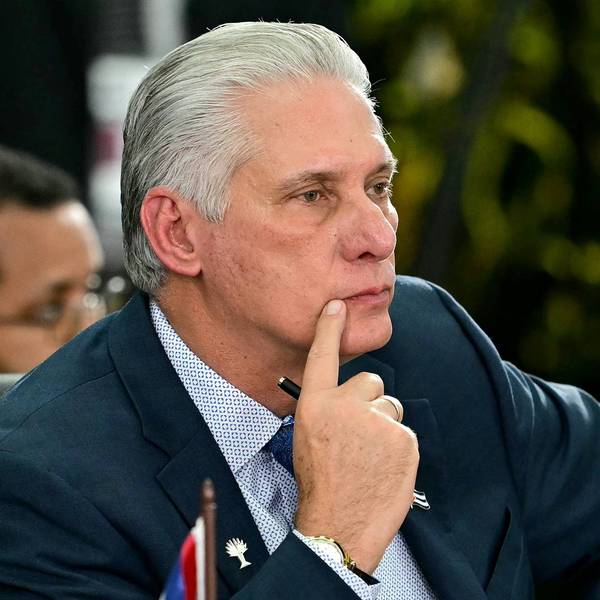
The Cuban government has responded with fierce condemnation. On January 30th, President Miguel Díaz-Canel wrote on social media that Trump’s action “exposes the fascist, criminal, and genocidal nature” of the administration, which has “hijacked the interests of the American people for purely personal gain.” Cuban Foreign Minister Bruno Rodríguez also denounced the measure, calling it part of a broader US strategy to dominate the hemisphere. He wrote, the US seeks to “submit them [the Americas’ to its dictates, deprive them of their resources, mutilate their sovereignty and deprive them of their independence,” and warned that “every day there is new evidence showing that the only threat to peace, security and stability in the region…is the one exerted by the US government against the peoples and nations of our America.”

In essence, the US is inciting chaos by restricting basic necessities of life—supposedly to stop the Cuban government from “incit[ing] chaos by spreading communist ideology across the region.” The policy is partly rooted in leftover Cold War ideology and geopolitical posturing, but largely appears to reflect personal vendetta and financial gain.

The consequences, regardless, are unmistakably humanitarian–and Trump himself seems unconcerned. “It doesn’t have to be a humanitarian crisis,” he told reporters on Saturday, January 31, dressed in a tuxedo aboard Air Force One, adding, “I think, you know, we’ll be kind.” The Cuban people bear the full brunt of that ‘kindness.’


Our work is licensed under Creative Commons (CC BY-NC-ND 3.0). Feel free to republish and share widely.


Julia Norman
Julia Norman is an independent writer and researcher from Los Angeles, California.
Full Bio >


TRUMP LIES
US talking deal with ‘highest people’ in Cuba: Trump


By AFP
February 1, 2026


Vehicles wait in line to refuel at a gas station in Havana, with Cuba's communist government accusing US President Donald Trump of trying to 'asphyxiate' the island's economy
- Copyright AFP/File ADALBERTO ROQUE

US President Donald Trump said Sunday that Washington was negotiating with Havana’s leadership to strike a deal, days after he threatened Cuba’s reeling economy with a virtual oil blockade.

“Cuba is a failing nation. It has been for a long time, but now it doesn’t have Venezuela to prop it up. So we’re talking to the people from Cuba, the highest people in Cuba, to see what happens,” Trump told reporters at his Mar-a-Lago estate in Palm Beach, Florida.

“I think we’re going to make a deal with Cuba.”

Trump gave no indication what such a deal might entail.

His second administration has been ratcheting up pressure on the communist-run island nation off south Florida since the January 3 US ouster of Venezuelan leader Nicolas Maduro, whose country was a close ally of Havana and a crucial source for oil exports to Cuba.

On Thursday, the Republican president signed an executive order threatening to impose additional tariffs on countries that sell oil to Cuba.

The following day, Cubans were queueing up in long lines at gas stations in Havana.

Mike Hammer, the US charge d’affaires to Cuba since 2024, said during a visit this weekend to Trinidad province in central Cuba that he encountered residents who “shouted some insults” at him.

“I think they belong to a certain party, but I know they do not represent the Cuban people, the ordinary Cubans,” Hammer said in a video posted to X, in reference to the Cuban Communist Party.

Meanwhile, the US State Department’s Bureau of Western Hemisphere Affairs said in a statement on X: “The illegitimate Cuban regime must immediately stop its repressive acts of sending individuals to interfere with the diplomatic work of CDA Hammer and members of the @USembcuba team.”

“Our diplomats will continue to meet with the Cuban people despite the regime’s failed intimidation,” the agency added.

Trump and Secretary of State Marco Rubio, the Miami-born son of Cuban exiles, have made no secret of their desire to bring regime change in Havana.

After Maduro’s fall, the US president warned Havana to “make a deal soon” or face unspecified consequences.

“NO MORE OIL OR MONEY FOR CUBA: ZERO!” Trump had stated earlier, claiming Cuba was “ready to fall.”

Mexican President Claudia Sheinbaum said Sunday her administration was planning to send humanitarian aid to Cuba, including “food and other products,” while working on a diplomatic solution to continue sending oil to the island despite Trump’s threatened tariffs.

“We never discussed with President Trump the issue of oil with Cuba,” Sheinbaum added, after the two leaders had spoken by phone Thursday.

For its part, Cuba’s government has accused Trump of seeking to economically strangle the island, where daily power cuts are intensifying and lines at gas stations keep getting longer.
FENTANYL CRISIS

‘It wasn’t working’: Canada province ends drug decriminalization

DRUG DECRIMINALIZATION IS A FEDERAL RESPOSIBILITY THAT'S WHY

By AFP
January 31, 2026


A 2016 photo showing a mural in Vancouver’s Downtown Eastside, which remains an area home to drug users - Copyright AFP Deborah JONES


Nav Rahi with Ben Simon in Toronto

Over 35 years as a drug user, Vancouver resident Garth Mullins said he’s had “hundreds and hundreds” of interactions with police, and long believed drug decriminalization was smart policy.

“I was first arrested for drug possession when I was 19, and it changes your life,” said Mullins, who is now in his 50s and was an early backer of Canadian province British Columbia’s decriminalization program that ended on Saturday.

“That time served inside can add up for a lot of people. They do a lifetime jolt in a series of three‑month bits,” he told AFP.

BC’s three-year experiment with drug decriminalization, which launched in 2023 and shielded people from arrest for possession of up to 2.5 grams of hard drugs, was groundbreaking for Canada.

Many praised it as a bold effort to ensure the intensifying addiction crisis devastating communities across the country was treated as a healthcare challenge, not a criminal justice issue.

But on January 14, BC’s Health Minister Josie Osborne announced the province would not be extending the program.

“The intention was clear: to make it easier for people struggling with addiction to reach out for help without fear of being criminalized,” Osborne said.

The program “has not delivered the results we hoped for,” she told reporters.

For Mullins, the province’s desired results were never realistic.

The former heroin user, who currently takes methadone, is an activist and broadcaster who co‑founded the Vancouver Area Network of Drug Users (VANDU), which advised BC’s government on decriminalization.

At VANDU’s office in Vancouver’s Downtown Eastside neighborhood, home to many drug users, the walls are full of pictures honoring those who have died from overdose.

“The idea behind decriminalization was one simple thing: to stop all of us from going to jail again and again and again,” he said.

Breaking the cycle of arrests is crucial because criminal records make it more difficult to find work and housing, often perpetuating addiction, experts say.

But thinking decriminalization could help steer waves of users into rehab was misguided, and misinforming the public about the possible outcomes of the policy risked a backlash, Mullins said.

“For everybody out there, in society, sending fewer junkies to jail might not sound like a good thing to do.”


– Plan not ‘sufficient’ –


After the province announced the program’s expiration, Canadian media was filled with critics who said it had been mishandled.

Vancouver police chief Steven Rai said his force had been willing to support the plan, but “it quickly became evident that it just wasn’t working.”

Decriminalization “was not matched with sufficient investments in prevention, drug education, access to treatment, or support for appropriate enforcement,” he added.

Cheryl Forchuk, a mental health professor at Western University who has worked on addiction for five decades, said BC “never really fully implemented” decriminalization because the essential complementary programs — especially affordable housing supply — were never ramped up.

“It was like they wanted to do something, but then really didn’t put the effort into it and then said, gee, it didn’t work,” she told AFP.


– Public safety –


BC’s experience mirrors that in the US state of Oregon, which rolled back its pioneering drug decriminalization program in 2024 after a four-year trial.

Like in Oregon, BC’s program faced fierce criticism, with many saying public safety was threatened by a tolerance of open use.

A flashpoint moment in the western Canadian province was a 2024 incident where a person was filmed smoking what appeared to be a narcotic inside a Tim Hortons, the popular coffee shop chain frequented by families across the country.

Local politicians in Maple Ridge, BC, attributed the incident to a permissiveness about drugs ushered in by decriminalization.

But for Mullins, the incident spoke to broader misconceptions about the intent of the policy.

Decriminalization did not allow for drug use inside a restaurant, and the person could have been arrested.


Drug user advocates, he added, don’t want policy that makes the broader public feel threatened.

“We need something where everybody feels safe, right? If people who are walking with their kids don’t feel safe, that’s a problem for me,” he said.

But, he added, security also matters to users for whom “the world feels very scary and unsafe.”
FOOD FIGHT

France tightens infant formula rules after toxin scare


By AFP
January 31, 2026


The infant formula industry has been rocked by several firms recalling batches that could be contaminated with cereulide, a toxin that can cause nausea, vomiting, and diarrhoea - Copyright AFP Fred TANNEAU


Mathilde DUMAZET

France has said it will impose stricter limits on the acceptable level of a toxin called cereulide in infant formula after potentially contaminated products were recalled in over 60 countries.

The infant formula industry has been rocked by several firms recalling batches that could be contaminated with cereulide, which can cause nausea, vomiting, and diarrhoea.

French authorities launched an investigation into the deaths in December and January of two babies who were thought to have drunk possibly contaminated powdered milk.

At this stage investigators have not established a direct link between the symptoms and the milk consumed.

The recalls have raised fresh questions about food safety challenges in the global supply chain.

There is no established safety limit for cereulide in infant formula.

“Protecting the health of infants is the top priority for health authorities,” the French agriculture ministry said late Friday.

The new threshold will be 0.014 micrograms of cereulide per kilogram of body weight, compared to 0.03 micrograms currently, it said.

This is the second lowering of a threshold in France in less than two weeks.

The recall of potentially contaminated infant formula has heaped scrutiny on Chinese firm Cabio Biotech, the supplier of an ingredient used in infant formula which is suspected of being tainted.

Headquartered in the central Chinese city of Wuhan, Cabio Biotech is one of the world’s largest producers of ARA, a fatty acid used primarily in baby formula and food products.

The French authorities have referred to a single “Chinese supplier” without naming it.

This week the European Commission asked the European Food Safety Authority (EFSA) to establish a standard for cereulide in children’s products.

It will issue an opinion on February 2.

The European Centre for Disease Prevention and Control said it had received reports of diarrhoea cases in infants following consumption of the products in question, but “no severe cases have been reported”.


– Lawsuit –


Several manufacturers, including European giants like Nestle, Danone, and Lactalis, have issued recalls of infant formula in France and dozens of countries since December.

The toxin is rare and difficult to detect, and some recalls have been carried out as a precaution, some manufacturers said.

On Thursday, Nestle provided a detailed timeline of its recalls, acknowledging that around 10 days had passed between the first detection of cereulide in late November and the first recalls on December 10.

The Swiss food conglomerate argued that, in the absence of “European regulations on the presence of cereulide in food”, it had followed standard procedures.

The detection led to the precautionary recall of all products in contact with the production line where cereulide had been detected.

The group stressed that it was the first company to detect the problem.

Foodwatch, a European consumer association, has filed a lawsuit accusing manufacturers and the government of acting too slowly.

Eight French families, who said their babies suffered severe digestive problems after drinking formula named in the recall, have joined the lawsuit.

On Friday, Nestle refuted the accusations made by the watchdog, saying it reserved the right to respond in court “if Foodwatch continues to disseminate misleading information”.

“Testing for bacteria of the Bacillus cereus family is routinely offered,” Francois Vigneau of lab testing firm Eurofins said last week. He added however that tests for cereulide were “not part of standard checks”.

“In the current context of milk recalls, this test is currently being requested because all stakeholders in dairy products in general, and infant formula in particular, are concerned about the situation,” added Vigneau.

According to World Health Organisation estimates from 2019, 23 million people in Europe fall sick from eating contaminated food every year, and an estimated 4,700 people die.
STRANGE FRUIT
Iguanas fall from trees in Florida as icy weather bites southern US


By AFP
February 1, 2026


A cold-stunned green iguana lies on the ground on February 01, 2026 in Miami Beach, Florida - Copyright AFP/File TOSHIFUMI KITAMURA
Matthew PENNINGTON

Iguanas stunned by cold temperatures dropped from trees in usually balmy Florida on Sunday as icy conditions blasted southern US states, dumping nearly a half-meter of snow in some areas and whipping up high winds that caused traffic chaos.

The heaviest snows were reported in North Carolina — a state that rarely sees snow other than in its highest elevations. The city of Lexington saw 16 inches (40 centimeters), and Faust in the state’s Walnut Mountains got 22 inches (56 centimeters).

State Governor Josh Stein reported 1,000 road collisions and two fatalities on Saturday and Sunday, and urged people to stay off the roads. He also advised citizens to be aware of the symptoms of frostbite.

The latest bout of extreme weather came about a week after a monster storm pummeled a wide swath of the United States, killing more than 100 people and leaving many communities struggling to dig out from snow and ice.

While Florida did not see snow like the Carolinas, Georgia, Tennessee, Kentucky and the southern part of Virginia, it saw record low temperatures, with the mercury touching 24F (-4C) in Orlando, the lowest recorded in February since at least 1923. Typically at this time of year, the temperature ranges between daily lows of 12C and highs of 23C.

Florida’s WPLG 10 TV network, based in Miami, reported that it was “raining iguanas” on Sunday morning, as the cold-blooded reptiles fall from trees when the temperature gets too low.

Videos posted on social media showed the stunned creatures on sidewalks after falling from trees in southern parts of the state.

Jessica Kilgore, who runs a service called Iguana Solutions that removes invasive species, told WPLG 10, she has collected hundreds of pounds worth of the lizards, both alive and dead, during the cold snap.

Florida’s Fish and Wildlife Conservation Commission issued an executive order, seen by AFP, allowing people to transport iguanas — which run wild in the state but can’t be owned without a permit — to commission offices.

The National Weather Service predicted that heavy snows would taper off in the Carolinas on Sunday but forecast high winds to spread up the east coast of the United States as an intense cyclone “slides out to sea.”

Governor Stein said that the highway running through North Carolina’s Outer Banks — a sliver of land filled with beach homes that juts out from the Atlantic coast — saw overwash from the ocean due to heavy winds and high tides and could take a while to reopen.

The weekend storm forced more than 800 flight cancellations on Sunday at Charlotte Douglas International Airport in North Carolina, a major hub for American Airlines, data from the tracker FlightAware showed.

About 158,000 customers remained without power Sunday, mostly in the south, according to poweroutage.us, with Mississippi, Tennessee, Florida and Louisiana hardest hit.
BAN DEEP SEA MINING

Japan says rare earth found in sediment retrieved on deep-sea mission


By AFP
February 1, 2026


Japan's deep-sea drilling vessel Chikyu has retrieved sediment containing rare earth at a depth of 6,000 metres - Copyright AFP/File TOSHIFUMI KITAMURA

Sediment containing rare earth was retrieved from ocean depths of 6,000 metres (20,000 feet) on a Japanese test mission, the government said Monday, as it seeks to curb dependence on China for the valuable minerals.

Japan says the mission was the world’s first bid to tap deep sea rare earths at such a depth.

“Details will be analysed, including exactly how much rare earth is contained” in the sample, government spokesman Kei Sato said, calling it “a meaningful achievement both in terms of economic security and comprehensive maritime development”.

The sample was collected by a deep-sea scientific drilling boat called the Chikyu that set sail last month for the remote island of Minami Torishima in the Pacific, where surrounding waters are believed to contain a rich trove of valuable minerals.

It comes as China — by far the world’s biggest supplier of rare earths — ramps up pressure on its neighbour after Prime Minister Sanae Takaichi suggested in November that Tokyo may react militarily to an attack on Taiwan, which Beijing has vowed to seize control of by force if necessary.

Beijing has blocked exports to Japan of “dual-use” items with potential military uses, fuelling worries in Japan that Beijing could choke supplies of rare earths, some of which are included in China’s list of dual-use goods.

Rare earths — 17 metals difficult to extract from the Earth’s crust — are used in everything from electric vehicles to hard drives, wind turbines and missiles.

The area around Minami Torishima, which is in Japan’s economic waters, is estimated to contain more than 16 million tons of rare earths, which the Nikkei business daily says is the third-largest reserve globally.

These rich deposits contain an estimated 730 years’ worth of dysprosium, used in high-strength magnets in phones and electric cars, and 780 years’ worth of yttrium, used in lasers, the Nikkei said.

“If Japan could successfully extract rare earths around Minami Torishima constantly, it will secure domestic supply chain for key industries,” Takahiro Kamisuna, research associate at The International Institute for Strategic Studies (IISS), told AFP.

“Likewise, it will be a key strategic asset for Takaichi’s government to significantly reduce the supply chain dependence on China.”

Beijing has long used its dominance in rare earths for geopolitical leverage, including in its trade war with US President Donald Trump’s administration.

China accounts for almost two-thirds of rare earth mining production and 92 percent of global refined output, according to the International Energy Agency.
Snapchat blocks 415,000 underage accounts in Australia


By AFP
February 2, 2026


Snapchat says teens may be skirting a social media ban in Australia 
- Copyright AFP/File Kirill KUDRYAVTSEV

Snapchat has blocked 415,000 accounts under Australia’s social media ban for under-16s, the company said Monday, but warned some youngsters may be bypassing age verification technology.

The platform urged the Australian authorities to oblige app stores to check users’ ages as an “additional safeguard” for the world-first crackdown.

Platforms including Snapchat, Meta, TikTok and YouTube must stop underage users from holding accounts under the legislation, which came into effect on December 10.

Companies face fines of Aus$49.5 million (US$34 million) if they fail to take “reasonable steps” to comply.

Australia’s eSafety online regulator reported last month that tech giants had already blocked 4.7 million accounts, delivering “significant outcomes”.

As of the end of January, Snapchat said it had blocked or disabled 415,000 Snapchat accounts in Australia belonging to under-16s.

“We continue to lock more accounts daily,” it said in an online statement.

But the law leaves “significant gaps”, Snapchat said, arguing that age estimation technology was only accurate to within two to three years.

“In practice, this means some young people under 16 may be able to bypass protections, potentially leaving them with reduced safeguards, while others over 16 may incorrectly lose access.”

Snapchat joined billionaire Mark Zuckerberg’s Meta in calling on Australia to require app stores to check users’ ages before allowing downloads.

“Creating a centralized verification system at the app-store level would allow for more consistent protection and higher barriers to circumventing the law,” Snapchat said.

The platform said it did not believe an outright ban was the right approach.

Snapchat said it understood Australia’s objectives and wanted to protect people online, but did not agree its platform should be covered by the social media ban.

“In the case of Snapchat — which is primarily a messaging app used by young people to stay connected with close friends and family — we do not believe that cutting teens off from these relationships makes them safer, happier, or otherwise better off,” it said.
Montreal studio rises from dark basement office to ‘Stranger Things’


By AFP
January 31, 2026


Visual effects artists at work at Rodeo FX in Montreal 
- Copyright AFP Sebastien ST-JEAN


Daphné LEMELIN

The visual effects studio that worked on the hit Netflix show “Stranger Things” was born 20 years ago in a dim basement in Old Montreal.

“Over time, it grew. We’ve seen really strong growth through the years,” Ara Khanikian, who supervises visual effects at Rodeo FX, told AFP at the studio’s current home, a modern office with elegant wood paneling.

But it all “really started in the basement of the building next door,” he said with a grin.

Though still headquartered in the Canadian city far from the action in Hollywood, Rodeo FX now has offices in Los Angeles, Paris and Toronto — establishing itself as a force in an industry dominated by studios tied to behemoths like Disney and Warner Bros.

The studio’s list of past projects includes major hits, including titles from Tom Cruise’s “Mission Impossible” franchise.

But “Stranger Things,” the science fiction and horror series that has shattered streaming records since it debuted in 2016, is a highlight.

Rodeo FX worked on seasons four and five of the Netflix show that follows a group of teenagers in small town America as they take on supernatural creatures and a parallel universe.

Philip Harris-Genois, a 3D modeler at Rodeo FX, worked tirelessly for a year to perfect Demogorgon, the monster whose petaled face opens to reveal rows of menacing teeth.

Harris-Genois said part of his job was to make the beast “even more imposing.”

Demonstrating the work, he added a scar to its chest with a deft mouse click.

Shaping Demogorgon, detail by detail, was like “making a clay sculpture,” he said.

Harris-Genois said he took inspiration from a lion when creating Demogorgon’s threatening posture — toes perched, ready to pounce.

– ‘A lot of love’ –

For Julien Hery, a supervisor on projects including “Stranger Things,” extraordinary visual effects “often draw inspiration from nature.”

For the first season of “Dune: Prophecy,” the HBO Max series released in 2024, the imperial palace was inspired by the Mediterranean coastline.

“We researched the vegetation. We looked for what kinds of trees grow along the Mediterranean coast, what kinds of rock,” so viewers will be convinced by the visual effects, he said.

Turning a concept into a finished product is time consuming work that involves animation, simulation, lighting and integrating the effects in a sequence filmed with live actors.

The fight sequence between Demogorgon and Jim Hopper (played by David Harbour) in a Soviet prison in Season 4 of Stranger Things — a scene of less than seven minutes — took up to a year of work, from conceptualization to final cut, Hery said.

“We obviously spend a lot of time on our projects,” he said.

“Season 4 was more than two years of work…It becomes very personal. We put a lot of love into it.”

– Critical acclaim –

That process appears to be paying off.

Among the studio’s major achievements is its work on the 2014 Best Picture “Birdman,” where visual effects created the impression of the film being shot in a single take.

It also contributed to the dream-like world in “Dune: Part 2,” which won the Oscar for Best Visual Effects last year.

Rodeo FX has also earned four nominations at the VES Awards, which honor the visual effects industry in a ceremony set for February 25.

And 2026 should include more high-profile work, said Hery.

“There are plenty of projects we can’t really reveal,” he told AFP, but confirmed the studio will be working on the Marvel blockbuster “Avengers: Doomsday” and the second season of “Monarch.”
How Lego got swept up in US-Mexico trade frictions

By AFP
January 31, 2026


Mexican Lego plants have been hit by rising costs of inputs after the government, under pressure from Washington, imposed stiff tariffs on a range of Chinese imports - Copyright AFP/File kena betancur


Yussel GONZALEZ

Manufacturing a Barbie or a Lego brick requires large quantities of plastic, much of which comes from China, the world’s largest producer of the material.

So when Mexico hiked tariffs on the Asian giant at the start of 2026, its toy manufacturers, including local factories of Lego and Barbie-maker Mattel, had mixed emotions.

On the one hand, they cheered the clampdown on cheaper Asian imports but on the other were left wincing at the rising costs of their inputs.

The toy sector is one of a raft of industries impacted by a year of simmering trade tensions between US President Donald Trump’s administration and Mexico, as well as China.

Mexico’s car assembly industry, one of the biggest in the world, is also holding its breath, given its reliance on Chinese-produced car parts.

President Claudia Sheinbaum argues that the tariffs on China, India and other countries with which Mexico has no trade deal, aim to protect Mexican industry from cut-price competition.

Analysts see the levies, however, as an attempt to appease Trump in the run-up to a high-stakes review of Mexico’s three-decade-old trilateral free trade deal with the United States and Canada, USMCA.

Trump accuses China of using Mexico as a tariff-free backdoor into the United States and complains that the USMCA, which his first administration negotiated, is weighted against Washington.

Saving the treaty is crucial for Mexico, which sends over 80 percent of its exports north of the border.

Some Mexican manufacturers say they are prepared to accept the pain of higher input costs if it leads to a positive outcome in the USMCA talks.


– Plastic and chips –


Polyethylene, the plastic used to make toys, is produced locally by the state-owned oil company Pemex.

But according to the toy industry, the company only manufactures 20 percent of what is needed, meaning the rest must be imported.

Many toys now also contain electronic chips, which also come primarily from Asia.

“If you, as a manufacturer, don’t have the supply (of inputs) in the country, what do you do? You go out and find them,” Miguel Angel Martin, president of the Mexican Toy Industry Association, told AFP.

He noted that the Lego sets purchased in the United States and Canada are all made in Mexico and said he hoped that the USMCA review would “be fair and benefit to all three countries.”


– ‘Playing both sides’ –


China is the elephant in the room in the USMCA negotiations.

Canada has been working to diversify its trade relations after being walloped by Trump’s tariffs offensive. In mid-January, it signed a preliminary trade agreement with Beijing.

The agreement sparked a furious reaction from Trump, who threatened to impose 100 percent tariffs on Canada if it becomes a “drop off port” for Chinese products destined for the United States.

Canadian Prime Minister Mark Carney downplayed Trump’s broadside as part of the hurly burly of the USMCA negotiations.

Juan Francisco Torres Landa, a partner at the international law firm Hogan Lovells who focuses on deal making, said Sheinbaum was under pressure to stop “playing both sides” between the United States and China.

At the same time, he said, “given our economic dependence (on the United States and China), there is no other option” to working with both.


– Survival mode –


Some Mexican industries clearly stand to benefit from Sheinbaum’s tariffs blitz, such as the textile and footwear sectors.

“In recent years, we have been hit hard by… unfair competition in international trade,” Juan Carlos Cashat, president of a footwear manufacturers’ association in central Guanajuato state, told AFP.

“We hope this can have a positive effect in the medium or long term,” he said.

Toy manufacturers, by contrast, are in “survival” mode, according to the toy industry association’s Martin.

He added that while the USMCA is being renegotiated, the industry will try to absorb most of the costs of its higher inputs.

But if the review, due to be completed by July 1, “does not produce a reasonably good outcome for the industry,” he said, “then the consumer will be the one to pay the costs.”