Monday, February 09, 2026


New trade routes in a fractured world

New trade routes in a fractured world
By bne IntelliNews February 6, 2026

US President Donald Trump has upended the liberal world order that promoted free trade agreement and cooperation, for a more selfish protectionist “me first” mindset. Trump is actively dismantling the rules-based international order, restricting competition and turning tools like tariffs into political weapons. As part of an new economic paradigm that is a return to a pre-world war imperialistic transactional approach he is also trying to divide the world into spheres of influence again as part of his updated Monroe Doctrine outlined in his National Security Strategy released at the end of last year. 

The result is a scramble to diversify away from US trade. In her speech announcing what she called the “mother of all trade deals” with India in January, European Commission President Ursula von der Leyen said the motivation was that “trade has been weaponised”. 

After 20 years of negotiation, the EU suddenly felt compelled to close the agreement, which will slash duties on Indian imports and pry open a long-protected market. Brussels feels exposed to the increasingly unpredictable US, Europe’s biggest trade partner, accounting for 20% of exports and $4.5 trillion in annual trade.

In the same week, the EU also moved to finalise a near-identical deal with Mercosur in Latin America, likewise decades in the making. Neither deal offsets reliance on the US market, but both mark the start of a long process to spread risk and diversify global business.

However, the process started well before Trump took office. After two decades of prosperity fuelled by “globalisation” following the collapse of the socialist experiment in 1991, the “rise of the rest” reached a point at the start of this decade where tensions between east and west were starting to grow as countries like Russia and China began to flex their economic muscles.

That led a fractured world where smaller countries began to coalesce into groups in either the US-led or China-led camps. This process was accelerated by the global pandemic in 2020 when companies suddenly had to shorten supply chains and reshoring operations. Trump has only catalysed a breaking up of global trade that was already well underway, amply illustrated by the slow death of the WTO, which at one point a decade ago was supposed to be regulator of globalised trade, but today is totally dysfunctional.

Russia’s invasion of Ukraine and ensuing sanctions further redirected investment into new Eurasian trade routes. The Middle Corridor, linking Europe and East Asia via Central Asia and the Caucasus while skirting Russia’s southern flank, has gained prominence. Trump has only catalysed a fragmentation of global trade that was already underway, illustrated by the slow decline of the WTO, once the regulator of globalised trade, now largely paralysed.

South-South trade grows

As bne IntelliNews has reported, the Global South is now rapidly forming alternatives to the Western-led global order, which Chinese President Xi Jinping and Russian President Vladimir Putin has criticised as the “unipolar” world – a US hedgemony. In their alternative multipolar world order, Global Emerging Markets Institutions (GEMIs) are being rapidly rolled out or beefed up to manage geopolitics, trade and security – new institutions that the Western powers are largely excluded from such as the BRICS+ or G20.  It’s still a work in process, but trade is already rapidly shifting to follow the contours of the new realities.

Entering 2026, trade tensions are rising between the US and its partners, while trade is on the increase within partnerships and blocs that do not include Washington, as set out in a map shared by analysts from research firm BMI in a recent webinar.
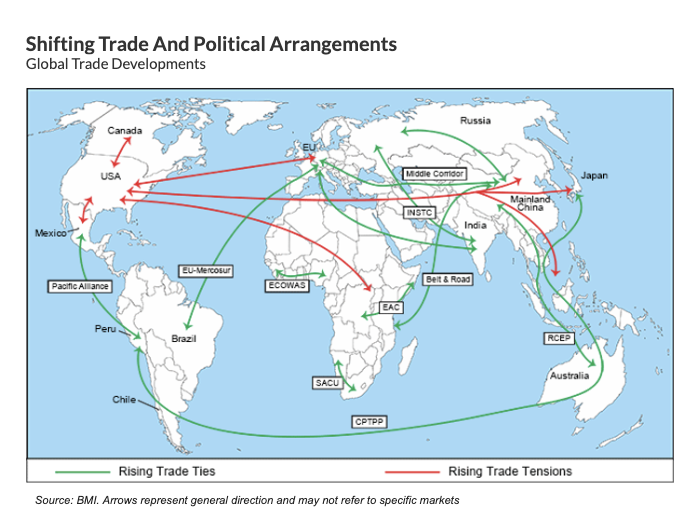
 

A new report from the United Nations Conference on Trade and Development (UNCTAD) also says that global trade “enters 2026 under mounting pressure from slower growth, geopolitical fragmentation, accelerating digital and green transitions and tighter national regulations”. 

According to UNCTAD, “These forces are reshaping trade flows, investment decisions and global value chains, with the greatest risks and opportunities concentrated in developing economies … Nearly two-thirds of global trade now occurs within value chains reshaped by geopolitics, industrial policy and new technologies.”

UNCTAD data indicates a sharp rise in South-South trade over the last three decades, from $0.5 trillion in 1995 to $6.8 trillion in 2025. More than half of Africa’s exports, for example, now go to other developing countries. The share of Brazil’s imports coming from Asia rose sharply after Trump’s tariffs were announced. 

However, as UNCTAD points out, interregional trade outside Asia, particularly between Africa and Latin America, remains underdeveloped. Strengthening these linkages could become a key driver of resilience in global trade networks.

Moreover, interdependence can fuel tension as much as growth, as shown by frictions in trade within Asia. As supply chains deepen locally and governments lean on industrial policy, economies increasingly clash, not only with the US or Europe, but with one another.

India has expanded anti-dumping duties and quality controls, hitting imports from China, Vietnam and South Korea, arguing the measures protect domestic manufacturing and reduce import dependence in electronics, chemicals, and steel. China has responded with similar tools, tightening controls on critical minerals and technologies, reverberating across Japan, South Korea and Southeast Asia. Since late 2025, much of China’s trade friction has targeted Japan following Prime Minister Takaichi’s comments on Taiwan.

In Southeast Asia, Indonesia’s restrictions on raw minerals and push for onshore processing have unsettled Japan and South Korea. Thailand and Vietnam face complaints over pricing in sectors from tyres to solar panels. Even within ASEAN, competition for investment is rising.

Yet trade is still expanding in digital services, finance, tourism, EVs, batteries and semiconductors, as companies hedge risks by spreading production. Australia is warming to trade with China again, and LNG supplies to Japan have risen with the Santos gas project. Trade agreements such as RCEP and bilateral deals, including Japan-Vietnam and South Korea-Indonesia, keep channels open despite disputes.

Europe’s trade partners 

As bne IntelliNews has reported, the EU has rushed to seal long-planned agreements with both India and the Mercosur bloc, while leaders of EU countries are also courting China. 

After more than 20 years of negotiations, the EU and Mercosur — Argentina, Brazil, Paraguay, Uruguay — concluded a major trade partnership in January, creating one of the world’s largest free-trade areas, covering roughly 700mn people.

The agreement is designed to dismantle up to 91% of tariffs on European goods entering Mercosur markets and 92% of levies on South American exports to the EU. The deal will significantly expand the access of European goods and companies to the South American market and resources, including rare earths. Brussels estimates it will save European exporters over €4bn annually in duty payments.

Safeguards are included for sensitive sectors, with final approval depending on a decision by the Court of Justice of the European Union.

The EU-India free trade agreement, finalised on January 27 after two decades, cuts duties on 97% of EU exports and grants preferential access for 99% of Indian exports, while protecting sensitive sectors like European automobiles.

Leaders from both sides framed the accord as a landmark step following intensified negotiations as India and Europe sought supply chain resilience together. Under the pact, tariffs on almost all EU goods exports to India will be removed or reduced, delivering up to €4bn in annual duty savings. 

India will gain improved access for textiles, leather and marine products, while lowering barriers on automobiles, and wines and spirits over time for consumers globally. The is part of India’s broader trade diversification, as New Delhi increasingly uses free-trade agreements (FTAs) and bilateral trade deals as an important tool to increase its geo-economic influence. 

Crossing Eurasia 

Efforts to improve transit times between Europe and East Asia across the Eurasian landmass have been underway for years, but Russia’s invasion of Ukraine and subsequent sanctions have altered priorities, in particular raising the emphasis on the Middle Corridor. 

China’s Belt and Road Initiative (BRI) spans over 140 countries with estimated investments up to $8 trillion, linking Asia, Europe, Africa and parts of Latin America. Going far beyond trade, it covers transport, energy, industrial, urban, digital and space projects. In the first half of 2025, Chinese firms committed $124bn to BRI projects, highlighting its ongoing strategic importance, according to a report by Australia’s Griffith Asia Institute. However, while some participants have benefitted from enhanced growth, concerns have been raised about debt and governance challenges.

The Middle Corridor (Trans-Caspian International Transport Route) links western China with Europe via Central Asia, the Caspian Sea, the South Caucasus, and Turkey. Bypassing Russia and the Suez Canal, it shortens journeys by 2,500 km and cuts transit times to 10-15 days. Trade is rising quickly, spurring investment in ports, railways and logistics hubs. However, capacity, costs, and political risks remain constraints.

The International North-South Transport Corridor (INSTC) links the Indian Ocean and Persian Gulf with Russia and northern Europe via Iran, the Caucasus and Caspian Sea. It can reduce transit times between India and Europe by 40% and freight costs by 30%. Growing cargo volumes and new agreements highlight the corridor’s rising geopolitical and economic significance.

Russia’s partners

As sanctions have reduced trade with Western countries, Russia has pivoted east, bolstering its relations with China, India and other countries from the Global South. 

When Russia and China declared a “no limits” partnership in 2022, the symbolism was powerful — but the economic reality has proven very different. Despite deepening ties in energy, defence and diplomacy, the commercial relationship is now showing signs of strain across trade, investment and financial channels.

Bilateral trade surged to a record $244bn in 2024, but has since contracted by around 10% in the year to September 2025. China remains Russia’s dominant trading partner, accounting for 30% of its exports and half its imports. Yet Russia accounts for just 3% of China’s goods exports.

The strong relationship between Russia and India was highlighted by Russian President Vladimir Putin’s visit to Prime Minister Narendra Modi of India in December 2025, as Putin has broken with the West completely and taken a big bet on the Global South Century.

As bne IntelliNews reported, Putin brought a planeload of big Russian businessmen with him, with the aim of setting up Russian JVs — to find a use for the pile of rupees accumulated from Russian oil sales to India and supercharge India’s industrial and manufacturing prowess at the same time.

South-South blocs 

Reflecting the increase in South-South trade, blocs uniting countries across Asia, Latin America and Africa have grown in prominence, and also attracted interest from outside the region. 

The Regional Comprehensive Economic Partnership (RCEP) unites 15 Asia-Pacific economies that together account for about 30% of global GDP, trade, and population. It brings together the ten ASEAN states with China, Japan, South Korea, Australia, and New Zealand. Signed in 2020 and in force since January 2022, RCEP is widely seen as strengthening Asian supply chains and deepening intra-regional trade, while enhancing China’s economic influence. The bloc has opened to new members, with Sri Lanka advancing its accession bid in 2025.

The Comprehensive and Progressive Agreement for Trans-Pacific Partnership (CPTPP) links 12 Asia-Pacific and European economies, eliminating tariffs on over 99% of goods and easing trade in services, digital commerce, and investment. The UK joined in 2024, and several other countries including Indonesia have applied or expressed interest.

Uniting Africa 

Despite recent growth, trade between African countries remains modest as a share of total trade, but the African Continental Free Trade Area (AfCFTA) is intended to change this pattern. 

It unites all 55 African Union member states and eight regional blocs. Its goal is to form a single continental market of around 1.3bn people with a combined GDP of about $3.4 trillion. As a flagship initiative of the AU’s Agenda 2063, it supports Africa’s long-term transformation and global competitiveness. AfCFTA seeks to remove trade barriers, expand intra-African trade, and promote value-added production and services. By strengthening regional value chains, it encourages investment, job creation, and industrial development. The agreement entered into force in May 2019, trading began in January 2021, and its secretariat is based in Accra, Ghana. 

The Economic Community of West African States (ECOWAS) is a regional bloc founded in 1975 under the Treaty of Lagos to promote economic integration, political cooperation, and stability across West Africa. Headquartered in Abuja, it unites 15 member states, with Nigeria, Ghana, and Côte d’Ivoire as its largest economies. Its mandate spans trade, transport, energy, agriculture, finance, and social policy, but progress toward a fully integrated market has been uneven, with intra-regional trade remaining low due to tariff resistance and fiscal concerns. ECOWAS has also become a key regional security actor, notably through its ECOMOG interventions in Liberia and Sierra Leone. Today, it enforces a zero-tolerance stance on military coups, threatening sanctions and intervention as instability spreads in the Sahel, where junta-led states have formed a rival bloc aligned with Russia.

The Southern African Customs Union (SACU) comprising Botswana, Eswatini, Lesotho, Namibia and South Africa is the world’s oldest functioning customs union. Revenue-sharing is vital to smaller members. Trade represents over two-thirds of GDP, and the bloc maintains agreements with the EU, UK, MERCOSUR, Mozambique, and the US.

The East African Community (EAC) — Burundi, the DRC, Kenya, Rwanda, Somalia, South Sudan, Tanzania and Uganda — has strong intra-regional trade. Cross-border digital payments and plans for a single regional currency by 2031 signal growing integration and dynamism. The region has also adopted the East African Payment System (EAPS), a real-time gross settlement system designed to ease cross-border payments and facilitate trade.

Made with Flourish


Trans-Saharan gas pipeline gaining momentum

Trans-Saharan gas pipeline gaining momentum
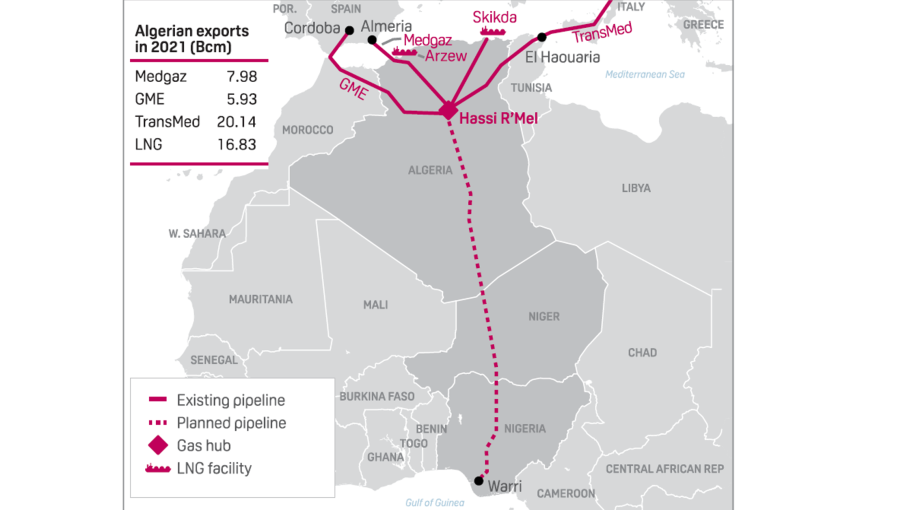
A gas pipeline to connect the vast gas fields in Nigeria with Europe is now 60% completed at a time when the EU is hunting for new reliable sources of gas. / bne IntelliNews
By Ben Aris in Berlin February 8, 2026

The Trans-Saharan Gas Pipeline (TSGP) project is making steady progress after Algeria, Nigeria and Niger reaffirmed their commitment to the 2024 agreements and are accelerating construction.

The three countries endorsed updates to the project’s feasibility study by UK engineering consultancy Penspen, alongside a new compensation agreement and a confidentiality pact at a recent meeting in Algiers. The agreements mark a renewed push to complete the 4,128 km pipeline, which is designed to transport up to 30bn cubic metres of natural gas annually from Nigeria to Algeria’s Mediterranean coast for export to European and global markets.

“The Trans-Saharan Gas Pipeline project is moving forward steadily,” officials from the Algerian Ministry of Energy and Mines said in a joint statement after the meeting.

The TSGP, first conceived in the early 2000s, is aimed at replacing some of the Russian gas which is no longer being sold to Europe. It will bolster energy cooperation in West and North Africa and provide an alternative supply route to Europe, which intends to ban Russian gas imports next year as part of the nineteenth sanctions package.

Once completed, the pipeline will connect Nigeria’s vast gas reserves to Algeria’s pipeline network, enabling onward delivery through the Trans-Mediterranean and Medgaz pipelines.

According to project backers, about 60% of the TSGP’s route has already been completed, with approximately 2,400 km of pipeline laid, primarily in Algeria and Nigeria. The remaining 1,800 km will be constructed across all three partner countries, traversing difficult terrain including the Sahara Desert and regions with security challenges.

The pipeline’s projected capacity of 30bn cubic metres per year represents a significant addition to regional and international supply, at a time when European demand for diversified gas sources remains high following the sharp reduction of Russian pipeline imports. At the same time, the EU has woken up to is dependency on American LNG and is seeking to diversify away from and increasingly unpredictable White House.

Algeria’s national energy company Sonatrach, the Nigerian National Petroleum Company (NNPC), and Niger’s Ministry of Petroleum are jointly managing the development phase. Technical, financial and environmental updates are ongoing as part of a revised roadmap.

Industry analysts say the project, if realised, could transform West Africa’s gas export profile. However, the TSGP has faced repeated delays due to financing hurdles, regional instability, and shifting global gas market dynamics.

How US and Russian nuclear arsenals have evolved – Statista

How US and Russian nuclear arsenals have evolved – Statista
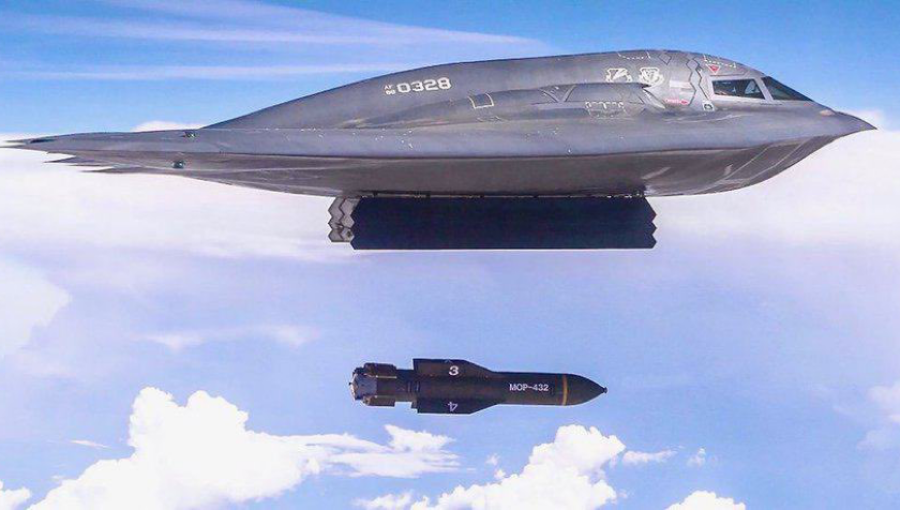
It’s 25 years since the New START treaty came into effect, which has just expired. / bne IntelliNews
By Valentine Fourreau for Statista February 6, 2026

Today marks 25 years of the New START treaty coming into effect, as well as its expiration date. Signed in 2010 by Barack Obama and one-term Russian President and Putin ally Dmitry Medvedev, the treaty set limits on strategic nuclear weapons, capped the number of deployed strategic warheads, and aimed to create transparency and predictability through verification measures - notably data exchanges and on-site inspections - so each side could monitor the other’s strategic arsenal and reduce worst-case assumptions, Statista reports.

While New START came at a time where relations between Russia and the U.S. were undergoing a "reset", the end of the treaty "comes at the worst possible time", according to UN secretary general António Guterres. He today urged the two countries to quickly sign a new nuclear arms control deal, as the existing treaty expired in what he called a “grave moment for international peace and security”.

Over 75 years have passed since the atomic bombing of Hiroshima and more than 12,000 nuclear warheads are still scattered across the world from silos in Montana to isolated corners of European airbases and even to the ocean depths where ballistic missile submarines lurk as a deterrent nearly impossible to detect. Hiroshima was the first of two atomic bombings in 1945 and it involved a 15-kiloton device while the weapon used in the attack on Nagasaki three days later had a 22 kiloton yield. Modern nuclear warheads are far more powerful with the U.S. Trident missile yielding a 455 kiloton warhead while Russia's SS ICBM has an 800 kiloton yield. Together, the United States and Russia possess roughly 90 percent of the world's nuclear weapons with a stockpile of over 8,000 between them, according to the Federation of American Scientists. This figure rises to over 11,000 when counting retired but still intact warheads in the queue for dismantlement.

Even though these are awfully high numbers, they still represent a huge reduction on the number of warheads in existence at the height of the Cold War. This infographic shows how stockpiles have evolved, particularly when various arms limitation treaties are taken into account. The number of warheads fell significantly in the wake of the Intermediate-Range Nuclear Forces Treaty which was signed by the U.S. and USSR in 1987 at a time when both countries possessed more than 60,000 nuclear weapons. The trend towards disarmament continued after the Berlin Wall came down and accelerated when the Soviet Union collapsed.


 You will find more infographics at Statista


New industrial robots installed per year – OWID

New industrial robots installed per year – OWID
China is leading in yet another tech revolution: the number of humanoid robots it is installing on factory floors is soaring. / bne IntelliNews
By bne IntelliNews February 9, 2026

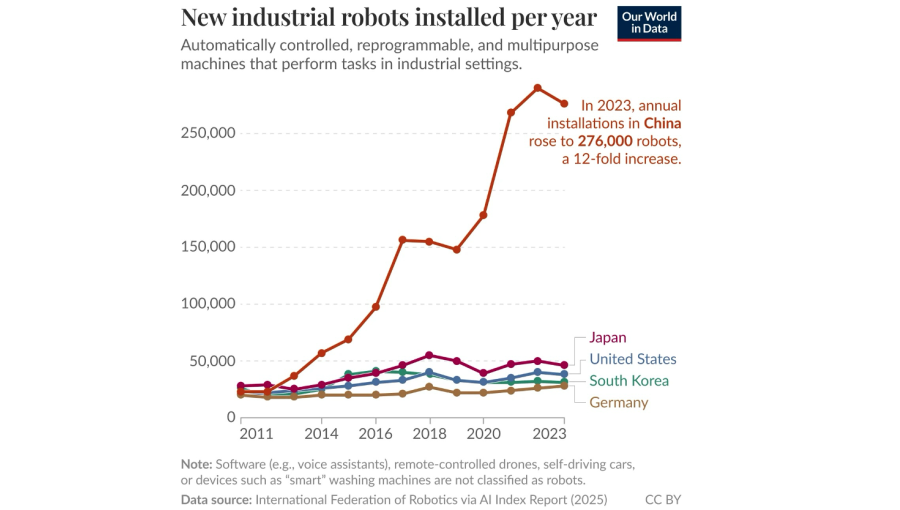
Industrial robots are rapidly becoming a common part of manufacturing in some countries. The chart here shows how many new ones are installed each year in the industrialized countries for which we have available data from the International Federation of Robotics (IFR), Our World in Data  (OWID) reports.

In this dataset, industrial robots are defined as automatically controlled, reprogrammable, and multipurpose machines used in industrial settings. The data covers only physical industrial robots, not software or consumer technologies.

The chart shows that in 2011, China, the United States, Japan, Germany, and South Korea were all installing similar numbers of these robots. However, in the decade that followed, the paths of these countries diverged. By 2023, annual installations in China had risen to 276,000 robots, a twelvefold increase.

Over the same period, installations in the United States, Japan, Germany, and South Korea also increased, but much more slowly: none of them even doubled. The United States, which saw the second-largest rise, went from 21,000 new installations in 2011 to 38,000 in 2023.

These figures refer to new robots installed each year; that is, annual additions to the existing stock of robots. The IFR also publishes data on the total number of robots in operation, and by this measure, China also had the largest installed base, at around 1.76mn robots in 2023.

Relative to its large manufacturing sector, China’s stock of robots today does not stand out – but the data here shows that this is changing quickly.

Explore the interactive version of this chart.


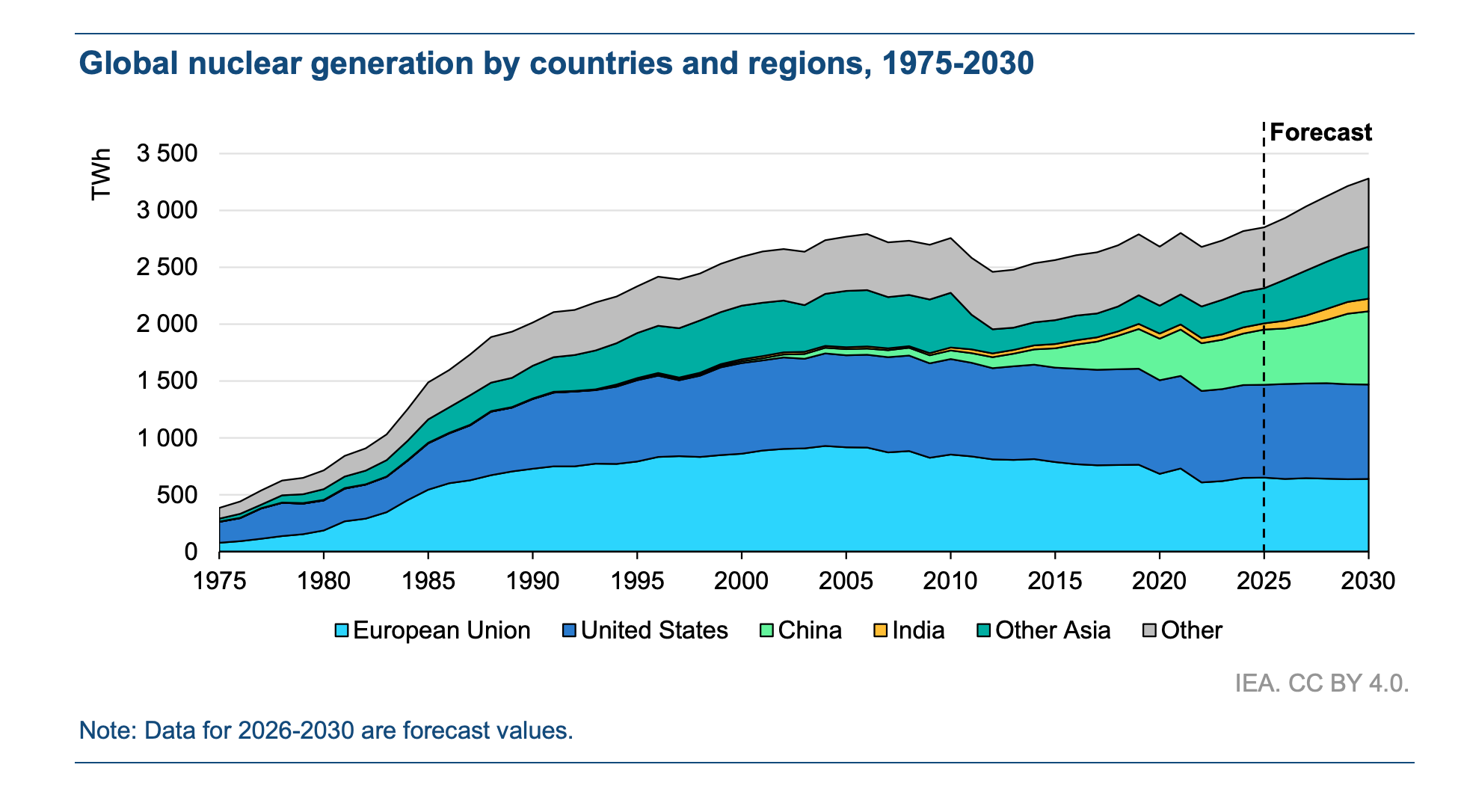
Half the world’s energy will come from renewables, nuclear by 2030 - IEA

Half the world’s energy will come from renewables, nuclear by 2030 - IEA
Half the world's power will be generated by renewables and nuclear by 2030, according to the IEA, but the distribution of generating capacity is uneven and the Global South will struggle to keep up with growing demand. / bne IntelliNews
By Ben Aris in Berlin February 8, 2026

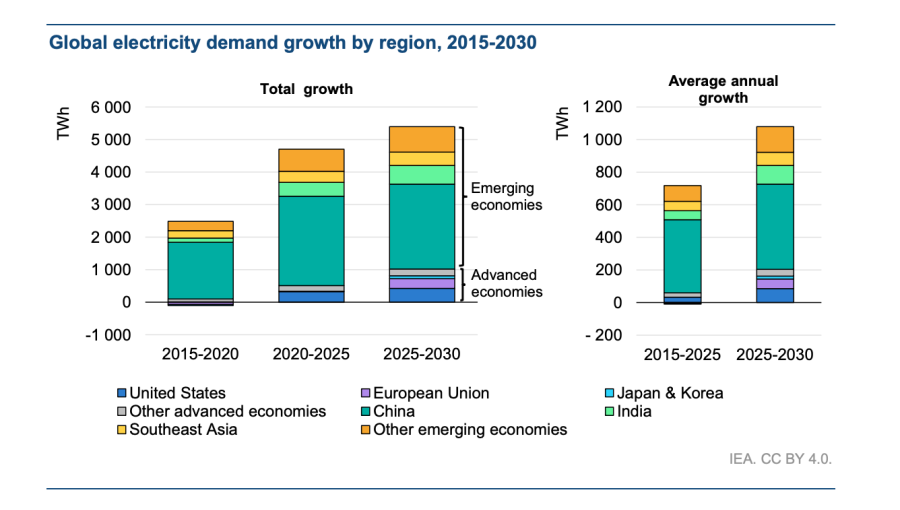
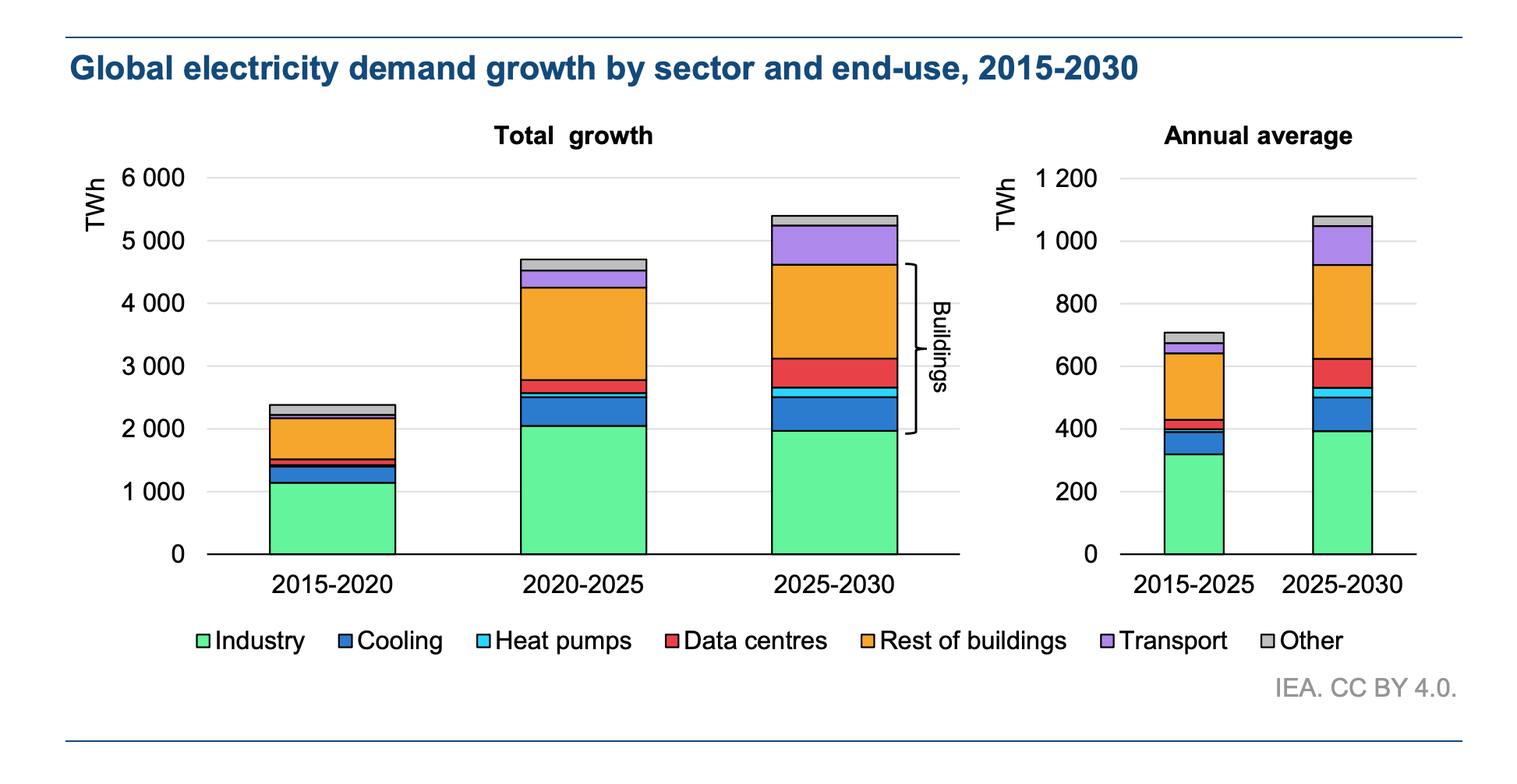
The International Energy Agency warned that while global electricity demand is set to surge over the next three years, the benefits of clean energy investment and rising renewable output remain unevenly distributed, threatening to deepen the divide between advanced and developing economies.

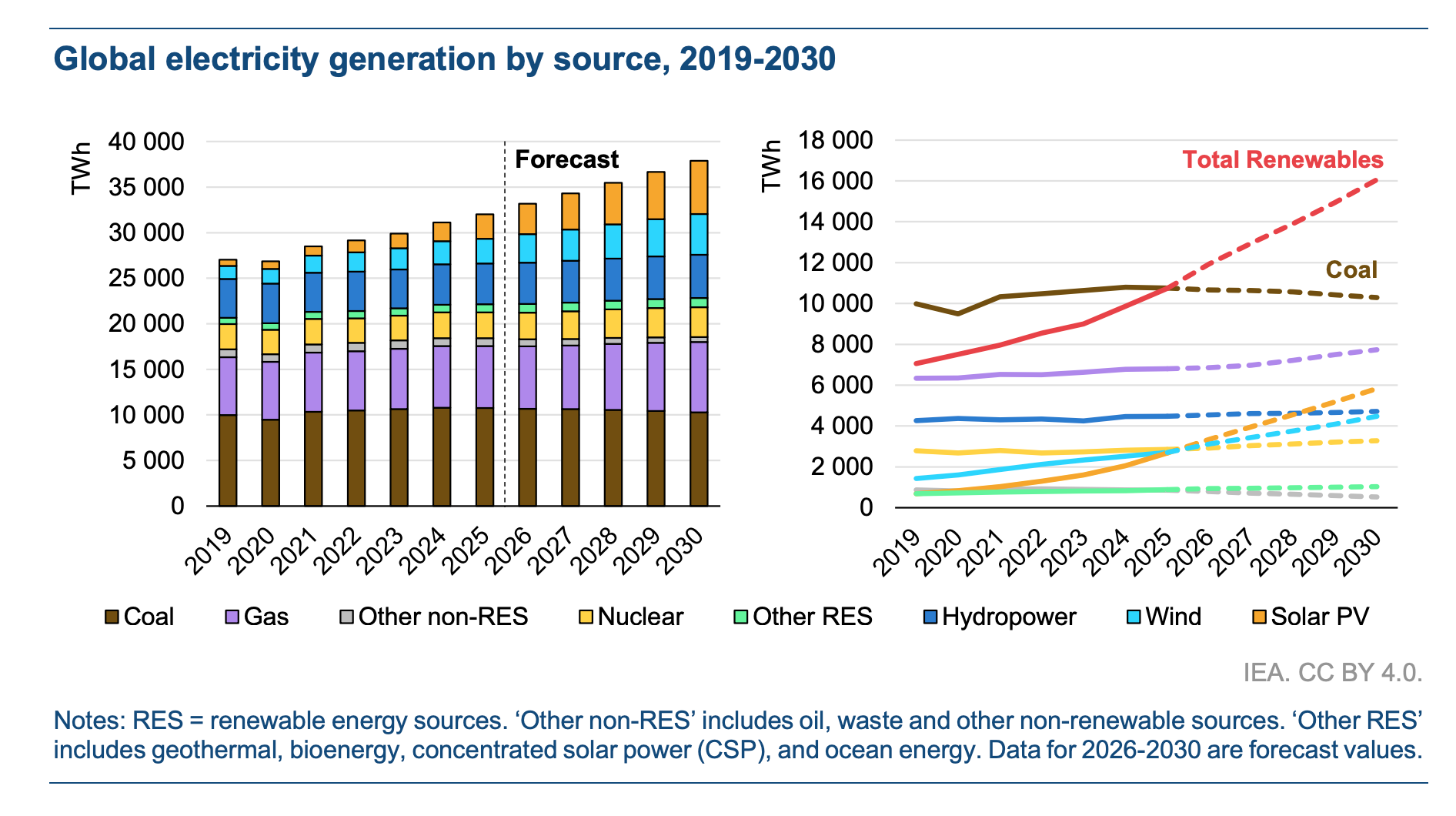
The “Age of Electricity” is here and half the world’s power will be generated by renewables and nuclear power plants (NPPs) by 2030, the IES says in its latest “Electricity 2026” report.

The IEA projected that global electricity demand will grow by nearly 3.4% annually through 2026, with demand from emerging and developing economies—particularly in Asia—driving most of the increase. However, the agency cautioned that infrastructure constraints, financing gaps, and persistent energy poverty risk leaving large parts of the Global South behind.

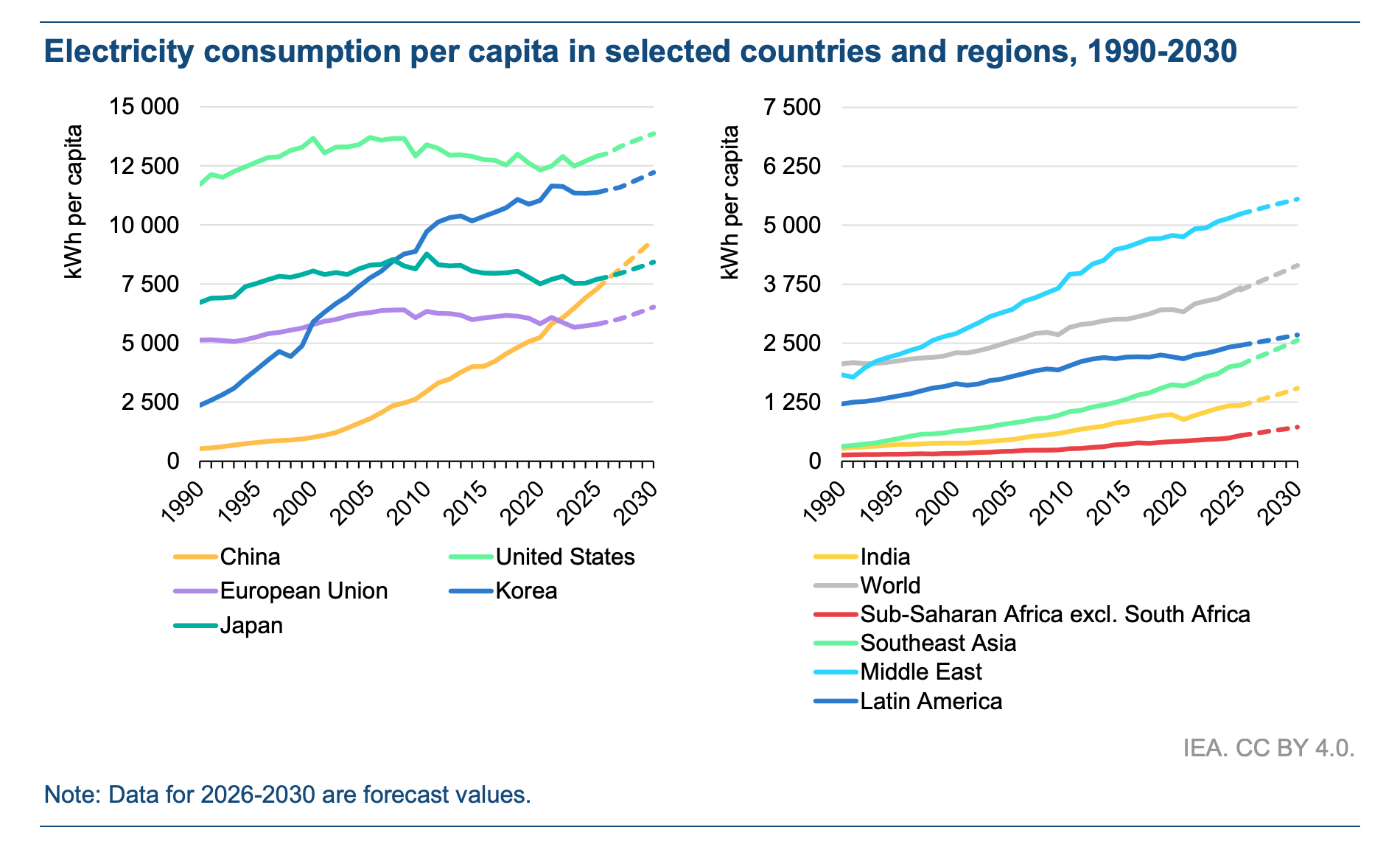
“We are seeing two very different realities emerging in electricity markets,” the IEA said. “In advanced economies, growth in demand is modest, while renewables are increasingly supplying that growth. But in many developing economies, electricity demand is rising rapidly and grid investment is struggling to keep up.”

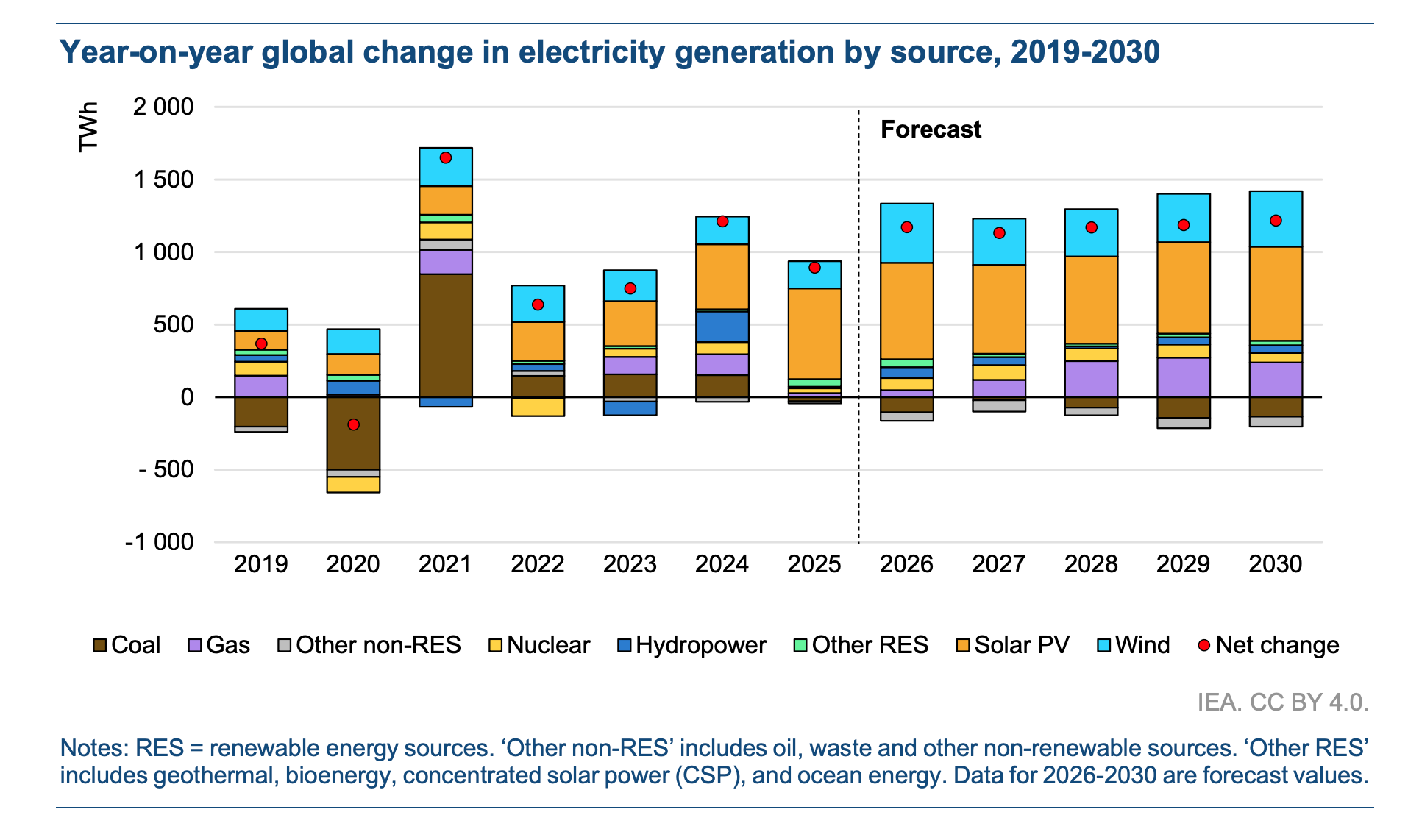
By 2025, the report forecasts that more than one-third of global electricity generation will come from renewables, with solar PV and wind accounting for the bulk of new capacity additions. The share of low-emissions generation—including renewables and nuclear—is expected to rise from 39% in 2023 to 50% by 2026, largely displacing coal-fired generation in major economies such as China and the US.

“Electricity is becoming cleaner, thanks to the spectacular growth of renewables,” the agency stated. “But the pace of change remains too slow in regions most in need of affordable and reliable power.”

China alone is expected to account for over one-third of global electricity demand growth through 2026, followed by India and Southeast Asia. However, the IEA highlighted that Africa, home to nearly 600mn people without access to electricity, continues to face chronic underinvestment in power infrastructure.

“Sub-Saharan Africa is the only region where electricity demand is expected to remain below pre-pandemic levels in 2026,” the IEA warned. “This underlines the urgent need for greater international support.”

The agency also noted that extreme weather events—linked to climate change—have added volatility to power markets. “Heatwaves, droughts, and cold snaps are creating new operational challenges for grids, especially where backup generation is limited,” the report said.

In advanced economies, electrification of transport, heating and industry is expected to continue driving demand, though energy efficiency gains and economic uncertainty may limit overall growth. Europe, in particular, is expected to see relatively flat electricity demand due to high prices and slower industrial activity.

To meet rising global demand and decarbonisation targets, the IEA estimates that annual investment in electricity networks must increase by more than 50% by 2030, reaching nearly $600bn globally per year.

“Without faster grid expansion and stronger investment in emerging markets, the global energy transition risks becoming a tale of two worlds,” the agency concluded.


History, law, and politics collide at the Malaysia–Indonesia border

History, law, and politics collide at the Malaysia–Indonesia border
/ Bintang Azhar - Unsplash
By bno - Surabaya Office February 9, 2026

Malaysia and Indonesia are currently embroiled in an amicable dispute over land boundaries in the Sumatra and Kalimantan islands of Indonesia, where the two countries have long shared a land border as neighbours. The land boundary between what is now Indonesia and Malaysia itself can be traced back to colonial arrangements made by the Dutch and British, via a treaty penned in 1915, The Independent SG reports. The treaty mentioned parts of Borneo, with Sebatik Island divided between the two countries. However, the fact that the legal foundations of the land remain rooted in agreements drawn during colonial rule, it leaves certain issues poorly defined given that both nations have now gained independence.

Despite clear legal references, there was no conclusive decision applicable to every segment of the border on the ground. Ever since 1977, both countries have embarked on joint technical committees that worked through what are officially called “Outstanding Boundary Problems” (OBPs). The unresolved areas are mostly located near rivers, where natural shifts happen, causing a complication in demarcation because of incomplete mapping.

As of now, there are still nine of such zones that remain unsettled, four along the Sarawak–West Kalimantan border and five between Sabah and North Kalimantan. Malaysian Prime Minister Anwar just last week stressed that these locations cannot be claimed by either side until negotiations conclude. In stating this, the prime minister further emphasises that border determination is still ongoing and incremental rather than finalised.

The persistent flashpoint that is Ambalat

Beyond land negotiations, maritime tensions between the two have been continuous, centred on the Ambalat Block that spans the Sulawesi Sea, Tempo.co reports. The dispute can also be traced back to other unclear colonial maritime boundaries, which later diverged interpretations of international law. Indonesia grounds its claim in UNCLOS principles, asserting rights as an archipelagic state. Malaysia, on the other hand, holds onto a unilateral maritime map issued in 1979 and its proximity to Sipadan and Ligitan.

Throughout the 1980s and 1990s, both countries increased patrols and went through multiple diplomatic protests as resource exploration in the area intensified. Tensions reached a high point back in 2009, when Malaysia signalled plans to explore for oil and gas in the area, which prompted Indonesia to bolster its naval presence. Despite repeated talks, Ambalat remains unresolved, though both sides have consistently rejected military escalation.

In 2025, the talks over Ambalat once again resurfaced thanks to the clashes along the Thailand and Cambodia border. As such, there was a concern that Malaysia and Indonesia might follow the same approach, though PM Anwar publicly stated that this is not the case. Anwar confirmed that he had raised the issue directly with Indonesian President Prabowo Subianto, confirming that discussions would continue under international law, including UNCLOS.

The Nunukan villages

Early in 2026, public attention reverted back to the three villages in Indonesia’s Nunukan regency: Kabungalor, Lipaga and Tetagas, Antara News reports. Indonesian officials had stated that these villages were now recorded as falling within Malaysian territory following agreements reached at a bilateral meeting in February 2025. They added that Indonesia would, in turn, receive 5,207 hectares of land for border infrastructure and a planned free-trade zone.

These remarks triggered widespread concern on Indonesian social media, with claims circulating that the territory had been abruptly “lost.” Indonesian authorities moved quickly to calm public anxiety, stressing that the boundary process had unfolded over many years and that no sudden changes had taken place.

But Anwar, responding to the uproar, addressed Malaysia’s Parliament in a special briefing to reject allegations that Kuala Lumpur had agreed to hand over land to Indonesia, The Independent SG reports. He described reports suggesting a 5,200-hectare transfer as false and misleading.

According to Anwar, border disputes should not be settled through compensation or land swaps. Instead, every metre is negotiated strictly within existing legal frameworks. He urged lawmakers not to politicise the issue, warning that distorted narratives risk undermining long-standing bilateral relations and public trust.

Indonesia opts for a review

On the Indonesian side, State Secretary Prasetyo Hadi said the government would conduct direct field inspections in the Nunukan area to gain a clearer understanding of conditions on the ground. He emphasised that any steps to be taken would involve coordination across ministries and agencies, with no rushed decisions.

Local border officials echoed this stance, denying claims that villages had been “lost” due to border changes. They clarified that recent parliamentary meetings focused on accelerating development and improving welfare in border communities, not redrawing lines. The message was consistent: the process is ongoing, methodical, and far from complete.

With all these issues unfolding, the Malaysia–Indonesia border dispute persists not because of sudden political manoeuvres, but because it sits at the intersection of colonial legacies, international law, resource competition, and domestic politics. Each flare-up reveals how easily technical negotiations can be overwhelmed by public narratives, especially in the age of social media.

While both governments continue to anchor their positions in law and diplomacy, the real challenge lies in managing perception. Public opinion can easily become a digital kangaroo court that can sway and narrate the next moves albeit prematurely. Without clearer public communication, unresolved borders risk becoming political symbols rather than legal questions, prolonging disputes that neither side truly wants to escalate.