Tuesday, February 10, 2026

Unions rip American Airlines CEO on performance


By AFP
February 9, 2026


Robert Isom, CEO of American Airlines, faces rising pressure from the carrier's unions over its lagging financial performance - Copyright GETTY IMAGES NORTH AMERICA/AFP/File WIN MCNAMEE

American Airlines CEO Robert Isom faced pressure Monday from labor unions frustrated with the carrier’s financial performance and handling of recent weather disruptions.

The airline’s union for flight attendants issued a “no confidence” vote in Isom, while the pilots’s union amplified a demand to meet with American’s board of directors after describing conversations alone with management as fruitless.

“We’re just not hearing what the long-term strategy is,” said Dennis Tajer, spokesman for the Allied Pilots Association, which headlined a recent message, “We Need Decisive Action.”

Isom, a board member, would be expected to join the meeting, said Tajer, adding that the union is not seeking Isom’s ouster.

“We don’t really care who’s running the airline,” Tajer told AFP. “We just want them to be wildly successful.”

American Airlines did not immediately respond to a request for comment.

In 2025, American Airlines reported profits of just $111 million. United Airlines made $3.4 billion in profit last year, while Delta Air Lines reported profits of $5.0 billion.

The weak results translate into lower bonuses for employees under American’s profit-sharing plan.

Tajer said some of the gap is because a greater share of American’s business is domestic, which has underperformed compared with international travel.

But some of American’s problems have been self-inflicted. In 2024, American scrapped an attempted revamp of its corporate booking system, denting performance.

The unions are also frustrated with the carrier’s handling of the recent Winter Storm Fern, which battered the company’s hubs in Dallas and Charlotte.

The storm had led American to cancel more than 9,000 flights, making it the “largest weather-related operational disruption in our history,” Isom said on January 27 conference call.

But the unions say the carrier was poorly prepared for the bad weather, which left workers stranded away from homes, sleeping in airports and placed on hold for six hours or more.

“When the recent winter storm hamstrung our operations to the point where flight attendants were sleeping on airport floors, Robert Isom’s response was that it was just ‘part of our job,” said Julie Hedrick, president of the Association of Professional Flight Attendants.

“His tone-deaf leadership shows a complete disregard for the human element and is actively harming both American Airlines and the people who keep it running every day.”
Warming climate threatens Greenland’s ancestral way of life

By AFP
February 9, 2026


Musher Nukaaraq Lennert Olsen rides with his sled dogs near the 'dog town' of Sisimiut, Greenland - Copyright KCNA VIA KNS/AFP STR


Nioucha ZAKAVATI

Standing in his boat with binoculars in hand, hunter Malik Kleist scans the horizon for seals. But this February, the sea ice in southwestern Greenland has yet to freeze, threatening traditional livelihoods like his.

“Normally the seals are on the ice or in the more calm waters. But today we had to sail all the way into the fjords to find them,” the 37-year-old tells AFP.

The Arctic region is on the frontline of global warming, heating up four times faster than the rest of the planet since 1979, according to a 2022 study in scientific journal Nature, causing the sea ice to retreat.

Seals rely on pack ice to give birth, to rest and for protection.

Hunters increasingly have to sail farther along the jagged coast of Sisimiut, navigating into the fjords for several hours to find them.

Traditionally, hunters’ boats would head straight out to sea, slowly pushing through the ice and creating holes that attract seals coming up for air.

But without any ice, “it’s too windy and the waves are too big,” Kleist says.

Last year was exceptionally warm in the vast autonomous territory, with several temperature records beaten, according to the Danish Meteorological Institute (DMI).

In December, the Summit Station, located at the height of Greenland’s ice sheet, recorded an average temperature of -30.9 degrees C (-23.6 Fahrenheit), 8.1C higher than the December average during the period 1991-2020.

“It affects everything we do. Because normally around November, December the ice comes. And this year there’s no ice, so it affects our living a lot,” Kleist says.

– Financial woes –

For the same reason, the government has also had to postpone the annual winter musk ox hunt that was due to start on January 31.

There wasn’t enough snow and ice to transport the massive animals that roam the Arctic tundra back from Kangerlussuaq where they are predominantly found, around 165 kilometres (103 miles) away. Greenland has no roads connecting its towns.

That has left some Sisimiut hunters with less income than usual.

“This time of year there is not much to hunt. So we rely on musk ox meat and skin,” Kleist says.

“Many of my fellow hunters are struggling with money right now.”

Every part of the animal, from the fur to the meat, is either used or sold.

The summer hunting season has therefore gained importance, enabling Greenlanders to fill their freezers to get them through the winter months, he tells AFP over a steaming bowl of fish stew.

The shorter winter season has also impacted another key activity in Greenland, one that has become increasingly important to the tourism sector: dogsled tours.

In the Sisimiut neighbourhood where the dogs are kept, their thunderous barking mounts as Nukaaraq Olsen, a 21-year-old musher, attaches them to the sled.

Raring to get going, his 18 dogs are hard to hold back. Twenty minutes later, the group bounds off.

But the road is bumpy, and several times Olsen has to get up to manually push the sled, stuck on the tundra’s rocks in patches where there is no ice.

“This year we had a lot of hot, warm days, even though it’s December or January,” he says.

Other parts of the route are no longer safe to use, due to repeated melting and freezing of snowfall which causes uneven layers, he explains.

– Dehydrated dogs –

The dogs’ health is also affected by the changing climate.

They are used to quenching their thirst with snow, but with little or no snowfall, they can easily get dehydrated. Mushers have to take that into account when caring for their animals.

Many have even had to get rid of their dogs, the business of maintaining them no longer profitable with the dogsled season shrinking to just two months, says Emilie Andersen-Ranberg, a researcher at the University of Copenhagen who runs a dog clinic in Sisimiut.

Others, such as 72-year-old Johanne Bech, are finding novel ways to adapt.

She plans to put wheels on her sled to continue running dogsled tours during the summer period.

That solution is growing in popularity, as “the window with snow is getting more and more narrow,” the veterinarian says.

Over the past 20 years, the number of sleddogs has been halved from 25,000 to 13,000, according to a 2024 article from the University of Greenland in 2024.

Yet Johanne Bech remains optimistic about the future.

“I hope this is just for a short time, so we can go back to a little more stable snow or more ice in the future.”
Solar, wind capacity growth slowed last year, analysis shows


By AFP
February 10, 2026


Just a small fraction of wind and solar growth came from rich G7 countries, the Global Energy Monitor found - Copyright GETTY IMAGES NORTH AMERICA/AFP/File JUSTIN SULLIVAN

Planned or under-construction solar and wind projects slowed last year, analysis showed Tuesday, casting doubts on whether countries will hit a goal of tripling renewable capacity by decade-end.

Dozens of nations agreed in 2023 to triple renewable energy capacity by 2030 as part of efforts to limit global warming.

But announcements and construction starts of new wind and solar projects grew 11 percent in 2025 — down from 22 percent in the previous year, as wind development projects faced hurdles, Global Energy Monitor (GEM) said.

“Wind developers experienced political barriers and a streak of failed wind power auctions in wealthy nations,” GEM research analyst Diren Kocakusak said.

US President Donald Trump has blocked wind projects, and made no secret of his antipathy towards renewables, though the global slump was not attributable to any one country, Kocakusak said.

GEM’s research also found that just a small fraction of wind and solar growth came from rich G7 countries, with the “centre of gravity” now shifting “decisively toward emerging and developing economies.”

As has been the case for years, China is expanding renewable capacity on a scale unmatched elsewhere.

It accounted for around a third of global capacity growth in 2025 — 1.5 terawatts — more than growth in the next six countries combined.

But that was not enough to set the world on track to meet the 2030 goal.


– ‘Disappointing developments’ –


Even if all the projects currently announced and under-construction proceed, the world would still fall short.

GEM’s research has found almost 40 percent of planned projects begin operations after their announced start date, or are put on hold or scrapped.

However, Kocakusak said that did not mean the goal was out of reach.

“Momentum appears to be slowing, but that’s not due to a lack of potential,” he told AFP.

There is still “enough time” for countries to ramp up capacity, and solar projects that have not yet been announced could be completed before 2030, he said. Wind projects can take longer to get up and running.

More than 3.5 terawatts of wind and solar projects have also been announced without a confirmed start date, and could help meet the 2030 goal if they come online quickly enough.

Some wealthy countries are supporting renewable growth, with Japan seeking to revise wind auction guidelines and Britain boosting investment.

These policies sit alongside “disappointing developments”, though, like reports Germany may limit grid priority for renewables, Kocakusak said.

“Whether the 2030 tripling target is achieved will depend on the level of commitment and implementation from countries and developers,” he said.


Back to black: Philips posts first annual profit since 2021


By AFP
February 10, 2026


Philips gets into the green - Copyright AFP Patrick T. Fallon

Dutch electronics and medical device manufacturer Philips said Tuesday it had bounced back into the black in 2025, as it seeks to turn the page on a scandal over faulty sleep apnoea machines.

Philips posted a profit of 897 million euros last year, after three straight years of losses.

“We strengthened our company while navigating a dynamic macro environment. We ended the year with strong, robust margin expansion despite tariffs,” chief executive Roy Jakobs said in a statement.

The profit came in above the consensus forecast of analysts polled by the company of 775 million euros.

Once famous for making lightbulbs and televisions among other products, Amsterdam-based Philips in recent years has sold off subsidiaries to focus on medical care technology.

It posted overall sales of 17.8 billion euros in 2025, compared to the 18.0 billion euros it banked in 2024.

Analysts’ consensus forecast was for sales of 17.7 billion euros.

Looking ahead, the firm said it expected sales growth of between 3.0 and 4.5 percent for 2026.

This outlook includes the impact of “currently known tariffs” but excludes potential costs from the ongoing saga of its sleep apnoea machines, Philips said.

Since 2021, the company has been battling a series of crises over its DreamStation machines for sleep apnoea, a disorder in which breathing stops and starts during sleep.

Millions of devices were recalled over concerns that users were at risk of inhaling pieces of noise-cancelling foams and fears it could potentially cause cancer.

In April, it announced it had reached a $1.1 billion deal to settle US lawsuits from the faulty machines.

Turning to the fourth quarter, Philips posted a profit of 397 million euros, above the forecast of 276 million euros.

In the third quarter of last year, the firm banked profits of 187 million euros on sales of 4.3 billion euros.

The firm has continued to shed jobs. It employed 64,817 people at the end of 2025, compared to 67,823 at the end of 2024.

Philips also announced a proposal to reappoint Jakobs as CEO.

“(This) reflects the Supervisory Board’s recognition of the progress made since 2022 and its confidence in his leadership as Philips enters the next phase of driving profitable growth,” the firm said.
AI chatbots give bad health advice, research finds


By AFP
February 9, 2026


ChatGPT image: — © AFP/File SEBASTIEN BOZON

Next time you’re considering consulting Dr ChatGPT, perhaps think again.

Despite now being able to ace most medical licensing exams, artificial intelligence chatbots do not give humans better health advice than they can find using more traditional methods, according to a study published on Monday.

“Despite all the hype, AI just isn’t ready to take on the role of the physician,” study co-author Rebecca Payne from Oxford University said.

“Patients need to be aware that asking a large language model about their symptoms can be dangerous, giving wrong diagnoses and failing to recognise when urgent help is needed,” she added in a statement.

The British-led team of researchers wanted to find out how successful humans are when they use chatbots to identify their health problems and whether they require seeing a doctor or going to hospital.

The team presented nearly 1,300 UK-based participants with 10 different scenarios, such as a headache after a night out drinking, a new mother feeling exhausted or what having gallstones feels like.

Then the researchers randomly assigned the participants one of three chatbots: OpenAI’s GPT-4o, Meta’s Llama 3 or Command R+. There was also a control group that used internet search engines.

People using the AI chatbots were only able to identify their health problem around a third of the time, while only around 45 percent figured out the right course of action.

This was no better than the control group, according to the study, published in the Nature Medicine journal.

– Communication breakdown –

The researchers pointed out the disparity between these disappointing results and how AI chatbots score extremely highly on medical benchmarks and exams, blaming the gap on a communication breakdown.

Unlike the simulated patient interactions often used to test AI, the real humans often did not give the chatbots all the relevant information.

And sometimes the humans struggled to interpret the options offered by the chatbot, or misunderstood or simply ignored its advice.

One out of every six US adults ask AI chatbots about health information at least once a month, the researchers said, with that number expected to increase as more people adopt the new technology.

“This is a very important study as it highlights the real medical risks posed to the public by chatbots,” David Shaw, a bioethicist at Maastricht University in the Netherlands who was not involved in the research, told AFP.

He advised people to only trust medical information from reliable sources, such as the UK’s National Health Service.
Iraqi calligrapher's handwritten Quran ends 6 years of artistry and craft

ISTANBUL (AP) — The finished work consists of 302 double sided scrolls, each measuring 4 meters (13 feet) in length and 1.5 meters in width. The sheets, resembling heavy parchment, were custom made for Zaman with a blend of traditional materials including eggs, corn starch and alum.


Ayse Wieting
February 2, 2026

ISTANBUL (AP) — Iraqi calligrapher Ali Zaman gazes with pride at his masterpiece — a colossal, handwritten manuscript of the Quran that has taken six years of craft and devotion to complete.

The finished work consists of 302 double sided scrolls, each measuring 4 meters (13 feet) in length and 1.5 meters in width. The sheets, resembling heavy parchment, were custom made for Zaman with a blend of traditional materials including eggs, corn starch and alum.

“Anytime I think of this Quran … it gives me very nice feeling that the mighty God gave me the life to be able to finish this thing and complete it. I feel very proud,” the 54-year-old told The Associated Press at a mosque in Istanbul l where the manuscript is kept.

Islamic calligraphy is regarded as one of the most valued artistic traditions in the Muslim world. The art form served to preserve and embellish Islam ’s holy book and was later also used to adorn mosques, palaces and manuscripts.

In Turkey, it flourished during the Ottoman era when the art was supported by the state and calligraphers developed distinctive styles.

Today, Istanbul is considered an important center for the art, known as “hat” in Turkish.

Art expert Umit Coskunsu says that because of the Islamic tradition’s restrictions on depicting figures, calligraphy became a central form of artistic expression. He describes “hat” as a form of worship.

“The art of hat is not just calligraphy, it is seen as a means of worshipping God and coming closer to Him,” Coskunsu said.

Zaman was born in Ranya, a town in Sulaymaniyah governorate, in Iraq’s northern semi-autonomous Kurdish region.

He moved his family to Istanbul in 2017 to pursue his Quran project and to hone his craft because, he says, the art of calligraphy is more valued in Turkey than in his home country.

Zaman says he developed an interest in Islamic calligraphy around the age of 12 when he was first exposed to it in Iraq.

“The art of calligraphy was very attractive to me… I felt that I could find my soul in it,” he said.

Each sheet of the manuscript was entirely handwritten. Zaman says he labored from dawn to dusk over a period of six years in a small room reserved for him at the Mihrimah Sultan Mosque in Istanbul.

The manuscript is being touted as the world’s largest, though it has not received that recognition officially. According to Guinness World Records, the largest printed Quran was achieved by the Holy Quran Museum in Mecca, Saudi Arabia, in March 2025.

Zaman’s son remembers long absences while his father worked on the project.

“We only saw him when we would bring him food or when he came home at night to sleep,” said Rekar Zaman. “Thank God, we see more of him now.”

The manuscript is stored in stacked scrolls, and covered for protection from dust and moisture, at the mosque where he created it.

His ultimate wish is for it to go to a buyer who can put it on public display.

“I want for this Quran to be in a country — in a museum, or in a place that is special for calligraphy — where it can be appreciated and valued,” Zaman said.

__

Associated Press writer Suzan Fraser contributed from Ankara, Turkey.


How women are reinterpreting the menstrual taboos in Chinese Buddhism

(The Conversation) — In some cultures, menstruation and childbirth are treated as polluting, not life-giving. One Buddhist text’s interpretation of ‘Blood Pond Hell’ shows how far such beliefs go – and how women respond.


'Blood Pond Hell 'detail depicted in a 1940 Taipei Hell Scroll. 
(The Trustees of the British Museum)

Megan Bryson
February 6, 2026
RNS

(The Conversation) — In many religions and cultures, women who are menstruating or who just gave birth are not allowed to enter sacred sites, such as temples, or participate in religious rituals. This is because they are often seen as ritually impure.

Early Christians cited menstruation as the reason for not allowing female deacons or priests. Modern Catholic teachings do not express this attitude directly, but some Catholic feminists argue that views of women’s blood pollution still influence the church’s position against women’s ordination.

According to certain Hindu texts, menstruating women should be cut off from the rest of the household and avoid participating in ritual life. In Hinduism, as well as other religions and cultures, traditional taboos related to menstruation and childbirth are, however, no longer practiced widely.

An extreme attitude toward the ritual pollution of menstruation and childbirth appears in a Chinese Buddhist text called the “Blood Bowl Scripture,” which I have studied in my research on East Asian Buddhism.

This text, written in China by the 13th century, spread to Japan soon after. It describes a complicated chain of events in which a woman gives birth at home, then washes her bloody clothes in a nearby river. People downriver don’t realize that the water has been polluted with the blood of childbirth, and they use the water to make tea that they offer to the gods. As punishment for offending the gods with tainted water, the woman who gave birth is condemned to fall into the “Blood Pond Hell” after she dies.

Rebirth in the hells is one possible form of reincarnation in Buddhism, which teaches that the quality of people’s karma in their present life determines where they are reborn in their next life. The “Blood Pond Hell” is one of many kinds of hells found in traditional Buddhism. According to Buddhist worldviews, people are reborn in the hells when their bad karma severely outweighs their good karma. However, after people serve their time in the hells, they can be reborn in other realms.

Japanese Buddhists expanded on this idea to claim that the pollution of menstrual blood alone led to rebirth in the Blood Pond Hell, which condemns all menstruating women to this kind of suffering.


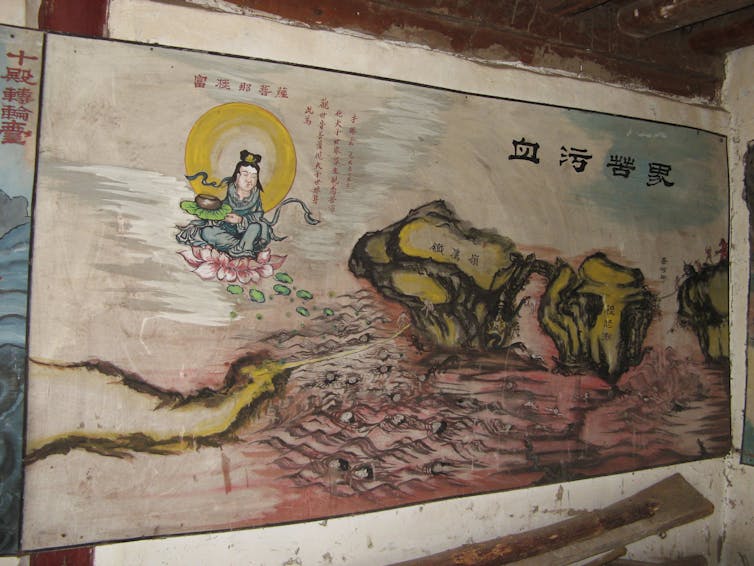
Mural depicting the hell of blood and filth, Dizang Temple, Yunnan, China.
Megan Bryson, CC BY

Most educated Buddhist monks in premodern China rejected the Blood Bowl Scripture because it didn’t come from India. Buddhism originated in India, and Buddhist scriptures are supposed to be the words of the Buddha, so the Blood Bowl Scripture was not included in official scriptural catalogs. But the text and its practices became an important part of popular Chinese Buddhism.

For example, a famous Chinese novel from the 17th century, “The Plum in the Golden Vase,” describes its female characters practicing rituals based on the Blood Bowl Scripture.

Blood Pond Hell beliefs and practices still exist today. However, they are not as common as they used to be – and women have developed new interpretations.
Beliefs in modern China

For most women in human history, giving birth has been a requirement, not a choice. Yet, for women in premodern China and Japan, fulfilling the social obligation to have children simultaneously condemned them to “Blood Pond Hell.”

The “Blood Bowl Scripture” encourages adult children to hire Buddhist monks to perform rituals that will save their mothers from this unpleasant fate.

How hell realms are interpreted in Buddhism.

Though not all Buddhists today believe in the hells, including the “Blood Pond Hell,” some do. Visitors to temples and Buddhist theme parks in Asia may find paintings or three-dimensional dioramas of women in a bloody pond.

People who do not believe in the hells may still perform the rituals to save their mothers from the “Blood Pond Hell” to show love and gratitude. In some parts of China, women preemptively save themselves from the “Blood Pond Hell” by performing their own rituals, usually as part of women’s religious associations.

Emphasizing mothers’ self-sacrifice

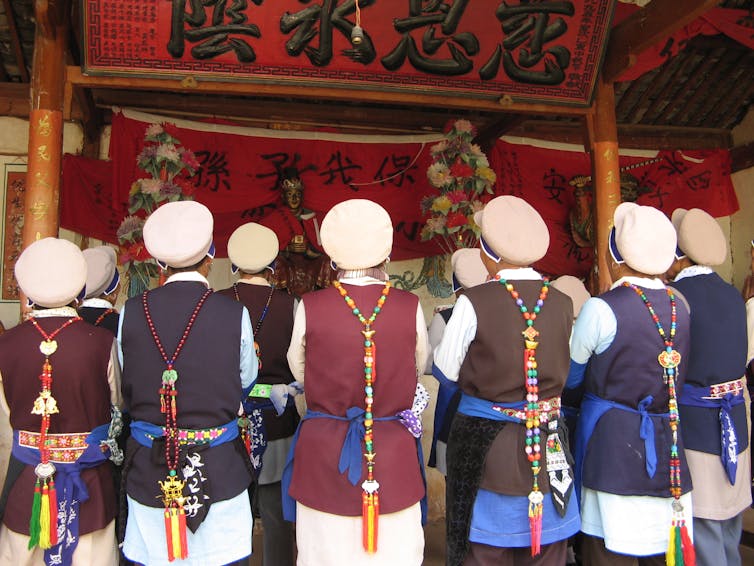
In many parts of China, middle-aged and older women form voluntary religious associations. The religious associations get together twice a month and on holidays to recite scriptures, make offerings to the gods and go on pilgrimages to sacred sites.

Most women who participate are already menopausal, with grown children. Pre-menopausal women are allowed to participate if they aren’t menstruating.

In the religious associations of southeast China’s Fujian province, women perform a ritual called “Returning to the Buddha” that aims to purify them of bad karma before they die. In this ritual, women atone for different kinds of bad karma, which includes spilling the polluted water they used to clean up after childbirth.


Women reciting scriptures together while facing a statue of their main temple’s deity in southwest China.
Megan Bryson, CC BY

Women’s religious associations across China also recite scriptures to repay mothers’ kindness. Reciting scriptures is seen as creating good karma, which the women dedicate to their mothers. These scriptures still portray uterine blood as polluting, but they also recognize the sacrifices mothers make in bringing their children into the world.

One such scripture describes how mothers sacrifice for their children first in life, then in death when they fall into the “Blood Pond Hell.” The women who recite these texts both express gratitude for their mothers’ sacrifices and recognize their own sacrifices as mothers.

Reframing the female body

In addition to reinterpreting the “Blood Pond Hell” through the lens of mothers’ sacrifice, women in modern China have developed new interpretations of how female bodies are portrayed in “Blood Pond Hell” beliefs and practices.

Buddhist texts often claim that being reborn as a woman is a karmic punishment, and some texts describe female bodies with disgust. For example, a repentance text for saving women from the “Blood Pond Hell” claims that menstruation is caused by 12-headed worms living in the birth canal that vomit blood and pus once a month.

However, in my research I encountered a sermon about this repentance text by the Taiwanese nun Venerable Shi Changyin. She claims that “worms” really meant “bacteria” or “cells,” but premodern people lacked the biomedical terminology to express this properly.

Changyin’s reinterpretation of worms as cells reflects other ways for women to think about the blood of menstruation and childbirth. The negative views of female bodies expressed in the “Blood Bowl Scripture” are one perspective among many in contemporary Chinese culture.

Buddhist teachings that downplay the importance of gender, traditional Chinese medicine, and biomedicine offer other perspectives on reproduction and female bodies. Many scholars and practitioners of Chinese Buddhism reject “Blood Pond Hell” beliefs as remnants of negative attitudes toward female bodies in early Buddhism.

They see Mahayana Buddhism, the main form practiced in China, as promoting gender equality. In traditional Chinese medicine, blood is an important part of women’s health as a source of vitality rather than impurity. And biomedicine avoids concepts like purity and pollution when treating issues related to menstruation and childbirth.

A narrative of empowerment

The “Blood Bowl Scripture” demonizes the blood of menstruation and childbirth and, by extension, reproductive female bodies in general. Yet many women, past and present, have participated in the scripture’s rituals to save their mothers or themselves from this fate.

It is important not to just dismiss women’s participation as internalized misogyny, but to understand what women get out of these practices.

Women in Chinese Buddhism have taken the initiative in emphasizing maternal self-sacrifice over ritual pollution and in using other frameworks to make sense of menstruation and childbirth.

(Megan Bryson, Associate Professor of Religious Studies, University of Tennessee. The views expressed in this commentary do not necessarily reflect those of Religion News Service.)


The Conversation religion coverage receives support through the AP’s collaboration with The Conversation US, with funding from Lilly Endowment Inc. The Conversation is solely responsible for this content.

Polygamous sect's sway has dwindled in twin towns on Arizona-Utah line. Residents enjoy new freedoms

COLORADO CITY, Ariz. (AP) — Until courts wrested control of the towns from a polygamous sect whose leader and prophet, Warren Jeffs, was imprisoned for sexually assaulting two girls, youth sports, cocktail hours and many other common activities were forbidden.


Jacques Billeaud
February 2, 2026

COLORADO CITY, Ariz. (AP) — The prairie dresses, walled compounds and distrust of outsiders that were once hallmarks of two towns on the Arizona-Utah border are mostly gone.

These days, Colorado City, Arizona, and neighboring Hildale, Utah, look much like any other town in this remote and picturesque area near Zion National Park, with weekend soccer games, a few bars, and even a winery.

Until courts wrested control of the towns from a polygamous sect whose leader and prophet, Warren Jeffs, was imprisoned for sexually assaulting two girls, youth sports, cocktail hours and many other common activities were forbidden. The towns have transformed so quickly that they were released from court-ordered supervision last summer, almost two years earlier than expected.

It wasn’t easy.

“What you see is the outcome of a massive amount of internal turmoil and change within people to reset themselves,” said Willie Jessop, a onetime spokesman for the Fundamentalist Church of Jesus Christ of Latter-Day Saints who later broke with the sect. “We call it ‘life after Jeffs’ — and, frankly, it’s a great life.”

A dark turn

Some former members have fond memories of growing up in the FLDS, describing mothers who looked out for each other’s kids and playing sports with other kids in town.

But they say things got worse after Jeffs took charge following his father’s death in 2002. Families were broken apart by church leaders who cast out men deemed unworthy and reassigned their wives and children to others. On Jeffs’ orders, children were pulled from public school, basketball hoops were taken down, and followers were told how to spend their time and what to eat.

“It started to go into a very sinister, dark, cult direction,” said Shem Fischer, who left the towns in 2000 after the church split up his father’s family. He later returned to open a lodge in Hildale.

Church members settled in Colorado City and Hildale in the 1930s so they could continue practicing polygamy after the sect broke away from The Church of Jesus Christ of Latter-day Saints, the mainstream Mormon church that renounced plural marriage in 1890.

Stung by the public backlash from a disastrous 1953 raid on the FLDS, authorities turned a blind eye to polygamy in the towns until Jeffs took over.

After being charged in 2005 with arranging the marriage of a teenage girl to a 28-year-old follower who was already married, Jeffs went on the run, making the FBI’s Ten Most Wanted Fugitives list before his arrest the next year. In 2011, he was convicted in Texas of sexually assaulting two girls ages 12 and 15 and sentenced to life in prison.

A court-ordered overhaul

Even years after Jeffs’ arrest, federal prosecutors accused the towns of being run as an arm of the church and denying non-followers basic services such as building permits, water hookups and police protection. In 2017, the court placed the towns under supervision, excising the church from their governments and shared police department. Separately, supervision of a trust that controlled the church’s real estate was turned over to a community board, which has been selling it.

The towns functioned for 90 years largely as a theocracy, so they had to learn how to operate “a first-generation representative government,” Roger Carter, the court-appointed monitor, pointed out in his progress reports.

The FLDS had controlled most of the towns’ land through a trust, allowing its leaders to dictate where followers could live, so private property ownership was new to many. People unaccustomed to openness and government policies needed clarification about whether decisions were based on religious affiliation.

Although the towns took direction from the sect in the past, their civic leaders now prioritize residents’ needs, Carter wrote before the court lifted the oversight last July.

‘Like a normal town’

With its leader in prison and stripped of its control over the towns, many FLDS members left the sect or moved away. Other places of worship have opened, and practicing FLDS members are now believed to account for only a small percentage of towns’ populations.

Hildale Mayor Donia Jessop, who was once distantly related to Willie Jessop through marriage, said the community has made huge strides. Like others, she has reconnected with family members who were divided by the church and quit talking to each other.

When a 2015 flood in Hildale killed 13 people, she was one of many former residents who returned to help look for missing loved ones. She got a chance to visit with a sister she hadn’t seen in years.

“We started to realize that the love was still there — that my sister that I hadn’t been able to speak to for in so many years was still my sister, and she missed me as bad as I missed her,” the mayor said. “And it just started to open doors that weren’t open before.”

Longtime resident Isaac Wyler said after the FLDS expelled him in 2004, he was ostracized by the people he grew up with, a local store wouldn’t sell him animal feed, he was refused service at a burger joint and police ignored his complaints that his farm was being vandalized.

Things are very different now, he said. For one thing, his religious affiliation no longer factors into his encounters with police, Wyler said. And that feed store, burger joint and the FLDS-run grocery store have been replaced by a big supermarket, bank, pharmacy, coffee shop and bar.

“Like a normal town,” he said.

People with no FLDS connections have also been moving in.

Gabby Olsen, who grew up in Salt Lake City, first came to the towns in 2016 as an intern for a climbing and canyoneering guide service. She was drawn to the mountains and canyons, clean air and 300 days of sunshine each year.

She said people asked “all the time” whether she was really going to move to a place known for polygamy, but it didn’t bother her.

“When you tell people, ‘Hey, we’re getting married in Hildale,’ they kind of chuckle, because they just really don’t know what it’s about,” said Olsen’s husband, Dion Obermeyer, who runs the service with her. “But of course when they all came down here, they’re all quite surprised. And you’re like, ‘Oh yeah, there’s a winery.’”

A ways to go

Even with the FLDS’ influence waning, it’s not completely gone and the towns are dealing with some new problems.

Residents say the new openness has brought common societal woes such as drug use to Hildale and Colorado City.

And some people are still practicing polygamy: A Colorado City sect member with more than 20 spiritual “wives,” including 10 underage girls, was sentenced in late 2024 to 50 years in prison for coercing girls into sexual acts and other crimes.

Briell Decker, who was 18 when she became Jeffs’ 65th “wife” in an arranged marriage, turned her back on the church. These days, she works for a residential support center in Colorado City that serves people leaving polygamy.

Now 40 and remarried with a child, Decker said she thinks it will take several generations to recover from the FLDS’ abuses under Jeffs.

“I do think they can, but it’s going to take a while because so many people are in denial,” Decker said. “Still, they want to blame somebody. They don’t really want to take accountability.” ___

Associated Press religion coverage receives support through the AP’s collaboration with The Conversation US, with funding from Lilly Endowment Inc. The AP is solely responsible for this content.


At dueling National Prayer Breakfasts, a religious debate over Trump's immigration policy

(RNS) — Trump told the crowd at the Washington Hilton, ‘I’ve done more for religion than any other president.’


President Donald Trump bows his head during the National Prayer Breakfast, Thursday, Feb. 5, 2026, in Washington. (AP Photo/Evan Vucci)


Jack Jenkins
February 5, 2026
RNS

(RNS) — President Donald Trump, speaking to a sprawling crowd at a National Prayer Breakfast in Washington on Thursday (Feb. 5), returned to his personal tradition of using the bipartisan convening as an opportunity to attack his political enemies along religious lines.

“I don’t know how a person of faith can vote for a Democrat,” said Trump.

In a more than hourlong speech, the president, a self-described nondenominational Christian, highlighted faith but spent roughly as much time lauding his administration, his Cabinet and himself while heaping criticism on others. At one point, he blasted Republicans who have opposed his policies, saying of U.S. Rep. Thomas Massie of Kentucky, “There’s something wrong with him.”

The breakfast at the Washington Hilton was one of two prayer breakfasts that took place in the capital Thursday, continuing a split that began during the COVID-19 pandemic as negative reports came out about the Fellowship Foundation, the secretive evangelical Christian group that has coordinated the event for decades. Since at least 2022, the established breakfast has been held at the Hilton and another “reset” event organized by members of Congress at the U.S. Capitol. President Joe Biden tended only to address the event at the Capitol, but last year, Trump spoke at both.

On Jan. 7 of this year, the co-chairs of the Hilton event, U.S. Reps. Jonathan L. Jackson of Illinois and Ben Cline of Virginia, announced that there would be only one breakfast, suggesting the return to a single event had come at the urging of Trump and House Speaker Mike Johnson. But Sen. Roger Marshall, a nondenominational Christian and Kansas Republican, and Sen. Kirsten Gillibrand, a Catholic and New York Democrat, hosted an event at the Capitol on Thursday anyway, coordinated by a separate National Prayer Breakfast Foundation created in 2023.

The more sedate Capitol event featured Scripture readings and prayers from Gillibrand, Marshall, Senate Majority Leader John Thune and House Chaplain Margaret Kibben, with a keynote address from Senate Chaplain Barry Black.


Senate Chaplain Barry Black addresses a prayer breakfast in the U.S. Capitol, Thursday, Feb. 5, 2026, in Washington. (Video screen grab)

At the Hilton, the religious politics were more obvious, with speakers offering contrasting interpretations of the president’s immigration policies. In his remarks, Trump referred to a Jan. 18 incident in which protesters disrupted the Sunday service at Cities Church, a Southern Baptist church in St. Paul, Minnesota, where activists allege a local U.S. Immigration and Customs Enforcement official serves as a lay pastor, and the subsequent arrests of multiple protesters as well as two journalists, including onetime CNN host Don Lemon.

After Trump’s remarks, Jackson led a prayer that appeared to reference the killing of Renee Good and Alex Pretti at the hands of Department of Homeland Security agents in Minnesota. “We pray that he would be mindful of the poor,” Jackson said, referring to Trump. “That he would be invested in the alleviation of suffering happening on farms in the Midwest, in the families preparing to bury their loved ones in Minneapolis.”

The audience at the hotel, which was largely receptive to Trump, also heard from President Nayib Bukele of El Salvador. Trump called Bukele “one of my favorite people” and praised him for allowing the U.S. to send people detained by DHS to the notorious mega-prisons in the Central American country.

Bukele, in his remarks, explained that the prisons were originally built to accommodate those imprisoned during his government’s campaign to eliminate gangs from the country. The rapid incarceration of thousands has sparked widespread allegations of human rights abuses in El Salvador, but Bukele attributed the effort to divine providence. “Our experience told us that it is impossible to have such big change without the intervention of God,” he said.

Bukele likened the anti-gang campaign to a spiritual battle, saying, “We won the spiritual war first, and that reflected in our physical world.”


President of El Salvador, Nayib Armando Bukele Ortez, listens as President Donald Trump speaks during the National Prayer Breakfast, Thursday, Feb. 5, 2026, in Washington. (AP Photo/Evan Vucci)

But Trump also chastised Bukele during his remarks, saying he “sends bad people to the United States,” referring to immigrants.

In his speech, Trump addressed his own spiritual future, walking back a suggestion he made last year that he might not get into heaven. The president said he had been joking, saying he actually believes he “probably should make it.“

Paula White-Cain, an evangelical minister who headed the White House Faith-Based Office in Trump’s first term, said in introducing the president on Thursday that “no president in modern history, or perhaps all of history, has done more structurally, substantially and sincerely to elevate and protect religious liberty.”

Trump agreed, saying, “I’ve done more for religion than any other president.”

He also seemed to take credit at one point for defending Christians in other countries from persecution, a recent focus of the White House, before he was president. He singled out a woman named Mariam Ibrahim in the audience, noting that, in 2014, she had endured imprisonment and persecution in Sudan for her Christian faith, resulting in an international outcry for her release.

“I did that. I did that with one phone call actually,” Trump said of her successful release. “She had such support. It was so easy. And when I explained it to the powers that be, ‘Yes, sir, we will do it right away.’ I just wish I knew earlier.”

He didn’t make clear how he had become involved with the effort to secure Ibrahim’s release, or whom he had called. According to a 2014 article published by BBC, Ibrahim was already living in the U.S. by the end of that year, two years before Trump was elected to his first term as president. The White House did not immediately respond to a request for clarification.

Political topics were not entirely absent at the Capitol event, even if they were subtler. Near the end of the service, a prayer was offered by Sen. Alex Padilla, a California Democrat who made national headlines last June when he was tackled and detained after attempting ask a question of DHS Secretary Kristi Noem at a press conference. After praying for members of Congress and members of the judiciary, Padilla prayed for members of the military and veterans.

“We thank them for their service and sacrifice in defense of our nation and our democracy,” he said. “May they recall Jeremiah Chapter 22:3, ‘Thus says the Lord: Do justice and righteousness and deliver from the hand of the oppressor him who has been robbed. And do no wrong or violence to the resident alien, the fatherless, or the widow, or shed innocent blood in this place.’”

The dueling breakfasts came less than two weeks after around 100 clergy and faith leaders were arrested in Minneapolis while protesting Trump’s immigration policies, part of rising religious criticism of his administration. Several pastors have been shot with pepper balls and pepper rounds by federal agents while protesting the administration, and dozens of denominations and religious organizations have filed suit against the administration over the past year, many claiming that their religious freedom has been violated by the U.S. government.

Religious groups have also sued the administration over the president’s decision to virtually shut down the refugee program — including Christians fleeing religious persecution — to anyone other than white Afrikaners from South Africa, and others have alleged his administration is regularly attempting to deport asylum-seekers.

The events also came two days after House Speaker Mike Johnson weighed in on a theological debate with Pope Leo XIV. Asked during a press scrum to respond to the pontiff’s public criticism of Trump’s immigration policies, Johnson outlined a religious argument defending Trump’s approach to immigration, and later published a lengthy post on social media further detailing his position.

Marie Griffith, a religion professor at Washington University in St. Louis and former director of the school’s John C. Danforth Center on Religion and Politics, said the dueling events, and the tensions over the mass deportation effort in Minneapolis, spoke to a “fracturing” of the U.S. religious landscape.

“You really see competing Christianities, diametrically opposed visions of what it means to be a Christian, of what is at the core of the Christian faith,” Griffith said.

While both prayer breakfasts still feature “evangelicals claiming proximity to political power,” she said, there appears to be division over what that looks like.

“Evangelicals attended both of those events, and so you’ve got people disagreeing about what this means in this moment to convey a Christian message, to call the president back to Christian values,” Griffith said.

At Mamdani’s interfaith breakfast, NY clergy condemn Trump’s immigration crackdown

NEW YORK (RNS) — During the event, Mamdani signed an executive order to prevent US Immigration and Customs Enforcement agents from entering city property without a judicial warrant.
\

New York City Mayor Zohran Mamdani shows an executive order after signing it during an interfaith breakfast at the New York Public Library’s midtown location on Friday, Feb. 6, 2026. (Video screen grab)

Fiona André
February 6, 2026
RNS


NEW YORK (RNS) — New York Mayor Zohran Mamdani hosted his first interfaith breakfast at the New York Public Library’s midtown location on Friday morning (Feb. 6). For this year’s breakfast, local clergy joined the mayor in condemning the Trump administration’s immigration enforcement policies.

During the event, Mamdani signed an executive order to prevent U.S. Immigration and Customs Enforcement agents from entering city property without a judicial warrant.

“ICE is more than a rogue agency. It is a manifestation of the abuse of power,” Mamdani said before signing the document amid applause. “In fact, there is no reforming something so rotten and base.”

Executive Order 13 will also prevent the federal government from accessing New Yorkers’ private data and create an interagency response committee on immigration, the mayor said.

During the traditional breakfast, Mamdani, who began building ties with local faith leaders during his campaign, made clear that he hoped to work with them to implement his affordability agenda and support the city’s immigrant communities amid ICE operations in the city. Throughout the event, speakers drew on various spiritual teachings to urge clergy to defend immigrant communities across the five boroughs.

During his 20-minute address, Mamdani referenced teachings from the Bible, the Torah and the Bhagavad-Gita, a sacred Hindu text, on the need for the faithful to care for strangers. The mayor, citing Deuteronomy 10:17-18, which speaks of God caring for strangers, commended the nearly 200 faith leaders in attendance to do the same.


People attend an interfaith breakfast at the New York Public Library’s midtown location on Friday, Feb. 6, 2026, hosted by mayor Zohran Mamdani. (RNS photo/Fiona André)

“We can rely on our faith to offer an embrace of one another,” he said.

Mamdani, the city’s first Muslim mayor, noted that his own tradition was founded on a story of immigration: the Prophet Muhammad’s journey from Mecca to Medina.

“Let us offer a new path — one of defiance through compassion,” said Mamdani, after praising the example set by Minnesota protesters Alex Pretti and Renée Good, both killed by ICE agents deployed in the state.

After an opening musical performance by Qais Essar, Sonny Singh and Sukhmani, which drew on Sikh, Sufi and Afghan cultures, leaders took turns on stage, all denouncing the administration’s immigration policy as opposed to their faith teachings.

In her welcoming remarks, Aliya Latif, the newly appointed executive director of the Mayor’s Office of Faith-Based Partnerships, said NY clergy ought to mobilize as forcefully as clergy who have protested ICE operations across the country.

“Faith leaders have responded to this crisis with the spirit of Dr. Martin Luther King Jr. They have prayed with their feet,” she said. “Our latest test will be how we care for the most vulnerable amongst us.”

Rabbi Emily Cohen, senior rabbi at West End Synagogue in Manhattan, also applauded faith leaders who have taken center stage in the protest movement against ICE operations.

“Religion is often characterized as a home for the right, but I’m continually inspired by the religious left … by ordinary people who wear their faith not as a suit of armor, guarding against the other, but as a big coat warming us against an icy world,” she said.

Dr. Sheikh Faiyaz Jaffer, the executive director of New York University’s Islamic Center, said that as the Quran teaches Muslims to honor all human beings, he encouraged faith leaders to advocate for a just treatment of immigrants across the country.

“We are not called to a sense of personal piety but to a sense of moral courage,” he said. “Faith leaders and faith communities must be the voices of conscience, standing with the vulnerable, defending human dignity and reminding society that every single one of us carries this intrinsic honor.”

Attendees included congressional candidate and former NYC comptroller Brad Lander, New York Muslim Democratic Club’s lead counsel, Ali Najmi, St. John the Divine’s dean the Rev. Winnie Varghese and Clarendon Road church’s the Rev. Charles Galbreath.

Rabbi Elliot Cosgrove, senior rabbi at Park Avenue Synagogue, also attended the event. During the mayoral campaign, Cosgrove said he believed Mamdani posed a “danger to the security of the New York Jewish community” because of his criticism of Israel.

This year, major Jewish organizations withdrew their sponsorship of the interfaith breakfast, including the Anti-Defamation League, UJA-Federation of New York and the New York Board of Rabbis.

The event also featured prayers by a revered Buddhist master, His Eminence Gegye Yongyal Rinpoche and Queens-based Hindu priest Uddab Shastri. Imam Ammar Abdul Rahman, the Muslim life director at Fordham University, also prayed that faith leaders translate the day’s conversations into action.

Rev. William Barber takes up Mike Johnson's challenge to debate immigration theology

(RNS) — Barber made the challenge during a Thursday (Feb. 5) interview for 'Complexified,' a Religion News Service podcast created in partnership with Iliff Institute for Religion, Politics & Culture. The episode will be released Monday.


The Rev. William Barber II, left, and House Speaker Mike Johnson. (RNS photo/Jack Jenkins; AP Photo/Jose Luis Magana)


RNS staff
February 6, 2026

(RNS) — Longtime activist and anti-poverty advocate the Rev. William Barber is challenging House Speaker Mike Johnson to a theological debate over President Donald Trump’s immigration policies, taking up the Republican congressman’s open-ended offer earlier this week to discuss the topic “with anybody at any time they want to.”

Barber made the challenge during a Thursday (Feb. 5) interview for “Complexified,” a Religion News Service podcast created in partnership with Iliff Institute for Religion, Politics & Culture. The episode will be released Monday.

“I want to have that debate with him,” Barber told “Complexified” host the Rev. Amanda Henderson.

Barber’s challenge came after Johnson was asked during a press scrum on Wednesday to respond to criticism of Trump’s immigration policies levied by Pope Leo. Like his predecessor, Pope Francis, Leo has directly criticized Trump’s immigration policies on multiple occasions: In November, he cited Matthew 25:35 while expressing concern about the president’s approach to immigration, noting that Jesus “says very clearly, at the end of the world, we’re going to be asked, ‘how did you receive the foreigner?’”

However, Johnson, a Southern Baptist who spent years working for the conservative Christian legal group Alliance Defending Freedom, offered a different interpretation on Wednesday. While acknowledging the Bible calls on believers to “welcome the sojourner,” he insisted the command is “an admonition to individuals, not to the civil authorities.” He argued that Romans 13 describes civil authorities as “agents of wrath to bring punishment upon the wrongdoer,” and that “assimilation” of immigrants “is expected and anticipated.”

“Sovereign borders are biblical and right, and they’re just,” Johnson said. “It’s not because we hate the people on the outside, it’s because we love the people on the inside.”

The speaker then added: “I’m happy to have this lengthy debate with anybody any time they want to.”

Later that day, Johnson posted a longer version of the argument to his X account.

But Johnson’s argument is at odds with a rising number of religious leaders who have grown increasingly vocal in their criticism of Trump’s mass deportation effort. That includes Barber, who derided on the “Complexified” podcast the speaker’s position.

“He reveals that he doesn’t know the Bible,” Barber said, referring to Johnson. “He reveals that he certainly doesn’t know Jesus. There’s no Jesus in anything he just said.”

Barber, who is also known for his leadership of the Poor People’s Campaign and support for a wide range of policies primarily embraced by Democrats, pointed out that Johnson’s position appears to focus on the interpretation of Hebrew Bible passages, instead of what he was initially asked about: words attributed to Jesus in the New Testament.

“Let’s talk about what Jesus said: Welcome the stranger. End of story. Case one. Drop the mic,” said Barber, a Disciples of Christ minister. “And he didn’t say it to individuals — he said it to the nations.”

Barber later added: “Why would the state have killed Jesus if Jesus wasn’t challenging the state?”

Representatives for Johnson did not immediately respond to a request for comment on Barber’s challenge, but the pastor has been floated as a potential debate opponent for prominent conservative religious thinkers before. In 2017, Barber, along with longtime collaborator the Rev. Jonathan Wilson-Hartgrove and others, published an open letter challenging leaders of Liberty University, a conservative evangelical school, to a “peaceful debate” over differences in political theology. In late 2019, the school’s newly established Falkirk Center challenged Barber and Wilson-Hartgrove to a debate on the topic “Was Jesus a Socialist?” Barber and Wilson-Hartgrove rejected the premise of the debate and argued it should focus on a broader topic, but the effort ultimately fizzled.

Trump’s mass deportation effort has sparked an unusually robust response from faith communities over the past year, with religious leaders across the country organizing to resist the administration’s efforts. In addition to outcry from Pope Leo, pastors in the U.S. have been shot with pepper balls and pepper rounds by federal agents while protesting Trump’s immigration policies, and around 100 clergy and faith leaders were arrested in Minneapolis last month while protesting the influx of Department of Homeland Security agents into the city. Hundreds more flocked to the city to be trained on how to resist the president’s immigration agenda, and dozens of religious denominations and groups have filed lawsuits over the past year against various aspects of the president’s policies.


Opinion

Mike Johnson's biblical defense of US border policy ignores the Bible's stance on power

(RNS) — Christian Scripture must be read alongside Israel’s long experience of exile, Jesus’ execution by the state and the New Testament’s recurring suspicion of imperial power.


Speaker of the House Mike Johnson, R-La., gestures as he meets with reporters at the Capitol in Washington, Tuesday, Feb. 3, 2026. (AP Photo/J. Scott Applewhite)


Michael DeLashmutt
February 6, 2026
RNS


(RNS) — In the middle of a recent 3 a.m. doomscroll — yes, we clergy are as susceptible as anyone — I ran across clips of Speaker of the House Mike Johnson, invoking the New Testament to defend U.S. border policy against Pope Leo XIV’s comments about the moral obligations Christians bear toward migrants.

Johnson’s argument was a familiar one, citing Paul’s Letter to the Romans to suggest that Christians are called to submit to governing authorities, whose responsibility it is to preserve order through law. That Scripture, Johnson claimed, means migrants are to be welcomed, yes, but only on the condition that they assimilate.
RELATED: The emperor’s gospel: Donald Trump and the power of Christianity

Unable to fall back asleep, I did what Anglican clergy do when the night runs out: I turned to Morning Prayer. As if by providence — or perhaps irony — the Old Testament reading appointed for the Daily Office that morning was the Book of Genesis, chapter 23, in which Abraham negotiates for a burial plot for his wife, Sarah, in a foreign land.


Reading it with Johnson’s appeal to Romans fresh in my mind, the story landed with particular force. Abraham, after all, is a refugee by any reasonable definition. He has left his homeland in Ur of the Chaldeans in response to a divine call, journeying into territory that is not his own. When he approaches his new Hittite neighbors in Canaan to request a tomb, he identifies himself plainly: “I am a stranger and an alien residing among you.”

Abraham is welcomed, albeit cautiously, and permitted to purchase land in order to bury his dead according to his own customs. He negotiates publicly, honors local legal norms and yet remains recognizably other. His presence is tolerated, even respected, without being absorbed.

In light of Johnson’s call for immigrant assimilation, this detail matters. The patriarch of Judaism, Christianity and Islam is not a settled landowner defending borders, but a migrant negotiating space for grief in a land not his own.

In the long line of descendants of Abraham, his story is hardly an exception. Moses flees Egypt. Israel becomes a nation in exile. Jesus begins life as a displaced child, fleeing political violence. The Prophet Muhammad’s defining journey — the Hijra — is an act of migration. Across the Abrahamic traditions, religious identity is forged through displacement, not secured against it.

This does not mean Scripture has nothing to say about law, order or political authority. The Letter to the Romans does describe governing authorities as instruments through which God restrains chaos in a broken world. Yet the context in which this letter is read matters greatly. Paul is writing to fragile house churches living under imperial surveillance, not to Christians wielding state power, and his concern is pastoral and pragmatic: how believers survive under empire without inviting unnecessary repression. It is not a blueprint for Christian governance, nor a timeless endorsement of every policy enacted in the name of law and order.

To lift Romans wholesale into a contemporary political theology — particularly one that treats the state as the primary moral agent — is to ask the text to bear more weight than it can sustain. Romans (along with the rest of Christian Scripture) must be read alongside Israel’s long experience of exile, Jesus’ execution by the state and the New Testament’s recurring suspicion of imperial power. The Bible offers no simple equation between God’s purposes and the interests of any given government, even one that claims Christian privilege.

This is where, for me, a concept from 20th-century ecumenical theology proves helpful: missio Dei, the mission of God. Emerging in Protestant and Catholic conversations after World War II, the term names a simple but profound conviction: God’s work of reconciling the world does not belong to the church. It belongs to God.

The church participates in that mission but does not control it, define it exhaustively or contain it. God’s purposes precede ecclesial institutions and, at times, exceed them.

Seen through this lens, the relationship between church and state becomes more complex, and more honest. The state can, at times, participate imperfectly in God’s reconciling work. Modern welfare systems that provide health care, education and shelter may well reflect, however partially, Christ’s command to care for the least among us. That such work is carried out by governments rather than (or in addition to) churches need not be interpreted simply as the failure of Christianity. It may also be evidence that God’s mission extends beyond the walls of the church.

But the reverse is also true. If both church and state can participate in God’s mission, then both can also act against it.

Policies that treat migrants primarily as threats rather than neighbors, that reduce human beings to problems to be managed or that invoke Scripture to sanctify exclusion should trouble Christians deeply. Not because borders are inherently unbiblical, but because the Bible resists being pressed into service of any political project that confuses control with faithfulness.

The question before Christians, then, is not whether states may enforce laws or maintain borders. It is whether our reading of Scripture serves God’s reconciling work in the world, or whether we are interpreting it merely to allay our anxiety about losing power, identity or security.

Abraham’s story suggests that God’s covenant people are, more often than not, strangers negotiating space rather than rulers enforcing boundaries. Paul’s letters remind believers to live wisely under imperfect authorities, not to confuse those authorities with the reign of God.

When Scripture is invoked in debates over immigration, it matters not only that the Bible is quoted, but how it is read, and to what end.