It’s possible that I shall make an ass of myself. But in that case one can always get out of it with a little dialectic. I have, of course, so worded my proposition as to be right either way (K.Marx, Letter to F.Engels on the Indian Mutiny)
Sunday, February 22, 2026
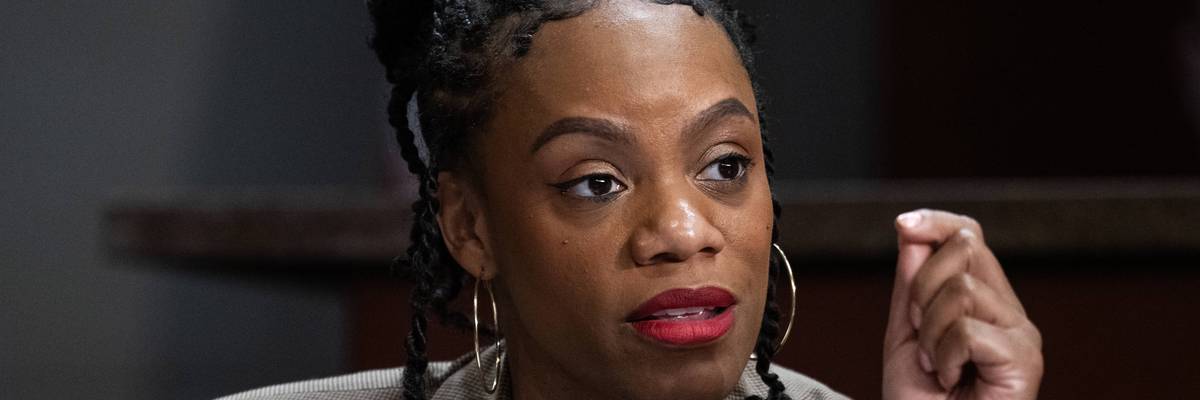
Move Over Spanberger... Summer Lee to Deliver Working Families Response to Trump State of the Union
“I’m going to say what too many politicians won’t: The system is rigged, the obscenely wealthy are profiting from it, and working people deserve more than scraps.” Rep. Summer Lee (D-Pa.) speaks in the Capitol Visitor Center on Wednesday, January 21, 2026. (Tom Williams/CQ-Roll Call, Inc via Getty Images)
Stephen Prager Feb 20, 2026 COMMON DREAMS As Democrats plan boycotts and counterprogramming to President Donald Trump’s State of the Union address next week, progressives are readying their own response to resist not just the historically unpopular commander-in-chief, but the centrist faction of their own party.
For years, the State of the Union has served as a platform for rising stars in the opposition party. The Democrats are rolling out the newly minted Virginia Gov. Abigail Spanberger, a darling of the party establishment whose inaugural committee boasts an army of corporate backers—including Amazon and Capitol One, lobbying groups for the gambling industry and car dealerships, and multiple tobacco companies.
Seeking to push an alternative vision, the left-wing Working Families Party (WFP) has chosen Rep. Summer Lee (D-Pa.), whom national director Maurice Mitchell described as “fearless, rooted in working-class communities, and unafraid to take on both MAGA extremism and corporate power.”
Previous WFP speakers have included Reps. Ayanna Pressley (D-Mass.), Rashida Tlaib (D-Mich.), and Delia Ramirez (D-Ill.).
“I’m going to elevate the voices of the people in my district and across the country who are angry, scared, and fed up with an administration that’s done nothing to help and a lot to hurt everyday people,” Lee said. “I’m going to say what too many politicians won’t: The system is rigged, the obscenely wealthy are profiting from it, and working people deserve more than scraps.
“Now more than ever,” she continued, “we need a political home for people who are ready to fight back against Trump’s corruption and cruelty, and the corporate politics that made him possible.”
Her address comes at a pivotal moment for the Democratic Party’s future. Despite the sinking popularity of Trump and soaring expectations of a blue wave in this November’s midterms, polls show that Democratic voters are overwhelmingly dissatisfied with their party’s leadership, believing it has failed to forcefully take on corporate power and pursue policy priorities like universal healthcare and increased taxes on the rich.
Contrary to Spanberger, a former congresswoman who consistently voted to hike military spending and called on former President Joe Biden to avoid pursuing an ambitious FDR-style social spending agenda, Lee has championed Medicare for All, a wealth tax on the richest Americans, and Green New Deal legislation while being one of Congress’ fiercest critics of the US’s unconditional military support for Israel.
“Summer Lee is the kind of leader this moment demands,” Mitchell said. “At a time when voters are losing faith in the two-party status quo, the Working Families Party is building a disciplined, independent political force that can defeat Trump and actually deliver on jobs, wages, healthcare, and more.”
Democrats on Capitol Hill Should Not Support Trump’s State of the Union Deception
If Democrats attend the SOTU, they are implicitly sending a message that these are normal times and that Trump is a normal president.
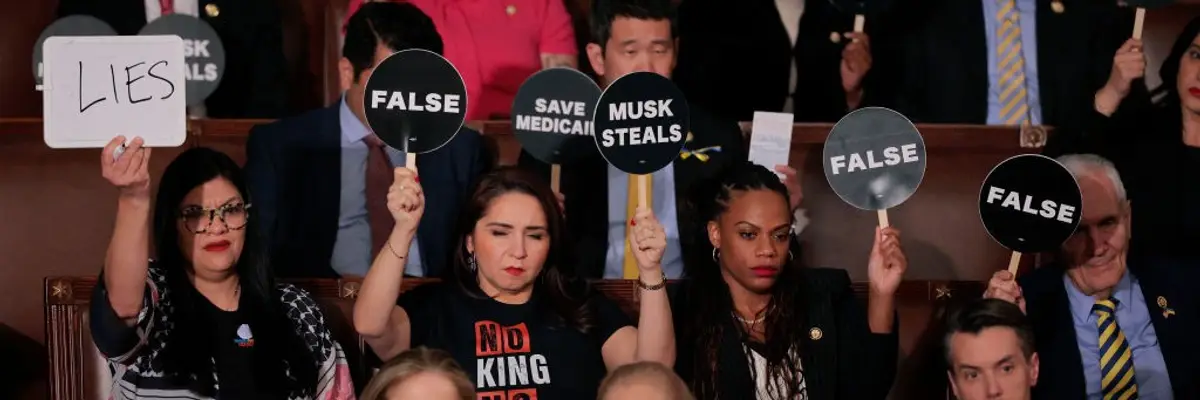
Rep. Rashida Tlaib (D-Mich.) (L) joins fellow Democrats in holding up signs to protest against US President Donald Trump as he addresses a joint session of Congress at the US Capitol on March 4, 2025 in Washington, DC. (Photo by Chip Somodevilla/Getty Images)
The annual state of the union address by the president is perhaps the oldest ritual in American politics. Informing the Congress of the state of the union is one of the few presidential duties written into the Constitution. Up until Woodrow Wilson, American presidents simply submitted a written assessment of the state of the union. Over the decades, SOTU has become a media spectacle. Members of Congress have been known to arrive in the chamber of the House of Representatives hours in advance to be seen on national television shaking hands with the president. Beginning with Ronald Reagan in 1982, presidents have invited guests to send a political message. Members of Congress now follow suit and use guests to make political points.
The SOTU is quite simply American political theater at its best. It is far more about posturing than public policy. In normal times, the issue of boycotting the SOTU would be a minor issue. These, however, are anything but normal times. Since the introduction of the SOTU speech by Wilson, no political party has boycotted SOTU. Members of Congress have chosen other means of making political points, which have included heckling of the president.
There is currently a debate raging among Democratic members of Congress as to whether the best way to protest President Donald Trump’s assault on American democracy is to attend the SOTU as normal or to protest the speech by boycotting it and attending an alternative event. Democratic leader Rep. Hakeem Jeffries (D-NY) has said that he will attend the SOTU. The New York Times reported on February 17: Mr. Jeffries on Tuesday said it was his “present intention” to attend. “We’re not going to his house, he’s coming to our house,” he told reporters at a news conference. “Having grown up where I grew up, you never let anyone run you off your block.” (Mr. Jeffries grew up in the Crown Heights section of Brooklyn.)
I certainly understand and appreciate Jeffries’ attitude. In past years under a Reagan or George W. Bush presidency it would have made a lot of sense. However, Trump 2.0 is far different presidency than either Reagan or Bush. Democrats had profound differences with Presidents Reagan and Bush. These differences are nothing compared with what the Democrats have with Trump. The bottom line is that unlike Reagan or Bush, Trump is waging war against our democratic system and the rule of law.
If Democrats attend the SOTU, they are implicitly sending a message that these are normal times and that Trump is a normal president. The argument can be made that members of Congress have an obligation to listen to any president’s SOTU. To counter this argument, I would say that by simply showing up in the House chamber to listen to the SOTU, Democratic members of Congress are sending the message that Trump is a president like we have had in the past. After the attack on the Capitol on January 6, 2021 and Trump pardoning those who stormed into the Senate chamber and who almost made it into the House chamber, the very space that the SOTU is held, destroyed completely any conception that Trump is a normal president.
Any Democratic member of Congress who attends the SOTU is simply acting as a bit player in Donald Trump’s latest reality show. Connecticut Democratic Sen. Chris Murphy who boycotted the SOTU last year put it quite simply, “These aren’t normal times, and we have to stop doing normal things.”
Democratic members of Congress have the opportunity by boycotting the SOTU and attending an alternative event to send America the message that these are not normal times. By boycotting Trump’s SOTU, Democratic members of Congress can stand up for American democracy.
Our work is licensed under Creative Commons (CC BY-NC-ND 3.0). Feel free to republish and share widely.
Martin Burns Martin Burns has worked as a congressional aide, polling analyst, journalist, and lobbyist. He was on the campaign trail for Harris-Walz in Pennsylvania and North Carolina. In addition to Common Dreams, his work has been published by The Hill, Irish Central, and the Byline Times. Martin resides in Washington, DC with his wife, and regular coauthor, Mary Liz. His website is Martinburns.news. Full Bio >
Bernie and AOC wouldn't be known without this American giant
The Conversation February 21, 2026 Jesse Jackson looks out from the U.S. Capitol in Washington, in January 2013. REUTERS/Kevin Lamarque
By Bert Johnson, Professor of Political Science, Middlebury College.
Jackson’s campaigns energized a multiracial coalition that not only provided support for other late-20th-century Democratic politicians, including President Bill Clinton, but helped create an organizing template – a so-called Rainbow Coalition combining Black, Latino, working-class white and young voters – that continues to resonate in progressive politics today.
He campaigned in Vermont twice in 1984, buoyantly declaring in Montpelier, the state capital, “If I win Vermont, the nation will never be the same again.”
Jackson’s presidential ambitions coincided with a pivotal moment in Vermont politics: The state’s voting patterns were shifting left, with new residents arriving and changing the state’s culture and economy. In 1970, nearly 70 percent of Vermonters had been born there. By 1990, that figure had dropped by 10 percentage points.
The Vermont Rainbow Coalition, which was formed to support Jackson’s first campaign, organized a crucial constituency in a fluid time, establishing patterns that would persist for decades.
Setting the standard
Jackson created a “People’s Platform” that would sound familiar to today’s progressives, calling for higher taxes on businesses, higher minimum wages and single-payer, universal health care.
In light of Jackson’s efforts, Vermont activists saw the potential for a durable statewide organization. Rather than disband the Vermont Rainbow Coalition after the 1984 primary, they kept the group going, endorsing candidates in campaigns for the legislature and statewide office in each of the next three election cycles. The coalition also endorsed Bernie Sanders’ failed bid for Congress in 1988.
Sanders served eight years as mayor of Burlington as an “independent socialist,” cultivating a core collection of local allies known as the Progressive Coalition who sought to wrest power away from establishment members of the city’s Board of Aldermen.
Sanders eventually went on to win election to the House as an independent in 1990, serving in the chamber until winning his Senate seat, also as an independent, in 2006. His presidential runs in 2016 and 2020 made him a prominent national figure and a leader among progressives.
Alexandria Ocasio-Cortez, who unseated a member of the House Democratic leadership in a stunning 2018 primary upset in New York, had been a Sanders campaign organizer and remains his close ally. On Jan. 1, 2026, Sanders swore in Zohran Mamdani – like Ocasio-Cortez, a Democratic socialist – as mayor of New York City.
“Jesse Jackson is one of the very most significant political leaders in this country in the last 100 years,” Sanders said. “Jesse’s contribution to modern history is not just bringing us together – it is bringing us together around a progressive agenda.” Not just Vermont
In Vermont, Jackson performed surprisingly well in unlikely places – taking nearly 20 percent of the 1984 primary vote in working-class Bakersfield and Belvidere, for example.
Today’s Vermont Progressive Party, which emerged out of the old Vermont Progressive Coalition, is one of the most successful third parties in the nation, winning official “major party” status in the state shortly after its official founding in 2000. The party has elected candidates to the state legislature, city councils and even a few statewide offices, including that of lieutenant governor.
Vermont was not alone in experiencing the catalyzing effect of Jackson’s presidential runs. Jackson had a significant mobilizing impact on Black voters nationwide. In Washington state, the Washington Rainbow Coalition started in Seattle and spread across the state between 1984 and 1996. New Jersey and Pennsylvania had their own successful and independent Rainbow Coalitions. In 2003, the Rainbow Coalition Party of Massachusetts joined the Green Party to become the Green Rainbow Party.
In my own research, I’ve investigated the durability of the “Jackson effect” in Vermont. There is no better test of what differentiates the Vermont Progressive Party from the state’s Democratic Party than the 2016 Democratic primary race for lieutenant governor, which pitted progressive David Zuckerman against two prominent, mainstream Democrats.
Zuckerman beat the Democrats most handily in towns that had voted the most heavily for Jesse Jackson in 1984, an effect that persisted even when controlling for population, partisanship and liberalism.
Many people would point to Sanders as the catalyst for Vermont’s continuing progressive movement. But Sanders and the progressives owe much to Jackson.
Bert Johnson has taught American politics at Middlebury since 2004. His research and teaching interests include campaign finance, federalism, and state and local politics.
Johnson is author of Political Giving: Making Sense of Individual Campaign Contributions (Boulder: FirstForum Press, 2013), and coauthor (with Morris Fiorina, Paul E. Peterson, and William Mayer) of The New American Democracy (Longman, 2011). His articles have appeared in Social Science History, Urban Affairs Review, and American Politics Research. He is owner and author of Basicsplainer.com.
IMPERIALIST PIRACY ON THE HIGH SEAS
‘This Is Murder’: Trump Strike Kills 3 More Boaters in the Pacific
“Demand Congress take action against these strikes now!” said Amnesty International USA.
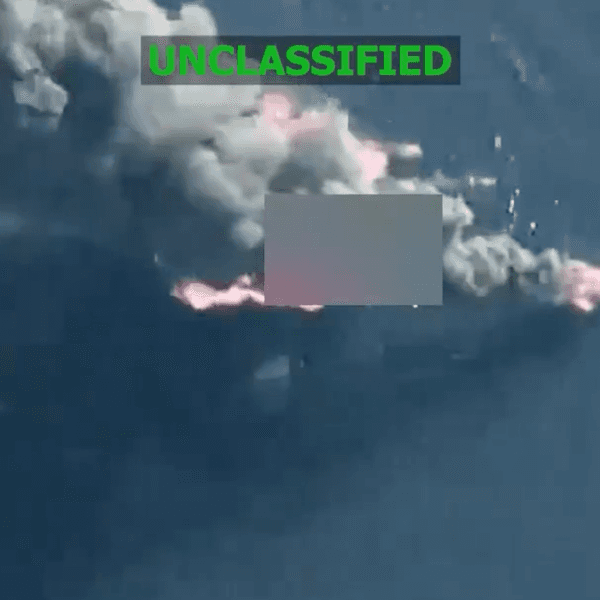
US Southern Command shared on social media a 16-second clip of a strike on a boat in the eastern Pacific that killed three people on February 20, 2026. (Photo: screen grab/SOUTHCOM/X)
President Donald Trump’s “summary executions continue,” Princeton University visiting professor Kenneth Roth said early Saturday after the US military announced its 43rd bombing of boaters whom the administration claimed were smuggling drugs.
Sharing a 16-second clip of the strike on social media, US Southern Command said late Friday that “Joint Task Force Southern Spear conducted a lethal kinetic strike on a vessel operated by designated terrorist organizations. Intelligence confirmed the vessel was transiting along known narco-trafficking routes in the eastern Pacific and was engaged in narco-trafficking operations. Three male narco-terrorists were killed during this action. No US military forces were harmed.”
Roth, the former longtime director of Human Rights Watch, noted that “the strike raised the death toll in Trump’s campaign against people accused of drug smuggling at sea to at least 147—each a murder.” Some tallies put the death toll at 148 or 149.
Since Trump started bombing boats in September, critics have condemned the strikes as “war crimes, murder, or both.” The administration has tried to justify the operation by arguing that it is in an “armed conflict” with drug cartels in Latin America, including Venezuela—whose president, Nicolás Maduro, was abducted by US forces last month and subsequently pleaded not guilty to narco-terrorism charges in a federal court in New York.
Various human rights advocates and legal experts, including Democrats and even some Republicans in Congress, have rejected that argument. However, both the GOP-controlled Senate and House of Representatives have declined to pass recent war powers resolutions intended to stop Trump’s boat bombings.
“Three more people have been killed. This is murder. Demand Congress take action against these strikes now!” Amnesty International USA said on social media Saturday, sharing a form constituents can use to contact their representatives.
Multiple journalists highlighted that in this case, and others, the targeted boat appeared to be stationary when the US bombed it.
The Friday bombing came after the US Department of Defense announced that it had killed 11 people on three boats in the Caribbean Sea and the eastern Pacific late Monday.
“The US military has carried out strikes every three or four days since the new leader of the Southern Command, Gen. Francis L. Donovan of the Marine Corps, took over last month after the previous commander, Adm. Alvin Holsey, abruptly retired,” the New York Timesreported. “Defense Department and congressional officials said Adm. Holsey had expressed concerns about the strikes.”
‘I Guess I Can Say I Am’: Trump Confirms He’s Considering Unprovoked Attack on Iran
One analyst predicted Iran would close the Strait of Hormuz and attack oil installations “in the hope of driving oil prices to record levels” should the US strike.
US President Donald Trump on Friday confirmed that he’s considering launching an unprovoked military strike against Iran.
According to the New York Times, Trump was asked by reporters on Friday if he was considering attacking Iran, and he replied, “I guess I can say I am considering that.”
The US has for weeks been sending fleets of warships, including the world’s largest aircraft carrier, to the Middle East in apparent preparation for a massive military operation against Iran.
According to a Friday report from Al Jazeera, the buildup is the largest by the US Air Force in the region since the 2003 Iraq War, and it includes deployments of E-3 Sentry Airborne Warning and Control System (AWACS) aircraft, F-35 stealth strike fighters and F-22 air superiority jets, and F-15 and F-16 fighter jets.
Trump has not given any justification for launching such an attack, nor has he asked the US Congress to approve it, even though the Constitution gives the legislative branch the power to declare war.
Reps. Ro Khanna (D-Calif.) and Thomas Massie (R-Ky.) have been pushing for a vote in the US House of Representatives on a war powers resolution that would require Congress to debate and approve any act of war with Iran.
It is also not clear what goals the president would hope to achieve with the attack. A Thursday CNN report indicated that Trump is now weighing several options ranging from “more targeted strikes to sustained operations that could potentially last for weeks,” including “plans to take out Tehran’s leaders.”
Trita Parsi, co-founder and executive vice president of the Quincy Institute for Responsible Statecraft, wrote in a Friday analysis of Trump’s reported attack plans that there is little chance that the president will be able to achieve a quick victory over Iran simply because the offers he has made to its government are nonstarters.
“Since the US strategy... is to escalate until Tehran caves, and since capitulation is a non-option for Iran, the Iranians are incentivized to strike back right away at the US,” explained Parsi. “The only exit Tehran sees is to fight back, inflict as much pain as possible on the US, and hope that this causes Trump to back off or accept a more equitable deal.”
Parsi acknowledged that there is no way Iran can defeat the US militarily, but could “get close to destroying Trump’s presidency before it loses the war” through a number of maneuvers intended to spike the price of oil, including “closing the Strait of Hormuz” and attacking “oil installations in the region in the hope of driving oil prices to record levels and by that inflation in the US.”
“This is an extremely risky option for Iran,” Parsi conceded, “but one that Tehran sees as less risky than the capitulation ‘deal’ Trump is seeking to force on Iran.”
‘The Siege Must Be Broken’: Countries Called to Ship Fuel to Cuba After Trump Tariffs Struck Down The US Supreme Court’s ruling “implies that Trump’s recent order imposing tariffs on countries selling oil to Cuba exceeds the president’s statutory authority.”
With the centerpiece of President Donald Trump’s economic agenda—his use of an emergency law to impose tariffs on countries around the world—struck down by the US Supreme Court on Friday, analysts said the sweeping ruling should promptly end the Cuba blockade that his administration has pressured other governments to take part in, leaving millions of Cubans struggling with shortages of essentials.
The court ruled that the 1977 International Emergency Economic Powers Act (IEEPA) does not empower the president to “unilaterally impose tariffs,” as Trump has on countries across the globe, insisting that doing so would boost manufacturing and cut the trade deficit—despite mounting evidence that the tariffs have instead raised costs on American households.
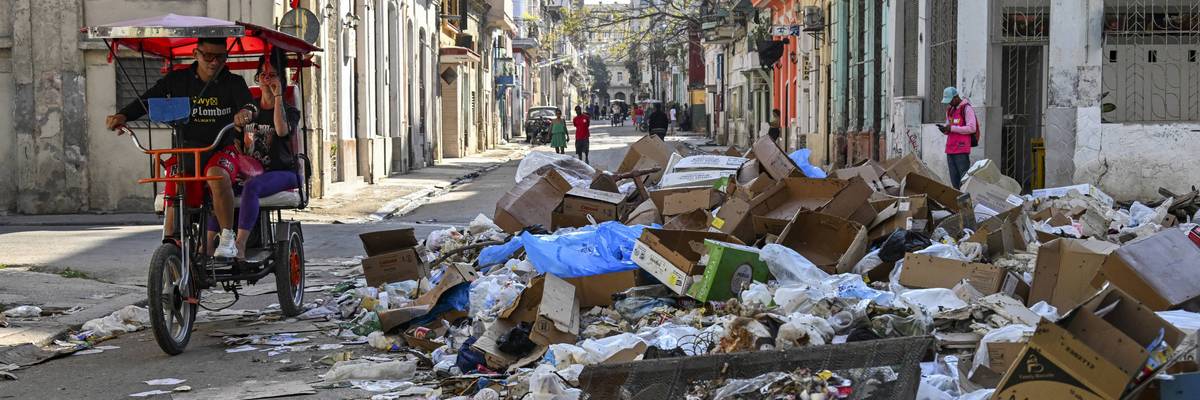
A bicitaxi rides past garbage piled up on a street in Havana, Cuba on February 17, 2026. (Photo by Yamil Lage/AFP via Getty Images)
Trump also invoked the IEEPA last month when he issued an executive order accusing Cuba of supporting terrorism and posing a security risk to the US, and threatening to ramp up the use of tariffs against any country that sends oil, which Cuba’s economy relies on almost entirely for energy, to the island nation’s government.
US Secretary of State Marco Rubio has long pushed for regime change in the communist country his family immigrated from in the 1950s, and the administration called on the Cuban government to make “very dramatic changes very soon.”
With Trump’s use of the IEEPA struck down by the high court, some advocates and observers said that countries should quickly reverse their decisions to join the US in keeping oil from Cuba.
“As far as I can tell, this strikes down Trump’s ability to tariff countries that provide oil to Cuba. Hopefully a measure of relief,” said Michael Galant, a member of Progressive International’s secretariat and a researcher on sanctions. “The siege must be broken.”
The court handed down the ruling as the manufactured crisis unfolding in Cuba largely faded into the background in the corporate media, but an article in the New York Times on Friday described how the lack of fuel shipments has left Cubans facing frequent blackouts, gas shortages, growing piles of trash in the streets of Havana and other cities as sanitation trucks aren’t running, soaring food prices, and suspensions of some medical care at hospitals.
Researcher Shaiel Ben-Ephraim also described how the “completely unprovoked” oil blockade that was started “with very little public discussion” has led to a “rising mortality rate among the elderly and those with chronic illnesses who cannot access life-support or specialized care” and a surge in diseases such as dengue fever and Orupuche virus, “which have become increasingly fatal due to the shortage of basic medicines and rehydration fluids.”
“All this has occurred within weeks. A sustained blockade could lead to hundreds of thousands of deaths. All with no debate, no approval from Congress and no provocation from Cuba,” said Ben-Ephraim.
Jorge Piñón, who researches Cuba’s oil supply at University of Texas at Austin, told the Times that the country’s fuel reserves could be entirely depleted by mid-March.
Trump issued his executive order on Cuba weeks after invading Venezuela, abducting President Nicolás Maduro, and pushing for control of the South American country’s oil supply. Venezuela has long been a top provider of oil to Cuba. Trump’s tariff threat led Mexico, which became a lifeline for Cuba after the flow of oil from Venezuela stopped, to halt its shipments.
Galant noted that Trump will likely “continue to do all that he can to starve the island,” and the president said soon after the Supreme Courtannounced its ruling that he would use different executive powers to impose a 10% global tariff, suggesting he was not prepared to back down on the tariffs he imposed before taking aim at Cuba.
But critics urged countries that have tried to help Cuba since Trump’s executive order, as Mexico has by sending humanitarian aid packages, to reverse their decisions to halt oil shipments to the island.
“So which countries are gonna start sending fuel to Cuba now?” asked organizer Damien Goodmon.
After Supreme Court Kills Tariffs, Trump Plots ‘15% Tax Out of YOUR Pockets to Feed HIS Deranged Ego’ “Donald Trump is a gangster with no respect for the rule of law and no understanding of economics,” said former Democratic presidential candidate Tom Steyer.
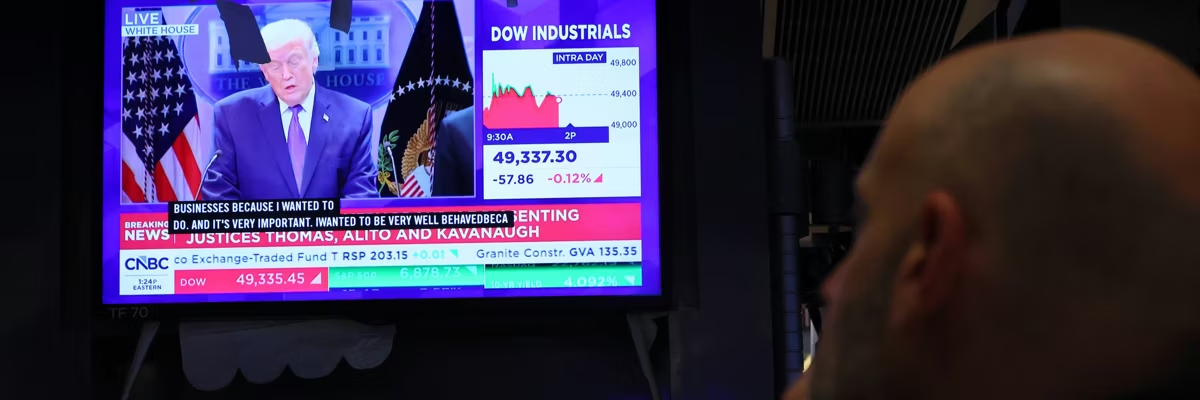
President Donald Trump’s press conference on tariffs is displayed on a television as traders work on the floor of the New York Stock Exchange on February 20, 2026 in New York City. (Photo by Michael M. Santiago/Getty Images)
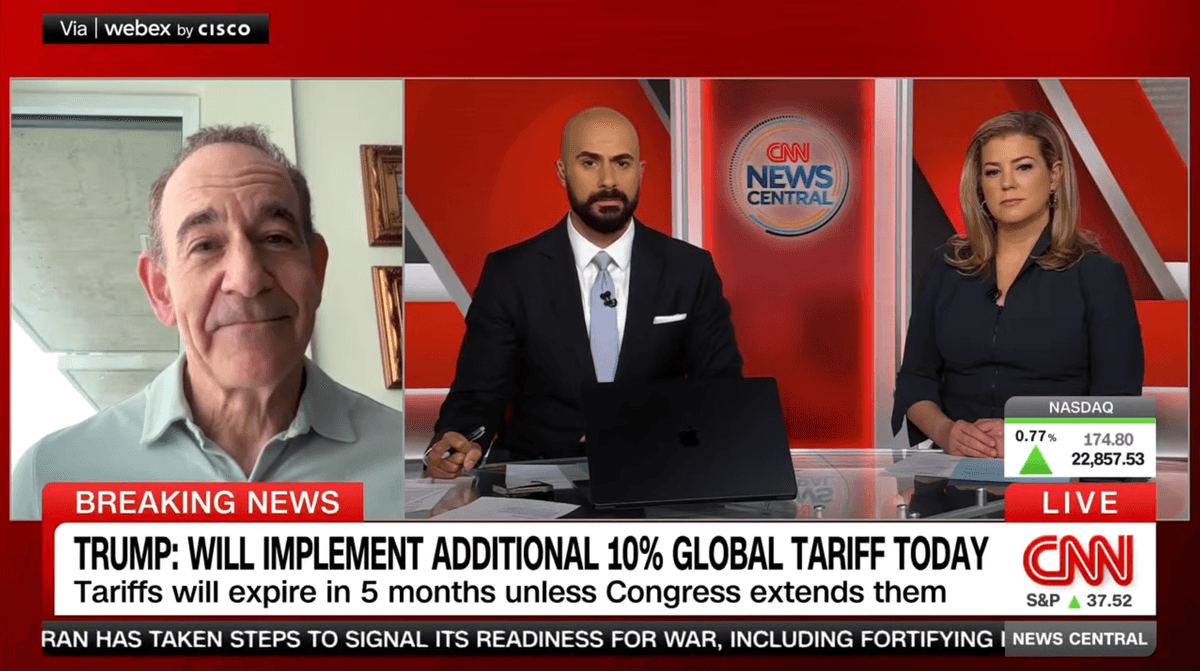
Shortly after the US Supreme Court on Friday ruled against President Donald Trump’s use of emergency powers to impose sweeping tariffs, the Republican announced plans for a 10% global import tax under another law. By Saturday, he’d hiked it to 15%.
In a 6-3 decision penned by Chief Justice John Roberts, the high court found that “nothing” in the text of the 1977 International Emergency Economic Powers Act (IEEPA) “enables the president to unilaterally impose tariffs.” Trump responded by not only lashing out at the justices but also invoking Section 122 of the Trade Act of 1974 for a 10% global tariff beginning February 24.
Then, in a Saturday morning Truth Social post, Trump said: Based on a thorough, detailed, and complete review of the ridiculous, poorly written, and extraordinarily anti-American decision on tariffs issued yesterday, after MANY months of contemplation, by the United StatesSupreme Court, please let this statement serve to represent that I, as President of the United States of America, will be, effective immediately, raising the 10% Worldwide Tariff on Countries, many of which have been ‘ripping’ the US off for decades, without retribution (until I came along!), to the fully allowed, and legally tested, 15% level. During the next short number of months, the Trump Administration will determine and issue the new and legally permissible Tariffs, which will continue our extraordinarily successful process of Making America Great Again GREATER THAN EVER BEFORE!!! Thank you for your attention to this matter.
Critics across the country swiftly blasted the announcement. Democratic strategist Jon Cooper argued that “Trump CANNOT legally impose a 15% global tariff because the US doesn’t meet the clear emergency economic conditions envisioned by Section 122. If Trump tries to invoke it, it would certainly face immediate legal challenges, economic pushback, and potential congressional scrutiny.”
Former Democratic presidential candidate Tom Steyerdeclared that “Donald Trump is a gangster with no respect for the rule of law and no understanding of economics. This is a 15% tax out of YOUR pockets to feed HIS deranged ego.”
California Gov. Gavin Newsom, who’s expected to seek the Democratic presidential nomination in 2028, similarly said that “Donald Trump just announced a NEW 15% TAX on the American people. He does not care about you.”
Another California Democrat, Congressman Ted Lieu, quipped that “crybaby Trump woke up this morning and still feels hurt from the Supreme Court slapping him. So he’s taking it out on the American people by increasing his 10% tax increase to 15%. These temporary tariffs will be challenged in court and Democrats will kill them when they expire.”
Elected Democrats have often spoken out against Trump’s legally dubious duties, but the GOP-controlled Congress hadn’t forcefully countered them. As Politico detailed Friday: Before the ruling, while congressional Republicans had occasionally grumbled about the policy, they had largely fallen in line when actually required to vote on it. Now, the Supreme Court’s decision could put more pressure on them to break with the president...
Last week, Sen. Ed Markey (D-Mass.), ranking member of the Senate Committee on Small Business and Entrepreneurship, released a report laying out how Trump’s economic policies, particularly the tariffs, “are making life unaffordable for millions of American small businesses, their workers, and their customers.”
Markey held a virtual press conference with Massachusetts small business owners celebrating the Supreme Court’s Friday ruling. The senator said that “for the last year, Trump has created Pain on Main with an affordability crisis plaguing communities across the country. At the heart of it are Trump’s tariff taxes.”
“The Supreme Court did what was right and struck down these illegal tariffs. Trump said the small businesses who brought this case hate our country. He’s wrong. Small businesses are our country,” Markey continued. “I will keep fighting until every cent illegally collected from small businesses, consumers, and families in Massachusetts and across the country has been returned.”
'Brilliant' Costco to reap rewards for opposing Trump early: report
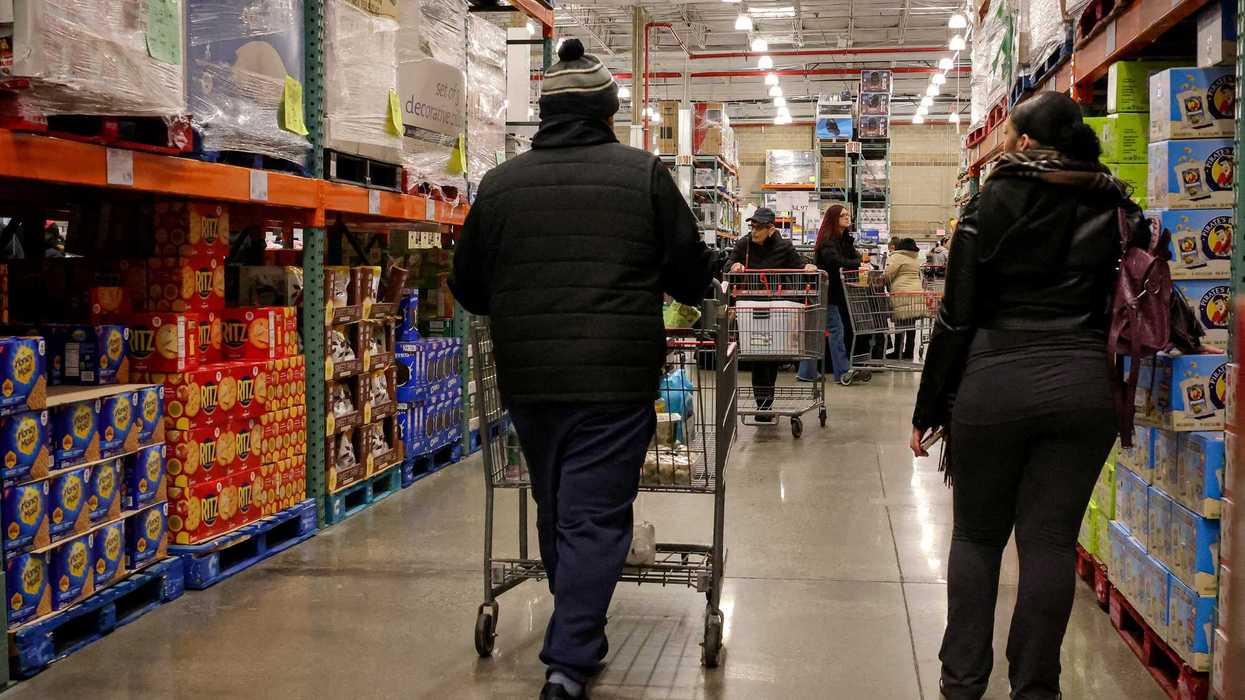
People shop at a Costco store in the Staten Island borough of New York City, U.S., January 16, 2026. Brendan McDermid/File Photo
Costco’s decision to buck President Donald Trump appears to have paid off now that a majority od Supreme Court Justices have destroyed his self-appointed power to impose arbitrary international tariffs at the whim of a social media post
“Back in December, I wrote about how Costco became the first major retailer — and the largest company — to sue the Trump administration over tariffs. At the time, the question practically asked itself: brilliant or insane?” said Inc. reporter Bill Murphy. “Two months later, there is a much clearer answer.”
When SCOTUS deemed Trump’s tariffs to be illegal on Friday it left open the door of what exactly to do about the tens of billions of dollars the Trump administration has been slurping up from U.S. consumers and businesses with its import tax.
“If the refunds materialize as many companies hope, Costco’s decision to jump into court early could look less like a gamble and more like sharp strategic timing,” said Murphy.
Costco was not the only company to sue the Trump administration over its tariffs, but it was the most visible among similar filings by similar tariff challenges EssilorLuxottica, Kawasaki Motors, Revlon, Bumble Bee Foods, Goodyear, and others.
But the Supreme Court’s decision was primitive and singular. It delivered no plans or tactic for Trump to return his ill-gained money to companies, nor for companies to reimburse their consumers the added fees they were forced to collect for tariffed purchases. So, Murphy predicted the administrative process to be “complex.”
Murphy pointed out that the mechanics of tariff refunds likely will depend on “preserving claims while entries are still legally contestable,” which is something early filers have already worked out.
The result, he said, is not a literal “front of the line” reimbursement in the way creditors recoup their fees. However, companies that moved first “may face fewer procedural hurdles as the government unwinds what could be more than $170 billion in collected duties.”
Costco, by being one of the first companies to speak up against the Trump administration in defense of their consumers, could conceivably benefit from direct cash recovery on tariffs that it has already paid, earlier administrative positioning because it recorded and kept tabs on its claims for its attorneys, and “strategic credibility with investors for having acted decisively,” said Murphy.
Trump hikes global tariffs while still fuming over Supreme Court’s ‘ridiculous’ ruling
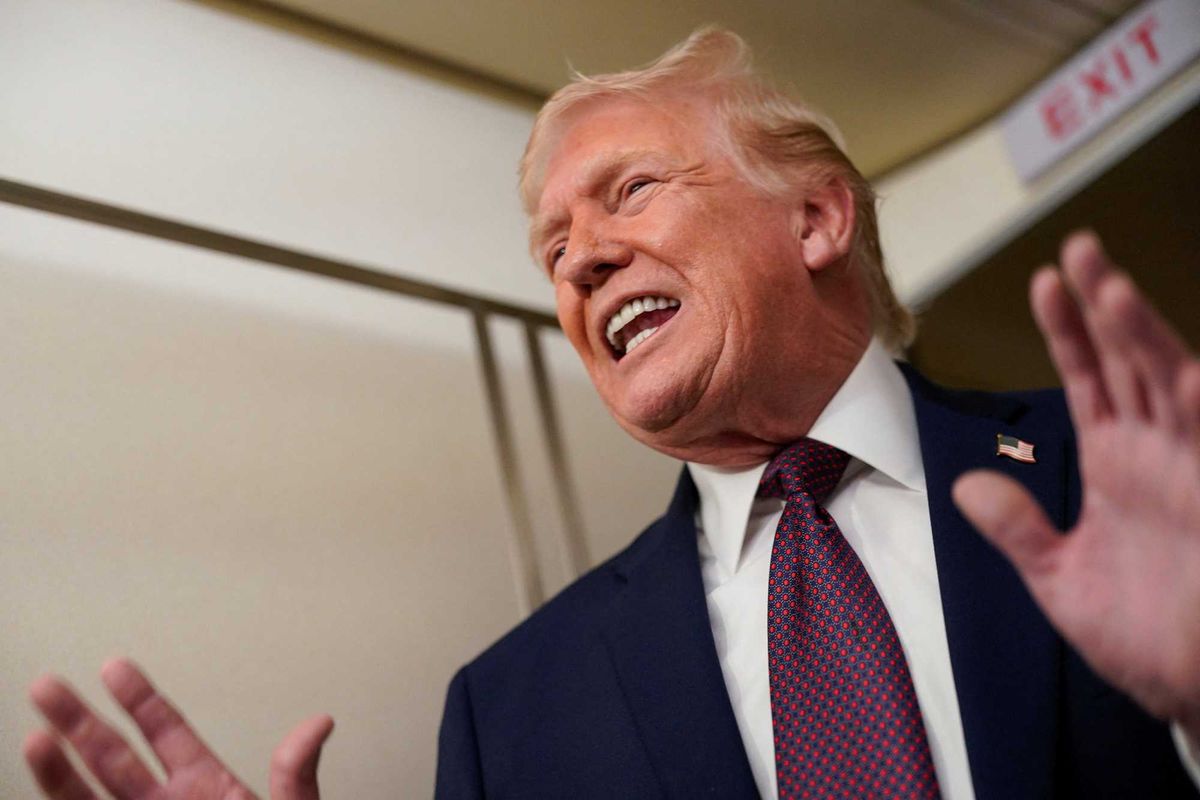
U.S. President Donald Trump speaks with members of the media aboard Air Force One en route from Florida to Washington, U.S., January 11, 2026. REUTERS/Nathan Howard
President Donald Trump announced a dramatic increase to global tariffs on Saturday in response to the Supreme Court’s ruling the day before against his so-called “reciprocal tariffs,” a ruling he slammed as “ridiculous” and “poorly written.”
“Based on a thorough, detailed, and complete review of the ridiculous, poorly written, and extraordinarily anti-American decision on Tariffs issued yesterday, after MANY months of contemplation, by the United States Supreme Court, please let this statement serve to represent that I, as President of the United States of America, will be, effective immediately, raising the 10% Worldwide Tariff on Countries, many of which have been ‘ripping’ the U.S. off for decades, without retribution (until I came along!), to the fully allowed, and legally tested, 15% level,” Trump wrote on his social media platform Truth Social.
“During the next short number of months, the Trump Administration will determine and issue the new and legally permissible Tariffs, which will continue our extraordinarily successful process of Making America Great Again - GREATER THAN EVER BEFORE!!!”
Shortly after the Supreme Court’s ruling Friday, Trump vowed to pursue “alternative” paths to imposing tariffs on other nations in an effort to circumvent the court’s decision. He also raged against the justices that ruled against his tariffs, including two of his own appointees, who he said he was "ashamed " of.
Economist flags Trump's one-day flip flop after having 'months to prepare' his next move
Donald Trump had "literally months to prepare" a response but still fumbled it, changing his mind after one day, according to an economist on Saturday.
The Supreme Court smacked down Trump's tariff policies in a stunning rebuke from the most conservative high court in modern history, and Trump responded by waffling his new plan, according to noted economist Justin Wolfers.
In response to the decision, Trump first said he had enacted a 10% global tariff by executive order. Then on Saturday, he raised it to 15% via a Truth Social Post.
"Based on a thorough, detailed, and complete review of the ridiculous, poorly written, and extraordinarily anti-American decision on Tariffs issued yesterday, after MANY months of contemplation, by the United States Supreme Court, please let this statement serve to represent that I, as President of the United States of America, will be, effective immediately, raising the 10% Worldwide Tariff on Countries, many of which have been 'ripping' the U.S. off for decades, without retribution (until I came along!), to the fully allowed, and legally tested, 15% level," Trump wrote this weekend.
Wolfers flagged the chaotic nature of the response, saying on X, "The President had literally months to prepare his response to the Supreme Court ruling, yet couldn't even stick with his decision on the s.122 (temporary) tariff from Friday to Saturday, raising it from 10% to 15%."
'Trump became enraged' and used expletives after news of Supreme Court smackdown: report
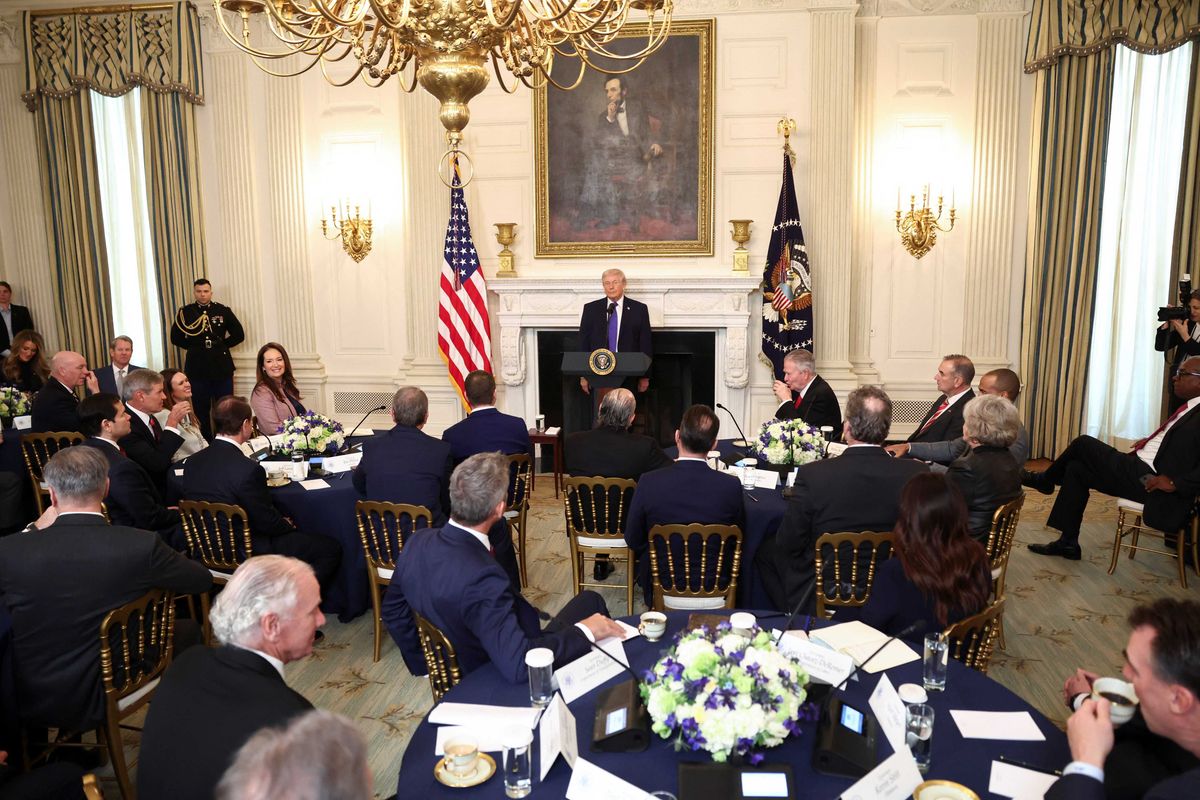
President Donald Trump holds a working breakfast with governors at the White House in Washington, D.C. on Feb. 20, 2026. REUTERS/Kevin Lamarque
President Donald Trump was reportedly infuriated Friday after the Supreme Court ruled that his tariffs were illegal.
Trump was hosting the National Governor's Association breakfast with a room full of the nation's governors at the White House when he found out about the high court's decision to strike down Trump's tariffs in a 6-3 vote.
"Apparently the gov breakfast had been going well, they were working together, and then President Trump became enraged. He started ranting about the decision, not only calling it a disgrace, but started attacking the courts at one point saying, these 'f------ courts,'" said CNN senior White House correspondent Kristen Holmes.
"This tariff policy — this could not be a bigger decision for President Trump — this could not be a bigger loss for President Trump," Holmes added. "Not only is so much of his economic agenda based on these tariffs, so much of his foreign policy is based on these tariffs. He has used these tariffs as leverage in almost every meeting that he has had around the world. He has touted them as the most important part of the economic agenda. So clearly, a huge loss, and he recognizes that today."
Trump and his administration have not yet made an official announcement in response. His team was reportedly meeting to determine next moves, Holmes said.
Farmers giddy as Trump dealt 'big loss' at Supreme Court
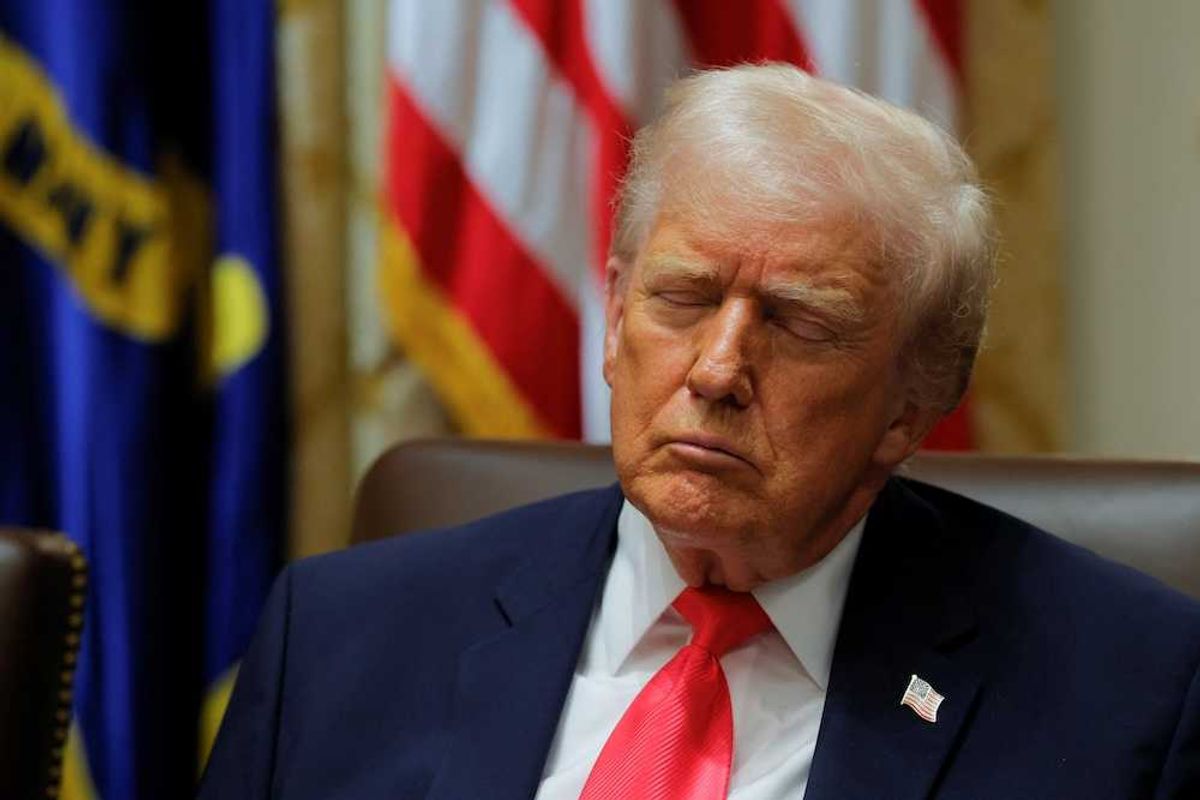
GOP senator accuses Trump of having poor 'bedtime manners' after he's caught napping
John Boyd, Jr., the head of the National Black Farmers Association, celebrated Friday on MS NOW following the Supreme Court's decision invalidating President Donald Trump's authority to use emergency powers to enact tariffs.
"So, John, this morning you were feeling pretty positive," said anchor Antonia Hylton. "But now that President Trump says he's going to keep pushing these tariffs through no matter what, how are you doing?"
"Well, you know, I don't care how you look at it today — it's a big win for me and a big loss for this president," said Boyd, who has previously warned the tariffs are devastating farmers to the point of suicide. "That's why he was screaming to the top of his lungs at this press conference. He knows he lost in a big way today. And this is the first step in the right direction."
The ruling, he continued, is "the first real hard note that this president has heard from the Supreme Court since he became elected. 6 to 3 is a pretty sweeping, you know, victory. I don't care how you look at it."
The next step, said Boyd, is "we want to turn to Congress to see how we can get compensated for lost revenue from all of the hardship that these tariffs have cost us. In the soybean market alone, we lost $54 billion, and the president is proposing $12 billion. I mean, people, you can do the math there. What the Supreme Court didn't do is lay out how farmers like myself are going to recoup our losses based on the damage from the president's tariffs."
"But I don't care how you look at it today, this president lost and John Boyd won today, because I've been on your show saying that these tariffs are illegal," he added. "And the courts agreed with me today. And what the president said to the Supreme Court today was deplorable. He called them lapdogs and fools and RINOs. How does he think that other world leaders are looking at this decision and rating him today? It shows his lack of leadership skills."
Historian breathes sigh of relief over Trump's crippling blow: 'James Madison is smiling'
Tim Naftali, CNN's presidential historian, described why the nation's founding fathers would have approved of the Supreme Court's decision to strike back President Donald Trump's tariffs. (CNN/Screenshot)
A historian Friday described the historic impact of the Supreme Court's decision in its ruling against President Donald Trump's tariffs — something the nation's founders would have appreciated.
Tim Naftali, CNN's presidential historian and former head of the Nixon Presidential Library, explained why the high court's ruling was an active practice of what the Constitution was intended to do.
"Well, wherever he is, James Madison is smiling today. Tariffs are a tax. The founders decided that taxes should be the responsibility of the Article One branch, which is Congress," Naftali said.
"And today the U.S. Constitution worked as it's supposed to work, which is to keep various parts of the government in check when they overstep constitutional bounds," he added.
The court's decision was also one of many times throughout history that the Supreme Court has pushed back on a president.
"This is a huge moment in American history," Naftali said. "Donald Trump is not the first president to have been disappointed by the court. The courts in the 1930s invalidated Franklin Roosevelt's New Deal. That's what led to the first push to pack the court that was Roosevelt's response to the fact that he was so angry at the court for undermining the New Deal.
"In the end, the court changed, and the New Deal stayed. Richard Nixon was furious at the court for forcing him to turn over the tapes when he lost the case. U.S. v Nixon. Well, the Dobbs decision really unsettled the Biden presidency. And Obama was not happy with Citizens United."
He said it's not new for presidents to be unhappy about a Supreme Court decision, but it is American.
"It's the way that it works. Our system is supposed to work this way every so often. One of the branches is supposed to be disappointed when it can't engage in a power grab that is unconstitutional."
Even Without the 'Emergency' Powers SCOTUS Rejected, Trump Has a Bunch of Tariff Options
Jacob Sullum Fri, February 20, 2026
REASON
President Trump's claim of sweeping tariff authority under the International Emergency Economic Powers Act (IEEPA) was rejected by the Supreme Court, leading to a major setback for him.See more
President Donald Trump suffered a major setback today at the Supreme Court, which rejected his claim of sweeping tariff authority under the International Emergency Economic Powers Act (IEEPA). Trump could have avoided that embarrassing defeat if he was not so keen on asserting broad, unbridled powers based on a dubious legal interpretation, which is part of a pattern with him.
"When Congress grants the power to impose tariffs, it does so clearly and with careful constraints," Chief Justice John Roberts notes in Learning Resources v. Trump, the decision rejecting Trump's interpretation of IEEPA. As that observation suggests, there is no shortage of statutes that empower the president to impose tariffs. Trump himself already has used some of them and can be expected to do so again now that the Supreme Court has closed off this particular route. But all of those laws restrict presidential action by specifying acceptable rationales, requiring agency investigations, or limiting the size, scope, or duration of tariff hikes.
Because Trump wanted to avoid those restrictions, he instead latched onto IEEPA, a 1977 law that does not even mention tariffs and had never before been used to impose them. The government's lawyers cited an IEEPA provision that authorizes the president to "regulate" imports in certain circumstances. That provision, they claimed, included a hitherto unnoticed power to completely rewrite the tariff schedule approved by Congress. Trump maintained that IEEPA authorizes the president to impose any taxes he wants on any imports he chooses from any country he decides to target for any length of time he considers appropriate whenever he deems it necessary to "deal with" an "unusual and extraordinary threat" from abroad that constitutes a "national emergency."
That reading of the law was implausible for several reasons, not least because it rendered superfluous the many statutes that explicitly allow the president to impose tariffs. Section 232 of the Trade Expansion Act of 1962, for example, authorizes taxes on imports that "threaten to impair the U.S. national security." During his first term, Trump used that law to impose tariffs on steel and aluminum, which he expanded last year, raising the rate and applying the taxes to home appliances made from those materials. He also invoked Section 232 to justify tariffs on cars and car parts.
Unlike the power that Trump unsuccessfully claimed under IEEPA, his Section 232 authority is limited. It requires a Commerce Department investigation that must be completed within 270 days after it is initiated, focused on specific goods that supposedly implicate national security. While such determinations are frequently dubious, the resulting tariffs are much more narrowly targeted than the steep, indiscriminate "Liberation Day" tariffs that Trump announced last April, which applied to myriad categories of goods from scores of countries.
According to Trump, those tariffs were aimed (if that is the right word) at addressing the "unusual and extraordinary threat" posed by the overall gap between exported and imported goods. Leaving aside the question of whether that long-standing deficit qualifies as an emergency or even a problem, you might wonder why Trump invoked IEEPA to deal with it rather than a law that is much more obviously relevant.
Section 122 of the Trade Act of 1974 authorizes tariffs to address "large and serious United States balance-of-payments deficits" that present "fundamental international payments problems." That law was inapposite, the Trump administration's lawyers argued, because balance-of-payments deficits are different from trade deficits. But as trade policy experts Marc L. Busch and Daniel Trefler noted in response to that argument, "goods trade is the dominant component of the current account, which is at the heart of the balance of payments." The upshot is that "more than 90 percent of the balance of payments is the trade deficit."
Why would the government obscure that reality? Possibly because, as the U.S. Court on International Trade (CIT) noted when it rejected Trump's interpretation of IEEPA last May, "Congress's enactment of Section 122 indicates that even 'large and serious United States balance-of-payments deficits' do not necessitate the use of emergency powers and justify only the President's imposition of limited remedies subject to enumerated procedural constraints."
Those constraints include a 15 percent rate cap and a maximum duration of 150 days, which can be extended only with congressional approval. The CIT concluded that "Section 122 removes the President's power to impose remedies in response to balance-of-payments deficits, and specifically trade deficits, from the broader powers granted to a president during a national emergency under IEEPA by establishing an explicit non-emergency statute with greater limitations."
Another seemingly germane law is Section 201 of the Trade Act, which authorizes tariffs when a good "is being imported into the United States in such increased quantities as to be a substantial cause of serious injury" to U.S. manufacturers. Such tariffs are supposed to "facilitate positive adjustment to import competition." Trump is clearly aware of that provision, which he invoked in 2018 to impose tariffs on solar cells and modules. He also targeted imports of residential washing machines under Section 201. But like Section 232 and Section 122, Section 201 includes limits that evidently irked Trump.
Section 201 tariffs require an investigation by the U.S. International Trade Commission (ITC), which must be completed within 180 days after the ITC receives a petition from aggrieved domestic manufacturers. That process includes public hearings and solicitation of public comments, and any resulting tariffs, which can be no higher than 50 percent, are supposed to target a specific industry, as opposed to all goods from a given country or set of countries. The tariffs initially can be imposed for four years, which can be extended to eight years, but they must be gradually reduced if they last longer than a year.
Section 301 of the same law authorizes tariffs when the Office of the U.S. Trade Representative (USTR) determines, in response to a petition, that "an act, policy, or practice of a foreign country" either violates a trade agreement or "is unjustifiable and burdens or restricts United States commerce." We know Trump is familiar with Section 301 because he used it to impose tariffs on imports from China in 2018. But the pesky process it requires is a bit more complicated than simply issuing an executive order.
A Section 301 committee considers petitions, conducts hearings, and makes recommendations to the USTR, which has to consult with the relevant foreign government to investigate the possibility of a voluntary resolution. Any resulting tariffs automatically end after four years unless the USTR receives a request to extend them.
During the first Trump administration, the USTR looked into digital services taxes imposed by France and other countries. Last July, it launched an investigation of Brazil's "acts, policies, and practices" related to "unfair, preferential tariffs," "anti-corruption enforcement," "illegal deforestation," "ethanol market access," "intellectual property protection," "digital trade," and "electronic payment services." But instead of waiting for the outcome of that investigation, Trump suddenly, unilaterally, and sharply hiked tariffs on various Brazilian imports, including beef, based on his alleged authority under IEEPA.
Section 338 of the Smoot-Hawley Tariff Act of 1930 likewise targets "discrimination by foreign countries," but it may be more appealing to Trump because it seems to give him broader discretion. It authorizes the president to impose tariffs "whenever he shall find as fact" that a foreign country "discriminates in fact against the commerce of the United States, directly or indirectly," or that it is imposing "any unreasonable charge, exaction, regulation, or limitation which is not equally enforced upon the like articles of every foreign country." Based on such a finding, the president "shall by proclamation specify and declare new or additional duties" up to 50 percent.
Although the president's authority under this provision "appears to overlap with that of USTR under Section 301 of the Trade Act," the Congressional Research Service notes, "Section 338 does not appear to require any agency investigation or determination as a prerequisite to imposing tariffs." But it does charge the ITC with identifying practices that discriminate against U.S. commerce and informing the president about them, which "may raise a question as to whether the ITC must find that discrimination has occurred before the President may impose tariffs."
U.S. officials, including President Franklin D. Roosevelt, threatened tariffs under Section 338 on various occasions from 1935 to 1949, but none were actually imposed. "There appears to be no activity under Section 338 provisions since 1949," the Institute of Geoeconomics reports. It notes that "Section 338 measures would seem to run counter to the frameworks provided under the World Trade Organization and other trade agreements, allowing for the possibility that members may be permitted to impose retaliatory measures against the United States if Section 338 was used to impose tariffs."
Since Trump was unfazed by the fact that no president had ever used IEEPA to impose tariffs in the 48 years since that law was enacted, he is unlikely to be deterred by the fact that Section 338 has been dormant even longer. And even without Section 338, there are plenty of ways he can pursue his protectionist agenda, which is driven by a long-standing hostility to free trade rooted in fundamental economic misconceptions. Although opponents of that worldview scored a big victory today, they will have to continue their fight against the painful policies that Trump is determined to impose on American businesses and consumers.
A federal agent aims at protesters at an ICE facility in Illinois. REUTERS/Jim Vondruska
Demands for accountability are mounting after internal records revealed this week that an officer with Immigration and Customs Enforcement’s Homeland Security Investigations fatally shot Ruben Ray Martinez, a 23-year-old US citizen, almost a year ago in South Padre Island, Texas.
“While Martinez’s death was reported in local media at the time, the reports did not identify HSI involvement or disclose that a federal agent fired the shots through the driver-side window,” Newsweek reported, citing publicly available information and records obtained by American Oversight through the Freedom of Information Act (FOIA).
“It shouldn’t take 11 months and a FOIA lawsuit to learn that the government killed someone,” American Oversight said on social media late Friday. Separately, the watchdog noted that “the details sound similar to the death of Renee Good,” a 37-year-old US citizen and mother of three fatally shot by officer Jonathan Ross last month in Minneapolis, Minnesota.
Good’s killing, and two Customs and Border Protection agents’ subsequent fatal shooting of 37-year-old US citizen and nurse Alex Pretti in Minneapolis, have fueled outrage over President Donald Trump’s mass deportation agenda, resulting in a congressional funding fight that has partially shut down the US Department of Homeland Security (DHS), which oversees both agencies.
ICE’s internal report on the Texas shooting states that HSI agents were helping redirect traffic at the site of a major accident early on March 15, 2025. Martinez and his passengers aren’t named, but the document claims that the driver of a blue four-door Ford “failed to follow instructions,” including verbal commands to stop and exit the vehicle.
Instead, the driver “accelerated forward, striking a HSI special agent who wound up on the hood of the vehicle. Upon observing this, HSI group supervisory special agent utilized his government-issued service weapon, discharging multiple rounds at the driver through the open driver’s side window,” according to the ICE report—a version of events that a DHS spokesperson echoed in a Friday statement added to the Newsweek article, which was initially published Wednesday.
The DHS spokesperson also said that the incident remains under investigation by the Texas Department of Public Safety’s Ranger Division, whose press secretary, Sheridan Nolen, confirmed that “this is still an active investigation by the Texas Rangers, and no other information is currently available.”
Charles Stam, a lawyer for the Martinez family, told the New York Times that the 23-year-old was the driver in the ICE report. Stam and another attorney, Alex Stamm, also said in a statement that eyewitness accounts of the scene don’t match the document.
“It is critical that there is a full and fair investigation into why HSI was present at the scene of a traffic collision and why a federal officer shot and killed a US citizen as he was trying to comply with instructions from the local law enforcement officers directing traffic,” the lawyers said.
The Times also reached Martinez’s mother, Rachel Reyes, who said her son worked at an Amazon warehouse in San Antonio and was out to celebrate his birthday. According to her: “He was a good kid. He doesn’t have a criminal history... He never got in trouble. He was never violent.”
Reyes also challenged the federal government’s narrative, telling the newspaper: “What they’re saying is different from what they told the family, so that’s adding insult to injury... They are making it sound different. I don’t appreciate their language.”
In a Friday interview with the Texas Tribune, American Oversight executive director Chioma Chukwu also called out the government: “What they’re telling the public is very different than what they’re doing behind closed doors. The only reason why we’re able to make these connections and really call into question the public statements that they’re making to mislead the public is because we’re able to get our hands on these documents... That should deeply concern everyone.”
The revelations this week have generated concern. André Treiber, the Democratic National Committee’s Youth Coordinating Council chair, wrote on social media Friday evening that “ICE murdered a Texan last March and we are only just learning about it now. They are once again offering the excuse that this was done in self-defense, but forgive me if I am extremely skeptical after they’ve been caught lying about that exact same thing multiple times already.”
Federal lawmakers also sounded the alarm on Friday. Congressional Progressive Caucus Chair Greg Casar (D-Texas) declared that “Americans deserve immediate answers and an independent investigation of the shooting.” Another Texas Democrat, Congressman Joaquin Castro, similarly called for “a full investigation,” including into the monthslong “cover-up.”
US Rep. Delia Ramirez (D-Ill.), whose Chicagoland district has also faced a recent ICE invasion, pointed to other deaths tied to the agency, including those of Silverio Villegas Gonzalez, who was shot by ICE in the Chicago suburb of Franklin Park last September; Keith Porter Jr., who was shot by an off-duty agent on New Year’s Eve in Los Angeles, California; and Linda Davis, a special education teacher in Savannah, Georgia, who was killed in a Monday car crash that involved a man fleeing ICE.
“For a whole year, DHS hid that they murdered Ruben, a young man in Texas, after a traffic stop. Just like they did with Silverio, Renee, Keith, Alex, and Linda, they lied and avoided accountability,” said Ramirez, who supports abolishing ICE. “How many more people have to be executed before my colleagues realize that reforms are not enough?”