WaPo op-ed bizzarely mourns lack of evangelicals in 'halls of power'
March 06, 2026
ALTERNET
Washington Post readers are pushing back against the paper and an op-ed that laments what its author sees as a shortage of evangelical Christians in the “halls of power.”
“Evangelicals are 23 percent of U.S. adults and one of the most loyal Republican voting blocs, with 81 percent backing Donald Trump in 2024,” writes author Aaron M. Renn. “Yet despite six of the nine Supreme Court justices being appointed by Republican presidents, there are no evangelicals on the Supreme Court.”
The Supreme Court “is just one of the many elite institutions in which evangelicals are absent or underrepresented,” he continues. Declaring that evangelicals “have excelled in politics,” he points to U.S. Senator Josh Hawley (R-MO) and House Speaker Mike Johnson as examples.
Arguing that evangelicals “are also prominent in well-run and profitable businesses with relatively low cultural impact, such as food processing (Tyson Foods) and retail (Hobby Lobby),” he says that “they are all but absent from the leadership of prestigious universities, major foundations, Big Tech companies, leading financial firms and large media companies.”
“A stronger evangelical presence in elite institutions could strengthen them while addressing polarization and public mistrust,” he continues. “The lack of evangelicals in the halls of power contributes to anti-institutional public sentiment. It also deprives those institutions of an important pool of talent.”
Washington Post readers scorched the op-ed and the paper.
“The author remarked, more than once, of the lack of formal education among the vast numbers of evangelicals,” wrote one reader. “He then questions the lack of said evangelicals on corporate and college boards and in executive offices. Am I the only one seeing a connection here?”
“Is this not a request for a new DEI program to benefit evangelicals?” asked a reader.
“I am an evangelical Christian,” said a critic. “Please don’t hold up Mike Johnson or Josh Hawley as an example of what Christ calls us to be. Perhaps the reason for our absence in the halls of power is the fact that the majority chose to elect an amoral, corrupt narcissist to be president. We should be absent from that depth of depravity.”
One reader encouraged the author to “go see the musical Godspell and see just how far off the mark the American Evangelicals are.”
“Since when did adherence to fundamentalist religious beliefs become a litmus test for government or institutional leadership?” asked a reader. “Aren’t we currently bombing a country based on that system? This ‘newspaper’ is devolving into an internet forum.”
“So now MAGA wants DEI for Evangelicals,” said one reader. “This is fantastic stand-up comedy material.”
“In some cases, not all, the author is confusing evangelical with fundamentalist,” wrote one critic. “The author is also narrowing the meaning of evangelical by using a political frame, not a theological frame. Many evangelicals define themselves via strict adherence to Jesus’ Sermon on the Mount (or the Plain) … I wish the author had explored at least modestly the increasing breadth of what the designation ‘evangelical’ represents in Christianity, not on Capital Hill.”
“Do you expect to be trusted in fields of science when you deny evolution?” asked a reader.
“Evangelical Christianity is the antithesis of intellectual pursuit, science, and progress,” wrote a reader.
And one critic, appearing to refer to “The Handmaid’s Tale,” charged: “Dreaming of Gilead, are you?”
'Mangled and killed by a car': Trump’s Yosemite policy denounced

Photo by Aniket Deole on Unsplash
March 07, 2026
ALTERNET
A longtime conservation advocate warned on Saturday that President Donald Trump’s recent park policies will likely take a toll on an innocent party — Yosemite Park wildlife bears.
Recalling a 2021 incident in which a mother bear stayed by her dead cub for hours after it was hit by a car, conservation advocate Beth Pratt wrote for the San Francisco Gate that Trump’s new Yosemite Park superintendent, Ray McPadden, has imposed a new policy which makes it likely future incidents like that will occur much more often.
McPadden recently claimed that there is “zero evidence” crowds adversely impact Yosemite’s ecosystem or landscape in “any consequential way” to explain removing the park’s reservation system.
“As someone who has spent the past 30 years documenting and studying Yosemite’s remarkable wildlife, I was astounded by the claim of ‘zero evidence,’” Pratt wrote. “I have witnessed it firsthand. And decades of park research and rigorous planning efforts demonstrate that there is substantial evidence that overcrowding in Yosemite has a profound impact on the park — and the bears and other wildlife that call it home.”
Pratt continued, “Sadly, dozens of bears are hit, and sometimes killed, on park roads each year. Vehicle strikes are now one of the leading causes of death for bears in Yosemite. The park has posted warning signs at hot spot collision areas, attempting to compel visitors to slow down for the wildlife, typically to no avail. And as visitation increases, the chance of a bear being hit by a vehicle also typically increases, according to my analysis of visitation trends and bear collisions. Keep adding more cars, and you’ll likely be causing the death of more bears.”
McPadden is not alone in claiming there will be no harm to wildlife in increasing tourism to Yosemite. Pratt also quoted Congressman Tom McClintock, who wrote on Facebook that the closure “is good news … for the gateway communities that depend on Yosemite commerce for their livelihoods.” Pratt begged to differ.
“Despite these misguided celebrations over the reversing of our reservation system in pursuit of greater business profits, in Yosemite, overcrowding can mean a wild bear who once frolicked in a meadow is mangled and killed by a car,” Pratt wrote. “Shouldn’t reducing overcrowding and saving the lives of the park’s bears be what we celebrate in our national parks?”
Trump’s opposition to strict conservation policies at Yosemite is consistent with his larger anti-environmentalist philosophy. Writing for The Guardian earlier this week, Damian Carrington reported that Earth is passing a “point of no return” toward becoming a “hothouse planet” due to climate change. Trump, like most of the Republican Party, denies the scientific reality of climate change and supports enriching the fossil fuel industry.
Additionally, Trump has used his power over the Interior Department to take down hundreds of signs, merchandise and presentations by the National Park Service that run counter to the administration’s ideological agenda. This includes content about climate change, slavery and Native American issues were among the subjects to come under scrutiny. For this reason, the Interior Department is currently being sued by the National Parks Conservation Association.
Trump targets hundreds of National Park signs for 'ideological indoctrination'

A U.S. National Park Service Ranger wears an NPS patch in Glen Canyon National Recreation Area near Page, Arizona, U.S., May 15, 2025. REUTERS/Rebecca Noble
March 06, 2026
ALTERNET
Hundreds of signs, merchandise and presentations by the National Park Service have been flagged by President Donald Trump’s administration for possible removal as part of its war against “ideological indoctrination.”
According to a NOTUS review of the material, an evaluation reveals that "in many instances, park staff acknowledged" the material was factual.
The removal reports were recently published online by an anonymous federal government employee and first reported by the Washington Post.
The removal requests were made to national parks, monuments and other sites. The order targets content that the administration deems “partisan” or “disparaging," according to Trump's executive order. Slavery, climate change and Native American issues were among the subjects to come under scrutiny.
The National Parks Conservation Association sued the Interior Department this month over removal of such content from park sites.
Whether the Interior Department and National Park Service subsequently reviewed each of the content reports isn’t clear. It has also avoided specifics on how much content is being removed or altered.
Molly Blake, a team member at Save Our Signs, told NOTUS the group has tracked hundreds of signs, displays and other material removed since Trump issued the executive order.
“The spreadsheet shows that the message that was sent is that we can’t talk about times in American history where people in power hurt other people. We can’t talk about times in American history where people’s civil rights were violated,” Blake said. “And that’s a really killing and disturbing development.”
A National Park Service spokesperson issued a statement calling such claims false.
The executive order has already had a chilling effect in some cases.
An exhibit at the Chesapeake and Ohio Canal National Historical Park that explores how people from different backgrounds can interpret archaeology in different ways was flagged as “factually accurite [sic], but submitting for review out of an abundance of caution,” the report said.
Another report that mentioned how Native American people were removed during development of the Transcontinental Railroad was also flagged, despite also being tagged as accurate by the reporting party.
“We understand a lot of folks are responding under duress, and I think that kind of comes out of some of the comments that have been leaked,” Blake said. “What I think is also just especially insidious is there’s no clear shared understanding of what it means to be quote-unquote ‘disparaging or inappropriate.’ And so then you get into these absurd situations where you’re reporting things that are historically accurate.”
Data Shows the Only Refugees Legally Settled in the US Since October Have Been White South Africans
“This kind of quota system mirrors the kind of policies that white supremacist groups, including the Klan, pushed for 100 years ago.”

A protester holds a sign that reads, ‘’will trade racists for refugees’’ during a demonstration against Immigration and Customs Enforcement (ICE) outside City Hall in Houston, Texas, on January 10, 2026.
(Photo by Reginald Mathalone/NurPhoto via Getty Images)
Stephen Prager
Mar 05, 2026
COMMON DREAMS
Not a single refugee who isn’t a white South African has been legally resettled in the United States since October, according to the State Department’s most recent arrivals report.
The report, published last month, shows that from the start of October 2025 and the end of January 2026, just 1,651 people were admitted under the US Refugee Admissions Program (USRAP), which allows those fearing persecution based on race, religion, nationality, political opinion, or social group to apply for refuge in the United States.
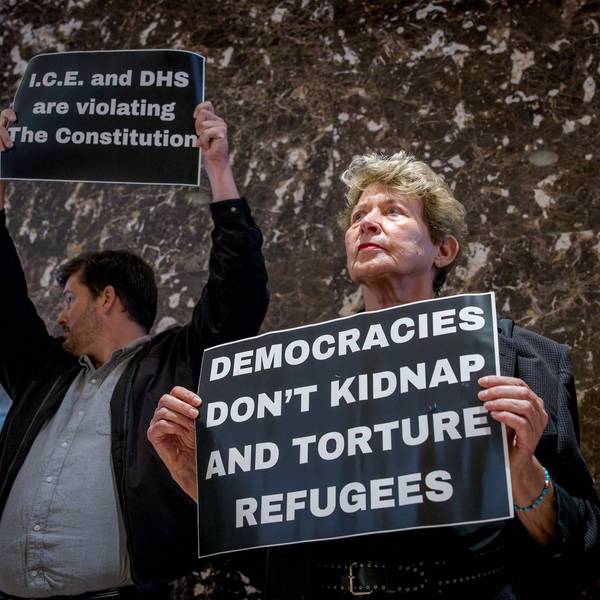
‘Stunning Betrayal’: Refugees at Risk of Arrest Under New DHS Memo

‘We Rely on Hispanic Labor’: ICE Raids Trigger Economic Alarm Bells in Trump States
Aside from just three, every single one of them was from South Africa.
Three Afghan refugees were also reported to have been settled in Colorado in November. But since then, their admission has been indefinitely suspended, and those who have entered may be at risk of deportation.
During that same period a year earlier—the final months of the Biden administration—a total of 37,596 refugees arrived in the US, with the greatest numbers coming from the Middle East, South Asia, and Africa.
The Trump administration dramatically curbed refugee admissions during its first year in power. On his first day back in office last January, President Donald Trump suspended USRAP processing, leaving around 600,000 people in the pipeline suddenly stranded, including roughly 10,000 who’d already booked flights.
Around 130,000 of those refugees had already been through the State Department’s meticulous and taxing vetting process, and were instead “left to languish in refugee camps around the world after being given the promise of safety and a new life in America,” as a group of Democrats in Congress put it.
The next month, however, Trump carved out an exception to the suspension exclusively for white South Africans, who he has falsely claimed face a “genocide,” and severe “discrimination” from land redistribution policies intended to correct extreme apartheid-era inequalities.
After previously discussing a cap of 40,000 refugee admissions for the fiscal year 2026---already a reduction by over two-thirds from the Biden administration---Trump announced on September 30 that he would lower admissions to just 7,500, a historic low.
He announced the change without consultation with Congress, which is required under the 1980 Refugee Act, leading Democrats to accuse him of acting in “open defiance of the law.”
But in late February, Reuters reported on an internal State Department document showing that the administration was planning to welcome as many as 4,500 white South Africans to the US per month and detailed plans to install trailers on US Embassy property in the country to expedite more immigrant approvals.
All the while, refugees fleeing war, government oppression, and genocide in countries including Syria, Sudan, Ukraine, Afghanistan, and others have been locked out or face threats of arrest by the US Department of Homeland Security (DHS) under a new policy requiring them to be reinspected to determine their ability for “assimilation.”
Many critics have pointed out the dramatic gulf in treatment between white immigrants from South Africa and members of other, largely nonwhite groups of immigrants, whom it has undertaken extreme measures to remove from the country with expediency.
Last month, a Rohingya refugee, who fled genocide in Myanmar and legally entered the US as a refugee, was found dead on the streets of Buffalo, New York, after being detained and then left outdoors in the freezing cold by immigration agents.
The policy was revealed as part of a case in which a federal judge halted a DHS effort to detain thousands of refugees in Minnesota who did not seek green cards after their first year of residency in the United States.
“While the Trump administration is trying to convert warehouses at home into massive prisons to jail and deport immigrants swept up in its racist crackdown, it is also working to build trailers in Pretoria so it can rapidly increase the number of white South Africans,” wrote Ja’han Jones in an opinion piece for MS NOW.
Likening it to the 1924 Immigration Act, which created strict ethnic quotas for entry into the US, Jones said: “It’s the kind of immigration policy the Ku Klux Klan dreamed of. Literally. This kind of quota system mirrors the kind of policies that white supremacist groups, including the Klan, pushed for 100 years ago.”
Analysis of Major Polls Shows Trump’s War on Iran Is Historically Unpopular
“Not merely negative-number-so-what unpopular, but worst-ever-support-for-war-when-it-started unpopular.”
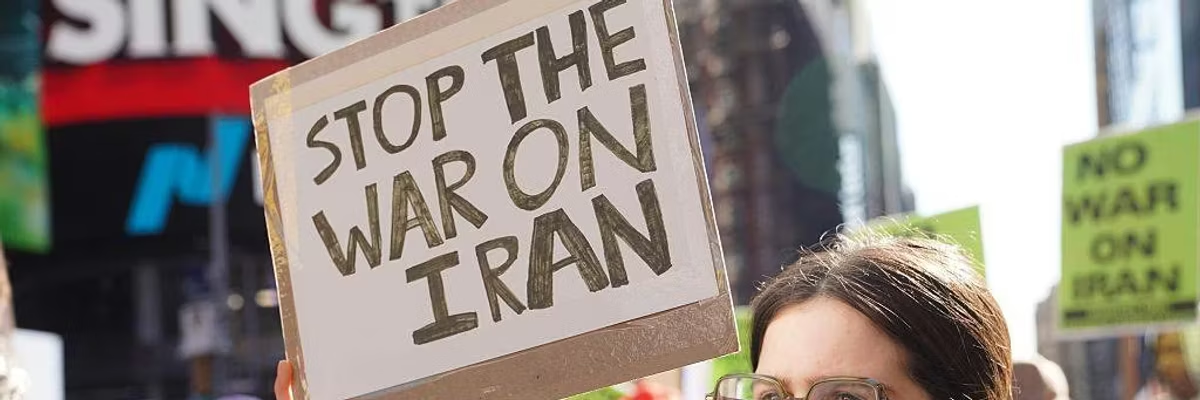
People attend a protest against US-Israeli attacks on Iran in New York on February 28, 2026.
(Photo by Zhang Fengguo/Xinhua via Getty Images)
Brad Reed
Mar 06, 2026
COMMON DREAMS
President Donald Trump’s unprovoked and unconstitutional war against Iran is historically unpopular among US voters.
In an analysis published Friday, polling expert G. Elliott Morris calculated an average of eight high-quality polls conducted over the last week about the war and found just 38% of Americans approve of the military strikes against Iran, while 49% are opposed.
Morris noted that there is simply no precedent for a US war being this unpopular from the very outset.
“The big takeaway from these numbers is that the new war in Iran is very unpopular,” he wrote. “Not merely negative-number-so-what unpopular, but worst-ever-support-for-war-when-it-started unpopular. With just 38% of Americans in favor, support for bombing Iran is lower than retrospective support for the war in Iraq was in 2014.”
Morris then offered some comparisons to past US military conflicts to show that the lack of support for Trump’s Iran war is simply in uncharted territory.
“No president in modern polling history has launched a major military operation with the public already against him,” he wrote. “After the September 11 attacks, a November 2001 Gallup poll found 90% of Americans approved of military action in Afghanistan, with just 5% opposed. The Gulf War in 1991 hit 79-80% approval. Gallup measured 76% support for the invasion of Iraq in March 2003 (Pew had it at 71%).”
Even comparatively unpopular operations, such as Trump’s strikes against Syria in 2017 or former President Barack Obama’s 2011 military operation in Libya, still had net-positive approvals at the times they occurred.
Morris added that Trump should be concerned about this because historically “wars only get less popular” over time as “casualties mount and costs become clear.”
CBS News polling director Anthony Salvanto on Tuesday also highlighted this phenomenon when analyzing a poll on the Iran war commissioned by his network that showed US voters’ support for the conflict dropped precipitously the longer they believed it would last.
“If you think it’s going to be a long conflict, months, even years... the numbers tilt toward disapproval overall,” he said.
Trump so far has not offered any kind of timeline for his war against Iran, and Politico reported on Wednesday that the US military is preparing for the conflict to last until at least September.
Trump on Friday insisted he would not end the conflict with Iran until its government offered its “unconditional surrender.”
Polls show majority of Europeans oppose US, Israeli strikes on Iran
March 7, 2026 Middle East Monitor

People gather at Place de la Republique (Republic Square) to protest against the war in the Middle East and express solidarity with Lebanon, Gaza and Iran in Paris, France on March 6, 2026. [Mohamad Salaheldin Abdelg Alsayed – Anadolu Agency]
Recent public opinion surveys across Europe showed on Friday that large segments of the public in several countries oppose the US and Israel’s strikes on Iran, Anadolu reports.
According to polls conducted in Spain, Italy, Germany and the UK, majorities in these countries reject military intervention and support cautious or neutral positions by their governments.
In Spain, a rapid poll conducted by Madrid-based research firm 40dB for the newspaper El Pais and Cadena SER radio found that around 68% of respondents reject the US and Israel’s attacks on Iran.
The survey also showed that 57% support Spain’s decision not to provide military support to the US and Israel, while 53% believe the US should not be allowed to use military bases in Spain for operations related to the conflict.
Around 42% of respondents said they approve of Prime Minister Pedro Sanchez’s handling of the crisis, while nearly 80% said they are closely following developments and that their most common feeling about the conflict is concern.
Italy
A similar trend appeared in Italy, according to a poll conducted by Rome-based research company YouTrend for Sky TG24 television.
The survey showed that 56% of respondents oppose the US and Israel’s military intervention against Iran.
Support for the attacks is higher among center-right voters, with 57% backing the intervention, while 79% of broader center-left voters oppose it.
Some 48% of respondents believe the Italian government should remain neutral and act as a mediator between the parties, while 29% say the government should condemn the attacks and immediately call for a ceasefire.
Germany
In Germany, a new public opinion survey published by public broadcaster ARD also indicates low public trust toward the US and Israel.
According to the survey, 58% of respondents believe the war waged by the US and Israel against Iran is not justified.
About 75% said they are concerned that the conflict could spread to other countries, while trust in the US fell to 15%, the lowest level in the past 20 years.
The survey also showed that only 17% of respondents consider Israel a reliable partner, while 85% believe global politics is increasingly dominated by a system where “might makes right.”
UK
In the UK, polls conducted by London-based research and data analysis company YouGov indicate limited public support for US strikes on Iran.
A survey conducted on March 2, after the US and Israel launched attacks on Iran, found that 49% of Britons oppose the strikes, while 28% support them.
A significant portion of respondents also oppose the use of Royal Air Force bases in the UK for US strikes against Iran.
A study conducted at the end of February showed that 58% were against such use, and even when the condition that operations be “limited only to missile targets” was added in the March 2 survey, opposition still measured 50%.
The research also revealed that 45% of Britons believe the government should neither praise nor condemn US strikes on Iran.
Meanwhile, 47% of respondents said Prime Minister Keir Starmer has handled the US-Iran tension poorly, while 34% said he managed the situation well.
Escalating regional tensions followed the Feb. 28 launch of joint US-Israeli airstrikes on Iran, killing more than 1,000 people, including Supreme Leader Ali Khamenei, over 150 schoolgirls, and senior military officials.
The conflict has triggered widespread regional instability and retaliatory attacks from Tehran against US-linked sites across the region.
Suspicious bets placed just before Trump’s Iran strike trigger calls for federal probe
Stephen Prager,

People hold placards with pictures of late Iran's Supreme Leader Ayatollah Ali Khamenei at a protest against Israel and the U.S. strikes on Iran, following the killing of Ali Khamenei, in Sanaa, Yemen, March 1, 2026. REUTERS/Khaled Abdullah
A consumer watchdog group is calling on the federal agency that regulates prediction markets to investigate what it says are a series of “highly suspicious bets” placed on President Donald Trump’s war with Iran.
In a letter sent on Thursday to Michael Selig, the chair of the Commodity Futures Trading Commission (CFTC), a representative for the group Public Citizen pointed out that users have been able to make off with six-figure winnings from betting on political outcomes using platforms like Kalshi and Polymarket, which “advertise that you can bet on almost anything, anywhere.”
“While bets on the future of the Iranian regime had been sporadic and imprecise for months before the invasion, several very substantial bets were placed in the last-minute moments prior to the February 28 attack,” wrote Public Citizen’s government affairs lobbyist Craig Holman.
“For most of the year, bets of [Iranian Supreme Leader Ayatollah Ali Khamenei] being removed from power were long shots and low-balled guesses,” Holman said. “In just the few hours before public announcement of the February 28 attacks, the odds and amount of the bets changed radically, rising from small bets at less than 25% to a few very large bets at over 50%. In the end, a few anonymous bettors hit the nail on its head and became very wealthy.”
Holman pointed to a report from NPR that an anonymous account with the username “Magamyman” made more than $553,000 placing bets on Polymarket just before the Iranian leader was killed by an Israeli strike Saturday.
The Wall Street Journal, meanwhile, reported findings from the crypto analytics firm Bubblemaps, which identified “six suspected insiders” who had won a $1.2 million profit on a US strike through Polymarket. As the Journal wrote:
These users’ bets were among half a billion placed on Polymarket alone regarding the precise timing of US strikes on Iran.
Sen. Chris Murphy (D-Conn.) said “it’s insane this is legal” and that “people around Trump are profiting off war and death.” He added that he was “introducing legislation ASAP to ban this.”
Holman asked Selig to identify the users who placed the highly lucrative bets and who, within the Trump and Netanyahu administrations, may have been privy to insider knowledge about the strikes.
The Trump family is deeply intertwined with the world of prediction markets. The president’s media company, earlier this year, partnered with Crypto.com to launch its own prediction platform called “Truth Predict.” Meanwhile, Donald Trump Jr. is an adviser to both Polymarket and Kalshi.
The president’s CFTC chair, Selig—who has appointed the CEOs of prediction market platforms as advisers—has sought to shield betting markets from regulatory scrutiny, describing his goal as ushering in “the Golden Age of American financial markets.”
Last month, facing what he called “an onslaught of state-led litigation,” Selig made the legally questionable assertion that Congress had given his agency the exclusive authority to regulate these platforms, not as tightly controlled gambling hubs but as commodities markets, which have much looser rules.
The Iran war is not the first time that mystery users have walked away with massive hauls after placing fortuitously timed bets on Trump’s military operations. In January, a user won $436,000 on a bet that Venezuelan President Nicolás Maduro would be ousted by the end of the month, which they’d placed just hours before Trump’s operation to remove him from power.
“Allowing prediction market platforms to bet on virtually anything, any time, is a recipe for disaster,” Holman said. “The American people should not have to wonder whether government officials are exploiting their access to classified information to make a quick buck. The CFTC must act swiftly to regulate platforms like Kalshi and Polymarket in order to protect the public.”
This story was published in partnership with Common Dreams.
Trump Cronies Forced to Delay Ballroom Vote After 98% of Public Comments Oppose ‘Corrupt’ Scheme
The president has stacked a planning commission with three of his staffers, but organizers hailed a “huge victory” Thursday after the panel delayed a vote following an outpouring of public opposition.
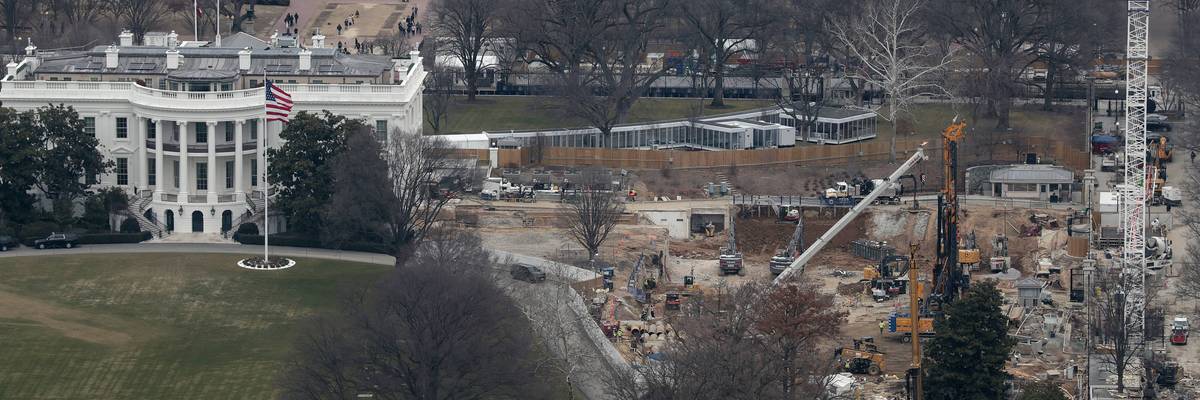
Viewed from the observation level of the Washington Monument, demolition work continues where the East Wing once stood at the White House on January 5, 2026 in Washington, DC.
(Photo by Heather Diehl/Getty Images)
Julia Conley
Mar 06, 2026
COMMON DREAMS
President Donald Trump has gone to significant lengths to ensure the 90,000-square-foot, $400 million ballroom he wants to replace the East Wing of the White House with is constructed swiftly—appointing his own associates and staffers to key commissions that must approve the project.
But even under the leadership of chairman Will Scharf, Trump’s former personal lawyer and the White House staff secretary, the National Capital Planning Commission (NCPC) on Thursday was forced to delay a planned vote on approving the ballroom until April 2—unable to ignore tens of thousands of public comments that have poured in denouncing the proposed ballroom as well as a parade of dozens of people who showed up at the commission’s meeting to express opposition.
Scharf “cited the expected length of testimony from the more than 100 people who had signed up to say what they thought of the project, which he said might require the meeting to stretch into Friday,” reported the Washington Post.
A longtime architect, David Scott Parker, told the panel that he had “grave concerns” about the exaggerated size of the planned ballroom, which “is nearly three times the original White House, in violation of classical architecture principles mandating balance.”
Rebecca Miller, executive director of the DC Preservation League, told the commission—which also includes two other White House staffers, deputy chief of staff James Blair and chief statistician Stuart Levenbach—that the proposed ballroom “is disproportionately large and impersonal and will detract from the dignified atmosphere that has characterized presidential events for centuries,” while Kyle Rowan, who described himself as an “ordinary citizen,” had a succinct criticism.
“It’s ugly,” Rowan told the commissioners. “It’s too much.”
Just one speaker out of 30 expressed approval of the project.
The critics who arrived at the commission’s meeting in person represented just a fraction of the criticism that has inundated officials since the panel began collecting public comments on the proposed ballroom.
More than 35,000 comments were sent in, and a New York Times artificial intelligence-powered analysis of the responses found that 98% of them were negative. The Post also used AI to determine that more than 97% of the comments were critical, and measured that finding against a sampling of comments that were manually checked.
Some of the remarks alluded to Trump’s plan to fund the ballroom construction through private donations, which he has insisted will benefit taxpayers—but which Democratic lawmakers and government watchdogs have warned is an example of blatant corruption, as companies with billions of dollars in federal contracts, including Amazon, Google, and Palantir, are among the donors.
“I am sick that Trump has torn down the East Wing of the People’s House, our house, and plans to build a monstrosity ballroom funded by not ‘We the People’ but by corrupt, out of touch, unaccountable to anyone, billionaires. It is beyond sickening,” wrote a commenter named Donna Smith.
Julie Mason added that the ballroom plan has “opened the door to excessive corruption by the president and his billionaire backers through quid pro quo,” and a South Carolina resident named Barbara Bryant added that the “financing of the project is perhaps its most troubling aspect.”
“The $400 million private corporate donation scheme is a blatant attempt to evade congressional oversight,” Bryant wrote. “By allowing corporations with active business before the government to fund a presidential vanity project, the administration has created a fertile ground for corruption, turning a national landmark into a billboard for private interests.”
White House press secretary Karoline Leavitt claimed without evidence on Thursday that the public comments “are clearly stemming from an organized campaign of Trump-deranged liberals who clearly have no style or taste.”
“It’s a shame that some people in this country are so debilitated with Trump derangement syndrome, they can’t even recognize or respect beauty when they see it,” said Leavitt.
An Economist-YouGov poll taken last month found that 58% of Americans opposed tearing down the East Wing to build the ballroom, while just 25% supported it.
The public comments echoed those of protesters who assembled outside the NCPC’s offices on Thursday at a demonstration organized by consumer advocacy group Public Citizen. The group has closely followed Trump’s decision to staff the commission with his own administration officials and the “myriad of conflicts of interest concerns” that have arisen as wealthy corporations have lined up to fund the ballroom.
Jon Golinger, a democracy advocate for Public Citizen who testified at the NCPC meeting Thursday, noted that one federal judge had accused the Trump administration of erecting a “Rube Goldberg contraption” to collect donations from “corporations, billionaires, and an unknown number of secret donors” while evading “congressional and public oversight and [shielding] the donors and recipients of the money from scrutiny.”
“According to news reports, the expectation is that those names will be etched on the White House as part of the ballroom’s brick or stone,” said Golinger. “It is outrageous that the Trump administration would engrave the names of corporations with government contracts who gave them checks on the White House like a big tacky advertising billboard. I urge NCPC to explicitly prohibit them from doing so.”
At the meeting, Golinger condemned Trump’s decision to stack the commission with his own staffers and said Scharf, Blair, and Levenbach lack the legally required experience in city or regional planning to sit on the panel.
“The fix is in for this project and this vote,” said Golinger.
Scharf argued he is qualified for the position due to his past work in the Missouri governor’s office.
At the protest, Golinger said the commission’s decision to delay the vote on the ballroom was a “huge victory,” considering Trump has filled the commission with his “cronies.”
“Public pressure has mattered,” he said. “It’s not the end of the fight, no doubt they’re going to come back and try to ram it through next time, but this [delay] isn’t something I even conceived.”
Trump's new DHS pick can't stop embarrassing himself — and he hasn't even startedRAW STORY
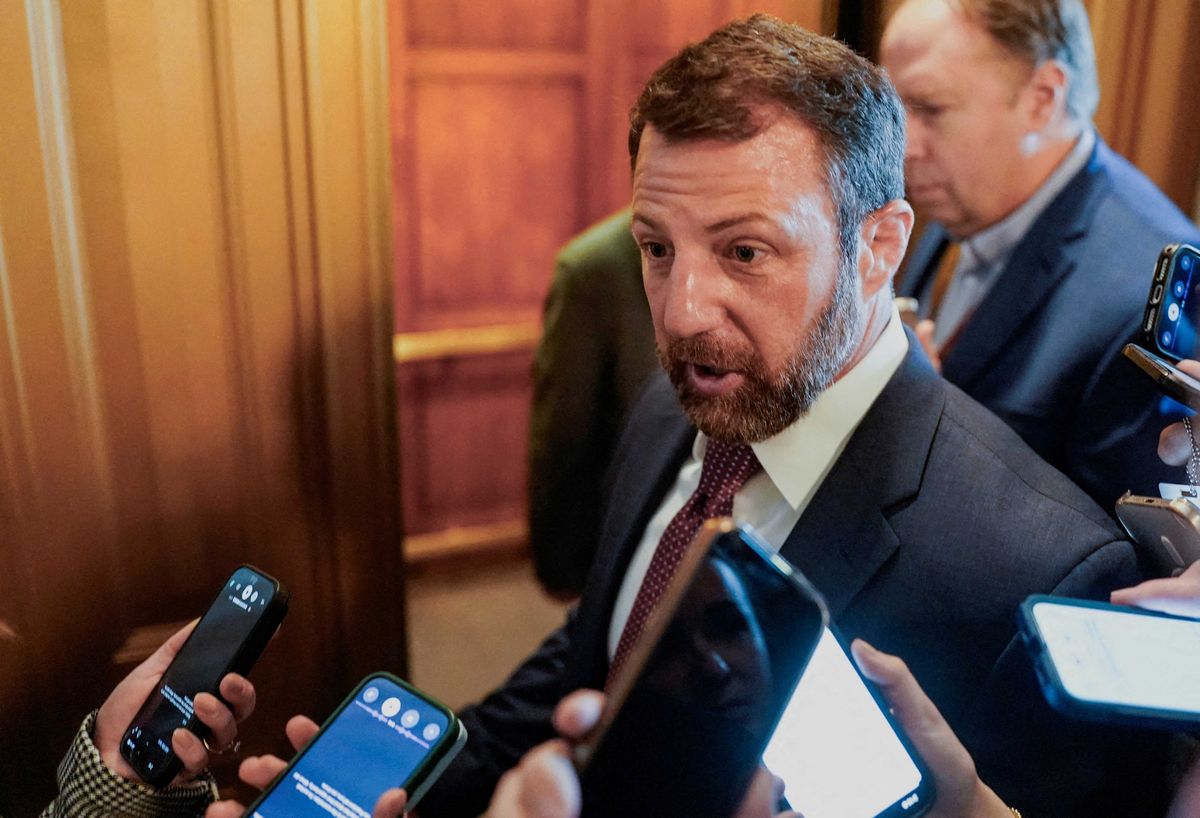
Sen. Markwayne Mullin (R-OK) speaks to the media near the Senate floor. REUTERS/Nathan Howard
There just might be a second reason — besides the constant fawning praise for Dear Leader — why Donald Trump chose Sen. Markwayne Mullin (R-OK) as his new Secretary of Homeland Security.
Trump has floated the idea of hosting a UFC fight on the White House grounds on July 4th, trampling the memories of John-John and Caroline Kennedy playing on those lawns, and presidential dogs Rex, Barney, and Beau scampering about.
So what could top an ultimate marquee match between Mullin and Defense Secretary Pete Hegseth? Let’s call it the “Cabinet Clash:” two Trump testosterone toadies, going mano a mano.
Because if you actually look at Mullin’s qualifications for his new role, there isn’t much that recommends him, other than that he compiled a 5–0 record in professional Mixed Martial Arts.
There was a time when the Secretary of Homeland Security was perhaps the most serious and consequential cabinet post. The job was created after 9/11 to coordinate intelligence, secure our borders, and manage the immense responsibility of protecting 330 million Americans.
Prestigious names have led the department: Tom Ridge, Janet Napolitano, Jeh Johnson. During Trump’s first administration, Gen. John Kelly. Serious people for a serious job.
Then the gravitas of the position took a nosedive when Kristi Noem rode in on her horse. Only this week was she thrown off, for being far less than forthright.
And now there’s Sen. Mullin, a man whose most notable pre-politics credential is that 5–0 MMA record.
Politically speaking, Mullin’s MMA stands for Macho Mixed-Up Ass.
Let’s start with the “mixed-up” part.
This week, Mullin pulled an Abbott and Costello routine, simultaneously arguing regarding strikes on Iran that the U.S. is and is not at war.
First he declared, “This is war, and we’re taking out the threat.”
Then he tried to clarify: “What I was saying was that they’ve declared war on us, but war is ugly. It always has been ugly.”
He finished with this gem: “We haven’t declared war. So if we haven’t declared war, then I don’t see that. The president hasn’t asked us to declare war yet, but they have declared war on us.”
Who’s on first, what’s on second, “I don’t know” is on third, and somewhere on that field of battle Mullin is still milling around, trying to decipher his own explanation.
If you thought Hegseth had captured the trophy for inauthentic and immature machismo, Mullin may give him a run for his money.
In November 2023, Teamsters President Sean O’Brien appeared before the Senate Health, Education, Labor, and Pensions Committee. Famously, Mullin challenged him to a fight.
“This is the time, this is the place,” Mullin said. “If you want to run your mouth, we can be two consenting adults. We can finish it here.”
Sure sounds like a sane, responsible adult to me.
This year, at the State of the Union, Mullin grabbed a protest sign from Rep. Al Green (D-TX). Frankly, Mullin would make a fine ICE agent. He’s had practice roughing up a person of color.
And if you’re a member of the media, take note.
In April last year, Mullin posted a video recounting an 1890 incident in which a reporter was shot by a congressman in the U.S. Capitol. Mullin suggested “fake news” might decrease if modern disputes could be handled that way. He said it was a joke. Haha.
Mullin does enjoy “joking” around on Fox News, where he has made something of a habit of embarrassing himself.
In one segment, he waxed poetic about how war has a particular smell and a particular taste. The only problem was that Mullin has never served a single day in uniform.
Even back home in Oklahoma, he has hardly been a profile in integrity.
Mullin ran for Congress on a term-limits pledge, then broke it twice. In 2013 his plumbing business was the subject of an ethics investigation. More recently, he racked up STOCK Act violations, meant to stop members of Congress profiting from insider information.
He called Rand Paul, a senator who will be overseeing his confirmation, a “freaking snake.”
Come to think of it, Paul v. Mullin would also make a great MMA fight.
So this Macho Mixed-up Ass is the man who would oversee the Secret Service, FEMA, Customs and Border Protection, ICE, and the TSA. A man who endorses war — and not war — violence against the press and political opponents, who is ethically challenged and has zero background in security, intelligence, or managing a massive federal bureaucracy.
And all that said, Mullin might yet need to be reminded who his boss actually is.
A few days ago, while discussing Iran on Fox News, Mullin repeatedly referred to Defense Secretary Hegseth as “President Hegseth.” He made the slip twice before awkwardly correcting himself.
The Department of Homeland Security was built in the wreckage of the worst intelligence failure in American history. The job requires toughness but also judgment, patience, legal sophistication, and the ability to manage roughly 260,000 employees across more than two dozen agencies.
So while I joke about a Hegseth-Mullin cage match, Mullin’s nomination is no laughing matter.
Whether he realizes it or not, the United States faces real threats from adversaries around the world, and those adversaries are watching this spectacle of discombobulation, inexperience, and bravado.
When the real test comes, America may discover the difference between a man who talks about the smell of war, and a leader who actually knows how to prevent one.
3 Steps for a Just Immigration System: Abolish ICE, Grant Amnesty, End US Imperialism
We need a new system of immigration—one that serves the common good, respects the dignity of all peoples, and aligns with the principles of a democratic society.
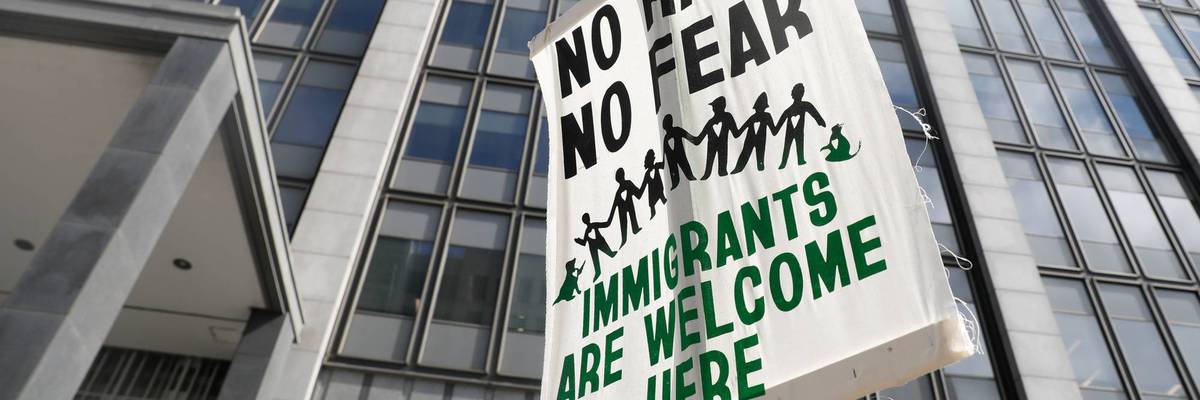
A person holds a sign reading, “No Hate No Fear Immigrants Welcome Here” outside the Phillip Burton Federal Building and US Courthouse to support Guillermo Medina Reyes, immigrant and activist, before a hearing to avoid being returned to ICE detention and deported to Mexico on Tuesday, July 15, 2025, in San Francisco.
(Photo by Lea Suzuki/San Francisco Chronicle via Getty Images)Common Dreams
On February 26, federal agents lied to gain access to a residential building. The agents, who local officials said lacked a warrant and wore “fake badges” to impersonate New York police officers, said they were looking for a “missing child.” In reality, they were hunting for Elmina Aghayeva, a Columbia University student who the Department of Homeland Security alleges had her visa terminated “for failing to attend classes.”
Due to the efforts of New York City Mayor Zohran Mamdani, Aghayeva has since been released. Still, the incidence speaks volumes to the level of normalized cruelty and injustice inherent in our current system of immigration control and enforcement. Aghayeva is not “the worst of the worst.” Even if we accept DHS’ assessment that she needed to be detained, there was a way of doing this lawfully—one where Immigration and Customs Enforcement (ICE) agents acquire a warrant, clearly identify themselves, respect her rights, and do not further erode public trust in law enforcement.

We need a new system of immigration—one that serves the common good, respects the dignity of all peoples, and aligns with the principles of a democratic society. Here are three steps we can take toward that end.
First Step: Abolish ICE
What was once a fringe position is now supported by the majority (76%) of Democrats and a plurality of US adults (46%).
While the Trump administration’s disregard for the rule of law has made ICE’s injustices more blatant, it has ultimately only exposed what the agency has been since its inception.
Given recent events, this turn is unsurprising. In the last year alone, ICE agents have: broken into people’s cars (Mahdi Khanbabazadeh and Marilu Mendez), used explosives to break into people’s homes (Jorge Sierra-Hernandez), pressed their knees into people’s necks (Tatiana Martinez and George Retes), kidnapped people (Kilmar Ábrego Garcia and Gladis Yolanda Chavez Pineda), detained hundreds of children including 5-year-old Liam Conejo Ramos, detained over 170 US citizens including Juan Carlos Lopez-Gomez and Dulce Consuelo Díaz Morales, shot people (Carlitos Ricardo Parias and Jose Garcia-Sorto), permanently maimed people (Kaden Rummler), and killed people (Silverio Villegas González, Geraldo Lunas Campos, Renee Good, and Alex Pretti).
In the name of pursuing people who commit fewer crimes than US citizens, actively contribute to the US economy, pay taxes for public services they cannot access, and culturally enrich our communities, ICE acts with reckless abandonment.
And let’s be clear: While the Trump administration’s disregard for the rule of law has made ICE’s injustices more blatant, it has ultimately only exposed what the agency has been since its inception: a lawless, bloated policing and surveillance behemoth with virtually no oversight. It was a mistake created in the frenzy following 9/11. For the good of the nation, it must be abolished (and DHS too).
Second Step: Grant Amnesty
Rather than mass deportation, we should offer amnesty for all undocumented immigrants currently living in the US who have not committed any violent crimes.
The problems with ICE stem from its basic mission: to find and deport the over 11 million undocumented immigrants in the country. Since the vast majority are law-abiding and legal status is not an observable trait, ICE agents resort to more invasive, discriminatory, and militant measures. Any alternative to ICE tasked with the same mission will likely replicate its problems.
The irony here is that deporting all undocumented immigrants would only harm the US. According to the Center for Migration Studies, Trump’s mass deportation plan “could cost over $500 billion to implement and would sacrifice billions in tax revenue per year. It also would lead to labor shortages and reduce the GDP by $5.1 trillion over the next 10 years.” By contrast, providing undocumented immigrants with amnesty would contribute $1.2 trillion to the US economy over 10 years and $184 billion per year in federal, state, and local taxes.
We cannot continue to indiscriminately violate international law and then complain when America’s victims come here seeking a better life.
That money could be used to improve the lives of millions by funding Medicare For All, tuition-free public colleges, city-owned grocery stores, and SNAP and other welfare programs, as well as building public housing and improving our crumbling infrastructure. Instead, we are actively engaging in an absurd policy of national self-harm where the only benefactors are the politicians who continuously scapegoat immigrants as well as corporations who benefit from surveilling, imprisoning, and exploiting their labor.
Beyond economic considerations, amnesty safeguards our democracy and protects human rights. The current immigration regime perpetuates racism, xenophobia, and Islamophobia, while ICE agents terrorize our communities and threaten all our lives.
Trump’s mass deportation agenda calls for separating undocumented immigrants from their friends, families, and communities. This includes 86 DACA recipients that ICE deported last year. Those people had lived in the US for most of their lives, respected its laws, and considered it their home. Now, they are being sent to an unfamiliar country—one where they may not know the language, culture, or anyone living there.
What’s more, many immigrants come to the US fleeing violence and persecution abroad. Deportation often entails purposely putting people’s lives at risk. As Farah Larrieux, a 46-year-old Haitian currently on Temporary Protected Status (TPS), said: “All these people are here because they were forced to come. […] They came to save their lives. For many, returning to Haiti now is, in practice, a death sentence, making them vulnerable to extortion and kidnapping.” If DHS succeeds in terminating TPS for Haitians, our tax dollars would go toward effectively funding her execution.
Third Step: End American Imperialism
Whether it’s Haiti, Cuba, Venezuela, Gaza, Somalia, Afghanistan, Iraq, Iran, or so many other nations, US interventionist policies fuel political instability abroad.
American imperialism must end. We cannot continue to invade, bomb, and wage wars that fuel the very mass displacement and migration that create the “border crisis.” We cannot continue to indiscriminately violate international law and then complain when America’s victims come here seeking a better life. They are not the “foreign invaders” who infiltrated “our homeland”—America invaded theirs. They have not “destroyed our country”—we destroyed theirs as they built ours. We owe them a debt: Amnesty and humanitarian aid in this context is not a gift, its reparations.
America must fund USAID, not more “forever wars.” We must work alongside foreign nations—as equals—to meaningfully improve economic and political stability around the world.
For the people who are already here, abiding by our laws and contributing to our communities, this is their home. Hunting and deporting them is not justice. It endangers everyone while diverting billions of dollars away from programs and policies that would benefit everyone.
Together, we can forge a better future—we simply need to take the right steps.
As Another Oil-Fueled War Erupts, Study Reveals Planet Heating at Unprecedented Rate
The findings mean global temperatures are on track to surpass 1.5°C above preindustrial levels before 2030.

People observe fire and smoke from an Israeli attack on the Shahran oil depot on June 15, 2025 in Tehran, Iran.
(Photo by Stringer/Getty Images)
Olivia Rosane
Mar 06, 2026
COMMON DREAM
Nearly a week into President Donald Trump’s illegal war on Iran that is likely to increase climate-warming emissions, new research has found that the pace of human-caused global heating has accelerated over the past 10 years.
The study, published in Geophysical Research Letters on Friday, concluded that global heating had nearly doubled from a rate of less than 0.2°C a decade from 1970-2015 to 0.35°C between 2015-25. This would put global temperatures on track to surpass 1.5°C above preindustrial levels before 2030.
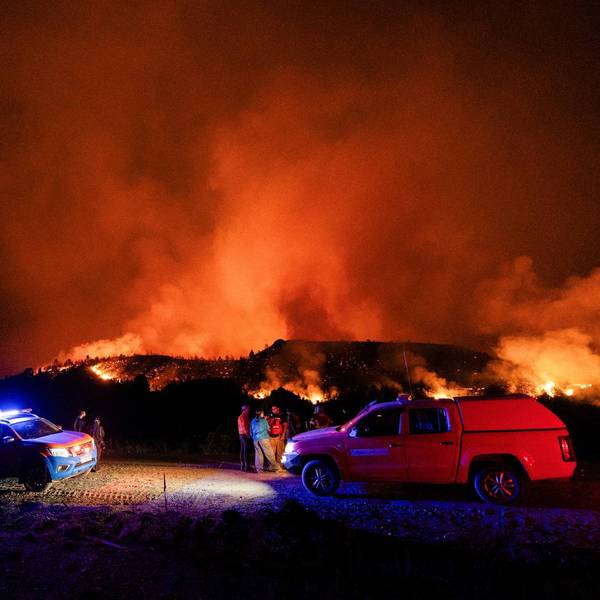
Earth Hurtling Toward ‘Hothouse Trajectory,’ Scientists Warn in Tipping Points Analysis
“Warming proceeding faster is not unexpected by climate models, but it is a cause of concern and shows how insufficient the efforts to slow and eventually stop global warming under the Paris Climate Accord have so far been,” study authors Stefan Rahmstorf and G. Foster wrote.
Scientists had long suspected that global warming was speeding up, given that the past three years were the three hottest on record. Yet previous studies had not been able to find statistically significant evidence of acceleration. The new study removed the natural variability from solar variations, volcanic eruptions, and El Niño from the data, which revealed a statistically significant speedup.
“How quickly the Earth continues to warm ultimately depends on how rapidly we reduce global CO2 emissions from fossil fuels to zero.”
It follows a study from 2025 that found a smaller increase of 0.27°C per decade from 2015-24.
“Either way, this represents a significant increase in the rate of warming,” Zeke Hausfather, a climate scientist at Berkeley Earth and a co-author on the earlier study, told The Guardian. “[This] should be worrying as the world hurtles toward crossing 1.5°C later this decade.”
Whatever the rate of increase, the solution, from a scientific perspective, is clear.
“How quickly the Earth continues to warm ultimately depends on how rapidly we reduce global CO2 emissions from fossil fuels to zero,” Rahmstorf, a Potsdam Institute for Climate Impact Research scientist, told The Guardian.
Yet the findings come at a time when emissions look set only to increase, as the US launches an oil-fueled war on Iran that risks drawing other major military powers into a greater conflict.
“The outbreak of any war is bad news for the climate, just as the election of politicians hostile to climate action is,” Mark Hertsgaard, Covering Climate Now executive director and co-founder, and Giles Trendle, former managing director of Al Jazeera English, wrote in a newsletter on Thursday. “The climate implications of this new war are not the center of attention at the moment, but they are essential context for understanding what’s at stake. At a time when civilization is hurtling toward irreversible climate breakdown, to overlook the climate consequences of three of the deadliest militaries on Earth going to war would be journalistic malpractice.”
War itself increases greenhouse gas emissions. Studies have found that Russia’s invasion of Ukraine emitted as much in its first two years as the annual emissions of the Netherlands, while Israel’s genocide in Gaza emitted as much in its first four months as each of the 135 lowest-emitting nations in a year.
The Conflict and Environment Observatory observed 120 incidents of environmental harm during the first three days of the Iran conflict, and noted that attacks on oil and gas infrastructure had global implications:
There are also consequences for the global environment through changes in greenhouse gas emissions. Attacks on oil and gas sites will release methane, carbon dioxide, and other greenhouse gasses, but the curtailment of production—as has occurred with Qatari LNG [liquefied natural gas], oil production in Iraqi Kurdistan, and Israeli offshore gas—does not necessarily reduce emissions. Instead energy price signals can lead to short term substitution, as well as more complex downstream energy supply changes over longer timeframes.
Fossil fuels are also required to power the machinery that makes war possible.
“What’s beyond dispute is that this war could not be fought without oil,” Hertsgaard and Trendle wrote. “The aircraft carriers, jet planes, and the myriad support systems they require gobble immense quantities of fossil fuels. Which helps explain why the US Department of Defense is the largest institutional emitter of greenhouse gases globally.”
There is also the speculation that control of fossil fuels is one motivation for the war itself, given that Iran has the world’s third-largest reserve of oil. While Trump has not included oil in his incoherent word salad of war aims, as he did when he kidnapped Venezuelan President Nicolás Maduro in January, climate advocate Bill McKibben pointed out that members of US oil industry have said that they would rather develop Iran’s oil than Venezuela’s, as its industry is more “structurally sound.”
“Europe, Asia, and other regions whose energy costs skyrocket because of this reckless escalation by the Trump administration are reminded, yet again, that fossil fuels are volatile, insecure, and expensive.”
“The military attacks on Iran are not about peace and democracy, but rather about sowing fear, bloodshed, and despair as the US attempts to further destabilize the region and secure access to profitable natural resources that it wants to control,” the Climate Justice Alliance said in a statement. “This is not surprising given recent foreign policy actions taken by the Trump administration in Venezuela and Cuba, and our ongoing history of engaging in coups, occupations, and endless wars to control resource-rich countries, especially for oil and gas.”
Yet, at the same time, the war is already offering an object lesson in the dangers of relying on fossil fuels—for everyone except fossil fuel CEOs. The war could disrupt markets such that profits soar for Big Oil and liquefied natural gas companies while ordinary people suddenly find themselves struggling to pay gas or heating bills.
“Iran is in the middle of one of the world’s most important energy corridors,” Lorne Stockman, Oil Change International research director, told Common Dreams. “Roughly 20% of global petroleum flows through the Strait of Hormuz, so when military escalation disrupts that route, global energy markets are immediately impacted.”
Stockman continued: “That instability means higher energy bills for people around the world while communities in the region suffer the devastation of war. Europe, Asia, and other regions whose energy costs skyrocket because of this reckless escalation by the Trump administration are reminded, yet again, that fossil fuels are volatile, insecure, and expensive. The only question is whether governments will heed that signal and make a fair fossil fuel phase out a priority.”
Chair of the Fossil Fuel Non-Proliferation Treaty Tzeporah Berman made a similar point on social media: “Drones hitting Saudi oil fields, Qatar halting LNG production, Iran putting a squeeze on the Strait of Hormuz, and US attack on Iran’s Kharg Island oil terminals—all of it should be a wake-up call that fossil fuel phaseout is a national and energy security priority.”
Yet Berman noted that the energy landscape is different today than it has been during previous periods of war.
“Unlike previous oil wars renewable energy is now available at scale,” Berman continued. “It’s distributed, diversified, and resilient. Most importantly, solar panels don’t blow up and once they are in place you don’t need ships to constantly feed them to make energy. The sun is looking like a pretty stable energy source right about now.”


