It’s possible that I shall make an ass of myself. But in that case one can always get out of it with a little dialectic. I have, of course, so worded my proposition as to be right either way (K.Marx, Letter to F.Engels on the Indian Mutiny)
Monday, March 30, 2026
France among nations eyeing Australia critical minerals investment, minister says
France is among the countries poised to invest in Australian critical minerals projects, Australia’s resources minister said on Thursday, as Canberra’s framework deal with the US prompts nations with advanced manufacturing sectors to secure access to supply.
Australia has been on a four-year mission to build an industry for minerals like rare earths that are key to future technologies such as electronics and defence, as countries look to diversify their supply chain away from dominant producer China.
As well as last October’s critical minerals agreement with the United States, which included an $8.5 billion pipeline of investments, Australia has inked agreements for sector cooperation with Japan, South Korea, India, France, Germany and Britain.
“Since the framework agreement with the US, that work has taken on new urgency from some other partners as they make sure they also have access to critical minerals,” Australian Resources Minister Madeleine King told Reuters in an interview during the Minerals Week summit in Canberra.
“France is more and more keen,” she said.
France has engaged at a policy and financing framework level, including through export credit agency Bpifrance Assurance Export, but unlike the US and Japan has not yet announced large-scale project funding for Australian critical minerals.
The French trade commission in Sydney did not immediately respond to a request for comment.
Australia is seeking billions of dollars more in investment for 49 mining projects and 29 midstream processing projects for a growing critical minerals sector that is forecast to produce A$18 billion ($12.52 billion) of export earnings in the financial year starting on July 1.
Australia this month joined the G7 Critical Minerals Production Alliance to help advance its growth objectives.
On Tuesday, Australia and the European Union signed a free trade agreement after eight years of negotiations, potentially easing EU access to Australian critical minerals but it stopped short of announcing a detailed list of investment projects as it did with the US.
“Many other countries just aren’t used to getting involved in mining and mining-style financing, but they’re going to have to, if they want to …have that secure supply,” King said.
Decades of investment
Australia has provided A$28 billion of financial support for the sector since the current government was elected in May 2022 and may need to be prepared to back the industry’s development for decades, King said.
“If you want to compare timelines, it took (China) 40 years,” she said. “We would like to do it quicker. But we do need to think of it as a long-term proposition.”
The Australian government supported its giant iron ore and liquefied natural gas markets to get on their feet and if anything critical minerals might be more difficult, she added.
Australia is developing an A$1.2 billion strategic reserve that will focus on antimony, gallium and rare earths to supply to its partners and which is expected to be operational in the second half of this year.
The reserve will “no doubt” have an element of a floor price, King said earlier this week, but its agreements will be structured to ensure Australia will reap rewards if prices rise, she said.
“When there is an upside, the government should be able to get some of that benefit, but also exit this part of the arrangement,” she added.
European Union’s trade commissioner Maros Sefcovic (right) met with US Trade Representative Jamieson Greer on Saturday. Credit: Maros Sefcovic | X
The European Union’s trade commissioner said on Saturday he held a “very positive” meeting with US Trade Representative Jamieson Greer on the sidelines of the World Trade Organization ministerial meeting in Cameroon.
“We agreed with the United States to further advance work on critical minerals,” commissioner Maros Sefcovic said, adding that tariffs were also discussed.
EU lawmakers advanced legislation on Thursday to fulfil the bloc’s side of its trade agreement struck with the US in Turnberry, Scotland, last July, after months of uncertainty over President Donald Trump’s tariff threats and new import levy.
Safeguards were added, reflecting concerns that Washington may not stick to the deal.
The US struck an agreement with the EU to impose 15% import tariff on most EU goods – half the threatened rate – and averted a bigger trade war between the two allies that account for almost a third of global trade.
Sefcovic said the vote and the positive meeting with Greer were important.
“It demonstrates on both sides, despite turbulences on the global stage, and that we are sticking to the agreement.”
The US is the EU’s largest trading partner, with EU exports to the US reaching a record 555 billion euros ($641 billion) in 2025.
Sefcovic said the EU is also looking to other trading partners.
“Our agenda for the future will be working as much as possible with all the partners who want to have a free trade agreement with us … and of course to lower tariffs with the partners with whom we are already trading,” he said.
(By Olivia Le Poidevin; Editing by Joe Bavier and Dave Graham)
Congo, China deepen mining ties as US pushes rival minerals pact
Chinese President Xi Jinping welcoming DRC President Félix-Antoine Tshisekedi Tshilombo during a visit to Beijing in 2023. Credit: China’s Vice Minister of Foreign Affairs via X
Democratic Republic of Congo and China have signed a deal to deepen cooperation in the African nation’s mining sector, Congo’s government said, as global powers jockey for influence in the strategically important minerals powerhouse.
Congo is the world’s leading producer of cobalt and holds vast reserves of copper, lithium, coltan and other battery metals. Chinese companies led by top cobalt miner CMOC, Zijin and Huayou already dominate its mining sector. And Beijing is also Congo’s biggest bilateral creditor.
However, the United States and other countries seeking supplies of the minerals needed for electric vehicle manufacturing and the energy transition are also courting Kinshasa.
Data sharing, local processing
Congo’s exports to China are already due to benefit from duty-free access to China from May 1 under an initiative covering 53 African countries.
The new agreement sets out cooperation on geological data sharing, investment protection and the promotion of local processing of raw materials in Congo, according to the Congolese government statement published late on Thursday.
It also includes a monitoring mechanism to ensure projects comply with Congolese law and are implemented in a stable and transparent investment environment.
A flagship iron ore project in northeastern Congo, known as MIFOR, will receive priority support from China, the statement said.
Congo not picking sides
“The US will certainly take notice,” Joshua Walker of NYU’s Congo Research Group said of the new agreement. “It is clearly a riposte to Washington.”
The Trump administration signed a strategic partnership with Congo in December to boost Western investment, redirect its mineral supplies and reduce China’s dominance in critical minerals mining and processing.
Congo has since shared a list of priority assets with the US, though its government has said it would seek other partners if the deal with Washington fails to deliver concrete projects.
Walker noted that Congo’s deal with the US is broader and binding, trading security backing in eastern Congo, where Kinshasa has fought a years-long conflict with Rwandan-backed rebels, for mining access.
But as Beijing and Washington compete globally for resources, the Congolese government, which is seeking to capitalize on the country’s vast reserves of critical minerals, is not picking sides.
“The DRC is clearly attempting to hedge its bets,” Walker said.
(By Ange Adihe Kasongo; Editing by Maxwell Akalaare Adombila, Robbie Corey-Boulet and Joe Bavier)
US issues new Venezuela-related general licenses for critical minerals
The US on Friday issued new, Venezuela-related general licenses for critical mineral investment and operations, according to the US Treasury Department.
The licenses authorize “the supply of certain items and services for minerals operations” and “negotiations of and entry into contingent contracts for certain investment in Venezuela’s minerals sector,” according to the Treasury Department website.
In a statement posted on X, the department said the licenses were part of efforts “to bring the Venezuelan economy back online and reorient investment to benefit Americans and Venezuelans.”
(By Ismail Shakil and Christian Martinez; Editing by Chris Reese)
AU
Citigroup picks London gold vault for precious metals push
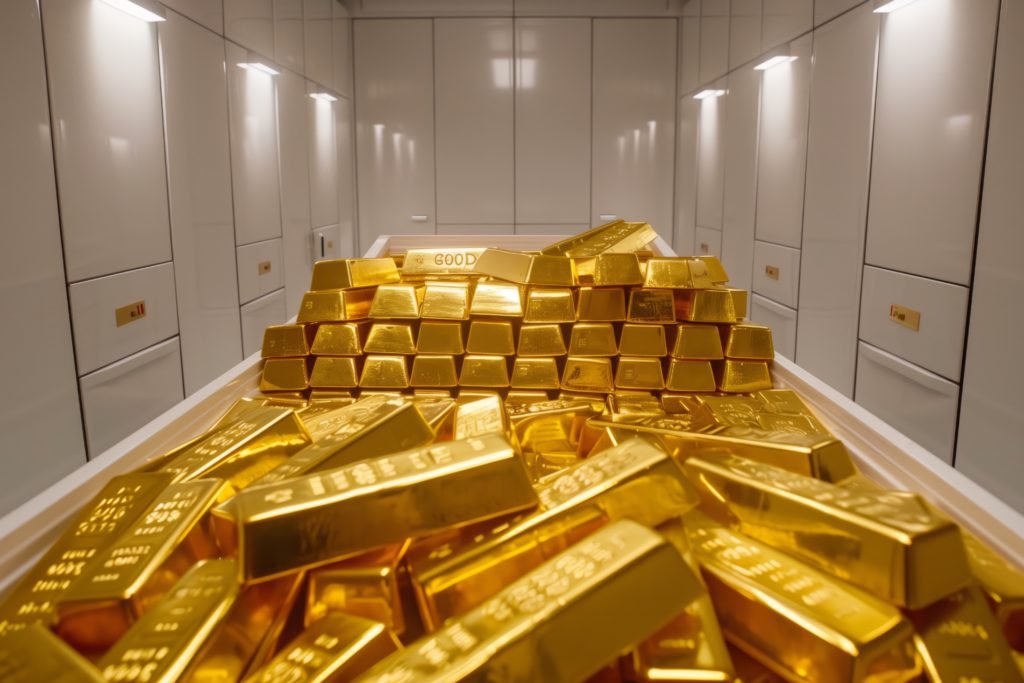
Citigroup Inc. plans to use a vault near London’s Heathrow Airport to store precious metals, as it seeks to join the small number of banks that provide a crucial role in the world’s biggest gold-trading hub.
The bank is partnering with secure logistics firm Malca-Amit, which operates the vault, according to people familiar with the matter, who asked not to be identified as the details are private. Citigroup is in the process of becoming a clearing member of the London market as investor interest in bullion increases, Bloomberg reported in October.
Those members clear tens of billions of transactions every day in London, where more than $1 trillion in gold is stored, offering vaulting capacity where precious metals can change hands to settle contracts. Their number has dwindled to just four banks in recent years: JPMorgan Chase & Co., ICBC Standard Bank Plc, HSBC Holdings Plc and UBS Group AG.
Bullion vaults are often located close to or within airports, where metal can be easily flown in or out. Malca-Amit’s site is near Heathrow Airport in west London, according to its website. A 2012 profile of the company’s high security facility described how at that time it had capacity for more than 300 tons of gold — an amount worth approximately $43 billion at current prices — and 1,000 tons of silver.
As the largest player in precious metals, JPMorgan’s London vault is one of the biggest stores of gold in the world. The vault, located in the City of London, holds almost 1,000 tons of gold on behalf of just one bullion-backed exchange traded fund, an amount worth roughly $136 billion.
HSBC also has its own London vault, while ICBC Standard Bank purchased Barclays Plc’s London facility in 2016. UBS contracts with an external custodian for its vaulting needs, just as Citigroup plans to. Revenues from vaulting — which are typically calculated as a percentage of the value of the gold stored — have jumped as prices have rallied about 45% over the past year.
Citigroup and JPMorgan declined to comment. Malca-Amit didn’t respond to a request for comment.
(By Jack Ryan and Yihui Xie)
Singapore looks to become hub for hosting central bank gold
Singapore is planning to expand its gold-storage capacity to become a custodian of bullion held by foreign central banks, part of a broader push by the city-state to compete with Hong Kong as a regional hub for the precious metal.
The Monetary Authority of Singapore said Friday it will “look to provide vaulting services for foreign central banks and sovereign entities to meet potential demand.” The nation’s also developing “gold-related capital market products to promote price discovery and build liquidity.”
In addition, Singapore plans to build a clearing system to support over-the-counter settlement for trading gold locally, according to a joint statement from MAS and the Singapore Bullion Market Association.
Singapore’s ambition to become a major gold-trading hub follows a historic rally for the precious metal underpinned by a search from investors for alternative stores of wealth. Though bullion has retreated since the war began in the Middle East, many central banks – including China’s – have been steadily adding gold over the past few years as a way to hedge against US dollar dominance.
“We are working closely with the industry to see how we can position Singapore as a gold-trading hub in Asia,” said MAS deputy chairman Chee Hong Tat, who is also Singapore’s minister for national development. “It plays to our strengths, and it adds a new vertical pillar to what we are already offering” in wealth and asset management, Chee told reporters at a briefing.
As part of its push, the government has established a working group that includes JPMorgan Chase & Co. and UBS Group AG as well as DBS Group Holdings Ltd., United Overseas Bank Ltd. and ICBC Standard Bank Plc. Bloomberg News first reported the initiative earlier in March.
Attracting central banks – the ultimate providers of liquidity, given the large volumes of gold they hold in reserves – will be among the keys to Singapore’s plans, along with support from established financial institutions that serve as market-makers. Together, they form the backbone of the world’s dominant gold-trading hub — London — where billions of dollars’ worth of the metal is traded every day.
Globally, central banks hold nearly 39,000 tons of bullion — or about 18% of all gold ever mined — according to the World Gold Council. Even a small share of that market would bolster Singapore’s influence in regional trade that is currently dominated by Hong Kong — the gateway for precious metals going in and out of China, the world’s largest consumer of bullion.
“The space is big enough for us to co-exist and for both cities to be able to grow our respective services,” Chee said. Central banks and investors “see gold as an asset that can help them in this more uncertain environment.”
Singapore’s proposal could potentially attract nations that have challenged the status and credibility of historic hubs such as London and New York. A number of countries including Germany have repatriated gold for security reasons, and there have been similar moves from Poland, the Netherlands and Serbia.
In Asia, the People’s Bank of China is backing the Shanghai Gold Exchange to court central banks in friendly countries to buy bullion and store it within the country’s borders, Bloomberg News reported in September. Cambodia was one of the first countries to take up Beijing’s offer.
Singapore’s gold reserves stood at 193.6 tons as of January, according to data from MAS.
(By Chanyaporn Chanjaroen, Yihui Xie and Joyce Koh)
Indonesia’s Agincourt says it can resume operations after government lifts sanctions
The Martabe gold mine, located in South Tapanuli, North Sumatra. Credit: PT Agincourt Resources
Indonesian gold miner Agincourt Resources said on Thursday that it has been given the go-ahead from the environmental ministry to resume operations at its Martabe gold mine, which was sanctioned after accusations of environmental breaches.
Agincourt was among the 28 firms whose permits were revoked by the government following claims they were responsible for environmental damage that worsened last year’s floods in Sumatra, which killed at least 1,200 people.
Agincourt is part of conglomerate Astra International. Astra’s majority shareholder is Jardine Matheson.
“The company welcomed the environmental ministry’s decision related to the approval to continue operations at the Martabe gold mine,” said Katarina Siburian, Agincourt’s spokesperson.
The company is making necessary preparations and will comply with all requirements, and is committed to environmental protection and safety standards, Katarina said, adding that operations have not yet resumed.
Mining operations at Martabe had been suspended since December last year.
Officials from Indonesia’s environment and energy ministries did not immediately respond to requests for comment.
Deputy energy minister Yuliot Tanjung was quoted on Wednesday by news website Bloomberg Technoz as saying that the permit had been restored, adding that the ministry was still evaluating the company’s mining quota.
Another company sanctioned by the government, PT North Sumatra Hydro Energy (NSHE), has also been given permission by the government to resume operations, energy ministry official Eniya Listiani told Reuters on Thursday.
The company is controlled by China’s state-run SDIC Power Holdings Co. Ltd.
Commercial operations at the hydropower plant operated by NSHE are expected to start in October, Eniya said.
The hydropower project, worth over $1.6 billion, has long been on the radar of environmental activists, with many calling for it to be stopped because of the ecological destruction it has wrought on the biodiverse island.
(By Bernadette Christina and Stanley Widianto; Editing by David Stanway)
Argentina no longer faces a $16.1 billion court-ordered payment tied to the 2012 nationalization of state-owned oil company YPF.
A U.S. appeals court overturned the 2023 judgment that had awarded damages to minority shareholders, Barrons said on Friday. The United States Court of Appeals for the Second Circuit ruled 2–1 that the claims were not recognizable under Argentine law. That removes a potential liability estimated at up to $18 billion, including interest.
The case stems from Argentina’s 2012 seizure of a 51% stake in oil company YPF from Repsol under then-president Cristina Fernández de Kirchner. Repsol settled for $5 billion in 2014. Other shareholders, including Petersen Energia and Eton Park, did not receive compensation. They filed suit in 2015, arguing that Argentina failed to make a required tender offer under YPF’s bylaws.
The U.S. district court agreed in 2023 and set damages at $16.1 billion. Argentina appealed. The appellate court reversed, finding that Argentine law did not support the breach of contract claims. The case was heard in New York because YPF is listed on the NYSE, but the legal standard ultimately rested on Argentine statutes.
For Argentina, the removal of a $16–18 billion liability directly affects reserves, debt servicing capacity, and fiscal planning. Argentina had argued the payment would consume a large share of its foreign currency reserves.
“We won the YPF trial,” Argentine President Javier Milei said on X.
For Milei, this means Argentina does not have to come up with $16–18 billion in hard currency. That removes a direct draw on reserves and avoids pulling capital out of oil and gas. YPF continues funding drilling, completions, and midstream buildout in Vaca Muerta without the spectre of diverting cash to a legal payout.
The ruling also sets clear limits for US investors. YPF may trade on the New York exchange, but Argentine law controlled the outcome. That limits how far foreign shareholders can pursue claims in U.S. courts and will feed directly into how investors price legal and political risk in state-controlled energy assets going forward.
By Julianne Geiger for Oilprice.com
CU
Codelco sees war disruptions adding 5% to cost of making copper
Top copper supplier Codelco expects disruptions from the Middle East war to lift its production costs by about 5%, offering one of the first quantified inflation estimates from a major mining company.
Higher diesel prices, more expensive supplies and the Chilean government’s proposed suspension of a fuel tax credit would together add roughly 10 cents per pound to Codelco’s cash costs, chief financial officer Alejandro Sanhueza told reporters in Santiago on Friday. Currently, the cost stands at about $2 a pound
“We are closely monitoring this situation,” Sanhueza said during an earnings presentation. “We haven’t yet been directly affected by the Middle East situation, but we are exposed to international prices.”
The Iran conflict poses a triple threat to global mining profits — driving up energy costs, disrupting supply chains for inputs such as sulfuric acid, and weighing on commodity prices amid concerns over stagflation. Copper prices have fallen almost 9% since the war began.
Still, Codelco struck a constructive tone on the outlook for copper prices, saying that while short-term volatility has increased due to geopolitical risks, the underlying supply–demand balance remains supportive.
“The long-term price fundamentals are quite strong. We have growing demand and supply that is increasingly difficult to expand,” Sanhueza said. “That gives us a positive view from a fundamental standpoint.”
Last year’s price surge helped drive a 23% increase in Codelco’s earnings before items, even as production stayed fairly flat. The company expects to produce slightly more copper this year as management strives to put a string of operational and project setbacks in the rear-view mirror.
Executive chairman Máximo Pacheco is battling to revive output after production sank to a 25-year low amid declining ore grades and delays and cost overruns at several projects designed to tap richer areas of deposits. Making that task more challenging are ongoing restrictions around a section of its biggest mine that collapsed in July, killing six workers.
Pacheco, the 73-year-old former energy minister whose term as chairman ends in May, wants to get output back to pre-pandemic levels of about 1.7 million tons, potentially reclaiming the mantle of the world’s top copper producer from BHP Group.
That recovery would be welcomed by a copper market in which supply is expected to struggle to keep pace with demand amid an artificial intelligence-driven data center boom and the shift toward electric vehicles.
(By James Attwood)
JX Metals plans to expand investment as chip demand surges
JX Advanced Metals’ new plant in Mesa, Arizona. Credit: JX Advanced Metals
JX Advanced Metals Corp. is planning to invest more in materials for chips and information technology as demand for semiconductors surges.
The company is planning to spend about ¥100 billion ($623 million) per year on all of its business segments, President Yoichi Hayashi said, adding that the focus will be on chip-related businesses. It has averaged ¥90 billion annually over the last three years.
JX is among the beneficiaries of the rapid build out of AI data centers and its customers include global chipmakers like Taiwan Semiconductor Manufacturing Co., SK Hynix Inc. and Intel Corp. That’s prompting it to shift to chip and information technology materials from its traditional copper smelting business
“I don’t think we should just expand investments indiscriminately, but it would be wrong to hesitate to invest when there’s a clear opportunity,” Hayashi said in an interview. “I believe this is a time when we need to take on a certain amount of risk.”
JX raised its operating profit forecast for the fiscal year ending March 31 by 20% due to greater-than-expected demand. One of its products, a thin film material called indium phosphide which is used in data centers, is seeing strong sales and the company said it will make additional investments to expand capacity.
The company is negotiating with its customers to raise prices for its products given tight supply and demand, Hayashi said. The range differs on products, he added, without giving specifics.
The president doesn’t see significant impact on operations from the war in the Middle East, though the company is monitoring the situation, he added.
JX aims to achieve ¥200 billion of operating profit in its growth-oriented units, including the chip material business, by the fiscal year ending March 2040. That compares with about ¥52 billion in the most recent fiscal year.
Microsoft has announced an 'AI for nuclear' collaboration with Nvidia, to provide end-to-end tools that streamline permitting, accelerate design, and optimise operations across the industry.
(Image: Brian Penny/Pixabay)
"The world is racing to meet a historic surge in power demand with an infrastructure pipeline built for the analogue age," Darryl Willis, Corporate Vice President, Worldwide Energy and Resources Industry, Microsoft, said in a blog post. "Driven by thonential expansion of digital technologies and the reindustrialisation of supply chains, the mandate for always-on, carbon-free power is urgent and absolute. Nuclear energy is the essential backbone for this future, but the industry remains trapped in a delivery bottleneck. Before a shovel even hits the dirt, critical projects are slowed by highly customised engineering, fragmented data, and mountains of manual regulatory review."
Tech giant Microsoft said it has formed a collaboration with multinational technology company Nvidia to provide a set of technologies that "bring disciplined engineering to the entire lifecycle of a nuclear plant - spanning site permitting, design, construction, and continuous operations. By enabling these capabilities within a connected, AI-powered foundation, we are empowering energy developers to make highly complex work repeatable, traceable, secure, and predictable - slashing development timelines and eliminating rework without sacrificing safety."
Willis said: "By unifying data, traceability, and simulation across phases, AI accelerates design validation with high-fidelity 3D models and Digital Twins, improves licensing consistency through AI-assisted document workflows, and connects design assumptions to operational performance - giving operators, regulators, and stakeholders clearer, continuous visibility."
Under the new collaboration, New York-based Everstar - an Nvidia Inception startup - brings domain-specific AI for nuclear to Microsoft's Azure cloud computing platform.
"The nuclear industry has been bottlenecked by documentation burden and regulatory complexity for decades," said Everstar CEO Kevin Kong. "This partnership means our customers get the secure, scalable cloud deployments they demand. It's a significant step toward making nuclear power fast, safe, and unstoppable."
Everstar has also announced its collaboration with the US Department of Energy (DOE), Idaho National Laboratory (INL), Argonne National Laboratory (ANL), and Microsoft as part of the DOE's Genesis Mission. "This announcement marks Everstar's first public milestone on a broader roadmap of activities that aims to compress the nuclear value chain by an order of magnitude for licensing, design, manufacturing, and operations," it said.
Everstar said its Gordian AI platform was used to convert a DOE safety analysis document into sections equivalent to a US Nuclear Regulatory Commission licence application - a process that typically takes a team of experts four to six weeks was completed in a single day.
Launched by President Donald Trump through an Executive Order dated 24 November last year, the White House says the Genesis mission is inspired by the legacy of the Apollo Programme "to unite America's brightest minds, most powerful computers, and vast scientific data into one cooperative system for research". The DOE-led mission aims to harness AI and advanced computing to double the productivity and impact of US science and engineering within a decade, and will "deliver decisive breakthroughs to secure American energy dominance, accelerate scientific discovery, and strengthen national security", the department said.
Taipower applies to restart Maanshan plant
Taiwan Power Company has submitted a plan to the Nuclear Safety Council for the restart of the Maanshan nuclear power plant, whose two units were taken offline in July 2024 and May 2025 following the expiry of their 40-year operating licences, in accordance with Taiwan's nuclear phase-out policy.
The Maanshan plant (Image: Ministry of Economic Affairs)
In May last year, Taiwan's Legislative Yuan passed an amendment to the Nuclear Reactor Facilities Regulation Act that allows nuclear power plant operators to apply for a 20-year licence renewal beyond the existing 40-year limit, potentially extending a plant's operating lifespan to 60 years.
Taiwan Power Company (Taipower) announced it has now submitted a licence renewal application and related documents for the Maanshan plant, which it says has already been approved by the Ministry of Economic Affairs, to the Nuclear Safety Council (NSC). The plan includes five main parts: the current status and planned schedule of the unit; manpower allocation and training; reactivation items and regular maintenance of the facility; planning of regulations during operation; and quality verification and audit plan.
The NSC said it will first conduct a procedural review of the documents that Taipower has now submitted. After confirming that the application documents are complete, it will proceed with the substantive technical review. The NSC said it will invite external scholars and experts, along with NSC colleagues, to form a special review team.
"This team will conduct a rigorous review in accordance with regulations and international practices to ensure that Taipower has submitted a proper plan for all aspects of the restart plan and that it meets quality assurance requirements before approving the plan," it said. "During the implementation of the restart plan, the NSC will also conduct on-site verification to confirm that Taipower is implementing the plan accordingly. After Taipower completes the relevant procedures according to the reactivation plan, it must submit an implementation report to the NSC for review, as required by regulations. In addition, Taipower must also submit documents related to aging assessment and management, radiation-related issues verification and assessment, and seismic safety assessment, as required by regulations."
"Even if the restart plan is approved by the Nuclear Safety Council, it cannot start generating electricity immediately," Taipower noted. "Further independent safety inspections are still required. These inspections will take approximately 18 to 24 months, after which a report must be submitted to the Nuclear Safety Council for review. The review time is determined by the Council. Only after the review is approved and a new operating licence is issued will the plant be qualified to operate."
Taiwan's nuclear energy policy
Taiwan's Democratic Progressive Party (DPP) was elected in January 2016 with a policy of creating a "nuclear-free" Taiwan by 2025. Under this policy, Taiwan's six operable power reactors would be decommissioned as their 40-year operating licences expired. Shortly after taking office, the DPP government passed an amendment to the Electricity Act, passing its phase-out policy into law. The government aimed for an energy mix of 20% from renewable sources, 50% from liquefied natural gas and 30% from coal.
However, in a referendum held in November 2018, voters chose to abolish that amendment. The Ministry of Economic Affairs said the amendment was officially removed from the Electricity Industry Act on 2 December.
Nevertheless, then Minister of Economic Affairs Shen Jong-chin said in January 2019 "there would be no extension or restarts of nuclear power plants in Taiwan due to subjective and objective conditions, as well as strong public objection".
In May 2025 - just days before the final closure of Maanshan unit 2, marking Taiwan's exit from nuclear power - Taiwan's legislature approved an amendment proposed by the main opposition party (Kuomintang) to the Nuclear Reactor Facilities Regulation Act, allowing nuclear reactor lifespans to be extended from 40 to 60 years. The move was aimed at bolstering energy security amid rising demand from AI growth and to curb reliance on imported liquefied natural gas.
Kentucky incentives support laser enrichment plant
A USD98.9 million incentive package from the Commonwealth of Kentucky and McCracken County will support the ongoing development of Global Laser Enrichment's planned Paducah Laser Enrichment Facility.
GLE's vision of the PLEF (Image: GLE)
North Carolina-based Global Laser Enrichment (GLE) completed its full licence application to the US Nuclear Regulatory Commission for the Paducah Laser Enrichment Facility (PLEF) in July last year. It intends to re-enrich high-assay depleted uranium tails acquired from the Department of Energy at the facility at Paducah, Kentucky, and says the project represents a transformational investment opportunity for the greater Paducah region. It is expected to be the single largest capital investment in Western Kentucky's history.
The performance-based incentive package will potentially provide up to USD98.9 million in tax and other economic incentives should GLE reach agreed investment and job creation thresholds, the company said.
"GLE greatly appreciates McCracken County and the Commonwealth of Kentucky's enthusiasm and support for nuclear energy and the creation of new US domestic nuclear fuel sources," GLE CEO Stephen Long said. "The incentive package reflects a shared vision for economic development, technological leadership, and the establishment of a resilient domestic nuclear fuel supply chain."
GLE is the exclusive licensee of the SILEX laser enrichment technology invented by Australian company Silex Sytems Ltd. The company completed a large-scale uranium enrichment demonstration programme last year at its Wilmington, North Carolina Test Loop facility, reaching Technology Readiness Level 6, and is continuing its technology maturation program (TRL-7+) and full-scale preliminary detailed design for the PLEF.
The company said it "remains on track to begin re-enriching the DOE’s Paducah inventory of depleted uranium tails by 2030".
Excavation work approved for India's Mahi Banswara units
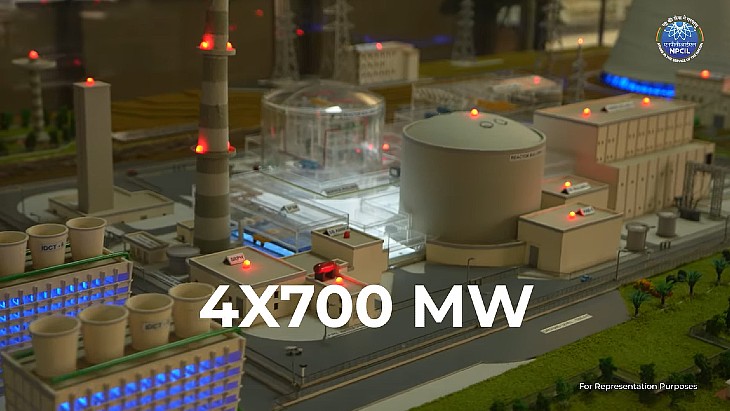
India's Atomic Energy Regulatory Board has approved the start of activities towards excavation for construction of the Mahi Banswara Rajasthan Atomic Nuclear Power Project units 1 and 2.
A model of how the completed plant could look (Image: Screengrab from NPCIL video)
The permission, announced on Thursday, has been issued to Anushakti Vidyut Nigam Limited (Ashvini) for the 700 MWe pressurised heavy water reactors planned at the plant, in the Banswara district of Rajasthan.
Ashvini is a joint venture between Nuclear Power Corporation of India Limited (51%) and National Thermal Power Corporation (49%) formed in 2024. Construction consent was issued for all four planned units at the Mahi Banswara plant last year.
The project is part of India's fleet mode initiative to build ten identical 700 MWe reactors at various locations across India under uniform design and procurement plans, an approach the Indian government says will bring in cost efficiencies and speed deployment, while consolidating operational expertise.
The other reactors that make up the ten planned units are Kaiga units 5 and 6 (in Karnataka), Gorakhpur units 3 and 4 (Haryana), and Chutka units 1 and 2 (Madhyar Pradesh). Two 700 MWe PHWR units at Kakrapar, in Gujurat, are already in commercial operation. Rajasthan units 7 and 8 are currently in the commissioning process.
India, which currently has about 7,900 MW capacity from 24 operable nuclear power plants, is planning a large expansion of its nuclear capacity. The country says that seventeen nuclear power reactors with a total of 13,100 MW capacity are either under construction (7) or under pre-project activities (10). The ambition is for India to reach a nuclear energy capacity of about 100 GW by 2047.
First 10 years of Russian final waste repository reviewed
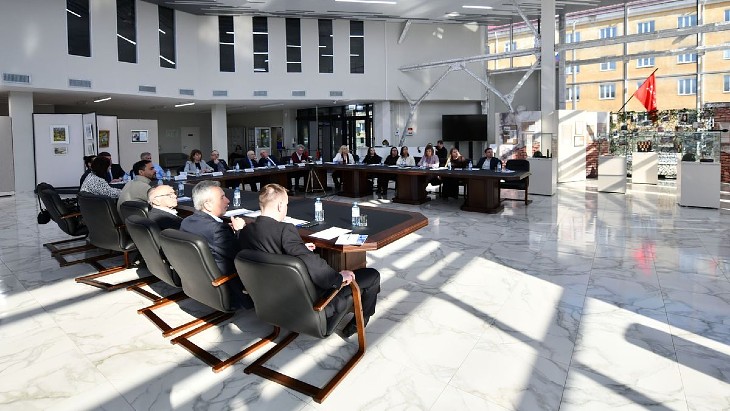
Russia put into operation its first near-surface final nuclear waste repository for solid low- and intermediate-level radioactive waste in 2016 in Novouralsk. A public event was told its first decade had been accident-free.
(Image: Rosatom)
The repository received its first waste shipment - 13 packages of waste totalling 47 cubic metres - in November 2016. It takes class 3 waste and class 4 waste such as, for example, clothing, air filters and packaging.
The repository is made up of reinforced concrete structures. The first phase, which opened in 2016, is 140 metres long, 24 metres wide and built at a depth of 7 metres. Together with the later phases, the repository can hold up to 55,000 cubic metres for up to 300 years. The walls of the storage structures, divided into cells, are more than half a metre thick and each cell is filled with special certified containers with 15-centimetre-thick concrete walls, which contain metal barrels containing pressed radioactive waste. After filling, each cell is concreted.
Once the waste is entombed, the facility was said at launch to be able to withstand a magnitude 6 earthquake. Once the site is fully loaded - which has been scheduled for subsequent decades - it will adopt the "green lawn" principle.
Vyacheslav Alexandrov, Director of the Ural Branch of the National Operator for Radioactive Waste Management (NO RAO), said: "An important result of our work is the accident-free and safe operation of the final isolation facility. We systematically conduct environmental monitoring and radiation control, and we share the results of these observations with the public. Throughout our operation, we have not recorded a single radiation incident. This speaks to the reliability of our facility's design solutions and, of course, is a testament to the high professionalism of our specialists."
Vasily Tinin, from Rosatom, said the facility had been created with a combination of domestic technologies and the world's best practices.
He said: "The facility plays an important role in meeting the needs of the nuclear industry and makes a significant contribution to achieving the national goal of transitioning from the accumulation of radioactive waste to reducing its storage volumes and eliminating the nuclear legacy. The experience of constructing and operating the facility in Novouralsk has laid a solid foundation for the further development of radioactive waste final disposal infrastructure in other regions where Rosatom State Corporation operates."
The National Operator for Radioactive Waste Management, part of state nuclear corporation Rosatom, also has two radioactive waste final disposal facilities under construction, in Seversk and Ozersk, with the first stages of these facilities scheduled to be commissioned in 2026. A separate underground research laboratory is being built as part of a project to create a deep final disposal facility for high-level radioactive waste in Krasnoyarsk Krai in Siberia.
Singapore to bolster nuclear safety capabilities
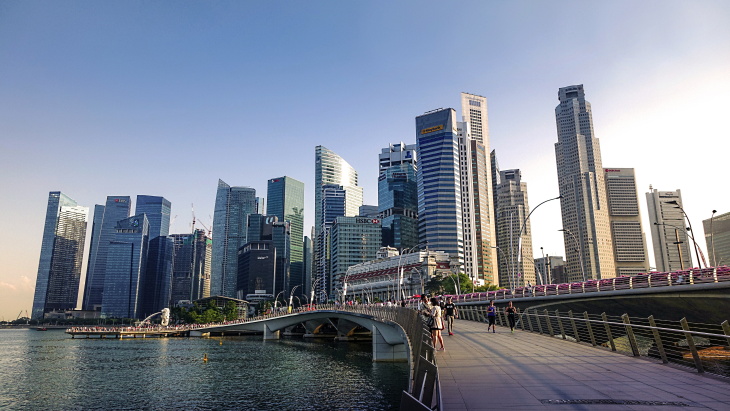
Singapore's National Environment Agency said it will issue tenders to commission three studies on nuclear safety standards and environmental considerations as the island city-state studies the potential deployment of nuclear energy.
(Image: cegoh / Pixabay)
The three studies will examine different aspects of nuclear safety: safety standards adopted by international organisations and national regulators, including how to design and operate the reactor safely, what safety systems are needed, and how to prevent accidents; international environmental standards and regulatory frameworks for nuclear facilities; and environmental considerations for the potential deployment of nuclear energy in Singapore and the region – both of which focus on how to protect public health and the environment.
"These studies will complement the ongoing study commissioned by the Energy Market Authority (EMA) to evaluate the safety performance and technical feasibility of advanced nuclear energy technologies," the National Environment Agency (NEA) noted.
The NEA, as the radiation and nuclear safety regulator, has been developing Singapore's nuclear safety capabilities through close partnerships with the International Atomic Energy Agency and established regulatory bodies in Finland, France and the USA, as well as its regional neighbours with whom it engages in nuclear safety cooperation discussions. The NEA's Nuclear Safety Advisory Panel, comprising experts in nuclear and related scientific fields, provides independent advice on nuclear safety, security and safeguards.
"The studies, together with our other capability-building efforts, ensure that Singapore is well equipped with the knowledge and technical expertise to independently assess the potential for safe deployment of nuclear energy in Singapore," the NEA said. "These capabilities will also allow us to contribute to strengthen regional discussion on nuclear, to better prepare for a region with nuclear power plants. The studies will also support our preparations in the event that countries in our region decide to deploy nuclear power."
In 2012, the Singapore government conducted a pre-feasibility study on nuclear energy. While the study concluded that nuclear power plants of the time were not suited for a small and densely populated city-state, it recommended that Singapore continue to monitor the progress of new nuclear energy technologies.
In March 2022, the EMA released a report that concluded nuclear energy could supply around 10% of Singapore's energy needs, helping its power sector achieve net-zero carbon emissions by 2050.
In October 2024, the EMA signed a memorandum of understanding (MoU) with the UAE's Emirates Nuclear Energy Company to develop capabilities in nuclear energy. Through the MoU, both parties would work together to strengthen capabilities in nuclear science and technology, and identify activities of mutual interest in areas such as the assessment of emerging nuclear technologies and human resource development. The parties agreed to facilitate information sharing through workshops, technical exchanges, and/or staff attachments.
In September 2025, the EMA appointed UK-headquartered engineering firm Mott MacDonald to conduct a study on the safety and technical feasibility of advanced nuclear energy technologies. The study aims to evaluate the safety performance and technical feasibility of advanced nuclear energy technologies, such as small modular reactors, based on their safety features, technology maturity, and commercial readiness.
Delivering his Budget 2025 speech in February last year, Prime Minister Lawrence Wong - who is also Finance Minister - said the government would study the potential deployment of nuclear power in Singapore and take further steps to systematically build up capabilities in this area. "We will need new capabilities to evaluate options, and to consider if there is a solution that Singapore can deploy in a safe and cost-effective way," he said.






_47682.jpg)
_66240.jpg)
_18080.jpg)