Sunday, April 05, 2026

South Korea brings old reactor back online

 04/04/2026, Saturday
TRT/AA


File photo

South Korea has restarted one of its oldest nuclear reactors, the Gori-2 unit in Busan, following a three-year shutdown for extensive safety upgrades. The reactor, first commissioned in 1983, was halted in 2023 when its 40-year operating license expired. After completing mandatory safety inspections and facility improvements under current regulatory standards, authorities granted approval late last year for the reactor to return to service.

South Korea brought one of its most aged nuclear reactors back online on Saturday, following a lengthy shutdown that lasted nearly three years for major safety renovations. The Gori-2 reactor, located at the Gori Nuclear Power Plant in the southeastern coastal city of Busan, resumed operations after receiving regulatory approval, according to local media reports citing state-run operator Korea Hydro & Nuclear Power Co.

The reactor first began generating electricity in 1983 as South Korea's third nuclear unit and played a foundational role in the country's early expansion of atomic energy. However, operations came to a halt in 2023 when its 40-year license expired, triggering a mandatory comprehensive review process that included rigorous safety inspections and facility upgrades required under current regulatory standards.

Regulators greenlight return to service

Regulatory authorities granted approval for the restart late last year, allowing the aging reactor to reconnect to the national grid after meeting all updated safety requirements. The three-year offline period allowed engineers to carry out extensive refurbishment work designed to extend the reactor's operational life while ensuring compliance with modern safety protocols.

Nuclear power remains key to South Korea's energy mix

The restart of Gori-2 reflects South Korea's ongoing effort to balance energy security concerns with nuclear safety considerations. Atomic power remains a major component of the country's electricity supply, helping to reduce dependence on imported fossil fuels. The decision to refurbish and restart an aging reactor rather than decommission it underscores Seoul's commitment to maintaining a stable and diverse energy portfolio amid global supply uncertainties.

Germany warns Goethe-Institut over exhibition with Palestinian artist

04.04.2026, dpa


Photo: Sebastian Gollnow/dpa


The German Foreign Office has criticized the country's own cultural organization, the Goethe-Institut, over the participation of a US-Palestinian artist in a recent exhibition in Lithuania with German funding.

“There should be no doubt whatsoever at events organized by German intermediary organizations that the federal government firmly rejects anti-Semitism and hatred of Israel,” the ministry said in a statement on Saturday in response to a report in the Bild tabloid.

It was made clear to the Goethe-Institut - which is largely funded by the Foreign Office - that "greater care is required in the early stages of planning and organizing events with partner organizations," the ministry added.

The exhibition "Bells and Cannons – Contemporary Art in Times of Militarization" ran from mid-October to early March in Vilnius and featured a film by Basma al-Sharif, a Kuwaiti-born Palestinian artist currently based in Berlin.

The filmmaker's appearance at the Dusseldorf Art Academy in western Germany earlier this year was the subject of a controversy after Jewish organizations accused her of anti-Semitic posts online.

The exhibition in the Lithuanian capital was a collaboration between the Contemporary Art Centre Vilnius (CAC), the Goethe-Institut in Vilnius and the Academy of Arts in Berlin.

The CAC curated the exhibition, a spokeswoman for the Goethe-Institut confirmed, adding that "no works with anti-Semitic content were on display."

However, she said some posts on the artist’s Instagram account were not compatible with the Goethe-Institut’s values, "specifically the denial of Israel’s right to exist."

The cultural organization had not been aware of the posts. "We deeply regret this," the spokeswoman added.

She said the Goethe-Institut rejects any form of anti-Semitism, and sees the recognition of Israel’s right to exist as indispensable.

Annual Easter peace marches draw thousands across 70 German towns

04.04.2026,  dpa


Photo: Enrique Kaczor/dpa


Germans gathered at around 70 locations across the country on Saturday for the traditional Easter marches calling for peace.

Marches were held in the major centres of Berlin, Munich, Cologne and Leipzig.

The three-day march through the Ruhr Region began in Duisburg, from where it will proceed via Essen, Wattenscheid and Bochum, ending in Dortmund on Monday.

The first rallies were held on Thursday and Friday, with a total of around 100 marches planned over the long Easter weekend. Saturday is traditionally the main day.

The marches are organized regionally by trade unions and leftist and Christian groups. They have declined in scope since the heyday of the peace movement in the early 1980s when hundreds of thousands participated.

This year, the focus is on Ukraine and conflicts in the Middle East.

Police said 3,000 people participated in the Stuttgart peace march, with up to 1,000 joining rallies in Berlin and hundreds more in Cologne.

The peace movement supports diplomatic initiatives to end wars, a strengthening of international law and efforts for the victims of war. It calls on the German government to halt rearmament and for a rejection of military conscription.

"In almost 40 years of Easter march work, I have never seen so many crises in the world at Easter," Kristian Golla of the Bonn-based Peace Cooperative Network said. "It really makes me think, but it also shows how important working for peace is," she added.

Kenya: Energy execs step down amid fuel manipulation probe
DW with Reuters
05/04/2026 

Five senior figures were arrested on allegations of purchasing an emergency fuel shipment at inflated prices. They are accused of trying to exploit the fuel crisis caused by the war in Iran.

The president's office said Kenya has standing contracts for fuel procurement
Image: Thomas Mukoya/REUTERS

Top executives in Kenya's energy sector have stepped down amid accusations of manipulating fuel stock data amid rising costs due to the war in Iran, President William Ruto's office said in a statement on Saturday.

The three resignations included Joe Sang, the managing director of the Kenya Pipeline Company (KPC); Daniel Kiptoo ​Bargoria, director general of the Energy and Petroleum Regulatory Authority; and Mohamed Liban, principal secretary for petroleum.

The resignation of the latter civil servant was accepted by Ruto himself.

The statement from the president's office pointed to alleged irregularities in Kenya's petroleum supply chain as the reason for the resignations.

What is Kenya's petroleum supply scandal about?

According to the government statement, the manipulation of fuel stock data was intended to justify an emergency import of fuel even though Kenya has several standing contracts.

Despite the war in Iran and the closure of the Strait of Hormuz, the statement said Saudi Aramco Trading Fujairah, Abu Dhabi's ADNOC Global Trading Ltd, and Emirates National Oil Company Singapore Ltd were all meeting their contractual obligations.

It added that the procurement of an overpriced, substandard quality emergency shipment of fuel "appears to have ​been done to exploit rising global prices and public anxiety, thereby creating ​a false impression of impending supply shortfall."

"The government is committed to protecting the public interest and safeguarding national resources. Any act of economic sabotage will be thoroughly investigated, and those found responsible will face firm and decisive action," the statement added.

Senior Kenyan energy officials arrested


The three individuals were arrested for their alleged role in the scandal, with Kenyan newspaper The Standard saying Joseph Wafula, the deputy director of petroleum in the Ministry of Energy, and Joel Mburu, a supply and logistics manager at KPC, had also stepped down after being arrested.

According to the Daily Nation news site, the five men were arrested on Thursday, with detectives reportedly seizing hundreds of millions in Kenyan shillings. 1 million shillings is worth around $7,700 or €6,700.

The deal between Kenya and the three suppliers mentioned above was part of a so-called government-to-government framework.

This had been introduced in 2023 as a response to the market volatility and foreign exchange constraints seen in 2022 in the wake of the Russian invasion of Ukraine.

Kenya is somewhat protected against energy price shocks as it generates around 90% of its energy from renewable sources, however, petroleum is still required to run things like vehicles.


Edited by: Sean Sinico

Alex Berry Writer and Editor in DW's online newsroom.
Nepal, Bangladesh, Morocco, Madagascar: What have the Gen Z protests achieved?

Six months after a wave of protest movements shook the political elite of countries across the Global South, the “Gen Z” activists continue their struggle for social justice. But while some of these activists have managed to bring down governments, building a viable political alternative remains a challenge for these largely spontaneous movements.


Issued on: 05/04/2026 
FRANCE24
By: Grégoire SAUVAGE


A medical student holds a flag bearing the logo of the popular Japanese manga One Piece, a symbol adopted by Gen Z protest movements worldwide. © Luis Tato, AFP

They toppled governments, captured the attention of the world’s media and forced their way to the front of the political scene in countries across the Global South. But six months after mass demonstrations shook Nepal, Madagascar and Morocco, how many of the demands championed by these hyper-connected “Gen Z” protesters have been met? FRANCE 24 examines the track record of youth movements pushing for change in their countries and whether they have managed to position their demands on the political agenda.

Hope for true change in Nepal

It was a Gen Z success story. After the spectacular fall of the government of KP Sharma Oli, 35-year-old Balendra Shah last week became the youngest prime minister in the Himalayan country’s history. Sudan Gurung, another influential figure from the protest movement, was also appointed interior minister.

Nepal's new prime minister, popularly known as "Balen", is a former Kathmandu mayor and social media-savvy rapper who made his entry into politics as an outspoken voice against corruption. He built a strong following among young people fed up with the country’s longstanding institutional stagnation and entrenched political elites.


Balen's first move as premier was to act on a report by a commission investigating last year's bloody repression of mass demonstrations that called for those responsible for the crackdown to be charged. Former prime minister Oli has been placed in police custody, as has the country’s former interior minister.


Nepal's newly sworn-in prime minister Balendra Shah (C) gestures as former interim prime minister Sushila Karki (2R) and president Ram Chandra Paudel (L) look on during a swearing-in ceremony in Kathmandu on March 27, 2026.
 © Prakash Mathema, AFP


But Balen is keeping the country in suspense over his plans to boost the country’s flagging economy, make the government more accountable, tackle corruption and redistribute the country’s wealth – key protest movement demands that swept the rapper to power.

“He doesn't do very many interviews – he doesn't really inspire confidence in that way,” said Feyzi Ismail, a lecturer in global politics and activism at Goldsmiths University of London. “But he really needs to come up with a very clear plan of action about what he's going to do to address these issues in concrete terms – like the unemployment crisis that drives almost 2,000 Nepalese people every day to leave the country to work overseas.”

The young prime minister takes office at a difficult time for the country. The US-Israeli war against Iran has driven up energy prices and affected the incomes of Nepalese migrant workers sending remittances back from the Middle East.

The worsening climate crisis also presents a serious challenge for the small Himalayan country, vulnerable as it is to flooding and landslides.


Beaten at the ballot box in Bangladesh

The students who managed to overthrow the government of Sheikh Hasina in 2024 brought a genuine sense of renewal to the political landscape during February’s legislative elections. Transparency International Bangladesh reported that 28 percent of the candidates were under the age of 44. But it was the long-established Bangladesh Nationalist Party and its promise to restore stability across the country that won a crushing victory.

“I think the Gen Z movement, if you can call it that, it captured a moment, and it seems to capture some aspirations of young people,” Ismail said. “They don't want the status quo, and that's important, that really spoke to a lot of what people were thinking and that was kind of bubbling underneath under the society. But that is very different from having a real engagement with politics and political programmes.”

While the protesters’ demands largely shaped the course of public debate, political parties headed by members of the youth movement struggled to convert that momentum into electoral successes.

"The results of the February 2026 election suggest that while the protests transformed the political agenda, established political actors retained structural advantages within the electoral arena," wrote Imran Ahmed, research fellow at the National University of Singapore’s Institute of South Asian Studies. "The strong performance of an established party such as the Bangladesh Nationalist Party suggests trust in actors with organisational experience and governing capacity."

‘Gen Z 212’ under pressure in Morocco

Between arrests and judicial harassment, Morocco’s Gen Z activists have found themselves hounded on all sides. Several key figures from the movement born in September last year, as well as those supporting it, have been arrested in recent weeks.

On March 29, 20-year-old Moroccan rapper Souhaib Qabli was sentenced to eight years in prison and a fine of 1,000 dirhams for “contempt of a constitutional institution” and “dissemination of false information”.

In reality, Qabli was arrested for lyrics denouncing corruption among the country’s ruling elite and criticising Rabat’s decision to normalise ties with Israel. He is the third rapper considered close to the protest movement to be arrested since the demonstrations broke out.

One month earlier, Zineb Kharroubi, a member of the Gen Z 212 France collective made up of members of the Moroccan diaspora, was detained on arrival in Marrakesh for “incitement to commit crimes on the internet”.

“We have counted more than 5,000 arrests, and 2,000 people are still in prison. Families are afraid to go out on the streets, because doing so could result in harsher sentences for their loved ones,” said Hakim Sikouk, president of the Rabat chapter of the Moroccan Association for Human Rights. “The authorities have really cracked down hard on the movement. Today, it is in a state of clinical death.”

The youth movement is still waiting for the government to make good on the promises it made – after three weeks of street protests – to increase social spending, set up new medical centres and renovate 90 hospitals.

The country’s healthcare sector became a lightning rod for public anger in Morocco, a country wracked by worsening inequality. In September 2025, the death of eight women who had come to give birth in Agadir’s Hassan II Hospital became the spark that set off a blaze of fury across the country, driving thousands of protesters to the streets.


Madagascar in suspense

On the largest island in the Indian Ocean, the youth of Madagascar are staying vigilant. The new government appointed on March 25 has been met with scepticism by the Gen Z movement that paved the way for the ousting of president Andry Rajoelina in October. It’s not hard to see why: none of the figures from the protest movement have been named to the government, while most of the former government’s ministers remain in place.

The country's interim leader Colonel Michael Randrianirina, whose army unit backed the protesters, has pledged elections by late 2027, and is a widely respected figure. Randrianirina has made the fight against corruption his rallying cry since taking power last year, going so far as to subject his cabinet ministers to mandatory polygraph tests.


Newly sworn in President of Madagascar Michael Randrianirina (C) poses for a photograph following his swearing in ceremony in Antananarivo on October 17, 2025. © Rijasolo, AFP

"He has a reputation for integrity that appeals to many. That said, this is not a naive endorsement – everyone remains wary, because simply appointing someone with an anti-corruption agenda to head the government is no guarantee that an anti-corruption policy will be implemented," said Ketakandriana Rafitoson, a political science professor and researcher at the Catholic University of Madagascar and a member of Transparency International. “In Madagascar, many people – including young people – question the very notion of a ‘re-foundation’ today, because we’re still a long way away.”

According to the World Bank, Madagascar is one of the world's poorest countries. Despite its abundant natural resources, three-quarters of the island's population live below the poverty line.

But the youth movement has not been sitting on its hands. Activists have set up a web site, published a charter and publicly positioned themselves as observers of the country’s re-foundation to guarantee "a deep systematic change in the face of corruption to build a free and sovereign Madagascar”.


Despite these lofty ambitions, the movement shows little desire to set itself up as a distinct political party.

“A number of them have been given positions or named as advisers, but without any influence on the course of events,” Rafitoson said. “But largely, this isn’t what the movement is looking for. The objective is that their ideas are taken into consideration and that they have a seat at the table, not that they occupy political posts.”
Kenya’s youth eye the presidential poll

Kenya’s streets have been cleared but Gen Z is still on the march. The movement recently launched a campaign to mobilise young voters ahead of the 2027 presidential election.

Dubbed #NikoKadi (literally, "I have the card," referring to being registered to vote), the social media campaign shares videos of young Kenyans proudly showing off their voter registration cards. Some businesses have also publicly offered discounts to people who have signed up to the country’s electoral roll.

A screengrab of a campaign poster calling for Kenyans to register to vote.
 © Screengrab from X


The movement has pledged to tackle voter abstention, especially among the country’s youth. Just 65 percent of Kenya’s 22.1 million voters cast a ballot in the 2022 general elections, down from 78 percent five years before, reflecting a growing disenchantment with the country’s political class.

In June 2024, a wave of protests led by the self-proclaimed “Generation Z” broke out in the east African country in response to President William Ruto’s announced tax hikes. The ensuing clashes were marked by looting, violence and police brutality, with at least a hundred people killed and dozens more disappeared.

"We want to improve the system,” said 26-year-old civil rights activist Ademba Allans, the figure behind the campaign. “We want to remove everyone in the government from office.”

“Apathy is one of the main obstacles,” he added.

This article has been translated from the original in French.
French central bank nets €13bn by pulling gold out of US reserves

France’s central bank has sold off the last of the gold it held in the United States Federal Reserve and replaced it with higher quality bars in Paris, taking advantage of rising prices to make nearly €13 billion as it upgrades its holdings.


Issued on: 04/04/2026 - RFI

Gold bars in a vault at the United States Mint. France has sold the remainder of its gold reserves stocked in the US to buy gold that meets modern international standards in France. © Mike Groll/AP

The Banque de France (BdF) announced last week that it generated a capital gain of €12.8 billion after upgrading 129 tonnes of gold – about 5 percent of France's total reserves – between July 2025 and January 2026.

The gold was the last of the French reserves held in New York. It was replaced with the equivalent amount bought in Europe and held in Paris.

The BdF has been gradually replacing older, non‑standard gold with bars that meet ​modern international standards since 2005. It moved the majority of its gold reserves out of the US Federal Reserve and the Bank of England between 1963 and 1966.

Rather than refining and transporting the gold that remained in the US, the bank opted to sell it and purchase new, compliant bullion on the European market.

Through 26 transactions, the BdF made a significant profit, capitalising on record-high gold prices during the period.

France’s total gold reserves of about 2,437 tonnes – the fourth-largest in the world – are now all in Paris. This includes 134 tonnes of older bars and coins, which the bank intends to bring up to standard by 2028.

Economic decision

In Germany, which holds the world's second-largest gold reserves, some economists have called on the government to withdraw its gold from the US, citing concerns about "unpredictable" policies under President Donald Trump.

The Bundesbank, Germany's federal bank, holds about 1,236 tonnes of gold in the US, or about 37 percent of its total.

"Trump is unpredictable and he does everything to generate revenue. That’s why our gold is no longer safe in the Fed’s vaults," said Michael Jäger, head of both the Association of German Taxpayers and the European Taxpayers Association.

BdF governor Francois Villeroy de Galhau insisted that the decision to move France’s gold out of the US was not politically motivated.

Instead, it was based on the fact that higher-standard gold is traded on the European market, and buying new gold was easier than refining the existing stock.

The exceptional capital gains contributed to the bank's net profit of €8.1 billion for 2025, following a net loss of €7.7 billion the previous year.

(with Reuters)
French, Japanese ships cross Strait of Hormuz in first since war

Paris (France) (AFP) – One French- and another Japanese-owned vessel are among a handful of vessels to have crossed the war-torn Strait of Hormuz, maritime tracking data showed Friday.

Issued on: 03/04/2026 - RFI

The passage is a vital maritime route for oil and liquified natural gas 
© - / NASA Earth Observatory/AFP/File

The passage, a vital maritime route for oil and liquified natural gas, has been virtually blocked by Iran since the start of the war.

But both ships made the crossing on Thursday, according to ship tracking company Marine Traffic's website.

The Maltese-flagged Kribi belonging to the French maritime transport group CMA CGM crossed the waterway to leave the Gulf on Thursday afternoon, Marine Traffic's data showed.

By early Friday, it was off Muscat, Oman, still broadcasting the message "owner France" on its transponder system in the field usually used to give the destination.


The vessel's navigation data showed it had crossed via an Iranian-approved route through its waters, dubbed the "Tehran Toll Booth" by leading shipping journal Lloyd's List.


Southern route

In addition, three tankers, including one co-owned by a Japanese company, crossed the Strait of Hormuz on Thursday by taking an alternative, southern route.

They hugged close to the shore of Oman's Musandam Peninsula, a first in nearly three weeks according to Lloyd's List.

Before the war, which started more than a month ago, about a fifth of global oil and liquefied natural gas (LNG) passed through the Strait.

All three ships signalled they were an "OMANI SHIP" in the message broadcast by their transponder as they crossed the strait.

The Sohar LNG, which was empty when crossing, is co-owned by Japanese shipping company Mitsui O.S.K.

That makes it the first Japanese vessel to exit the Gulf since the start of the war, according to a company statement quoted by Japanese media.

The Hong-Kong flagged New Vision, which crossed the strait on March 1 right after the war started, is expected in the French port of Le Havre on Saturday evening.

Since the conflict started however, that has dwindled to a trickle as Iran selectively attacks ships and energy facilities throughout the Gulf in retaliation for US and Israeli attacks.

A few commercial ships crossing the Strait of Hormuz recently have passed through the Iranian-approved route in the north of the waterway.


Down to a trickle

Just 221 commodities vessels have crossed the Strait of Hormuz since 1 March, some more than once, according to Kpler data up to Friday morning.

In peacetime, the same waterway handles around 120 daily transits, according to Lloyd's List.

Of the vessels that made the crossing, 60 percent either came from Iran or were heading there.

The other countries whose vessels - of origin or destination - made the crossing, were in decreasing order: the United Arab Emirates, China, India, Saudi Arabia, Oman, Brazil, and Iraq.

It was not clear from the data how many had been cleared to make the crossing by Tehran.

But it did show that, among the 118 crossings by ships carrying cargo, 37 had left the Gulf carrying crude oil.

Most of those oil tankers - 30 of them - came from Iran or sailed under the Iranian flag. And most ships carrying Iranian oil did not specify their destination on their transponder.

Of those who did, all but one reported they were heading to China.

In the early days of the war, transponder data showed dozens of ships broadcasting messages such as "Chinese crew" or "Chinese owner" in the field usually used for their destination.

This appeared to be an attempt by the ships to avoid being targeted by Iran.
Thousands rally against racism in Paris suburb to defend mayor

Several thousand people marched through the streets of Paris' largest suburb on Saturday to denounce racism after the town's newly elected black mayor was subject to disparaging comments on social media and national television shows.

Issued on: 04/04/2026 - RFI

A protester holds a placard reading 'racism, xenophobia, hate get lost' during a rally against racism convened by Saint-Denis Mayor Bally Bagayoko, in Saint-Denis, in the outskirts of Paris, France, on 4 April, 2026. 
AFP - THOMAS SAMSON

Bally Bagayoko, 52, of the hard-left France Unbowed (LFI) party, was elected mayor of Saint-Denis in the first round of municipal elections on 15 March.

The Frenchman born to Malian parents and brought up in the neighbourhood was almost immediately targeted by racist disinformation and remarks, some aired on one of the country's most watched news channels.

Demonstrators gathered on the steps of Saint-Denis's town hall, a town of 150,000 is one of France's most diverse, with a large immigrant population. Music bands, trades unions and associations joined the demonstation.

"We come to state firmly and definitively our visceral attachment to the values of the Republic embodied by those who are heirs of immigration," said Bagayoko.

He attacked what he said were "failing, sometimes even complicit institutions".

Also present was LFI leader Jean-Luc Melenchon. He denounced "a sickening wave of racism coming from the political and media elites who, without reservation, without restraint, have displayed their contempt for a part of our people."

Saint-Denis Mayor Bally Bagayoko, with the founder of French left-wing party La France Insoumise (LFI) Jean-Luc Melenchon and President of Gauche Democrate et RĂ©publicaine parliamentary group Stephane Peu, during a rally against racism, in Saint-Denis, in the outskirts of Paris, on 4 April, 2026. 
AFP - THOMAS SAMSON

Government minister absent

Aurore Bergé, the government's minister against discrimination did not attend the event.

"If there is one minister who should have been there, it is her," said Bagayoko when he was asked about her absence, but he did thank her for having reached out by telephone to express her solidarity.

Prime Minister Sebastien Lecornu this week also denounced what he described as the "normalisation of evil and racism" following the campaign against Bagayoko.


Bagayoko has filed a legal complaint against the CNews television channel, often described as France's Fox News, over comments about him made by one guest on the show.

Paris prosecutors announced on Thursday that they had opened an investigation into possible public insults of a racist nature over some of the remarks broadcast on CNews.

A separate investigation had been opened into the racist abuse the mayor received on the X platform, after the comments broadcast on CNews.

(AFP)


How effective is France’s fight against racial discrimination?

Recent comments on a television programme comparing a newly elected black mayor to a monkey and a tribal chief have reignited the debate over what critics call France's failure to tackle mounting racism in the country.


Issued on: 04/04/2026 
By: Alison Hird with RFI

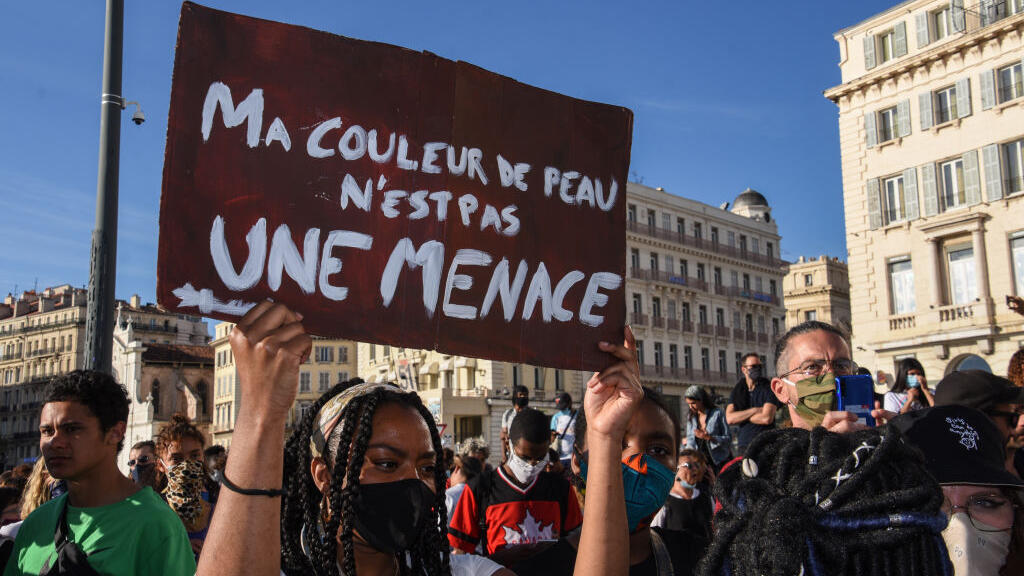
A woman holds up a banner reading "My colour isn't a threat" during an anti-racism demonstration in Marseille. 
SOPA Images/LightRocket via Gett - SOPA Images

Bally Bagayoko, of the far-left France Unbowed (LFI) party, has been subjected to racist comments both on and off screen since he was elected mayor of the multi-cultural Paris suburb of Saint-Denis two weeks ago.

The town hall’s switchboard operators say they are receiving five or six calls a day with racist questions such as "is this the town hall for Arabs and blacks?", according to the head of the department Kelly Kidou.

"They’re not necessarily anonymous calls – people feel sufficiently emboldened that they don’t even bother to hide their numbers," she told Franceinfo public radio.

Racist insults targeting public officials, including town hall staff, are punishable under French law by up to five years in prison and a €75,000 fine.

Bagayoko has promised to "create the conditions to be able to bring the perpetrators to justice" – not least because staff at the town hall reflect the area's ethnic diversity.

Born in France to Malian parents, Bagayoko has filed a criminal complaint against the CNews TV channel, after it broadcast interviews in which guests drew analogies involving monkeys, apes and tribal chiefs.

Paris prosecutors too have opened an investigation into "public insults of a racist nature" over some of the remarks, with a separate probe opened into racist abuse the mayor received on social media platform X following the CNews broadcast.

The channel has said the remarks were 'taken out of context" and “deliberately distorted” and the contributor concerned has denied racist intent.

But the Bagayoko case has once again prompted questions about the effectiveness of France’s efforts to combat discrimination.

Official figures show more than 16,400 racist, xenophobic or anti-religious offences were recorded in France in 2025, including 9,700 crimes and misdemeanours – a 5 percent increase on the previous year.

'Old colonial fears'


“We’re seeing the expression of a form of racism that has become increasingly overt in recent months,” says Dominique Sopo, president of anti-racism organisation SOS Racisme, pointing to “levels of expression we thought had almost disappeared”.

Bagayoko has come under attack in large part due to his position as a figure of authority, Sopo says.

"It’s not just someone who happens to be seen as black – he's a black person in a position of power. And that’s what upsets people."

Bagayoko has spoken publicly about discrimination and police violence and plans to gradually disarm the municipal police. This has led to him becoming the focus of a "highly fantasised narrative", according to Sopo.

"He's seen as embodying a threatening 'mass', echoing old colonial fears," he notes, adding that such narratives are no longer confined to the far right but are being "picked up in mainstream media, treated almost as plausible, which reveals a deeply ingrained racist imagination".

The Movement Against Racism and for Friendship Between Peoples (MRAP) has also filed an official complaint against CNews. Its co-president, lawyer Kaltoum Gachi, says the case shows "the normalisation of racist expression" which "no longer has limits".

In addition to the targeting of elected officials, she points to a recent wave of racist abuse directed at a newborn child named ZaĂ¯d at the start of the year, who was described in online posts as a "terrorist migrant" and a "delinquent".

"It shows how widespread and unchecked racism has become," said Gachi.


Bally Bagayoko is seen as a threat, says Dominique Sopo.
 AFP - JULIEN DE ROSA


Broad legislation


France has extensive legislation criminalising racial hatred and discrimination. Victims can pursue cases through both criminal courts and civil proceedings, depending on whether the racial insults were made in public or in private.

Public incitement to racial hatred, racial defamation and racial insult are crimes punishable under a 1972 law by up to a year in prison and a €45,000 fine.

In 2013, Sophie Leclere, a candidate with the far-right National Front (now the National Rally) was convicted of public racial insult and sentenced to nine months in jail, five years ineligibility to run for public office and a €50,000 fine after sh published a Facebook post comparing black MP Christiane Taubira to an ape.

The sentence was reduced on appeal to a €3,000 fine and a suspended sentence. Leclere was sacked from the party.

Protection from racial discrimination in employment, services and housing is enshrined in both the French penal code and European Union directives, by which France is bound.

Meanwhile, the country's broadcasting regulator Arcom has the power to fine broadcasters, suspend programmes or withdraw broadcasting licences altogether.

It has levied fines of up to €75,000 against CNews. Sopo describes the channel – owned by right-wing billionaire Vincent BollorĂ© – as "structurally and deliberately working to legitimise racism".

Ambition without action

In 2023, France launched a national anti-discrimination plan, targeting racism, anti-Semitism and discrimination linked to a person's origins – the first time racial discrimination was explicitly framed as a priority in public policy.

The plan includes measures centred on training and raising awareness across public and private institutions.

Patrick Simon, a socio-demographer at the National Institute for Demographic Studies, said the 2023 plan "had ambitions", but added that while training and information are important, they "are not actions that directly transform practices".

He notes that the plan lacks tools, such as sanctions, and monitoring mechanisms to give it teeth.

MRAP contributed to the plan, and its co-president Gachi admits that while it "looked ambitious on paper, in practice it delivered very little".

"There's a clear gap between political rhetoric and concrete action, and that raises serious questions about real political will," she said.

Simon points to deeper, longer-standing structural issues too.

"Policies tackling discrimination based on origin have been stagnating for more than 20 years, unlike those addressing gender or disability," he says.

Part of the explanation for this, he says, lies in France's refusal to recognise ethnic minorities as legal groups, in line with its universalist principles – making discrimination tied to those origins harder to measure, let alone address.

"There are between zero and 10 criminal convictions for racial discrimination per year, across all sectors,"says Sopo. "That says it all."

'Racism is not an opinion'

Calling for more decisive intervention within institutions – employers, housing agencies, public services – where racial discrimination occurs, Simon says training initiatives alone are unlikely to tackle racism.

"You have to act on the mechanisms, the decision-making chains. Frankly, I'm not very optimistic."

He also warns that growing numbers of non-white individuals in positions of power is itself generating a backlash that is "likely to intensify".

France has introduced quotas in the workplace regarding gender and disability, but its constitution forbids a quota system for hiring people from ethnic minorities.

Gachi is not convinced quotas are part of the solution. "The priority is to enforce existing laws more effectively," she says. "Racism is not an opinion, it’s a criminal offence. The law must be applied and prosecutors must take up these cases."

This article is based on interviews from RFI's DĂ©bat du Jour programme.
Five EU finance ministers call for 'tax on energy companies' windfall profits

Five European Union finance ministers are calling for a tax on windfall profits of energy companies in reaction to rising fuel prices due to the Iran war, according to a letter from the ministers to the EU Commission seen by Reuters on Saturday.


Issued on: 04/04/2026 - RFI

Fuel prices have started to rise in Germany. Here, a man fills up his car at an Aral gas station in Berlin, Germany, 2 March, 2026. 
REUTERS - Axel Schmidt

The finance ministers of Germany, Italy, Spain, Portugal and Austria made the joint call in a letter dated Friday, saying such a measure would be a signal that "we stand united and are able to take action".

"It would also send a clear message that those who profit from the consequences of the war must do their part to ease the burden on the general public," they wrote.

Oil and gas prices have spiked since the US-Israeli strikes on Iran began on 28 February, creating a price shock similar to the energy crisis Europe went ​through after Russia invaded Ukraine in 2022 - even though EU countries are now getting more energy from ​renewable sources.

Letter highlights 'market distortions'


In the letter, addressed to EU Climate Commissioner Wopke Hoekstra, the ministers pointed to a similar emergency tax in 2022 to address high energy prices.

"Given the current market distortions and fiscal constraints, the European Commission should swiftly develop a similar EU-wide contribution instrument grounded on a solid legal basis," they wrote.

The letter gave no details of what level of windfall tax the ministers were proposing, or on which companies it should fall.

The bloc's energy chief said on Tuesday it was considering reviving energy crisis measures used in 2022, including proposals to curb grid tariffs and taxes on electricity.

The EU introduced a suite of emergency policies in 2022, after Russia cut gas deliveries. They included an EU-wide cap on gas prices, a tax on energy companies' windfall profits, and targets to curb gas demand.

Europe's heavy reliance on imported fuel leaves it exposed to the Middle East conflict's impact on global energy prices.

European gas prices have risen more than 70 percent since the US-Israeli war with Iran began on 28 February.

EU Energy Commissioner Dan Jorgensen said Brussels was particularly concerned in the short term about Europe's supply of refined petroleum products such as jet fuel and diesel.

(Reuters)
Mideast war presents 'serious risk' for Africa, major report warns

The Middle East war "presents a serious risk to Africa", the African Union and the African Development Bank (AfDB) said in a report seen by AFP Saturday.

Issued on: 04/04/2026 - RFI

A vehicle is refuelled at a petrol station in Rosebank, Johannesburg on 1 April, 2026, a day after South Africa lowered its fuel tax for a month to offset a global oil price surge driven by the Iran war. AFP - PHILL MAGAKOE

The conflict threatens to increase the cost of living and curtail growth on the continent, the report warned.

The Middle East accounts for 15.8 percent of Africa's imports and 10.9 percent of its exports, the report noted.

"The conflict, which already has triggered a trade shock, could quickly turn into a cost-of-living crisis across Africa through higher fuel and food prices, rising shipping and insurance costs, exchange rate pressures, and tighter fiscal conditions," it added.

The growth rate of most African countries continues to be slower than before the Covid pandemic, it noted.

"A loss in output growth of 0.2 percentage points on Africa's GDP is projected for 2026 if it (the conflict) exceeds six months," it said.

"The longer the conflict lasts and the more severe the disruption to shipping routes and energy and fertilizer supplies, the greater the risk of a significant growth slowdown across the continent."

Reduced deliveries of liquefied natural gas (LNG) from the Gulf will impact fertiliser production, limiting its availability during the crucial planting period up to May, it added.

Spotlight on Africa: Africa faces security worries as Iran conflict spreads
Currencies hit

The report was compiled by the UN Development Programme (UNDP) and the United Nations Economic Commission for Africa (UNECA).

According to recent data from the African Development Bank (AfDB), the currencies of 29 African countries have already depreciated, increasing the cost of servicing external debt, making imports more expensive and reducing foreign exchange reserves,

Some countries could see some short-term gains, such as Nigeria for its oil exports or Mozambique for its LNG.

The rerouting of ships around Cape of Good Hope could benefit ports in Mozambique, South Africa, Namibia and Mauritius.

Kenya is establishing itself as a logistics hub in East Africa, while Ethiopian Airlines, the leading carrier in Africa, is serving as an "emergency air bridge" between the continent, Asia, and Europe, the report noted.

But these gains are likely to be uneven and will not offset the consequences for inflation, budgets, and food security in Africa, they warned.

Above all, the current crisis could hit the costs of humanitarian aid and divert donor funds towards other priorities.

(AFP)