Sunday, April 05, 2026

Judge halts Trump effort requiring colleges to show they aren't considering race in admissions


President Donald Trump arrives to speak about the Iran war from the Cross Hall of the White House on Wednesday, on April 1, 2026, in Washington.
PHOTO: Associated Press

April 04, 2026 

BOSTON - A federal judge has halted efforts by the Trump administration to collect data that proves higher education institutions aren't considering race in admissions.

The ruling from US District Court Judge F. Dennis Saylor IV in Boston on Friday (April 3) granting the preliminary injunction follows a lawsuit filed last month by a coalition of 17 Democratic state attorneys general. It will only apply to public universities in plaintiffs.

The federal judge said the federal government likely has the authority to collect the data, but the demand was rolled out to universities in a "rushed and chaotic" manner.

"The 120-day deadline imposed by the President led directly to the failure of NCES (National Center for Education Statistics) to engage meaningfully with the institutions during the notice-and-comment process to address the multitude of problems presented by the new requirements," Saylor wrote.

President Donald Trump ordered the data collection in August after he raised concerns that colleges and universities were using personal statements and other proxies to consider race, which he views as illegal discrimination.

In 2023, the Supreme Court ruled against the use of affirmative action in admissions but said colleges could still consider how race has shaped students' lives if applicants share that information in their admissions essays.

The states argue the data collection risks invading student privacy and leading to baseless investigations of colleges and universities. They also argued that universities have not been given enough time to collect the data.

"The data has been sought in such a hasty and irresponsible way that it will create problems for universities," a lawyer for the plaintiffs, Michelle Pascucci, told the court, adding that the effort seem was aimed at uncovering unlawful practices.

The Education Department has defended the effort, arguing taxpayers deserve transparency on how money is spent at institutions that receive federal funding.

The administration's policy echoes settlement agreements the government negotiated with Brown University and Columbia University, restoring their federal research money. The universities agreed to give the government data on the race, grade-point average and standardized test scores of applicants, admitted students and enrolled students. The schools also agreed to be audited by the government and to release admissions statistics to the public.

The National Center for Education Statistics is to collect the new data, including the race and sex of colleges' applicants, admitted students and enrolled students. Education Secretary Linda McMahon has said the data, which was originally due by March 18, must be disaggregated by race and sex and retroactively reported for the past seven years.

If colleges fail to submit timely, complete and accurate data, the administration has said McMahon can take action under Title IV of the Higher Education Act of 1965, which outlines requirements for colleges receiving federal financial aid for students.

The Trump administration separately has sued Harvard University over similar data, saying it refused to provide admissions records the Justice Department demanded to ensure the school stopped using affirmative action. Harvard has said the university has been responding to the government's requests and is in compliance with the high court ruling against affirmative action.

On Monday, the Education Department's Office for Civil Rights directed Harvard to comply with the data requests within 20 days for face referral to the US Justice Department.
On war, Trump must remember the wisdom of St. Augustine

The 'just war' theologian understood that force must be governed by prudence, reckoning with second and third order effects. We didn't do that in Iraq, or now


Ronald Dodson
Apr 05, 2026
RESPONSIBLE STATECRAFT

Peace is not merely the absence of fear. It stabilizes the conditions under which ordinary people can act, plan, invest, and raise families.

Chaos, by contrast, is asymmetric. It falls hardest on those least equipped to bear it, displacing populations, destroying fragile livelihoods, and forcing the marginal participant — whether the paycheck-to-paycheck citizen, retail investor, or refugee — into the worst possible outcomes.

This is why the decision to go to war cannot be judged by intention or immediate success alone. On this point, St. Augustine of Hippo remains indispensable. He understood that force must be governed by prudence and ordered toward the restoration of peace, which requires reckoning with second- and third-order effects. The failure to do so in the past is instructive —and the conflict today in Iran is falling into a similar pattern.

Augustine did not romanticize peace. He understood that conflict is a permanent feature of political life after the Fall. But he insisted that the use of force must be governed by prudence, not abstraction. War, if it is to be just, must aim at the restoration of order, not the satisfaction of ideological or psychological impulses.

More pointedly, rulers bear responsibility not only for the justice of their cause, but for the consequences their decisions impose on their own people, and this is where the U.S. Iraq War represents a profound failure.

The case for the war, as it was presented, rested on a mixture of claims: weapons of mass destruction, democratization, regional transformation, credibility. Some of these were empirical claims that proved false. Others were aspirational claims that proved ungrounded.

But even setting aside the question of whether the initial justification was accurate, a more fundamental error was made at the level of prudence. In 2003 the United States chose to dismantle the Iraqi regime without a credible plan for the order that would follow. That is not simply a tactical oversight, but a violation of the basic logic Augustine outlines. To remove an existing political structure, however flawed, without the capacity to replace it with a more stable one, is to unleash precisely the kind of chaos that just war reasoning is meant to prevent, and that chaos was not abstract.

Inside Iraq, the collapse of order produced sectarian violence, mass displacement, and the fragmentation of civil life. Those who suffered most were not political elites or ideologues, but ordinary Iraqis whose lives were suddenly exposed to forces they could not control. The asymmetry of chaos was on full display. But the consequences did not remain contained.

Regionally, the destabilization of Iraq altered the balance of power in ways that strengthened Iran, empowered non-state actors, and contributed to a broader arc of instability that would later manifest in conflicts across Syria and beyond. The idea that a single regime change could be surgically executed without cascading effects revealed a dangerous underestimation of how deeply political orders are embedded in history, identity, and power structures…and here is where the argument moves from history into present danger.

Strategic chokepoints like the Strait of Hormuz are not merely geographic features; they are levers of global order. Roughly one-fifth of the world’s oil flows through that narrow corridor, making it one of the most consequential pieces of terrain on earth. Under conditions of relative stability, even adversarial states tend to treat such chokepoints with restraint. The game is dangerous, but legible. There is typically one primary actor with the capacity to threaten closure, and that actor is constrained by its own interests. But chaos changes the game.

If a state like Iran were not merely pressured but fractured; if central authority degraded or collapsed, the result would not be a freer or safer Strait. It would be a more dangerous one. Instead of a single actor with a “kill-switch,” you could have multiple actors: factions, militias, proxy groups, each with partial capability and far less incentive toward restraint.

We are already seeing early forms of this dynamic. Control over transit through Hormuz has become selective, politicized, and contingent — more akin to a toll system than a neutral passage. At the same time, threats to shipping, rerouting of energy flows, and fragmented enforcement mechanisms are spreading risk across the system rather than containing it. This is a strictly worse equilibrium.

In game-theoretic terms, a single rational actor with a credible threat can be deterred and bargained with. A fragmented set of actors with partial control and asymmetric incentives cannot. The system becomes less predictable, less governable, and more prone to cascading failure.

In other words, the move from one chokepoint controller to many is not diversification. It is degradation. And this is precisely the kind of second-order consequence that prudence is meant to anticipate.

The Iraq War provides a clear illustration of how these costs manifest at home. American lives were lost. Capital was expended at extraordinary scale. Trust in institutions eroded as the gap widened between what was promised and what was delivered. And again, the burden was not evenly shared. Those who fought the war and those whose economic positions were most sensitive to macro instability bore the brunt.

One might argue that these outcomes were simply the result of poor execution. That with better planning, more troops, or different decisions, the war could have achieved its aims. This response misses the more consequential point.

The failure was not merely operational. It was conceptual. It lay in the assumption that political order could be rapidly engineered from the outside, that the removal of a regime would naturally give rise to a better one, and that the complex fabric of a society could be rewoven under conditions of external intervention.

This is precisely the kind of abstraction Augustine warns against. It substitutes a theory of how things ought to work for a sober assessment of how they actually do.

Prudence, in the classical sense, is not timidity. It does not forbid the use of force. But it demands that leaders account for the full chain of consequences their actions will set in motion. It asks not only, “Is this cause just?” but “What will follow if we act—and if we fail?” In Iraq, these questions were either insufficiently asked or insufficiently answered.

The result was not simply a war that went poorly. It was a war that imposed asymmetric costs on the most vulnerable, both abroad and at home, while failing to secure the durable order that alone could justify those costs.

This is why the lesson of Iraq is not reducible to a debate over intelligence failures or tactical errors. It is a lesson about the limits of power and the necessity of prudence. It is a reminder that political communities are not blank slates, and that the destruction of order is far easier than its creation. Above all, it is a reminder of responsibility.

When a state chooses to go to war, it is not engaging in an abstract exercise. It is making a decision that will reverberate through the lives of its citizens and others, often in ways that cannot be fully predicted or controlled. To ignore the asymmetry of those effects is to abdicate the very duty that justifies political authority in the first place.

Augustine’s insight endures because it is grounded in a realistic understanding of human and political life. Peace is fragile. Order is hard-won. And chaos, once unleashed, rarely confines itself to the intentions of those who set it in motion. The Iraq War stands as a case study in what happens when these truths are neglected, and a warning of how much worse the next iteration could be.


Ronald Dodson is CEO of Dallas North Capital Partners and Dalcor Legacy. A lifelong Texan based in Dallas, he writes on geopolitics, markets, and political theology, bringing a Christian realist lens to questions of power, order, and responsibility.
The views expressed by authors on Responsible Statecraft do not necessarily reflect those of the Quincy Institute or its associates.


As Trump orders UFO data released, question hangs: If aliens exist, what would they think of us?


By AP
Published Apr 5, 2026 


A patron passes a painting inside the International UFO Museum and Research Center in Roswell, N.M., on June 10, 1997. AP-Yonhap

For generations, human beings have wondered: What would alien life from another planet be like? But we rarely ask the opposite: What would they think of us?

It's a question that can produce some, well, uncomfortable answers if you happen to be an earthling.

“If I were looking at Earth from a distance, I would be pretty disappointed,” theoretical physicist Avi Loeb says. “Most of our investing is dealing with conflicts to prevent other people from killing us or us killing others. Look at the Ukraine war over a little bit of territory. That is not a sign of intelligence."


The debate on whether little green men or UFOs are among us escalated in February when former President Barack Obama, responding to a podcaster's question, said aliens are “real,” but he ”hasn’t seen them” and “they’re not being kept at Area 51.” U.S. President Donald Trump later announced on social media that he was directing release of government files because of “tremendous interest.”

Stepped-up interest in UFOs also is swirling as the United States heads back toward the moon with Wednesday's launch of NASA’s Artemis II mission. The four astronauts aboard will do a fly-around of the moon before returning to Earth.


Gen. John "Jay" Raymond, Commander U.S. Space Command, left, and Chief Master Sgt. Roger Towberman, center, hold the Space Force Flag as U.S. President Donald Trump gestures to it during the presentation of the in the Oval Office of the White House in Washington, May 15, 2020. AP-Yonhap

In a world riven by war, civil unrest, climate change and divisiveness, it's easy to wonder what newcomers to Planet Earth might make of us and our struggles. Whatever the case, well over a majority of Americans echo the sentiment of the slogan from “The X-Files”: “The truth is out there."

A 2021 survey conducted by the Pew Research Center showed about two-thirds of Americans said their best guess is that intelligent life exists on other planets. About half of U.S. adults said UFOs reported by people in the military are “definitely” or “probably” evidence of intelligent life outside Earth.

“We don’t want to think this is the only place in this extraordinarily and incomprehensibly large universe where life and intelligence and even technology have emerged,” says Bill Diamond, president and chief executive of the SETI Institute in Mountain View, California.


“It sort of says about humans, ’We don’t want to be alone.'"

Something is up there. But what?

Americans have been fascinated by the thought of life outside this planet following the recovery of debris in 1947 near Roswell, New Mexico. The military initially said the material was from a flying disc, only to reverse course and tell the public it was from a weather balloon.


A visitor walks past a line of posters for the forthcoming film "Star Trek," on the first day of ShoWest, the largest annual convention for the motion picture industry, in Las Vegas on March 30, 2009. AP-Yonhap

Hollywood ran with it. Flying saucers, little green men and eventually humanoid gray aliens became part of popular culture. April 5 even is celebrated annually throughout the iconic “Star Trek" franchise as “First Contact Day” to mark the date in 2063 when humankind, in “Trek” canon, first made contact with Vulcans.

Much in the popular culture suggests any aliens might be aggressive. Priscilla Wald, who teaches about science fiction at Duke University, has a theory as to why.

“It seems to me it’s a reflection on who we are, that we’re projecting onto aliens the way we treat each other," Wald says. "So the aliens are coming down, they want to conquer us, they’re violent. Who does that sound like? It sounds like us.”

In 2024, the Pentagon released hundreds of reports of unidentified and unexplained aerial phenomena. However, that review gave no indications that their origins were extraterrestrial.


Debbie Dmytro points to the spot where she first saw four silent golden lights flying low in the sky in 2023, in Royal Oak, Mich., as she poses for a photo, March 24. AP-Yonhap

On two separate occasions, Debbie Dmytro saw things in the sky over Michigan’s southern Oakland County. The greenish object Dmytro says she saw March 1 in the sky over Royal Oak, Michigan, looked like neither plane nor helicopter. Dmytro, a 56-year-old medical professional, acknowledges that it could have been some type of commercial or delivery drone.

What she saw in 2023 in the same general area north of Detroit is not so easily explained.

“Four yellow lights, yellowish golden lights and they were all flying very, very low,” Dmytro remembers. She says the lights were about 100 feet (30 meters) up at their nearest.

“I’ve never seen anything so low without any noise and flying in complete uniformity,” she says. “Is it something man-made? Is it something that’s not manmade? Who knows?”


A sign directs travelers to the "1947 UFO Crash Site Tours" in Roswell, N.M., June 10, 1997. AP-Yonhap

Who knows indeed? UFOs, the term for unidentified flying objects, has in recent years given way to UAP — unidentified aerial phenomena or unidentified anomalous phenomena.

“Absolutely, there are such things” as UAPs and UFOs, says Diamond, whose SETI — Search for Extraterrestrial Intelligence — seeks to explore, search and understand the nature of life and intelligence in the universe.

“People observe things in the sky that they can’t immediately identify or recognize as either human engineering such as planes or drones or helicopters, or animals, such as birds, and therefore they don’t know what they are," Diamond says.

Time for the truth

Like so many, Dmytro wants to know what the government knows. “I think there’s more information out there. I’m open to learning more,” she says. “I have an open mind. It’s always about scientific proof.”


This image from a 2015 video provided by the Department of Defense and labelled, "Gimbal," shows an unexplained object being tracked as it soars high along the clouds against the wind. AP-Yonhap

Retired Rear Adm. Timothy Gallaudet says evidence clearly shows there are UAP zipping around the airspace and in the oceans.

“The nonhuman intelligence that operates them or controls them are absolutely real,” Gallaudet says. “We’ve recovered crashed craft. We don’t know if they’re extraterrestrial in origin."

Gallaudet worked as acting administrator for the National Oceanic and Atmospheric Administration. He participated in a 2024 congressional hearing on UAP disclosure and says the release of government files promised by Trump is something people find of interest. He just hopes the president follows through.

There are billions of galaxies in the universe and each has billions of stars, so the likelihood life developed elsewhere is fairly high, according to University of Michigan Astronomy Professor Edwin Bergin, who teaches about looking for life elsewhere. He believes that if intelligent beings navigated vast distances to reach Earth they would make themselves known — despite humanity’s penchant for creating chaos.

“I would think that they would look at us like we were crazy ... but they would come out," he says. "I mean, why come here otherwise unless you’re going to sit and observe.”

Loeb, director of the Institute for Theory & Computation at Harvard and head of the university's Galileo Project for the Systematic Scientific Search for Evidence of Extraterrestrial Technological Artifacts, believes in the likely existence of extraterrestrials.


Attendees playfully wear tin foil hats at the Edinburg UFO Festival, in Edinburg, Texas, April 5, 2024. AP-Yonhap

“They might be laughing at us,” he says. "They might be watching us ... to make sure we will not become predators, that we will not become dangerous to them.”

In the interest of national security

Much of the government’s secrecy around UFOs and UAP is tied to national security concerns, according to Diamond.

“We have pretty advanced technologies, satellite, ground-based that are for various purposes mostly national security and defense that are pointing at the sky or things on board aircraft,” Diamond says. “Sometimes these pick up objects. The technology behind it is sensitive and protected.”

Government data, including a “trove ” of UAP video the Navy is sitting on, should be shared with scientists for research and a better understanding of the characteristics of the objects, says Gallaudet, who spent 32 years in the Navy and viewed classified UAP video.

“When you look at these things in our airspace having near collisions with our aircraft, that’s a real valid concern,” he says. “We are just not sure of what they are and what they intend to do with their interaction with humanity. That could be a national security threat, or not."

“When has ignorance ever been a good national strategy?" Gallaudet asks. "Whether it be scary, harmful or not, or a mix, I think seeking the truth is in our best interest.”

Meanwhile, Diamond doesn't think any “true alien encounter could be kept secret.”

“If any civilization has mastered interstellar travel, they have technology and capabilities beyond our wildest comprehension,” he says. “If they want to interact, they will; if they don’t, they won’t. If they want to be seen, they will be, and if not, they won’t be!”
Collapse of Tokyo's aging cherry blossom trees during viewing season raises safety concerns

By AP
Published Apr 5, 2026 


People take pictures as they walk under cherry blossoms at Yoyogi Park, Tokyo, March 29. AP-Yonhap

TOKYO — Many of Tokyo's popular and iconic Somei Yoshino cherry blossom trees were planted during Japan's postwar advancement in the 1960s, and are now getting old and frail.

Some have fallen and many others require support, triggering safety concern as the Japanese celebrate the season of their favorite flower.

Two cherry blossom trees collapsed on Thursday, one at Kinuta Park in downtown Tokyo and the other at the Chidorigafuchi greenway. The one in Kinuta Park damaged a fence while the other tree almost fell into the Imperial Palace moat, though nobody was injured.


The tree in Kinuta Park was 18 meters (59 feet) tall and 2.5 meters (8.2 feet) in diameter. It was among the oldest, believed to be more than 60 years old, officials said. In March, another old cherry tree collapsed at the park, injuring a passerby.

Last year, 85 trees fell in Tokyo parks, injuring three people, and many were cherry trees, according to Masakazu Noguchi, a Tokyo metropolitan official in charge of public parks.

People gather under the trees during the season of hanami, or cherry blossom viewing, and the collapse of trees has alarmed officials in Tokyo, the birthplace of the cherry blossom variety.


People enjoy viewing cherry blossoms in bloom at Ueno Park in Tokyo, Japan, March 28. AP-Yonhap

Tokyo assembly member Yutaka Kazama expressed concern on social media last month that “cherry blossom trees with their roots partially exposed or obviously rotten (at Kinuta park) seem dangerous," calling for firm safety measures but without quickly resorting to tree felling.

Aging and erosion by internal fungus growth are among the main causes for the deterioration of the cherry blossom trees.


A tree doctor, Hiroyuki Wada, said heavy tilting, holes or mushrooms growing at the bottom are signs to look for in order to avoid risk-prone trees. Risks increase when tree trunks retain water after rain, he said.

“Many trees in our daily lives were planted soon after the war and are now 70-80 years old and getting weaker," he said, adding that they are affected by extreme heat in the summer and an extensive dry season.

“I hope people think about the climate change through what's happening to the cherry blossom trees, which is very symbolic,” he said.


People watch the cherry blossom in full bloom at a garden of the Imperial Palace in Tokyo, March 27. AP-Yonhap

Following the March incidents, officials conducted tree health checks at Tokyo's main parks ahead of the cherry blossom viewing season.

At the Kinuta Park, officials have conducted preliminary inspections of more than 800 cherry trees. They chopped down a number of trees and posted warning signs near some trees but the tree that fell Thursday was without caution signs.

“At the moment, our measures are mostly temporary, not fundamental steps such as replanting,” Noguchi said. “We call on visitors to use caution because we cannot say it’s safe even after inspection.”


People cross a street under a canopy of cherry blossoms in Tokyo, Japan, March 28.
 AP-Yonhap

At the Inokashira Park, one of Tokyo’s most popular viewing spots, dozens of aging cherry blossom trees or their branches have been chopped down in recent years as part of a safe tree regeneration plan and for safety. Some people lamented on social media the empty spaces around a pond that used to be seamlessly encircled by flowering pink blossoms.

Wada says an effective regeneration plan is key to preserving cherry blossoms and their scenery.

Cherry blossom viewers say the news of falling cherry trees is worrisome, but they didn't want to miss the short-lived fluffy pink blossoms.

“I'm a bit worried, but I guess it's OK if we stay away from tree trunks,” said Lisa Suzuki.

Another visitor Akira Kamiyashiki said he came with his daughter despite the safety concerns because rain is expected over the weekend. “Seeing the keep-off signs, I now feel safe,” he said.

Cherry blossoms, or “sakura,” are Japan’s favorite flower and usually reach their peak in late March to early April, just as the country celebrates the start of a new school and business year. Many Japanese enjoy walking or picnicking under the trees.


AI porn isn’t regulated. What does that mean for depictions of queer bodies?


A robot hand reaching out to a rainbow body.

Design by Sophie Holland via Uncloseted media. Used with permission.

By Emma Paidra

This story is part of Global Voices’ April 2026 Spotlight series, “Human perspectives on AI.” This series will offer insight into how AI is being used in global majority countries, how its use and implementation are affecting individual communities, what this AI experiment might mean for future generations, and more. The story is from Uncloseted Media and GAY TIMES was first published on March 14, 2026. It is republished here as part of a content-sharing partnership with Global Voices.

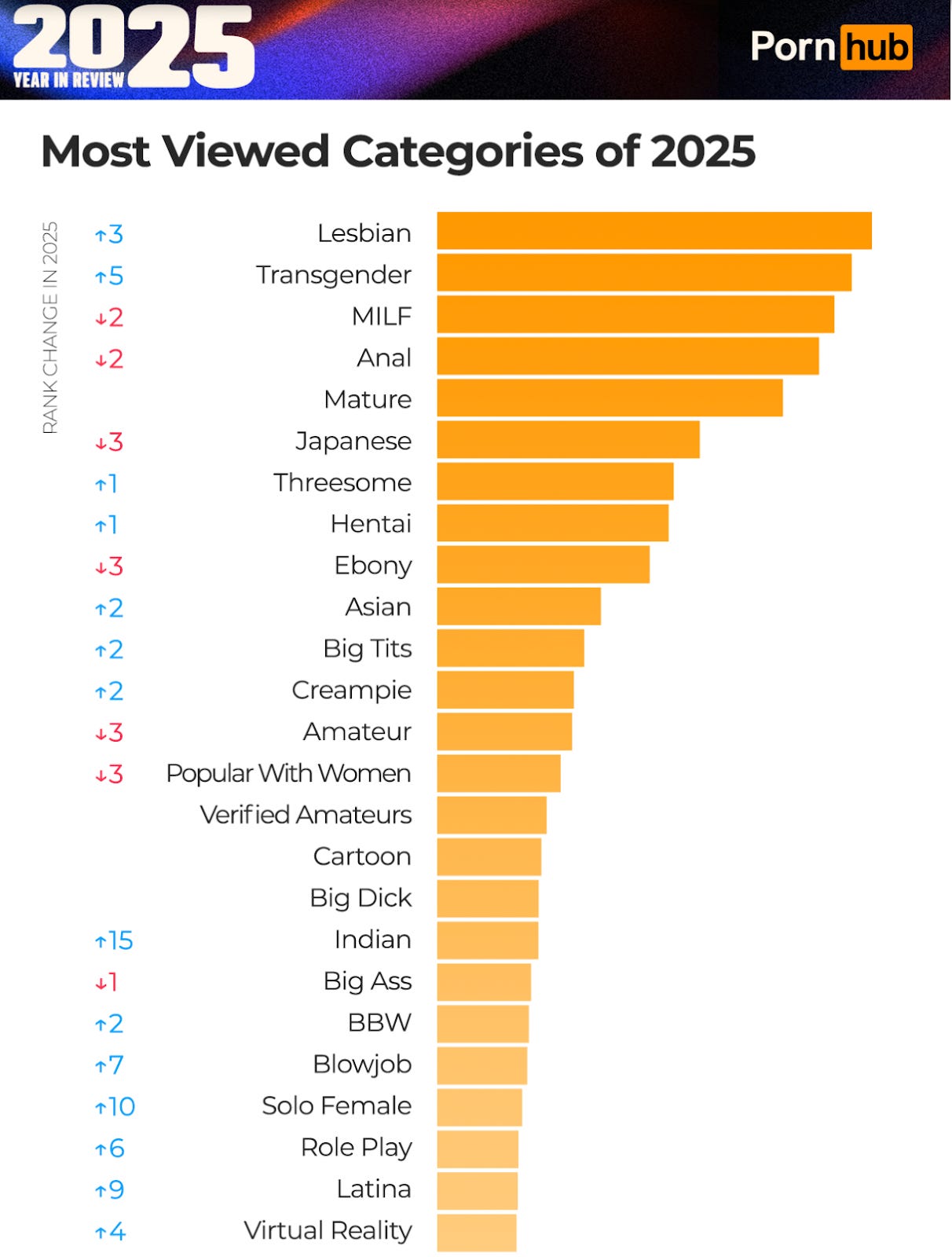
When Pornhub released its most-watched categories of 2025, queer-themed content held the top two spots: “Lesbian” was the most viewed category, and “Transgender” was the second most viewed, up five spots from 2024.

The global appetite for LGBTQ+ adult content is increasing in tandem with the explosion of AI porn. Over the last year, Google searches for “AI porn generators” have steadily climbed, with one site receiving 8.57 million visitors in January. But unlike porn made up of real people, AI porn is largely unregulated, opening the door for the exploitation of queer bodies.

A ranking of the most viewed categories of 2025 according to PornHub. Screenshot from PornHub

A ranking of the most viewed categories of 2025 according to PornHub. Screenshot from PornHub 

“More often than not, AI-generated pornography falls under this umbrella of ‘non photo-realistic media,’ or ‘non hyper-realistic adult content,’ not unlike illustration,” Aurélie Petit, a postdoctoral researcher at the Quebec research chair on French-language artificial intelligence and digital technologies, told Uncloseted Media and GAY TIMES. “And the moment you don’t know how to address this kind of content, then you don’t know what to do with a big part of AI adult productions.”

Though there have been steps taken to regulate the AI porn industry, there is still a long way to go. Last year, the U.S. Congress passed the TAKE IT DOWN Act, which bans the publication of intimate, non-consensual images in the U.S., including AI-generated images. And the sharing of these images, known as deepfakes, is now a felony in Tennessee.

But much of AI porn isn’t based on one person’s likeness. Rather, it’s generated from a vast database of preexisting content used to teach the AI model. So any user who wants to create porn can simply ask an AI model to create their dream scenario, and — in a matter of minutes — a video to their liking depicting realistic people is created.

“There’s a very real concern that some of the worst types of content on the internet — hateful content, non-consensual content of children … those exist on the internet, and we cannot verify that data sets [used to power AI algorithms] don’t include those images,” says Miranda Wei, postdoctoral fellow at Princeton University’s Center for Information Technology Policy.

Outside of deepfakes, U.S. laws leave AI-generated porn in a legal gray area, often varying by state or municipality. In California, Governor Gavin Newsom signed a bill cracking down on deepfakes and requiring AI-generated content to be watermarked. But there is yet to be a consistent policy across the board on how to legislate AI porn.

“When you have real people, or images that look like real people, we understand harm,” says Petit. “But most platforms do not know what to do. … It’s really a legal blur, a policy blur.”

Depictions of trans women

Because transphobic people make up a significant chunk of porn consumers, mainstream trans porn is often designed in a way that leans into prejudice. Videos using slurs or harmful tropes perform well on porn websites, and Google trends show that searches for “tranny porn” and “shemale porn” remain high. On Reddit, the largest trans-related subreddit is r/traps, a porn-sharing group named after a derogatory term that describes trans women as “traps” for cis men.

“[The internet] is still often reflecting a very heteronormative mindset. … Those preexisting biases for what kinds of content exists on the internet informs the data that is fed into those AI models,” Wei told Uncloseted Media and GAY TIMES.

A quick search for “AI trans porn” produces countless generated images of hyper-feminine trans women with unrealistically large penises, often the same length as their torsos. Other videos show trans women being penetrated by men with penises so large that, in real life, they would inevitably cause physical harm.

“When they say trans, you need to really understand it’s trans women, and a trans woman who still has a penis … it’s really a fetishization of trans women pre-operation,” Petit says.

One of Google’s first search results for “AI trans porn” is for CreateAIShemale. On the site, users can build a trans woman from a wide variety of options. They can choose her age, the size of her breasts, butt, and penis, and select from nearly 70 modifiers including “bimbo,” “spanked, hand print,” “impregnation,” and “pony cock.” The site also lists 42 options for “race,” with strange inclusions such as “goblin” and “green skin.”

On a separate but similar site, the owners write: “Your fantasy, your rules. With Trans AI customization, you can design every detail of your AI companion — from physical characteristics and outfits to voice tone and personality traits. … Our shemale AI models can generate images and videos on demand, making your interactions more vivid and exciting. … Shemale AI makes it possible instantly.”

Brandon Robinson, associate professor of Gender and Sexuality Studies at the University of California, Riverside, says these infinite customization options are concerning: “[It] can further the objectification of trans women, as it treats them as just sex objects that can be changed and customized to one’s own likes and desires,” they say. “It also erases that trans women are real, actual human beings, with their own wants, needs, and desires.”

Beyond the fetishization lies a celebration of violence against trans women. A quick search yields videos with headlines that include “AI Generated Shemale Getting Destroyed by a Massive Dick.”

Robinson says these depictions exacerbate preexisting stereotypes. “A lot of men come into dating or hooking up with trans women with these stereotypes.”

A ranking of the most searched for “gay terms,” according to PornHub. Screenshot from PornHub.

A ranking of the most searched for “gay terms,” according to PornHub. Screenshot from PornHub.

Depictions of gay men

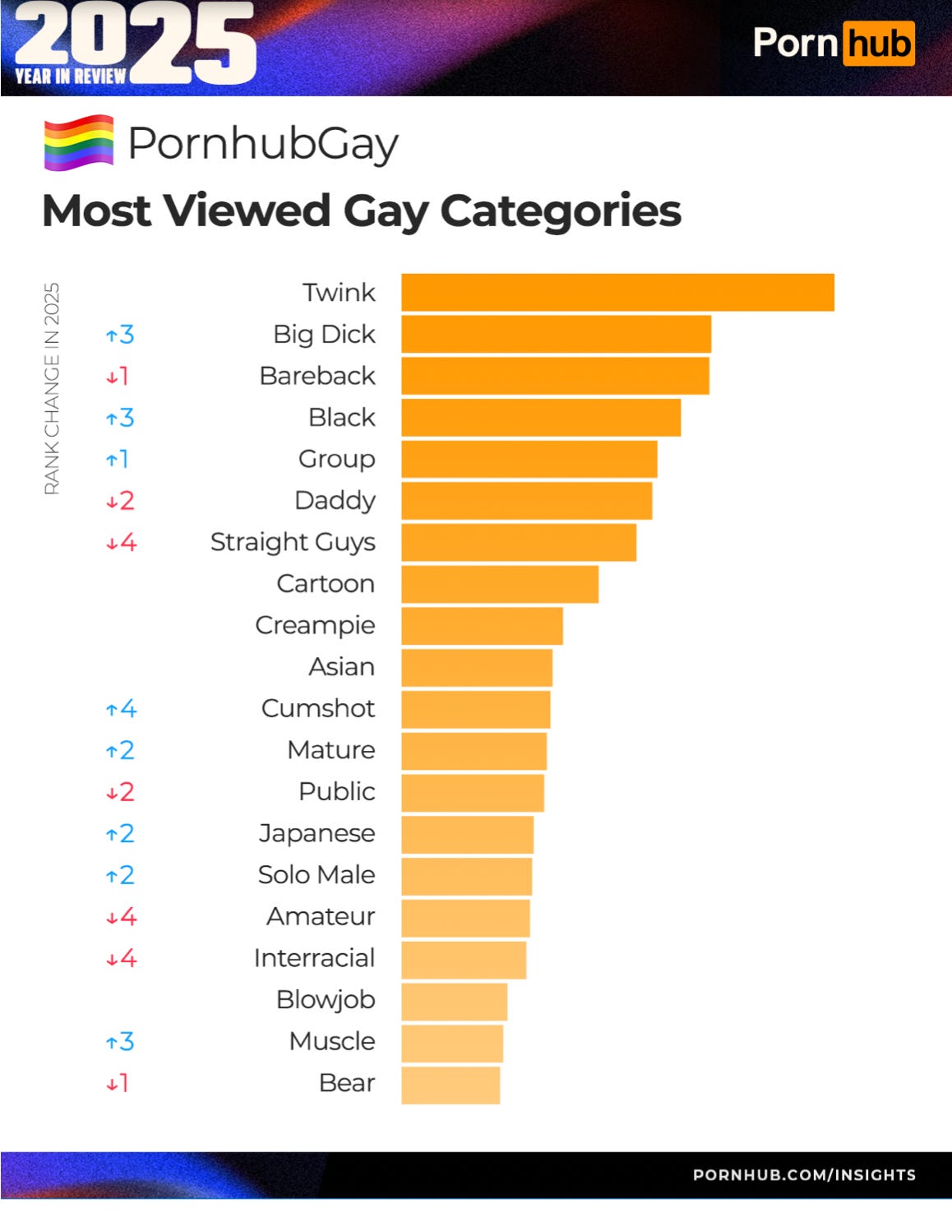
While deepfake laws in the U.S. now offer some protection, AI porn that isn’t based on one person’s likeness is harder to prosecute. And that’s concerning when you look at the global appetite for gay porn. In 2025, Pornhub reported that “femboy” and “twink” were the site’s two most searched for gay terms. And “Femboy Fixation” was one of the top five trends that defined 2025, with searches for “cute femboy” and “sexy femboy” up 79 percent and 93 percent, respectively.

What’s concerning is that AI has the ability to produce depictions of categories — which are code words for skinny, younger men — that take it to the next level. Many AI-generated depictions of these men show very thin, often emaciated, bodies. “It’s giving very unrealistic body ideas,” Robinson told Uncloseted Media and GAY TIMES. “And we know that there’s a history of eating disorders and body dysmorphia within the gay community.”

A ranking of the most searched for “gay categories,” according to PornHub. Screenshot from PornHub

A ranking of the most searched for “gay categories,” according to PornHub. Screenshot from PornHub

Depictions of children in AI porn are another space that has opened the door for bad-faith actors. A 2026 issue brief from UNICEF found that across 11 countries, at least 1.2 million children reported having had their images manipulated into sexually explicit deepfakes through AI tools in the past year. And while there have been regulations on deepfakes, groups devoted to creating twink and femboy AI porn can create videos that depict youthful, small bodies, potentially making content that blurs the lines between adult content and child pornography.

While some may find it hard to believe that something as sinister and criminalized as child pornography could be informing AI models, Wei says it’s happening. “Using Child Sexual Abuse Material (CSAM) is definitely not legal. It is awful. But lots of illegal things still happen,” she says. “People do use generative AI to generate AI CSAM, because the models have probably ingested CSAM before.”

Lesbian porn and AI

Unrealistic depictions of lesbian sex are also popping up in AI porn. One AI-generated lesbian porn video shows a woman licking semen out of another woman’s vagina — inserting an invisible male presence into sex between women.

Another disturbing part of AI’s representation of lesbians has to do with how it often makes women look identical. In one AI-generated image, two lesbians in matching black bikinis sit on the beach. Their haircuts, facial features, and bodies are the same. Through these kinds of images, AI risks encouraging viewers to overlook women’s individuality or — worse — lean into the fetish of incest.

In addition, many of the AI-generated depictions of women are feminine, extremely thin, white, and often have unrealistically large breasts and butts. While these attributes are already sought after in conventional porn, AI generators have the ability to produce depictions of women with impossible body proportions.

“[AI porn] maintains unrealistic beauty standards that most people can’t conform or live up to, but also it pushes most people out of being seen as desirable and beautiful,” says Robinson.

The impact on the viewer

AI-generated porn can be harmful for those who watch it, especially for young people: Pornography is already highly addictive, with one study finding a 91 percent increase in pornography consumption since 2000. Another study found that between 17 and 24 percent of adolescents have experienced a dependency on AI.

Wei finds this troubling because much of how AI porn is generated is a black box. “​From a consumer standpoint, you don’t really have the ability to audit how this tool was made,” she says.

Because of this, users may unknowingly consume media that is based on abusive imagery or even child pornography. This is because the massive amount of data that tech companies use to feed their AI models is gathered from across the internet, making it impossible for individuals to vet each piece of information. “It feels more risky to use it when you don’t know who created [the AI porn], what their intentions were, or how they collected the data that was used to make it.”

Wei says what is most concerning is that the data that tech companies use to feed their AI models is not always publicly available. “Large tech companies can be very protective of where they get their data. That is part of their business,” she says. “The scale at which these data sets are being collected means that you cannot have a human manually go through and verify that every piece collected was consensual [or] that a queer person was accurately depicted.”

What can be done?

Some popular generative AI models say there are safety regulations in place. ChatGPT’s website states that the model cannot be used for the creation of “illicit activities” or “sexual violence.” But Petit says that bad-faith actors may still succeed in skirting regulation. “There’s so many AI generators, and there’s people whose entire game is to break the generation,” she says. “You can tweak it more and more and can make the AI do something it doesn’t want.”

In one Reddit thread, a user of Elon Musk’s Grok expressed frustration about newly implemented moderation methods making it harder to generate explicit images. In response, another user seemingly confirmed they were able to find a workaround: “Right now I’m generating realistic videos of completely naked men with tentacles and fluids and non-con sex talk and moans and it works great,” the user wrote.

The potential for nefarious uses of AI came to light when it was revealed that, starting in December 2025, Grok produced and shared upwards of 1.8 million sexualized images of women over the course of nine days. “As we’ve seen with Grok and the numerous scandals over the past few years, the ability to stop an AI model from creating explicit imagery of someone is … unsolved,” Wei says.

Wei doesn’t have a bulletproof solution. “I’m not necessarily aware of a universal technique that could prevent, 100 percent of the time, the creation of images of other people,” she says.

There are, however, strategies that help safeguard AI models. For example, red teaming, which consists of prompting an AI model to generate illicit content, is an ethical tool companies can use to spot regulatory weaknesses. “[It’s] a way to adversarially test, to attack a model and see if it can do harmful things which you are trying to prevent it from doing,” says Wei.

With some companies like Google employing hackers to red team in hopes of identifying security concerns, Wei thinks other AI companies should do the same.

Another approach lies in public model cards, which are small files accompanying AI models that provide information about the data the model was trained on, as well as the AI’s intended use and limitations. Both of these methods are in pursuit of transparency, which Wei sees as necessary to safer AI use. “There should be a way to make technologies safe when people want to use them. … Transparency is needed in order to make progress on safety issues, but that’s again, ongoing.”

In the meantime, Wei says that “tech companies and lawmakers need to step up” and implement greater regulation around AI porn. “Effective regulation also needs the input of people who already have lived experience with pornography, like sex workers and adult actors, and anyone who would be depicted in this imagery.”

Additional reporting by Spencer Macnaughton and Hope Pisoni.


DRC: Urban trees are natural CO₂ stores that merit closer attention

Overview of Bunia. Screenshot from the video “By early 2026, the city of Bunia will have a modern airport built in international standards” on the Today TV YouTube channel

Overview of Bunia. Screenshot from the video “By early 2026, the city of Bunia will have a modern airport built in international standards” from the HK Today TV YouTube channel.

This article was first published on March 8, 2026, on www.greenafia.com. Global Voices republished the article as part of a partnership agreement with GreenAfia.

Trees planted in large cities are an integral part of the solution to climate change. Although traditionally considered less important than old-growth forests, an October 2025 study shows that they can play a major role in conservation efforts, sparking interest among scientists in the Democratic Republic of the Congo (DRC).

scientific study conducted in the Ituri Province of Bunia, northeastern DRC, proved that urban trees are not just landscaping features. They are natural carbon sinks, capable of offsetting a substantial proportion of human activity-related carbon dioxide (CO₂) emissions.

Cities as Carbon sinks

Unlike the much-studied natural forests, African urban areas are largely absent from climate policies, due to a lack of reliable data. To address this shortage, researchers from the University of Bunia inventoried 2,311 trees across 21 one-hectare plots in three communes of Bunia: Mbunya, Nyakasanza, and Shari.

Using non-destructive methods based on tree diameter, height, and wood density, the team estimated the aboveground biomass and carbon stock without felling a single tree.

Figures from this study speak for themselves: 1,759 tons of aboveground biomass stored by urban trees in Bunia; 8,795 tons of carbon sequestered, which is equivalent to 2,374 tons of CO₂ removed from the atmosphere.

On average, one urban tree in Bunia stores 380 kilograms of carbon, which is equivalent to approximately 124 kg of CO₂ absorbed. In one urban hectare, the average carbon stock is 47.6 tons, a figure comparable to that of some degraded forest areas.

In Bunia, if an urban tree can offset up to 124 kg of CO₂, it gains a carbon value of USD 1 to 4 on the voluntary carbon market (a carbon credit trading mechanism that enables businesses and individuals to offset their carbon footprint voluntarily), proving that DR Congolese cities can transform their trees into effective climate assets.

Not all species play the same role

One of the study’s major contributions was identifying the most effective species for carbon sequestration: Eucalyptus globulus: 61 percent of the stored carbon; Mangifera indica (mango trees): 14 percent; Persea americana (avocado trees): 9 percent; Grevillea robusta: 7 percent; and Senna siamea: 5 percent.

These findings show that the choice of species is important. Some species, due to their wood density and rapid growth, play a disproportionate climatic role in relation to their number.

This study changes a great deal, especially in urban policy development, where DR Congolese cities can now include urban trees as climate infrastructure, alongside roads and drainage systems. Planting or preserving some trees, therefore, becomes a measurable climate mitigation strategy.

In terms of land use and reforestation, this study provides a scientific basis for selecting the species to prioritize, avoiding decorative plantings with low carbon impact, and focusing urban greening programs on species with a strong climate performance.

Bunia could also attract the attention of policymakers within the climate funding framework. With local data, cities like Bunia can pursue urban carbon-credit pilot projects, climate-adaptation and mitigation funding, and improved ecological management of their green spaces.

This study shows how the fight against climate change isn’t solely in the great forests of the Congo Basin, but also in the streets, fields, schools, and urban districts where every tree counts. But most importantly, every species selection, every preservation or destruction policy has a measurable climate cost.

BURMA/MYANMAR

Rohingya council condemns Min Aung Hlaing's presidency as illegitimate


05/04/2026, Sunday
TRT/AA

File photo
The Arakan Rohingya National Council has condemned the appointment of former junta leader Min Aung Hlaing as Myanmar's president, calling the election process fundamentally illegitimate. The Rohingya group accused the new president of responsibility for mass killings and forced displacement during the 2016–2017 crackdown. It urged governments to refuse recognition and support accountability efforts at the International Criminal Court.

The Arakan Rohingya National Council (ARNC) has issued a sharp condemnation of Min Aung Hlaing's appointment as Myanmar's 11th president, describing the move as an attempt to legitimize military rule under a democratic facade. The former junta chief secured the presidency on Friday after receiving more than half the votes in a parliament widely seen as dominated by the armed forces. According to official results, Min garnered 429 votes out of 584 lawmakers present in the bicameral legislature, which has a total of 664 seats.

ARNC: Election process 'fundamentally illegitimate'

In an official statement, the ARNC declared that the process elevating Min Aung Hlaing lacks any democratic legitimacy, pointing to a military-controlled parliament and an election that the United Nations and other international observers have condemned as neither free nor fair. The Rohingya group accused the newly installed president of direct responsibility for atrocities committed against the Rohingya minority, including mass killings, widespread sexual violence, and the forced displacement of hundreds of thousands during the 2016–2017 military crackdown in Rakhine State.

Ongoing international legal proceedings

The ARNC noted that Min Aung Hlaing is already the subject of multiple international legal efforts. Proceedings are ongoing at the International Criminal Court (ICC), and arrest warrants have been issued under universal jurisdiction by courts in Argentina. The group also highlighted the broader human rights catastrophe unfolding in Myanmar since the 2021 military coup, which has left thousands dead and millions internally displaced as the junta battles armed resistance movements across the country.

Call for global action and non-recognition

The Rohingya council urged governments worldwide to refuse recognition of the new presidency, to increase pressure on Myanmar's military leadership, and to support all accountability mechanisms aimed at ending what it described as ongoing repression and impunity. The ARNC specifically called for stronger sanctions against the junta and for the international community to prioritize the Rohingya's right to justice, return, and citizenship. Türkiye has consistently been one of the most vocal advocates for the Rohingya people, providing humanitarian aid and pressing for accountability for crimes committed against the Muslim minority in Myanmar.
Detention of Kurdish poet extended in Turkey amid probe over Kurdish-language writing


Hengaw — Sunday, April 5, 2026

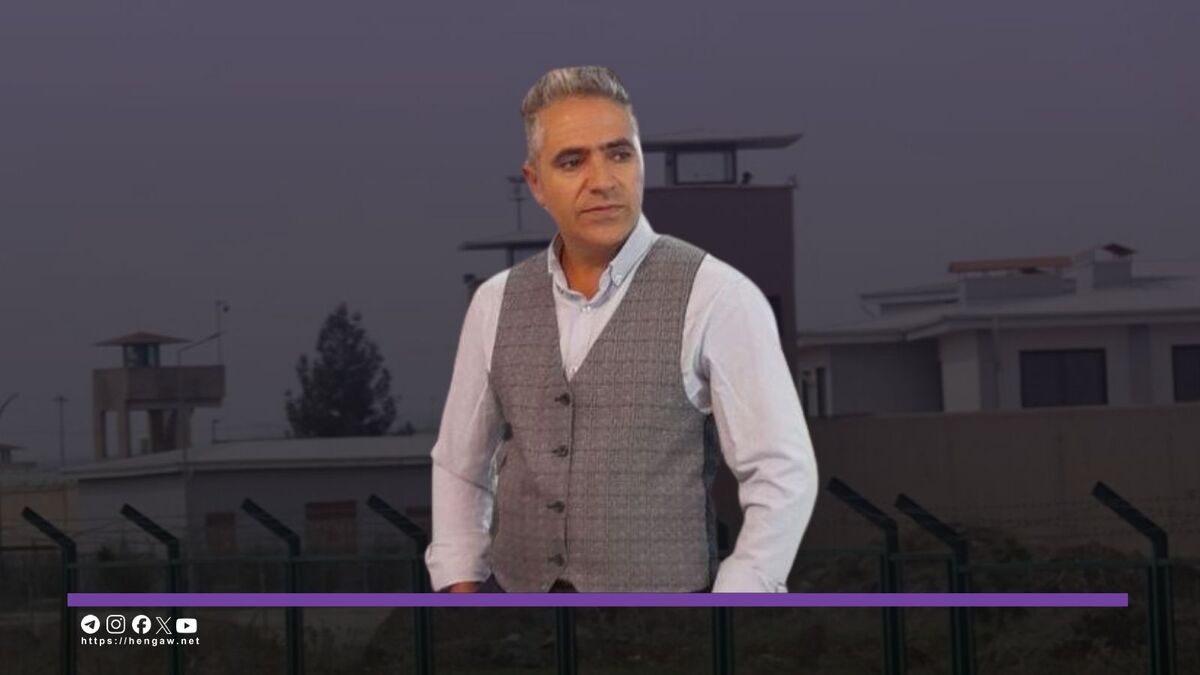
Turkish authorities have extended the pretrial detention of Kurdish poet and civil activist Behrouz Shojaei for another month, more than 40 days after his arrest, according to information obtained by the Hengaw Organization for Human Rights.

Shojaei, 43, from Qatur, West Azerbaijan (Urmia) province, Iran, and a member of the cultural association “Surawa,” was detained by Turkey’s National Intelligence Organization (MIT) and is being investigated over his literary activities, including writing and publishing poetry in Kurdish.

A Turkish court ordered the extension of his detention for an additional 30 days on Saturday, April 4, 2026.

Shojaei, a father of three, was arrested on January 31, 2026, after crossing into Turkey through the Razi border crossing while traveling to Kayseri for work.

A source familiar with the case said he has been held in a detention facility in the city of Van, where he has undergone intensive interrogations over the past 40 days.

Authorities have cited his Kurdish-language poetry and its publication online as the basis for the charges against him.

Source: Hengaw

Chicago protest denounces Israeli law on execution of Palestinian prisoners

Washington, April 5 (SANA) Demonstrators gathered in Chicago on Saturday to protest an Israeli law allowing the execution of Palestinian prisoners, according to media reports.

The Palestinian news agency WAFA said activists and supporters of the Palestinian cause took part in the protest, raising slogans condemning the legislation as a serious escalation and a violation of human rights.

Protesters called on the international community to take action against the law and urged increased political and media pressure, including through social media campaigns.

They also called on the U.S. public to contact members of Congress to oppose the measure.

The legislation allows the imposition of the death penalty on Palestinian prisoners and has prompted criticism from governments and human rights organizations over concerns about due process and potential misuse.

On March 30, Israel’s parliament, the Knesset, passed the law, drawing condemnation from Arab countries and international groups.

IZ/A