IRAN
The Risible Big Lie of Two Weeks to A Nuke
At the end of the day, 47-years worth of Washington’s feckless attacks on Iran and now the Donald’s Mother of all Stupidity boil down to a single fraudulent injunction from the amen chorus on the Potomac: Iran can’t have a (nuclear) bomb!
That’s the sum and substance of the matter because self-evidently there is no other even plausible basis for labeling Iran a military threat to the homeland territory of the USA. Even before the Donald’s Iranian Demolition Derby, it had no blue water navy, long range bombers or even missiles that could make one-fifth of the 10,000 kilometer trip form Tehran to Washington DC.
Also, as we showed in Part 7, its flyspeck of an economy is at best 3% of America’s GDP. You don’t erect a credible, sustainable military threat to the Pentagon’s $1.0 trillion per year armada on a pint-sized GDP. Full stop.
So we needs tear apart limb for limb the quarter-century long Big Lie perpetuated by Washington neocons and Israeli propagandists. Namely, their endlessly repeated claim that Iran is “months away” or “weeks away” from building a nuclear weapon, and therefore extreme measures are necessary to preclude it.
Indeed, this blatantly untruthful narrative is mainly what accounts for Washington’s decades of often brutal economic sanctions on Iran, as well as threats of military strikes, including Israel’s long-running irregular warfare of assassination and economic sabotage.
With respect to the latter, for instance, upwards of 100 Iranian nuclear scientists, engineers and government officials have been assassinated by Israel during the last two decades, capped off by the Donald’s own take-out of the IRGC Quds Force chief, Qasem Soleimani, in January 2020. The justification for these recurrent killings was the alleged urgent need to derail Iran’s purported sprint toward getting a nuke.
Yet the evidence tells a far different story. It pivots from a clear US intelligence assessment in November 2007 (and continues through repeated verification) that Iran has not pursued an active nuclear weaponization program.
That was the conclusion of the U.S. intelligence community—including all 16 intelligence agencies—via a crucial National Intelligence Estimate (NIE) on Iran. This 2007 NIE stated with “high confidence” that Iran had had a small, secret research program on nuclear weaponization but abandoned it in 2003:
“We judge with high confidence that in fall 2003, Tehran halted its nuclear weapons program… Tehran’s decision to halt its nuclear weapons program suggests it is less determined to develop nuclear weapons than we have been judging since 2005.”
— U.S. National Intelligence Estimate, “Iran: Nuclear Intentions and Capabilities,” November 2007
In major part, the 2007 NIE was aimed at debunking a 2002 Israeli propaganda offensive suggesting the opposite – that Iran was close to weaponization. But much of that information came from the Mujahedin-e Khalq (MEK), an Iranian dissident group with a long history of providing fabricated or exaggerated claims to Western governments. This included a major role in providing the false intelligence about what turned out to be Saddam Hussein’s non-existent WMDs.
Later investigations, in fact, showed that many of the supposed Iranian documents sourced from the MEK were either planted or heavily edited. So the crucial 2007 NIE effectively debunked the most alarmist of these Israeli claims.
Moreover, a few years after the MEK documents were circulated, Iran’s Supreme Leader, Ayatollah Ali Khamenei, issued a fatwa declaring just the opposite – namely, that production, stockpiling, and use of nuclear weapons is forbidden under Islamic law. This 2005 edict was reaffirmed multiple times thereafter. Western analysts who have studied Khamenei’s writings and speeches describe the fatwa as genuine and consistent with his religious worldview.
Moreover, under Iran’s velayat-e faqih system (“Guardianship of the Islamic Jurist”), the Supreme Leader’s word is the highest authority on both religious and state matters. Officials had routinely invoked the Ayatollah’s fatwa against nuclear weapons in diplomatic negotiations, IAEA meetings, parliamentary speeches, UN addresses, and media interviews in exactly the same way they referenced his other fatwas or directives on economics, culture, or foreign policy.
Former President Hassan Rouhani explicitly stated that the Ayatollah’s nuclear weapons fatwa was—
“….more important for us than the NPT and the additional protocol. It is more important to us than any law”.
In short, the Ayatollah’s fatwa against nuclear weapons had long been awarded strong and consistent public deference by Iranian officials and has never been publicly reversed. Of course, three weeks ago Bibi Netanyahu chose to assassinate him anyway, presumably owing Bibi’s superior knowledge that it was all a ruse.
From the US side, however, not so much. At least back in the day US officials operated on the presumption that the Ayatollah’s fatwa was Iranian state policy.
President George W. Bush–no wallflower when it came to starting foreign wars— later admitted as much in his memoir “Decision Points”. Therein he confessed that he had been ready to order military strikes on Iran’s nuclear sites much like the Donald’s bunker buster campaign of this past June, but had been stopped cold by the November 2007 NIE.
Bush wrote that the report “pulled the rug out from under” any immediate military option. The intelligence community’s conclusion that weaponization had stopped in 2003, he candidly admitted, forced the administration to ground the B-2s. As he explained,
“…….The NIE didn’t just undermine diplomacy. It also tied my hands on the military side. There were many reasons I was concerned about undertaking a military strike on Iran, including its uncertain effectiveness and the serious problems it would create for Iraq’s fragile young democracy. But after the NIE, how could I possibly explain using the military to destroy the nuclear facilities of a country the intelligence community said had no active nuclear weapons program?”
Thereafter, Iran continued uranium enrichment up to fuel grades levels (< 4%) for its large nuclear power plant at Bushehr. These were levels far below what is needed for a bomb (90%+ purity) and was done in a manner generally consistent with its obligations as a signatory of the Nuclear Nonproliferation Agreement (NPT).
During this period (2007 to 2015) Iran’s enrichment activities included a small volume (360 Kgs) of 20 percent medical grade material, but the stockpile remained small and was under IAEA monitoring all the while.
According to subsequent intelligence community findings there was no credible evidence of any resumed weaponization wok at Iranian facilities, either overt or covert. Accordingly, diplomatic efforts intensified during the Obama Administration, culminating in the 2015 Joint Comprehensive Plan of Action (JCPOA).
Under the JCPOA Iran agreed to dispose under IEA supervision more than 98 percent of its enriched uranium stockpile of about 9,000 kilograms, even though the overwhelming bulk of it (@8,630 Kg) was fully legal <4% reactor fuel grade material.
Beyond that, it also agree to dismantle two-thirds of its centrifuges and convert its Fordow facility to research only. In return, economic sanctions were to be lifted and thereafter the IAEA was authorized to conduct the most intrusive inspection regime ever applied to any country.
Needless to say, Bibi Netanyahu was having none of it. For reason of domestic politics and maintenance of his fragile multi-party coalition of just over 60 votes in the Knesset, he need the “Far Enemy” front and center, and always on the verge of have a nuke and presenting an existential threat to Israel.
Thus, in the eve of the completion of the JCPOA, Netanyahu’s minions on the banks of the Potomac arranged for him to speak to a joint session of the US Congress on March 3, 2015 where he denounced the Obama deal in strident terms before the ink was hardly dry on the deal:
“This deal will not prevent Iran from developing nuclear weapons.
It will all but guarantee that Iran gets those weapons.
It doesn’t block Iran’s path to the bomb; it paves Iran’s path to the bomb.”
From 2016 through early 2018, however, the IAEA issued 12 consecutive reports verifying that Iran had no diversion of nuclear material and no undeclared activities. Enrichment stayed at 3.67 percent — the level needed for civilian power reactors. Stockpiles remained within agreed limits. Iran kept its side of the bargain.
Nevertheless, on May 8, 2018 President Trump withdrew the United States from the JCPOA. He reimposed the full suite of sanctions that had been lifted, plus new ones targeting oil sales, banking, and shipping. This so-called “maximum pressure” campaign aimed to force Iran back to the table on harsher terms.
But here’s the thing. Iran had actually adhered to both the letter and spirit of the Obama deal and thereby had put its civilian enrichment program under a system of airtight international safeguards monitored by the IAEA.
At the time, of course, the neocons and Netanyahu megaphones made the shrill argument that the JCPOA was another case of a Munich-style appeasement that would only guarantee Iran’s pathway to the bomb. In truth, however, unlike Hitler at Munich who got most of what he wanted, the Iranians at Lausanne (where the Obama deal was negotiated) gave up almost all of what they had.
That is, they made huge concessions on nearly every issue that makes a difference. This included the number of permitted centrifuges at Natanz, the status of the Fordow and Arak facilities, the disposition of their enriched uranium stockpiles, the intrusiveness and scope of the inspections regime and on braking mechanisms with respect Iran’s so-called “breakout” capacity.
While every signatory of the non-proliferation treaty has the right to civilian enrichment, Iran had agreed to reduce the number of centrifuges by 70% from 20,000 to 6,000 and actually did so after the deal took effect. Moreover, its effective enrichment capacity had been reduced by significantly more because the remaining Natanz centrifuges consisted exclusively of its most rudimentary, outdated equipment – slow, low-yielding first-generation IR-1 knockoffs of 1970s European models.
The disposition of the heavy water reactor at Arak is even more dispositive. For years, the War Party had falsely waved the bloody shirt of “plutonium” because the civilian nuclear reactor being built there was of Canadian “heavy water” design rather than GE or Westinghouse “light water” model; and, accordingly, when finished it would have generated plutonium as a waste product rather than conventional spent nuclear fuel rods.
In truth, the Iranians couldn’t have bombed a beehive with the Arak plutonium because you need a reprocessing plant to convert it into bomb grade material. Needless to say, Iran had no such plant, no plan to build one, and no prospect for getting the requisite technology and equipment on the international market.
But even that bogeyman was dispatched by the nuke deal. The latter required Iran to destroy or export the heavy water reactor core of its existing plant and replace it with a core that cannot produce material which can be reprocessed into weapons grade plutonium. All of these requirements were subject to rigorous international inspection and, in fact, were complied with before Trump cancelled the deal.
As to its already existing enriched uranium stock piles, including some 20% medical-grade material, 97% of this material was to be disposed of, and that requirement was complied with, too. Iran ended up with only 300 kilograms of fuel-grade material out of its 10,000 kilogram stockpile.
As it happened, that was an amount that could have been readily stored in the Donald’s wine cellar at Mar-o-Lago. And, in fact, that’s all Iran had at the time of Trump’s cancellation of the JCPOA, according to IAEA reports.
The deal’s real clincher, however, had been Iran’s agreement to what amounted to a 20-year cradle-to-grave inspection regime encompassing the entire nuclear fuel chain. International inspectors were allowed to visit Iran’s uranium mines and milling and fuel preparation operations, its enrichment equipment manufacturing and fabrication plants and the storage facilities for its centrifuge rotors and bellows production.
Beyond that, Iran had also agreed to and had complied with a robust program of inspections to prevent smuggling of materials into the country to illicit sites outside of the framework facilities. That encompassed imports of nuclear fuel cycle equipment and materials, including so-called “dual use” items which are essentially civilian imports that could be repurposed to nuclear uses, even peaceful domestic power generation.
In short, not even a Houdini could have secretly broken-out of the box contained in the JCPOA agreement and then confronted the world with some kind of fait accompli threat to use the bomb.
To do so would have required diversion of thousands of tons of domestically produced or imported uranium and the illicit milling and upgrading of such material at secret fuel preparation plants. It would also have involved the secret construction of new, hidden enrichment operations of such massive scale that they could house more than 10,000 new centrifuges and the building of these massive spinning arrays from components smuggled into the country and transported to remote enrichment operations undetected by the massive complex of spy satellites overhead and covert US and Israeli intelligence agency operatives on the ground in Iran.
Finally, it would have required the activation from scratch of a weaponization program which has been dormant according to the US National Intelligence Estimates (NIEs) for more than a decade. And then, that the Iranian regime – after cobbling together one or two bombs without testing them or their launch vehicles – would nevertheless have been willing to threaten to use them sight unseen.
In short, the case against the JCPOA was rampant hogwash. It’s only purpose was to kill the deal so that Bibi Netanyahu would again be in a position of wave the bloody shirt of an Iranian nuke for purposes of domestic politics and keeping his Washington servitors on a short leash!
Still, you needed to be a raging, certifiable, paranoid boob to believe that the Iranians could have broken out of the JCPOA control box based on a secret new capacity to enrich the requisite fissile material and make a bomb. And you also needed to believe that Iran is run by absolutely irrational, suicidal madmen.
After all, even if they managed to defy the immensely prohibitive constraints described above as well as all the engineering challenges involved in weaponize an actual bomb with 90% + enriched uranium that didn’t get them all that far, anyway. After all, even if the Iranians got a few nuclear bombs, what in the world would they do with them?
Drop them on Tel Aviv? That would absolutely insure Israel’s navy and air force would unleash its 200 nukes and thereby incinerate the entire industrial base and major population centers of Iran.
At the end of the day, the idea that deterrence would have failed even if the Iranian regime were to defy all the odds, and also defy the fatwa against nuclear weapons issued by its own Supreme Leader, amounted to one of the most preposterous Big Lies ever concocted.
The truth is, there never was a plausible or rational basis for the Donald’s bombastic claim that the Obama nuke deal was fatally flawed. So in cancelling the deal, what Trump really did was embrace the immense tissue of lies beneath the unwarranted demonization of Iran that Bibi Netanyahu and the Empire Firsters on the banks of the Potomac had fabricated over the course of three decades.
In any event, subsequent to the Donald’s foolish cancellation of the JCPOA in May 2018 Iran responded by gradually increasing enrichment levels as bargaining leverage for an expected new round of negotiations. Even then, it continued to allow IAEA inspectors access and publicly stated it would return to full compliance if the U.S. rejoined the deal.
Accordingly, the U.S. National Intelligence Estimates after 2018 continued to assess that Iran was not actively pursuing weaponization. The 2019, 2020, and subsequent NIEs all repeated the core finding: To wit, Iran had not restarted the program halted in 2003. The intelligence community’s position remained unchanged even as enrichment levels rose.
For instance, an unclassified July 2023 report under the Biden Administration again attested that—
Unclassified ODNI Report on Iran’s Nuclear Weapons Capability (July 2023 edition): “Iran is not currently undertaking the key nuclear weapons-development activities that would be necessary to produce a testable nuclear device…”
Finally, as recently as March 2025 Trump’s own Director of National Intelligence, Tulsi Gabbard, testified before Congress that Iran still did not have a nuclear weaponization program. She stated the assessment was based on the latest all-source intelligence and that no new evidence had emerged contradicting the long-standing conclusion. Her testimony was direct and unambiguous.
Weeks later, Gabbard’s deputy, Joe Kent, a former CIA officer, essentially confirmed the same point in a public hearing. He noted that while Iran had accumulated more enriched material, theweaponization infrastructure and design work remained dormant.
Needless to say, even the small 420 kilogram (kg) stockpile of 60% enriched uranium (out of total stocks of about 9,000 kg) that the International Atomic Energy Agency says Iran had at the time of the subsequent June bombing had been produced for bargaining chip purposes in the context of the negotiations with the Trump Administration then underway.
As a NPT (nonproliferation treaty) signatory and operator of the aformentioned 3,000 megawatt civilian nuclear reactor at Bushehr, Iran was allowed to have the 7,582 kilograms of civilian reactor grade enriched uranium that the IAEA also certified last spring, as well as the 1,257 kilograms of medical grade uranium (20%).
What was really up for debate was just the 409 kilograms of 60% enriched material in its possession that could be spun to 90% weapons grade in a relatively short time.
But for crying out loud, it is goddamn obvious to anyone not looking for an excuse for war that Iran had produced this material as of last June as a bargaining chip. That is, in order to get a new nuke deal with Washington to replace the one the Donald himself unilaterally cancelled in 2018, and thereby pave the way for lifting the brutal and demented economic sanctions that Washington has again imposed on Iran.
IAEA Report On Iran’s Enriched Uranium Stockpiles As Of May 2025
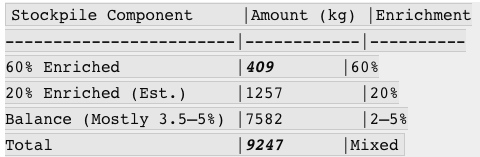
The proof of the bargaining chip pudding could not be more evident in the graph below. During the 10-year run-up to the 2015 nuke deal with the Obama Administration, the Iranians increased their enriched uranium stock piles to just slightly below the current level, to about 9,000 kilograms. But in an almost mirror image of the present, fully 96% of that amount was fuel-grade material at <4%, with about 350 kilograms of that material enriched to the 20% purity level for medical grade uses.
That is to say, most of the 2015 stockpile was generated as a bargaining chip, and that was exactly its fate. Upon activation of the JCPOA in 2015, all of the 20% material was destroyed as certified by the IAEA.
At the same time, the total stockpile of civilian grade material was also reduced by 97% to de minimis working levels, as further certified by the IAEA. Indeed, Iran ended up retaining only 300 kilograms of its 9,000 kilogram stockpile – an amount that could have been readily stored in the Donald’s wine cellar at Mar-a-Lago.
As mentioned above, however, the Donald had recklessly canceled the deal in May 2018 on the grounds that it had to be a bad deal by definition because he didn’t negotiate it!
Of course, that foolish move only caused the Iranians to restart the stockpiling process yet again, as is so explicitly depicted by the green line in the graph below.
The irony, therefore, is that after the Donald’s feckless June 2025 bombing campaign the Iranians likely had close to 100% of the 9,248 kilograms (including the 409 Kg of 60% material) held before June still in tact.
That’s based on pretty convincing satellite photos showing that all of the Donald’s amateur “art of the deal” head fakery last June about “two weeks to decide” before the actual the bombing runs enabled the Iranians to drive trucks up to the Nantanz and Fordow facilities and remove the stockpiles to safe sites elsewhere.
Stated differently, Obama negotiated the Iran enriched stockpile to down by about 97%, while the Donald bombed roughly the same level of stockpile from 9,000+ kilograms to, well @ 9,000 kilograms!
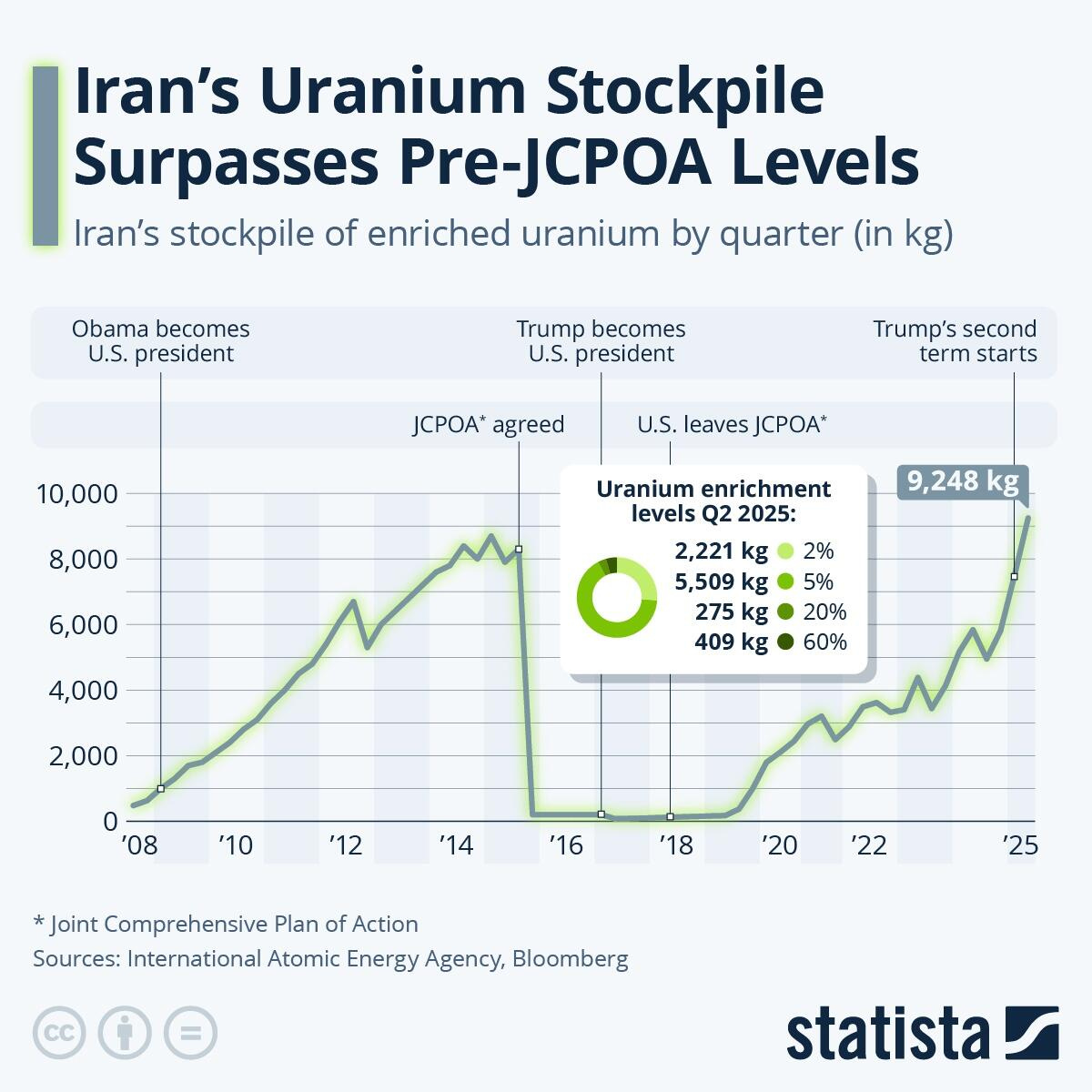
And yet and yet. The “obliterated” material was neither illegal, even remotely anything like a real nuke and likely not obliterated, either. Yet the 9,247 Kg of enriched uranium, and especially the 409 Kg of 60% material has became just the latest iteration of the flat-out Big Lie that Netanyahu has been telling for decades.
Indeed, for want of doubt here is but a smattering of Bibi’s endless lying about Iran’s purported “imminent” nuclear bomb threat. And yet it is on the basis of this rote lie that the Donald has loaned out America’s war machine to one of the most demented warmongers on the planet today.
- 1992 (Knesset address as MP): “Within three to five years, we can assume that Iran will become autonomous in its ability to develop and produce a nuclear bomb.”
- 1995 (in his book Fighting Terrorism): Iran would have a nuclear weapon in “three to five years.”
- 1996 (address to joint session of U.S. Congress): “The deadline for attaining this goal [nuclear weapons] is getting extremely close.”
- 2009 (to U.S. congressional delegations, per WikiLeaks cables): Iran was “probably one or two years away” from developing weapons capability / “Iran has the capability now to make one bomb… they could wait and make several bombs in a year or two.”
- Early 2012 (closed talks with Israeli officials, reported by Israeli media): Iran is just “a few months away” from attaining nuclear capabilities.
- September 16, 2012 (U.S. television interviews): Iran is “6-7 months” from nuclear bomb capability.
- September 27, 2012 (UN General Assembly speech):
“By next spring, at most by next summer… they will have finished the medium enrichment and move on to the final stage. From there, it’s only a few months, possibly a few weeks before they get enough enriched uranium for the first bomb.”
“Before Iran gets to a point where it’s a few months away or a few weeks away from amassing enough enriched uranium to make a nuclear weapon.” - March 3, 2015 (address to joint session of U.S. Congress):
“With this massive capacity, Iran could make the fuel for an entire nuclear arsenal and this in a matter of weeks, once it makes that decision.”
“The foremost sponsor of global terrorism could be weeks away from having enough enriched uranium for an entire arsenal of nuclear weapons and this with full international legitimacy.”
(He also noted Iran’s breakout time under the proposed deal would be “very short – about a year by U.S. assessment, even shorter by Israel’s,” but stressed post-deal risks of rapid weaponization via existing infrastructure.) - June 2025 (public statement amid Israeli strikes on Iran): “If not stopped, Iran could produce a nuclear weapon in a very short time. It could be a year. It could be within a few months.”
Indeed, the Netanyahu’s imminent bomb lie never stops reincarnating. In the days before the Trump/Netanyahu Saturday morning attacks, the US and Iran were in productive discussion—during which the Iranian negotiator had explained to Witcoff and Jared Kushner that the 400 Kg of 60% material could be made into approximately 10 nukes based on the math of bomb engineering.
Their point, of course, is that like in 2015 they were willing to give up the entirely of the 400 Kg plus most of the 8,838 Kg of fuel grade and medical grade material in return for a comprehensive deal and the lifting of the harsh economic sanction. That offer, in fact, has been verified by both British and IAEA representative in the meetings as well as the Oman foreign minister who had been the chief intermediary.
Unfortunately, the Donald’s negotiators in the persons of his son-in-law and NYC real estate developer apparently missed the point entirely. The construed it as a threat to make 10 bombs with a matter of weeks, which is absolute baloney that anyone with a modicum of technical knowledge would recognize.
The fact is, enrichment from 60% to 90% is the easy part – its just requires running the centrifuges for another week or two. The hard part is the engineering steps need to build a functional nuclear weapon from this 90% material, which requires sophisticated design work, precise machining of the core, reliable detonators, and a delivery system that can survive re-entry or other stresses.
None of that work is underway, according to every U.S. intelligence assessment, and hasn’t been for more than two decades!
Even if Iran suddenly decided to dash for a weapon, it would still need years to master the engineering, conduct computer simulations (since actual testing is detectable), and integrate the device with a missile. The 2003 halt in weaponization means Iran lacks the institutional knowledge and facilities that were shut down long ago.
Still, the 25-year myth persists because it serves multiple political purposes. It justifies sanctions, unites allies against a common foe, distracts from the Palestinian issue and keeps Bibi’s unruly coalition in the Knesset busy tilting at the wholly confected claim that the Far Enemy is on the verge of having a “nuke”.
Yet the intelligence record is remarkably consistent: Iran had a limited weaponization research effort that it abandoned in 2003 and has not restarted. Enrichment levels have risen and fallen as diplomatic leverage, but the weapon program itself remains frozen.
So to summarize: Every time the “imminent bomb” clock has been reset, the predicted deadline has passed without a weapon. The pattern has repeated since the early 1990s. The 2007 NIE was the clearest public confirmation of that reality. Subsequent IAEA reports, U.S. intelligence assessments, and even admissions from former presidents all point in the same direction.
Iran is not now and never has been a nuclear threshold state in the sense of being months from a bomb. It possesses the scientific knowledge to build one if it chose to, but it has deliberately refrained from crossing that line. The 400 kilograms of 60-percent material is leverage, not a warhead in waiting. Until intelligence agencies report resumed weaponization activity, the myth remains exactly that — a risible Big Lie sustained by politics rather than evidence.
In all, we are now on the cusp of a conflagration in the Persian Gulf that could result in $150 oil and $5 gasoline any day now. But also it could also generate a thundering collapse of this year’s global grain harvests due huge fertilizer shortages emanating from the Persian Gulf blockage, as well as a breakdown of global semi-conductor and manufacturing supply chains for want of helium – one-third of the supply of which is ordinarily produced in the Persian Gulf natural gas processing plants.
And yet and yet. The entire impending disaster us owing to a groundless, risible Big Lie that has been promoted for decades by Bibi Netanyahu and his neocon fifth column on the banks of the Potomac. That’s surely a war crime of biblical proportion, as it were.
David Stockman was a two-term Congressman from Michigan. He was also the Director of the Office of Management and Budget under President Ronald Reagan. After leaving the White House, Stockman had a 20-year career on Wall Street. He’s the author of three books, The Triumph of Politics: Why the Reagan Revolution Failed, The Great Deformation: The Corruption of Capitalism in America, TRUMPED! A Nation on the Brink of Ruin… And How to Bring It Back, and the recently released Great Money Bubble: Protect Yourself From The Coming Inflation Storm. He also is founder of David Stockman’s Contra Corner and David Stockman’s Bubble Finance Trader.