Saturday, May 02, 2026

NOT NICE

More Details Emerge of Trump’s Secret Use of ICE to Spy on Critics

Privacy groups are pushing Big Tech to notify users about federal surveillance after anonymous ICE critics were exposed.
April 30, 2026
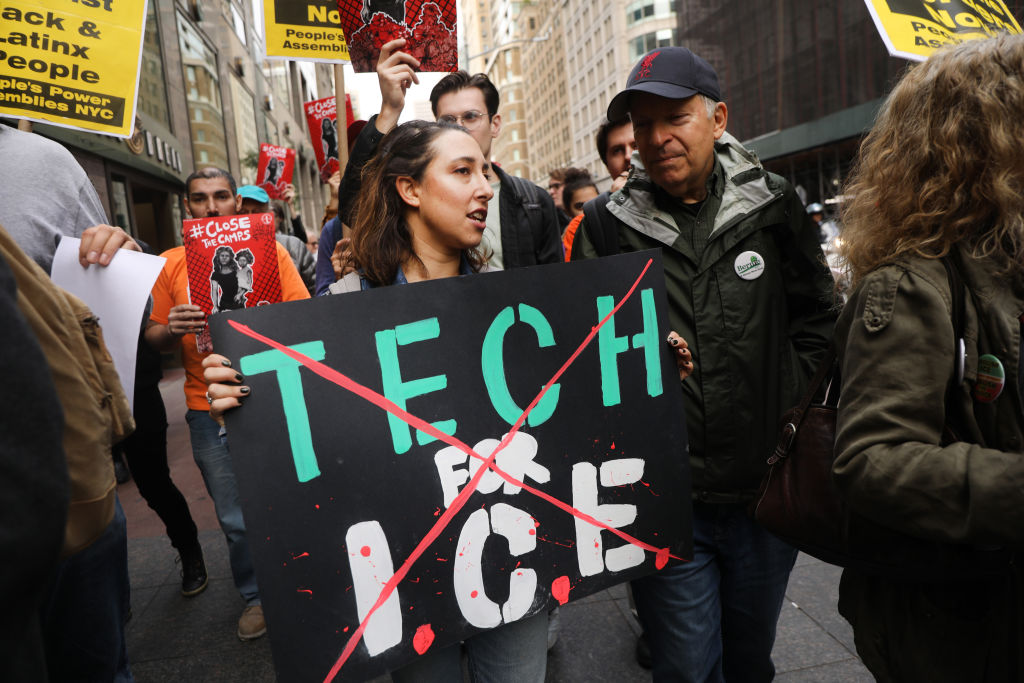
Immigrant rights protesters participate in a demonstration to draw attention to tech companies involvement in the immigration enforcement system on October 11, 2019, in New York City.Spencer Platt / Getty Images

Lawmakers and privacy advocates are demanding answers from the Trump administration about its weaponization of digital tools and popular web platforms to spy on critics and activists. Targets have included a student who attended a pro-Palestine protest and anonymous web users posting about President Donald Trump’s violent immigration crackdown, but the administration’s secret systems of surveillance likely cast a wide net.

Privacy groups are also making demands of Big Tech firms such as Meta and Google, which have come under pressure from Immigration and Customs Enforcement (ICE) to hand over identifying information for anonymous users. Officials from the agency have wielded legally dubious administrative subpoenasmeant to be used to determine duties on imported products — in an attempt to compel the information.

The efforts to expose domestic spying under the Trump administration offer a preview of how Democrats could yield subpoena power next year if voters hand them the House majority in November. Rep. Delia Ramirez, a Democrat from Illinois who was appointed ranking member of the cybersecurity subcommittee of the House Committee on Homeland Security this week, said emerging technologies are being used to violate civil rights and target Trump’s critics.

“The Trump-Miller regime is weaponizing the government and abusing every authority to persecute anyone whom they perceive as an enemy,” Ramirez told Truthout in a text on April 29, referencing Stephen Miller, the anti-immigrant extremist serving as a top adviser to Trump. “And fascism always requires a public enemy.”


ICE Targets Personal Information of Trump Critics

On April 17, attorneys with the Civil Liberties Defense Center filed a motion in federal court to throw out a grand jury subpoena that Reddit received from the Department of Homeland Security (DHS) demanding “extensive private information” about an anonymous user. The user had posted statements critical of ICE and other political content on Reddit, a popular online discussion forum.

Reddit originally received an administrative subpoena from an ICE official in Virginia demanding the user’s personal information, The Intercept first reported earlier this month. The Civil Liberties Defense Center, representing the Reddit user, immediately filed a motion against the summons. Rather than defend the original administrative subpoena in court, ICE switched tactics in early April and demanded that Reddit attorneys appear before a secret grand jury, according to organization’s executive director Lauren Regan.


Trump’s ICE Has Started Targeting Activists, Not Just Immigrants
ICE demanded Meta hand over personal information attached to Instagram accounts that track immigration raids. By Mike Ludwig , Truthout October 1, 2025


“First the government is filing these administrative summonses in hopes that the users won’t know what do to or how to challenge them in court, and as soon as lawyers step in litigating the lawfulness of these subpoenas and summonses, the administration is withdrawing them so there isn’t a court ruling against them in regard to these shenanigans,” Regan said in a recent interview with Truthout.

On April 22, the Electronic Frontier Foundation (EFF) sued DHS for the release of public records detailing the use of administrative subpoenas by ICE to try and unmask the administration’s online critics. So far, what little is publicly known about the practice comes from Regan and other civil liberties attorneys who have defended web users against ICE’s subpoenas.

In at least six cases reported in 2025, ICE claimed users were “doxxing” immigration agents by documenting their activity online, part of a broader crowd-sourcing movement that works to publicly identify masked agents who make violent arrests and alert communities about their presence. Attorneys for the users argue that social media posts and websites such as StopICE.net are protected by the First Amendment.

According to the EFF complaint, the administrative subpoenas are issued under an obscure 1930 tariff law that empowers customs officials to file summonses for “determining liability for customs duties, taxes, fees, and other monetary obligations arising from the importation of merchandise into the United States.”

However, since early 2025, DHS and ICE have issued subpoenas under the 1930 law to web platforms including Google, Meta, Reddit, and Discord demanding names, email addresses, and IP addresses linked to anonymous accounts, the complaint alleges. The lawsuit was filed under the Freedom of Information Act.

EFF Deputy Legal Director Aaron Mackey said DHS should not claim legal authority to unmask online critics and then run away from court when attorneys for the same users challenge the administrative subpoenas.

“We want to know if there has been any internal audit, and if the office of legal counsel has actually looked at any of this and said, ‘yes this is legal,’ and what are the legal reasons,” Mackey said in an interview on April 29.

Targeted via Google After 5 Minutes at a Protest

As a Ph.D. candidate with a British passport studying at Cornell University in upstate New York, Amandla Thomas-Johnson thought he would be “the last person to be hunted down by the immigration authorities.” However, Thomas-Johnson is Black and attended a pro-Palestine protest on campus in October 2024 as pro-Israel groups used a mix of doxxing, public threats, and financial pressure to push university leaders to punish anti-genocide activists as campus protests spread nationwide.

Thomas-Johnson said he spent only five minutes at the protest but was banned from campus shortly after. When Trump returned to office in January 2025, Thomas-Johnson went into hiding at a professor’s rural home. Three months later, after a friend was detained at an airport in Florida and questioned about his whereabouts, Thomas-Johnson self-deported to Canada before fleeing to Switzerland.

“I did not return to the UK as reports that pro-Palestine journalists had been arrested there made me fearful,” Thomas-Johnson wrote in October 2025. “I hoped my arrival in Switzerland would mark the end of my ordeal.”

After a few weeks in Switzerland, Thomas-Johnson received an email from Google informing him that the company had revealed his personal information to DHS. At first, he was not alarmed because an associate, Momodou Taal, had received similar emails from Google and Facebook notifying him that the U.S. government had requested personal information. After Taal challenged the requests — administrative subpoenas likely filed under the 1930 tariff law — law enforcement eventually withdrew them and Taal’s data reportedly remained private.

“This is the standard playbook for authoritarianism I think — intimidation of the people, and making the people live in fear,” Regan said. “Making them think that if they critique the government or have beliefs contrary to the current regime in power, then somewhere they will be threatened and targeted.”

During Trump’s first administration, tech companies routinely fought federal subpoenas on behalf of their users who were targeted for protected speech, according to The Intercept. However, in Thomas-Johnson’s case, Google released personal information to DHS before notifying him and providing time to challenge the request in court.

“My data was handed over without warning — at the request of an administration targeting students engaged in protected political speech,” Thomas-Johnson wrote for EFF on April 14.

For nearly a decade, Google has promised billions of users that it will notify them before disclosing their personal data to law enforcement — and the company has done so many times, according to EFF. On Google’s Privacy & Terms page, the company pledges that, “When we receive a request from a government agency, we send an email to the user account before disclosing information.” However, the group says that promise was broken in Thomas-Johnson’s case.

On April 14, EFF sent complaints on behalf of Thomas-Johnson to the attorneys general of California and New York requesting they investigate Google for deceptive trade practices.

“Google should answer the question: How many other times has it broken its promise to users?” EFF Senior Staff Attorney F. Mario Trujillo said in a statement on April 14. “Advance notice is especially important now, when agencies like ICE are unconstitutionally targeting users for First Amendment-protected activity.”

In an email, a Google spokesperson said all subpoenas undergo a review process designed to protect user privacy while also meeting legal obligations.

“We inform users when their accounts have been subpoenaed, unless under legal order not to or in an exceptional circumstance,” the spokesperson said. “We push back against those that are overbroad, including objecting to some entirely.”

Mackey said EFF is also suing DHS for more information on the practice, but Congress must also provide oversight and accountability. Lawmakers must use their own subpoena power to determine the extent of surveillance under Trump.

Democrats Demand Answers About Israeli Spyware

The lawsuit came as Democrats in Congress continue to press DHS for details about domestic surveillance. ICE’s acting director, Todd Lyons, acknowledged earlier this month that the agency is deploying Israeli spyware that can intercept encrypted messages, as well as advanced data tools that monitor smartphones and social media to enforce Trump’s mass deportation campaign.

The admission came several months after House Democrats Summer Lee (Pennsylvania), Shontel Brown (Ohio), and Yassamin Ansari (Arizona) sent a letter to DHS demanding information on the department’s use of foreign spyware.

The lawmakers had requested information about Graphite, a spyware program produced by the Israeli firm Paragon Solutions that can covertly access encrypted messages, photos, and location data on smart devices. In an April 3 joint statement, the lawmakers said Lyons acknowledged that ICE is using a “specific tool” but did not name Graphite and “failed to provide the documentation and evidence requested by Congress to verify what safeguards, standards, and oversight mechanisms are actually in place.”

“They are moving forward with invasive spyware technology inside the United States, and instead of answering the serious constitutional and civil rights concerns that we raised, DHS is asking the public to accept vague assurances and fear-based justifications,” Representative Lee said.


“We must be clear that giving our rights away won’t ensure our security,” Ramirez said. “That’s why we must — through oversight, policy, and regulation — take away every weapon fascists would wield against us.”

Lee added that the people most at risk — including immigrants, Black and Brown people, journalists, and anyone speaking against the government — deserve more from ICE, an agency with “a long record of overreach and abuse.”

“Constitutional rights do not disappear because this administration wants more surveillance power, and fear tactics cannot be used as a way to sidestep accountability, privacy, and due process,” Lee said, adding that she will continue to fight for transparency.

Transparency may be difficult to achieve while the GOP controls Congress, but Representative Ramirez said more oversight could come if the balance of power changes after the midterms. Ramirez said she is also looking at oversight of consumer technology, such as Meta’s Ray-Ban smart glasses, which have been used to identify and record unsuspecting people in public.

“We must be clear that giving our rights away won’t ensure our security,” Ramirez said. “That’s why we must — through oversight, policy, and regulation — take away every weapon fascists would wield against us.”
Interview

The Unions We Need Will Be Built by Workers, Not Labor Officials


Organizer Daniel Gross explains how to make sure that union building actually works and is sustained over time.
PublishedMay 1, 2026

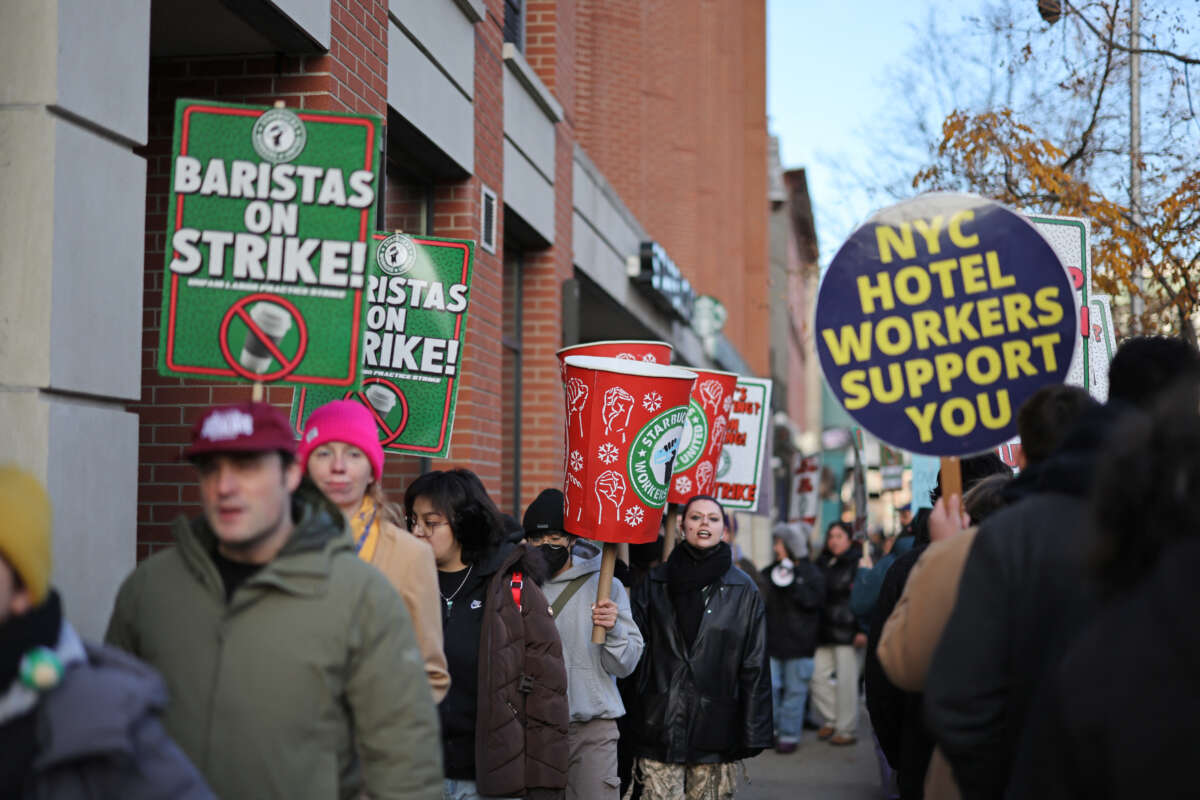
Striking Starbucks workers walk the picket line in New York on December 1, 2025.ANGELA WEISS / AFP via Getty Images

Despite a hostile labor environment, the number of workers under a union contract in the U.S. reached a 16-year high in 2025, and public support for unions hit as high as 71 percent. The labor movement secured a number of impressive victories, including a new contract for dockworkers that raised wages by 60 percent following a brief strike, and unionized journalists at Politico and E&E News (PEN Guild) won an arbitration case against the company’s management over its adoption of artificial intelligence tools. Yet, the far greater union growth and coordinated working-class power that can systemically challenge the agenda of the ruling class remains elusive. In his “State of the U.S. Unions 2026” report, labor movement researcher Eric Dirnbach noted half of all union members live in just seven states, which he referred to as alarming numbers that represent a long-term existential crisis for the labor movement. “The decline of the labor movement,” he writes, “is no doubt one of the factors that have enabled Trumpism to capture the nation.”

In Unions of Our Own, longtime labor organizer Daniel Gross suggests the type of power that can challenge the ruling class may emerge when workers themselves — not union officials — design and refine unions that meet their needs. The new book introduces an accessible step-by-step union model framework to help workers take on the task of building unions that actually work for them, informed by decades of Gross’s own organizing experience — including as a founding member of the Industrial Workers of the World Starbucks Workers Union in 2004 — and countless conversations with other worker-organizers. Bringing together insights that have achieved victories going back over a century, the union model framework is being used by a growing community of workers in diverse industries.

In the conversation that follows, Gross discusses the eight building blocks of unions outlined in Unions of Our Own, the difference between union organizing and union building, solidarity unionism versus traditional unionism, and lessons learned from the era when capitalists and the state repressed solidarity unionism.

This interview has been lightly edited for length and clarity.

Ella Fassler: So, to start, why did you decide to write Unions of Our Own? Was there a gap in the literature about unions you were trying to fill?


The State Is Escalating Charges Against Protesters. Labor Must Defend Them.
John Caravello is facing decades in prison for an anti-ICE protest. He needs labor to build a national defense campaign. By Blanca Missé , Truthout March 11, 2026


Daniel Gross: Yeah, I think two things came together. One, I am just really blessed from the work I’ve gotten to do in my life to connect with a lot of visionary workers that want to do unionism where they work and in their industries. They want to do unionism grounded in racial and gender justice. They’re concerned, in many cases, about capitalism, and they, of course, want to win. And the thing that just comes up again and again are the questions: Can unionism be done in a different way? Can we have our own union? Can our values be deeply embedded in the union, with respect to how we want to be at work, but also regarding how our companies show up in the world?

I’ve been doing this work for a minute and I have learned a bunch. First of all, by failures. My first foray into the labor movement was definitely a swing and a miss at Borders bookstore around 2000. That experience started a journey where I became obsessed with questions like, “What does it take to maximize the chance of victory?” Through my own experience accompanying others, and then really nerding out on a large number of historic and contemporary campaigns, I found that there are these eight building blocks to building and sustaining unions that really deliver needs to workers.

You joke that the book isn’t a beach read meant for entertainment — it’s clearly one that’s geared toward taking action, and the book’s structure, along the lines of those eight building blocks, makes that clear. Can you talk a little bit more about what they are?

Yeah, absolutely. It gets to the second part in the prior question, you know, what’s out there? Of course, you don’t want to duplicate good work already being done. I had many questions during many conversations with workers: “Hey, what resources are you finding out there? What are you not finding out there?” And then, of course, my own observation of what’s going on. There are many really good resource books out there. What I found, though, is that these books are largely about union organizing. They answer the questions: How do we get a structure of co-workers together, carry out a plan, and win our demands?

To kind of put it in simple terms, organizing is the heart of those books.

But really to safeguard and make sure that organizing actually works and is sustained over time — that requires something bigger. In the book, I call that bigger piece union building. That piece is not out there. Union building, for example, involves assessing various mechanisms for holding worker gains. Traditional collective bargaining agreements are considered one mechanism, but there are many others. I think the implicit idea with the union organizing framework has been that considering these types of things are above the pay grade of co-workers on the job. The assumption has been that there are professionals who will worry about that and who make those decisions for them. Unions of Our Own is trying to wrest open those fundamental questions and decision-making spaces for workers.

The other piece: A lot of what’s out there, as good as it is, has the implication that there is one method of organizing, it’s tried and true, and the problem is that we’re just not doing it well enough. We have to train more. We have to be more disciplined. We have to run the recipe all the way. There are good people that promote this. It’s not bad or shady, but I just fundamentally have not seen it to be true that there is a certain method and you can just carry it out like a checklist and then you’ll have your needs met, your vision is going to be expressed in the world, and you’re going to have a sustainable union.

Even with all the great training, initiatives, and ideas and strategies and money being expended, there’s been a 70- to 80-year decline in labor unionism in the United States. Once a certain traditional model of unionism consolidated — we’re talking around 1950 — as the hegemon, to use that big word, unionism has been on decline. If there’s one really, really central belief in the book, it’s actually that co-workers are best positioned to figure out their own successful union models, and they actually have a really unique power to be able to do that well by virtue of being workers.

On the other hand, we’ve seen that starting with a blank slate is not a good idea. It doesn’t work. It doesn’t work because it’s really hard, and if we do it that way, we’re cut off from working-class wisdom that exists today that has come before.


Co-workers are best positioned to figure out their own successful union models, and they actually have a really unique power to be able to do that well by virtue of being workers.

So what the book offers up is neither the cookie-cutter nor the blank-slate approach. It’s saying here’s a framework. The eight blocks of the framework are: constituency, problem, solution, strategy, mechanism, structure, funding, and metrics. The framework is about having the context to know where there’s big decisions you have to make, and helps you test those decisions out.

Yeah, it seems to offer a Middle Way approach, to use a Buddhist analogy, which I think you referenced in the book.

At least I know one reader will appreciate that!

So, as long as I’ve known you, you’ve been an advocate of rank-and-file unionism as opposed to traditional unionism. How do you relate to, or introduce, these different union models in your book? Do you encourage rank-and-file unionism?

Yes, absolutely. So yes, I’m definitely a rank-and-file unionist. That’s been the through line. I got lucky in a way. That’s the tradition I connected in right away from the beginning. The book doesn’t hide the type of unionism I believe in, but I don’t dismiss any union form in the book. Really, what it does is tee up for workers to be able to have that debate, to be able to have that discussion and test out a particular model. What I’m really against is this idea that there are forces not on the shop floor who have taken away that decision-making space.

I say this explicitly in the book: Whatever vision a group of co-workers wants to pursue, they’re going to have my full support and my full respect, but at least they’ll have the ability to weigh their options.

There are many types of unionisms out there. Social movement unionism, community unionism, open-source unionism, class struggle unionism. Every day someone invents a new unionism. What the book is saying is that, yes, there are all those types, but the first decision tree is really between two types: traditional unionism and solidarity unionism.

Traditional unionism will have the hard structural elements of representational type of unionism. It’s the kind of unionism where the goal is around an exclusive collective bargaining agreement with a certain type of provisions that have to do with how the union is funded.

And then solidarity unionism is directly led and operated by workers. It’s not a representational model, and that has really major ramifications. It has a preference for direct action. They both have pros and cons. I get into both in the book.

I think this is going to be one of the more (hopefully) important parts of the book — to really open up that question to workers. Because typically you connect with some resource, or some union connects with you, and all of that decision-making, all that thinking, it’s already been done for them. No one’s like, “Hey, what type of union do you want to form?” They mostly say, “We’re going to organize you into our union.”

Imagine solidarity unionism really does expand in the U.S. What do you think are the most important lessons we could take from the era when it was more prominent in the early 1900s, but was ultimately repressed and co-opted, to ensure we don’t make the same mistakes today?

Solidarity unions need to make these types of unions more sustainable. That’s been the knot on solidarity unionism. The critique is often overplayed, or overstated, and there is a lot of straw-manning of solidarity unionism, but it is also the most important critique of solidarity unionism.

The book is obsessed with sustainability. My argument is that it really takes these eight building blocks working together and working in their own right so we have a union that renews itself. That’s really what sustainability is. It has to renew itself over time. We need unions where we’re creating value by solving yesterday’s injustices, but also where we can expect value for each other in the future. How we hold our gains, and how we tie those things to membership experience is a key part.

The other part, which I get into the book as well, is the question of repression. The reality is that solidarity unionism was taken down partially from outright murder, kidnapping, imprisonment, deportation, and destruction of materials, records, and literature. I try to use the most concrete language possible to just wake us up. It is very, very, very devastating. What I found, sadly, while looking at labor trends in many countries around the world, is that there’s still assassination, kidnapping, and violence and threats against families today. Colombia is a standout.

So I think we need to try to preempt these forms of repression. One of the ways to preempt it is really to think about the first element of the model I get into called constituency. How do we think about the different segments of society, the different groups, different individuals that we bring together into our models, our unions? That connectedness to other groups can make a union harder to repress. It is important to have explicit preemptive strategies against repression.

And then, of course, you need strategies for active defense and responsiveness to repression because you’re not going to be able to preempt it all.

It can be hard to feel hopeful about labor organizing with that horrifying history, and grim ongoing reality for many workers, in mind. I saw you were described as a very “optimistic” organizer in a blurb about Unions of Our Own. So, I’m wondering, what are the most hopeful labor movement trends that you’re seeing right now?

Yeah, I laugh at that “optimistic” part because a lot of people say that to me. I am a pretty optimistic person. I guess that’s a compliment. I don’t know about that. I think what I’m endlessly hopeful about is the quest for freedom and the desire for freedom and dignity.

But to get to your question more specifically, I am optimistic about the labor movement. Definitely in recent years, the turn to unionism, as I mentioned in the book, has been absolutely undeniable. There is motion in the working class in the U.S. Every month there’s a new group of workers that have always been exploited getting organized. Just in my personal trajectory, I can tell you, it’s like living on a different planet. I’m from the generation when there was one labor reporter at a large national publication. There was one dude! Now, thankfully, I can’t get through the amount of excellent labor reporting that takes place in any given week.


Every month there’s a new group of workers that have always been exploited getting organized.

Then there’s the big but, right? The big but is that the vast, vast majority of us are still screwed at work and are mostly unorganized as a working class. And that means we are screwed in society. We have the oligarch theft of a pretty unfathomable proportion of resources and power and water and land. So, with all this motion, this commendable, undeniable motion, we still have not seen that growth in unionism and working-class power that one would want to see.

It is a great honor to try to bring something into the mix that actually says the wisdom, the answers and the journey to test and refine those answers, comes from folks employed together on the shop floor. The more we can be clear about that, the more we could take down the myth that a lawyer or professionals are going to be the ones that can get you out of the predicament. The more we can challenge that notion, the better.

Beautifully said. Thank you so much for your time, and for your commitment to struggle. As we wrap up, where can people find you and Unions of Our Own?

From the book’s website, folks can purchase the book, access ready-to-use tools for free, register for companion trainings, and even get confidential one-on-one support to deal with problems at work. They can also follow me on Bluesky.


This article is licensed under Creative Commons (CC BY-NC-ND 4.0), and you are free to share and republish under the terms of the license.


Ella Fassler

Ella Fassler is an independent journalist based in Providence, Rhode Island. Their work on social movements, labor, technology and the carceral system has been featured in Teen Vogue, The Boston Globe, The Nation, Vice, The Appeal, Slate, Mic, In These Times, and elsewhere. Follow them on Twitter or Bluesky.


Palestinians Observe May Day Amid a Deepening Crisis for Workers

Years of war and genocide have devastated our labor market and living standards.

May 1, 2026

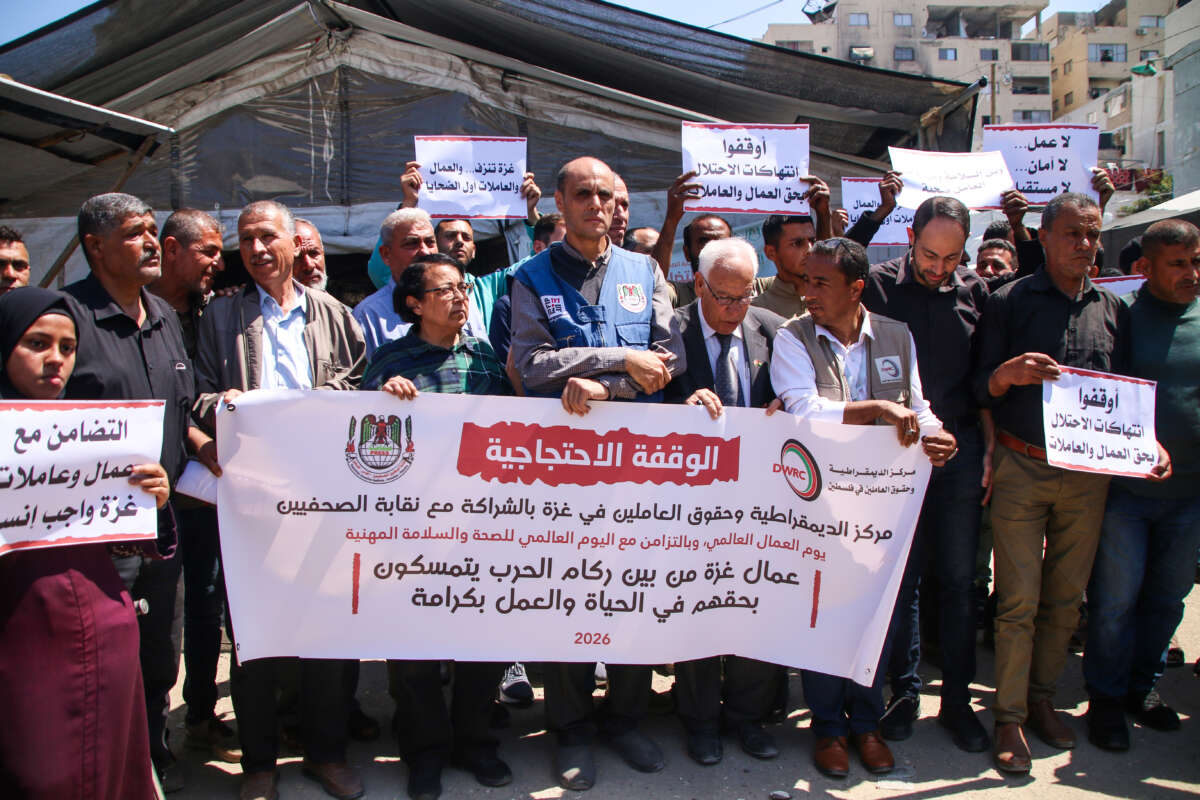
Palestinian workers demonstrate during a vigil held in tribute to Gaza's workers on April 30, 2026 in Gaza City, Gaza.
Ahmad Hasaballah / Getty Images

As workers around the world celebrate and recognize their efforts on May 1 — known globally as May Day or International Workers’ Day and celebrated in Palestine as Labor Day — this day passes in Palestine under a harsh economic reality that reflects a deepening crisis in the labor market and unprecedented levels of unemployment.

According to data from the Palestinian Central Bureau of Statistics, the unemployment rate in Palestine stands at around 27.5 percent, while it rises sharply among young people to nearly 40 percent, meaning that roughly one in every three young people is unable to find a job. In the Gaza Strip, estimates indicate that unemployment has reached alarming levels of around 78 percent, amid a widespread collapse in economic sectors and the halt of many productive activities.

In this context, Labor Day this year is not an occasion of celebration, but a moment that reflects the scale of the challenges facing Palestinian workers — the loss of job opportunities, declining incomes, and increasing living pressures that weigh heavily on families across different regions.

Behind these numbers, the crisis of the labor market in Palestine is reflected in daily lives of Palestinians — graduates searching for their first job opportunity, workers who have lost their sources of income, and employees facing the loss of the economic stability that once formed the foundation of their lives.

Unprecedented Challenges Facing the Palestinian Labor Market

A Ministry of Labor official explained that the Palestinian labor market faces unprecedented challenges due to severe economic deterioration and a declining ability to create new job opportunities amid the widespread closure of productive sectors and damage to many economic facilities. He noted that unemployment rates have risen significantly in recent periods, especially among young people and recent graduates, leading thousands of graduates to enter the labor market without sufficient available opportunities.


He added that the ministry is working within limited capacities to implement temporary employment programs and expand vocational training, along with efforts to support small- and medium-sized enterprises as one of the possible solutions to ease the crisis. However, these efforts remain insufficient in the face of the scale of the current crisis.

He further emphasized that the continuation of the current economic situation is increasing pressure on the labor market and pushing young people toward alternative or unstable forms of employment at a time when the Palestinian economy requires broader interventions and long-term measures to revive affected sectors.


Engineering Graduate in Gaza: Postponed Dreams Amid a Shrinking Labor Market

Ayman Abu Salama, a 28-year-old top engineering graduate from the Islamic University of Gaza, is one of many graduates who have been confronted with a reality very different from their post-graduation expectations. He said that one of his main goals since starting university was to secure a job in his field and build a stable professional future after years of study and effort, but the reality after graduation was far more difficult than expected. “I’ve applied to dozens of jobs, but I haven’t received any real response so far,” Abu Salama said. “I feel stuck in the same place, despite all the effort I put into my studies.”

He added that the recent war and the widespread destruction of infrastructure and facilities in the Gaza Strip have led to a significant decline in job opportunities, especially in engineering and construction-related fields, as many engineering institutions and offices were either destroyed or forced to shut down, sharply reducing employment prospects for new graduates.

Abu Salama said that he is still searching for a job without success, despite submitting numerous applications. He noted his frustration when he sees peers in other countries who graduated at the same time managing to enter the labor market and build their professional lives, while he remains stuck at the stage of searching for a first opportunity.

He said this reality affects him not only financially but also leaves a deep psychological impact on young people like him who have spent years in academic preparation, only to find themselves facing a closed labor market and extremely limited opportunities. “Sometimes I lose hope, but I keep trying because I have no other choice,” Abu Salama said.

A Goldsmith Who Lost His Home and Workshop After 25 Years of Work

Ghassan Abu Zayed, a goldsmith and workshop owner, lost his source of income and his home as a result of shelling. He is also my father. He began working in this field after returning from Iraq, where he learned the craft of goldsmithing, and later established his own workshop about 25 years ago.

Over the years, he equipped a fully functioning workshop with specialized machinery, some of which was imported from abroad, and produced various types of jewelry such as bracelets, necklaces, and rings. The workshop served as his primary source of income for many years.

His home and workshop were hit during recent Israeli bombings, turning the entire place into rubble along with all the equipment and tools used for his work.

“I worked in this profession for more than 20 years, and everything I built was gone in a moment,” he said. “It’s not just a financial loss — it’s the loss of a lifetime of hard work.”

My father said this destruction led to a complete halt of his profession of more than two decades, and he is no longer able to continue working in the same field due to the loss of equipment and the difficulty of rebuilding the workshop.

He pointed out that this is the reality for numerous professionals and small business owners in Palestine, many of whom have lost their workplaces and sources of income over the past years of war and genocide, directly affecting the labor market and living standards.

“Rebuilding is not easy, especially under the current conditions … starting from scratch feels impossible,” he said.

Labor Day in Palestine Is No Cause for Celebration This Year

Between official figures reflecting rising unemployment rates and individual stories documenting the loss of jobs and income sources, this year’s Labor Day comes in a very different context in Palestine. Rather than being a celebration of work and achievement, it reveals the difficult economic reality experienced by workers, graduates, and professionals alike.

The testimonies of those I spoke to highlight the scale of challenges facing the labor market — whether through limited opportunities, damaged projects, or the suspension of economic activities — making it harder than ever for Palestinians to find a job or stay employed.

While efforts to adapt to this reality continue, the future of work in Palestine and the ability of young people and workers to secure stable opportunities remains a question without an answer.


This article is licensed under Creative Commons (CC BY-NC-ND 4.0), and you are free to share and republish under the terms of the license.


Eman Abu Zayed
Eman Abu Zayed is a writer and journalist from Gaza who believes in the power of words to change reality
.

May 1, 2026: The Venezuelan working class at a historic crossroads


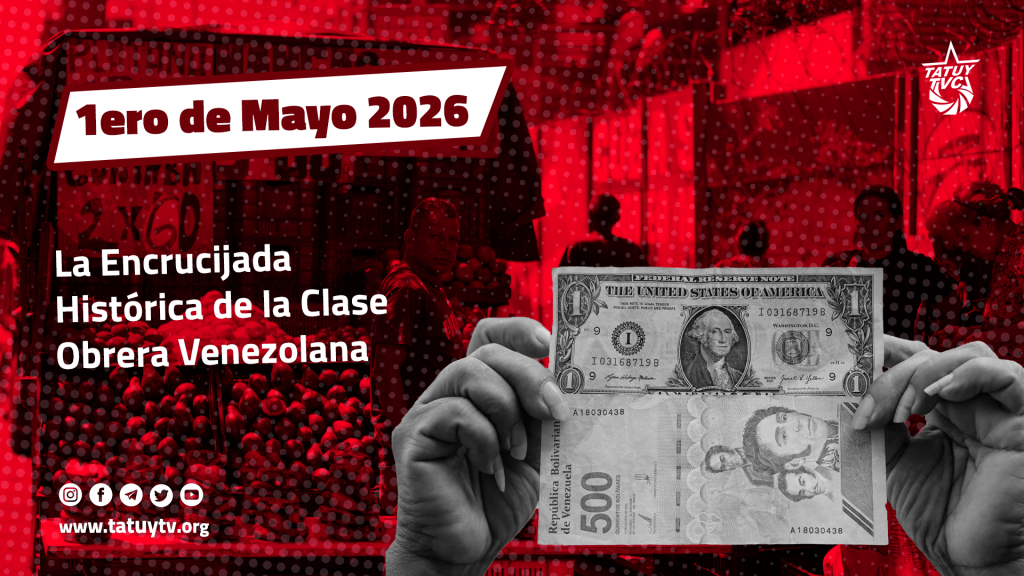
TauyTV graphic

First published in Spanish at TatuyTV. Translation by LINKS International Journal of Socialist Renewal.

As we approach another International Workers’ Day, Venezuela finds itself amid one of the most decisive political and economic junctures in its contemporary history. Recognising that media is not a sterile exercise, but a factory producing ammunition for the battle of ideas, we are initiating a crucial debate on the minimum wage in Venezuela in 2026. Our analysis goes beyond the mere expectation of an isolated presidential announcement.

Today, the wage issue has become the epicentre of a structural struggle over the model of society we defend in the face of imperial siege and deep internal contradictions. In this article, we examine the real threats facing the Venezuelan working class — from US tutelage over energy geopolitics to the state’s silent reconfiguration — to provide grassroots activists with solid arguments in this non-negotiable struggle for life and dignity.

The LOTTT: A historic achievement under imperial siege

To understand the scale of the minimum wage crisis in Venezuela, it is essential to draw on historical memory. Working people experienced a highpoint in the struggle for their rights when, on April 30, 2012, Commandante Hugo Chávez enacted the Organic Law on Labour and Workers (LOTTT).

This legal instrument represented a historic safeguard: it restored the retroactive calculation of retirement/redundancy payouts, established job security as a principle, and built a powerful legal bulwark against outsourcing and precarious employment. The LOTTT was, in essence, a legal expression of the socialist ideal of the Bolivarian Revolution, ensuring that labour was recognised as a social fact and not a commodity subject to the savage laws of capital.

However, this emancipatory project was the target of a fierce onslaught by imperialism. Barely five years later, on August 24, 2017, the first economic sanctions imposed by Washington marked a tragic turning point. Designed with surgical precision against PDVSA [the state oil company] and the national financial system, these measures deliberately sought to strangle the republic’s revenues, with a direct impact on people’s purchasing power, at a time when the nation was already suffering a severe recession as a result of falling oil prices.

The blockade is not a metaphor: it is an act of economic warfare that resulted in estimated annual losses of more than US$25 billion and the confiscation of international assets worth more than $30 billion — resources that could have been channelled into social welfare and decent wages.

The blockade’s devastating impact on workers

The financial siege imposed since 2017 not only shattered the country’s macroeconomic equilibrium, it triggered a hyperinflationary cycle that ultimately wiped out the value of the minimum wage. By 2019, year-on-year inflation exceeded 300,000%, according to official figures, destroying a decade of progress in income distribution.

The working class’ purchasing power collapsed. If in 2012 a minimum wage could cover the basic food costs of three households, by the end of the hyperinflationary cycle that same wage was not enough to cover even 1% of the food that a typical family of five needed. The sanctions made no distinction between political activists and the civilian population; they penalised the entire nation, plunging Venezuela’s historic working class into an unprecedented crisis of survival in peacetime.

Internal blows: The dismantling of labour rights

If external aggression is the starting point for understanding Venezuela’s reality, the next step is turning our attention to the government’s response. Faced with this economic siege, the executive’s response was to liberalise, yielding more and more to the demands of capital.

In the labour sphere, this entailed a progressive erosion of rights and safeguards. On August 20, 2018, the so-called Programme for Economic Recovery, Growth and Prosperity brought with it currency devaluation and a de facto relaxation of controls, severely impacting the labour ecosystem.

One of the most insidious and lethal blows to institutionalised protections was Memorandum 2792, issued on October 11, 2018. This ministerial document, which had no force of law, served to flatten pay scales in the public administration and overrode vital clauses in collective agreements signed over many years. This memorandum was the first direct blow to the heart of collective bargaining. The measure was strongly rejected by the trade union movement.

Subsequently, the offensive against public sector pay intensified on March 22, 2022 with the ONAPRE Directive, which cut bonuses, eliminated historic compensation and sparked the most intense street protests in recent times, led by educators and healthcare workers.

In parallel with making working conditions more precarious, the government established control of inflation as an absolute priority. One of the tools it used was to freeze the minimum wage. Set at 130 bolivars a month since March 15, 2022 — equivalent to at the time — it is now a purely symbolic figure, completely eroded by devaluation [and equivalent to $0.27].

The bonus trap: Subsistence with no future

Faced with a declining minimum wage, the government adopted a compensation strategy that generates deep scepticism among organised workers: bonuses. Denounced by Chávez as a recurring policy of the Fourth Republic, bonuses [non-salary compensations] reduce costs for employers, erode labour liabilities, and facilitate redundancies.

Ahead of an expected May 1 announcement, workers fear a repeat of the policy introduced in 2023: indexation of variable bonuses through the Patria System, without touching the statutory minimum wage. The acting president and other spokespeople have sought to lower expectations, insisting that wage increases must be “responsible”.

This bonuses policy amounts, in practice, to the hollowing out of labour rights. Although it allows for immediate survival, it has no bearing whatsoever on the calculation of holiday pay, benefits and long service, or severance pay. More critically, and perversely, it wipes out a lifetime’s savings by not contributing to retirement payouts, as severance pay is calculated based on the final salary, condemning the worker to a retirement without assets. It is the philosophy of day-to-day survival, a trap that robs the working class of its future and hides behind the technical justification of “not fuelling inflation”.

The situation regarding pensions is even more dire. The elderly population receives even less in bonuses than public sector workers.

Expectations regarding a new minimum wage in Venezuela for 2026 will put the macroeconomic reality to the test. Despite five consecutive years of growth, Venezuela’s current GDP stands at about 36% of the 2012 figure. However, demands are fuelled by optimistic forecasts, realistic or otherwise, regarding the country’s future.

However, the current context of US semi-colonial tutelage is a major obstacle. The government does not directly manage oil revenues, the economy’s main source of foreign exchange, leaving it at the mercy of the Trump administration’s whims to access (part of) its own resources. US officials have arrogantly stated that the Venezuelan government must submit a budget proposal for approval before funds are released.

Another spectre looming large is the International Monetary Fund (IMF), with its “recommendations” for fiscal discipline. Although the Venezuelan government has stated that there are currently no plans to take on debt, it is possible that external debt could pave the way for a future of debt and structural adjustments. For all these reasons, it is likely that Delcy Rodríguez’s government will adopt a conservative stance in the face of the increasingly widespread demands for wage rises.

The state’s restructuring: modernisation or silent dismantling?

Alongside job insecurity, an enigmatic “modernisation of the state” is currently underway. Strategic, albeit unofficial, information confirms a thorough purge of the public administration’s payrolls through the Patria System and ONAPRE, under the formal pretext of eliminating duplicate positions and conducting attendance audits.

However, the underlying political interpretation is far harsher: we are facing an imminent and silent structural reduction of the state apparatus. In parallel with the commission assessing the “strategic” value of state assets, the trend towards shrinking the state is clear. One scenario is the creation of a bureaucratic elite with privileged salaries to sustain the various institutions, casting hundreds of thousands of workers into the unprotected ranks of casual labour, the informal sector and the transnational subsistence economy.

At the same time, a commission has been set up to draft up a reform of the labour law and the pension system.

Proposals for the minimum wage: The battle over figures

The class struggle is being waged on several fronts, from the streets to the tripartite negotiating tables. The fundamental demands of the trade union rank-and-file are non-negotiable:

  • Full restoration of rights: A radical minimum wage rise and the total and immediate conversion of bonuses into wages.
  • Scientific indexation: A wage indexed to the real household costs, currently estimated by Cendas-FVM at more than $530 a month for a family.
  • Dismantling of illegal measures: Complete repeal of Memorandum 2792 and the ONAPRE Directive.
  • Freedom of association: Release workers and trade union leaders detained for peaceful protest.
  • Collective bargaining: The immediate resumption of negotiations on fair collective agreements, preserving the historic achievements of the LOTTT at all costs.

In quantitative terms, the differences highlight the tension between street-level realism and technical adjustments:

  • Trade union sectors: The Bolivarian Socialist Workers’ Confederation (CSBT, pro-government) is proposing quarterly increases of $50. The Confederation of Workers of Venezuela (CTV, centre-right) is demanding an initial $200, rising to $450. The Federation of University Professor Associations of Venezuela (FAPUV) is requesting a base pay of $300 plus indexation. The Independent Trade Union Alliance (ASI, Christian Social) estimates its minimum at $377.
  • Liberal economists: Spokespersons such as Luis Oliveros and José Guerra, representatives of orthodox austerity thinking, propose amounts of just $100 and $150, figures completely disconnected from the dollarisation of the popular economy and more in line with employers’ need to contain labour costs.

The capitalists demand flexibility

While various labour organisations demand dignity and fair wages, the business sector, represented by trade associations such as Fedecámaras and Conindustria, is seizing the opportunity and “tripartite dialogue” (state, trade unions and business) to sink its claws into protective legislation. Taking advantage of the weakness of incomes, their aims are clear and directly undermine the doctrine of social justice that characterised the original Chavismo:

  • Abolition of retroactive calculations: Elimination or drastic reduction of the retroactive application of social benefits, seeking a simple payment system that liquidates accumulated labour liabilities.
  • Make it easier to sack workers: Complete dismantling of job security to facilitate low-cost mass redundancies, allowing staff turnover without fair compensation.
  • Dismantling of historical calculation: Comprehensive review of the pension system to eliminate historic pension calculation mechanisms, replacing them with capitalisation schemes or universal minimum amounts.

Conclusion: A May Day of struggle and dignity

This May 1 is not a date for empty applause or for the complacency of bureaucracies disconnected from reality. The Venezuelan working class, which stoically resisted the onslaught of the United States’ illegal sanctions, cannot be sacrificed once again, this time on the altar of “macroeconomic stabilisation” or the internal re-engineering of the capitalist state under imperialist tutelage.

Unconditional defence of the LOTTT is the indispensable starting point for any project of national recovery with a human face. Wages are not a variable in spreadsheets to be optimised in the face of monetarist conceptions of inflation. They are a materialisation of the social debt owed by the state and capital to those who actually produce wealth. Precarious employment is not an inevitable fate. We demand indexation, back pay and full respect for the history of workers’ struggle. In the face of transnational capital and our own mistakes, there must be but one slogan: not one step back.


‘Fighting for a wage rise is also an act of resistance against imperial tutelage’: Interview with Venezuelan retired oil worker’s leader Denis Ospino


Denis Ospino

Retired oil worker Denis Ospino was a prominent part of the revolutionary resistance against the 2002–03 management lockout at Venezuela's state oil company, PDVSA. She was crucial to restoring and stabilising oil production, playing an active role in protecting the Western Oil Production Directorate headquarters, and as part of the civilian and reserve unit defending operational facilities on Lake Maracaibo’s eastern shore. A staunch defender of oil workers’ rights, she is an executive committee member of the Autonomous and Independent Workers’ Committee (CAIT).

Speaking with Federico Fuentes for LINKS International Journal of Socialist Renewal, Ospino discusses the situation for Venezuelan workers, the regime of “tutelage” imposed by US President Donald Trump after January 3, the economic measures announced by Acting President Delcy Rodríguez, the growing wave of trade union protests since February, and the importance of anti-imperialist international solidarity with the Venezuelan people.

Rodríguez’s 8 April announcement that there would be a “responsible” wage rise was met with derision by many workers and trade unions. Could you describe the situation facing Venezuelan workers? Why is the issue of wages so important?

It is important to note that the economic sanctions imposed on Venezuela since 2017 are still in place, despite United States President Donald Trump imposing control mechanisms over our economy and the country’s reintegration into the US’ geopolitical orbit. These sanctions have profoundly impacted working people, undermining the Constitution and the Organic Law on Labour and Workers (LOTTT). This led to a significant reduction in the value of formal employment, which is now seen more as a burden than a means to obtain a dignified livelihood. This situation forced millions of Venezuelans to seek opportunities abroad or resort to informal activities to survive.

Now more than half of the workforce is in the informal sector, and the minimum wage is among the world’s lowest. We have gone four years without a minimum wage rise, which has remained stagnant at 130 bolivars a month (about US$0.27) since 2022. Meanwhile basic food costs for a family are between $500–700 a month. The comprehensive minimum income in Venezuela consists mainly of bonos [non-salary benefits, known as bonuses], which are adjusted according to the value of the BCV [Central Bank of Venezuela] dollar, and amounted to $190 a month for formal sector workers in early 2026. But those who live off bonuses — that is, workers and pensioners — face a complex reality: not only do prices fluctuate upwards from one day to the next, but they are often marked in dollars and even euros while we are paid in bolivars. This market chaos ultimately devours any “responsible increase” in the minimum wage.

The first thing the government must do, if it wants to act responsibly, is stop this dollar-induced economic chaos and fix prices. The Commission for Labour Dialogue and Social Security, also announced on April 8, must also address inflation, so that wage rises are not rendered meaningless. Also, any minimum wage rise must be real and not symbolic. It must boost benefits, holiday pay and pensions, and serve as a basis to adjust upwards workers’ pay scales covered by collective agreements.

What is the prevailing mood among workers and trade unions after the imperialist attack on January 3?

It is more than three months since the military aggression against Venezuela and the start of Delcy Rodríguez’s interim government. Workers are in a state of uncertainty because the country’s revenue and finances depend on the US. Venezuela is 90% dependent on oil revenues. Simply opening up the oil sector is not enough for workers, we must understand the terms of this opening, which is being controlled by the Trump administration, where transnational corporations will control oil production, and where PDVSA’s role is scaled back. Ever since the bombardment, our energy sovereignty has been ceded. We have entered a political and economic phase that is worse than that of the Fourth Republic [before the election of Hugo Chávez in 1999].

Oil workers believe this situation will benefit them, but as they see the US’s intentions, they view their employment future with concern. Will outsourcing return? Will they lose their collective agreement? Will they become employees of transnational corporations, and under what conditions? What will become of PDVSA? Even retired oil workers are worried their pension fund will disappear. In a country under the tutelage of a capitalist power, nothing is sustainable or secure.

How do you view the relationship between Venezuela and US imperialism after January 3?

US government representative Chris Wright, during his visit to Venezuela, said that since the arrest of Venezuelan President Nicolás Maduro on January 3, at least 150 million barrels of Venezuelan oil have been sold on the global market. This was according to the US newspaper Nuevo Herald. The US sold this Venezuelan crude at an average price of $60.48 a barrel during the first quarter. The sale of this oil would therefore amount to about $9.070 billion in gross revenue. But Venezuela has only received $500 million.

At a recent press conference, Trump clearly outlined the nature of his administration’s relationship with Venezuela and the future of our strategic resources. He said: “The relationship’s been great. We’ve taken out 100 million barrels of oil already… We paid for the war many times over, and we’re going to be running the oil.” This confirms imperialism’s intention to appropriate oil sale proceeds.

Given the return of the World Bank and the International Monetary Fund (IMF) to the country, along with other announced economic measures, is there a strategic shift in the government’s economic policy?

Economic plans are not neutral; they are tools to determine which sectors, social groups or economic interests will receive state support. Rodríguez’s recent announcements show a revealing shift in Venezuela's economic direction. The economic opening up initiated with the 2018 recovery plan is being expanded. This shift aims to attract foreign capital via a new free-market economic architecture and legal guarantees for capital, with the absolute priority being Venezuela’s reintegration into international financial markets.

Following the military aggression against our country and Maduro’s kidnapping, there has been a complete U-turn in the nation’s foreign and economic policy. New foreign investment and strategic agreements with Chevron to increase oil production have been announced, facilitated by legal reforms to encourage greater domestic and foreign investment. Also, the World Bank and the IMF have resumed their relations with the Venezuelan government. This is against the backdrop of an emerging new financial architecture, driven by reforms in the oil and mining sectors and a restricted and conditional lifting of financial sanctions. Despite the easing, the sanctions have not been completely lifted. Restrictions remain on oil operations and relations with certain sanctioned countries. Commercial transactions with the Venezuelan government also require prior authorisation from Washington.

Nevertheless, the IMF’s return brings the debt issue to the fore. Venezuela has a recognised debt of about $170 billion. Of this, $150 billion is owed to international organisations, while $19 billion is bilateral loans from China and Russia. A particularly sensitive issue is the $60 billion in PDVSA sovereign bonds, which defaulted at the end of 2017. The scale of the debt represents 193% of Venezuela’s gross domestic product, according to the latest available figures. A return to the IMF inevitably involves “refinancing debt” and also reaching agreements with other development banks and creditor nations. By expanding international oil companies’ operations, Venezuela will have greater resources to pay interest and debt.

What can you tell us about some of the other measures taken to date, such as the Amnesty Law and the forthcoming “responsible” pay rise, which you already mentioned?

The government signalled its willingness to politically open up through the Amnesty Law, appointing a new Attorney General and Ombudsman, initiating a process to renew Supreme Court of Justice (TSJ) authorities and resuming dialogue with the democratic opposition. The aim has been to pass reforms to the hydrocarbons and mining laws and agree on 29 laws and eight new codes covering various areas, including criminal, civil, economic, environmental and electoral law. This is a managed reconfiguration of the political chessboard. Alongside the government’s ongoing control over essential institutions, Rodríguez seeks political cohabitation with the opposition in the National Assembly. Her aim is forming a power bloc in which the interests of the capitalist class predominates, ahead of the upcoming presidential elections.

The announced wage rise is also concerning. It marks a definitive break with the policy of decreed wage rises, insofar as it aligns with broader shifts in economic policy that seek to undermine labour rights, as part of the worldwide attack by the capitalist class against workers. According to Rodríguez, wage rises must be “responsible”; that is, they are conditional on economic sustainability, inflation and sufficient profits. This approach erodes the constitutional right to a dignified wage. It is not being enacted under traditional state direction, but as part of the shift towards prioritising economic liberalisation and foreign investment. The new wage policy, alongside the oil royalties cut in the Hydrocarbons Law reform, is part of the state’s adaptation to forms of capitalist accumulation that are dependent on imperialism. Analysts estimate that direct tax revenues could fall by up to $7.445 billion

Finally, the announced Commission for Labour Dialogue, which seeks to adapt the legal framework to the new economic realities through tripartite dialogue, aims to secure agreement on a new model of social protections and improved working conditions. Business leaders, government and opposition MPs, and senior government officials all agree with this approach. So too does [far-right opposition leader] María Corina Machado. For all of them, a living wage must be the result of economic growth, private investment and the regular functioning of the labour market. All agree on reforming the labour law as the means of improving wages.

What does all this tell us about the nature of Rodríguez’s government?

It is important to clarify certain aspects: the January 3 military aggression carried out by Trump against our sovereignty marked a new phase of direct interventions in Latin America, within the context of Trump’s National Security Strategy presented in early December. It aims to align all regional governments with Washington’s interests, offering cooperation in return, or otherwise face economic, political or military pressure.

Without oversimplifying, we must recognise the different stages of the political process in Venezuela. During Chávez’s government, there was a notable rise in political and social participation of historically marginalised groups, which created spaces for popular participation and the expansion of social rights. However, after Chavismo — now under Maduro — lost its parliamentary majority in 2015, there was a steady process of democratic deterioration. The TSJ’s intervened to limit and nullify the opposition’s legislative power through various rulings, marking the start of absolute political control that undermined the 1999 Constitution. This period featured strong authoritarianism, with the concentration of power, erosion of institutions and the criminalisation of labour protests.

Post January 3, with Rodríguez in office now for more than 100 days, Trump has imposed a subordinate regime, which can be described as “tutelage” under Washington’s supervision. This control is evident in oil revenue management, with oil sale proceeds deposited into special accounts controlled by the US rather than into PDVSA’s accounts. Thus, the government faces a paradox: it needs the “economic freedoms” offered by the US to survive, but these freedoms aim to weaken its political control in the long term, steering it away from the Bolivarian agenda.

What position has the CAIT taken?

Faced with this economic and political reconfiguration, the Autonomous and Independent Workers’ Committee believes we urgently need broad unity to combat the policy of converting wages into bonuses. We firmly state: “Wages yes! Bonuses no!” As trade unionists, we understand that a minimum wage rise will have a direct and significant impact on collective agreements and pay scales.

On unity, we issued a call to the Bolivarian Socialist Workers’ Confederation (CSBT), who have said they will defend workers’ redundancy/retirement pay outs and oppose changes to the labour law. We said to them we must agree on a common agenda and take these proposals to the Commission for Labour Dialogue, alongside maintaining our street demonstrations. Trade unions remain an essential pillar in defending labour rights, despite the difficulties they face.

Demanding a pay rise is not merely an economic demand; it is an act of resistance against the government’s anti-labour policies and also against imperialist tutelage. Demanding “Wages yes, bonuses no” means denouncing the US Treasury Department, through the Office of Foreign Assets Control (OFAC), confiscating proceeds from Venezuela’s crude oil sales. It means demanding the total and unconditional lifting of all sanctions.

We must promote spaces to come together and debate, which unite different sectors in defence of sovereignty, independence, democracy and the Bolivarian Constitution. Reversing the loss of sovereignty is, above all, a political task that requires strengthening internal capacities, sustained mobilisations of the people and constantly confronting the US government as it attempts to impose control. In this context, the failure of senior government officials to condemn imperialism and its aggressions in their speeches and positions since 3 January is concerning.

What is the current state of the trade union movement?

Venezuela’s trade union movement faces a serious crisis. It is fragmented and dispersed, with more than 50% of the workforce in the informal sector. Job insecurity particularly affects young people, who lack knowledge of labour laws or a trade union culture. The collapse of labour relations and absence of collective bargaining has hindered progress on wages and labour rights. Mass migration has also weakened trade union organisations, as many members and leaders have left the country. However, trade unionism remains vital to defending labour rights, as shown by the recent mobilisations.

What was the significance and political orientation of these protests?

These demonstrations are significant, but they have not brought together all workers. Various national trade union coalitions, together with the Intergremial, the CTV [Confederation of Venezuelan Workers] and other sectors such as university lecturers and public sector workers, submitted a national list of demands to the labour ministry in February. This document demanded drastic wage rises and respect for labour rights after years of wage freezes.

On March 12, hundreds of workers and retirees from the education, university and health sectors, as well as pensioners, marched in cities across Venezuela. They are the hardest hit by the current situation. In Venezuela, there are disparities in allocating bonuses and wages. This policy is discriminatory because workers’ needs are the same. As for pensioners, they only receive a “war bonus,” which is half of what workers get, and no food allowance. This means pensions are as low as $60 a month.

The April 9 demonstration was organised by the National Trade Union Coalition to march towards Miraflores [the presidential palace]. The coalition’s politics align with Machado’s electoral agenda, with the march demanding “Elections now.” Historically, the Venezuelan opposition have believed that a mass march reaching Miraflores is enough to force a president to resign. The choice for the final destination showed it was about seeking to force political change. For working people, marches on Miraflores stir memories of the coup attempt on April 11, 2002, against Chávez.

Some right-wing trade unions and political parties also organised a march to the US Embassy to demand a pay rise there…

Yes. A protest was called for April 16 to march on the US Embassy. This march was not strictly a labour protest, as it was accompanied by slogans such as “Mr Trump, complete the transition now” and calls for elections. The delegation, however, was not received by a high-level diplomatic staff. Despite a small turnout, it had a notable impact on social media, with extensive live coverage. They have also called for a demonstration on April 30 to mark May Day, again with the aim of ending at Miraflores. They are not seeking to reclaim the labour rights we have lost, but to capitalise on existing discontent and channel it in Machado’s political interests.

But we already know how this story ends. In 2019, Juan Guaidó’s proclamation as “interim president” attracted many groups of workers, who abandoned their autonomous and independent struggle for better wages and against Memorandum 2792 and the criminalisation of labour protests. A similar situation occurred in 2023, when educators mobilised for their demands, only for many of the union’s leaders to then focus on the opposition’s primaries, which were won by Machado’s candidate, Edmundo González Urrutia.

How can leftists and trade unionists demonstrate anti-imperialist solidarity with Venezuelan workers’ struggles today?

On international solidarity, we must explain that, after the events in Venezuela, Trump is gambling on exporting this model of intervention, with bombings and assassinations, to impose control on other nations. This aggressive strategy involves, in particular, tightening economic pressure and direct military intervention in Latin America. Following the attack on our country, the US began confronting Iran. At the same time, on March 7, Trump summoned 12 Latin American presidents to Miami to reorganise “hemispheric security” through a political-military alliance with allies in his “backyard”. This strategy forms part of the US National Security Strategy’s plan for domination, which redirects military spending towards preparations for a “world war”. This makes total control of the Western Hemisphere essential. Against this, the working people and the social and political organisations of Latin America must unite around an anti-imperialist agenda.

At the same time, millions in the US have protested against Trump, particularly in the huge “No Kings” marches in March, expressing a profound rejection of authoritarianism, harsh immigration policies and unilateral actions. More than 8 million people demonstrated out of concern for democracy, the rising cost of living and war. The crisis of capitalism is affecting all the peoples of the region, and those countries around the world with mineral, energy and rare earth resources. It is essential to link up with this anti-Trump movement in the US, as part of our resistance and progress. This represents the best form of solidarity that the left can adopt.