Saturday, May 02, 2026

 Israel’s New World Order: Nothing But the Threat of Endless Death


by  | Apr 30, 2026 | 

For the last two and a half years, the State of Israel has unilaterally — and with jaw-dropping illegality — reimagined warfare as a religiously-mandated existential struggle against alleged “forces of darkness” in which there are no rules, and no sense of proportionality or restraint.

Everyone in the Gaza Strip — 2.3 million people at the start of this “conflict” — has been regarded as, in one way or another, “associated” with Hamas, the administrative government of Gaza whose military wing, along with other armed factions, broke out of the “open-air prison” of Gaza on October 7, 2023, killing hundreds of Israeli security personnel, and hundreds of civilians.

Completely supported by almost all the nations of the west, who approved the shamefully ill-defined notion that Israel had “the right to defend itself”, Israel has reinterpreted “self-defense” to mean genocide, inflicting such disproportionate destruction on Gaza that almost its entire built environment has been destroyed, and over ten percent of its population — a quarter of a million people — have been killed or wounded.

As of today, the official death toll, as assessed by Gaza’s shattered health ministry, is 72,594, with 172,404 people injured, and with, of course, many of those injured suffering life-changing and in many cases life-threatening injuries.

Even since a ceasefire was declared six months ago, Israel has continued to directly kill and wound Palestinians in the Gaza Strip, breaking the ceasefire on thousands of occasions, leading to another 818 deaths, and 2,301 injuries.

On April 20, UN Women published an article, “Who are the women and girls behind Gaza war’s horrific casualty toll?”, pointing out that over half of those killed were women and girls — at least 22,000 women and 16,000 girls, proportions much higher than in previous conflicts in Gaza.

As the article also explained, “Nearly 11,000 women and girls in Gaza have sustained injuries so severe they now face lifelong disabilities.” In addition, “Nearly one million women and girls have been displaced in Gaza, with many being forced into displacement an average of four times. Access to water and food has been severely limited, with nearly 790,000 women and girls experiencing crisis-level or catastrophic levels of food insecurity.”

Nor must we forget the men and boys who make up the other 34,000 victims of Israel’s genocide, of whom at least 10,000 were children, while the majority of the men were also civilians.

Israel itself admitted, in documents released last year, and subsequently analyzed by Israel’s +972 Magazine and the Guardian, and which I wrote about here, that, by its own assessment, 83% of those killed in Gaza were civilians, having only been able to verify that 7,330 individuals had been combatants.

Moreover, numerous responsible analysts have also undertaken detailed research establishing that the true death toll is many times higher than the figure compiled by Gaza’s health ministry — perhaps, as I have discussed at various times over the last two years, anywhere between 150,000 and several hundred thousand.

These much higher figures rely, primarily, on assessments of the number of secondary deaths in addition to those resulting from direct military attacks — caused by the collapse of healthcare services, shortage of food and clean water, and the spread of diseases.
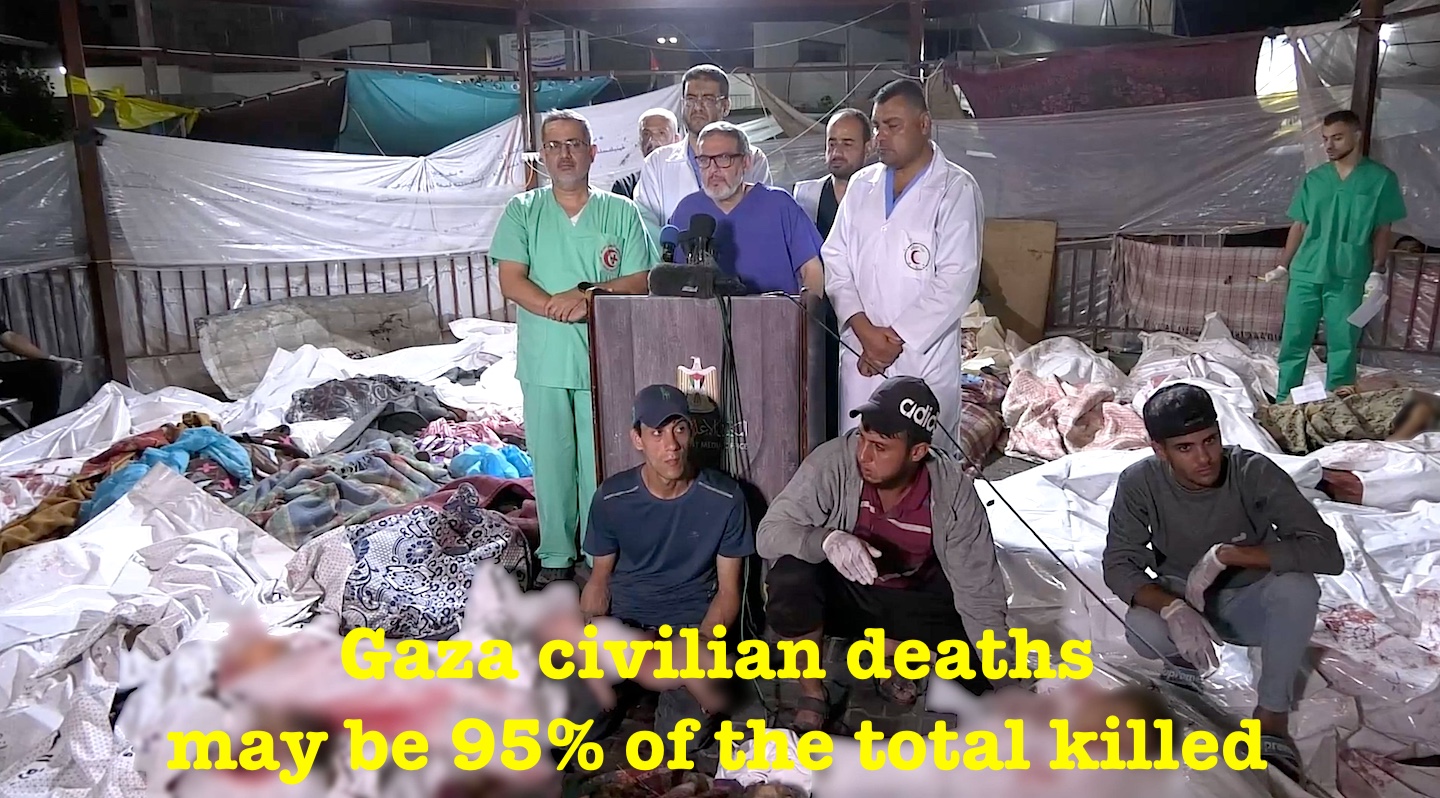
The header for my article analyzing the IDF’s estimate that 83% of those killed in Gaza were civilians, which I suggested, might be as high as 95%. The photo is of a press conference by doctors, led by Dr. Ghassan Abu Sitta, outside Al-Ahli Hospital on October 17, 2023, after the first hospital massacre undertaken by Israeli forces.

Israel’s ongoing efforts to increase the death toll in Gaza, despite a ceasefire

On every front, Israel has, over the last 30 months, maximised its efforts to create as many secondary deaths as possible, through prolonged sieges on all supplies of food, water, fuel and medical supplies, through the deliberate destruction of Gaza’s hospitals and its entire healthcare sector, through the destruction of Gaza’s sewage systems, and, most recently, through a refusal to allow in any kind of machinery for clearance and reconstruction, most urgently needed for the mountains of garbage that have built up and that have become a significant health hazard.

As the poet and writer Omar Hamad reported on X just yesterday, “Gaza is witnessing over 17,000 cases of rodent-related and parasitic infections among its displaced population. This is the reality left behind by the genocide, an environment forced upon Gaza by Israel’s destruction and its total ban on the entry of insecticides and life-saving medicines.”

As the UN Office for the Coordination of Humanitarian Affairs (OCHA) reported just last week, there is “a proliferation of rodents, cockroaches, flies, and other pests, contributing to disease transmission, with a high prevalence of scabies, lice, and skin infections. The scale and persistence of such public health risks are linked to overcrowding, inadequate sanitation, and limited access to hygiene services.”

Investigations of the various displacement sites in which the majority of the population are living “indicated that rodents or pests were frequently visible in 1,326 of the 1,644 assessed sites (81 per cent), affecting about 1.45 million people. Additional alerts highlighted persistent sanitation‑related risks, including sewage in surrounding streets (61 per cent of sites), accumulated solid waste (56 per cent), and flooding or stagnant water (24 per cent). Traces of open defecation and dead animals were also reported. Only 3 per cent of sites indicated no visible environmental health hazards within or around the site perimeter.”

As the report added, “These environmental conditions are closely mirrored in reported household‑level health concerns. A total of 1,322 sites (81 per cent) reported the presence of skin infections or rashes, including scabies, lice, bedbugs, or other ectoparasitic infestations. Skin infections or rashes were reported in nearly two‑thirds of sites, lice in over 65 per cent, and bedbugs in more than half. Other ectoparasitic infestations were identified in over one‑quarter of sites. According to health partners, more than 70,000 cases of rodent and ectoparasitic infestations have been reported so far in 2026.”

Aid agencies are doing what they can, but are restrained by deliberate Israeli obstruction, either because they “rely on items that are largely unavailable in Gaza”, or because they are “often difficult to take in”, because “implementation requires lengthy processes including procurement, approvals, shipment, deployment and safe application.”

The genocide, in other words, still grinds on, deliberately maintained by Israel, which is clearly still trying to kill as many Palestinians as possible.

Israel still wants everyone in Gaza to die

When pushed, Israeli officials still talk about their hopes for the “voluntary migration” of the population, as though it is some kind of humanitarian option, but it has always been a mirage, because no country will take in significant numbers of the Palestinians, either because of increasing anti-immigrant sentiment, or because it would so clearly involve the crimes of ethnic cleansing or forced displacement on a significant scale.

When Israel reluctantly re-opened the Rafah Crossing with Egypt in February, it was an opportunity for senior Israeli officials to demonstrate their commitment to their claim of wanting to encourage people to leave, but, instead, they have persistently restricted the numbers of those allowed out, which, yesterday, prompted the Israeli newspaper Israel Hayom to ask, “Why is Israel preventing Gazans from leaving?”

Polling conducted last year, by what Reuters called “a think tank based in Ramallah and funded by Western donors”, which may not have been reliable, apparently found “that 49% of those surveyed declared that they would be willing to apply to Israel to help them emigrate via Israeli ports and airports, against 50% who said they would not be willing to do so.”

The reason Israel doesn’t want to make even the most cursory efforts to encourage Palestinians to leave Gaza, is, as senior officials, pundits and far too many Israeli citizens have made all too clear, with relentless barbarism, since October 7, is because they want everyone in Gaza to die, as I first pointed out nearly a year ago, when Israel stepped up its relentless extermination in Gaza, after deliberately breaking a six-week ceasefire in January and February, in an article entitled, Israel Wants to Kill Everyone in Gaza.

The header of my article from last May.

Not only did the Israelis admit it themselves, but numerous international organizations and genocide experts have, since January 2024, when the International Court of Justice warned of a “plausible” genocide being undertaken in Gaza, concluded, with increasing certainty, that the cumulative effect of all Israel’s actions since October 2023 has been undoubtedly and deliberately genocidal in intent, fulfilling four of the five indicators of genocide in the 1948 Genocide Convention; namely, “acts committed with intent to destroy, in whole or in part, a national, ethnical, racial or religious group”, by “killing members of the group”, by “causing serious bodily or mental harm to members of the group”, by “deliberately inflicting on the group conditions of life calculated to bring about its physical destruction in whole or in part”, and by “imposing measures intended to prevent births within the group.”

To cite just a handful of examples, Amnesty International concluded that Israel’s actions constituted a genocide in December 2024, the UN’s Independent International Commission of Inquiry on the occupied Palestinian territory, including East Jerusalem, and Israel reached the same conclusion in September 2025, Francesca Albanese, the UN Special Rapporteur for Palestine, has published a series of reports (“Genocide as colonial erasure”, “From economy of occupation to economy of genocide”, “Gaza Genocide: a collective crime” and “Torture and genocide”), defining the contours of Israel’s genocide, and its support through governments in the west and businesses worldwide, and in July 2025 the prominent US-Israeli genocide scholar Omer Bartov wrote, in “I’m a Genocide Scholar. I Know It When I See It.”, an article for the New York Times, “My inescapable conclusion has become that Israel is committing genocide against the Palestinian people.”

In November 2024, Israel was finally hit with a legal blow that it couldn’t simply shrug off, when the International Criminal Court (ICC) issued arrest warrants for Benjamin Netanyahu and then-defense minister Yoav Gallant for war crimes and crimes against humanity. Although devious efforts were subsequently made to topple the chief prosecutor, Karim Khan KC, in a manufactured sexual harassment scandal, and although the US has obligingly waged warfare on the court through the imposition of sweeping sanctions on its judges, the arrest warrants still stand, and both Netanyahu and Gallant are, as a result, unable to visit the 125 countries who are signatories to the Rome Statute that initiated the ICC in 1998.

From demands for silent compliance to AI-facilitated mass slaughter

The most grotesque innovation of the last 30 months has involved the use of AI (artificial intelligence) in military targeting.

For most of the 16 years before October 7, 2023, Israel sought to control the trapped population of Gaza through an insistence on silent compliance. Despite its total control of the border, not only preventing the entry and exit of the population, but also restricting the supplies that were allowed in, the Palestinians were meant to endure these persistent and deliberate deprivations in total silence.

When they did respond — primarily through militants firing missiles at Israel — the response was brutal, via intensive bombing campaigns that were sickeningly described by Israeli officials as a regular process of “mowing the lawn.” Every few years, these “wars” took place — Operation Summer Rains, a four-month offensive in 2006, Operation Cast Lead, a brutal three-week assault in 2009, the week-long Operation Pillar of Defense in 2012, the 50 harrowing days of Operation Protective Edge in 2014, and the three-day Operation Black Belt in 2019.

Some of these attacks involved specific targeting, because Israel has controlled the Palestinian population registry for Gaza and the West Bank since its illegal occupation began in 1967, with any changes — including the registration of births, marriages, divorces, deaths or changes of address — requiring its approval.

With this vast database at its disposal, the opportunities for mass surveillance offered by smartphone technology, and the dawning capabilities of AI programs to process information more rapidly than human analysts, meant that, by 2021, when Israel launched Operation Guardian of the Walls, which lasted for eleven days, it was triumphantly described as “the world’s first AI war”, with the Jerusalem Post enthusiastically explaining how, “in the years prior to the fighting, the IDF established an advanced AI technological platform that centralized all data on terrorist groups in the Gaza Strip onto one system that enabled the analysis and extraction of the intelligence.”

As the article proceeded to explain, “Soldiers in Unit 8200, an Intelligence Corps elite unit, pioneered algorithms and code that led to several new programs called ‘Alchemist’, ‘Gospel’ and ‘Depth of Wisdom’, which were developed and used during the fighting”, with data collected through “signal intelligence (SIGINT), visual intelligence (VISINT), human intelligence (HUMINT), [and] geographical intelligence (GEOINT)”, including information collated “in real time.” The article enthused about how the IDF stated its belief that “using AI helped shorten the length of the fighting, having been effective and quick in gathering targets using super-cognition.”

Aviv Kochavi, then the head of the IDF, captured most compellingly how the new technology was transforming Israel’s concept of warfare. “in the past we would produce 50 targets in Gaza per year. Now, this machine produces 100 targets in a single day”, he said in admiration.

By October 2023, Israel had had another two and a half years to expand its AI-driven military targeting, and the result was devastation on an unprecedented scale, as apartment block after apartment block was levelled, and entire neighbourhoods were destroyed. The attacks looked remarkably like arbitrary carpet-bombing, but when some of those involved in the AI-driven military targeting programs publicly expressed their misgivings in revelatory investigations published in November 2023 and April 2024 (which I wrote about here and here), they revealed that what looked like random carpet-bombing was actually the result of a giddy enthusiasm amongst military commanders for the alleged accuracy of these apparently miraculous technological developments that allowed them to target and kill at a rate that was previously inconceivable.

While the commanders viewed the programs as a miracle, however, those who were perturbed behind the scenes recognized fundamental problems that were irreconcilable with notions of proportionality and accuracy that ought to underpin any military operations.

These whistleblowers identified a 10% error rate, which is shockingly high, but, more fundamentally, they were alarmed by the parameters set by those who were establishing the targeting programs, primarily because they included “low-level” targets, who may have been nothing more than employees of Hamas’ civilian administrative government, who were not legitimate targets, but also because “a system of mass surveillance”  had been established which assessed and ranked the likelihood of activity in the military wing of Hamas or PIJ (Palestinian Islamic Jihad), assigning “almost every single person in Gaza a rating from 1 to 100, expressing how likely it is that they are a militant.”

As I explained in an article last month, The Horrors of AI-Driven Military Targeting, From Gaza to Iran:

Having learned “to identify characteristics of known Hamas and PIJ operatives, whose information was fed to the machine as training data”, the program then located similar “features” amongst the general population. Those with “several different incriminating features” would “reach a high rating”, and would automatically become “a potential target for assassination.”

Alarmingly, however, “These ‘features’ might include ‘being in a Whatsapp group with a known militant, changing cell phone every few months, and changing addresses frequently’ — even though the former is no guarantee of militancy, and the latter two might well involve no militancy whatsoever. As the sources explained, the AI program ‘sometimes mistakenly flagged individuals who had communication patterns similar to known Hamas or PIJ operatives — including police and civil defense workers, militants’ relatives, residents who happened to have a name and nickname identical to that of an operative, and Gazans who used a device that once [unknowingly] belonged to a Hamas operative.’”

As a result, in the early weeks of the genocide, the AI program “clocked as many as 37,000 Palestinians as suspected militants”, identifying them, and their homes, as “targets for possible air strikes”, even though that figure was more than the entirety of Hamas’s military membership, according to official Israeli statements.

Another key aspect of the programming was the tolerance of mass civilian casualties when pursuing “high-value” targets, via unheard-of rates of “collateral damage.” One, early on, involved “the killing of approximately 300 civilians” in an attack aimed at one individual, a figure that appalled an international law expert at the US State Department, who told the Guardian that they had “never remotely heard” of even “a one to 15 ratio being deemed acceptable.”

In addition, another program, the sickeningly-named “Where’s Daddy?”, deliberately targeted individuals “while they were in their homes — usually at night while their whole families were present — rather than during the course of military activity”, because, “from what they regarded as an intelligence standpoint, it was easier to locate the individuals in their private houses.”

As one of the sources explained, “In practice, the principle of proportionality did not exist.”

Nor too did any meaningful human oversight. One source, as I described it, “stated that human personnel often served only as a ‘rubber stamp’ for the machine’s decisions, adding that, normally, they would personally devote only about ’20 seconds’ to each target before authorizing a bombing — just to make sure the Lavender-marked target is male.”

That 20-second review was therefore, the only measure of human oversight that prevented what was, in essence, a policy that I have described as “automated genocide.”

AI targeting in Gaza: a powerful image accompanying “Gaza as a testing ground: Israel’s AI warfare”, an article on the website of the SETA Foundation.


Legally, of course, this is a nightmare, as those involving in assessing the legality of war are increasingly recognizing. An article for the Georgetown Security Studies Review, for example, stated that, “By relying on AI, in some cases almost granting it executive authority, Israel is undermining principles of proportionality, distinction, and precaution”, as identified in a UN report in June 2024, which assessed attacks on civilian infrastructure in the first three months of Israel’s genocidal assault, before the central involvement of AI-driven military targeting had even been established.

As the Georgetown article noted, huge questions need to be asked about the conduct of war in the AI era when “the fate of thousands of lives [is] at the discretion of an automated system”, and when the removal of “even the slightest shred of humanity from it leaves us all as potential targets.”

Israel expands its depravity from Gaza to Lebanon and Iran

What we still don’t know, as Israel has eviscerated all sense of proportionality in its attacks on civilians, and has deliberately erased distinctions between militants and administrative workers in Gaza’s civilian infrastructure, is how much its other deadly targeting of key protected individuals — medical personnel and journalists — has involved AI-driven “terrorism” assessments, or whether these have been cynically grafted on after they were identified and killed.

What is clear, however, is that there has never been a conflict in which so many medical personnel and journalists have been killed, with so much deliberate misinformation invented afterwards in a sickening effort to justify their slaughter. Over 270 Palestinian journalists have been targeted and murdered in Gaza, and in September 2025 the health ministry reported that 1,722 health workers have been killed, with this figure including some of the 562 aid workers who have also been killed.

What we also know is that Israel has expanded the depraved, disproportionate model it established in Gaza to Lebanon, which has been suffering from Israeli depredations throughout the long blood-soaked decades of Israel’s existence.

In September 2024, stepping up its attacks on Hezbollah, which has long supported the Palestinians and has repeatedly engaged in attacks on Israel, a truly depraved mass attack, involving booby-trapped pagers and walkie-talkies, was initiated, with the support of the US tech firm Palantir, which was reportedly aimed at Hezbollah militants, but which, in reality, killed, maimed and mutilated numerous civilians. UN experts, who condemned the attacks as “terrifying” violations of international law, noted that the attacks “ killed at least 32 people and maimed or injured 3,250, including 200 critically. Among the dead [were] a boy and a girl, as well as medical personnel. Around 500 people suffered severe eye injuries, including a diplomat. Others suffered grave injuries to their faces, hands and bodies.”

Israel followed up by assassinating Hassan Nasrallah, the secretary-general of Hezbollah, in an attack in Beirut, during a sustained period of savage attacks on Lebanon that resembled the destruction rained down incessantly on Gaza. On the deadliest day, September 23, 558 people were killed, including 50 children and 94 women, and 14 ambulances and fire engines were also targeted and attacked, and on October 1 Israeli troops invaded Lebanon for the sixth time since 1978.

Although a ceasefire was declared in November, Israel treated it with the same scorn it has applied to ceasefires in Gaza, and on March 2, two days after Israel persuaded the US to foolishly initiate a war on Iran, it resumed full-scale attacks, also, as in Gaza, imperiously ordering the mass evacuation of Lebanese civilians, creating over a million internal refugees.

On March 16, Israel followed up by invading southern Lebanon, aiming to occupy the whole of the land up to the Litani River, and, as was explained in the Guardian by Mohamad Bazzi, the director of the Hagop Kevorkian Center for Near Eastern Studies and a journalism professor at New York University, “pledging to clear frontline villages of their inhabitants and establish a new ‘security zone’ that would be devoid of people and occupied by Israeli troops.”

Israel’s fanatical defense minister, Israel Katz, explicitly promised another Gaza, stating that his forces would destroy “all houses” in Lebanese border villages “in accordance with the model used in Rafah and Beit Hanoun”, towns in Gaza whose existence has been completely erased.

The perilous refusal of Israel to submit to any kind of restraint, and why it must be stopped

Israel’s behavior over the last six weeks has, above all, demonstrated its extraordinary arrogance. Having seduced Trump into attacking Iran based on promises that another assassination — of Iran’s leader Ayatollah Khameini — would sow discord and lead to regime change, the US soon discovered, to its dismay, that Iran was a formidable adversary, and had been preparing, since unprovoked attacks last year, for retaliation. After successfully targeting US bases throughout the Middle East, Iran proceeded to shut down the Strait of Hormuz, precipitating a global energy crisis whose magnitude is being deliberately hidden by politicians and the media throughout the west, but which was significant enough for Trump to recognize the need for a ceasefire.

For Iran, any ceasefire deal also had to include Lebanon, but Israel refuses to be constrained by anyone, including the US or Iran, because it simply doesn’t care about anyone or anything other than itself.

This was made clear when, last September, as Gaza ceasefire negotiations were taking place, Israel brazenly targeted Hamas officials who were meeting in Doha, in Qatar, violating the powerful Gulf state’s sovereignty, and requiring frantic diplomatic efforts by the US to limit the attack’s political damage.

It has also been made clear in the responses, within the US, to the deadly attack on a girls’ elementary school in Minab, in Iran, on the very first day of the “war”, when, it seems, Palantir-developed AI technology misidentified the school as a military target. The attack killed 168 people, mostly schoolgirls, and, in the US, it has led, at the very least, to some hand-wringing, and to noticeable unease within parts of the US military.

In contrast, within Israel, and with the handful of exceptions noted above, there has been no meaningful discussion about the extent to which AI-driven military targeting is not a miracle, but a flawed system that has contributed to the colossal and unjustifiable slaughter of civilians in vast numbers, and which needs serious oversight before it proceeds any further.

Israel’s most disturbing actions over the last two months, however, took place on April 8, when, in a deliberately provocative snub to the US-Iran ceasefire deal, it launched the most devastating attacks ever seen on Beirut and southern Lebanon, striking over a hundred targets in a ten-minute period, claiming it was targeting Hezbollah strongholds without, of course, providing any evidence, and killing at least 357 people, who seemed quite clearly not to be the 250 Hezbollah “operatives and commanders” that Israel claimed to have killed.
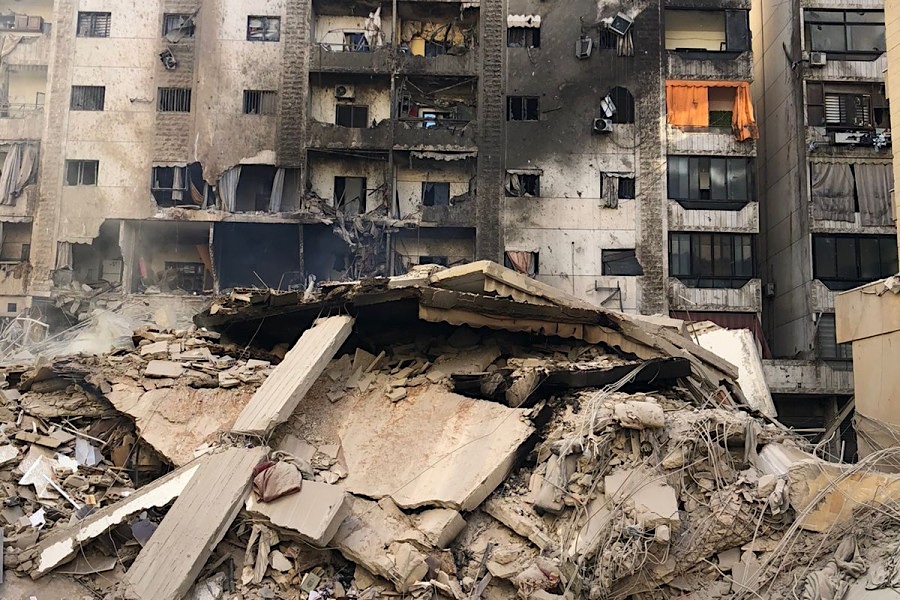
Destruction in Lebanon: a photo from the website of the International Center for Transitional Justice (ICTJ).


Despite the threat that Israel’s actions pose to the Iranian ceasefire, it has still continued to engage in the destruction of southern Lebanon, is still destroying village after village, and also attracted global condemnation last week through its deliberate targeted killing of the renowned and tenacious Lebanese journalist Amal Khalil, who, of course, it subsequently smeared as a “terrorist.”

Whereas the US still has allies throughout the Middle East which it needs to placate, even with Donald Trump’s tendency to insult and belittle even those closest to him, Israel has no friends or allies whatsoever, just a handful of countries that it manipulates — largely through infiltration — to fulfil its aims.

As its arrogance and its derangement have grown over the last 30 months, this now means endless war on as many fronts as possible not only against military targets, but against entire civilian populations who are all, following the Gaza model, regarded as, in one way or another, “associated” with Hamas, or Hezbollah, or the Iranian “terror state”, or even just through ever more hysterical interpretations of antisemitism, which the Israeli state has long insisted means any criticism whatsoever of its actions.

What the last 30 months have also shown us is that Israel’s predatory notions of “self-defense” extend far beyond the Middle East, via high-level influence over compliant governments in the west, and especially the US, the UK and Germany, which, as well as being Israel’s main arms suppliers (in the case of the US and Germany), have also obligingly initiated draconian clampdowns on free speechprotest and direct action in defense of Israel, and where (again, in the US and Germany) alarming efforts are also being made to make citizenship or employment dependant on allegiance to Israel.

Most alarmingly, as the dark forces behind the AI revolution openly manifest their true ugliness, not just via their enthusiasm for AI-driven warfare, but also for the surveillance and control of entire populations, Israel’s reach also now threatens all of us, wherever we are.

As Jonathan Greenblatt, the CEO of the fanatically pro-Israeli Anti-Defamation League (ADL), explained at an event held by the Sinai Temple in Los Angeles in March, the group has analysts “working round the clock” to “take down” those regarded as “extremists” through monitoring social media and other platforms, sharing the information it gathers with the FBI. The extensive surveillance operation that he outlined “tracks activity across social media, messaging apps, video games, cryptocurrency platforms, podcasts, short-form video, Wikipedia and large language models.”

For those paying attention, it has been clear throughout the last 30 months that what has been happening in Gaza will not stay in Gaza. Instead, the genocide in Gaza is a template — for a world of limitless slaughter, and of total surveillance and control, that will persist as long as Israel, and those backing it, continue to be allowed to wield their depraved power.

For all our sakes, Israel and its backers need, across their many spheres of influence, to be restrained and disarmed.

Andy Worthington is a freelance investigative journalist, activist, author, photographer (of a photo-journalism project, ‘The State of London’, which ran from 2012 to 2023), film-maker and singer-songwriter (the lead singer and main songwriter for the London-based band The Four Fathers, whose music is available via Bandcamp). He is the co-founder of the Close Guantánamo campaign (see the ongoing photo campaign here) and the successful We Stand With Shaker campaign of 2014-15, and the author of The Guantánamo Files: The Stories of the 774 Detainees in America’s Illegal Prison and of two other books: Stonehenge: Celebration and Subversion and The Battle of the Beanfield. He is also the co-director (with Polly Nash) of the documentary film, “Outside the Law: Stories from Guantánamo”, which you can watch on YouTube here.

Varoufakis Decries Western Complicity as Gaza Flotilla Leaders Abducted by Israel

“This is a double violation of international law: First, Israel abducted them illegally at sea. Second, Israel is now transporting them, violently, illegally, to one of its notorious prisons.”


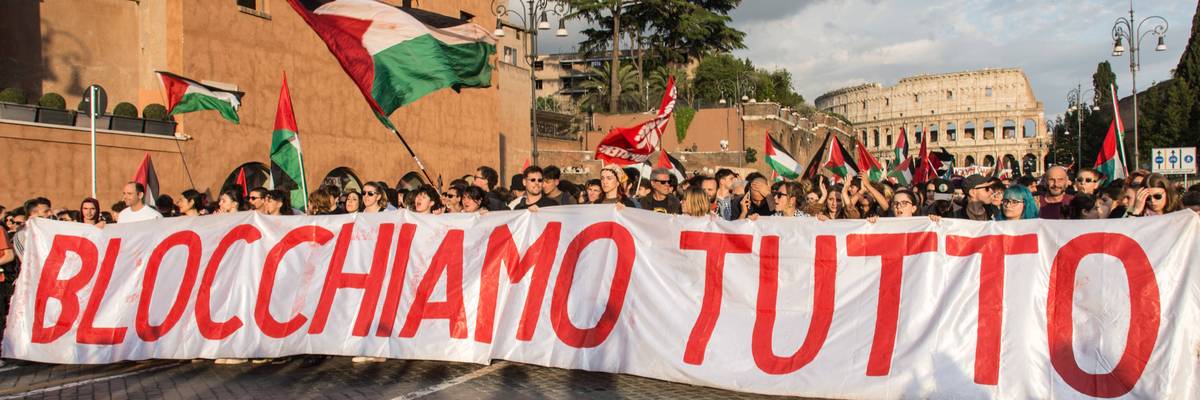
Demonstrators march with a banner reading, “We Block Everything,” during a May 1, 2026 Rome protest in solidarity with the Global Sumud Flotilla.
(Photo by Andrea Ronchini/NurPhoto via Getty Images)


Brett Wilkins
May 01, 2026
COMMON DREAMS

Former Greek Finance Minister Yanis Varoufakis on Friday slammed European leaders—and the West at large—for what he said is their complicity in Israel’s abduction of two leaders of the Gaza-bound humanitarian aid flotilla seized off the coast of Greece.

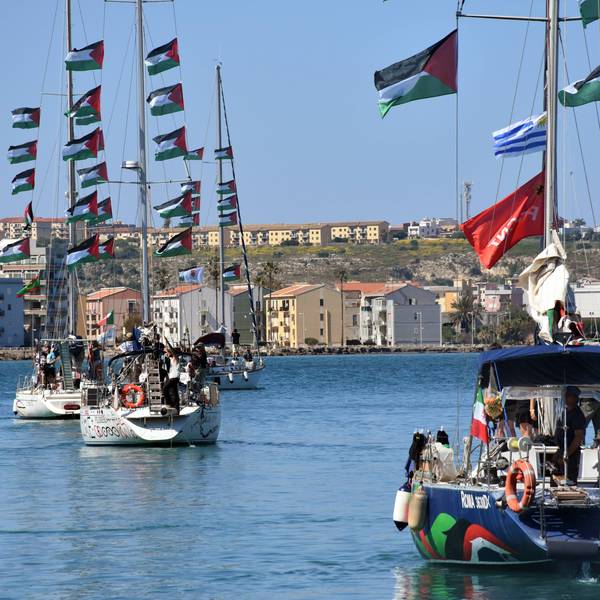
In what numerous critics called an act of piracy, Israeli authorities intercepted the Global Sumud Flotilla on Thursday in international waters 45 nautical miles west of the Greek island Kythira and 600 nautical miles from Gaza, according to Greenpeace, whose MY Arctic Sunrise was the aid convoy’s most prominent vessel.


‘This Is Piracy’: Israel Condemned for Seizure of Gaza-Bound Flotilla Near Greece

Around 175 activists aboard 22 vessels were seized by Israeli forces. The BBC reported Friday that most of them have been released in Greece.

Some of the flotilla members said they were beaten and dragged while handcuffed. The Washington Post reported 34 people—including citizens of Australia, Colombia, Italy, Ukraine, and the United States—required medical attention for broken ribs, noses, and other injuries. Detained activists also said they were denied food and water and were forced to sleep on deliberately flooded floors.

Flotilla organizers said 31 of the remaining vessels will continue heading toward Palestine in a bid to “break the illegal siege of Gaza.”


Two members of the flotilla steering committee—Saif Abu Keshek and Thiago Ávila—were taken to Israel for interrogation.

Abu Keshek is a Spanish-Swedish citizen of Palestinian origin. Ávila is Brazilian. Israel’s Foreign Ministry claimed that Abu Keshek is “suspected of affiliation with a terrorist organization” and Ávila is “suspected of illegal activity.”

As is very often the case with Palestinians it has killed, Israel provided no evidence to support its claims against the accused.

Spain and Brazil have been outspoken critics of Israeli human rights crimes, and both countries have formally joined the South Africa-led genocide case against Israel currently before the International Court of Justice in The Hague.

Varoufakis noted on X that Ávila “has distinguished himself with repeated attempts to break the illegal, genocidal, Israeli blockage of Gaza.”

“Unlike the remaining abducted members of the Sumud Flotilla crew, which the Israeli navy disembarked in Crete, Saif and Thiago are detained and bound for an Israeli prison,” the Democracy in Europe Movement 2025 co-founder continued. “This is a double violation of international law: First, Israel abducted them illegally at sea. Second, Israel is now transporting them, violently, illegally, to one of its notorious prisons.”

It is not known where Israel will send the two men. Ávila was previously held at Ayalon Prison in Ramla, along with other activists seized from the Madleen last summer. Ávila reportedly refused deportation papers and launched a hunger strike, prompting prison authorities to place him in solitary confinement.

While it is not as notorious as the Sde Teiman military prison—where former inmates and Israeli staff have described torture, rape, murder, and other abuse of Palestinians—Ayalon Prison’s alleged human rights violations include torture, medical neglect, and deliberately degrading conditions.

“Meanwhile,” Varoufakis said Friday, “the Greek government is cooperating fully in Israel’s criminal behavior, effectively surrendering its search and rescue obligations and conniving with Israel to victimize the brave crews of the Sumud Flotilla who are steadfastly, through their activism, defending international law as well as the verdict of the International Court of Justice, which has clearly and unequivocally declared Israel’s continued naval blockade of Gaza and its occupation of the Palestinian territories illegal.”

“Through their complicity and their silence, the Greek government, the European Union, the mainstream media, the West more generally, are flouting, indeed they are trashing, their supposed, much publicized, ‘Western values,’” he added.

Varoufakis is calling on the world to demand:The immediate release of Saif and Thiago;
An end to Israel’s criminal behavior in international waters;
The termination of Israel’s illegal Gaza blockade; and
That the Greek government and the European Union cease and desist from lending logistical and moral support to Israel’s genocide in Gaza and its ethnic cleansing campaigns in East Jerusalem and the West Bank.

Varoufakis’ call was echoed by the Global Sumud Flotilla, which demanded that “all governments do all they can to pressure the Israeli regime to release all the illegal abductees.”

Spanish officials including Prime Minister Pedro Sánchez also decried Thursday’s raid and demanded the release of the flotilla activists while calling for an end to EU-Israel Association Agreement, a bilateral trade and economic policy framework.

“Israel is once again violating international law by assaulting a civilian flotilla in waters that do not belong to it,” Sánchez said on X. “Our government is doing everything necessary to protect and assist the detained Spaniards. But that is not enough. The EU must suspend the association agreement NOW and demand that [Israeli Prime Minister Benjamin] Netanyahu comply with the law of our seas.”

On the other hand, US State Department spokesperson Tommy Piggott condemned the flotilla as a “pro-Hamas initiative” and called on allied countries “to take decisive action against this meaningless political stunt.”

The United States provides Israel with tens of billions of dollars in armed aid and diplomatic support including repeated vetoes of United Nations Security Council ceasefire resolutions for Gaza.

Israel maintains that its actions were legal. Its officials have repeatedly invoked the San Remo Manual on International Law Applicable to Armed Conflicts at Sea—often shortened to the San Remo Manual—to justify the interception and seizure of flotilla vessels attempting to reach Gaza on the high seas.

Thousands of demonstrators took to the streets of cities including Athens, Barcelona, Gaza City, Istanbul, Madrid, Milan, Naples, Paris, and Rome on Thursday as protesters showed solidarity with the flotilla members and condemned Israel’s actions.

Meanwhile, Gazans continue to suffer from Israel’s bombing and blockade, which have killed or wounded more than 250,000 Palestinians and forcibly displaced, starved, or sickened around 2 million others.

Earlier this week, United Nations Assistant Secretary-General Khaled Khiari said that despite “some improvements in access and aid delivery... food security remains a challenge, while essential services, particularly water, sanitation, and health, are again on the brink of collapse.”

Netanyahu and Yoav Gallant, his former defense minister, are wanted by the International Criminal Court for alleged crimes against humanity and war crimes in Gaza, including murder and forced starvation.
Rights Group Petitions Israeli Supreme Court to Free Abu Safiya and 13 Other Gaza Doctors

By holding doctors from Gaza without charge, Physicians for Human Rights Israel said the military was “effectively paralyzing an entire healthcare system already made fragile by the ongoing destruction.”


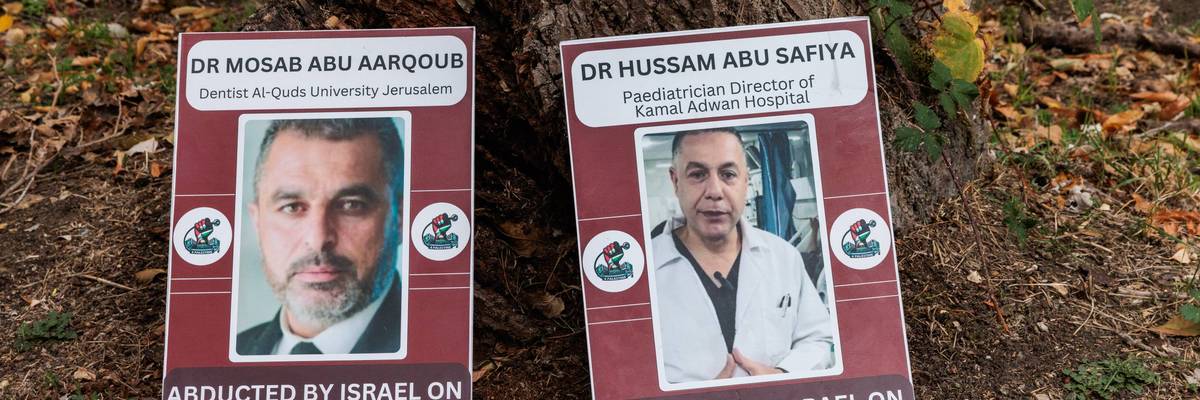
Images of Palestinian doctors from Gaza detained by Israel, including Dr. Hussam Abu Safiya of Kamal Adwan Hospital, are displayed by pro-Palestinian activists protesting outside Woolwich Crown Court in London on October 14, 2025.
(Photo by Mark Kerrison/In Pictures via Getty Images)

Stephen Prager
May 01, 2026
COMMON DREAMS

An Israeli human rights group is petitioning for the country’s Supreme Court to order the release of 14 doctors from Gaza who have been imprisoned for more than a year without charges.

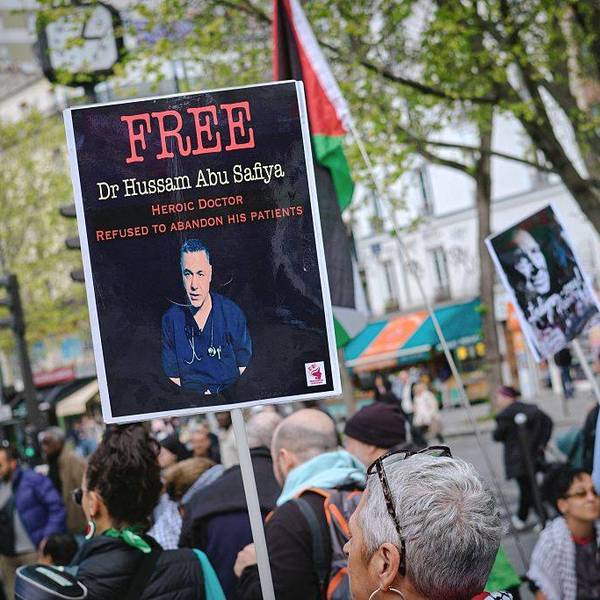
Among them is Dr. Hussam Abu Safiya, the director of the Kamal Adwan Hospital, who has been detained without charges since December 2024 and this week had his detention extended by a district court, which Physicians for Human Rights Israel (PHRI) described as “unlawful.”
RECOMMENDED...


Rights Group Demands Release of Gaza’s Dr. Abu Safiya After Israeli Court Extends Detention

On Thursday, PHRI said that Israel’s Supreme Court must recognize “the special protections afforded to doctors and medical workers under international humanitarian law, as well as the urgent need for medical personnel from Gaza to carry out their duties and help rehabilitate the extensive damage inflicted on Gaza’s healthcare system.”

They called on the court to revoke the detentions of Safiya and 13 other doctors, who include pediatricians, orthopedic specialists, and surgeons.

Nearly all of the hospitals in Gaza have been damaged or destroyed during more than two years of genocidal war by Israel, and more than 1,500 healthcare workers have been killed in what UN experts have described as a “medicide.”


PHRI said that hundreds of medical workers have been targeted and arrested by the Israel Defense Forces without charge, “effectively paralyzing an entire healthcare system already made fragile by the ongoing destruction.”

“Over the past two years, testimonies from detained medical workers have described dire conditions of incarceration, including starvation and abuse amounting to torture across Israeli detention facilities,” the group said, noting that at least five of them had died in custody.

PHRI said it had submitted a request to Israel’s Supreme Court to reconsider the detention orders, but upon receiving no response, it filed a petition.

“Despite protections under international humanitarian law, and an ongoing ceasefire, doctors from Gaza are still being held without any due process, subjected to severe conditions amounting to torture,” the group said. “The continued detention of doctors who could provide urgently needed medical care—actively hinders the rehabilitation of the healthcare system and prevents any meaningful recovery.”
Far Right Israeli Settler Movement Enters Syria in a Push for “Greater Israel”

The settlers are increasingly crossing the border into Syria, with at least tacit support from the Israeli military.

April 28, 2026

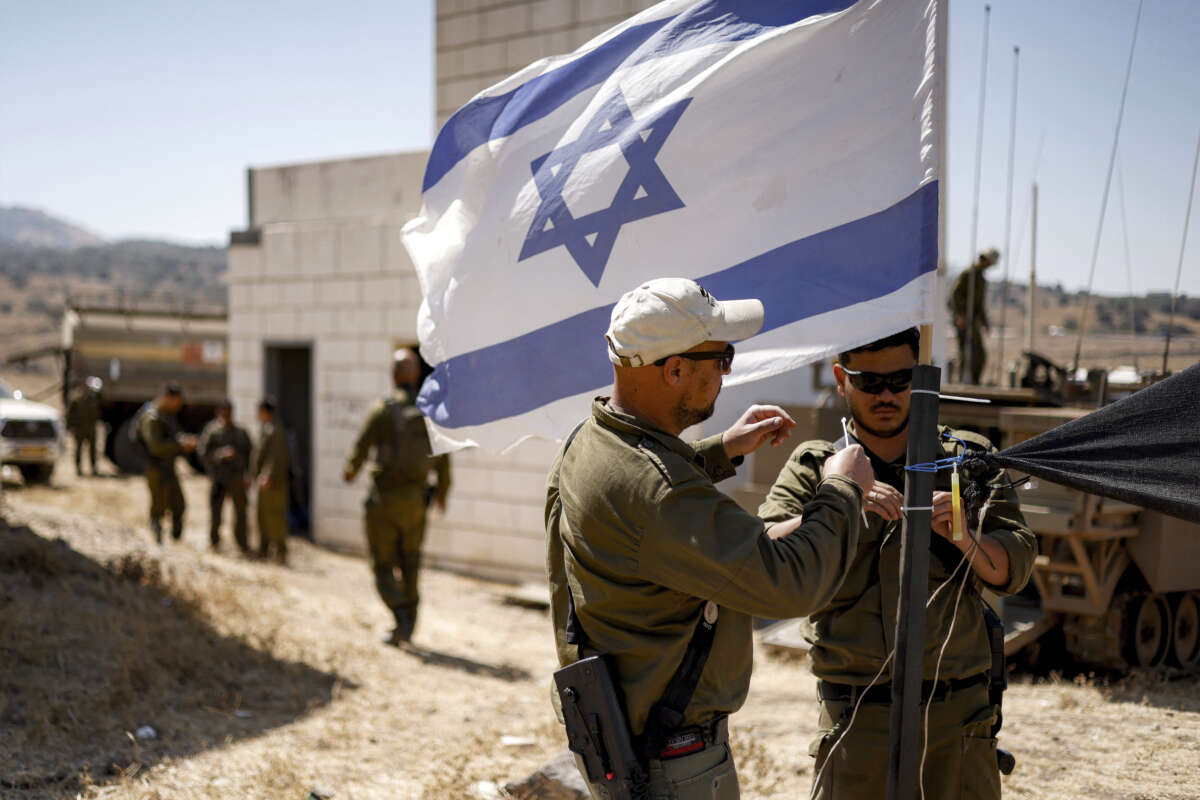
Israeli army soldiers add zip ties to the mast of an Israeli flag flying at a special area for exercises during a military drill in the Israeli-annexed Golan Heights on July 8, 2025.JALAA MAREY / AFP via Getty Images

Syrian journalist Oudai Efnikher is deeply familiar with life under Israeli occupation. He was born in Kafer Hareb, a village in Syria’s Golan Heights, from which he and his family were expelled after Israel seized the territory during the 1967 Six-Day War.

Now he is once again facing down Israeli forces, as they “take our land, kill our crops, and abduct our fathers.”

“This is a slow occupation, but soon, we will lose what they have not yet taken,” Efnikher told Truthout.

After Bashar al-Assad was ousted by Syrian rebels in December 2024, Israeli forces wasted no time before launching a massive aerial bombardment campaign on the country, destroying almost 80 percent of the military capacity left behind by the Assad regime.

Israeli forces also entered the demilitarized buffer zone established by a UN Security Council resolution in 1974 between the Israeli-occupied Golan Heights and the rest of Syria. They seized the territory and then established a “security buffer” beyond the last demarcation line administered by UN observer forces.


“Price Tag” Attacks Part of Effort to Expand Israeli Settlements in West Bank
200 masked settlers descended on the West Bank on March 22, throwing Molotov cocktails and terrorizing Palestinians. By Theia Chatelle , Truthout March 28, 2026


The area now under Israeli military control is off-limits to Syrian civilians and government forces. Farmers have been unable to tend to their land, and landowners have little hope they will ever be able to access it again

In total, Israel now occupies an additional 177 square miles of Syrian territory than it did before the fall of Assad.

“Maybe Israel will take it all. They already have a safe zone in southern Syria, so that could ultimately be the best option for Israel,” Syrian political analyst Issam Khoury told Truthout.

But what is most concerning for Efnikher is not the Israeli military’s presence in Syria, but what has become regular incursions by Israeli settlers.

On April 22, a group of roughly 40 settlers affiliated with the far right Halutzei HaBashan movement, or the Pioneers of Bashan — a reference to the name in the Torah for the fertile territory located northeast of the Sea of Galilee, which the Torah says was once ruled by the tyrant King Og before Moses defeated him — entered Syrian territory and asked the Israeli government to legalize settlement activity there.

According to Efnikher, who has been working to monitor Israeli settlement activity in Syrian territory since Assad’s fall in December 2024, this was the fifth such incursion by Israeli settlers into Syria.


According to Etkes, this is how the Israeli settlement movement functions: by “changing the facts on the ground” until what was once unthinkable becomes reality.

The settlers see themselves as fulfilling a biblical mandate. They consider this Syrian territory part of the ancient land of Israel. Still, the Israeli military condemned the incursion, calling it “a criminal offence that endangers civilians and IDF troops.” Dror Etkes, a longtime Israeli settlement monitor who led the advocacy group Peace Now’s Settlement Watch project and later founded Kerem Navot, an organization that tracks Israeli land seizures in the West Bank, says none of this comes as a surprise.

“Nothing is surprising anymore, not after Gaza,” he said. “Many things I didn’t think would happen have happened, so I think I should be pretty cautious when it comes to predicting what will happen in this country.”

Etkes watched settlers build their first outposts in the West Bank in the 1960s, and then, after the Second Intifada, the construction of the separation barrier. “If you had asked me 10 years ago, five years ago, two years ago, not to mention 50 years ago, whether half a million Jews would be living in the West Bank, whether we would have 350, 360, 370 outposts in the West Bank, of course nobody would have said yes,” he added.

According to Etkes, this is how the Israeli settlement movement functions: by “changing the facts on the ground” until what was once unthinkable becomes reality. And this, he says, is the goal of the settlement movement — whether it’s in Syria, Lebanon, Gaza, or the West Bank.

The Pioneers of Bashan is not the only settler organization entering closed military zones to pressure the Israeli government to legalize settlements in foreign territory.

In southern Lebanon, a group called Uri Tzafon has worked to build a movement to establish outposts in territory currently occupied by the Israeli military. The group has flown drones into Lebanese territory, urging residents to leave, and planted trees to cement a claim to the land.

It was the same in Gaza with the far right Tzav 9 movement, which on more than one occasion since October 7, 2023, attempted to enter the enclave and establish outposts.


Slowly, the borders of the Israeli imagination — much like the state’s own physical borders — are being expanded by the settlement movement.

Slowly, the borders of the Israeli imagination — much like the state’s own physical borders — are being expanded by the settlement movement. In many cases, these incursions have taken place with the implicit endorsement of the Israeli military.

According to both Etkes and Efnikher, it would have been impossible for the settlers to enter Syrian territory without at least the tacit approval of Israeli forces. There are hundreds of miles of fencing dividing the Israeli-controlled Golan from Syrian territory, reinforced by hundreds of thousands of mines.

Efnikher added that there are a number of gates in the fencing that allow the Israeli military to cross into and beyond the demilitarized buffer zone, which is how the Pioneers of Bashan were able to enter Syrian territory.

The Israeli military said in a statement after detaining and escorting the settlers back to Israeli-controlled territory that “settlement in Bashan is essential to preserve the achievements of the war.”

The push for these settlements is part of the project of Greater Israel, which seeks to expand Israel’s borders to what some settlers and religious nationalists claim were the boundaries of the ancient Israelite kingdom — a biblical vision, contested by mainstream archaeology, that imagines a realm stretching from the Euphrates to the Nile, encompassing parts of modern-day Saudi Arabia, Jordan, Iraq, and Egypt

But the expansionist drive is not only about land. It is also about water. Efnikher pointed to the Mantara Dam, the largest dam in Syria’s Quneitra Governorate. The dam controls water flow into the Yarmouk River, another critical water supply for southern Syria.

Before he was a journalist, Efnikher owned a restaurant overlooking the dam. It has been closed since Israeli forces expanded their occupation of the territory — a significant financial blow to him and his family, though he stressed that he is better off than most.

Israeli forces have destroyed thousands of dunams of farmland with pesticides in the process of building their outposts, and have established checkpoints — including aerial ones — to regulate the movement of Syrians near the buffer zone.

“There is a heavy psychological toll, falling heaviest on children and the elderly,” Efnikher said. “We’re talking about villages displaced since 1967 and families still affected across generations, now living through yet another occupation.”

He pointed to the West Bank as emblematic of what the Quneitra Governorate might soon become.

Israel has held control of the West Bank for so long that many Palestinians and Israelis in the territory, more than a third of whom are children, do not remember a time when it was free of Israeli outposts and settlements. Now, according to the UN’s High Commissioner for Human Rights, there are more than 279 illegal settlements and 700,000 settlers living in the West Bank.


“This is a model [they’re] trying to copy-paste in Syria and in Lebanon. It’s the same people, coming from the same places, from the same ideological greenhouses.”

The commitments of the settlement movement vary, but at its forefront are those who see it as their personal mission to restore Jewish sovereignty over the land they claim as Greater Israel, even if it must be paid for in blood.

“It’s been almost 58 years since this project started. And all of it started actually illegal[ly] or half-legal, started without official authorization. This is a model [they’re] trying to copy-paste in Syria and in Lebanon. It’s the same people, coming from the same places, from the same ideological greenhouses,” Etkes said.

Efnikher warned that Israeli forces are intensifying their incursions in the Quneitra region: They enter the villages, make arrests — by his tally, more than 70 Syrians from the Quneitra Governorate are currently held in Israeli prisons — set up checkpoints, and then withdraw.

But Efnikher fears it is only a matter of time before they stay. The presence of the Pioneers of Bashan is one troubling sign. “They are winning,” Efnikher said of the Israeli forces. Even for Etkes, there is little hope.

“Look at what they achieved in the last 58 years in the West Bank,” he said. “They have very good reasons to be very optimistic.”


This article is licensed under Creative Commons (CC BY-NC-ND 4.0), and you are free to share and republish under the terms of the license.


Theia Chatelle

Theia Chatelle is a freelance journalist and photographer covering conflict, human rights, and displacement across the Middle East, Europe, and the United States. Based in Jerusalem, she reports on war and social movements, with a focus on human-interest storytelling and investigations into state power. Her work has appeared in The Forward, The Nation, Haaretz, and the Jewish Telegraphic Agency, among other outlets. Her photography has been published by MS NOW and USA Today, among others. Chatelle holds bachelor’s and master’s degrees in American Studies from Yale University. She was a 2025 fellow at the International Women’s Media Foundation and is an alumna of the Rory Peck Trust and the Type Media Center.
Hundreds of Incarcerated Migrants Go on Hunger Strike in Remote Michigan Prison


Migrants at the GEO Group-run facility demand their right to due process, edible food, and an end to sleep deprivation.
April 29, 2026

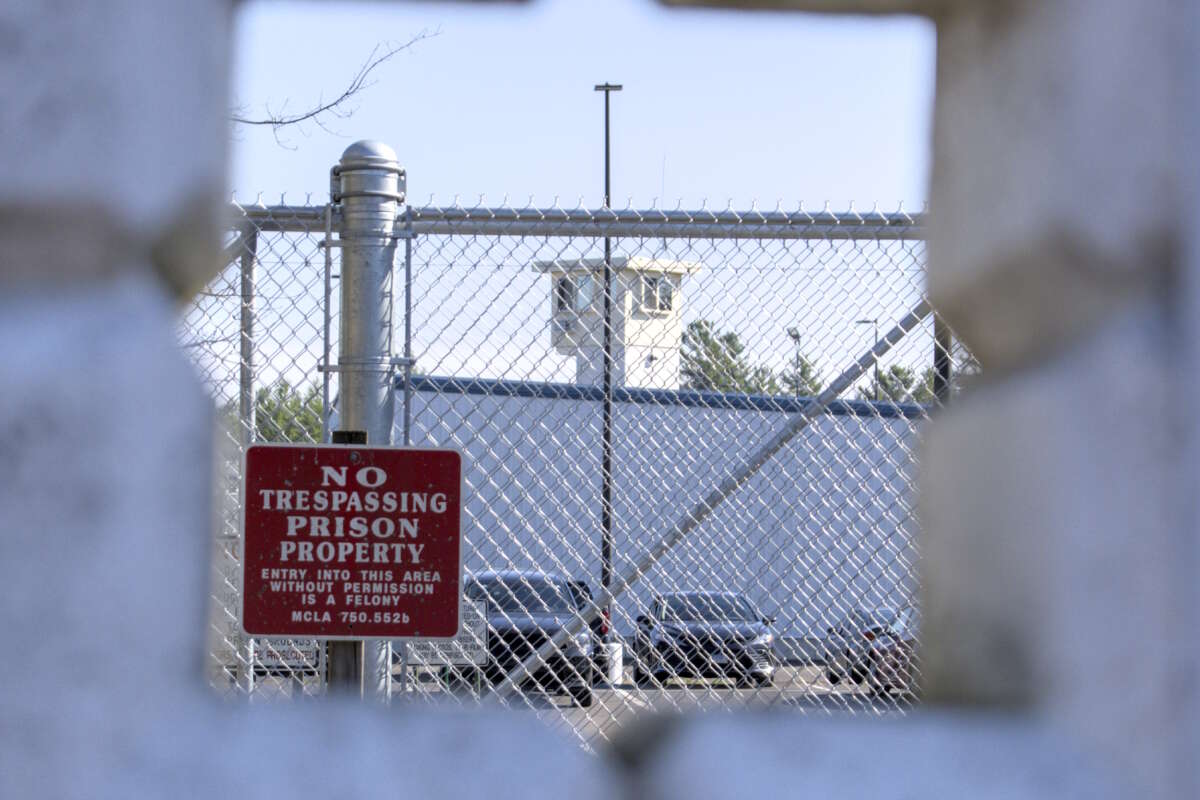
GEO Group’s North Lake Processing Center near Baldwin, Michigan
.@CWYONKERS via Instagram

Hundreds of immigrant men at North Lake Processing Center, an Immigration and Customs Enforcement (ICE) facility, began a hunger strike on April 20 in an attempt to assert their rights to due process, edible food, and an end to sleep deprivation. Outside the prison, advocates from all over Michigan converged to offer solidarity to those inside and share the strikers’ demands with the wider public.

“There are people who want to speak and want their voices to be heard … but [ICE] is covering everything up,” says a man who was released from the prison on April 24 after winning a habeas corpus petition. The man, identified by the pseudonym Juan in a Spanish-language interview released to the press, says that “almost everyone” inside the prison is participating in the hunger strike.


The Prison Up North

Most visitors to Baldwin, Michigan, are there for outdoor recreation. Located a three-and-a-half-hour drive from Detroit, Baldwin has a small downtown with an ice cream shop, a pizza joint, and a boat store catering to summer tourists, just like most other small towns in the area. Tall pine trees sprout from both sides of the highway leading into the town and signs for campgrounds and boat launches abound. But a few blocks away is one of the largest immigrant prisons in the country, North Lake Processing Center, where around 1,400 immigrants are currently jailed.

The prison is almost hidden; it’s easy to drive past the unassuming street where it’s located. Unlike most state prisons, there are no road signs indicating its location and it cannot be seen from the highway. Instead, it’s tucked into the pine trees located a few blocks through a neighborhood off Route 10 where the paved road turns to dirt.


As Opposition Grows, Oklahoma Organizers Share How They Halted an ICE Warehouse
Organizers also channeled mass outrage into long-haul organizing for immigration justice in Oklahoma and beyond. By Lydia Pelot-Hobbs , Truthout April 25, 2026

At close range, though, the razor wire and the guard tower come into view.

North Lake Processing Center is a privately run ICE prison operated by the GEO Group. Originally opened in 1999, and closed by the Biden administration in 2022, it recently resumed jailing immigrants as part of Donald Trump’s mass deportation campaign. Since its reopening in June 2025, it has quickly filled with people from Detroit, Chicago, and throughout Michigan and Ohio as part of the Trump administration’s ramped-up attacks on immigrants.

Conditions in the prison, by all reports, are abysmal. Attorney Diana Marin, who represents clients at North Lake in filing habeas corpus petitions, told Truthout the descriptions she hears are consistently the same. There is the sleep deprivation — the lights are only off from 12:00 am to 5:00 am, and even then, guards shine flashlights inside cells and keep their radios on full volume, making it impossible to find any rest. Then there is the food: Rations are inconsistent and of poor quality. “I have not had an individual that I represented or have talked to who has told me, no, there’s enough food here,” Marin says.

The medical care, or lack of it, is another major concern. In February, advocates organized a phone zap for someone who had an abscess in his mouth that began to limit his ability to speak after medical staff gave him ibuprofen and no antibiotics. According to Marin, this remedy is fairly typical at North Lake, regardless of symptoms.

Deaths in ICE facilities are at record highs and many seem to stem from inadequate medical care. At North Lake, Nenko Stanev Gantchev, a Bulgarian man who had lived in Chicago for 30 years, died in December. The cause of his death is unclear, although his family says he did not receive necessary medical attention while in the facility.

The uncertainty gives new weight to the poor conditions. People imprisoned at North Lake have been waiting for months, some as long as a year, and many say they have no idea what’s happening with their cases.

Isidro is a volunteer hotline operator with Asamblea Popular, a rapid response and ICE watch group in Detroit that receives dozens of calls each week from people imprisoned at North Lake. She says that immigrants held in the prison are given so little information that sometimes they call the hotline just to see if operators can Google information about their cases. (Isidro is using a pseudonym to protect her mutual aid work from state repression.)

Marin, who has represented and consulted with dozens of individuals at the facility, highlights that imprisonment itself is traumatic, especially for people who were picked up by ICE as they went about their daily errands, or as they fulfilled their legal obligations at immigration check-in appointments. Now, she says, “It’s incredulous to them that … their entire every single day is dictated by whatever it is the GEO Group decides is going to happen to them.”


Hunger Strike Builds Hope Out of Despair


For over a week, the hunger strike has rolled across North Lake, with some units dropping out while other men joined in. Reports indicate that the men were also withholding labor.

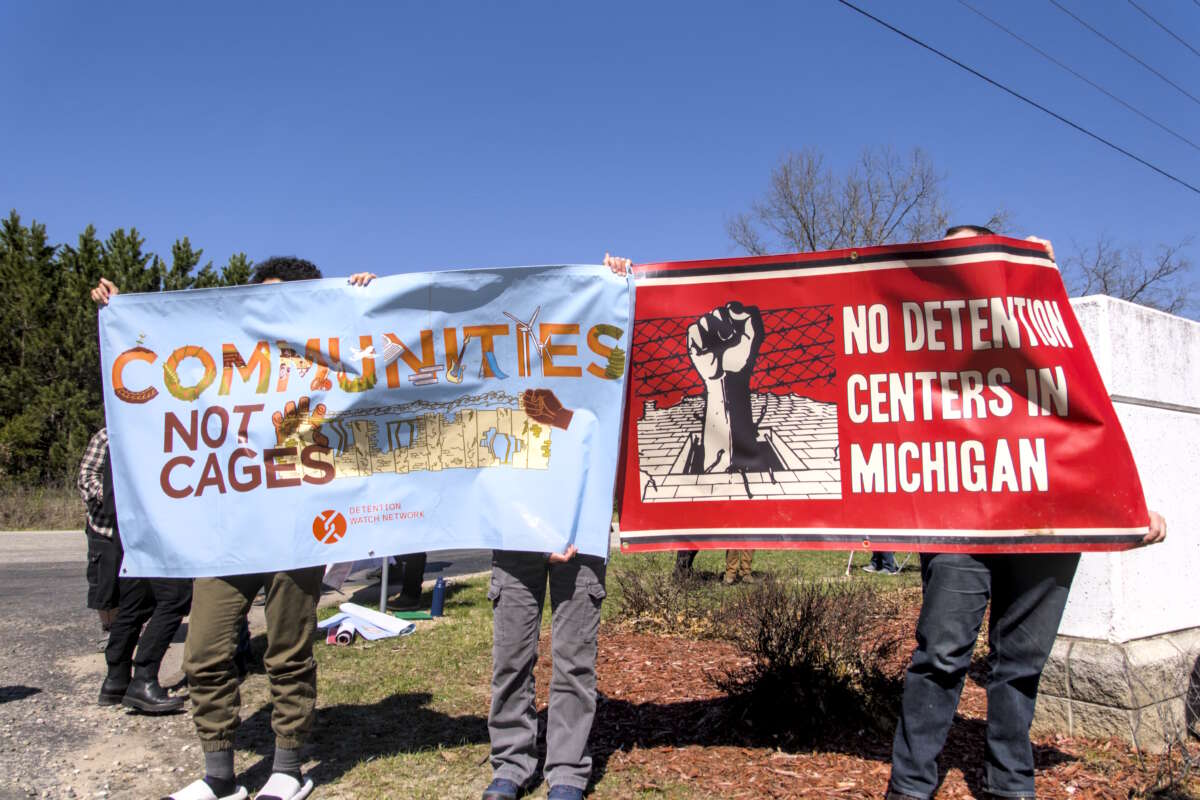
JR Martin, a member of No Detention Centers in Michigan, a group that has been fighting the North Lake prison since the first Trump administration, told Truthout that hunger strikes are “a common occurrence in ICE detention, but also part of the history of this particular facility. No Detention Centers in Michigan was supporting people who were incarcerated at North Lake between 2019 and 2022, who were organizing hunger strikes in response to conditions that are strikingly similar.”

The same week the strike began at North Lake, men at an immigrant detention facility in Pennsylvania also began a hunger strike. That prison, Moshannon Valley, is also run by GEO Group.

Details about the strike are difficult to confirm due to the monitoring of communications from imprisoned people and the fears of retaliation. One unit of men at North Lake reported to outside supporters that they stopped striking after guards came by and seemed to be taking down names of those refusing to eat, but other units continued on. Those imprisoned at the facility fear having their support networks broken up by being transferred within the prison, or worse, to one of the infamous immigration jails in the South as retaliation for fighting back.

The strikers have shared a list of demands orally with outside supporters. The top three are that ICE officials speak with them to explain why they are being held, that they be released on bond as happened in the past, and that decisions about their status need to come more quickly, since many have been waiting for more than 120 days for resolution to their cases. They also argue they should not be at the mercy of immigration judges, who are employed directly by the Trump administration. They call for more food, of increased quality, and improvements in the laundry since the clothes issued and laundered by GEO Group make them itchy. Finally, they ask for an end to arbitrary rules, such as a 6:00 am headcount, and for conditions that allow for regular sleep.


“They haven’t lost perspective that there’s value in doing something even if it’s just to keep the hope alive.”

Testimony from those in North Lake regularly echoes a call for human dignity and an end to the treatment that undermines it. Marin says that when she has spoken with strikers, although they were hungry and dizzy, “they haven’t lost perspective that there’s value in doing something even if it’s just to keep the hope alive.”

“I think the longer folks are in there, the more they’re going to figure out ways to build community and to come together to give each other hope that either there’s going to be outside knowledge about what’s happening or … their demands will be met,” Marin says.

ICE issued a statement to news outlets denying the strike, concluding with the claim that “being in detention is a choice” and that those detained could self-deport. One of the strikers, Ahmad Alnajdawi, says that he has requested a final removal order and even offered to pay for his own flight, but is still imprisoned in the facility. “I don’t know why I’m sitting here,” he told a public radio reporter. “I’m not fighting my case, I’m not applying for bond, I’m waiving my right for asylum, appeal, for everything,” Alnajdawi said, making a plea to those outside the prison’s walls to recognize that everyone in North Lake is a person with loved ones.


Women’s Collective Civil Action


While the hunger strike is in the men’s units, Isidro and Marin both highlighted the plight of the women at North Lake. “Women are probably bearing the brunt of this in ways that are unaccounted for and not spoken about enough,” Marin told Truthout.

“It’s not surprising that the inequities that exist on the outside are also being replicated on the inside. I think women find it harder to have supportive family or spouses on the outside that are really going to fight for them,” Marin said.

Some of the women, however, are fighting for themselves. Thirteen women at North Lake have filed a joint petition for habeas corpus, calling themselves the Women’s Collective Civil Action, or WCCA. The petition highlights the terror the women experienced as they were abducted by men in plainclothes, and their concerns for the children from whom they’ve been separated. Some women in the facility are victims of domestic violence, who might have been eligible for visas through the Violence Against Women Act in the past.

Isidro spoke to a woman who called the hotline for support because she believed she might be a few months pregnant. “She has no real way of knowing. I don’t know what medical attention they’re getting in there for things like that,” Isidro said.


Solidarity on the Outside


On April 21, the second day of the strike, supporters of the people held at North Lake protested outside of the prison. Despite less than 24 hours’ notice, approximately 40 people from across Michigan made the trek to protest outside the fence that Tuesday afternoon, including people from Grand Rapids, Kalamazoo, and Ypsilanti. Later that week, on April 26, about 75 supporters gathered to show their continuing support.

Protesters stand outside North Lake’s main gate on April 21, 2026, in solidarity with prisoners on strike.@CWYONKERS via Instagram

Those inside “have been made to feel that they are alone or that they should be hopeless. And I think everyone wants to do as much as we can to let them know that we’re with them and that no one should be treated this way. No one should be held by ICE or confined for profit by the GEO group,” Martin, whose group coordinated the protest, told Truthout.

The presence reflects the large network of people around the state who are working overtime to support those imprisoned in North Lake, not just through demonstrations outside the gates but through hotlines, commissary funds, rent funds, bond funds, and more. These groups, like No Detention Centers in Michigan, build on earlier immigrant solidarity networks, but most of them have expanded dramatically and taken on new forms in the last year.

No Detention Centers in Michigan learned about the strike quickly and has been able to support it because, as Martin said, organizers “already had something in place that was intended to support people in detention and to resist the expansion of this system and also to recognize the connections between the immigration detention system and the carceral system more broadly.”

For her part, Isidro says that the work is personal. “It is my community,” she told Truthout. Marin, meanwhile, refers to her work at North Lake as her “pro bono docket,” which she does in addition to her full-time job in employment law.

A week into the strike, a group of clergy in Michigan announced a fast in solidarity with the hunger strikers, calling for anyone to join them. “I think people have come from all over the state because they know that this is the largest detention facility in the Midwest, and they’re horrified that this facility exists, that it has ever existed, and that it’s now serving the purpose that it does, which is to hold … people who’ve been kidnapped from the broader region and beyond,” Martin says.

At time of publication, the hunger strike and actions in support of it are ongoing.

Press freedom is under attack

As Trump cracks down on political speech, independent media is increasingly necessary.

Truthout produces reporting you won’t see in the mainstream: journalism from the frontlines of global conflict, interviews with grassroots movement leaders, high-quality legal analysis and more.

Our work is possible thanks to reader support. Help Truthout catalyze change and social justice — make a tax-deductible monthly or one-time donation today.


This article is licensed under Creative Commons (CC BY-NC-ND 4.0), and you are free to share and republish under the terms of the license.


October Krausch


October Krausch, Ph.D., is a public sociologist, activist and writer in the Detroit metro area. Their writing has been published in Truthout, In These Times, Inside Higher Ed and The Progressive, among others. They have been involved in a range of community movements including anti-eviction movements, free schools, independent media and Latin American solidarity work, and are currently facilitating the Abolitionist Book Club, an inside/outside reading group with members of the Black Prisoners Caucus. Always working to balance love and rage, October finds freedom in the struggle.


For Decades, Trans People Have Helped Lead the Fight Against Sexual Violence

Today, trans and gender-nonconforming survivors continue a legacy of resistance that goes back longer than we may know.

April 29, 2026

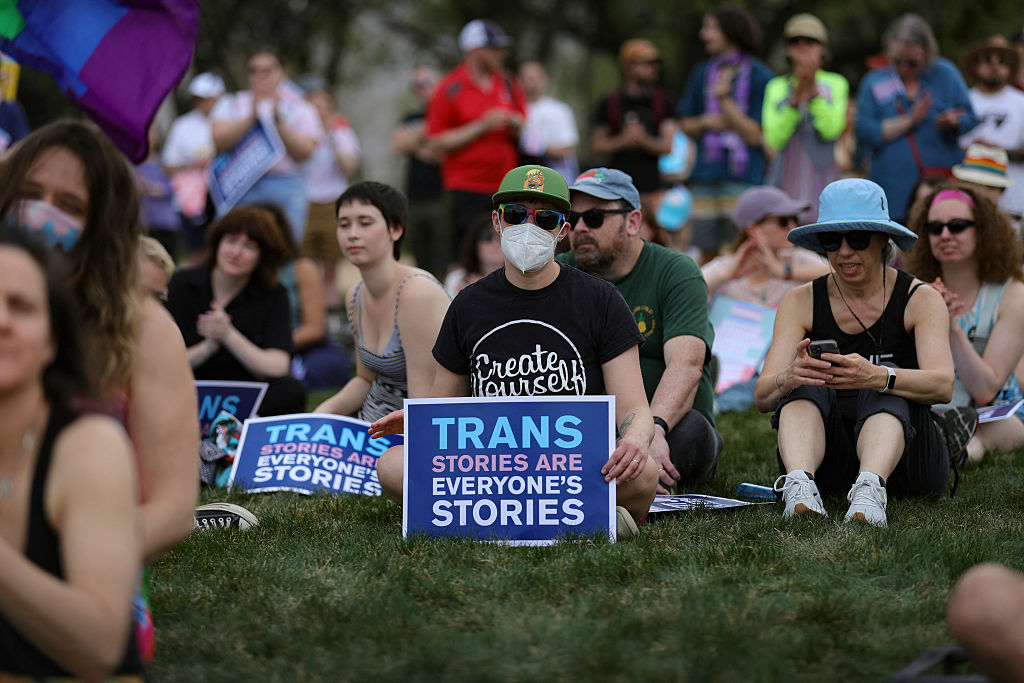
People attend the Trans Day of Visibility Rally hosted by the Christopher Street Project on the National Mall in Washington, D.C., on March 31, 2025.Bryan Dozier / Middle East Images / AFP via Getty Images

Support justice-driven, accurate and transparent news — make a quick donation to Truthout today!

Over the past year, we have seen the Trump administration repeatedly use the specter of sexual violence to scapegoat immigrants and trans people — specifically women and transfeminine people. Both historically and currently, these groups are disproportionately likely to face sexual violence, but in the right-wing narrative, they have been reframed as its perpetrators. While breathtaking in its hypocritical victim-blaming, this story is actually an old one: Powerful men excuse or deny their own acts of sexual violence while demonizing marginalized communities as the “real” threat to justify their repression.

But for as long as that story has unfolded, people have resisted. Every April is Sexual Assault Awareness Month, a time to recommit to supporting survivors and preventing sexual assault. This year, I want to focus on some of those stories of resistance. For decades, trans people, queens, butches, and other gender-nonconforming people in the U.S. have resisted sexual violence in countless ways — whether through seeking policy change, opening their homes to other survivors, telling their stories, escaping attackers, confronting harassment, or organizing others to support survivors. What follows are just a few examples.


Frances Thompson’s 1866 Testimony

Frances Thompson, a Black disabled woman, was one of the many Black people attacked by white people during the Memphis Massacre of 1866. In the aftermath, she testified before Congress about her experience of being raped. Her testimony was part of an effort to pass the Reconstruction Amendments, and she won. Partly because of her testimony, Congress passed the 14th Amendment, guaranteeing equal protection under the law to all people.

The promise of that amendment has yet to be realized. It did not even protect Thompson in her lifetime: Years after her testimony, authorities arrested and stripped her — another sexual assault at the hands of white men. Thompson was fined and jailed after these authorities learned that she was a transgender woman, and the white press speculated that, as a trans woman, she must have lied about getting attacked. She continued to speak out, telling a reporter about mistreatment from the chief of police — allegations the reporter declined to put in print. But Thompson’s legacy lives on, and still today, Black people, trans people, women, and disabled people targeted by the government use the 14th amendment as a legal tool to demand equal treatment.

Related Story

Trans People Behind Bars Share How They Are Navigating the Dangers of Visibility
The vitriol of Trump’s anti-trans attacks has stoked anti-trans violence by prison staff and other incarcerated people. By Gabriel Arkles , Truthout/TheAppeal March 31, 2026


Ralph Kerwineo’s 1914 Article

Ralph Kerwineo, a multiracial clerk in Milwaukee, catapulted into the public spotlight when his first wife, Mamie White, went to the police to report that he was assigned female at birth. She did so after he had left her and married a younger woman, Dorothy Klenowski. When put on trial, Kerwineo managed to convince the judge that he lived and dressed as a man solely for economic and safety reasons, not for any “immoral” purpose. Kerwineo used the media spotlight to condemn male violence toward women, writing about the prevalence of sexual harassment particularly in the workplace. He explained, “Don’t misunderstand me; there are good men in the world, just as there are good women, but living, both as a man and a woman, I have found that most men do not consider sexual sins of any great consequences. Two-thirds of the physicians I met made a nurse’s virtue the price of influence in getting her steady work.” Klenowski shared the same message, telling a reporter that she “had to leave place after place of employment because of the overtures to me by either the proprietors or others in authority.”


Don Solovich’s 1923 Report

Don Solovich, a Serbian-speaking immigrant, performer, server, and butler, refused to be silent when they encountered violence. One day in 1923, Solovich met a man named Macon Irby on the street in California. Irby commented on Solovich’s visible femininity, and Solovich explained they were a female impersonator. The two decided to get a hotel room together. Irby tried to initiate sex, but Solovich said no, after which Irby beat and robbed them. Solovich went to the police, and Irby was charged with robbery. Irby’s defense was that it was Solovich who tried to initiate sex, which outraged Irby so much that he beat Solovich. Irby denied taking their money and, in explaining why he beat them, imitated the feminine way Solovich walked for the jury. The first jury could not reach a verdict, so Irby was tried again, and Solovich would have had to testify again. That jury convicted, but the conviction was then overturned on appeal — the prosecutor had elicited testimony implying that Irby had sex with men, which the appellate court ruled was irrelevant to the issue of robbery. Years later, Solovich was killed, and their killer offered a similar defense for his violence in court.


Mabel Hampton’s Escapes, Around 1910, 1921

Mabel Hampton, a Black stud, dancer, singer, and domestic worker, encountered sexual assault numerous times in her life — and she found ways to get away. Her uncle tried to rape her when she was just 8 years old. She screamed and kicked, and soon after, she ran away, using money she earned dancing for change on the street to leave town. When she was a teenager, strangers assaulted her, and she managed to dash onto a subway car to escape when they tried to move her, narrowly dodging a thrown knife. This time she told her friends, who drew their own knives and looked for her attackers. Hampton supported civil rights and lesbian movements over the course of decades, and she co-founded the Lesbian Herstory Archives in 1974.


Rev. Dr. Pauli Murray’s 1940 Letters

Pauli Murray, the Black transmasculine lawyer, writer, professor, reverend, and saint, is probably best known for their brilliant legal strategies opposing race and sex discrimination. But before they became a lawyer, they had their own encounters with the legal system. In 1940, when Murray was traveling with their girlfriend Adelene “Mac” McBean through Virginia, they were both arrested for objecting to the racist treatment they received on a segregated bus. After white officers jailed them, some of the men in an adjacent cell started verbally harassing Murray and Mac. These men also used an angled mirror under the cell door to look at them, depriving them of any privacy. In response, Murray applied principles of nonviolent struggle and wrote a letter to the men, explaining how they had come to be arrested and stressing how unjust racial segregation was. The harassment stopped. Four men pushed apology notes back to them. The women Murray and Mac were confined with also became less hostile. As Murray wrote in one of their memoirs, “eventually we were all agreeing on the need for solidarity in the struggle for racial emancipation.”


Stormé DeLarverie’s 1969 Bail Money

Stormé DeLarverie, a disabled Black performer, survived plenty of violence in her life. While sometimes called a butch lesbian, male impersonator, drag king, trans man, gender-bender, or nonbinary person, she refused labels and expressed no preference on the gendered language people use. Deeply committed to protecting her community from street-based harassment and other violence, she not only worked as a bouncer at a lesbian bar, she also regularly patrolled the streets in her off hours to see if anyone could use her help. That’s what DeLarverie was doing at Stonewall in 1969 — just seeing if anyone needed anything. When a cop called her a slur and punched her in the eye, though, she spun around and knocked him out with one punch. Then she went home to tend her eye and get money so she could bail out anyone who needed it. She was often armed and never shied away from confronting someone harassing LGBTQ+ people, all of whom she considered her babies. Later in her life, she told an interviewer: “I’m a human being that survived. I’ve helped other people survive.”


Sylvia Rivera’s 1973 Speech

Sylvia Rivera, a Puerto Rican street queen, revolutionary, and another Stonewall veteran, supported her community’s safety through many means, including direct action and mutual aid. Rivera’s 1973 speech — now famous thanks to Tourmaline’s archival work — is a powerful example of how she called on others to show up for gay people beaten and raped in jail. “I’ve been trying to get up here all day for your gay brothers and your gay sisters in jail that write me every motherfucking week and ask for your help, and you all don’t do a goddamn thing for them. Have you ever been beaten up and raped in jail?” she asked the crowd. “They’ve been beaten up and raped after they’ve had to spend much of their money in jail to get their self home and to try to get their sex changes.… I have been to jail. I have been raped, and beaten.”

Rivera took the audience to task for failing their siblings, but she didn’t stop there. She called on them to come to the headquarters of the organization she co-founded — Street Transvestite Action Revolutionaries (STAR) — to learn more. Among other things, the STAR Manifesto demanded “the right to self-determination over the use of our bodies” and “the immediate end of all police harassment.”


Dee Deirdre Farmer’s 1989 Lawsuit

Before Dee Deirdre Farmer brought her case to the Supreme Court and won, prison officials had nearly complete impunity when it came to allowing sexual violence in prisons. Farmer nonetheless pursued a case in 1989 demanding accountability after officials ignored the risk she faced as a young trans woman in a federal penitentiary for adult men, leading to her rape. She brought her case without a lawyer through the lower courts and all the way up to the Supreme Court, finally getting representation from the ACLU once she had convinced the Supreme Court to hear her case. Against the odds, she won, with the Supreme Court unanimously ruling in 1994 that violent assault was not “part of the penalty” for breaking the law. Her case has since been cited tens of thousands of times. In the decades since, Farmer has continued to advocate for trans, LGBTQ+, HIV-positive, and disabled people in prison, assisting over a thousand incarcerated people with their own cases.


Lorena Borjas’s Cart and Folding Bed, 1980s to 2020

Lorena Borjas, an immigrant from Mexico and survivor of trafficking, police violence, and domestic violence, helped countless other trans Latina New Yorkers survive pandemics, poverty, and violence. She worked relentlessly, usually without pay, to protect her community. She filled her cart with condoms and food and brought it to trans sex workers on the streets in Queens. Borjas welcomed trans people who didn’t have a safe place to stay into her own home, where she had a folding bed for them to sleep on. She connected trafficking survivors with immigration lawyers. She raised money to post bail. For countless survivors, she offered advice, connection, support, and love.


Juan Evans’s 2014 March

Juan Evans, a formerly incarcerated trans man and organizer with Racial Justice Action Center and Solutions Not Punishment Collaborative (SnapCo) in Atlanta, spent his life fighting for prison abolition and the freedom, health, and safety of trans sex workers and Black women, among others. In 2014, he was pulled over, and the police officer, surprised by his ID and gender presentation, demanded to know about his genitals. The officer arrested Evans for being trans, repeatedly threatening him with the assault of a strip search to inspect his genitals and calling him a “thing” and an “it.” His wife, his lawyer, and his boss came to the station and got him out. Afterward, Evans led a march and rally to demand change and spoke to the press. He received an official apology from the mayor and worked with others at SnapCo to push for better policies and training for police. Through SnapCo, he also used somatic healing to address the trauma of the experience, and continued organizing to close jails.


Alyssa Rodriguez’s 2022 Settlement

Alyssa Rodriguez, a Puerto Rican trans New Yorker, was criminalized and incarcerated several times, and advocated for herself and other LGBTQ+ people in carceral systems. She was confined in juvenile detention as a teen, where she was denied hormone treatment, forced to wear boys’ clothes and underwear, and punished for her femininity. She started legal action in 2006 that ultimately led to important changes in how transfeminine, gender-nonconforming, and LGBTQ+ young people were treated in juvenile detention in New York State. Years later, Rodriguez brought a lawsuit against the New York City Department of Correction when officials’ actions led to her rape on Rikers Island. While she passed away in 2020 before her lawsuit concluded, her estate settled the case for $1.4 million.

Fighting sexual assault has been a key part of many liberation movements, including movements for trans and queer liberation. Today, trans and gender-nonconforming survivors continue a legacy of resistance that goes back longer than we know. Trans and gender-nonconforming people — in the midst of the unrelenting and seemingly ever-escalating attacks on our communities — continue to organize to provide shelter, support each other, find safer havens, share our stories, defend ourselves, mobilize to protect rights, and demand accountability.


This article is licensed under Creative Commons (CC BY-NC-ND 4.0), and you are free to share and republish under the terms of the license.

Gabriel Arkles
Gabriel Arkles is an attorney and writer based in Brooklyn, New York. His work has also appeared in publications such as NBC News, CBS, the Advocate, Scholar and Feminist Online, NYU Law Review, Northeastern Law Journal, Southwestern Law Review, and Signs. He writes in his individual capacity, and his views do not necessarily reflect those of his employer.


New Poll Shows Americans Reject Trump’s Plans to Redesign Washington, DC

The poll also found that a plan to place Trump’s name on US currency is deeply unpopular.
April 30, 2026

White House Press Secretary Karoline Leavitt shows an artist's rendering of President Donald Trump's planned Triumphal Arch during a press briefing on April 15, 2026.Brendan Smialowski / AFP via Getty Images

New polling indicates that most Americans are opposed to President Donald Trump’s vanity projects, including his plans to reshape the look of Washington, D.C. and to put his name on U.S. currency.

Within a Washington Post/ABC News/Ipsos poll that was published on Thursday, respondents were asked their opinions on Trump tearing down portions of the East Wing of the White House, to be replaced with an extravagant, reportedly $400 million ballroom. Even with the caveat that the project would be financed by private donors, only 28 percent of respondents said they supported the project, while 56 percent were opposed.

Support for Trump’s vision for a 250-foot-tall triumphal arch near the Lincoln Memorial and Arlington National Cemetery was equally low. Only 21 percent of Americans said the project should move forward, while 52 percent were opposed.

And asked whether they approved of Trump’s signature replacing the Treasury Secretary’s name on U.S. dollar bills, only 12 percent of Americans said they liked the idea, while 68 percent were opposed, the poll found.

Trump is pushing for other projects featuring his likeness to move forward, too, including a redesign of art inside U.S. passports to include his portrait. The poll did not inquire about that proposal, as the administration released the idea to the public as the survey was being conducted. But given the low approval ratings of Trump’s other projects — and his current job approval numbers sinking to record lows — it’s highly unlikely that changes to the passport design would receive wide approval from the public.

Indeed, other surveys indicate a distaste for the proposed passport redesign. A recent YouGov poll asking Americans their opinions on passports including Trump’s likeness found that only 18 percent would prefer passports with that imagery, while 67 percent would pick a passport without Trump’s face, if given the option.

Many of Trump’s proposed changes have generated widespread controversy. The triumphal arch, for example, received just under 1,000 responses during a public comment period, 100 percent of which were deemed to be opposed to the project. Despite those comments — and a veterans group voicing its intent to sue over its construction — the Commission of Fine Arts (whose members were all selected by Trump) voted to advance the planned building of the monument.

The ballroom project is supposed to be financed by private donors, Trump said, a move that raises concerns about conflicts of interest, as many of the companies and billionaires that have pledged to contribute are poised to benefit from policies the administration may enact relating to their business ventures. Donors for the ballroom also include companies that have profited from Trump’s draconian anti-immigration policies, as well as Israel’s occupation of Palestine and its genocide in Gaza.

In recent days, some Republican senators have pushed for the U.S. government to fund the entirety of the ballroom project, citing the shooting at the White House Correspondents Association (WHCA) dinner last weekend.

“If you don’t think $400 million of taxpayer money is a good investment to create a secure facility at the White House, then I disagree,” said Sen. Lindsey Graham (R-South Carolina). “I bet you 90 percent of Americans would love to have a better facility.”