Monday, May 04, 2026

Two foreign activists seized from Gaza aid flotilla appear before Israeli court

Spanish national Saif Abu Keshek and Brazilian Thiago Avila were brought before an Israeli court Sunday after Israeli troops seized them from a flotilla attempting to bring humanitarian aid to the besieged Gaza Strip. Avila told his lawyers that he had been beaten so badly in Israeli custody that he passed out twice.


Issued on: 03/05/2026 -
By: FRANCE 24

People gather in front of the European Commission office in Barcelona in support of activists Saif Abu Keshek and Thiago Avila, members of the Global Summud Flotilla seized by Israel, in Barcelona, Spain, May 2, 2026. © Bruna Casas, Reuters

An Israeli court Sunday extended by two days the detention of two foreign activists from a Gaza-bound flotilla who were brought to Israel for interrogation, a rights group representing them said.

The flotilla of more than 50 vessels had set sail from France, Spain and Italy with the aim of breaking an Israeli blockade of Gaza and bringing humanitarian supplies to the devastated Palestinian territory.

They were intercepted by Israeli forces in international waters off Greece early on Thursday, with Israel saying it had removed some 175 activists – two of whom were taken to Israel for questioning.

Spanish national Saif Abu Keshek and Brazilian Thiago Avila appeared before a court in the southern city of Ashkelon on Sunday.

AFP footage showed the two being escorted into the courtroom, with Avila's hands cuffed behind his back and Abu Keshek's feet shackled.

"The court extended their detention by two days," Miriam Azem, international advocacy coordinator at the rights group Adalah, told AFP.

Adalah said the state attorney had presented a list of suspected offences committed by the pair, including "assisting the enemy during wartime" and "membership in and providing services to a terrorist organisation".

But Adalah's lawyers challenged the state's jurisdiction, arguing against the "unlawful abduction" of the two activists in international waters.

Its lawyers told the court Avila and Abu Keshek had testified to "severe physical abuse amounting to torture, including being beaten and held in isolation and blindfolded for days at sea".

Screenshot of a post by the Adalah Center for Human Rights on X on May 2, 2026. © Screenshot, X


No formal charges were filed against the two, it said.

"We argued that ... they were part of a humanitarian mission that aimed to provide humanitarian aid to the civilians in Gaza, and not to any other organisation, whether terrorist or not," lawyer Hadeel Abu Salih told journalists after the hearing.

"We deny all the accusations that were presented ... and demand these two men be released immediately," she said.

Spain's government called for Abu Keshek's "immediate release", the foreign ministry said in a statement to AFP, indicating the Spanish consul had accompanied Abu Keshek to the hearing.

Adalah's lawyers had met the two men at Ashkelon's Shikma Prison on Saturday.

They said Avila recounted being "subjected to extreme brutality" by Israeli forces when the vessels were seized, saying he was "dragged face-down across the floor and beaten so severely that he passed out twice".

Abu Keshek was also "hand-tied and blindfolded ... and forced to lie face-down on the floor from the moment of his seizure" until reaching Israel, it said.


Rebuilding Gaza Strip: Labour Day is the last thing on Palestinians' minds
© France 24
01:48

Israel's foreign ministry said the pair were affiliated with the Popular Conference for Palestinians Abroad (PCPA) – a group accused by Washington of "clandestinely acting on behalf of" Palestinian militant group Hamas.

It said Abu Keshek was a leading PCPA member, and that Avila was also linked to the group and "suspected of illegal activity".

The Global Sumud Flotilla's first Mediterranean voyage to Gaza last year drew worldwide attention, before being intercepted by Israeli forces off the coasts of Egypt and Gaza.

Avila was one of the organisers of that flotilla, which was also intercepted by Israeli forces, with crew members – including Swedish activist Greta Thunberg – arrested and expelled.

Israel controls all entry points into Gaza, which has been under an Israeli blockade since 2007.

Throughout the Gaza war, there have been shortages of critical supplies in the Palestinian territory, with Israel at times cutting off aid entirely.

(FRANCE 24 with AFP)


Israeli Forces Intercept Boats from Activist Flotilla Seeking to Reach Gaza

people on boat with lifejackets and hands up
Scene from video aboard the boats stopped by Israelo forces (Global Sumud Flotilla)

Published Apr 30, 2026 6:31 PM by The Maritime Executive


For the second time, Israeli forces have acted to stop a flotilla of small boats loaded with activists that were attempting to reach Gaza and creating an international spectacle. Last October, Israeli forces intercepted the boats close to the Israeli shore, but this time Israeli forces sought to stop the flotilla while it was in international waters near Greece.

The group, calling itself the Global Sumud Flotilla, had initially set out from Barcelona on April 12. Last week, they had attempted to circle an MSC containership in the central Mediterranean that they accused of transporting materials to Israel. 

The group gathered in Italy and set off on Sunday, reporting that it consisted of 56 small boats. They were calling themselves the “largest coordinated civilian maritime mobilization,” saying their goal was to challenge the Israeli blockade of Gaza and advance the opening of a permanent humanitarian corridor. They reported that Greenpeace’s Arctic Sunrise vessel and the rescue ship Open Arms had accompanied them as they set off from Italy. They said the boats were registered in Poland, Italy, Spain, Slovenia, and France.

Late on Wednesday, April 29, they reported Israeli forces intercepted the boats in the vicinity of Crete. A Greek government spokesperson confirmed that 55 vessels were 50 nautical miles off the Peloponnese and were being watched by Israeli warships and the Hellenic Coast Guard.

An Israeli naval officer can be heard in one of the group’s videos urging them to change course and not to proceed. They were told to direct their aid through established and recognized channels. They were also told they could sail to Ashdod, Israel, to offload supplies, which would be transferred to humanitarian groups and delivered to Gaza. 


The group contends the Israelis launched drones and employed communications jamming technology before boarding their boats. The group’s online tracker claims 22 boats were intercepted west of Crete and that 45 boats are still sailing south of Crete. Other reports are saying 36 boats were still heading toward Gaza.

The group issued a statement calling the intervention “piracy.” They claimed some of their boats were disabled and demanded that Greece, Malta, Italy, and Cyprus launch a SAR operation. They were also calling on commercial and private boats in the area to divert and provide aid.

The “Board of Peace,” organized by world leaders including Donald Trump, issued a statement saying, “The ‘flotilla’ heading to Gaza is the performative love-boat activism of people who know nothing of and care even less for the condition of Gazans.” They also called for directing aid through established humanitarian channels while reporting their success in stopping Hamas from stealing aid supplies. 

Israel’s UN envoy, Danny Dannon, said Israel was stopping the flotilla before it reached “our area.” He called the activists in the group “delusional attention-seeking agitators.”

Israel’s Foreign Minister, Gideon Saar, said they were coordinating with the Greek government and would transfer those intercepted to Greece. The group was claiming that as many as 175 to 180 people had been taken into custody.

The first attempt at the flotilla stopped when there was an explosion on a boat off Malta in May 2025. The group asserted that they had been attacked by Israeli drones. About 40 boats and as many as 450 people approached Israel in October and were stopped by Israeli forces. The group claimed they were treated harshly, while Israel said they were given food and water and quickly placed on airplanes to be deported back to Europe.


Three dead on Atlantic cruise ship in suspected Hantavirus outbreak, says WHO

Three people have died aboard a cruise ship crossing the Atlantic after an outbreak that includes a confirmed case of hantavirus, the World Health Organization said Sunday, raising concerns about a rare but potentially severe infection at sea.


Issued on: 04/05/2026 
By: FRANCE 24

The outbreak occurred on the MV Hondius, travelling from Ushuaia in Argentina to Cape Verde. © AFP
01:24


Three people have died on a cruise ship in the Atlantic, the WHO said Sunday, one a confirmed case of hantavirus -- an illness usually transmitted to humans from rodents.

The outbreak occurred on the MV Hondius, travelling from Ushuaia in Argentina to Cape Verde.

"To date, one case of hantavirus infection has been laboratory confirmed, and there are five additional suspected cases," the World Health Organization told AFP.

"Of the six affected individuals, three have died and one is currently in intensive care in South Africa."

Earlier Sunday, South Africa's health ministry told AFP there had been an outbreak of a "severe acute respiratory illness", which had killed at least two people, with a third in intensive care in Johannesburg.

The patient treated in Johannesburg tested positive for a hantavirus, a family of viruses that can cause hemorrhagic fever, South African spokesperson Foster Mohale said.

In its statement, the WHO said hantavirus infections "are typically linked to environmental exposure (exposure to infected rodents' urine or faeces).

"While rare, hantavirus may spread between people, and can lead to severe respiratory illness and requires careful patient monitoring, support and response."

Husband and wife

The first person on the cruise to develop symptoms was a 70-year-old passenger. He died on board the ship and his body was currently on the island of Saint Helena, a British territory in the South Atlantic, Mohale the South African spokesman said.

His 69-year-old wife also fell ill on board and was evacuated to South Africa, where she died in a Johannesburg hospital, he said, adding that they were not yet able to confirm the victims' nationalities.

Hantaviruses are spread by rodents, in particular through contact with their droppings, urine or saliva © MIGUEL MEDINA / AFP/File


The third case, a 69-year-old Briton, was also evacuated to Johannesburg, where he was being treated in intensive care.

WHO chief Tedros Adhanom Ghebreyesus said in a post on X that the agency was working with the ship's operators and member states affected.

"WHO is facilitating medical evacuation of two symptomatic passengers, conducting a full risk assessment, and supporting affected people onboard," he added.

"Rapid, coordinated action is critical to contain risks and protect public health."

Earlier Sunday, a source close to the case speaking on condition of anonymity had said a Dutch couple were among the dead. The third fatality was still on board the ship.

Discussions were under way to decide whether two other sick passengers should be placed in isolation in hospital in Cape Verde, after which the ship would continue to Spain's Canary Islands, the anonymous source said.

The MV Hondius is listed as a polar cruise ship on the websites of several travel agencies. It is operated by a Dutch-based tour company, Oceanwide Expeditions.

One of the cruises offers an itinerary departing from Ushuaia for Cape Verde, with stops in the islands of South Georgia and Saint Helena.

According to several online ship-tracking sites, the MV Hondius was just off the port of Praia, the capital of Cape Verde, on Sunday.

The vessel can accommodate around 170 passengers and has some 70 crew members.

Humans can catch hantaviruses from contact with infected mice or rats or their droppings, or being bitten or inhaling contaminated dust. There are multiple types of hantaviruses in different parts of the world, with different symptoms.

AFP contacted the cruise operator Oceanwide Expeditions but has not yet had a reply.

(FRANCE 24 with AFP)


'Low' risk to public of hantavirus after cruise ship deaths, WHO says

The Hague (AFP) – A suspected outbreak of hantavirus on a cruise ship, on which three people have died, presents a low risk to the public, the WHO Europe said Monday, as Dutch authorities planned to repatriate two sick people.


Issued on: 04/05/2026 - FRANCE24

The ship is currently located off the coast of Cape Verde © - / AFP

"The risk to the wider public remains low. There is no need for panic or travel restrictions," the World Health Organization's director for Europe Hans Kluge said in a statement, adding that hantavirus infections were "uncommon and usually linked to exposure to infected rodents".

In its first statement on the crisis, the vessel's operator Oceanwide Expeditions confirmed three deaths on board the MV Hondius, travelling across from Ushuaia in Argentina to Cape Verde off the coast of west Africa.

Two died on board and one after disembarking the ship. One passenger is in intensive care in Johannesburg and two others "require urgent medical care", the statement said.

"Dutch authorities have agreed to lead a joint effort to organise the repatriation of the two symptomatic individuals on board MV Hondius from Cape Verde to the Netherlands," the operator said.

Such a repatriation would depend on several factors, including authorisation from local officials in Cape Verde, said Oceanwide Expeditions.

An AFP photographer saw the ship on Monday morning, anchored in the port of Praia, off the coast of Cape Verde.

In a statement sent to AFP, the Dutch foreign ministry said it was "busy looking at the possibilities to medically evacuate a few people from the ship".

"If this can take place, the ministry of foreign affairs will coordinate it," said a spokesperson.

'Acting with urgency'


While local doctors have visited to assess the medical condition of the two sick passengers, no permission has been given to evacuate them to shore.

"Disembarkation and medical screening of all passengers require coordination with local health authorities and we are in close consultation with them," said the operator.

The WHO said it was "acting with urgency to support the response to the hantavirus event on board a cruise vessel in the Atlantic, following the tragic loss of life".

"WHO Europe is working with the countries involved to support medical care, evacuation, investigations and public health risk assessment."

Hantavirus, an illness usually transmitted to humans from rodents, has been confirmed in the passenger currently in intensive care in Johannesburg, the operator said.

However, it has not yet been established whether the virus caused the three deaths, said Oceanwide Expeditions.

There has also been no confirmation of hantavirus in the two symptomatic passengers still requiring attention on the ship.

"The exact cause and any possible connection are under investigation," said the ship's operator.

On Sunday, the WHO said one case of hantavirus had been confirmed and that there were "five additional suspected cases."

"While rare, hantavirus may spread between people, and can lead to severe respiratory illness and requires careful patient monitoring, support and response," the United Nations health agency said.

burs-cbw/po/sbk

© 2026 AFP


Cruise ship operator says Dutch to repatriate two ill passengers

The Hague (AFP) – Dutch authorities will attempt to repatriate two sick people from a cruise ship battling a suspected outbreak of hantavirus that has already claimed three lives, the vessel's operator said Monday.


Issued on: 04/05/2026 - FRANCE24


In its first statement on the crisis, Oceanwide Expeditions confirmed it was dealing with "a serious medical situation" on board the MV Hondius, travelling from Ushuaia in Argentina to Cape Verde.

The operator confirmed the three deaths, two on board and one after disembarking the ship. One passenger is in intensive care in Johannesburg and two others "require urgent medical care," the statement said.

"Dutch authorities have agreed to lead a joint effort to organise the repatriation of the two symptomatic individuals on board MV Hondius from Cape Verde to the Netherlands," the operator said.

Such a repatriation would depend on several factors, including authorisation from local officials in Cape Verde, said Oceanwide Expeditions.

In a statement sent to AFP, the Dutch foreign ministry said it was "busy looking at the possibilities to medically evacuate a few people from the ship."

"If this can take place, the ministry of foreign affairs will coordinate it," said a spokesperson.

The ship is currently located off the coast of Cape Verde. While local doctors have visited to assess the medical condition of the two sick passengers, no permission has been given to evacuate them to shore.

"Disembarkation and medical screening of all passengers require coordination with local health authorities and we are in close consultation with them," said the operator.

Hantavirus, an illness usually transmitted to humans from rodents, has been confirmed in the passenger currently in intensive care in Johannesburg, the operator said.

However, it has not yet been established whether the virus caused the three deaths, said Oceanwide Expeditions.

There has also been no confirmation of hantavirus in the two symptomatic passengers still requiring attention on the ship.

"The exact cause and any possible connection are under investigation," said the ship's operator.

On Sunday, the World Health Organization said one case of hantavirus had been confirmed and that there were "five additional suspected cases."

"While rare, hantavirus may spread between people, and can lead to severe respiratory illness and requires careful patient monitoring, support and response," said the WHO.

burs-ric/yad

© 2026 AFP


Hantavirus: spread by rodents, potentially fatal, with no specific cure

Geneva (AFP) – Hantavirus, the disease which has caused a deadly outbreak on a cruise ship in the southern Atlantic, circulates in rodents and can be deadly when transmitted to humans.


Issued on: 04/05/2026 - FRANCE24

The cruise ship MV Hondius off the coast of Praia, the capital of Cape Verde © - / AFP

Dutch cruise operator Oceanwide Expeditions confirmed Monday it was dealing with "a serious medical situation" on board the MV Hondius, travelling from Argentina to Cape Verde.

Hantaviruses are among the pathogens that can cause respiratory and cardiac distress, as well as haemorrhagic fevers.

There are no vaccines or specific medications to combat hantaviruses, meaning treatment consists solely of attempting to relieve the symptoms.

The virus

There are many types of hantavirus, which vary in their geographical spread and their pathologies, according to Switzerland's FOPH health ministry.

"Human-to-human transmission has only been observed with one single virus type, which is extremely rare," it says.

Hantaviruses are found on every continent.

The virus is named after the Hantan River in South Korea, where more than 3,000 troops fell seriously ill after becoming infected with it during the 1950-1953 Korean War, the FOPH says.

Transmission

Hantaviruses are transmitted to humans through infected wild rodents, such as mice or rats, which shed the virus in their saliva, urine, and droppings.

A bite, contact with these rodents or their droppings, or breathing in contaminated dust can cause infection.

The French National Public Health Agency says human infection generally occurs through the inhalation of dust and aerosols contaminated by the excretions of infected animals.

This is typically "during activities in forests, or in long uninhabited buildings near forests, as well as during activities in rural areas where fields and farms offer a favourable environment for reservoir rodents", it says.

The only way to minimise the risk of infection is to avoid contact with rodents and their secretions and excretions.

The World Health Organization's Europe director Hans Kluge said hantavirus infections are "uncommon" and "it is not easily transmitted between people".

"The risk to the wider public remains low. There is no need for panic or travel restrictions," he said Monday.

Diagnosis

Suspected cases can be confirmed through various laboratory tests, according to the WHO, including through "the presence of hantavirus-specific IgM antibodies".
Onset

The two most common illnesses caused by infection are haemorrhagic fever with renal syndrome (HFRS), caused by hantaviruses found mostly in Europe and Asia; and hantavirus pulmonary syndrome (HPS), caused by viruses found in the Americas.

The hantavirus types in the Americas can also cause pulmonary oedema or acute respiratory failure.

Different health authorities give varying time periods before symptoms start to manifest.

According to the US Centers for Disease Control and Prevention (CDC), HPS symptoms usually start to show one to eight weeks after contact.

HFRS symptoms usually develop within one to two weeks after exposure, and in rare cases, up to eight weeks, says the CDC.

Symptoms

Though most cases of hantavirus infection pass unnoticed, according to Switzerland's FOPH, hantaviruses can cause infections of varying severity in humans -- sometimes fatal.

The first clinical symptoms generally present like flu: fever, headache, and muscle aches.

The CDC says four to 10 days after initial HPS illness, late symptoms appear, which include coughing and shortness of breath. "Patients might experience tightness in the chest, as the lungs fill with fluid," it says.

The types of hantavirus prevalent in Europe and Asia can cause kidney dysfunction and even acute kidney failure.

Fatality rate

The Public Health Agency of Canada says around 200 HPS cases occur each year, primarily in North and South America, putting the average case fatality rate at 40 percent.

It adds that between 150,000 and 200,000 HFRS cases occur each year worldwide, most of which are in China, where the average case fatality rate is from one to 12 percent.

© 2026 AFP

California races to rescue giant sequoias after devastating wildfires

04.05.2026, DPA

Photo: Insa Sanders/dpa

After recent devastating wildfires killed nearly 20% of the world's giant sequoias, California scientists and land managers launched a large-scale restoration effort. Early results suggest the work is helping - but the next fire season will be a crucial test.

By Paul Rogers, The Mercury News

Five years ago, a tragic and depressing environmental story unfolded when thousands of giant sequoia trees, an iconic California species that tower 300 feet high and can live for 3,000 years, were killed during multiple large wildfires that roared across the southern Sierra Nevada.

The fires in 2020 and 2021 at Sequoia National Park, Sequoia National Forest and other areas in the US state burned with unprecedented intensity, killing nearly 20% of the world’s giant sequoias, and exposing the growing vulnerability of the most massive trees on the earth.

“It was heartbreaking,” said Kevin Conway, state forests program manager for Cal Fire, the state’s primary firefighting agency. “You can’t help but ask, what could I have done? What should I have done? Could I have prevented this?”

After the fires, stunned scientists, park managers and environmental groups formed a partnership to reduce the chances of similar catastrophic outcomes in the years ahead. Now, with another summer fire season looming, they say they are making encouraging progress.

Since their efforts began in 2022, the partnership has thinned the overgrown brush and small trees that provide fuel for fires to burn hotter in 44 of the 94 giant sequoia groves in California.

Crews also have conducted controlled burns and planted more than 682,000 sequoia seedlings in areas that burned severely in wildfires of 2020 and 2021.

Altogether, their work has reduced fire danger on 23,251 acres over the past four years, according to a new report issued earlier this month.

“It’s a race against time,” said Steve Mietz, the former superintendent of Redwood National Park who recently became president of Save the Redwoods League, an environmental group based in San Francisco. “It’s not a matter of if, but when we will have more fires. We have the answers. We know what to do. It’s not hopeless.”

It's a team effort

The partnership, called the Giant Sequoia Lands Coalition, has eight primary members, which own lands between Tahoe National Forest and Bakersfield where the 94 groves of massive and ancient sequoias are located.

They are: Cal Fire, California State Parks, the National Park Service, Tulare County, the Tule River Indian Tribe of California, UC Berkeley, the US Forest Service, and the federal Bureau of Land Management.

Another nine organizations are also included, providing scientific research, funding and support.

A cousin of the coast redwood, which is the world’s tallest tree, giant sequoias are the largest living tree by volume on Earth.

Decimated by logging in the 1800s and early 1900s, nearly all of the remaining groves are preserved on public land within Yosemite National Park, Sequoia-Kings Canyon National Park, Calaveras Big Trees State Park and Sequoia National Forest.

The trees evolved with fire, said Kristen Shive, a fuels and forest specialist with the University of California Cooperative Extension Program at UC Berkeley. Giant Sequoia cones have resin that needs fire to melt it to release seeds.

Their spongy, reddish bark can grow to 2-feet thick. It acts like insulation, protecting the tree’s inner living tissue from heat.

Fires from lightning and those set by Indian tribes typically burned through giant sequoia groves every 10 to 20 years before the Gold Rush of the 1850s. But starting about 100 years ago, efforts to fight wildfires began to make them more vulnerable to fire.

When fire crews put out fires, it allowed small trees, brush and dead wood to build up to unnaturally dense levels, Shive noted. Now, when wildfire flames enter the groves, they burn hotter and more intensely than ever before, with the potential to kill the ancient trees entirely.

“Those fires in 2020 and 2021 were a game changer,” she said. “We had thousands of acres of high-severity fire. It was a shocking change and a hard one. We were going out to do surveys and seeing trees that had lived for millennia and had died due mostly to human mismanagement. It was a really hard pill to swallow.”

Another added stress is climate change. Hotter temperatures dry out soils and vegetation, making fire more severe. The drought of 2012-2016 and 2020-2022 killed millions of other trees in the Sierra, providing more fuel for fires.

The solution, Shive and Conway said, is removing many of the overgrown smaller trees that surround the giant sequoias in dense thickets, like white fir, red fir and incense cedar. Large sugar pines and ponderosa pines that died during droughts are also removed with chainsaws.

Much of the debris is piled and burned out of fire season. Some of the larger wood on private land or Cal Fire-owned demonstration forests can be sold to lumber companies to offset the costs of thinning.

After thinning, areas can be treated with controlled burns, using techniques native tribes used for centuries, Conway said. Removing the extra material not only causes wildfires to burn less intensely and less hot, but it also allows more sunlight into the forest so giant sequoia seedlings have a chance to grow, he added.

“These forests aren’t in their natural condition,” Conway said. “We are trying to get them back to their natural condition so they are resistant to drought, fire and disease. It is a more open, thinner stand of trees.”

Sometimes the practices are controversial

In 2022, the Earth Island Institute sued the National Park Service to halt fuel reduction projects planned for Merced Grove in Yosemite. The group claimed that not enough environmental study had been done. A federal district court dismissed the case, and in 2023, the Ninth Circuit US Court of Appeals upheld that decision.

Six wildfires have threatened the Merced Grove in the past 15 years. The work to thin other tree species and perform controlled burns began last year and is expected to continue this year.

It could take another five to 10 years to treat all 94 groves, Conway said. Research has shown that the work has saved giant sequoias.

In 2020, the Castle Fire burned into Mountain Home Grove, a giant sequoia grove east of Porterville in Tulare County that Cal Fire had thinned and treated with controlled burns. That fire killed 7% of the giant sequoias there but 18% of the giant sequoias outside it, he said.

The main challenge is funding. Although some money is available from Proposition 4, a climate bond passed by California voters in 2024, more state, federal and private funding is needed to finish the job and maintain the forests, Mietz said.

“Ancient sequoias take thousands of years to reach their majestic beauty,” he said. “They attract people from across the world. They are one of the largest organisms on the planet, a marquee species in the Sierra range. We have the science. We have the know-how. We just need the resources.”

Energy crisis fuels calls to cut methane emissions

Paris (France) (AFP) – World officials pushed Monday for faster action to reduce methane emissions from the fossil fuel sector, arguing it would both help slow climate change and boost energy security as the Middle East war chokes off supply.


Issued on: 04/05/2026 - RFI

The fossil fuel sector -- oil, gas and coal -- accounts for 35 percent of methane emissions from human activity, the IEA said in a report © AHMAD AL-RUBAYE / AFP/File

Using its role as rotating president of the Group of Seven industrialised powers, France convened government officials, industry leaders and experts to build momentum on cutting methane emissions ahead of the UN's COP31 climate summit in November.

Methane, the second biggest contributor to climate change, stays in the atmosphere for far less time than carbon dioxide, but its warming effect is roughly 80 times more potent over a 20-year period.

"I sincerely hope that the discussions we will have today will enable us to join our forces to accelerate the implementation of effective solutions to reduce methane emissions," French Ecological Transition Minister Monique Barbut said in a speech.

"Of course, action on methane is not a fight of any single actor and nobody can win it alone," Barbut said.

Under the Global Methane Pledge, launched at COP26 in Glasgow in 2021, nearly 160 countries committed to cutting global methane emissions by 30 percent by 2030 compared with 2020 levels.

But Barbut said the world remains "very far" from meeting that goal.

Around 60 percent of methane emissions are linked to human actions.

The fossil fuel sector -- oil, gas and coal -- accounts for 35 percent of methane emissions from human activity, the International Energy Agency said in a report on Monday.

"Yet there is still no sign that methane emissions from fossil fuel operations are falling, despite well-known and proven mitigation pathways," according to the IEA's Global Methane Tracker 2026.

Such emissions from the sector remained "near record highs", the report said.
Time to 'pull this lever'

Methane emissions from the energy sector come from leaks from gas pipelines and other infrastructure, or are deliberately released during maintenance procedures.

Officials at the Paris conference said that cutting leaks and flaring from oil and gas operations could increase the availability of energy while slashing planet-heating emissions.

"We could have three times more gas on the market if we eliminated this waste," the European Union's energy commissioner, Dan Jorgensen, said. "This shows that methane abatement and energy security are not competing priorities."

"Methane is the single fastest lever we have to limit near-term warming. We can no longer wait to pull this lever," Jorgensen added.

Oil prices have soared since the United States and Israel launched the war against Iran in late February and Tehran closed the Strait of Hormuz in response.

The IEA said 20 percent, or around 110 billion cubic metres, of the world's liquefied natural gas (LNG) flowed through the Strait of Hormuz last year.

Nearly 100 billion cubic metres of natural gas could be made available annually through a global effort to cut methane from oil and gas operations, the IEA said.

A further 100 billion cubic metres would be unlocked through the elimination of non-emergency flaring worldwide, it added.

"Reducing methane emissions remains one of the best things we can do to slow global warming while cleaning up our air, improving public health, and increasing our energy security," British energy minister Ed Miliband said in a video message.

Agriculture is also a major emitter through livestock -- cows and sheep release methane during digestion and in their manure -- and rice cultivation, where flooded fields create ideal conditions for methane-emitting bacteria.

Discarded household waste also creates large amounts of methane if left to rot in landfills.

"We must, however, be clear the energy sector offers today the fastest and often the most cost effective reductions," Barbut said.

© 2026 AFP
China’s Production Capacity for Green Fuels Reaches Eight Million Tons

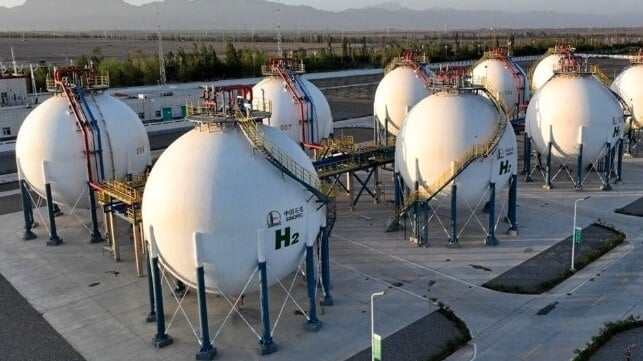
Green hydrogen storage tanks at a new green-fuel facility (Sinopec press handout)

Published May 3, 2026 6:24 PM by The Maritime Executive

As global shipping builds momentum for a net-zero emissions future, countries are increasingly investing in production of green fuels. China continues to be a trailblazer in the green fuel industry, going by data released last week by the country’s energy regulator, the National Energy Administration (NEA).

As of March, China’s green hydrogen production capacity exceeded over 1.1 million tons. This consists of 250,000 tons for operational projects, which is more than double the capacity in 2024. The other remaining 900,000-plus tons is for projects under construction. The huge pipeline of projects - now exceeding the installed capacity - reflects on the success of China’s hydrogen policy, launched in 2022.

In addition, NEA revealed that China has so far built an overall green fuel production capacity of around 8 million tons of oil equivalent per year. This production scale reflects expansion from traditional ethanol and biodiesel fuels to green ammonia and green methanol. NEA added that annual production capacity for green ammonia stands at 700,000 tons, while that of green methanol is around 380,000 tons.

With disruptions in the Strait of Hormuz, NEA has emphasized the development of green fuels as a strategic priority. NEA described the transition as progressively substituting petroleum for energy security. “This is new for green fuel. It is the first time green fuels have been explicitly framed in China as part of an energy security narrative,” commented Kai Yu, a researcher in China’s clean energy.

Besides the policy milestones, Beijing has also rolled out incentives for city clusters supporting scaling of hydrogen applications to areas such as aviation, shipping and manufacturing. The reward scheme promised by the central government to five city clusters is worth around $232 million.

In a world moving towards decarbonization, hydrogen will play a fundamental energy role, especially in the production of other alternative fuels like green methanol and ammonia. China is still in the initial phases of achieving commercial scale for these fuels, supported by renewable electricity surplus and electrolyzer deployment.

However, the risks at this stage are also massive. The hydrogen fuels market is not yet mature and the export volumes are low. Again, there are few bankable offtake plans and the next 12-24 months will be pivotal in indicating ammonia and methanol demand levels. The fact that China is not waiting for the hydrogen market to mature could indicate it is aiming for an influential role in production of green fuels.

This positioning is also evident in recent strategic decisions taken by one of China’s largest shipbuilding companies, the Yangzijiang Group. The Singapore-listed company last month unveiled a new ship repair and conversion arm, targeted at the rising demand for retrofits and green upgrades of vessels.


Climate change and pollution are increasing stroke risk, new research finds

The World Stroke Organization has also highlighted air pollution as a major factor in stroke risk.
Copyright Canva

By Roselyne Min
Published on 

Climate change and air pollution may be linked to stroke risk, the World Stroke Organization says.

Environmental changes made worse by climate change, including extreme temperatures, sudden temperature swings, humidity, air pressure, wildfires, dust storms and sandstorms, may be linked to a higher risk of stroke, according to new research.

Researchers working with the World Stroke Organization examined published studies looking at links between stroke and climate-related environmental changes.

They found that an increasingly unstable climate may raise the risk of both having a stroke and dying from one.

Researchers cautioned that most of the evidence shows associations, rather than proving that climate-related weather events directly cause strokes. However, they said the overall pattern of findings was consistent and biologically plausible.

“Hot temperatures can cause dehydration, ‘thickening’ the blood and raising the risk of blocked blood vessels, while humidity and air pressure changes can increase blood pressure, an important cause of stroke,” said Anna Ranta, senior lead author of the review and researcher at the Department of Medicine at the University of Otago, Wellington, New Zealand.

Ranta said weather extremes occurring together, such as extreme heat and drought, or cold, humidity and wind, can have an additive effect, increasing the risk of stroke and death even further.

The research found that some groups appear to be at greater risk, including older adults, people with metabolic disorders, and those living in colder or lower-income settings, where both cold and heat extremes can contribute more heavily to the stroke burden.

The World Stroke Organization has also highlighted air pollution as a major factor in stroke risk.

Its most recent Global Stroke Fact Sheet found that environmental risk factors, primarily air pollution and lead exposure, account for approximately 37% of the global stroke burden.

“The particulate matter of the ‘air pollutants’ enters the bloodstream via the lungs and cause damage to blood vessel walls. This can result in blocked and ruptured brain arteries and cause a stroke.”

Because climate change and air pollution share a common source in the burning of fossil fuels, the World Stroke Organization said reducing greenhouse gas emissions could help lower climate-related stroke risks and protect brain health.

Stroke is the third leading cause of death and disability globally, with 11.9 million new cases in 2021 and 1 in 4 adults at risk in their lifetime, according to the World Health Organization.

European and Canadian leaders hold security talks in Yerevan amid uncertainty over US policy


European leaders and Canadian Prime Minister Mark Carney are meeting in Armenia on Monday for a European Political Community summit focused on security and geopolitical tensions as uncertainty grows over US policy under President Donald Trump. The talks in Yerevan come amid strains over the Iran conflict, the war in Ukraine and shifting transatlantic ties.


Issued on: 04/05/2026 - 
By: FRANCE 24
Video by: Taline OUNDJIAN


(From L) European Commission President Ursula von der Leyen, Canada's Prime Minister Mark Carney, NATO Secretary General Mark Rutte, Ukraine's President Volodymyr Zelensky and Canada's Foreign Minister Anita Anand attend the 8th European Political Community summit in Yerevan on May 4, 2026. © Ludovic Marin, AFP
04:03


European leaders and Canadian Prime Minister Mark Carney gather in Armenia Monday as they seek to navigate a fraught geopolitical environment under an unpredictable White House.

US President Donald Trump will loom large over the meeting of the European Political Community (EPC). It takes place in Yerevan, a crossroads between Russia and the Middle East – the two main issues on the agenda.

"Leaders from across the continent, with Canada as a guest, will discuss how to cooperate to strengthen security and collective resilience," European Council President Antonio Costa wrote on social media as he arrived in the Armenian capital Sunday.

The Iran war, which has rattled the global economy by sending energy prices soaring, has deepened a rift in transatlantic ties.

Following a spat between Trump and German Chancellor Friedrich Merz, who had criticised Washington's handling of the conflict, the United States announced it would withdraw 5,000 US troops from Germany.

That has added to the doubts surrounding the US commitment to defend its European allies as Russian President Vladimir Putin's war in Ukraine grinds into a fifth year.

Ukraine's President Volodymyr Zelensky and NATO chief Mark Rutte will be present in Yerevan, while Merz will be represented by France's Emmanuel Macron.


They will be joined by Canada's Carney – the first-ever non-European leader to join the EPC talks, in a sign of the ever-closer ties between Ottawa and Europe ushered in by Trump.

The summit "in a nutshell, will be an opportunity to emphasise that Europe's security is a 360-degree challenge", said a senior EU official.

Like Europe, Canada's economy has been hurt by Trump's tariffs – but Carney has remained defiant, emerging as something of a figurehead for countries looking to stand up to the Republican president.

In a stirring speech earlier this year, he urged middle powers to join forces in the face of a new global reality defined by great power competition and a "fading" rules‑based order.

"The EPC was initially perceived as an anti-Putin club," said Sebastien Maillard, a special adviser at the Jacques Delors Institute, a think tank.

"With the invitation to Canada, this initiative – which was initially driven by geography – is now taking on an anti-Trump slant."

Moving to diversify away from its southern neighbour, Ottawa has joined the EU's defence financing scheme – the first non-European country to do so – and sought to increase cooperation on trade.

"Canada has a way of looking at the world and looking at ways to solve the challenges we have currently that Europe shares to a great extent," said the EU official, speaking on condition of anonymity.

'Reorientation'


A biannual political forum, the EPC was established on the initiative of French President Emmanuel Macron in 2022 in response to the invasion of Ukraine.

It brings together the members of the European Union and, this time, 21 other countries, from Albania to Britain.

EPC summits do not normally produce concrete decisions but offer the opportunity for leaders to exchange in groups and bilaterally. Most leaders arrived in the Armenian capital for an informal dinner on Sunday.

Spanish Prime Minister Pedro Sanchez was expected to join the meeting on Monday, Madrid said, after a technical problem with his plane forced him to make an emergency landing in Turkey and spend the night in Ankara.

The Yerevan gathering is the first of its kind in the Caucasus and comes as Armenia fosters closer ties with Europe while seeking to cautiously loosen itself from Russia's grasp.

It will be followed Tuesday by an EU-Armenia summit with the bloc's chief officials Costa and European Commission chief Ursula von der Leyen, who described it as a "major milestone" in the country's rapprochement with Europe.

Relations between Yerevan and its traditional ally Moscow have become strained in recent years, in part because Russian peacekeepers failed to intervene during military conflicts with neighbouring Azerbaijan.

Under Prime Minister Nikol Pashinyan, Armenia has formally pursued a strategy of what he calls "diversification", in which the landlocked country pursues ties with both Russia and the West.

Costa says the bloc looks forward to "deepening this relationship" with the country of three million, which signed a comprehensive partnership agreement with the EU in 2017 and last year declared its intention to apply for membership.

In April the EU established a mission to help the former Soviet nation tackle foreign interference, with Russia suspected of a disinformation push ahead of June elections.

Putin has declared himself "completely calm" about Armenia's overtures to Europe -- while also warning that belonging to both the EU and the Russian-led Eurasian Economic Union was "simply impossible".

(FRANCE 24 with AFP)


Canada joins European summit in Armenia as leaders confront security challenges

European leaders are gathering in the Armenian capital Yerevan, alongside Canadian Prime Minister Mark Carney, seeking to steady their footing in an increasingly fraught geopolitical landscape shaped in no small part by an unpredictable White House.


Issued on: 04/05/2026 - RFI

France's President Emmanuel Macron and Canada's Prime Minister Mark Carney greet each other during the 8th European Political Community (EPC) summit in Yerevan on 4 May 2026. AFP - LUDOVIC MARIN

The meeting of the European Political Community – a relatively new forum designed to foster cooperation across the continent – is taking place this in Yerevan this Monday at a symbolic crossroads between Russia and the Middle East. Both regions, and the tensions surrounding them, are set to dominate the agenda.

US President Donald Trump will loom large over proceedings, even in absence. His administration’s recent moves have stirred unease among European allies and sharpened questions about the future of transatlantic relations.

“Leaders from across the continent, with Canada as a guest, will discuss how to cooperate to strengthen security and collective resilience,” European Council President Antonio Costa wrote on social media as he arrived in the Armenian capital on Sunday.

Transatlantic strains come into focus


The ongoing Iran war – which has driven energy prices sharply higher and unsettled global markets – has widened divisions between Europe and Washington. A recent spat between Trump and German Chancellor Friedrich Merz have underscored the tension, after Merz criticised the US handling of the conflict.

In response, Washington announced plans to withdraw 5,000 US troops from Germany – a move that has only deepened doubts about America’s long-term commitment to defending its European allies.

Those concerns come as Russian President Vladimir Putin presses on with the war in Ukraine, now in its fifth year. Ukrainian President Volodymyr Zelensky is attending the summit, alongside NATO chief Mark Rutte. Germany, meanwhile, is being represented by French President Emmanuel Macron.

Canada’s presence adds a fresh dimension, as Prime Minister Mark Carney becomes the first non-European leader to join EPC talks – a sign of strengthening ties between Ottawa and European capitals, forged in part by shared friction with Washington.

Like many European economies, Canada has felt the impact of Trump’s tariffs. Yet Carney has struck a defiant tone, positioning himself as a leading voice among so-called middle powers seeking to navigate a world increasingly shaped by great power rivalry and what he has described as a “fading” rules-based order.

For some observers, the EPC itself is evolving in response. Once viewed primarily as a forum aligned against Moscow, it is now taking on a broader geopolitical character. “With the invitation to Canada, this initiative – initially driven by geography – is now taking on an anti-Trump slant,” said Sebastien Maillard of the Jacques Delors Institute.

Ottawa, for its part, has been quick to diversify its partnerships – joining the EU’s defence financing scheme SAFE as the first non-European participant and stepping up trade cooperation with the bloc.

Armenia’s pivot westwards

Beyond the wider geopolitical backdrop, the Yerevan summit also shines a spotlight on Armenia itself – a nation navigating its own reorientation.

The EPC, launched in 2022 at the initiative of Macron in response to Russia’s invasion of Ukraine, brings together EU member states and 21 additional countries, from Albania to Britain. While it does not typically produce concrete decisions, it offers leaders a space for dialogue – both in formal sessions and on the sidelines.

This week’s gathering marks the first time the forum has been held in the Caucasus, underlining Armenia’s growing engagement with Europe. It will be followed by an EU–Armenia summit attended by Costa and European Commission President Ursula von der Leyen, who has described the meeting as a “major milestone”.

Relations between Yerevan and its traditional ally Moscow have become increasingly strained. Russia’s failure to intervene during recent conflicts with neighbouring Azerbaijan has fuelled frustration in Armenia and prompted a rethink of its strategic positioning.

Under Prime Minister Nikol Pashinyan, the country has embraced a policy of “diversification” – seeking to balance ties with Russia while steadily deepening links with Europe. Armenia signed a comprehensive partnership agreement with the EU in 2017 and has since declared its intention to apply for membership.

In April, the EU launched a mission to help Armenia counter foreign interference, amid suspicions of a Russian disinformation campaign ahead of upcoming elections.

Putin has said he remains “completely calm” about Armenia’s overtures to Europe, but he has also issued a pointed reminder: membership of both the EU and the Russian-led Eurasian Economic Union, he warned, would be “simply impossible”.

(With newswires)

Watch: The 28th EU member? Why Canada is eyeing a closer bond with Brussels


By Jakub Janas
Published on 

Prime Minister Mark Carney has arrived in Yerevan for the European Political Community Summit, where he is spearheading efforts to create a Middle Powers alliance. But could the world’s "most European" non-European country actually become the 28th EU member state?

Canadian Prime Minister Mark Carney, holding both Canadian and British passports, represents a unique bridge between the Anglophone world and a Europe increasingly wary of US isolationism.

And the summit in Armenia could offer Canada a vital opening to build new European ties.

Some 57% of Canadians now support joining the 27-member bloc, with 84% prioritising stronger economic ties as a buffer against US political turmoil.

The latest surveys show that most Germans and Spaniards back Canada's EU accession, while in Poland, France and Italy, proponents significantly outweigh those against it.

Ottawa is no geopolitical lightweight: Canada’s population is around 41.5 million, roughly 10% of the EU's.

Although it is a founding NATO member, it remains outside the European Economic Area. However, its GDP per capita remains significantly higher than the EU average, so if Canada were ever to enter the union, it would be a wealthy net contributor.

However, despite the public enthusiasm, the "Brussels bubble" has issued a polite reality check.

European Commissioner for Enlargement Marta Kos recently said that Canada fails the "European state" requirement of Article 49 of the Treaty on European Union.

Unlike Ukraine, Turkey or Cyprus, Canada lacks the geographic and ancient cultural connections necessary to satisfy current treaties without a total legal overhaul.

However, the relationship could evolve toward a bespoke model mirroring Norway's or Switzerland's: a "close family" bond that provides deep integration into the single market and security programmes, while stopping just short of a formal marriage.

And for that, Canadians could one day say “yes”. Or “oui”, as both English and French are the official languages.


World leaders arrive in Armenia for eighth EPC summit


By Rory Elliott Armstrong with AP, AFP
Published on 

World leaders from nearly 50 countries, including Canadian Prime Minister Mark Carney, are meeting in Yerevan, Armenia for the 8th European Political Community summit.

World leaders began to arrive in Yerevan, Armenia on Sunday ahead of the 8th European Political Community meeting under the motto 'Building the Future: Unity and Stability in Europe'.

At a time of profound geopolitical transformation, leaders from nearly 50 countries, including all 27 members of the European Union, will meet on Monday to discuss important politics face-to-face, including the US-Iran tensions.

British Prime Minister, Sir Keir Starmer, Ukrainian President Volodymyr Zelenskyy, French President Emmanuel Macron and Polish Prime Minister Donald Tusk were amongst those arriving on Sunday afternoon.

The summit will be co-chaired by European Council President António Costa and Armenian Prime Minister Nikol Pashinyan.

Ukrainian President Volodymyr Zelenskyy is expected to have sideline meeting with several countries.

Canadian Prime Minister Mark Carney will also be joining as a guest - the first time a non-European country has participated in the meeting.

"Europe and Canada are more than just like-minded partners -- together we are building a global alliance to defend peace, shared prosperity and multilateralism," said Costa.

Identifying a "rupture" in the US-led system of global governance, Carney said at the glitzy World Economic Forum in Switzerland that middle powers needed to chart a new path and rally together to defend key international values.

With Europe and Canada's relationship shifting with the United States under Trump, they have increasingly moved closer to each other in many areas.

The European Political Community (EPC) is an intergovernmental forum for political and strategic discussions about the future of Europe established in 2022 after the Russian full-scale invasion of Ukraine .

Armenia eyes closer European ties

Dozens of European leaders are also expected to attend the first-ever EU-Armenia summit, as the former Soviet nation hopes will bring it closer into the European fold as Yerevan seeks to gradually distance itself from Russia.

EPC takes place following the historic peace agreement between Armenia and Azerbaijan, as both countries embarked on a pro-European course.

For Armenia, the EU summit, the first of its kind, is about telling the European Union "we are here and we are ready", said Olesya Vartanyan, an analyst on security issues in the South Caucasus.

Under Prime Minister Nikol Pashinyan, Armenia has formally pursued a strategy of what he calls "diversification", in which the landlocked country pursues ties with both Russia and the West.

"In reality it's a process where Armenia tries to establish relationships with the European Union," said political scientist Alexander Iskandaryan.

The country of three million people between Europe and Asia signed a comprehensive partnership agreement with the European Union in 2017, deepening its cooperation in trade and other areas.

Last year, the country adopted a law formally declaring its intention to apply for EU membership.

When the EU's Enlargement Commissioner Marta Kos visited Armenia in March, she declared that "Armenia and the EU have never been closer".