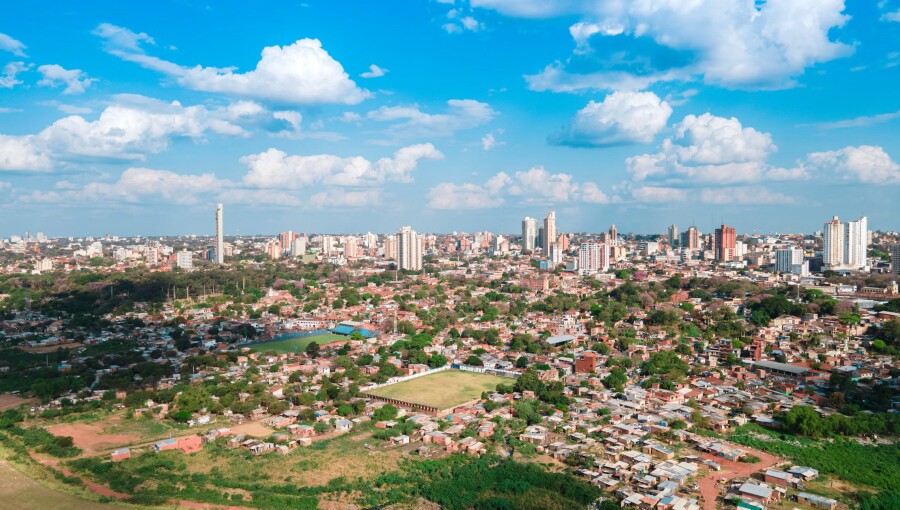
Paraguay has lost Taiwan's most prominent champion in Latin America in a bank scandal, creating an opening China may seek to exploit.
The Senate removed President Santiago Peña on November 6, days after the central bank seized Ueno Bank, a digital lender whose owner, Grupo Vazquez, had counted Peña as a business partner until 2025. The bank's board had voted on November 2 to put Ueno into resolution once its solvency ratio fell below half the legal minimum.
The lower house voted 78-0 to impeach him moments after he offered to resign on November 5, and prosecutors have since questioned him on suspicion of breach of trust and influence peddling. Peña, who sold his stake in Ueno's holding company in 2025, has said he will co-operate with investigators.
Peña made three state visits to the island and told the UN General Assembly in September that Taiwan deserved "full and meaningful participation" in the United Nations. Paraguay has recognised Taipei since 1957 and is now its only diplomatic partner in South America and one of 12 worldwide. His removal does not end that relationship, but it leaves it in the hands of a ruling party reeling from scandal, with a general election due in 2028.
China has applied pressure over Paraguay’s Taiwan ties, but this is not evidence of involvement in Peña’s removal. Beijing sanctioned Paraguay's information technology minister, Gustavo Villate, in October over Taiwan, barring him from China and Chinese organisations from dealing with him. In December 2024 Asuncion expelled Xu Wei, a Chinese official in the country for a UNESCO meeting, for interfering in its internal affairs after he urged lawmakers to drop Taiwan; Beijing called the charge unfounded. Reuters counted at least 19 Paraguayan lawmakers and five journalists who had visited China since late 2023, on trips participants said came at the invitation of the Chinese consulate in Sao Paulo.
After Peña's visit to Taipei in May, Beijing's language turned personal.
"Relevant Paraguayan political figures not only turn a blind eye to it, but also blatantly visit Taiwan to endorse Lai Ching-te and his like in defiance of global criticism and willingly serve as chess pieces for" what it called "Taiwan independence" separatist forces, foreign ministry spokesperson Guo Jiakun said on May 12. "The wheels of history wait for no one."
Yet none of that shows Beijing brought Peña down. The rot at Ueno was exposed in Asuncion: the banking association demanded in October that the central bank disclose the solvency of lenders it had helped through mergers, and the first senators to ask hard questions about the bank were loyal to Peña's estranged mentor, former president Horacio Cartes, the Associated Press reported. The charges against Peña turn on public money parked at a connected lender, including about $355mn from the IPS state pension fund, and on his choice of Carlos Carvallo, who had run Ueno's predecessor finance company, as central bank governor. No investigator or lawmaker has alleged a Chinese role.
China is a beneficiary, not a demonstrable cause, and the economics explain why it can afford to wait. Chinese suppliers already provided 36% of Paraguay's imports in the first half of 2026, more than any other country, without any diplomatic relationship. What Paraguay cannot do is sell directly to China. Its beef, which earned $2.1bn in 2025, and its soy reach Chinese buyers only through third countries, while Taiwan bought $288mn of Paraguayan beef that year. Local research centre CADEP has found the Taiwan tie delivers only modest economic gains, Reuters reported in March.
Pedro Alliana, Peña's vice president, now serves out the term to August 2028 and has signalled no change. He called Paraguay and Taiwan "brotherly peoples" in October, ABC Color reported, and Taiwan's foreign ministry said on November 6 that the turmoil would not affect relations. But Alliana is himself under investigation over Ueno, and he paused his own bid for the Colorado nomination when the bank failed.
The opposition leans the other way. Efrain Alegre, runner-up in 2023 with 28% of the valid vote, campaigned on reassessing the Taiwan tie in favour of Beijing to open China to Paraguayan cattle and soy. Paraguayo Cubas, whose anti-establishment National Crusade took almost 24% on a campaign against corruption, has no clear public line on Taiwan. Between them, the challengers won more than half the vote.
Some opposition lawmakers who have toured China are blunter. "We must not miss our chance," Liberal deputy Billy Vaesken, who spent 15 days there in late 2024, told Reuters. Beijing, for its part, says nearly 90% of Paraguayans back ties with China, citing a poll it has not named.
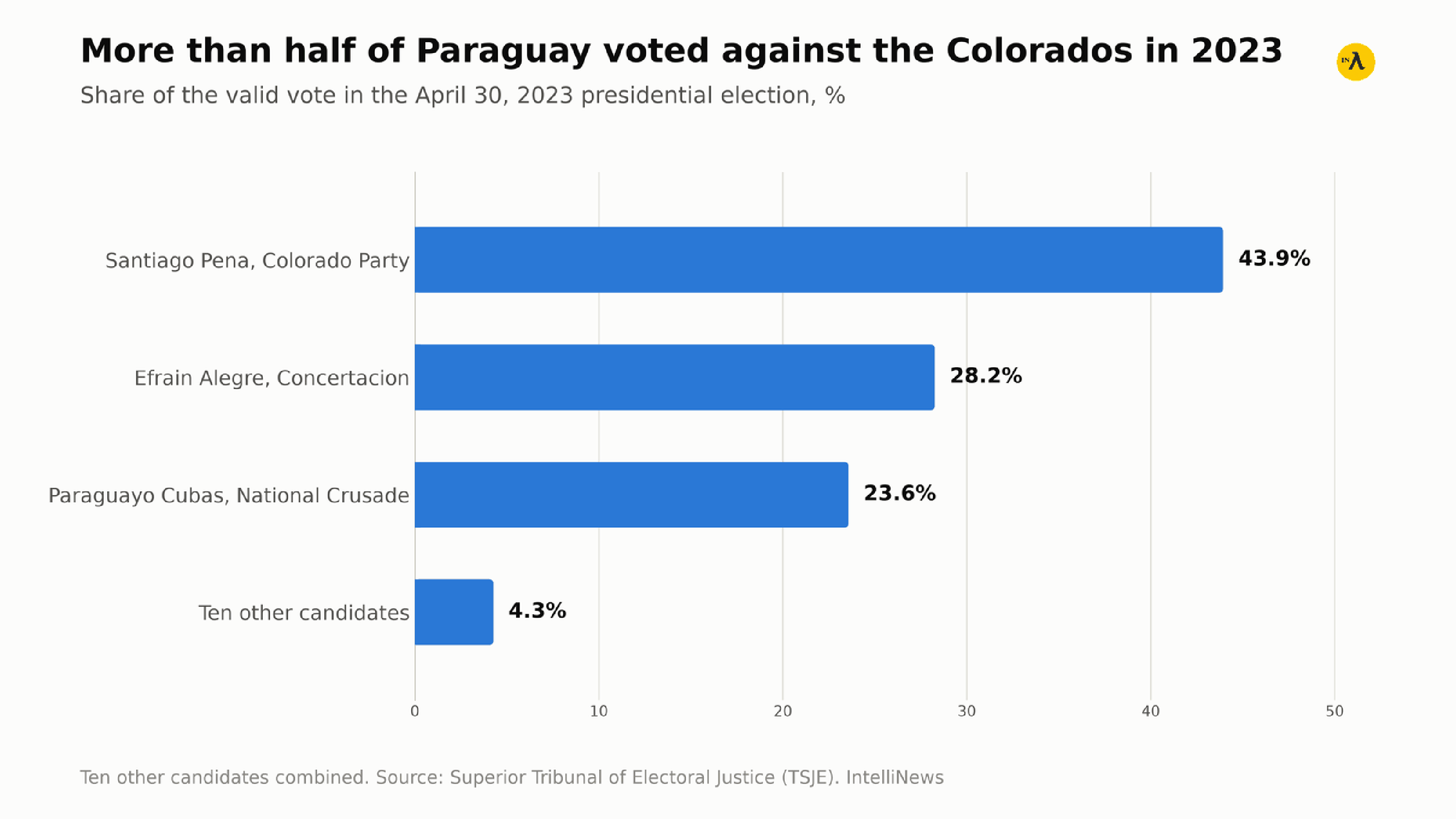
Share of the valid vote in Paraguay's April 30, 2023 presidential election. Source: Superior Tribunal of Electoral Justice (TSJE). IntelliNews
Paraguay would be following a well-worn path. Panama, the Dominican Republic, El Salvador, Nicaragua and Honduras all switched to Beijing after sustained courting, and Taiwan's allies worldwide have fallen from 21 at the end of 2016 to 12. The pattern invites the view that Latin America is being drawn into Beijing's orbit one capital at a time.
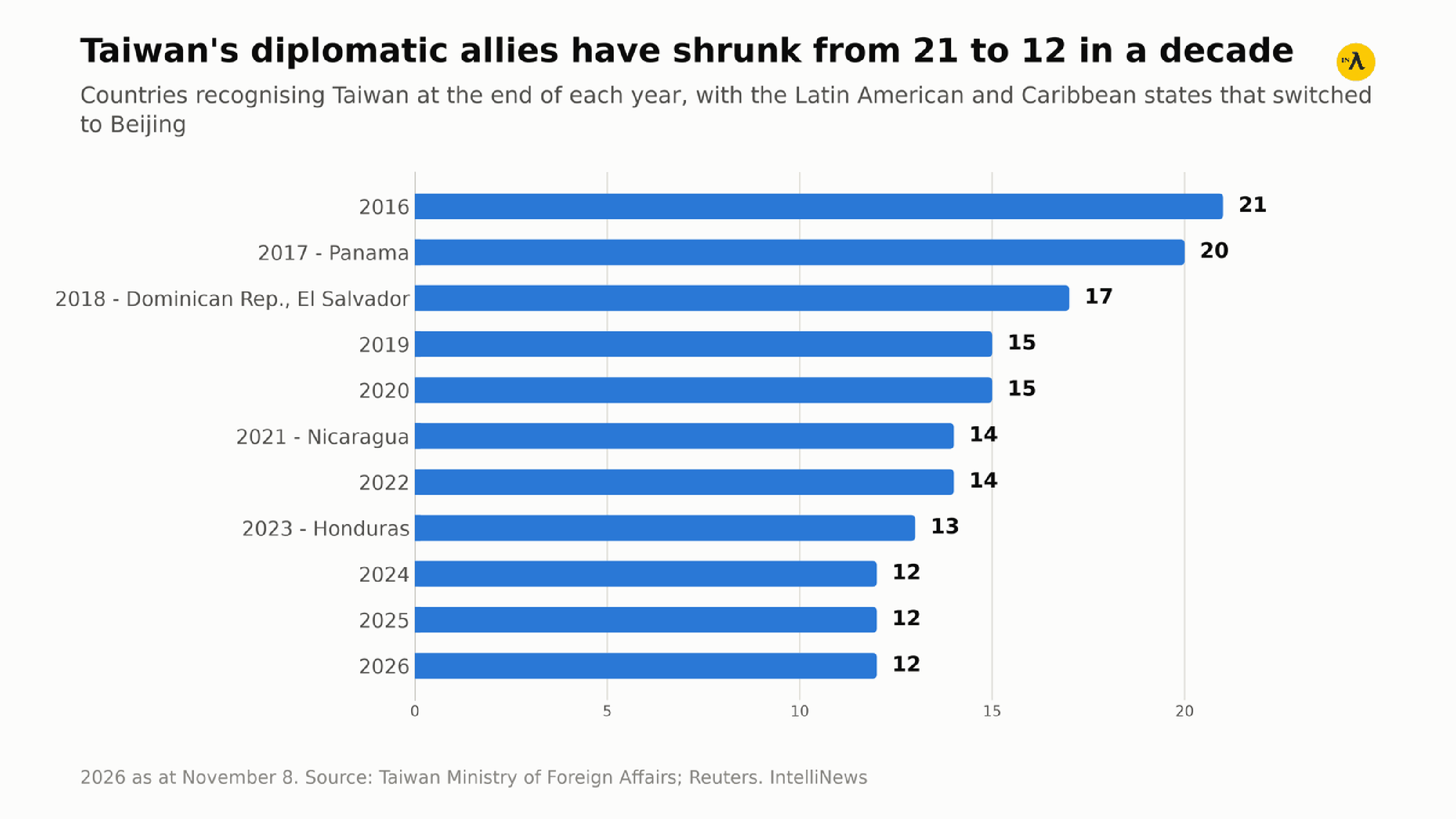
Countries recognising Taiwan at the end of each year, 2016-2026. Source: Taiwan Ministry of Foreign Affairs; Reuters. IntelliNews
That view overstates Beijing's grip. Paraguay signed a defence pact with the US in January, Honduras's new president, Nasry Asfura, has weighed reversing his predecessor's 2023 switch, and Asuncion's recognition of Taipei still blocks any China-Mercosur trade framework. Influence in the region is contested, not settled.
China did not need to engineer Peña's fall to gain from it. Its approach in Paraguay has been to make the case for switching to every politician, exporter and journalist who will listen, then wait for a government weak enough to act on it. If the Colorados go into the 2028 election as badly damaged as they look this week, the next government may be the one.
Paraguay crisis threatens emerging uranium ambitions

Paraguay’s emerging mining industry faces fresh political uncertainty after President Santiago Peña resigned Thursday amid a banking crisis, raising questions about the future of US-backed investments in the country’s largely untapped titanium and uranium resources.

Peña stepped down after the collapse of Ueno Bank, a major digital lender linked to his government, triggered widespread protests, froze millions of depositors’ savings and cost him the support of the long-ruling Colorado Party.
Minutes after his announcement, the lower house voted 78-0 to impeach him, sending the charges to the Senate. Lawmakers also moved to consider his resignation, opening a path for Vice-President Pedro Alliana to assume power without a Senate trial.
The upheaval comes as Paraguay seeks to transform its modest mining industry into a destination for foreign investment, particularly in minerals considered strategically important to the US. The leadership change introduces uncertainty over the implementation of recently announced bilateral agreements and the investment climate for exploration companies.
US minerals push
Paraguay has strengthened its minerals relationship with Washington this year, signing a memorandum of understanding on critical minerals followed by an agreement on civilian nuclear cooperation in August.
The diplomatic push continued in October when US Deputy Secretary of State Christopher Landau visited Paraguay with a trade delegation. The visit included announcements of new investments in uranium development and energy infrastructure, signalling growing US interest in the country’s mineral potential.
Among the companies with a foothold in Paraguay is Uranium Energy Corp. (NYSE-AM: UEC), which owns the Alto Paraná titanium project in the country’s east.
The project hosts an inferred resource of 3.58 billion tonnes grading 7.31% titanium dioxide (TiO₂), alongside an indicated resource of 70 million tonnes grading 7.6% TiO₂, according to the company’s technical disclosures.
A preliminary economic assessment outlined a base-case after-tax net present value of $419 million, using an 8% discount rate, and an internal rate of return of 21%. The proposed operation would produce high-titanium slag and high-purity pig iron, with access to nearby hydroelectric power potentially reducing operating costs and emissions.
Víctor Fernández, president of the Paraguayan Chamber of Mining (CAPAMI), described the country as a relatively unexplored mining frontier in an October interview with Global Americans.
Fernández, who also serves as UEC’s Paraguay country head, identified the Yuty and Coronel Oviedo uranium projects, alongside Alto Paraná, as significant developments in the country’s mining pipeline.
He said uranium, rare earth elements, nickel, niobium and gold are among the minerals that warrant further exploration, while lithium and platinum-group elements may also be present in favourable geological settings.
Investment challenges
Despite its geological potential, Paraguay remains a minor mining jurisdiction compared with established South American producers such as Chile, Peru and Argentina.
Fernández said the country needs regulatory reforms to translate geological discoveries into commercial production, particularly by simplifying permitting and improving legal certainty for investors.
A new mining code is being drafted to improve the investment climate. CAPAMI has advocated longer exploration periods, royalties based on profits and legal guarantees designed to support projects throughout their operating lives.
The country has considerable deficiencies in geological information, as only approximately 4% of its territory has been mapped in detail. This lack of detailed mapping restricts the information available to companies that are evaluating potential mineral deposits.
Gold mining is concentrated mainly in the Paso Yobai district of Guairá department, where artisanal and small-scale operations provide employment and income. The sector also faces environmental and public health challenges, including the use of toxic substances in mineral processing.
Paraguay has sought to attract exploration capital through a relatively low corporate tax rate and investment incentives, while its extensive waterways offer access to international markets.
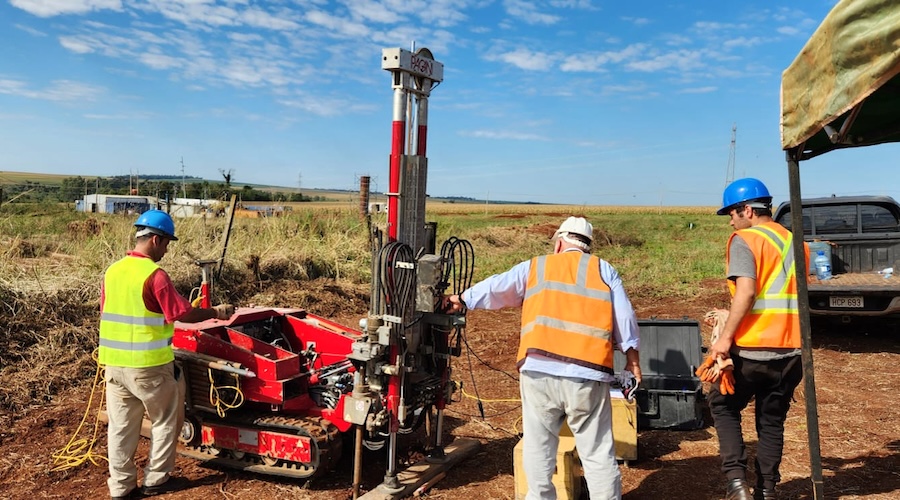
The Paraguay and Paraná rivers connect the landlocked country to Atlantic ports, providing potential export routes for future mineral production.
Another advantage is its electricity supply, generated almost entirely from renewable sources, principally the Itaipú and Yacyretá hydroelectric dams. Access to low-emissions power could appeal to companies developing energy-intensive mineral processing operations.
Still, the country’s limited mining infrastructure, early-stage exploration sector and lack of an established large-scale production history present challenges independent of the political crisis.
The ongoing political crisis adds a further consideration for investors assessing long-term projects that require stable regulations, sustained financing and government support.
There is no indication of halted existing mining developments or suspended agreements with Washington. However, the transition leaves the incoming administration responsible for maintaining those relationships while restoring confidence in the country’s financial and political institutions.

No comments:
Post a Comment