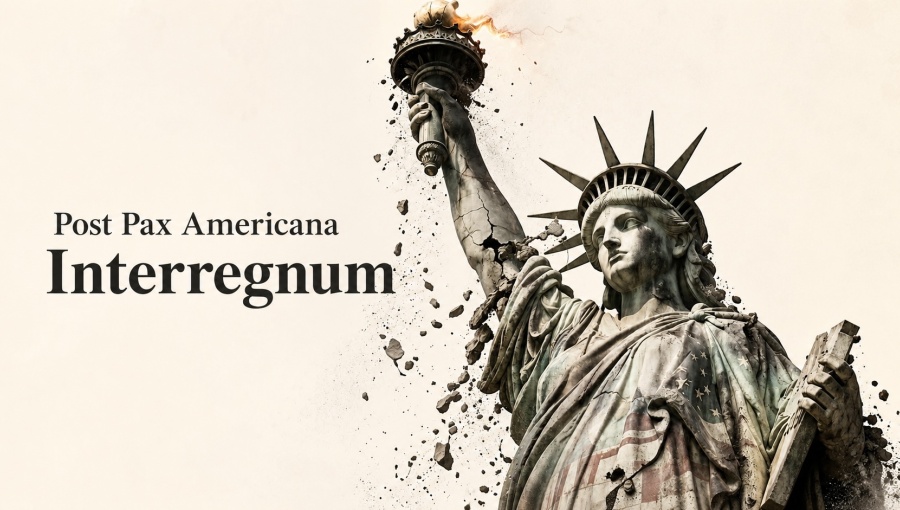
The post-Pax Americana Interregnum is here and it is starting to become clearer what it looks like.
We have been arguing this year that the result of the East-West clash and the “rise of the rest” from the Global South in general, and the Ukraine war in particular, has led to an end of the unipolar “rules-based” order and ushered in a multipolar world.
Just how badly those rules are being eroded in the West was demonstrated by Ukrainian President Volodymyr Zelenskiy decision to bring treason charges on November 4 against Iuliia Mendel, Zelenskiy’s former press secretary, while all of his best friends have been charged with stealing tens of millions of dollars – during a war – and remain untouched. Likewise, Latvia’s decision to PNG journalist and IntelliNews columnist Leonid Ragozin is a repressive move that Russian President Vladimir Putin would be proud of.
From this perspective Russian President Vladimir Putin and Chinese President Xi Jinping have already won in their face off with Washington and Brussels. Now Putin needs to get his war done, and with Kyiv now entirely blacked out as Russian missiles very effectively target substations to destroy the links to the three remaining nuclear power stations, that is looking increasingly likely. The upcoming meeting in Abu Dhabi will be very interesting indeed.
One of the classic features of an interregnum is political and trade chaos. But in this modern version it has a new dimension: hackers and greed.
Two big banks have gone bust in the last two weeks: Alta Banka collapsed in the days after the Serbian electoral revolution that ousted Serbian President Aleksander Vucic that held pretty much all the accounts of Russians living there. The owners tried to escape to Moscow, but authorities forced their plane to turn around and they are now in jail.
Then two days ago the Ueno bank in Paraguay blew up, holding 60% of all deposits in the country. The country is now on fire after demonstrations turned into riots. Some 3mn people don’t know how to pay for food today. And the pensioners are even worse off as with a $10,000 deposit insurance cap many will lose the bulk of their life savings.
However, even more worryingly, France's Credit Mutuel Arkea has confirmed that hackers used a supplier's platform to reach the bank and steal over a hundred million dollars. They got into the bank’s system and used its own system to transfer the money and turn it into crypto which immediately disappeared. This comes on top of North Korean hackers stealing a mind boggling $6bn from Binance, the world’s biggest crypto-exchange.
This is the downside from the AI revolution. Previously, hackers used their nous and superior knowledge of coding to get into your machine. Now they have a tool that can win a Fields Medal to solve never solved before Millenium Prize maths problems. Hybrid attacks as the tectonic geopolitical tension shifts so rapidly they are literally “earthquakes” in their own spheres has already seen a rapid rise in hybrid attacks that are a new feature of an interregnum. Bomb threats hit about 20 flights across Europe on November 5, the third wave in four days, forcing diversions to France, Bulgaria and Austria, but searches found no explosives. Multiple supermarket freezers were turned off this week, causing the food to spoil. And in a really bizarre one, hackers targeted blood banks in France, attempting to raise plasma freezer temperatures to a boiling 110°C – what freezer even has a 110°C setting?!
At IntelliNews, we have also seen the rise of AI bots explode this year, where bot hits have gone from hundreds to tens of thousands that overload the server as they try and steal our archive. We have had to spend thousands on beefing up our security but at the same time face a quandary as google searches are in rapid decline, a major source of traffic, as AI searches take over. That has left us (and all press) in a quandary: how do you distinguish between benign enquiries and malicious ones?
As part of the same interregnum story, democracy is falling apart. We have already written extensively about how the boomerang effect of sanctions is causing an economic crisis in Europe, that has led to the rise of the right, but it has also now wrecked the US and the consequences for the midterm rout of the Republicans will have big consequences for trade, the wars and geopolitical relations. As we have written before, the Washington consensus that underpinned the rules-based order, is giving away to the Moscow consensus, where government’s put the fate of the state ahead of individual freedoms. Serbia just went in the other direction, but across Europe it’s clearly headed right to a nationalist populist model that is fragmenting the EU – another classic interregnum phenomena.
I suspect that the US will now get bogged down in a warring deadlock between the Democrat Houses and a lame duck Trump, who will focus more on foreign policy as that is the only thing he still controls. He will also use his standard tactic of trying to overwhelm the checks and balances system by issuing so many executive orders (decrees) that Congress’ legal machine to counter them can’t keep up. This was how he defeated media scrutiny when he was campaigning: he said so many bonkers things the media didn’t have enough time to debunk them before he said something else equally outrageous.
Given the new team on the Capital doesn’t take over until January 3, Putin has one last window to leverage his hold over Trump to force Zelenskiy to capitulate. Ukraine is currently facing Zelenskiy’s worst nightmare and I don’t think the coverage is panicking enough. Putin threatened to open Pandora’s box after Ukraine hit the Wildberries warehouse in July and he has done just that with the snows about a month away or less. We always knew exactly what was going to happen – and now it's happening. To take one example, Kyiv is now in total darkness. Only a month ago the assessment was that thanks to Russian attacks there would be 8 hours of blackouts a day; currently there are 17 hours, just one hour away from the worst case scenario, and Kyiv’s mayor Klitschko said yesterday soon the blackouts will be “complete”. Without ammo there is nothing Zelenskiy can do to stop this; the US offer to sell 500 interceptors – that won’t begin to arrive until 2030 – is a joke, a piece of propaganda to appease the pro-Ukraine lobby.
Even in Ukraine the democratic project is falling to pieces. Zelenskiy has cut a Churchillian figure for most of the last four years, but ironically (on purpose?) The National Anti-Corruption Bureau of Ukraine (NABU) has chosen now to conclude its pre-trial Energoatom corruption scandal investigation results. And it also released details of Operation Carthage where top Ukrainian Security Service (SBU) officials were protecting 52 scam centres, drug running and murdering a journalist by dousing her with concentrated acid. The investigators are saying this has gone beyond “corruption” and they are treating it as “organized criminal group” investigations. The scale of this scandal is staggering as it's not a scam but institutional. Everyone in Bankova has now been implicated. There is now a very good chance that even Zelenskiy will go to jail as soon as he leaves office.
Again the western coverage has been pulling its punches. Brussels just released its EU accession progress report which is clearly fully aware of all these problems but dressed up its criticism in the mildest language possible. I recommend you have a look at the report, as it’s a classic example of obfuscation where no one in Brussels wants to undermine Bankova, but also can’t lie about the severity of the problems. Then there was the National Guard secret prison story this week that is just icing on the cake as a wrong-direction indicator.
In the meantime, China continues to build the high speed railways that are missing from Europe and the US, shaving nanometres off its chip sizes and expanding its ties within the Global South. The CRINK (China, Russia, Iran, and North Korea) technology swap is growing increasingly effected as aptly demonstrated by the military tech Iran now has access to in its war with America. And the evolving CRINK military alliance is something that should scare the bejesus out of Western military analysts. These relations are another classic feature of an interregnum, as those in the second tier club together to challenge the waning imperialists. The expanding BRICS+, G20 and the recent third Russia-Africa summit in October are all examples of how well this plan is going. In an interregnum, these are marriages of convenience until the new world order emerges, but currently they are very convenient indeed.
This article originally appeared in Editor’s Picks, a free daily email digest of bne IntelliNews’ best stories from the last 24 hours. Sign up for free here.
https://to989.infusionsoft.com/app/form/editors-picks-subscribers

No comments:
Post a Comment