It’s possible that I shall make an ass of myself. But in that case one can always get out of it with a little dialectic. I have, of course, so worded my proposition as to be right either way (K.Marx, Letter to F.Engels on the Indian Mutiny)
French small modular reactor developer Calogena has been awarded EUR40 million (USD44.6 million) through the European Commission's Innovation Fund to support the potential construction of its first commercial nuclear reactor in Pierrelatte, in southern France.
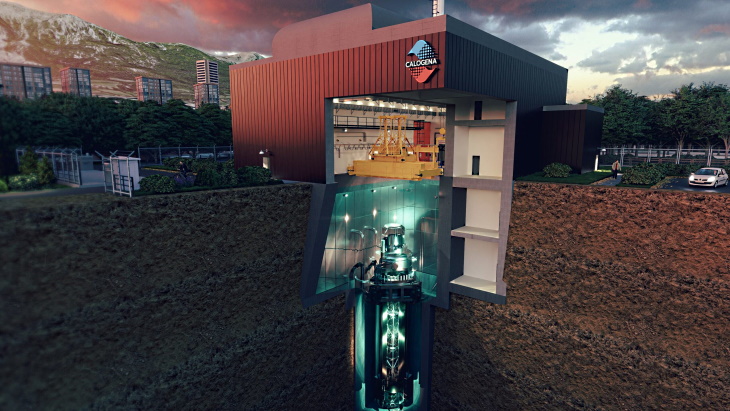
(Image: Calogena)
Calogena - a subsidiary of Group Gorgé founded in 2021 - is developing a water-cooled small modular reactor (SMR), called the CAL30, with a thermal power of 30 MW, specifically designed to supply urban heating networks with carbon-free energy. Its technology is based on a low-temperature, low-pressure pool-type reactor. It says its simple design aims to deliver a high level of safety and allows it to be located close to district heating networks. The CAL30 will be able to supply heat to about 20,000 homes. Calogena said its aim is for deployment as early as 2030.
The Innovation Fund is one of the world's largest funding programmes for the deployment of innovative net-zero and low-carbon technologies. Established by Article 10a (8) of Directive 2003/87/EC to support innovation across all EU Member States, it is one of the key tools of the European Green Deal Industrial Plan. Financed by revenues from auctioning allowances from the European Union Emissions Trading System and with an estimated revenue of approximately EUR40 billion between 2020 and 2030, the Innovation Fund aims to help businesses invest in clean energy and bring technologies to market that can decarbonise European industry, while fostering its competitiveness.
"The Innovation Fund grant would enable Calogena to reach a new industrial milestone by building its first commercial reactor in Pierrelatte, supplying the town with locally produced, low-carbon heat," the company said. "For Calogena, this support marks the transition to its first commercial project, following more than EUR50 million in funding secured under France 2030 to develop its technology and bring it to industrial scale."
Calogena was selected in 2023 as part of the Innovative Nuclear Reactors call for projects under the aegis of the French government via the Secrétariat Général Pour l'Investissement, in order to support the development of nuclear technologies.
Through its CityHeat project with Finland's Steady Energy, Calogena also participates in the European SMR Industrial Alliance.
The Pierrelatte project could become Calogena's first commercial reference and pave the way for deployment in other European towns and cities. The company is already involved in several projects outside France and is notably in contention to supply more than fifteen reactors in Finland.
In June, Calogena signed a cooperation agreement with Veolia, a European leader in district heating, to explore the potential of its SMRs to decarbonise district heating networks in Central and Eastern Europe.
"This funding marks a major milestone for Calogena," said Julien Dereux, Executive Chairman of Calogena. "Having developed our technology and brought it to industrial scale, we are now entering the construction phase of our first commercial reactor. The European Commission's support confirms the maturity of our project and its potential to address one of Europe's major energy challenges: producing local, low-carbon, cost-competitive heat at scale while strengthening energy sovereignty. Pierrelatte would be our first commercial reference and should pave the way for wider deployment across Europe."
Calogena's CAL30 is one of four SMR designs being evaluated by the French Nuclear Safety and Radiation Protection Authority.
X-energy selects Fluor for second Xe-100 project
Fluor Corporation is to provide design and engineering services to support the second-of-a-kind US project featuring X-energy's Xe-100, at Energy Northwest's proposed Cascade Advanced Energy Facility near Richland, Washington.
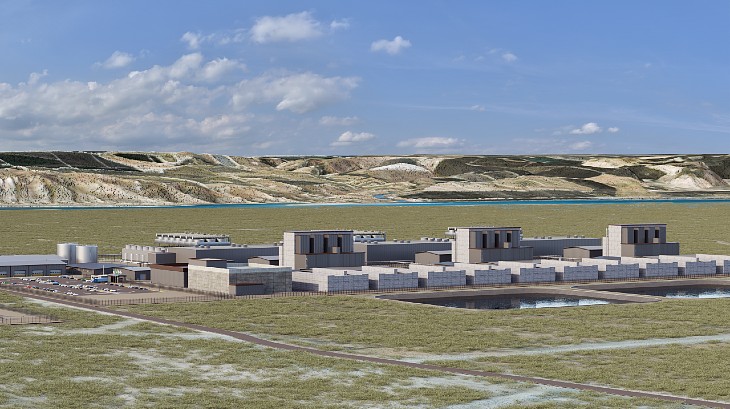
A rendering of the proposed Cascade plant (Image: Amazon/X-energy)
This is the second commercial contract between the two companies for nuclear island engineering and design: in April, Fluor entered into a contract with X-energy to support the company's first proposed Xe-100 project at Dow's UCC Seadrift Operations in south Texas under the US Department of Energy's Advanced Reactor Demonstration Program. The latest agreement builds on Fluor's ongoing work for the Texas project, the companies said, enabling them to incorporate learnings from one project into the next, with the aim of targeting long-term cost and schedule reductions through standardisation and repeatable project execution.
The Cascade facility is expected to deploy four of X-energy's Xe-100 high-temperature gas-cooled reactors, each with a capacity of 80 MWe, for a total capacity of 320 MWe, with the potential to scale to a total of 12 units.
Under the agreement, Fluor will provide engineering, design development, supply chain, estimating and project control services for the nuclear island scope of the Cascade facility. The value of the contract has not been disclosed, but Fluor said it will "recognise" the value in the third quarter.
Cascade Nuclear Partners, a joint venture of Kiewit Nuclear Solutions, Black & Veatch, and Aecon, is responsible for the conventional island and integrating requirements across the plant to support potential future phases of the project.
"Advanced nuclear technologies are poised to play a critical role in meeting growing energy demand while supporting decarbonisation goals," Fluor's Business Group President of Energy Solutions Pierre Bechelany said. "The Cascade Advanced Energy Facility represents an important step forward in the deployment of next-generation nuclear energy. Fluor is proud to bring decades of nuclear expertise and project execution experience to support X-energy and its partners in advancing this innovative project."
The Cascade facility is the first project in a collaboration between X-energy and Amazon launched in 2024, with the goal of deploying 5 GW of new nuclear capacity by 2039: utility American Electric Power and X-energy signed a joint development agreement to evaluate the potential second project, for 960 MWe of capacity at a former coal plant site in Indiana, in October.
Engaging experienced engineering partners and suppliers early in each project’s development cycle helps ensure that components, capabilities and expertise are in place as each project advances, X-energy says, as part of a disciplined approach to building project readiness that positions the company and its partners to commercialise and scale energy solutions.
"The success of our projects begins with working as one team, building on each other's expertise to drive toward scale," said Dragan Popovic, Global Chief Operating Officer at X-energy. "Repeated execution with partners of Fluor's quality helps us build that expertise in real time, so that every lesson we carry forward supports greater efficiency in design, licensing, and construction."
NAC to supply used fuel storage solution for Norway
NAC International of the USA has been contracted to deliver casks for the dry storage of Norway's used nuclear fuel from the former research reactors at Halden and Kjeller.
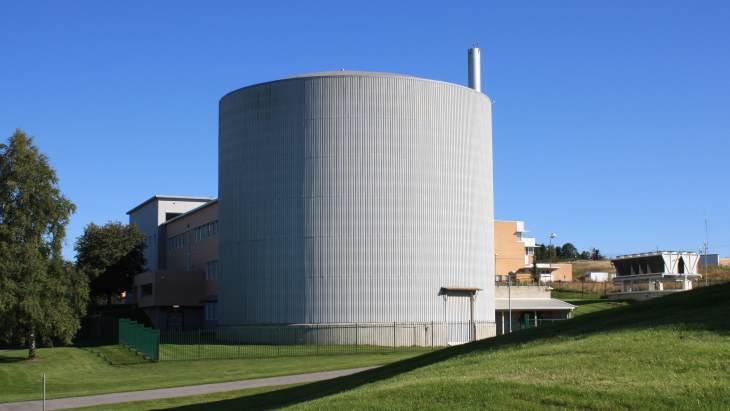
The JEEP-II research reactor at Kjeller, which shut down in April 2019 (Image: IFE)
Norway holds about 16.5 tonnes of used fuel from six decades of operating nuclear research reactors. Much of it cannot be stored long term or disposed of in its current form. The inventory includes metallic uranium fuel, aluminium-clad fuel and experimental fuels.
Following an international tender for a suitable storage system, Norwegian Nuclear Decommissioning received four offers. With the NAC agreement, work on new storage and transport solutions enters a more concrete phase, and once the used fuel has been moved out of the current storage solution, it will open the way for further dismantling of the nuclear facilities that Norwegian Nuclear Decommissioning has been given responsibility for decommissioning.
Using NAC's solution, the used fuel will be stored in a stainless steel container, surrounded by a protective concrete silo. For transport, a separate transport container will be used, not the concrete silo itself. The storage solution is designed for passive dry storage and has a design life of more than 70 years.
Last month, Norwegian Nuclear Decommissioning signed an agreement with Swedish nuclear technical services provider Studsvik to manage used nuclear fuel from the former research reactors at Halden and Kjeller. Under that agreement, which runs until 2055, Studsvik will transport the fuel to its licensed facilities at Studsvik outside Nyköping, Sweden, inspect it and, where required, treat it, including oxidation of metallic uranium fuel, to prepare it for interim storage and final disposal. The treated fuel will remain at Studsvik until it is returned to Norway for final disposal.
"The casks could be important in enabling such treatment," Norwegian Nuclear Decommissioning said. "The transport will take place when the necessary permits and approvals are in place. The casks could also contribute to increasing the safety of the Norwegian nuclear facilities by allowing some of the current solutions to be phased out more quickly, i.e. both in parallel with treatment at Studsvik, and as a supplement to such treatment for some types of fuel. The casks will also be used when the spent fuel returns from Sweden."
"This is good work by everyone involved who has managed to bring an important agreement to fruition," said Norwegian Nuclear Decommissioning Director Pål Mikkelsen. "Together with the agreement with Studsvik, we now have good solutions for the further decommissioning work."
Before the solution can be put into use, NAC will collaborate with Norwegian Nuclear Decommissioning and the Institute for Energy Technology on design, analysis and safety documentation. The development work also includes additional equipment, plans for inspection, maintenance and training. NAC anticipates a development period of 22 months, with start-up dependent on the necessary security agreement being in place. The documentation will then be reviewed before Norwegian Nuclear Decommissioning and the Institute for Energy Technology submit the documentation to the authorities for processing.
The background
Norway's two research reactors - the nuclear fuel and materials testing reactor at Halden and the JEEP-II neutron scattering facility at Kjeller - were declared permanently shut down in June 2018 and April 2019, respectively. In addition to the research reactors, there are several other nuclear facilities that will be decommissioned and a wide range of nuclear waste that must be handled and disposed of in a safe way. The clean-up activities are estimated to cost more than NOK21 billion (USD2.2 billion) and will last for at least 20 years.
Norwegian Nuclear Decommissioning, established in 2018 as a government agency under the Ministry of Trade, Industry and Fisheries, is responsible for decommissioning the research reactors and other related nuclear infrastructure. It is also responsible for the safe handling, storage and disposal of nuclear waste in Norway.
The nuclear facilities in Halden were transferred from the Institute for Energy Technology to Norwegian Nuclear Decommissioning on 1 April last year. Last month, the latter submitted a licence application to the country's nuclear regulator to take over responsibility for the nuclear facilities at Kjeller.
Norwegian Nuclear Decommissioning plans to build a range of different facilities for the storage and disposal of radioactive waste: storage for low- and intermediate-level radioactive waste; storage for used nuclear fuel; a treatment plant where waste can be sorted, processed and treated; and final disposal landfills, "including deep disposal for used fuel/high-level radioactive waste".
Reactor components completed for El Dabaa 1
All the key components have now been manufactured for the first unit’s reactor at Egypt's El Dabaa Nuclear Power Plant.
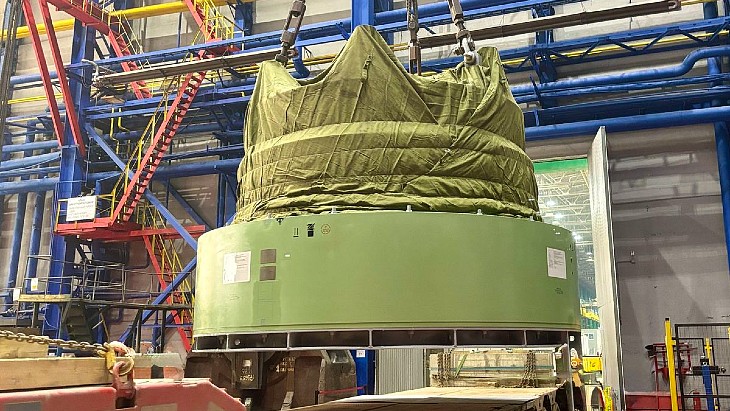
(Image: Rosatom)
Production of the reactor internals and the VVER-1200 reactor head for the unit were produced at Rosatom’s Izhora site in St Petersburg.
Rosatom, Russia's state nuclear corporation, says the total weight of the reactor vessel internals and the reactor head to be shipped to Egypt is about 340 tonnes. Including the already assembled reactor vessel the total weight will be more than 670 tonnes.
"Completion of the internals and reactor head is a crucial step in the construction of the power unit, paving the way for the next stages. Once they are installed, construction workers will be able to proceed with the installation of the remaining reactor hall equipment and move forward with commissioning," Rosatom said.
"The internal reactor vessel devices (including the shaft, baffle, and protective tube block) and the reactor lid form the basis of the reactor core, ensure the correct placement and fixation of the nuclear fuel, as well as the tightness and safety of the entire reactor installation."
Background
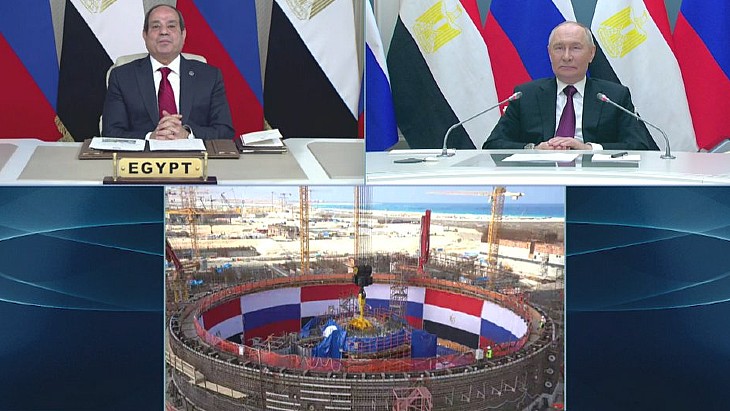
The reactor pressure vessel was installed in unit 1 in November last year, following a ceremony which included speeches from the Egyptian and Russian presidents (see picture below). Among the construction landmarks this year, concreting work on the fourth tier of the reactor building's inner containment was completed in August.
(Image: Kremlin.ru)
El Dabaa will be Egypt's first nuclear power plant, and the first in Africa since South Africa's Koeberg was built nearly 40 years ago. The Rosatom-led project, about 320 kilometres north-west of Cairo, will comprise four VVER-1200 units, like those already in operation at the Leningrad and Novovoronezh nuclear power plants in Russia, and the Ostrovets plant in Belarus.
Under the 2017 contracts, Rosatom will not only build the plant, but will also supply Russian nuclear fuel for its entire life cycle, including building a storage facility and supplying containers for storing used nuclear fuel. It will also assist Egyptian partners in training personnel and plant maintenance for the first 10 years of its operation. Rosatom has said it is aiming for a future service life of up to 100 years for nuclear power plants.
The four units are being built almost concurrently, with first concrete at unit 1 in July 2022, followed in turn by the others, concluding with first concrete at unit 4 in January 2024. Egypt's aim is for 9% of electricity to be generated by nuclear by 2030, which would be achieved by the commercial operation of the first two units by that time, directly displacing oil and gas.
IHI to supply components for first Polish AP1000
Japanese engineering firm IHI Corporation has received an order from Westinghouse covering engineering and procurement activities for long-lead items for one containment vessel and an associated large steel module for the first unit of Poland's first nuclear power plant.
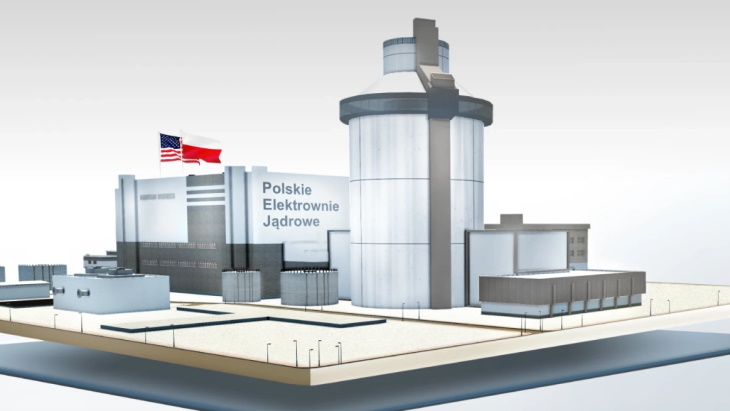
(Image: PEJ)
The contract covers the containment vessel - an essential safety system that encloses the reactor and other critical systems - as well as the CA01 'super module'. Measuring more than 26 metres long, 29 metres wide and 23 metres high, the concrete and steel CA01 module - composed of 47 sub-modules - sits inside the unit's containment module where it houses the plant's reactor pressure vessel, steam generators and other components.
Three Westinghouse AP1000 reactors are planned for the plant at the Lubiatowo-Kopalino site in the Choczewo municipality in Pomerania in northern Poland. The AP1000 reactor design uses modular construction techniques, enabling large structural modules to be built at factories and then installed at the site. The reactor building and systems consist of dozens of prefabricated, steel-concrete structural and mechanical modules.
Last month, Polskie Elektrownie Jądrowe (PEJ) gave Westinghouse the go-ahead to start ordering long-lead items for the project's first AP1000 unit. It said the scope of the order for the first unit covers six key components of the nuclear island, including the reactor containment vessel and associated structural modules.
Westinghouse subsequently placed conditional purchase orders with Polish companies Energomontaż-Północ Gdynia SA (EPG), FAMAK SA, Mostostal Kielce SA and Mostostal Krakow SA to support the first AP1000 unit at the Lubiatowo-Kopalino site. The conditional purchase orders cover the CA02 Walls Module Scope for Mostostal Kielce, the CA03 Module Scope for EPG, the CA05 Walls Module Scope for Mostostal Krakow, and the CA20 Floors Module Scope for FAMAK.
In an AP1000 unit, the CA02 walls module and the CA03 module are part of the in-containment refuelling water storage tank in the containment building. The CA05 walls module consists of reinforced steel plates that provide protective walls separating various rooms in the containment building. The CA20 floors module consists of reinforced concrete slabs placed on steel plates to form the floors of the larger CA20 module that houses plant equipment inside the unit.
Early procurement of components with long lead times is common in nuclear projects worldwide. It helps secure the availability of production capacity, mitigates the risk of delays, and supports timely project implementation. The scope of work includes preparing technical documentation, quality and supervision plans, selecting and contracting suppliers, and initiating material procurement necessary to commence production. The production and delivery of finished components to the construction site will be handled as part of a subsequent order, which PEJ plans to issue as part of the power plant construction contract.
Construction of the Lubiatowo-Kopalino plant is scheduled to begin in 2028. Under a recent update to the country's nuclear power programme, the first unit is scheduled to start commercial operation in 2036, and the plant is expected to reach full capacity by 2038 - three years later than previously planned.
Construction of Chinese HTGR begins
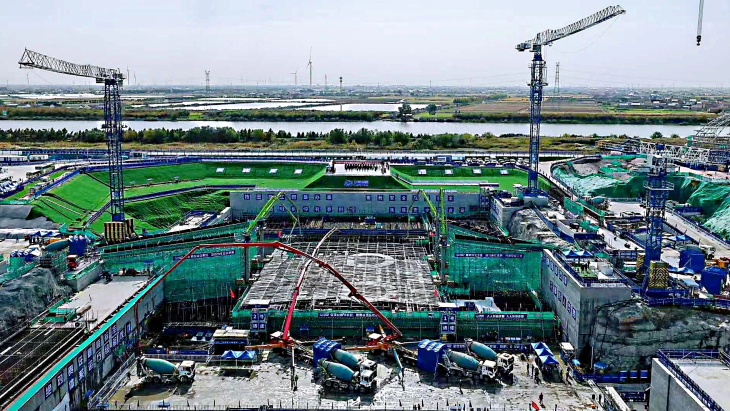
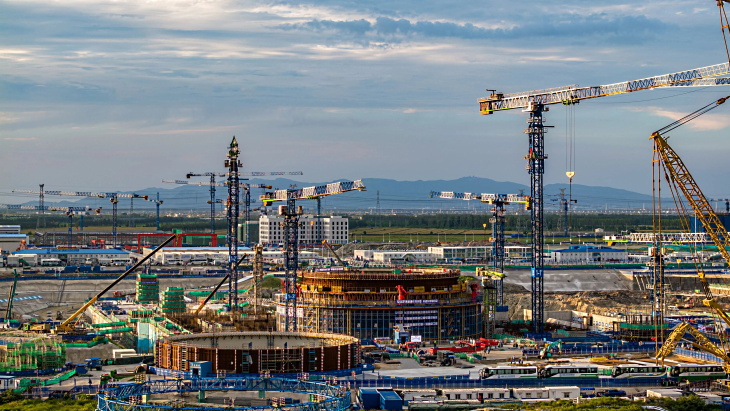
The first batch of concrete has been poured for the nuclear island of the high-temperature gas-cooled reactor that forms part of the initial phase of the Jiangsu Xuwei Nuclear Heating and Power Plant, China National Nuclear Corporation has announced.
(Image: CNNC)
Xuwei Phase I was among 11 reactors approved by China's State Council in August 2024. China National Nuclear Corporation (CNNC) plans to build two 1,208 MWe (net) Hualong One (HPR1000) pressurised water reactors (units 1 and 2) and one 660 MWe high-temperature gas-cooled reactor (HTGR) (unit 3) at the site in Lianyungang, Jiangsu province. The project will be equipped with a steam heat exchange station, which will adopt the heat-to-electricity operation mode for the first time.
Construction has now started on unit 3 of the plant, which will feature a Chilong One HTGR, jointly developed by CNNC and Tsinghua University. The unit has a rated capacity of 660 MWe and is designed for an operational lifespan of 60 years.
(Image: CNNC)
"With the commencement of concrete pouring for the high-temperature gas-cooled reactor nuclear island of Unit 3, the project construction is progressing smoothly according to plan," CNNC said.
First concrete was poured in January this year for the nuclear island of the unit 1 Hualong One at the Xuwei project.
CNNC said the project is planned to be implemented through direct procurement, with specialised nuclear power engineering subsidiary CNNC Energy Technology Company Ltd entrusted with the high-temperature reactor design, equipment and material procurement and delivery, certification support, construction technical support, commissioning support, equipment training, and related project management. CNNC Energy Technology Company Ltd has previously undertaken EPC general contracting for the nuclear island and balance of plant for the Shandong Shidaowan High-Temperature Gas-Cooled Reactor Nuclear Power Demonstration Project, as well as nuclear island commissioning services. CNNC holds a 46% stake in the company.
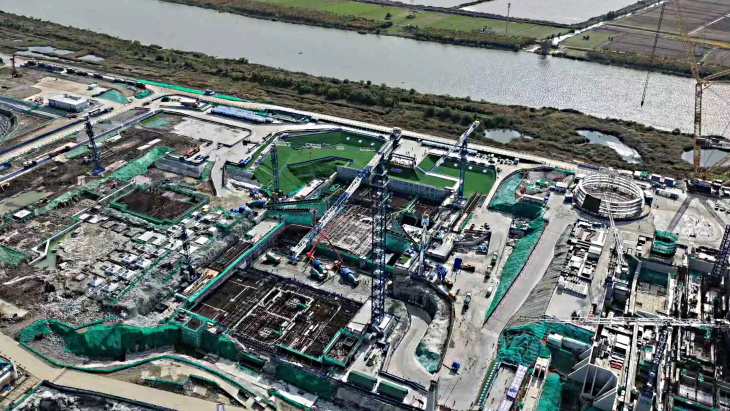
(Image: CNNC)
A contract for the construction of the conventional islands of the three units was awarded in September last year to a consortium formed by China Energy Engineering Jiangsu Electric Power Construction No 3 Company and China National Nuclear Huachen Construction Engineering Company. Under the CNY4.2 billion contract, Jiangsu Electric Power Construction No 3 Company will build the three conventional island power plants, their ancillary facilities, and the construction and installation of some 'balance of plant' components.
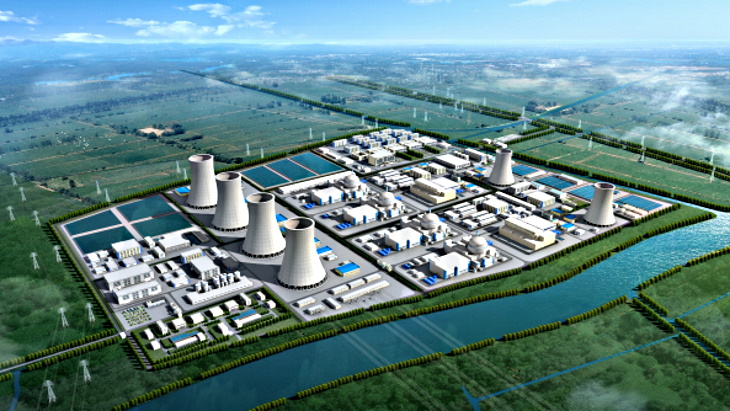
At the plant - very close to CNNC's existing Tianwan plant - demineralised water will be heated by the primary steam of the Hualong One units to produce saturated steam, and the primary steam of the HTGR will be used to heat the saturated steam for the second time "to generate three different types of high-quality industrial steam with different parameters". CNNC said: "This will meet the industrial steam demand of the petrochemical park. Once completed, the plant will have both high-quality steam supply and power generation capabilities under its design conditions."
A rendering of the Xuwei plant (Image: CNNC)
Once the first phase of the project is completed and put into operation, it will supply 32.5 million tonnes of industrial steam annually, with a maximum power generation of more than 11.5 billion kilowatt-hours, which can reduce the use of standard coal by 7.26 million tonnes and reduce carbon dioxide emissions by 19.6 million tonnes each year.
"Jiangsu Xuwei Nuclear Power Plant is the world's first large-scale coupling project of nuclear energy and petrochemicals, the world's first coupling project of pressurised water reactor and high temperature gas-cooled reactor, the world's first application project of 'reactor-machine-heat' coordinated control mode, and the world's first commercial application project of high temperature gas-cooled reactor," according to CNNC.
CNNC Suneng Nuclear Power Company is the CNNC subsidiary which is the owner of the Xuwei project and responsible for project investment, construction and operation management.
"From experimental reactors and demonstration projects to the commercial promotion of the Xuwei project, China's fourth-generation nuclear energy technology is accelerating towards large-scale industrial application," CNNC said. "The commercial application of high-temperature gas-cooled reactors not only provides a large-scale supply of high-quality heat sources for the petrochemical industry, but also promotes the transformation of China's nuclear energy from primarily power generation to diversified supply, providing a replicable 'Chinese solution' for the green transformation of energy-intensive industries worldwide."

No comments:
Post a Comment