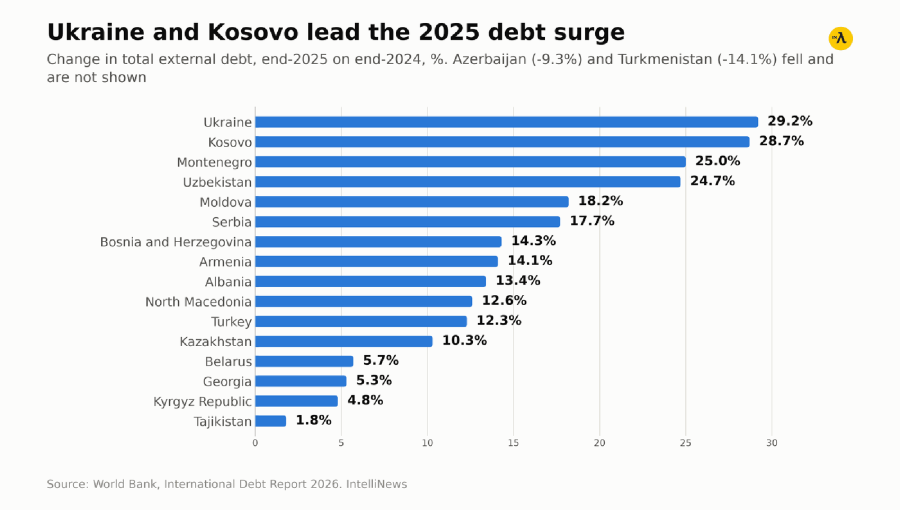
External debt in developing Europe and Central Asia surged 15.3% to $1.34 trillion in 2025, the fastest increase of any developing region, driven largely by borrowing in Ukraine and Turkey, the World Bank said in its International Debt Report 2026.
The 18-country group added about $178bn in external debt during the year, compared with a 5.5% increase to a record $9.4 trillion across all low- and middle-income countries. Sub-Saharan Africa recorded the second-fastest increase, at 10.8%, while East Asia and the Pacific saw debt fall 1.8%, largely reflecting a contraction in China.
The Europe and Central Asia group covers the Western Balkans, Eastern Europe outside the EU, Turkey, the South Caucasus and Central Asia, excluding Russia and the EU's eastern members.
Debt growth outpaced the region's capacity to service its obligations. External debt reached 152.2% of exports, up 14.7 percentage points from 2024, the largest deterioration among developing regions. Interest payments alone absorbed 6.8% of export earnings, the highest regional share, while total debt service rose to 24.8% of exports from 22.9%.
The stock of external debt amounted to 49% of gross national income, also the highest ratio among the developing regions covered by the report.
Ukraine and Turkey accounted for about two-thirds of the region's increase in debt, although their borrowing patterns differed sharply. Kyiv relied predominantly on official lending to finance its war effort, while Ankara tapped international capital markets. Kazakhstan and Uzbekistan were also major borrowers, with the four countries together accounting for 82% of the region's external debt.
"The return of private lending to low- and middle-income countries is welcome, but these countries are borrowing more, paying more, and in many cases leaving less for long-term development," said Haishan Fu, the World Bank Group's chief statistician.
Ukraine's external debt increased 29.2% to $250.3bn, the fastest rise in the region and the largest percentage increase among the 10 biggest developing-country borrowers outside China. Debt reached 403% of exports and 118% of national income.
Multilateral creditors held $131.6bn of Ukraine's debt, with the European Union accounting for $82.3bn, almost all of the $84bn owed to the bloc by the entire region.
Official creditors disbursed $122.2bn to Ukraine in 2022-25. New official loans in 2025 carried average terms of 40 years and an interest rate of 0.2%, while debt service absorbed 17% of exports.
Private creditors have largely remained on the sidelines. Their long-term claims on Ukraine increased only from $72bn to $82bn over the decade.
Some of Ukraine's debt is serviced from proceeds generated by immobilised Russian sovereign assets rather than the Ukrainian budget. The G7's $50bn Extraordinary Revenue Acceleration loans are nevertheless recorded as Ukrainian debt because the contractual obligation rests with Kyiv. Ukraine's public debt has continued to rise, while the EU has committed a further €50bn through its Ukraine Facility.
Turkey remained by far the region's largest debtor, with external debt rising 12.3% to $572.8bn.
The country's public sector issued $27.7bn in bonds in 2025, the second-largest amount among developing countries after Mexico. Turkish private companies raised $23.5bn, second only to China. Turkey, Brazil and India together accounted for 83% of net long-term inflows to private borrowers in developing countries.
Short-term borrowing represents a significant vulnerability. Turkey's short-term external debt reached $165.8bn, equivalent to 29% of its total external debt and about 64% of the region's short-term debt. Debt service absorbed 25% of exports, although the overall debt stock was relatively modest at 36% of national income.
Central Asia presented a mixed picture. Uzbekistan's external debt increased more than sixfold over the past decade, from $13.6bn in 2015 to $88bn, including a 24.7% rise in 2025.
The country was the largest international bond issuer among borrowers eligible for concessional World Bank lending last year, raising $3.9bn. Its borrowing costs were among the region's highest. New private-creditor loans carried an average interest rate of 8.6%, while its 2028 local-currency bond yielded 15.5%, compared with 7.38% for its dollar-denominated note.
Kazakhstan's debt service amounted to 64% of exports, the highest ratio in the region, although much of its debt is not directly attributable to the state. Of its $183.1bn external debt stock, $115bn was owed by private companies without state guarantees. About half of the total consisted of intercompany lending, largely linked to foreign investment in extractive industries.
The Kyrgyz Republic's debt increased 4.8% to $12.5bn, but its debt-to-exports ratio rose 54% to 215%. Debt service jumped 186.7% to 28% of exports, suggesting a substantial decline in export earnings. The government expects to spend $1.8bn servicing external debt in 2027-29.
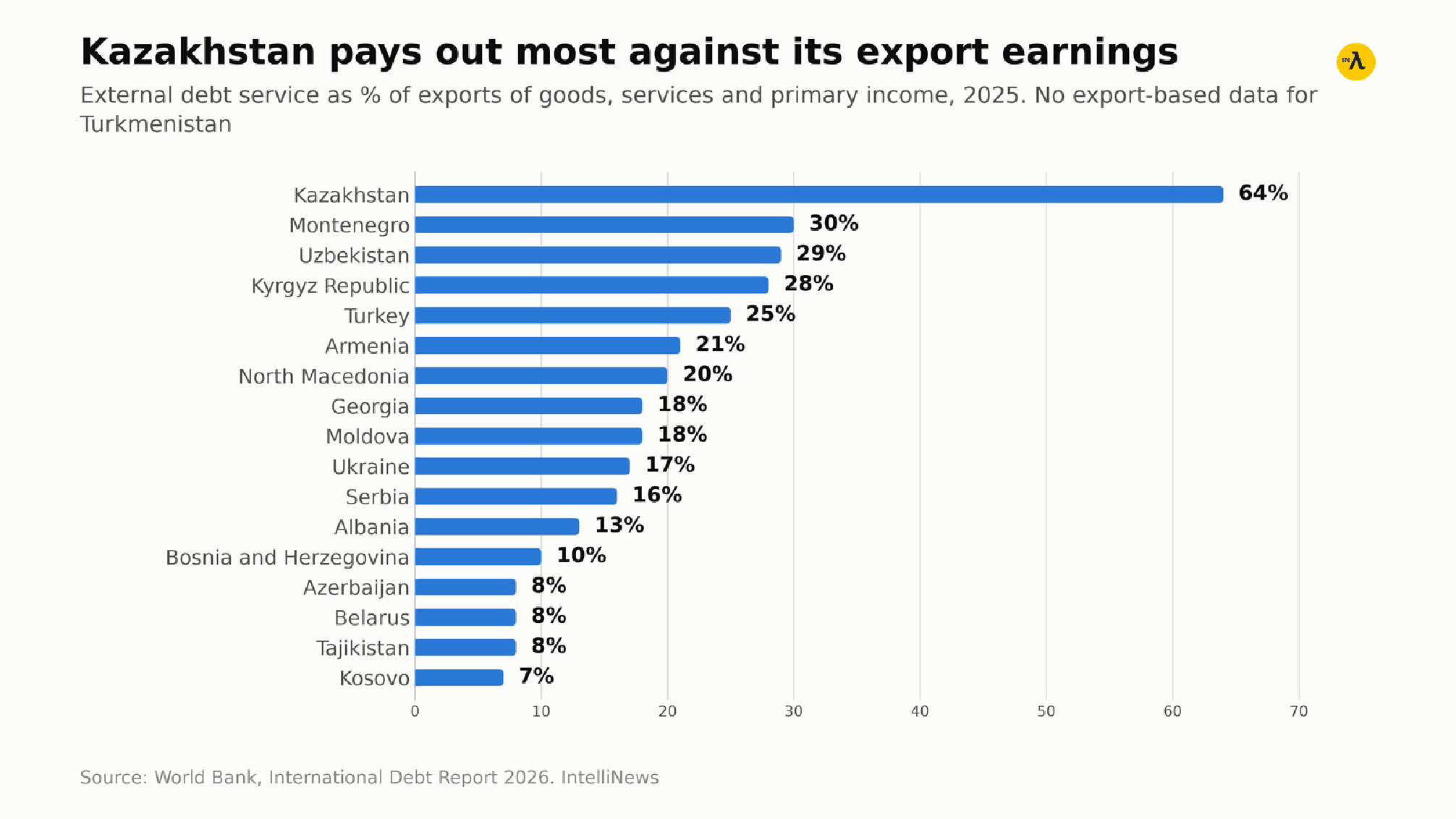
External debt service as a share of exports, 2025. Source: World Bank, International Debt Report 2026. IntelliNews.
China remained the dominant bilateral creditor for several Central Asian countries, holding $1.5bn of the Kyrgyz Republic's $1.9bn bilateral public debt and $738mn of Tajikistan's $894mn. Turkmenistan's reported external debt fell 14.1% to $2.9bn, although the World Bank did not provide export-based debt indicators for the country, which publishes limited financial data.
In the South Caucasus, Azerbaijan was an outlier, with external debt falling 9.3% to $12.3bn, equivalent to just 17% of national income.
Armenia's debt rose 14.1% to $18.7bn. Its debt-to-exports ratio increased 47.6% to 122%, while debt service rose 62.3% to 21% of exports, pointing to weakening export earnings.
Georgia's external debt increased 5.3% to $25.4bn, equivalent to 71% of national income, the fourth-highest ratio in the region. Its debt indicators improved, with official lenders accounting for $9.2bn of the $11.2bn in public external debt. The Asian Development Bank was its largest creditor.
The Western Balkans and Moldova also recorded substantial increases. Kosovo's debt rose 28.7% and Montenegro's 25%, among the fastest increases in the region. Moldova's debt increased 18.2%, Serbia's 17.7%, Bosnia and Herzegovina's 14.3%, Albania's 13.4% and North Macedonia's 12.6%.
Currency movements contributed to the increases. More than a quarter of the $303bn rise in public and publicly guaranteed debt across developing countries reflected the weaker dollar, which inflated the dollar value of liabilities denominated in other currencies. The World Bank did not provide a regional breakdown.
The effect was particularly relevant in the Balkans, where borrowing is heavily denominated in euros. Montenegro's central bank reported an increase of 6.6% to €10.32bn in external debt in 2025, compared with the World Bank's 25% rise in dollar terms, although the institutions use different definitions.
Montenegro nevertheless faced one of the region's heaviest debt burdens. External debt equalled 118% of national income and 252% of exports, while debt service absorbed 30% of exports, second only to Kazakhstan. Private creditors held $4.1bn of its $5.8bn public debt, while China accounted for $646mn of the $820mn owed to foreign governments.
Serbia's external debt has almost doubled since 2015 to $59.6bn. China was its largest bilateral creditor, with $3.2bn, followed by the United Arab Emirates with $1.1bn. North Macedonia owed Hungary $1.2bn, more than any other government. Albania's debt service rose 47.3% to 13% of exports, while multilaterals held $4.5bn of Moldova's $5bn public debt.
Belarus, for which the World Bank provides estimates, owed Russia $7.2bn and China $2.2bn of its $9.5bn in bilateral debt. The report showed no new public loan commitments for Belarus in 2025.
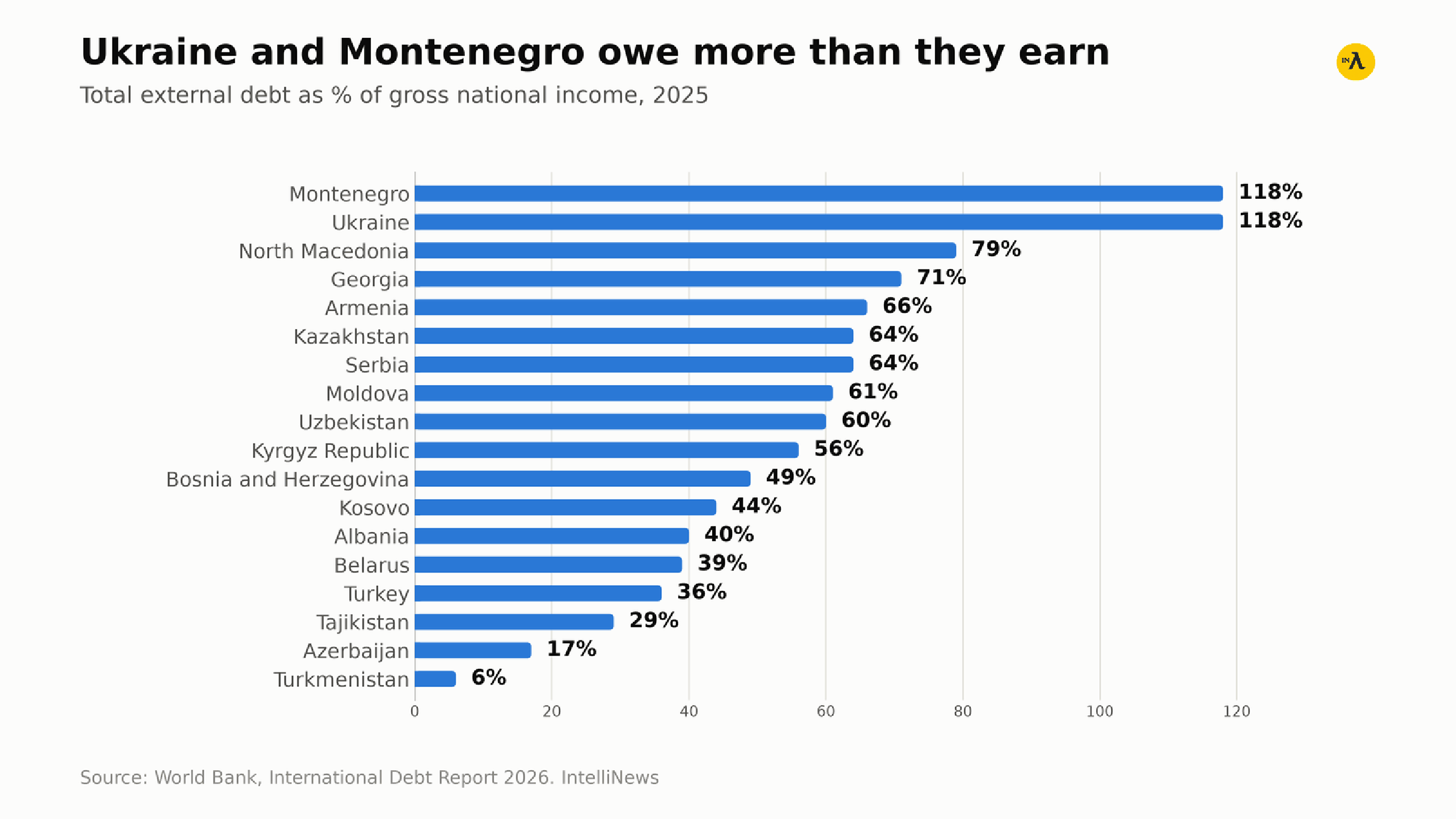
External debt as a share of gross national income, 2025. Source: World Bank, International Debt Report 2026. IntelliNews.
Borrowing has continued in 2026, with more than 10 developing countries exceeding their full-year 2025 bond issuance by mid-August. Bosnia and Herzegovina raised $1.8bn, compared with $412mn during the whole of last year.
New private-sector borrowing in the region averaged 5.3% interest and a seven-year maturity, compared with 1.9% and 29 years for official lending.
The shift towards commercial financing in countries including Uzbekistan, Montenegro and Bosnia & Herzegovina is increasing borrowing costs and shortening repayment periods, as export growth across the region struggles to keep pace with rising external debt.
| Country | External debt, end-2025 ($bn) | Change on 2024 | Debt/GNI | Debt/exports | Debt service/exports |
| Turkey | 572.8 | +12.3% | 36% | 142% | 25% |
| Ukraine | 250.3 | +29.2% | 118% | 403% | 17% |
| Kazakhstan | 183.1 | +10.3% | 64% | 193% | 64% |
| Uzbekistan | 88.0 | +24.7% | 60% | 227% | 29% |
| Serbia | 59.6 | +17.7% | 64% | 108% | 16% |
| Belarus | 35.9 | +5.7% | 39% | 66% | 8% |
| Georgia | 25.4 | +5.3% | 71% | 127% | 18% |
| Armenia | 18.7 | +14.1% | 66% | 122% | 21% |
| Bosnia and Herzegovina | 16.0 | +14.3% | 49% | 108% | 10% |
| North Macedonia | 14.3 | +12.6% | 79% | 123% | 20% |
| Kyrgyz Republic | 12.5 | +4.8% | 56% | 215% | 28% |
| Moldova | 12.4 | +18.2% | 61% | 165% | 18% |
| Azerbaijan | 12.3 | -9.3% | 17% | 35% | 8% |
| Albania | 12.2 | +13.4% | 40% | 96% | 13% |
| Montenegro | 10.9 | +25.0% | 118% | 252% | 30% |
| Tajikistan | 7.2 | +1.8% | 29% | 76% | 8% |
| Kosovo | 5.6 | +28.7% | 44% | 84% | 7% |
| Turkmenistan | 2.9 | -14.1% | 6% | n/a | n/a |
| Region | 1,340 | +15.3% | 49% | 152% | 25% |
Source: World Bank, International Debt Report 2026, country profiles. Exports cover goods, services and primary income.

No comments:
Post a Comment