Some of the world's biggest oil traders are asking Washington for permission to put sanctioned tankers back to work, as a global vessel shortage pushes oil transportation costs to extraordinary levels.
Trafigura, Vitol, Mercuria and Abu Dhabi National Oil Co. are negotiating with U.S. officials for licenses to purchase or lease blacklisted oil tankers, Bloomberg reported Friday, citing people familiar with the discussions.
The talks involve approximately 50 vessels currently under U.S. sanctions. Treasury officials are considering approvals on a case-by-case basis, although no decisions have been finalized.
The proposal comes after months of shipping disruptions stemming from the Iran war, which has forced tankers onto longer routes, increased insurance costs, and tied up vessels in inefficient transfers around the Strait of Hormuz.
The cost of chartering a supertanker from the U.S. Gulf Coast to China reached nearly $80 million in October, roughly ten times the average rate before the conflict.
Valero estimated last month that shipping U.S. crude to Asia had reached $30 to $35 per barrel, compared with approximately $5 a year earlier.
Those costs have consequences. Asian orders for U.S. crude for November delivery fell roughly 50% in October, potentially pushing shipments to their lowest level in seven years.
Adding sanctioned vessels could relieve some of that pressure.
U.S. Energy Secretary Chris Wright said last month that Washington was exploring arrangements allowing investors to acquire and refurbish blacklisted tankers for transporting legitimate oil cargoes.
As of November 4, U.S. sanctions covered 1,568 ships, including 462 crude tankers, according to Treasury data compiled by Bloomberg.
But the potential benefit depends heavily on which vessels receive approval. Restoring previously idled tankers would add actual shipping capacity. Simply legalizing vessels already transporting sanctioned oil would do considerably less to ease the shortage.
Many blacklisted tankers are also aging vessels requiring repairs, inspections and insurance before entering conventional commercial service, and U.S. authorization would not automatically remove restrictions imposed by the European Union or Britain.
By Julianne Geiger for Oilprice.com
Russian Owner of Notorious Tanker Challenge US Sale as It Reaches Scrappers
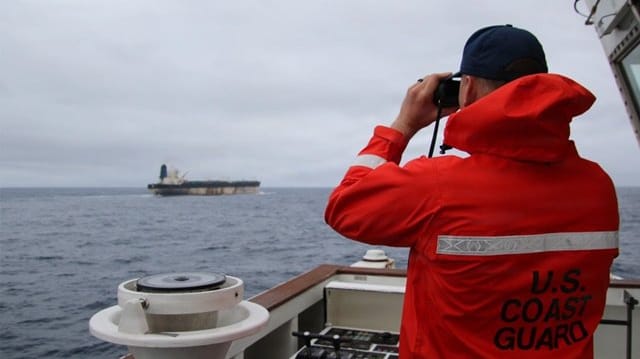
The crude oil tanker Bella 1 (aka Marinera) reportedly arrived at Chattogram, Bangladesh, on November 4, under the name Era, prompting urgent new court filings in the United States from the purported Russian owners of the vessel, who are challenging the United States' forfeiture and sale of the vessel. The vessel famously made international headlines in December 2025 and January 2026 as the United States Coast Guard chased it across the Atlantic before a seizure and took the vessel to Scotland.
Lawyers for Burevestmarin, a Russian company that claims to have acquired the vessel on December 17, 2025, are contesting the sale by the United States, calling it an “economically irrational sale for its own convenience,” and accusing the United States of conducting the “maneuver behind closed doors.”
In a filing on November 4, the lawyers revealed the tanker, which had been sold by the United States to GMS as a cash buyer, was resold on October 14 to a recycler in Bangladesh for $20,763,062.25, which they assert contradicts statements from the United States. It says the U.S. reported the GMS was not authorized under its license to transfer ownership of the ship and would retain the vessel while it was scrapped.
They are asserting that this was the latest in a series of steps in the illegal forfeiture and sale of the vessel to GMS at a “grossly unreasonable price at which to attempt the government's fire sale.” They highlight that the court was told in a filing in August that the ship tanker was sold under an April court order for $9.1 million, yielding proceeds of just under $8.1 million after more than $1 million in costs related to the sale. The U.S. Government further asserted that it had additional unspecified costs for “repairing serious safety and operational deficiencies, maintaining and transiting the vessel,” unrelated to the sale.
The court case for the forfeiture had been sealed until August 2026. Burevestmarin, however, filed in October, making a claim and seeking to overturn the sale. The United States in March had contended to the court that the tanker, which it continues to refer to as Bella 1, had been used dating back to at least 2023 to transport Venezuelan and Iranian oil in violation of sanctions. However, the U.S. says the vessel was stopped in January 2026 after the pursuit because it was operating without a valid flag. It says the ship was claiming to be registered in Guyana, although the authorities said it was not a legitimate registry.
The United States refused to recognize the sale of the vessel to Burevestmarin and the attempt to register the vessel in Russia while it was being pursued across the Atlantic. In the March filing for the forfeiture and sale, the United States lists a Turkish company as the owner of the tanker.
The United States has opposed Burevestmarin’s attempts to seek a temporary restraining order and compensation for the seizure. Burevestmarin was asking the court to hold the ship or force its return, not permitting it to be beached for scrapping. The United States, in its response, highlights that the company waited months to file its case, refutes the various elements of the claim, and asserts that the company came to court with “unclean hands,” saying it was involved in the vessel’s movements while it failed to respond to USCG orders to stop. The United States also points to what it calls a “threatening email” from representatives of Burevest sent in March 2026 to the company hired to tow the tanker, demanding the vessel be returned to the Russian Federation.
The lawyers for the company assert that the United States told the court alternately that the tanker was going to India or Bangladesh for scrapping. The vessel has not been transmitting an AIS position since mid-October.
The lawyers are saying not only was the vessel sold at half its scrap value, but that it has far greater value as an operating asset. In the November 4 filing, they are again asking the court to stay any transfer of the vessel by GMS to a third party and to show cause why the vessel should not be preserved or held pending adjudication of the sale order’s validity.
The court has ordered the U.S. Justice Department to respond by Friday morning to the latest filing from Burevestmarin’s lawyers.
Sanctioned Russian Merchant Vessels Are Underway
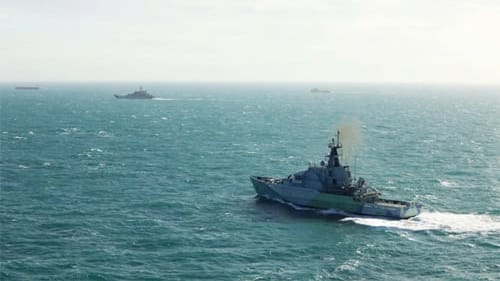
The military cargo convoy of sanctioned Russian-flagged vessels which had been observed forming up in the Russian port of Baltiysk in the Kaliningrad has set sail. It formed into two separate packets, likely one headed for the Mediterranean and the other for West Africa.
Two ships, the Ascalon (IMO 9198226) and Anastasiia (IMO 9349291) set off together on October 31. Sailing in company, the ships passed through the Langeland Belt, escorted first by the German Coastguard vessel Bamburg (IMO 9830020) and the Danish Coastguard vessel Merkur (MMSI 219167000), and then by the Danish naval patrol vessel HDMS Rota (P525). On November 6, the two vessels were making their way through the English Channel, with no surface naval escort visible, and appear to be heading southwest.
Meanwhile, the Lady R (IMO 9161003) and the Lady D (IMO 9349289) set off together from Baltiysk on November 5, and early on November 6 were between Rügen and Bornholm, heading west and being escorted by the Danish naval patrol vessel HDMS Najaden (P523). The Sparta (IMO 9268710) appears to be engaged separately on a regular resupply run between Baltiysk and St. Petersburg.
All four of the ships travelling to warmer waters are moving with their AIS systems activated.
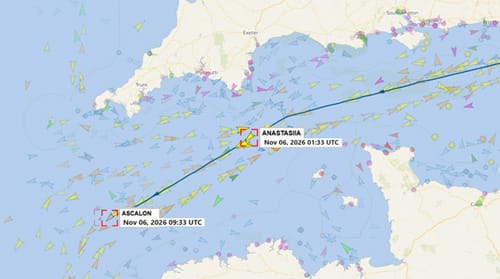
Two Russian military cargo vessels convoying through the English Channel November 6 (VesselFinder)
At the same time, Russia’s shipments of diesel to the United States remain in disarray, with four product tankers having initially been identified as leaving Baltic terminals and as being en route to the East Coast. Owners and managers appear to have heeded the warning of civil and criminal prosecutions issued to port operators should they handle the cargos.
As of November 6, three of the product tankers, each operating under sanctions, are underway, but none appears bound for the United States. The Russia-flagged Talisman (IMO 9292060) has just passed north of Malta, heading eastwards, and is displaying “For Orders,” possibly destined for Turkey. The Sierra Leone-flagged Leruo (IMO 9385831) is west of the Azores heading for Brazil, showing “For Orders” on its AIS. They had loaded at Primorsk. The Sierra Leone-flagged product tanker Beast (IMO 9290921), sanctioned by the EU and UK, left Ust Luga on October 30, indicating that she was heading for “Brazil For Orders.” Currently, southwest of the Faroe Islands, and probably as a consequence of her sanctioned status, she avoided UK territorial waters and took the long route to the Atlantic by sailing north around the Shetland Islands.
The only product tank that still appears to be approaching the United States is the Maltese-flagged Agioi Fanendes (IMO 9798375). This vessel, not sanctioned, passed through the Pentland Firth in UK territorial waters displaying “For Orders,” and is now south of Newfoundland, still heading towards the U.S. East Coast ports.
Dmitry Peskov, the Kremlin spokesperson, when questioned about the diesel tankers altering course has said that all the diesel will find buyers. However, in the interim, Ukraine has resumed its attacks on refineries producing diesel, exacerbating the shortages which previously had resulted in Russia voluntarily limiting its own exports.
Early on November 5, Ukrainian drones once again attacked Rosneft’s refinery complex at Ryazan, one of Russia’s largest petroleum processing facilities and serving Moscow and Central Russian regions. The complex was again set ablaze, and diesel and petrol stocks will need to be diverted within Russia to keep the politically-sensitive capital region well supplied. The attack on Ryazan follows a huge attack on November 3 mounted against the Slavneft-Yanos refinery in Yaroslavl, which also services the Moscow region.

No comments:
Post a Comment