Wednesday, October 21, 2026


Source: The World

Universities have become flashpoints for organizing around Brazil in recent weeks.

About a hundred students sit on the pavement in front of the university’s main administrative building. They’re making signs for a march this evening.

Tiago wears a red soccer jersey and holds a marker in his hand. That’s not his real name, though. He asked that it not be included, fearing attack from far-right supporters for speaking out. Students have faced this here in the past.

“We’re here because we’re afraid that if Flávio Bolsonaro wins, he will dismantle the public infrastructure for education and health in the country,” he said. “And that will affect a large part of the population.”

Roughly 2 million students in Brazil today study at one of the more than 110 federal and state universities around the country. That accounts for roughly 20% of the students studying at universities in Brazil. It’s an important section of the student body.

“The best universities in Brazil are public universities. They either belong to the federal government or the state government,” said João Feres Júnior, a political science professor at Rio de Janeiro State University’s Institute for Political and Social Studies. “So yeah, they’re publicly funded. Students pay no tuition. There is no debt coming from tuition. And sometimes they can get a stipend too.”

It’s perhaps the biggest difference between public universities in Brazil and the United States.

More than half of students at federal and state universities today are from working-class or poor communities.

The Brazilian government also provides extensive federal funding for grants and research at both public and private universities.

But President Jair Bolsonaro, the father of candidate Flávio Bolsonaro, cut billions of dollars from Brazil’s federal universities when he ran the country from 2019 through 2022. He also tried to defund humanities departments like sociology and philosophy, which he accused of being “Marxist,” the Brazilian equivalent of “woke.”

At the time, grants dried up and universities scrambled for private investment. Brazilian Students led some of the largest protests against his government. Today, they fear a Flávio Bolsonaro administration will mean a return to the policies of his father.

They have reason to be concerned.

At the launch of his candidacy in July, Flávio Bolsonaro danced on stage with a large pair of scissors alongside Argentine president Javier Milei. Milei has overseen widespread budget cuts to education in his country, sparking rolling protests there from teachers and students.

Flávio calls his plan, if elected, the “tesouraço,” which translates loosely to “The massive scissoring.” He has proposed transferring oversight of federal universities from the Ministry of Education to the Ministry of Science and Technology, as part of his promise to cut billions from universities and refocus higher education away from so-called “Marxist social sciences.”

“We have to teach our youth to have their own businesses,” he said on a Brazilian program earlier this year. “To study IT, computer science, technology, math, Portuguese, sciences. That’s all we need.”

Guilherme Vargas says Bolsonaro is on the right path. Vargas, a mechanical engineering student at Santa Catarina Federal University, supports Flávio for the presidency and says Flávio’s promise to trim government fat and push for excellence won’t affect federal universities.

“No, I don’t believe there will be big cuts,” he said. “There’s no way to end funding for the Federal University, because it’s a source of research for the country, and research and education is necessary anywhere.”

But many students are scared. And they’ve been organizing. Earlier this week, they held marches across Brazil, hoping to turn the tide in the election.

“The student movement has woken up,” says Anderson Gheller Froehlich, a professor at UNEMAT, a state university in Mato Grosso. “And the youth are going to save the country. It’s the youth that are going to the streets to convince others to vote.”

Flávio Bolsonaro won the first-round election in early October by just over two million votes. Students have been leading the race, encouraging the 33 million people who didn’t vote to show up this time. They say this election is not just a fight over higher education in Brazil, but the future of other public services, like health and social security.

”I think that by going to the street and talking to the workers, the students absolutely have the ability to change this election,” said Ariadne Meneghel, a leader in the DCE student union at Santa Catarina Federal University.

The runoff vote between Lula and Flávio Bolsonaro is on Sunday, Oct. 25.


This article was originally published by The World; please consider supporting the original publication, and read the original version at the link above.

Source: Pan American Dispatch

The presidential campaign has entered the anything goes phase for the far right.

Polls, are being used as weapons. Anything goes to keep Lula from winning the runoff. Anything goes to boost jailed ex-President Bolsonaro’s son Flávio.

Even when it comes to issues Lula has nothing to do with, such as the crisis at Brazil’s Federal Supreme Court, his opponents look for pretexts to justify polling results that are completely at odds with reality.

Fake news is nothing compared with what is already happening and what is still to come. Lula is already being blamed for things he never said. They will stage hoaxes and make up all kinds of stories, with the media turning a blind eye.

What Globo did to help elect Fernando Collor will look like child’s play compared with what is already happening and what the far right will do in coming days.

Be prepared. What lies ahead will go far beyond anything we can imagine. We must be ready to defend ourselves. Otherwise, the outcome could be devastating for us.

Journalists at Globo itself have discussed the contest between Lula and Collor without even mentioning the network’s own role in manipulating the final debate between the two candidates. That manipulation ultimately proved decisive.

The clash between two political projects is giving way to legal battles, with the right resorting to dirty tricks because it struggles to present viable proposals that can compete with the undeniable success of Lula’s government.

Flávio’s decision to agree to a debate while threatening Lula, only to back down later, is another example. He retreated not only in the face of evidence linking him to Daniel Vorcaro, but also after footage of orgies emerged.

Flávio is still basking in his first round victory, even as new polls clearly point to a shift in the political landscape. The change comes especially in the wake of massive popular demonstrations across Brazil. Although Flávio has said nothing about the scale of these rallies, he has begun changing his position on key issues.

He once dismissed social policies as “populist” measures designed to buy public support. Now he has embraced Bolsa Família and other policies that have long been hallmarks of Lula’s political career. He has also abandoned his radical proposal to privatize nearly all state owned companies. He now explicitly says he will not privatize Petrobras, Caixa Econômica Federal or Banco do Brasil, Brazil’s three most prominent publicly-owned companies.

These concessions are part of the anything goes approach in the final stretch of the campaign. Principles no longer matter. The overriding goal is to win votes in a fiercely contested election.

This article was originally published in Revista Forum, has been translated by Panamerican Dispatch with express consent of the editor-in-chief, and can be read in its original Portuguese here.


This article was originally published by Pan American Dispatch; please consider supporting the original publication, and read the original version at the link above.
Source: PanAmerican Dispatch


Image by Brian Mier


This Sunday, the fact that Lula brought out the largest crowd to São Paulo’s Paulista Avenue since the Diretas Já movement in the waning days of the U.S.-backed military dictatorship, with estimates of over 1 million, has rightfully occupied a lot of headline space, even in bourgeois media outlets like Globo which notoriously lies about crowd size at leftist marches and protests.

But across Brazil, scores of other campaign marches have brought out huge crowds in the past few days, even in small and mid sized cities, like the conservative city of Uberlândia, which saw 50,000 people come out to show their support for Lula on October 8.

This Sunday I headed to May 13 Park in Recife’s Santo Amaro neighborhood to cover a Lula rally for TeleSur that had been organized by labor unions, the Workers’ Party and social movements like UNE, the National Union of Students (União Nacional dos Estudantes). I had covered Lula’s surprise visit to Recife on September 25 and witnessed the hastily assembled crowd of 80,000 firsthand. Within minutes of arriving at the park, I knew this one was going to be much bigger.

As I nudged my way through the crowd with my camera equipment, I saw Mayllane Silva, state director of UNE, Brazil’s oldest social movement, which is historically connected to the Communist Party of Brazil (PCdoB). I asked her why UNE helped organize the rally.

“UNE is out on the streets today because we believe President Lula’s reelection is essential to defending education in our country,” she said. “We can’t leave education in Flávio Bolsonaro’s hands, given that he wants to take our universities out from under the Education Ministry. He wants to tear down education in our country. That’s why UNE isn’t just out on the streets here in Pernambuco, but all across Brazil, to say we want President Lula reelected president so we can defend our education system.”

During the presidency of Flávio Bolsonaro’s father, Jair, the government gutted funding for the federal public university system, leaving many of Brazil’s most prestigious public schools, like the Federal University of Rio de Janeiro, on the verge of bankruptcy. The large number of young people present was certainly tied to the fight to protect public education against more of the Bolsonaro family’s market friendly spending cuts, but it was clear that the fight was bigger than that.

A young man named Álvaro Luís told me, “We’re here for all of the minority groups that suffer daily attacks from bolsonarismo. We’re here to fight for those who are unprotected. We are here for the Afro-Brazilians, the working class, for the LGBT community, for women and children, and for a better future for our country.”

When President Lula was first elected in 2002, less than 4% of Brazil’s public university students were Afro-Brazilian, and the vast majority had graduated from prestigious private high schools. The Workers’ Party introduced an affirmative action system that represented an improvement over the U.S. model, because it based university entrance quotas on social class and graduating from public elementary and high schools, as well as on race. Today the share of Afro-Brazilian students matches their share of the population at large, roughly 52%. Millions of low income young people became the first in their families to attend college, and many now worry that under Bolsonaro, university will regress into being an elite privilege.

I approached a young woman who was holding a handmade sign that said, “Fire on the Racists,” and asked why she had come out. “My name is Alana Lima. I have a bachelor’s degree in journalism from the Federal University of Pernambuco, and I was an affirmative action student. I am the daughter of a woman who worked as a kitchen maid and a man who didn’t finish elementary school. I am here today because I know the power that education has to transform people’s lives, and I don’t want this right, which was denied to our ancestors, to be denied to future generations.”

I’ve been covering protests and rallies in Recife for five years now, and this was the largest I had ever seen. Although no size estimate has been made by any credible source at the time of writing this article, I estimate that it was easily twice as large as the crowd of 80,000 that came out to see Lula in person on September 25. Drone footage shows the crowd simultaneously filling the Princesa Isabel Bridge, which connects the Santo Amaro neighborhood to Antônio Vaz Island, crossing the island, and at the same time occupying the entire Buarque do Macedo Bridge to Recife Antigo Island.

As the march reached its final destination at Marco Zero, the original founding point of Recife, newly elected and reelected lawmakers from the Workers’ Party (PT), the Communist Party of Brazil (PC do B) and the Socialism and Freedom Party (PSOL) made speeches reminding the crowd of what will be lost if Bolsonaro takes a chainsaw to the national budget like the ones wielded by Milei and Musk.

Jones Manoel, who was recently elected federal deputy for PSOL, said, “Federal investment in our state will dry up, and important public assets like the Abreu e Lima refinery could end up privatized. So it’s essential that all of Pernambuco’s working class mobilizes to guarantee President Lula’s reelection.”

Even with the size of the rally, the maracatu drum groups, and the humorous chants against Flávio Bolsonaro that seemed to energize the crowd, there was a palpable underlying tension. Toward the end, I ran into a friend who works at one of the Lula administration’s national ministries. Midway through a cheerful exchange of pleasantries, her smile vanished for a second. “I’m really nervous about this,” she said.

Brazil’s presidential runoff will take place on October 25.


This article was originally published by PanAmerican Dispatch; please consider supporting the original publication, and read the original version at the link above.
avatar

Brian Mier has lived in Brazil for over 30 years and holds master’s degrees from Loyola University Chicago and the University of London. He is an editor of Panamerican Dispatch. The views expressed in this article are those of the author and do not necessarily reflect the position of Panamerican Dispatch.

A new cycle of struggles has begun in Portugal

Wednesday 21 October 2026, by José Soeiro, Maria Manuel Rola


At the end of last June, the left and the labour movement in Portugal secured an unlikely victory: the government’s proposed labour reform, which would have overhauled the Labour Code from top to bottom, was defeated in parliament. Public pressure was so intense – with two general strikes, dozens of protests and a campaign that rallied the majority of public opinion against the government’s violently regressive agenda – that the far right, fearful of the electoral consequences of seeing its support for such a thoroughly unpopular proposal through to the end, changed its position and ultimately joined forces with the left to vote down the government’s labour reform package.

This struggle ushered in a new cycle of confidence for the popular movement.

The government, which holds a minority in parliament, put labour issues on hold and sought to change the subject. It ensured that the PS abstained on the draft state budget, on the one hand, and, on the other, reached an agreement with the far right on a new rental law which, in practice, virtually eliminates any rights for tenants.

A two-month delay in paying rent can lead to eviction. There is no longer a cap on deposits for renting a property. The number of months’ rent a tenant must pay in advance when signing a tenancy agreement has been increased to three. The 2 per cent cap on rent increases has been removed. With this proposal, the rental market – which is used by those unable to buy a home – becomes even more cut-throat, in the eurozone country where house prices have risen the most, where only 2 per cent of housing is social housing, where the rent per square metre has doubled over the last five years, where, on average, people spend 50 per cent of their income on rent for legally registered tenancies alone (that is to say, it is even worse if we take the informal market into account), and where the poverty rate rises from around 15 per cent to 27 per cent when housing costs are factored in.

The rising cost of living, including fuel prices, and the approval (albeit without a final vote yet) of the tenancy law have created the conditions for a new cycle of protests.

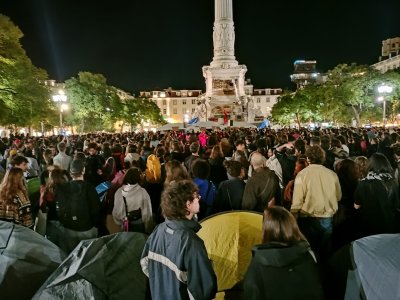
On 10 October, a coalition of various groups and associations, called ‘Não Dá Mais’ (‘We Can’t Take It Anymore’), organised demonstrations against the rising cost of living in five cities, attended by several thousand people. In the city of Porto, which has the greatest impact in the north of the country, this demonstration coincided with two other protests – in support of Palestine and to safeguard an old market (the Bulhão), which is highly symbolic for the city – and was followed by a call, inspired by events in Spain and the wave of outrage over Maricarmen’s death, to set up a tent camp at the end of the rally, occupying the square where it had taken place.

On the first night, around 30 tents were pitched and remained in place. On the second night, there were more than 50. The camp was going to be cleared by the council at the end of the second night. The activists used social media to call for a new demonstration at the same location, with the aim of deciding, at an open-air public assembly, whether to resume the sit-in. On that same day, the Mayor declared that he would be “absolutely uncompromising” if the square were to be occupied with tents again. But not even that deterred the organisers of the camp, who set it up once more, with more people and more support.

At 3 am, with no journalists left in the square, the Government and the City Council, acting in concert, ordered a brutal police charge against a few dozen peaceful activists who had spent the night in that square. Curiously, this was on the very same day that, 20 years ago, a movement had begun to occupy the municipal theatre located in the same square.

The mobile phone videos shocked public opinion and the city. That very same day, thousands of people flocked to the square in outrage, in a massive demonstration that also made its way to the entrance of the city hall. Not only did the movement explode, but it also began to spark reactions in other cities and a huge wave of solidarity.

Not even the attempts by the Government and some commentators to stigmatise and blame the activists for having ‘provoked the police’ had any effect.

For the past ten days, the square has been constantly filled with thousands of people in the late afternoon and evening, with cultural events and workshops, whilst the organisers manage the day-to-day running of catering, security and cleaning. A new camp also sprang up in Lisbon last weekend, and in Coimbra. At the trade union demonstration called by the CGTP (Portugal’s largest trade union confederation) against the rising cost of living on the 17th, trade union organisations and the ‘campers’ converged, forming a crowd of diverse ages and social backgrounds, which returned to the square in Porto. That same evening, the Porto camp was re-established with thousands of people, and several hundred spending the night there. A new cycle of protests has begun and will reach its next major national milestone on 14 November with a national demonstration.

At present, it is impossible to predict how the movement will develop. The issue of housing, however, is already at the centre of public debate, even as the government attempts to refocus the debate on ‘violence’ or the legitimacy of occupying a public space with tents. Progress has been made, notably during the demonstrations on 17 October, in developing a convergence between the housing protests and the trade union mobilisations. The political parties are under pressure to provide answers regarding the housing crisis, and the far right is already beginning to backtrack on its commitments regarding the new tenancy law, which may thus be defeated by popular mobilisation, as happened with the Government’s labour reform package. There is also discussion as to what effect the Spanish general strike will have on the timetable and repertoire of struggles in Portugal. Undoubtedly, the inertia has been shaken off and we are facing a new cycle of collective action, with significant youth participation, which is already fostering a new collective consciousness and may have lasting effects on the reorganisation of the popular movement and the balance of power in the country.

20 October 2026

Translated by International Viewpoint.


Source: FAIR
Guardian (9/26/26): “Donald Trump has long coveted the oilfields of other nations.”

Since the January 3, 2026, military strikes and kidnapping of President Nicolás Maduro, the Trump administration has imposed semi-colonial rule over Venezuela, forcing dramatic shifts in the country’s domestic and foreign policies.

The capstone of the new tutelary regime is an oil deal announced in late August that Trump called “the biggest in history.” The agreement turns over 17 prime oilfields, holding over 20% of the country’s reserves, to a Pentagon-controlled corporation tasked with supplying cheap fuel to the US war machine for decades to come.

After spending years manufacturing consent for US-sponsored regime change in Venezuela (e.g., FAIR.org, 6/4/21, 1/11/23, 2/12/25), having a government in Caracas subservient to Washington represented a new scenario for the corporate media. The novel conditions have raised few significant qualms for Western outlets. Tactical objections notwithstanding, there is no fundamental disagreement with the US running the affairs of a Global South country.

Not ‘stealing Venezuela’s oil’

Energy Secretary Chris Wright (France 24, 3/9/26): “I’ve seen those headlines. ‘We’re Stealing Venezuelan Oil.’ Of course, that’s not true at all.”

Working hand in glove with the Trump administration, the acting Delcy Rodríguez government has overhauled Venezuela’s hydrocarbon legislation (Venezuelanalysis, 7/13/26) to offer what oil experts consider a business environment more favorable to foreign capital than at any point in the country’s history. The new oil agreement with the White House manages to go even further.

The 17 oilfields in question will be taken over by North American Blue Energy Partners (NABEP), a private company in which the Pentagon’s Office of Strategic Capital (OSC) will get a 35% stake while investing nothing—and wielding veto power over its board.

Furthermore, according to the White House, the US State Department will secure 20% of NABEP’s output at cost, and have a right of first refusal over the remaining 80%. On top of this, Venezuelan officials have already suggested Washington would be given an additional “sales discount”  (Venezuelanalysis, 9/9/26).

In summary, Trump is looking to secure cheap crude supplies at a time when his disastrous Iran debacle has thrown global energy markets into upheaval. The agreement is so blatantly skewed that US Energy Secretary Chris Wright felt he needed to clarify that Washington was not “stealing Venezuela’s oil” (AFP, 9/3/26).

Nevertheless, Western media outlets were largely unfazed by such an obvious oil grab, euphemistically referring to the deal as “highly unusual” (New York Times, 8/29/26) or “remarkable” (BBC, 9/1/26), at most as “contentious” (Guardian, 9/1/26).

Corporate journalists did raise objections over the central role played by NABEP owner Alejandro Betancourt, a shady Venezuelan businessman who faced multiple money-laundering probes before the Trump administration intervened, and pressured judicial authorities at home and abroad to drop the investigations (BBC, 9/2/26; CNN, 9/4/26; New York Times, 9/4/26).

But media seemed satisfied with Trump’s state and energy secretaries Marco Rubio and Chris Wright pledging that US oversight will keep proceedings honest (Reuters, 9/2/26; New York Times, 9/4/26), despite the fact that billions in Venezuelan oil revenues, controlled by the US Treasury Department since January, are unaccounted for (Council on Foreign Relations, 6/3/26; Financial Times, 7/22/26).

Procedurally transparent plunder

The New York Times (5/5/26) wrote positively of “a new era of accountability” in which “the United States would control Venezuelan oil sales” and “Venezuela would submit monthly budgets to the White House.”

Objections to the Venezuela/NABEP/Pentagon venture were mostly procedural and out of concern for appearances, not driven by any principled opposition to US imperialist predation. Faced with outright colonial plunder of Venezuela, the political and media establishment only demands “accountability” and “transparency” (New York Times, 5/5/26; Financial Times, 9/18/26).

For months, the White House has controlled Venezuelan oil export revenues, with Trump officials openly calling them “one of the largest assets ever to go on the US balance sheet,” and a source of “leverage” over Caracas. Yet Trump’s Democratic opponents have found no issue with seizing another country’s income, raising only questions about the allocation of the funds in reference to alleged corruption on the part of Caracas and Trump insiders (The Hill, 9/30/26; Washington Post, 9/17/26). This despite the fact that the Venezuelan government has to submit a “monthly budget” to access its own funds (New York Times, 1/28/26) and is subjected to US-imposed auditors (Reuters, 4/27/26).

The other source of disappointment with Trump stomping all over Venezuelan sovereignty, but prioritizing oil over regime change, is impatience for the restoration/recovery/return of “democracy” to Venezuela (Politico, 9/2/26; Guardian, 8/30/26; CBC, 9/3/26). Despite  widely acknowledgement that Trump is eroding democracy at home (New York Times, 8/20/26, 10/14/26; Guardian, 10/8/26), somehow pundits expected him to prioritize it in an oil-rich foreign country.

In the establishment’s consensus, “democracy” does not mean a political system that meaningfully reflects the Venezuelan people’s collective will, but simply one that empowers opposition figures that have been groomed for years, like far-right María Corina Machado, their undemocratic credentials notwithstanding (FAIR.org, 10/23/25).

Eager to stay in power, Rodríguez has over-complied with every US demand, going as far as adopting language about Venezuela undergoing a “democratic transformation.” Her pliancy has earned her favorable corporate media profiles that completely contrast with the demonization of Maduro.

After securing an exclusive interview, Time (7/30/26) described the acting leader as a “disciplined operator” who “advocate[s] for greater economic openness,” in contrast to the “authoritarian” Maduro, who oversaw “economic collapse.” Along the same lines, the Guardian (9/12/26) presented Rodríguez as a “a pragmatic, witty and intelligent workaholic,” unlike her “authoritarian” and “incompetent” predecessor in the presidential palace.

Nevertheless, given the broad Beltway consensus for comprehensive regime change, it is unlikely that the Rodríguez administration’s subservience to Trump will secure any leeway in determining its political path forward, free from outside meddling—especially if, as is anticipated, the GOP lawmakers most likely to be impressed by such obsequiousness lose power in the US’s upcoming midterm elections (Axios, 9/23/26; Financial Times, 10/9/26).

Please think of the corporations!

Reuters (9/1/26): ExxonMobil and ConocoPhillips “have repeatedly said that their requirements of legal certainty and contract sanctity ‌have not ⁠yet been met.”

Alongside their exceptionalist expectations about “democracy,” legacy outlets also focus on those they consider the true victims of Trump’s neocolonial offensive in Venezuela: multinational oil corporations.

According to Reuters (9/1/26), the recent oil deal “raises red flags for major producers,” who fear having their reputation sullied by being “seated at the same table with Betancourt,” as well as the prospect of the US government becoming a “competitor.”

Bloomberg (8/30/26) raised concerns that the agreement “reprises [the] neocolonial past” of Venezuela’s oil industry. The warning stems not from apprehension that the Venezuelan people’s future is being determined by a foreign nation, but from fear that the US’s “out-sized power” might lead to “popular unrest.” This could create conditions for what the business mouthpiece views as a catastrophic outcome: the nationalization of foreign-owned oil assets.

“The troubled history of Venezuela’s oil offers a cautionary tale,” Bloomberg’s Kevin Crowley and Patricia Garip wrote:

The country was once dominated by US and European operators and was among the world’s largest producers. But assets owned by ExxonMobil Holdings Corps. and ConocoPhillips were seized and nationalized during political upheaval in the 2000s.

Corporate media present companies that made massive profits in Venezuela for decades as victims, because the Chávez government wanted them to comply with new laws and accept minority stakes in joint ventures.

The New York Times (9/1/26) complains that the two corporations “have spent years trying to get the country to repay them for their seized assets, with little success.” The statement conceals the fact that the Venezuelan government, when it enacted the 2007 decree imposing state majority in all Orinoco Oil Belt projects, offered to compensate ExxonMobil and ConocoPhillips for their transition to minority partners, or to buy out their assets altogether. However, both corporations rejected the offers in order to pursue international arbitration. The former has already recouped most of what it was granted, while the latter will eventually collect on a significant award.

Despite the fact that Chevron, BP, Shell and other energy giants have signed deals in recent months taking advantage of the reformed hydrocarbon law (Venezuelanalysis, 9/3/26), pundits complain that ExxonMobil and ConocoPhillips remain “hesitant” (CBS, 8/31/26) and need to be “lured” (Reuters, 9/1/26). Still, the Western corporations are likely to return to the country with favorable deals (Reuters, 9/16/26).

The victor and his spoils

Belén Fernández (Al Jazeera, 9/24/26): “You’re not technically supposed to admit that you attacked a country just to get its oil.”

Faced with strategic defeat in West Asia, Trump has clung to his Venezuela success, stating on multiple occasions that “to the victor belong the spoils,” in reference to the US hijacking the Venezuelan oil industry following the January 3 attacks and presidential kidnapping (Al Jazeera, 9/24/26; Guardian, 9/26/26).

Furthermore, Trump has not been shy in boasting about the US winning a “war” against Venezuela (Financial Times, 9/18/26; New York Times, 6/26/26). Corporate journalists have rarely pointed out that this stance directly contradicts the administration’s official position that the kidnapping of Maduro and Flores was a “law enforcement” operation (New York Times, 1/6/26; PBS, 1/8/26) in order to justify bypassing congressional approval.

The US president has likewise claimed to have recovered the costs of the military operation “many times over” (Al Jazeera, 3/3/26; Guardian, 6/28/26), a fact confirmed by Luigi Pisella, a business sector spokesperson with close ties to the acting Rodríguez administration (Venezuelanalysis, 8/10/26). Pisella stated that the US has retained $4.7 billion from the Venezuelan export revenues it controls to cover the costs of its military operation.

In spite of their ostensible hostility to Trump, corporate outlets have historically been complicit with his Venezuela policies, from whitewashing a deadly sanctions program (FAIR.org, 6/13/22) to endorsing a military buildup over debunked “narcoterrorism” accusations (FAIR.org, 11/19/25). The New York Times and Washington Post went as far as to withhold information in order to not jeopardize the January 3 operation (FAIR.org, 1/13/26).

Now, with a semi-colonial regime in place, the only concerns are about procedural transparency, democratic appearances and the well-being of multinational corporations. The Venezuelan people always get the short end of the stick.


This article was originally published by FAIR; please consider supporting the original publication, and read the original version at the link above.

Ricardo Vaz is a journalist and political analyst based in Caracas, Venezuela. He works on the editorial team of the independent media outlet Venezuelanalysis, on the technology team of the Tricontinental Institute for Social Research, and is also a member of the Tatuy TV and Utopix communication collectives.