Wednesday, October 21, 2026

STATEHOOD OR INDEPENDENCE

Puerto Rican Communities Bear the Brunt of the Water Crisis

Source: Originally published by Z. Feel free to share widely.

As a child, visits to my grandmother’s home in the rural area between the municipalities of Humacao and Yabucoa, in eastern Puerto Rico, often began with the same question: “Is there running water?” Decades later, we have stopped asking—not because the problem has been solved, but because we already know the answer. She either has no running water at all or lives with such low water pressure that access remains uncertain.

Community-based organizations across Puerto Rico, particularly in rural areas, have long organized to demand access to running water, but public officials often treat this struggle as a problem of the past. Yet the water-rationing program initiated by the Puerto Rico Aqueduct and Sewer Authority (PRASA) on August 7 in response to an anticipated drought caused by the El Niño phenomenon reveals how persistent the problem remains. Although the program was recently suspended following temporary relief from cloud-seeding efforts, declining reservoir levels recorded on September 21—nearly a week after the intervention—underscore why Puerto Rico’s water crisis cannot be understood as a matter of climate alone.

The water crisis predates the current drought. PRASA has long struggled with deteriorating infrastructure, compounded by two unsuccessful privatization attempts between 1995 and 2004. Many communities have responded by developing their own aqueducts, but these initiatives cannot match the scale of the structural problem on their own.

Amid the drought, there are also growing concerns that El Súper Tubo, Puerto Rico’s main distribution pipeline, has reached the end of its useful life. In response, the government has called on residents and community organizations to prepare for drought conditions that could persist through the end of the year.

There is broad consensus in Puerto Rico on the importance of local communities in addressing the water crisis. Yet calls for communities to take the lead raise questions that demand a more nuanced approach. How is the burden of the water crisis distributed? What do calls for autonomous community action demand of local leaders and the everyday work of their organizations? How have the austerity measures imposed amid Puerto Rico’s debt crisis affected PRASA’s capacity to respond?

Who Bears the Burden of Puerto Rico’s Water Crisis?

The rationing affected an estimated 500,000 residents across San Juan, Trujillo Alto, Loíza, Canóvanas, Juncos, Gurabo, and Carolina, many of whom continue experiencing interruptions and low water pressure. The burden of Puerto Rico’s water crisis falls along lines of race, class, and gender. In Loíza—where 43 percent of the population lives in poverty and 32 percent identifies as Black or African American—residents have endured unreliable access to running water for nearly six months. Similarly, residents of Canóvanas—where 32 percent of the population lives in poverty and 15 percent identify as Black or African American—have faced this crisis for nearly six months. Among the seven municipalities affected by PRASA’s rationing program, Loíza and Canóvanas have both the highest poverty rates and the largest proportions of residents who identify as Black or African American.

PRASA’s rationing program is not the only institutional response to the water crisis. Jennifer González Colón, Puerto Rico’s right-wing governor, declared a state of emergency through Executive Order 2026-035. The order attributes the crisis primarily to insufficient rainfall, prioritizes available water for potable use, and authorizes exemptions from standard procurement procedures. At the same time, communities and social movements have demanded more transparency from PRASA and González Colón over the management of the situation. In response, PRASA has threatened to fine residents for “misuse of water,” and Puerto Rico’s Department of Natural and Environmental Resources has deployed personnel in enforcement operations resembling police raids to identify residential and community wells it considers illegal.

The Double State of Exception

This move by González Colón’s administration recalls the politics of exception that have accompanied other emergencies in Puerto Rico, including hurricanes, earthquakes, and the COVID-19 pandemic. As Sociologist José Atiles Osoria points out, the Puerto Rican government’s growing reliance on executive orders as a form of governance creates a double state of exception: one produced by U.S. colonial rule and the other by Puerto Rico’s executive branch’s routine use of executive orders. In a similar vein, sociologist Naomi Klein, in her work on The Shock Doctrine, reminds us how government institutions capitalize on emergencies to maximize fear and trauma, and expand their powers.

Puerto Ricans remember how these politics of exceptionality created opportunities for private firms to profit after the widespread destruction caused by Hurricane María in 2017. The current crisis has also revived more intimate memories of María.

“This feels like going back to the times after Hurricane María. This activates my PTSD from [Hurricane] María,” one resident told me while collecting water from a tanker truck. We walked together briefly after filling our containers, and she ended our conversation with a clear statement: “This whole situation is not the result of insufficient rainfall. It is the result of the inefficiency of the people in charge.”

PRASA’s Unsustainability

Puerto Rico’s water crisis raises questions regarding PRASA’s situation under La Junta’s austerity measures. La Junta is the federally appointed fiscal control board created by Congress in 2016 to address the archipelago’s $70 billion in public debt and nearly $50 billion in pension liabilities. One of those drivers is PRASA. By 2017, the company had accumulated approximately $5 billion in debt, largely due to its reliance on borrowing to finance capital improvement projects. As part of its austerity agenda, referred to as government-rightsizing, La Junta initially pushed PRASA to reduce operating expenses, raise rates for its customers – 95 percent of whom are residential— and pursue private investment in infrastructure.

As a result, PRASA cut $30 million from its 2026-27 budget for replacing and renovating equipment. At the same time, in its PRASA 2025 Fiscal Plan, La Junta reported that the capital improvement budget had grown, largely through federal post-disaster recovery funds from the Federal Emergency Management Agency and the U.S. Department of Housing and Urban Development. Between 2019 and 2025, approximately $9 billion in federal funding was available for PRASA, of which $6.6 billion was obligated and $773 million disbursed, much of it in response to Hurricane María, Hurricane Fiona, and the earthquakes that struck Puerto Rico in 2020.

These numbers raise more questions than answers, especially given the repeated transparency and contracting scandals under González Colón’s administration. These controversies have ranged from fraud investigations involving procurement in the electric power sector to questionable contracting practices by Víctor Ramos, secretary of the Department of Health. Hence, the biggest scandal of González Colón’s administration was the concerns over conflicts of interest and the alleged influence of former secretary of government Francisco Domenech in benefiting his former lobbying firm, Politank. These and other corruption allegations provide grounds for questioning the management of the current water crisis and PRASA’s use of its resources, particularly given the recent influx of recovery funds.

Community Responses

The resurgence of post-María collective memories of solidarity, community organizing, and mutual aid requires a more nuanced analysis in the context of the current water crisis. After María, autonomous recovery efforts were widely celebrated across Puerto Rican civil society, either as empowering forms of self-reliance or—among more progressive groups—as emancipatory practices that challenged profit-driven approaches to disaster recovery. Now, the water crisis is reviving these memories and familiar calls for communities to care for one another.

However, calls for communities to organize amid the water crisis and other emergencies can obscure the tensions that arise when residents are expected to fill gaps in governance themselves. In Puerto Rico, the burden of fulfilling the state’s role often falls on community leaders who devote hours of unpaid labor to helping neighbors who come to see them as substitutes for public officials. I witnessed these tensions while conducting research for my doctoral dissertation between 2022 and 2025, as community leaders and activists repeatedly expressed frustration with the growing expectation that they provide services and resources in the absence of public officials and state institutions.

One neighborhood activist I spoke with, who is unnamed to avoid jeopardizing her organization’s funding, runs a community agroecological project. When I asked about her workload as a neighborhood activist, she immediately questioned the popular slogan that “only the people save the people.” That slogan sounds nice, and we use it during protests and mobilizations. But sometimes I feel like, all of a sudden, I have another responsibility. Now I have to ‘save the people,’ many of whom don’t even care about what is happening around them,” she said.

Another organizer working in an impoverished community in the San Juan metropolitan area expressed her concern with burnout among local leaders: “Our problem is that the urgent always comes before the important,” they said.

Recognizing these burdens challenges romanticized views of community action, which often place heavy demands on community leaders, many of whom are women and older adults. It also reminds us that community organizing must constantly balance efforts to address broader structural problems with the need to provide practical solutions to people’s immediate needs. Moreover, communities and their leaders should not be expected to absorb the consequences of PRASA’s institutional limitations, Puerto Rico’s debt crisis, and La Junta’s austerity measures. The drought may be a natural emergency, but the water crisis is more than that. It is also the outcome of a colonial system in which debt, austerity, and extraction have shaped the infrastructure on which Puerto Ricans depend. Community organizing may help people survive the crisis, but it should not relieve those who produced it of responsibility.

The following article is syndicated in partnership with the North American Congress on Latin America (NACLA).

Mikael E. Rosa Rosa is a full-time lecturer at the Beatriz Lassalle Graduate School of Social Work, University of Puerto Rico, Río Piedras CampusHe completed doctoral studies at the Crown Family School of Social Work, Policy, and Practice at the University of Chicago. His research and activist work focus on community organizing, colonialism, and neoliberal governance regimes.


Source: Waging Nonviolence

After Operation Metro Surge, the Trump administration moved to rein in the Bovino-style spectacle with its made-for-TV arrests. In an attempt to avoid another public outcry, Immigration and Customs Enforcement has quietly settled into a new rhythm.

Arrests have still increased month after month, reaching a record high of roughly 51,000 people taken into ICE custody in August. This is part of a new surge — carried out in hospitals, courthouses and airports — with an intent to stay off the nightly news. As The New York Times reported, this phase is “captured mostly by grainy security camera footage, through cracked blinds and from behind closed doors.” 

This phase is also backed by a dragnet of data. At airports, ICE has been running name matches with TSA to detain people at check-in counters and gates. It has found a backdoor into the country’s license-plate cameras: Records show local and state police ran more than 4,000 immigration-related searches on Flock’s camera network in a single year. (Yet another reason Flock cameras should not exist.)

Perhaps surprisingly, much of the tech infrastructure driving ICE’s new surge is headquartered in … Vermont. The town of Williston, outside Burlington, is home to both ICE’s Law Enforcement Support Center, which houses the agency’s national tip line, and ICE’s National Criminal Analysis and Targeting Center, or NCATC, its social-media surveillance hub.

As ICE tries a new approach, this new phase of resisting ICE requires moving to more offense — and the people of Vermont are offering us some clear lessons. 

Vermont resistance

Resistance started with the fight over flights. Early in Trump’s second term, activists documented ICE moving detainees onto commercial flights out of Burlington’s airport — more than 450 people as of mid-July 2025, by their count. They showed up in airports as witnesses and disruptors, sometimes aided by empowered flight attendants. They forced an ICE retreat: organizers say ICE hasn’t moved detainees through the airport in more than a year.

More recently they’ve gone after the hard infrastructure. Sit-ins at the White Cap Business Park in Williston, where the NCATC facility is located, have led to arrests for allegedly blocking the entrance to the ICE offices, including 11 people in February and 13 in July.

After those arrests came some unusual twists, which speak volumes about the courage it takes to refuse unjust orders and to continue protesting in the face of repression.

Complicity and noncooperation

Responses to authoritarianism are as old as a time — many of the same dynamics from Vermont show up in the ancient story of Pharaoh and Moses.

Undeniably the most powerful person in his land, Pharaoh was the ultimate authoritarian. His big trick was taking beautiful work and turning it evil. Take the work of midwives, whose job is to usher life into the world — he turned that work into ugliness by ordering the Hebrew midwives to kill every newborn boy. 

But we all have a choice. And famously, several of the midwives refused. Their act of noncooperation with an unjust order is the reason Moses lived.

We are living through a moment when institution after institution is being turned toward evil. Some, like the Department of Justice, were already a mixed bag. But now it is being turned against the very logic of due process it claims to serve, as we’ve seen recently with the criminal indictment of whistleblower Cassidy Hutchinson. Other institutions, like the Environmental Protection Agency and the Centers for Disease Control and Prevention, are being perverted, with great resistance from insiders who cling to the key values that these agencies were founded on.

In Vermont, the local prosecutor, Chittenden County State’s Attorney Sarah George, faced her own choice. When asked to bring charges against the protesters who held the sit-ins, she repeatedly declined, citing limited resources. That makes sense: No one was harmed, and the protesters have a strong necessity defense — the argument that they were preventing an even greater harm. Every minute that ICE isn’t taking part in abducting people is good for the country.

Then came a bizarre turn of events. The state’s public safety commissioner directed state police to send the cases to Vermont’s Attorney General Charity Clark, bypassing normal procedure and upending the traditional role of the attorney general. Clark, a Democrat, decided to charge the protesters with trespassing.

In an op-ed, she said her hands were tied: “Justice must be blind or our system will fail.” Back to Pharaoh: This is a bit like a midwife in the next town over raising her hand to say, “I’d like to kill Moses, because that’s what the law dictates.”

Protesters recently unearthed relevant Vermont history — a model of state-level noncooperation. After the Fugitive Slave Act of 1850, which ordered cooperation with slave catchers, Vermont passed a state statute known as the Habeas Corpus Law. It effectively nullified the federal law, and went so far as to require state attorneys to defend anyone accused of being a slave, with full representation before a judge and a jury. The entire practice of nullification was deemed highly escalatory — so much so the federal government threatened military invasion — but due to the state’s resistance, throughout Vermont there was effectively no participation in the Fugitive Slave Act.

As in that case, the pressure from the federal government has continued. One week before a planned week of direct action, the federal government suddenly charged five people from the earlier protests with obstructing access to a federal facility (punishable by up to 30 days in prison or a $5,000 fine), likely hoping to deter further escalation.

We all have a choice: complicity with Pharoah or noncooperation. Despite the threats and new legal challenges, the protesters in Vermont chose the riskier, more liberatory path.

A funeral, a guerrilla garden and a sit-in

The week of direct action went on as planned, beginning with a funeral. On Oct. 5, more than 30 clergy led a procession of a hundred or so mourners who walked behind a hearse to the White Cap Business Park, singing “Amazing Grace.” They carried 95 paver stones, each representing a life taken by ICE — directly or from complications while detained — and placed them one by one in a handmade coffin of Vermont pine. The action echoed the Stolen Neighbors Quilt created in Minnesota, which remembers people who were deported. Here, names of those killed by ICE were read out. Then, in front of the doors of the spy center, the coffin was nailed shut.

Rev. Marybeth Redmond said at the vigil, “I have walked alongside Vermonters struggling to survive, and I have never seen our immigrant neighbors so hunted, so afraid and so alone.”

In the end, it was a symbolic act. Security scattered the stones, and the property manager and others were seen taking crowbars to the coffin. But it was only the beginning of the week.

The next action was a garden. Because what would you expect from Vermont? Rather than using just their bodies to get in the way, about 40 protesters arrived at sunrise with pots, planters and bags of soil. 

They affixed the boxes to the pavement with construction adhesive, painted and chalked them with flowers, insects and slogans, flew a rainbow kite, and by mid-morning, had gotten a full dance party going. The action blocked the road to 188 Harvest Lane, which houses ICE’s national tip line.

They were also highlighting the environmental violence of ICE’s data intensive operation. Gardener Isaac Petersen said, “ICE’s surveillance technology is extremely energy-intensive, much of it powered by AI and data centers. It harms our communities directly by targeting our neighbors.”

State and local police moved some barriers, but largely left the garden alone, which blocked the road for most of the day. ICE’s parking lots were nearly empty all day, and the rumor was that ICE was told to avoid coming into the office.

Each day escalated from the day before. By Thursday, protesters went right up to the front entrance of the Harvest Lane facility. Dozens had arrived before 8 a.m. to deliver handwritten note cards with “tips” encouraging ICE employees to find other jobs. The protesters started by taping those messages to the windows and doors. Then they hauled out a rug, a couch, a coffee table and a fold-up mattress — a makeshift living room — and sat down, singing and playing music, effectively shutting the place down. 

Much of this has been intergenerational. Vermont protesters have ranged from people in their early 20s to an 83-year-old from Bethel and 85-year-old from Sharon.

Some of those sitting at the entrance this week had taken part in earlier acts of civil disobedience, and several now face charges brought by Clark. 

Organizers say the ICE facility was effectively shut for much of that week, its parking lots empty. Police interference was minimal: At one point, officers came over only to remove the items protesters had used to block a surveillance camera, then returned to their cars. As the organizers said in their press release, “ICE employees went home rather than face Vermont’s week of bold, decisive action.”

What you can do 

The week of action was only one moment, and organizers hope others will organize their own — aimed at different pieces of ICE infrastructure. There are other flash points around the country this month, too, in Austin, Minneapolis and Arizona.

As for Shut Down ICE VT, the group behind the week of action, they plan to keep going. One simple way to support them: Call the tip line that ICE runs out of Williston to encourage neighbors to turn each other in. To disrupt its activity, the group is encouraging people to call 866-347-2423 and tell whoever picks up all the different ways ICE could be making a better world. According to organizers, this tactic has been so successful the lines are clogged — one person was on hold for 2 hours and 18 minutes until her phone died. (This tactic was used in the early DOGE days.) Instead of doing Pharaoh’s bidding: What are the beautiful things you could be doing with your life? It can be a bit of a daily ritual.

Because here, in the end, is Pharaoh’s trick: He changed the meaning of what was legal. He didn’t simply say, “You must obey me.” He said that if you refused, you were the one breaking the law.

But we should remember whose side the law has so often taken. The law stood against enslaved people seeking freedom. It stood against women having control of their own bodies. It stood against trans people claiming full autonomy. The law, by itself, is no defense against injustice — and must not be turned into an instrument of oppression.

Sarah George declined to prosecute protesters for a reason. By stepping in to take up the case, Charity Clark has signaled a willingness to participate in the repression. The people shutting down ICE in Vermont are on the right side of history. Let’s find ways to join them.


This article was originally published by Waging Nonviolence; please consider supporting the original publication, and read the original version at the link above.

Daniel Hunter coaches and trains movements across the globe. As founder of Choose Democracy he’s helped stop Trump’s coup attempts. He has trained extensively with ethnic minorities in Burma, pastors in Sierra Leone, and independence activists in northeast India. He has written multiple books, including "What Will You Do If Trump Wins,” "Climate Resistance Handbook" and "Building a Movement to End the New Jim Crow."


INDIA

The Cockroaches that just keep coming back

COMMENT: The Cockroaches that just keep coming back
/ Abhijeet Dipke - X, Cockroach Party founderFacebook
By IntelliNews - New Taipei Bureau October 21, 2026

The founders of the Indian protest platform, the Cockroach Janta Party (CJP), have been in and out of jail multiple times over the past few weeks. On October 14 two of CJP’s biggest names - Ashutosh Ranka and Saurav Das - were detained, initially for five days but the term was then extended for at least two more days by a special executive magistrate, Hindustan Times reported.

Meanwhile, the CJP’s founding President, Abhijit Dipke has also been taken into custody at least three times since his return to Delhi earlier in October with the goal of launching a new wave of protests against the alleged disenfranchisement of millions of people from India’s voter lists. At Dipke’s last attempt to stage a mass protest on the evening of October 16, he was swiftly picked up by law enforcement agencies alongside an estimated 150 others before being released the next morning.

Dipke, Ranka and Das had all previously been involved in a separate protest which ultimately led to the resignation of India’s then Education Minister Dharmendra Pradhan in July. While Dipke had been detained intermittently, Ranka and Das were able to continue coordinating the protest action, speak to the media and make social media posts in his absence.

Indian authorities see the CJP and other allied parties participating in protest action under the demand to dismiss India’s Election Commission chief Gyanesh Kumar as unjust and a threat to public order. To counter the widespread law and order challenge seen in the form of  the large gatherings at central Delhi's designated protest spot, Jantar Mantar, the government simply removed its designation as a protest site. This in turn was criticised by the CJP and the traditional opposition political parties and leaders as an oppressive move by the ruling Bharatiya Janata Party to which the incumbent Prime Minister Narendra Modi belongs.

Apart from CJP leaders, another name emerging among the protests is Neha Bohra, a student of Jawaharlal Nehru University (JNU) and the President of the Communist Party of India's student wing, All India Students Association (AISA). Neha has been more accusatory than usual and is ready to issue more calls to mass protests in her statements and actions than even the CJP leaders.

However, despite how it is portrayed as a quasi-party of sorts, the CJP isn't associated with any political parties and claims just to be its own thing. However, Dipke did previously serve as a volunteer for the Aam Aadmi Party headed by former Delhi Chief Minister Arvind Kejriwal.

The law enforcement take

In their appearance at the hearing in front of the executive magistrate presiding over the matter of custody or release for Ranka and Das, the Delhi Police highlighted that publicly made statements indicate that CJP and AISA leaders intend to continue their protest activity, and that this could result in a threat to public order.

According to a report by The Indian Express, the magistrate presiding in the case of the CJP leaders too has purportedly received death threats and harassment, but no specific perpetrators were named and two separate legal cases were filed probing the threats.

The CJP leaders, when released previously, agreed to sign a bond that binds them not to engage in activities that may result in the disturbing of the peace. However, this is contradictory to the nature of protests in a country with the population density and socio-economic conditions of India.

The CJP’s cause has resonated with the wider opposition to the BJP and has brought in the leadership of parties ranging from those older than the Indian republic itself such as the Indian National Congress (INC), and parties with only a regional presence such as the Trinamool Congress from West Bengal.

That said, despite support the CJP is pulling in, its leaders have given no sign of eventually moving into electoral politics themselves - as of October 20 - and are unlikely to be co-opted by any of their ideological peers with a more substantial political base.

This makes the CJP more of a flash in the pan kind of movement than a generationally relevant banner which may one day produce a government ruling India - something the group's supporters may not be ready to hear.

However, this is not to say that due to the prevailing concept of anti-incumbency against the BJP being felt by Indian voters, the CJP won't be the right catalyst to give names and faces to popular sentiments that can be seen as opposition to the larger than life persona of Prime Minister of India since 2014, Narendra Modi.

Source: Jacobin

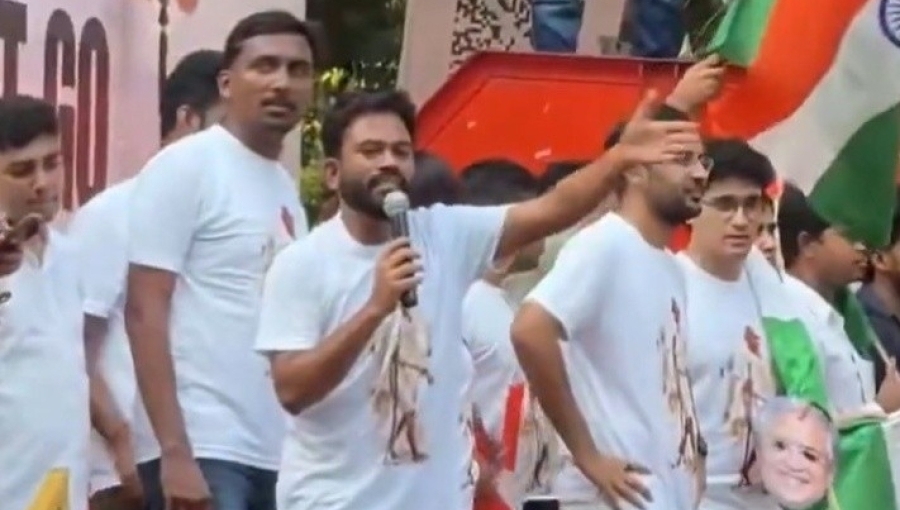
October 10, India’s capital city, New Delhi, was turned into a fortress as protesters tried to oppose a countrywide exercise to revise the electoral rolls. The protests were called by the Gen Z movement known as the Cockroach Janta Party (CJP), working with left-wing student groups, which forced the resignation of the minister of education in July.

In response, the Indian government deployed more than twenty thousand police officers and paramilitary personnel, suspended internet access in central Delhi, and barricaded the city center. Thousands of protesters, including the leaders of the CJP and prominent opposition politicians, were detained.

The protests stem from a massive government effort, known as the Special Intensive Revision (SIR), to revise India’s electoral rolls by removing dead, duplicate, and ineligible voters. Concerns intensified in the last month that under the SIR eligible voters are losing their right to vote, with 130 million names left off the draft electoral rolls since the start of the program.

The events of the last year are part of a larger pattern that has cast doubts on the legitimacy of India’s elections. There are growing fears the SIR was designed to advance Prime Minister Narendra Modi’s goal of a centralized and authoritarian government. Evidence suggests that it handed Modi’s Bharatiya Janata Party (BJP) an electoral advantage in recent state elections by removing voters from marginalized communities, including Muslim voters.

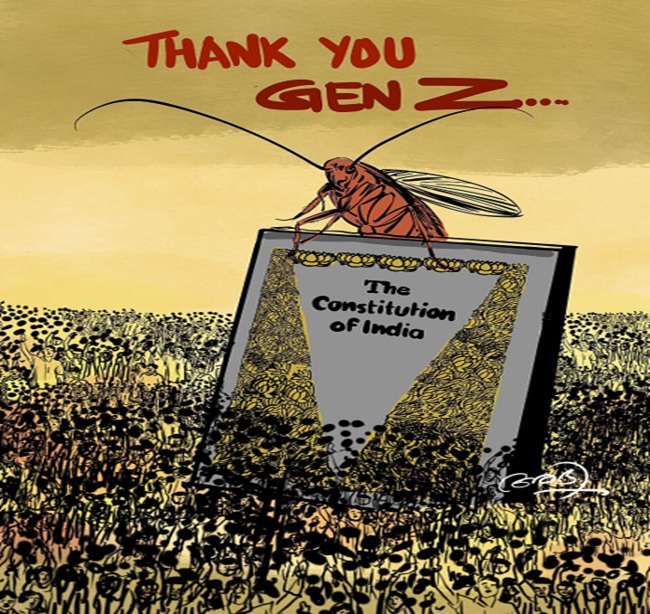
The Gen Z protests have garnered support from a broad spectrum of opposition parties, including those on the Left. But the real energy of the protests is coming from the ingenuity and irreverence of young Indians who have flooded the streets of New Delhi despite the violent crackdown. In a country that has long touted itself as the world’s largest democracy, the developments are striking and could prove a turning point for its future.

How Modi Changed India’s Elections

While the electoral rolls in India are revised every year to add new voters and remove people who have died or moved away, the SIR, which launched back in June 2025, has inverted the voter registration process for the first time in the country’s history. Instead of election officers verifying voters at their homes, the SIR asked voters to fill out a form and prove their eligibility to vote. Voters are matched against records from a previous SIR conducted between 2002 and 2004 and in many cases asked to provide documents showing they are eligible to vote. Critics of the SIR claim that it is stripping eligible voters from the rolls.

The SIR is the work of the Election Commission of India (ECI), the country’s chief electoral body, which oversees national elections and provincial elections, including in states with populations larger than California’s. The commission is led by a three-person panel whose chief, like a Supreme Court judge, can be removed only if the Parliament impeaches them.

In a key development in December 2023, the Indian government passed a law making changes to the selection process for choosing election commissioners. The result is that the executive branch of the government now has the most influence in the process. The same law also quietly inserted a clause giving these commissioners legal immunity. Making matters worse, the election commissioner responsible for introducing the SIR, Gyanesh Kumar, just so happens to be the first chief election commissioner appointed under the new law, raising questions about what’s really going on.

How Centralization of Voter Rolls Could Thwart Democracy in India

Criticism of the SIR intensified after The Indian Express reported on September 23 that two of the three election commissioners were sidelined despite raising objections at least fourteen times about the exercise. Among their criticisms were concerns about the process in which new voters were registered, how names were deleted and restored, who had the power to file appeals against restored voters, and who had access to the voter database.

The electoral body has maintained that access to the voters’ list is secure and decentralized, meaning that local electoral officers make the judgment on who stays on the voter list. But the revelations in The Indian Express showed that the SIR was relying on ECINET, a digital platform that logs voters. The result is increasing centralization, giving more control over the voter rolls to the commission’s headquarters in Delhi. In one instance, the newspaper documented that officials in the state of Goa flagged ninety-seven voters who were mistakenly removed. Despite eight emails from Goa’s chief electoral officer to officials in New Delhi, the voters were knocked off the rolls when the deadline passed.

India’s principal opposition leader, Rahul Gandhi of the Indian National Congress, alleged that the additions and deletions of voters were undertaken as an exercise to disenfranchise a section of voters critical of Modi’s BJP. In the state of West Bengal, the exercise removed some nine million names from the electoral rolls in the months before the state elections in April 2026. Modi’s BJP won power in the state for the first time in the election. Thirty-four percent of those removed from the rolls were Muslim even though they make up just 27 percent of the state’s population. The BJP has maintained that many Muslims eliminated from the lists were “illegal Bangladeshi migrants,” even though evidence has shown scores of Indian nationals were also removed. Of the few appeals tribunals have decided — under 3 percent of some 2.5 million — about 90 percent ended in restoration.

With the BJP falling short of a majority in the 2024 general election, the stakes are high for Modi. The party was forced to form a coalition with regional allies that do not share a Hindu-nationalist ideology. The opposition alliance led by Gandhi’s Congress won 234 seats, thirty-eight seats shy of a majority, despite the Congress having its bank accounts frozen and being comfortably outspent. The result is that for the first time in years many Indians are no longer afraid to openly criticize their government — they are even prepared to fight back.

The Rise of India’s Cockroach Movement

In May, the curiously named Cockroach Janta Party (CJP) first made global headlines after it hit roughly fifteen million followers on Instagram in a week — then again at the end of July after it forced the resignation of India’s minister of education, no small feat. Though the CJP appeared to come out of nowhere, it was the result of long-simmering tensions in India. It started as a satirical joke made by Abhijeet Dipke, an Indian student in Boston, after India’s chief justice, Surya Kant, likened unemployed young Indians questioning the government to “cockroaches” and “parasites.” Dipke posted a comment on X, “What if all cockroaches came together?” and millions responded. He returned from Boston to New Delhi on June 6 and headed directly to Jantar Mantar, launching a protest against the government’s mishandling of a competitive public exam.

Though he had limited experience in political organizing, Dipke joined hands with left-wing student organizations in New Delhi. Their first protest lasted thirty-six days and attracted people from all over India and from all walks of life including a vast number of students, exam aspirants, schoolteachers, construction laborers, activists working with civil society organizations, Dalits, Muslims, and other social minorities.

By taking up the issue of competitive exams, the movement’s leaders tapped into frustration among young people in India who have seen pathways to social mobility fall apart in recent years. Among those with graduate and postgraduate degrees, the rate of unemployment is particularly high. More than twelve million candidates applied for 8,868 openings in the state-owned Indian Railways company in 2025. The unemployment crisis is further compounded by the high cost of living, hikes in petrol prices, and the effects of pollution, which has left a near-permanent industrial haze over many Indian cities. The country has touted 7.7 percent growth in GDP numbers for the last fiscal year while ignoring persistent inequities on the ground.

A Democracy Under Mortal Threat

Despite well-documented inequalities in the country, India has long maintained an orderly and transparent electoral process. But a generation of political observers have now witnessed the erosion of once powerful institutions and the threat of detentions and police action against dissenters.

In 2019, as Modi ran for a second term, the Election Commission cleared him in six separate complaints that he had violated the election code of conduct. In his second term, he further undermined the independence of the selection of election commissioners, seen as a fresh attempt to tip the political playing field in favor of his party and turn India into a one-party state. Then in 2024, Modi led an even more divisive campaign even as his opposition decried inaction from the election commission. The SIR exercise too has invited widespread public anger since it asked citizens to submit multiple documents simply to prove their eligibility to vote. In some cases, it even forced people identified as dead to come forward to prove that they were, in fact, alive.

On September 24, a day after The Indian Express broke the story on the many inefficiencies of the SIR, Abhijeet Dipke and the Cockroach Janta Party called for a protest seeking the removal of the chief election commissioner, Gyanesh Kumar, and the rollback of the SIR process. And with that, the “cockroaches” kickstarted an even bigger public outcry.

Mass Protests Are Needed to Protect Voting Rights

As with the summer protests over education reforms, the Gen Z movement hoped to channel the growing anger in India over the undermining of democratic elections. Alongside the Cockroach Janta Party, the left-wing student organization All India Students’ Association (AISA) was credited with some of the more robust protest actions in the past week. AISA is the student wing of the Communist Party of India (Marxist–Leninist) Liberation, and its cadre have had to use all their experience, discipline, and political commitment in organizing mass collective actions in the protests.

“[The protests] have opened democracy’s Pandora’s box to talk about all the other ways we can ask for accountability,” said Neha Bora, the president of AISA, speaking to Jacobin before this month’s protests. “The energy from this movement should be put into struggles to build our country anew. . . .  We know that every mass protest is the possibility of something new and reinforces the idea there could be an end to this violent period.”

The movement’s leaders, including Dipke of the CJP and Bora of AISA, announced a united mass protest on October 10. In response, police in India detained over ten thousand people across the country. Then on the day of the protest, the government deployed the overwhelming force of twenty thousand police and paramilitary personnel in order to prevent protesters from gathering in the city.

The unprecedented crackdown has done little to stem the tide, as the opposition parties led by Rahul Gandhi held a protest of their own, marching to the Supreme Court on October 12 along with thousands of people. The sheer number who took to the streets this week was reminiscent of previous mass outcries in the Modi era against the disenfranchisement of India’s Muslim community, and against laws that would have left farmers vulnerable. But those protests faced a similar crackdown from the BJP: smear campaigns against the leaders, the use of excessive police force to stop demonstrations, and the eventual arrest of activists under anti-terror laws. Muslim activists and intellectuals like Sharjeel Imam and Umar Khalid have been jailed without trial for six years.

However, the Gen Z movement has posed new questions to the BJP and has made it difficult for the party to control the narrative, despite its influence over mainstream television news channels in India. TV news has tried to paint the protesters as agents of India’s supposed external enemies like Pakistan and China. But the arrest of two of the Cockroach Janta Party’s leaders, Saurav Das and Ashutosh Ranka, while they were holding the Indian national flag has made that charge hard to sustain.

The movement has not only been able to rapidly form a broad coalition on common social interests; it has also mobilized concerns shared by young Indians across religion, caste, and class divides. It has offered Indians the first real sign of lasting political change — little wonder that Modi is now throwing the full might of the state against them.


This article was originally published by Jacobin; please consider supporting the original publication, and read the original version at the link above.

Prajwal Bhat is a New York City–based journalist.