Showing posts sorted by relevance for query AMERICAN FREEMASONS. Sort by date Show all posts

Tuesday, March 27, 2007

The Origin of American Conspiracy Theories


Americans are fascinated with conspiracy theories, in fact they generate the majority of them. Along with religious revivalism, conspiracy theories are second nature in the body politic of America.

Here is a fascinating thesis that shows that the conspiracy theory meme began in America with its founding during the revolutionary war. And since then conspiracy theory has dominated American politics.

Be it in the religious revivalism of the 1800's, the anti-Masonry movement, or the later Know Nothings, through out the history of American politics conspiracy theories have abounded, and have had major political impact. They are as American as apple pie.

This is a PhD. Thesis and is a full length book available for download as a PDF.

Conspiracy Theory and the Society of the Cincinnati, 1783-1790


At the same time, I became aware of a tradition of radical political dissent in
modern America, an abundance of conspiracy theories that also extended into popular culture. It was the time of Timothy McVeigh and the militia movement, of Waco, Ruby Ridge, Pat Robertson, and the X-Files. Suddenly conspiratorial explanations for current and historical events seemed everywhere. From Richard Hofstadter’s writings I realized that conspiracy theories occurred in episodic waves throughout American history, and from Bernard Bailyn and Gordon Wood I learned that the founding fathers believed in a secret English plot against American liberty. I decided to investigate, but soon became aware that other scholars were already writing on conspiracy theories in post-World War II America. Clearly, I had to look off the beaten path for a case study in American political “paranoia.”

It was then that I remembered a somewhat obscure document from my studies
on the Connecticut ratification debates. Just before the Philadelphia Convention of 1787, Dr. Benjamin Gale, an eccentric physician from Killingworth, wrote a long letter to Erasmus Wolcott.

In this diatribe, Gale complained about the machinations of the Society of the Cincinnati, a veterans organization of officers of the Continental Army. Gale charged that all the talk about the weakness of the Articles of Confederation was merely a smokescreen for the treasonous ambition of the Cincinnati. According to Gale, this society planned to establish a military dictatorship or monarchy and assume the mantle of hereditary nobility for themselves. Gale was obviously an Antifederalist, one who not only attacked the movement for a new Constitution as unnecessary and dangerous, but who felt it was the result of a deliberate conspiracy against American freedom.

I had found my topic. Apparently, a conspiracy theory existed in the 1780s, the
very period when the political culture and system of the United States was taking
shape, and it accused the leaders of the Continental Army of anti-republican subversion.

Small wonder then that such discourses of radical suspicion surfaced periodically
over the course of American history. If some American revolutionaries felt that even George Washington and Henry Knox could be traitors, we should not be surprised that so many Americans question the report of the Warren commission or distrust the federal government and the United Nations. The Deepest Piece of Cunning is a journey to the origins of conspiracy theories in the United States. It should shed some light on the political controversies of the 1780s as well as the persistence of conspiracy theories in American political culture.

Abstract

In May 1783, the officers of the Continental Army of the United States of America
organized themselves into the Society of the Cincinnati. Soon after, the veterans
organization became the focus of an elaborate conspiracy theory which falsely accused the officers of trying to establish a hereditary nobility and subvert the young republic.

Over the course of the mid-1780s, prominent revolutionary politicans such as John Adams and Elbridge Gerry joined in the outcry. The conspiracy theory became a major political controversy, and even impeded efforts to reform the Articles of Confederation.

However, despite their frantic tone and lack of a factual basis, the accusations were not merely a fringe phenomenon created by political crackpots. Instead, the conspiracy theory was deeply embedded in American political culture. When the political and economic problems of the 1780s threatened to disrupt the republican experiment, many revolutionaries looked for a threat that might explain the crisis. They found that threat in the Cincinnati, whose military background, federal organization, and aristocratic trappings made them suspect.

See:

1666 The Creation Of The World

Once More On the Fourth

Conspiracy Theory or Ruling Class Studies


Bilderberg

Conspiracy Theory

Conspiracy


Ruling Class

Freemasons


Find blog posts, photos, events and more off-site about:
, , , , , , , , , , , , , ,
, , , , , , , , ,

Tuesday, July 28, 2020

Black soldiers monument faces scrutiny amid racial reckoning

THE FIRST BLACK REGIMENT IN THE US UNION ARMY, PROMOTED BY FREDERICK DOUGLAS AT THE TIME , MANY OF THE NON COM OFFICERS WERE ALSO PRINCE HALL FREEMASONS, THE BLACK AMERICAN FREEMASONS. 

y

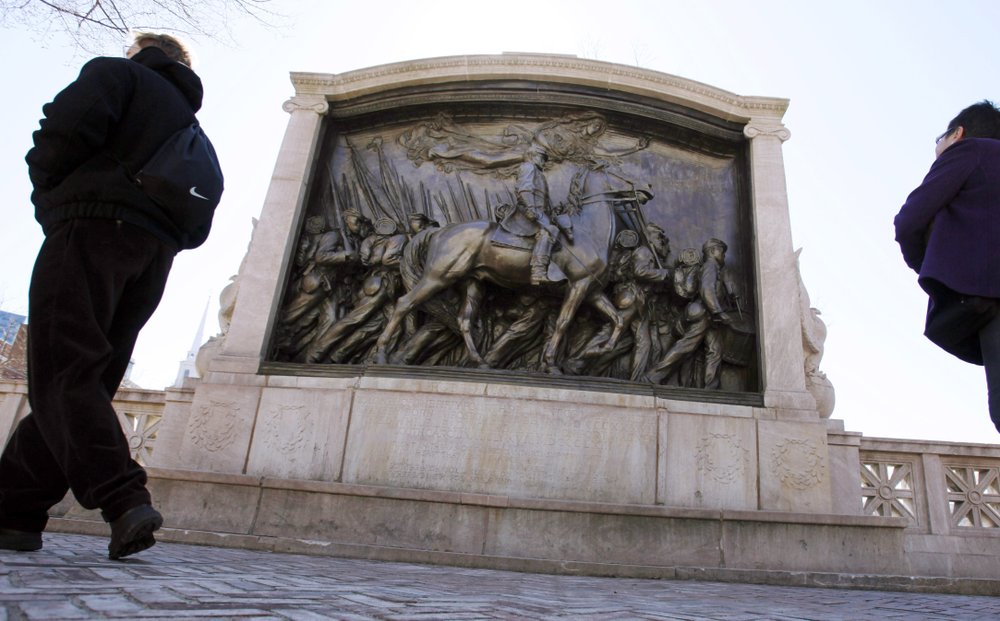
In this March 26, 2011, file photo, people walk past the memorial to Union Col. Robert Gould Shaw and the 54th Massachusetts Volunteer Infantry Regiment, near the Statehouse in Boston. Amid the national reckoning on racism in July 2020, the memorial to the first Black regiment of the Union Army, the Civil War unit popularized in the movie "Glory," is facing scrutiny. (AP Photo/Michael Dwyer, File)


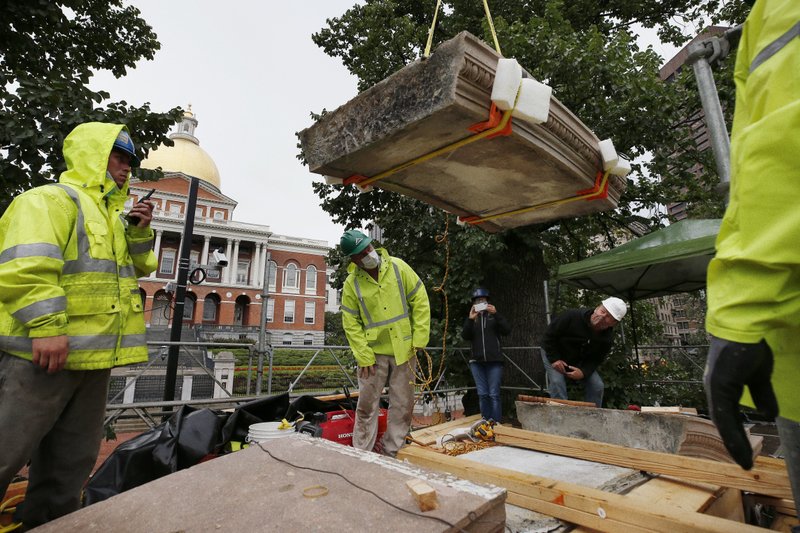
Workers inspect the top cornice stone as it is lifted from the Shaw 54th Regiment memorial opposite the Statehouse, Friday, July 17, 2020, in Boston. Amid the national reckoning on racism, the memorial to the first Black regiment of the Union Army, the Civil War unit popularized in the movie "Glory,” is facing scrutiny. (AP Photo/Michael Dwyer)


BOSTON (AP) — The white Union Army commander sits rigid atop an imposing horse. His Black men, rifles to their shoulders, march resolutely alongside on their way to battle.

For L’Merchie Frazier, the towering bronze relief in downtown Boston captures the stirring call to arms answered by Black soldiers who served in the state’s famed Civil War fighting unit, which was popularized in the 1989 Oscar-winning movie “Glory.”

But the longtime Boston artist says she understands how the imagery of the Robert Gould Shaw and Massachusetts 54th Regiment Memorial can conjure mixed feelings as the nation takes another hard look at its monuments and memorials in the wake of the killing of George Floyd by Minneapolis police.

“Whose story is being told with this monument?” said Frazier, who is the education director at the nearby Museum of African American History. “The hierarchy is very evident. White commander out front; Black soldiers in the background. It’s the first thing you see.”
mid the national reckoning on racism, the Shaw memorial is the latest and, perhaps, one of the more curious to receive scrutiny.

Unlike other felled monuments, the work by American sculptor Augustus Saint-Gaudens isn’t a paean to the Confederacy. It doesn’t have explicit ties to colonialism, such as the Christopher Columbus monuments that have been toppled in Boston and elsewhere.

Instead, the creation of the memorial in the aftermath of the Civil War was championed by prominent Black Bostonians of the day.

It was originally envisioned as a traditional equestrian monument to Shaw, but the colonel’s family, a wealthy Boston clan strongly opposed to slavery, requested that it also honor the Black men who served and died alongside him during their famed charge on Fort Wagner in Charleston, South Carolina, in 1863.

The monument is also significant because it’s the nation’s first honoring Black soldiers, said Elizabeth Vizza, executive director of the Friends of the Public Garden, a group helping pay for a $3 million restoration of the monument, which started in earnest in May.

Saint-Gaudens spent 14 years creating a richly detailed bas relief, using Black men of different ages as models for his realistic soldiers. After it was unveiled to fanfare in 1897, American author Henry James declared the work “real perfection,” according to the National Park Service.

“This was a radical piece of art,” Vizza said. “It was not lost on people back then.”

The work, which sits across from the Massachusetts Statehouse, has been vandalized over the years, mostly by people snapping off Shaw’s broadsword. But during the unrest that followed Floyd’s killing in May, the monument was tagged with anti-police slogans, expletives and other graffiti, along with about a dozen others in and around the Common.


Kevin Peterson, founder of the New Democracy Coalition that’s calling on Boston to rename Faneuil Hall after Crispus Attucks, said the Shaw monument should be moved to a museum because it casts Blacks as “subservient” to whites.

Similar complaints have prompted the removal of other ostensibly well-meaning monuments in recent weeks, including a statue of Theodore Roosevelt in front of the American Museum of Natural History in New York and a statue of Abraham Lincoln depicting a freed slave kneeling at his feet in Boston.

The Rev. Vernon Walker, a board member with Massachusetts Peace Action, which has called for changing the state seal’s controversial depiction of a Native American man, suggests the Shaw memorial could better recognize the achievements of the Black soldiers themselves.

Roughly half the regiment’s 600 soldiers were killed, wounded, captured or presumed dead following the failed assault on Fort Wagner, and their heroism inspired tens of thousands of Black men and others to sign up for the Union Army, helping turn the tide of the war.

Sgt. William Carney became the first Black man awarded the Medal of Honor for saving the regiment’s flag from capture. Two sons of prominent Black abolitionist Frederick Douglass, who had pushed Lincoln to allow Blacks to serve in the war, also fought at Fort Wagner.

But while the names of Shaw and other fallen white commanding officers were etched in the monument from its unveiling, those of the Black soldiers weren’t added until the 1980s, during its last major facelift.
The film “Glory” features shots of the restored monument in its end credits. Director Edward Zwick and leading cast members, including Matthew Broderick, Denzel Washington and Morgan Freeman, declined to comment through their representatives.

For now, the Shaw memorial is not among the public works that have come up as Boston continues to review public concerns about city monuments in the wake of the national debate on racism, said Mark Pasnik, who chairs the city’s Art Commission overseeing the process.

But Vizza, of the park group, doesn’t think the memorial, which is expected to be restored by November, should be changed or moved.

She believes people will have a greater appreciation for the work if they simply learn more about it, something her organization, the mayor’s office, and the National Park Service have taken pains to do.

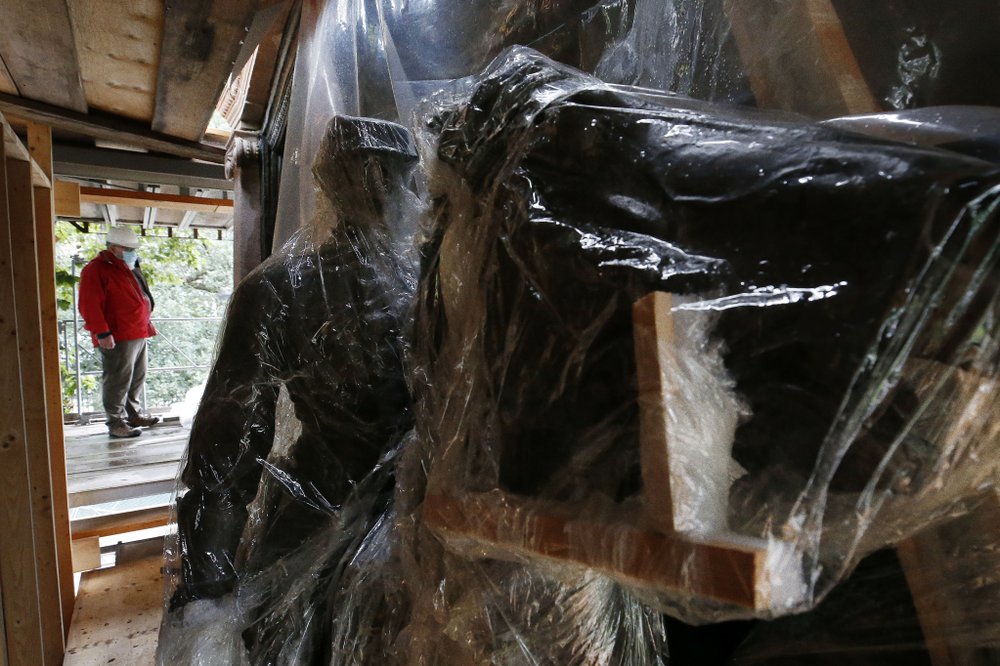
Ahead of the restoration, which included disassembling parts of the memorial last week, officials hosted forums on public monuments that included prominent Black scholars and civil rights activists.

A temporary exhibit also has been installed on the fencing around the construction site detailing the 54th regiment’s exploits. And a new “augmented reality” app leads people on a virtual tour of the monument where they can learn more about its significance and ongoing restoration.

Frazier, of the Museum of African American History, says those are all laudable steps, and agrees the monument should remain where it is.

“It’s not enough to just see the piece. You have to go deeper,” she said. “There’s so much not told, but the monument is so moving that it can lead you to those things, if you’re curious.”


Tuesday, July 04, 2006

Once More On the Fourth


Radgeek once again extols an anarchist version of what American Independence means,


July 4th is the anniversary of the ignominious death of a tyranny, not the birth of a new government. On July 4th, 1776, there was no such thing as the United States of America. The regime under which we live today was not proclaimed until almost a decade later, on September 17, 1787. What was proclaimed on July 4th was not the establishment of a new government, but the dissolution of all political allegiance to the old one. All for the best: a transfer of power from London to Washington is no more worthy of celebration than any other coup d’etat. What is worth celebrating is this:

We hold these truths to be self-evident, that all men are created equal, that they are endowed by their Creator with certain unalienable Rights, that among these are Life, Liberty and the pursuit of Happiness. —That to secure these rights, Governments are instituted among Men, deriving their just powers from the consent of the governed, —That whenever any Form of Government becomes destructive of these ends, it is the Right of the People to alter or to abolish it …. [W]hen a long train of abuses and usurpations, pursuing invariably the same Object evinces a design to reduce them under absolute Despotism, it is their right, it is their duty, to throw off such Government, and to provide new Guards for their future security.

Declaration of Independence, July 4th, 1776

That is, the revolutionary doctrine that we all, each of us, are the equal of every puffed-up prince and President, that as such you, personally, have every right to refuse the arbitrary orders of tyrants, to ignore their sanctimonious claims of sovereignty, to sever all political connections if you want, and to defend yourself from any usurper who would try to rule you without your consent.

It was an agrarian mechanics rebellion that is forgotten in the Sturm and Drang of American Nationalism.

Just as it is forgotten that
the first martyr of the revolution was a free black mechanic and sailor.

The image “http://docsouth.unc.edu/nell/nellfp.jpg” cannot be displayed, because it contains errors.

It would be the mechanics revolt in Boston that touches off the revolution.

Deference or Defiance in Eighteenth-Century America? A Round Table

Gangs of America by Ted Nace - Chapter 4
Why the Colonists Feared Corporations
In which the citizens of Boston demonstrate the use of the hatchet as an anti-monopoly device (1770-1773)

Shay's Rebellion


Which is why the earliest celebrations of July 4th were not state holidays but a mechanics movement along with protests over changes in their rights as journeymen. It was the core of the Republican poitics of the early 19th Century. It would be the mechanics, including free black sailors and tradesmen, who formed the unions as well as fraternal societies that were populist organizations in America.

Not surprisingly, this consensus proved untenable. As mechanics demanded protection for
their skilled trades, wealthier merchant- manufacturers celebrated the large scale, technologically
advanced operations that threatened to put artisans out of business. In the most insightful chapter
of the book, Peskin examines how mechanic, manufacturer, and manufacturing changed in meaning
between the 1790s and 1820. Terms that had been broadly inclusive of productive labor taking place
in rural households and urban craft workshops became narrow: manufacturing was what took place
in factories, a manufacturer was someone owning a factory, and mechanic lost its association with
craft skill to become a synonym for a factory machinist. Perversely, the Mechanics’ banks that
appeared in the 1800s had little to do with artisan labor, but rather marked the attempt of urban
businessmen to dress a suspicious financial institution in republican garb. By the late 1820s, at “the
high tide of antebellum protectionism” (207), politicians had become the leading advocates of
manufacturing and craft artisans were virtually excluded from the conversation. At precisely the
moment when “the factory system and industrial capitalism were becoming significant in reality as
well as in rhetoric” (218), it became far more difficult to assert that all would share equally in
manufacturing’s bounty. The labor radicalism of the Workingmen’s parties offered one model of
competing class interests, whereas the sectional defiance of Southern nullifiers would offer another.
Peskin observes the continuities between colonial promanufacturing rhetoric of the 1760s and the
Whig party’s American System in the 1830s. But by this later date, mercantilist faith in government’s
ability to create an economy greater than the sum of its parts had “become a bittersweet fantasy, an
attempt to hold on to an increasingly distant past, when harmony and national self-sufficiency
seemed attainable goals” (221). Manufacturing Revolution: The Intellectual Origins of Early American Industry.


One should not forget the importance of the internationalism of the American revolt which inspired both the French and the Haitian revolution. Word of which had spread from Africans in the French colony of New Orleans via free black sailors
who were inculcated with Freemasonry and the enlightenment values of liberty, equality and fraternity, as was the Haitian revolt.

This portrait (left) of an unidentified Revolutionary War sailor was painted in oil by an unknown artist, circa 1780. Prior to the war, many blacks were already experienced seamen, having served in the British navy and in the colonies' state navies, as well as on merchant vessels in the North and the South. This sailor's dress uniform suggests that he served in the navy, rather than with a privateer.


Jim Thomson | The Haitian Revolution and the Forging of America

Many Fraternal Groups Grew From Masonic Seed (Part 1 -- 1730-1860 )

Prince Hall, Freemasonry, and Genealogy

Joe William Trotter - African American Fraternal Organizations

African-Americans in Antebellum Boston

African American Odyssey: Free Blacks in the Antebellum Period ...

Weevils in the Wheat: Free Blacks and the Constitution, 1787-1860

The Revolution's Black Soldiers

Adeleke, Tunde "Violence as an Option for Free Blacks in Nineteenth-Century America"

The Racist Roots of Gun Control

Women in Antebellum America | Pre-Civil War Women | Women in ...


Also See: Happy 4th of July

Plutocrats Rule

American Fairy Tale

Secular Democracy

Slavery in Canada

A NEW AMERICAN REVOLUTION


Find blog posts, photos, events and more off-site about:
, , , , , , , , , , , , ,
, , , , , , , , ,

Monday, December 20, 2021

GOP becoming a cult of know-nothings

November 28, 2021·

Supporters of former President Trump are seen the North Carolina Republican Party Convention on June 5

The Republican Party is becoming a cult. Its leaders are in thrall to Donald Trump, a defeated former president who refuses to acknowledge defeat. Its ideology is MAGA, Trump's deeply divisive take on what Republicans assume to be unifying American values.

The party is now in the process of carrying out purges of heretics who do not worship Trump or accept all the tenets of MAGA. Conformity is enforced by social media, a relatively new institution with the power to marshal populist energy against critics and opponents.


What's happening on the right in American politics is not exactly new. To understand it, you need to read a book published 50 years ago by Seymour Martin Lipset and Earl Raab, "The Politics of Unreason: Right-Wing Extremism in America, 1790-1970." Right-wing extremism, now embodied in Trump's MAGA movement, dates back to the earliest days of the country.

The title of Lipset and Raab's book was chosen carefully. Right-wing extremism is not about the rational calculation of interests. It's about irrational impulses, which the authors identify as "status frustrations." They write that "the political movements which have successfully appealed to status resentments have been irrational in character. [The movements] focus on attacking a scapegoat, which conveniently symbolizes the threat perceived by their supporters."

The most common scapegoats have been minority ethnic or religious groups. In the 19th century, that meant Catholics, immigrants and even Freemasons. The Anti-Masonic Party, the Know Nothing Party and later the American Protective Association were major political forces. In the 20th century, the U.S. experienced waves of anti-immigrant sentiment. After World War II, anti-communism became the driving force behind McCarthyism in the 1950s and the Goldwater movement in the early 1960s ("Extremism in the defense of liberty is no vice").

The roots of the current right-wing extremism lie in the late 1960s and 1970s, when Americans began to be polarized over values (race, ethnicity, sex, military intervention). Conflicts of interest (such as business versus labor) can be negotiated and compromised. Conflicts of values cannot.

You see "the politics of unreason" in today's right-wing extremism. While it remains true, as it has been for decades, that the wealthier you are, the more likely you are to vote Republican (that's interests), what's new today is that the better educated you are, the more likely you are to vote Democratic, at least among whites (that's values, and it's been driving white suburban voters with college degrees away from Trump's "know-nothing" brand of Republicanism).

Oddly, religion has become a major force driving the current wave of right-wing extremism. Not religious affiliation (Protestant versus Catholic) but religiosity (regular churchgoers versus non-churchgoers). That's not because of Trump's religious appeal (he has none) but because of the Democratic Party's embrace of secularism and the resulting estrangement of fundamentalist Protestants, observant Catholics and even orthodox Jews.

The Democratic Party today is defined by its commitment to diversity and inclusion. The party celebrates diversity in all its forms - racial, ethnic, religious and sexual. To Democrats, that's the tradition of American pluralism - "E pluribus unum." Republicans celebrate the "unum" more than the "pluribus" - we may come from diverse backgrounds, but we should all share the same "American values."

One reason right-wing extremism is thriving in the Republican Party is that there is no figure in the party willing to lead the opposition to it. Polls of Republican voters show no other GOP figure even close to Trump's level of support for the 2024 GOP presidential nomination. The only other Republican who seems interested in running is Gov. Larry Hogan of Maryland, who recently criticized "Trump cancel culture."

If Trump does run in 2024, as he seems inclined to do, can he win?

It all depends on President Biden's record. Right now, Biden's popularity is not very high. In fact, Biden and Trump are about equally unpopular (Biden's job approval is 52 to 43 percent negative, while Trump's favorability is 54 to 41.5 percent negative). Biden will be 82 years old in 2024. If he doesn't run, the Democrats will very likely nominate Vice President Harris. When a president doesn't run for reelection, his party almost always nominates its most recent vice president, assuming they run (Richard Nixon in 1960, Hubert Humphrey in 1968, Walter Mondale in 1984, George H.W. Bush in 1988, Al Gore in 2000, Joe Biden in 2020). Democrats would be unlikely to deny a black woman the nomination. There is also some talk of Transportation Secretary Pete Buttigieg running if Biden doesn't.

The 2024 election could be a rematch between Trump and Biden. Or a race between Trump and a black woman. Or between Trump and a gay man with a husband and children. Lee Drutman, a political scientist at the New America think tank, recently told The New York Times, "I have a hard time seeing how we have a peaceful 2024 election after everything that's happened now. I don't see the rhetoric turning down. I don't see the conflicts going away. ... It's hard to see how it gets better before it gets worse."

Bill Schneider is an emeritus professor at the Schar School of Policy and Government at George Mason University and author of "Standoff: How America Became Ungovernable" (Simon & Schuster).


How the 19th-Century Know Nothing Party Reshaped American Politics

From xenophobia to conspiracy theories, the Know Nothing party launched a nativist movement whose effects are still felt today


Lorraine Boissoneault
January 26, 2017
Anti-immigrant cartoon showing two men labeled "Irish Wiskey" and "Lager Bier," carrying a ballot box. Everett Collection Historical / Alamy Stock Photo

Like Fight Club, there were rules about joining the secret society known as the Order of the Star Spangled Banner (OSSB). An initiation rite called “Seeing Sam.” The memorization of passwords and hand signs. A solemn pledge never to betray the order. A pureblooded pedigree of Protestant Anglo-Saxon stock and the rejection of all Catholics. And above all, members of the secret society weren’t allowed to talk about the secret society. If asked anything by outsiders, they would respond with, “I know nothing.”

So went the rules of this secret fraternity that rose to prominence in 1853 and transformed into the powerful political party known as the Know Nothings. At its height in the 1850s, the Know Nothing party, originally called the American Party, included more than 100 elected congressmen, eight governors, a controlling share of half-a-dozen state legislatures from Massachusetts to California, and thousands of local politicians. Party members supported deportation of foreign beggars and criminals; a 21-year naturalization period for immigrants; mandatory Bible reading in schools; and the elimination of all Catholics from public office. They wanted to restore their vision of what America should look like with temperance, Protestantism, self-reliance, with American nationality and work ethic enshrined as the nation's highest values.

Know Nothings were the American political system’s first major third party. Early in the 19th century, two parties leftover from the birth of the United States were the Federalists (who advocated for a strong central government) and the Democratic-Republicans (formed by Thomas Jefferson). Following the earliest parties came the National Republicans, created to oppose Andrew Jackson. That group eventually transformed into the Whigs as Jackson’s party became known as the Democrats. The Whig party sent presidents William Henry Harrison, Zachary Taylor and others to the White House during its brief existence. But the party splintered and then disintegrated over the politics of slavery. The Know Nothings filled the power void before the Whigs had even ceased to exist, choosing to ignore slavery and focus all their energy on the immigrant question. They were the first party to leverage economic concerns over immigration as a major part of their platform. Though short-lived, the values and positions of the Know Nothings ultimately contributed to the two-party system we have today.

Paving the way for the Know Nothing movement were two men from New York City. Thomas R. Whitney, the son of a silversmith who opened his own shop, wrote the magnum opus of the Know Nothings, A Defense of the American Policy. William “Bill the Butcher” Poole was a gang leader, prizefighter and butcher in the Bowery (and would later be used as inspiration for the main character in Martin Scorsese’s Gangs of New York). Whitney and Poole were from different social classes, but both had an enormous impact on their chosen party—and their paths crossed at a pivotal moment in the rise of nativism.


In addition to being a successful engraver, Whitney was an avid reader of philosophy, history and classics. He moved from reading to writing poetry and, eventually, political tracts. “What is equality but stagnation?” Whitney wrote in one of them. Preceded in nativist circles by such elites as author James Fenimore Cooper, Alexander Hamilton, Jr. and James Monroe (nephew of the former president), Whitney had a knack for rising quickly to the top of whichever group he belonged to. He became a charter member of the Order of United Americans (the precursor to the OSSB) and used his own printing press to publish many of the group’s pamphlets.

Whitney believed in government action, but not in service of reducing social inequality. Rather, he believed, all people “are entitled to such privileges, social and political, as they are capable of employing and enjoying rationally.” In other words, only those with the proper qualifications deserved full rights. Women’s suffrage was abhorrent and unnatural, Catholics were a threat to the stability of the nation, and German and Irish immigrants undermined the old order established by the Founding Fathers.

From 1820 to 1845, anywhere from 10,000 to 1000,000 immigrants entered the U.S. each year. Then, as a consequence of economic instability in Germany and a potato famine in Ireland, those figures turned from a trickle into a tsunami. Between 1845 and 1854, 2.9 million immigrants poured into the country, and many of them were of Catholic faith. Suddenly, more than half the residents of New York City were born abroad, and Irish immigrants comprised 70 percent of charity recipients.

As cultures clashed, fear exploded and conspiracies abounded. Posters around Boston proclaimed, “All Catholics and all persons who favor the Catholic Church are…vile imposters, liars, villains, and cowardly cutthroats.” Convents were said to hold young women against their will. An “exposé” published by Maria Monk, who claimed to have gone undercover in one such convent, accused priests of raping nuns and then strangling the babies that resulted. It didn’t matter that Monk was discovered as a fraud; her book sold hundreds of thousands of copies. The conspiracies were so virulent that churches were burned, and Know Nothing gangs spread from New York and Boston to Philadelphia, Baltimore, Louisville, Cincinnati, New Orleans, St. Louis and San Francisco.


At the same time as this influx of immigrants reshaped the makeup of the American populace, the old political parties seemed poised to fall apart.

“The Know Nothings came out of what seemed to be a vacuum,” says Christopher Phillips, professor of history at University of Cincinnati. “It’s the failing Whig party and the faltering Democratic party and their inability to articulate, to the satisfaction of the great percentage of their electorate, answers to the problems that were associated with everyday life.”


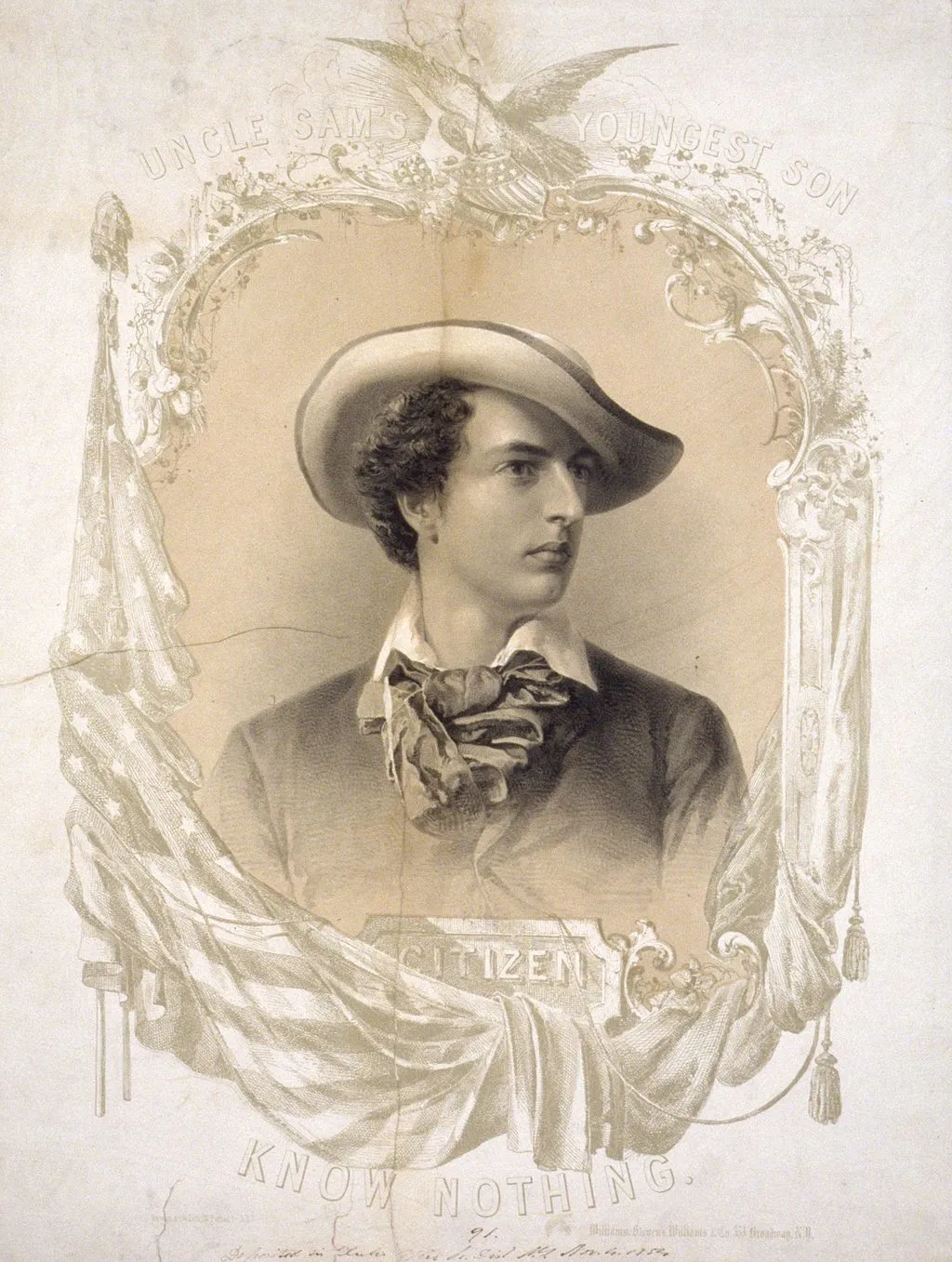
Citizen Know Nothing. Wikimedia Commons

Phillips says the Know Nothings displayed three patterns common to all other nativist movements. First is the embrace of nationalism—as seen in the writings of the OSSB. Second is religious discrimination: in this case, Protestants against Catholics rather than the more modern day squaring-off of Judeo-Christians against Muslims. Lastly, a working-class identity exerts itself in conjunction with the rhetoric of upper-class political leaders. As historian Elliott J. Gorn writes, “Appeals to ethnic hatreds allowed men whose livelihoods depended on winning elections to sidestep the more complex and politically dangerous divisions of class.”

No person exemplified this veneration of the working class more than Poole. Despite gambling extravagantly and regularly brawling in bars, Poole was a revered party insider, leading a gang that terrorized voters at polling places in such a violent fashion that one victim was later reported to have a bite on his arm and a severe eye injury. Poole was also the Know Nothings’ first martyr.

On February 24, 1855, Poole was drinking at a New York City saloon when he came face to face with John Morrissey, an Irish boxer. The two exchanged insults and both pulled out guns. But before the fight could turn violent, police arrived to break it up. Later that night, though, Poole returned to the hall and grappled with Morrissey's men, including Lewis Baker, a Welsh-born immigrant, who shot Poole in the chest at close range. Although Poole survived for nearly two weeks, he died on March 8. The last words he uttered pierced the hearts of the country’s Know Nothings: “Goodbye boys, I die a true American.”

Approximately 250,000 people flooded lower Manhattan to pay their respects to the great American. Dramas performed across the country changed their narratives to end with actors wrapping themselves in an American flag and quoting Poole’s last words. An anonymous pamphlet titled The Life of William Poole claimed that the shooting wasn’t a simple barroom scuffle, but an assassination organized by the Irish. The facts didn’t matter; that Poole had been carrying a gun the night of the shooting, or that his assailant took shots to the head and abdomen, was irrelevant. Nor did admirers care that Poole had a prior case against him for assault with intent to kill. He was an American hero, “battling for freedom’s cause,” who sacrificed his life to protect people from dangerous Catholic immigrants.

COUNT THE STEREOTYPES


On the day of Poole’s funeral, a procession of 6,000 mourners trailed through the streets of New York. Included in their number were local politicians, volunteer firemen, a 52-piece band, members of the OSSB—and Thomas R. Whitney, about to take his place in the House of Representatives as a member of the Know Nothing Caucus.

Judging by the size of Poole’s funeral and the Know Nothing party’s ability to penetrate all levels of government, it seemed the third party was poised to topple the Whigs and take its place in the two-party system. But instead of continuing to grow, the Know Nothings collapsed under the pressure of having to take a firm position on the issue the slavery. By the late 1850s, the case of Dred Scott (who sued for his freedom and was denied it) and the raids led by abolitionist John Brown proved that slavery was a more explosive and urgent issue than immigration.

America fought the Civil War over slavery, and the devastation of that conflict pushed nativist concerns to the back of the American psyche. But nativism never left, and the legacy of the Know Nothings has been apparent in policies aimed at each new wave of immigrants. In 1912, the House Committee on Immigration debated over whether Italians could be considered “full-blooded Caucasians” and immigrants coming from southern and eastern Europe were considered "biologically and culturally less intelligent."

From the end of the 19th century to the first third of the 20th, Asian immigrants were excluded from naturalization based on their non-white status. “People from a variety of groups and affiliations, ranging from the Ku Klux Klan to the Progressive movement, old-line New England aristocrats and the eugenics movement, were among the strange bedfellows in the campaign to stop immigration that was deemed undesirable by old-stock white Americans,” writes sociologist Charles Hirschman of the early 20th century. “The passage of immigration restrictions in the early 1920s ended virtually all immigration except from northwestern Europe.”

Those debates and regulations continue today, over refugees from the Middle East and immigrants from Latin America.

Phillips’s conclusion is that those bewildered by current political affairs simply haven’t looked far enough back into history. “One can’t possibly make sense of [current events] unless you know something about nativism,” he says. “That requires you to go back in time to the Know Nothings. You have to realize the context is different, but the themes are consistent. The actors are still the same, but with different names.”

Lorraine Boissoneault | | READ MORE

Lorraine Boissoneault is a contributing writer to SmithsonianMag.com covering history and archaeology. She has previously written for The Atlantic, Salon, Nautilus and others. She is also the author of The Last Voyageurs: Retracing La Salle's Journey Across America. Website: http://www.lboissoneault.com/

Monday, August 14, 2023

QAnon's weirdest obsession: Why does the radical far right fear the Masons?

BECAUSE THEY CONFUSE THE AFAM WITH THE GRANDE ORIENTE

Robert Guffey
SALON
Sun, August 13, 2023 

QAnon Sean Gallup/Getty Images

In my most recent nonfiction book, "Operation Mindf**k: QAnon & the Cult of Donald Trump," I focused extensively on a "QTuber" named Rick Rene, because I viewed him then and now as the perfectly imperfect microcosm of the entire messed-up QAnon universe, which perceives the Democratic Party as an elaborate cover for Satanic/Masonic pedophiles seeking to transform the Earth into a "one-world government."

In an email he sends out to all new subscribers, Rene relates his superhero origin story: "I'm a dad and a Christian and love the Bible. I used to fill my time teaching Bible classes at my church and coaching my kids in sports." Then his son, he says, started sending him links to various online right-wing conspiracy theorists. They "seemed pretty out there," Rene writes, definitely not material he was seeing "from the Mainstream Media or the News Apps on my phone." But the more he listened, Rene says, the more he "became intrigued enough to research these 'crazy theories,'" or, in the now-familiar phrase, to do his own research. Rene claims he didn't vote for Trump in the 2016 Republican primary (another familiar theme) but soon had "taken 'the red pill,'" which in QAnon speak means choosing to believe that everything Donald Trump says is true, along with a lot of other implausible things Trump doesn't quite say.

Rene no longer teaches Bible classes at his church. Instead, he advocates for the destruction of American intelligence agencies. In his Sept. 30, 2021, episode, Rene casually said of the FBI that we need to "blow it up and start over again from scratch!" On July 6, 2021, he waxed poetic about what he hoped would be the imminent destruction of the Washington Monument and the Statue of Liberty.

Why would a purportedly churchgoing, God-fearing Texas patriot pray for the violent destruction of such American landmarks? Because he and thousands of other evangelicals believe they were secretly constructed by Freemasons, who are essentially Satanists, and therefore must be obliterated.

This rhetoric has led not just to increased threats against such landmarks but to actual acts of destruction. On July 6, 2022, a curious monument known as the Georgia Guidestones (often referred to as "America's Stonehenge"), one of that state's most popular tourist attractions, was largely destroyed in a late-night bombing under the cover of night. That came just a few weeks after Republican gubernatorial candidate Kandiss Taylor (whose red, white and blue campaign bus was emblazoned with the slogan "JESUS GUNS BABIES") had announced that destroying the "Satanic" guidestones was a key element of her platform.

An AP news report on the Georgia bombing quoted Katie McCarthy of the Anti-Defamation League observing that conspiracy theories "do and can have a real-world impact. These ideas can lead somebody to try to take action in furtherance of these beliefs. They can attempt to try and target the people and institutions that are at the center of these false beliefs."

Rene could barely contain his exuberance while commenting on the Georgia bombing in his podcast the next day. It was "exciting," "amazing" and "awesome," he declared, and despite security camera footage showing a man placing an object at the base of one of the stones, it might not have been a bombing at all.

Guys, this is, to me, just awesome, particularly if this ends up being lightning or something natural versus a bombing to show that God is not putting up with this. He told us he's going to take these down, and He is going to. … This is the blessing, guys. We see these [prophetic] words coming true. … I believe the Stonehenge of Europe will be on the horizon as well, the Washington Monument, the Statue of Liberty, and many, many other things in the D.C. area will be destroyed.

Let's try to untangle the logic here, if that's even the word for it. Stonehenge was built by pagans; therefore, it's Satanic and needs to be destroyed.

The Washington Monument was built by Freemasons; therefore, it's Satanic and needs to be destroyed.

The Statue of Liberty was built by the French; therefore, it's Satanic and needs to be destroyed.

Ironically enough, the Georgia Guidestones were apparently conceived by an Iowa doctor with far-right beliefs about race and religion. QAnon folks like Rick Rene and Kandiss Taylor either don't know that, don't believe it or don't care. No one has ever accused extreme right-wing conspiracy theorists of being good at understanding actual history.

* * *

Rick Rene's obsession with eliminating "Masonic monuments" is by no means unique. I'm not exaggerating for effect or trying to be funny when I say that people who believe as Rene does think that Freemasons are perhaps the most destructive and poisonous influence infecting America today. Anti-Masonic prejudice, while a 19th-century hangover in many ways, is still common among certain strata of evangelical Christians, and this fear is being actively stoked by the QAnon movement. Those who hold antisemitic beliefs are often anti-Masonic as well, since they believe that Kabbalism, or Jewish mysticism, is a central pillar of Freemasonry.

Adolf Hitler explicitly attacked "Jewish Freemasonry" in his infamous manifesto "Mein Kampf," and according to the U.S. Holocaust Memorial Museum, Nazi policy toward the Freemasons moved rapidly from discrimination to outright elimination. It was at first limited to merely excluding those who refused to sever their Masonic connections but soon ramped up to far more aggressive measures. By 1935, even conservative Masonic lodges that had promised loyalty to the regime had been dissolved and had their assets confiscated.

Nazi propaganda continued to link Jews and Freemasons; Julius Streicher's virulent publication Der Stürmer (The Assault Trooper) repeatedly printed cartoons and articles that attempted to portray a "Jewish-Masonic" conspiracy. Freemasonry also became a particular obsession of the chief of Security Police and SD, Reinhard Heydrich, who counted the Masons, along with the Jews and the political clergy, as the "most implacable enemies of the German race." In 1935 Heydrich argued for the need to eliminate not only the visible manifestations of these "enemies," but to root out from every German the "indirect influence of the Jewish spirit" — "a Jewish, liberal, and Masonic infectious residue that remains in the unconscious of many, above all in the academic and intellectual world."

The Nazis mounted anti-Masonic exhibitions in Paris, Brussels and elsewhere in occupied Europe. Wartime Nazi propaganda claimed that a Jewish-Masonic conspiracy had provoked World War II and was behind the policies of Franklin D. Roosevelt.

To this day, conspiracy theorists such as Holocaust denier Michael A. Hoffman essentially believe that the Freemasons are the puppet masters of the New World Order, the Jews are the puppet masters of the Freemasons, and both groups worship Satan. Satanism is, of course, running rampant in the modern world.

More than 20 years ago, I ordered one of Hoffman's self-published pamphlets about a series of alleged assassinations he blames on the Masons. The supposed victims were Capt. James Morgan, an anti-Masonic writer who disappeared under mysterious circumstances in 1826; Joseph Smith, founding prophet of the Church of Jesus Christ of Latter-day Saints (aka the Mormons); and Edgar Allan Poe. I was somewhat able to follow Hoffman's fractured account of the first two alleged murders, but his accusations regarding Poe's death are another story. His central evidence seemed to be Poe's famous story, "The Cask of Amontillado," in which a man named Montresor bricks up a drunken man named Fortunato, evidently an old friend, behind a wall of masonry. According to Hoffman, the Freemasons interpreted this parable as an affront and decided to get back at Poe by murdering him three years after the story was published.

I wrote Hoffman a letter asking him to explain this evidently unhinged notion, claiming that I was a professor at Cal State Long Beach and that my academic colleagues were skeptical about his claims. That wasn't true. I wasn't even a student at the school then — but ironically enough, I actually am a professor there now. I suppose I shouldn't have bothered, but Hoffman's response was instructive: He wrote back an extended rant about the stupidity of college professors and claimed he had adequately explained the whole thing and no further elaboration was necessary. He did not, of course, offer any concrete evidence that the Masons had murdered Poe.

If you're thinking that someone like Hoffman is a fringe character at the outermost edge of the far right, well, sure. But the fact of the matter is, such people are not as fringe as they used to be. Once upon a time, this kind of quasi-Nazi paranoia was only found in DIY 'zines and on the dark web. QAnon changed all that, galvanizing the lunatic fringe and propelling its views into the mainstream of the Republican Party. Threats of violence against Freemasons, and acts of vandalism against their lodges, have increased considerably all over the world during the last few years. Consider these examples, all drawn from an eight-month period:

On July 10, 2022, a Tennessee firefighter set a Masonic lodge on fire. Two weeks earlier, on June 27, a man broke into the Scottish Rite Masonic Center in Houston and held two men hostage, claiming, according to a local news report, that "he wanted to talk to them [the Freemasons] about their belief system."

Less than a month before that, on June 2 or 3, two large sphinx sculptures located at the entrance of the Scottish Rite Temple in Washington, D.C., were "severely damaged" and smeared with "filth."

The Masonic temple in San Bernardino, California, was heavily damaged in an arson fire on March 13, 2022 — after nearly being destroyed in another arson attack just over a year earlier. A few weeks earlier, on Feb. 18, a man was arrested for vandalizing Masonic lodges across central Illinois, causing "massive damage."

In an especially instructive example across the Atlantic, on New Year's Eve of 2021, someone tried to burn down the Grand Lodge of Ireland. Anti-vaccination graffiti was spray-painted on the sidewalk directly outside. According to the Irish Times, "The graffiti is understood to be a reference to mRNA, the technology used in some Covid-19 vaccines." Philip Daley, grand secretary of the lodge, told the newspaper that there had been previous demonstrations by anti-vaccination activists outside his hall and other Masonic halls in Ireland. "The view is that we created the virus and we are part of the new world order and we have to be stopped," he said.

* * *

Christopher Hodapp, author of "Heritage Endures" and other books about Masonic history, has expended considerable effort on tracking perpetrators of anti-Masonic crimes as well as professional agitators who spread anti-Masonic propaganda. In a Feb. 15, 2022, blog post, Hodapp wrote about Pastor Greg Locke of Tennessee, "who regularly urges his audiences to 'destroy everything Masonic,'" and had recently held a book-burning event in Florida, "consigning 'Harry Potter' and 'Twilight' books to the flames (along with, by the way, 'Fahrenheit 451,' with absolutely no sense of irony whatsoever). Declaring Freemasonry to be Satanic … his anti-Masonic rant from that event has been endlessly forwarded" on social media.

As a Religion News article explains in depth, Locke also claimed he had identified a group of "full-blown, spell-casting" witches within his church, two of them members of his wife's Bible study group. "In recent years Locke has used his sermons to attack LGBTQ people, accuse Democratic politicians of child abuse, spread claims about election fraud, denounce vaccines and claim that the COVID-19 pandemic is a hoax," the article continued.

Want a daily wrap-up of all the news and commentary Salon has to offer? Subscribe to our morning newsletter, Crash Course.

All of this brings us to perhaps the main reason Freemasons and Democrats are so often accused of being pedophiles by these unhinged conspiracy theorists. As I wrote in "Operation Mindf**k," "Among corporations and intelligence agencies — not to mention certain high-profile political figures — it's standard operating procedure to accuse your opponents of offenses you yourself are committing." For the sake of completism, I should have added "churches" to the list.

Considering the massive scale of the sexual abuse scandals within the Roman Catholic Church and the Southern Baptist Convention — by far America's two largest religious denominations — I find it strange that thousands of supposedly devout Christians are so concerned about Freemasons and Shriners and "the Illuminati" molesting their children. How many documented cases of child abuse involving Freemasons are there, and how does that compare to the documented cases of child molestation among the Protestant and Catholic clergy? If you're one of those God-fearing, churchgoing "digital warriors" who yearns to help Q and his cohorts wipe out all the demonic pedophiles behind the U.S. government, you are statistically far more likely to find a pedophile abuser preaching the gospel behind a pulpit on Sunday morning than among the modest crowd eating potato salad in a Masonic Lodge on a random Monday night.

To be fair, not all the anti-Masonic perpetrators and agitators mentioned above can be identified as white racists or Christian nationalists. That's part of the genius of QAnon, from a propaganda standpoint. This particular conspiracy theory has successfully repackaged hundreds of years of antisemitic and anti-Masonic disinformation into a secular religion that extends its influence among all sorts of people who would never spend 10 seconds listening to a religious fanatic like Pastor Locke.

In a recent interview with the Times Union of Albany, New York, historian Mitch Horowitz, author of "Occult America" and "Uncertain Places," observed that "with the advent of QAnon, we may be a whisker away from a new Satanic Panic":


That movement swept the United States and Britain in the 1980s and early '90s on account of a cultural myth and canard that child-sacrificing Satanic cults were at work. In time, and after some really tragic and disruptive criminal trials and false accusations, media coverage exposed the Satanic Panic as a widespread hoax and a kind of cultural spasm. It may have been a reaction against changes in the workforce and the economy, in particular women entering the workforce en masse, and people turning to childcare centers and other alternative forms of daycare.

This theme has reasserted itself through the work of Alex Jones and people adjacent to the QAnon movement, and it's now commonly encountered online. And despite the news coverage and the widespread debunking of the Satanic Panic, we seem to be going through this cultural amnesia in which we're revisiting it.

* * *

Every weekday afternoon, on the Los Angeles talk-radio station KFI, a pair of conservative hosts named "John and Ken" take to the air to berate what they perceive to be the ultra-liberal views of "hack, snowflake Democrats." I've listened to John and Ken intermittently for the past 20 years, and I've never heard John admit to being wrong about anything.

Sometime in August of 2020, when my five-part series about the madness of QAnon began appearing on Salon, John expressed frustration and confusion as to why anyone would waste time writing about the subject. The people who had burrowed deep into QAnon conspiracy theories, he said, were basement-dwelling "morons" who couldn't have any effect on the real world and certainly not on national politics.

On Jan. 7, 2021, I heard John admit that he had been badly wrong about that one.

In the months before the 2020 election, pundits on both the left and the right were encouraging "reasonable" people to ignore QAnon. Among the many comments posted by Salon's readers in response to my initial articles were numerous pleas that I should stop drawing attention to all this silly, right-wing gooney-bird nonsense. Didn't I know I was just giving voice to a despicable cause?

Not long ago, I received a message via my website directed to "the dude who wrote 'Cryptoscatology: Conspiracy Theory as Art Form,'" which would be me. The correspondent was concerned that "the PTSD of the Trump Admin sure seems to have driven you into the arms of DNC group-think conformity" and went on to claim that Q followers were "victims of state abuse, their good intentions weaponized against them, and they should be pitied for their gullibility and lack of media sophistication. The belief that they represent our national demons, or god forbid a domestic terror threat, is a divisive tool that distracts from the actual powers that threaten the Bill of Rights, among many other things."

While I agree with this person's concluding claim that "sh*t is not normal," the message was accompanied by a link to a nonsensical 20-minute video that attempted to convince its viewers that Ashli Babbitt's death during the Jan. 6 Capitol riots was "a charade staged by law enforcement actors." The windows of the Capitol building, according to the video, were made of "Hollywood glass" — they broke far too easily after being smashed by hordes of enraged Christian patriots! — and the blood seen on Babbitt's face after she was shot could only have been the result of "a Hollywood squib."

This was very likely another example of a conspiracy theorist getting lost in the ethereal hall of mirrors known to many students of the genre as "Chapel Perilous," a hazard I warned my readers about in the introduction to "Cryptoscatology," the same book this correspondent had apparently enjoyed. Had this person trapped themselves in a labyrinth with no exit? I wouldn't be surprised. QAnon has been a dead end for many "digital soldiers," the five-star roach motel of embittered conspiracy buffs.

* * *

Full disclosure: I became a Freemason in 2002 and a 32nd Degree Scottish Rite Freemason in 2004. Ever since, I've been amused and bemused by the emotions that people display when the subject comes up. First of all, most people have never heard of Freemasonry, but those who have generally react as if they've just discovered I was a member of House Slytherin. Either they know almost nothing about the subject, or what they think they know has been so distorted by misinformation and disinformation that it might as well be fantasy.

According to Jay Kinney, co-author of "Hidden Wisdom: A Guide to the Western Inner Traditions," "Freemasonry as it evolved in the 18th century was influenced by the Enlightenment and … incorporated the emerging ideas of brotherhood, freedom of thought, and freedom of association." Maybe that's a simple explanation as to why so many authoritarians and outright fascists have been so hostile toward Freemasonry and its traditions throughout the years.

Several years ago, a woman asked me with complete sincerity if Freemasons really controlled the world from behind the scenes. One of my students told me that he'd always assumed Freemasonry was connected to white supremacy. I told him that well over 90 percent of my lodge were people of color. I don't think he believed me. But after Donald Trump was elected president, I began to notice a radical tonal shift in these anti-Masonic attitudes.

In 2015, I interviewed my friend Richard Schowengerdt, a longtime Mason who was a Defense Department engineer for more than 50 years. Where did the intense bigotry against Masons come from, I asked him? After all, the supposed "secrets" of Freemasonry haven't been secrets for a long time; you can read about them in any number of books and online sources. Richard told me that


The governments of many countries were afraid of Masonry because it openly taught freedom and the concepts of the Renaissance, freedom of thought and all of this, and I'd say more than 50 percent of it was political. The leaders of these countries were afraid of Masonry, that it would take away their power and eventually they would crumble, you know? Through the Renaissance and the upheaval of Protestantism, through Martin Luther and all that, Freemasonry changed the world. Masonry and a lot of the esoteric groups were associated with people like Martin Luther and anyone who might upset the Roman Catholic hierarchy. … [T]he other half of it was, there were some fears such as you've mentioned: the occult and practices that were considered to be devilish, but almost all of this was fabricated by people who were dead set against Masonry and wanted to discredit it in any way they could find.

The most paranoid anti-Masons I've encountered, either online or in the real world, have never bothered to speak to a Freemason. Their attitudes are based on misinformation they've absorbed through the internet thanks to extremist platforms like 4chan and 8kun, where QAnon and other 21st-century right-wing ideologies were born.

One of my creative writing students at CSU Long Beach — who admitted that he spent much of his free time burrowing into internet rabbit holes devoted to dubious conspiracy theories — told me that he and two friends had attempted to attend a Masonic Lodge meeting despite not being members. They had even rented tuxedos in hopes of slipping past the imaginary dragons at the gate, but even so their infiltration was not well planned. When they arrived, they were informed by the sole Mason in the building that monthly meetings were still being held remotely. He then gave them the code for the Zoom meetings, so they could follow along from home.

"So we went home and managed to enter the Zoom meeting," my student told me in hushed tones. "It was incredible! These Masons kept talking about a 'chili cookout' they were planning in some remote park out in the middle of nowhere. We knew 'chili cookout' had to be code for something else, but we couldn't figure out what. That's why that old Mason guy gave us the code to crash the meeting. He knew we couldn't figure it out! We think it had something to do with Pizzagate, like maybe 'chili cookout' was code for some weird pedophilia ritual. What do you think?"

I didn't even bother to tell him that I was a Mason, and that sometimes — in fact almost always — a chili cookout is only a chili cookout. He wouldn't have believed me anyway.

Read more

from Robert Guffey on the secrets of QAnon

The deep, twisted roots of QAnon: From 1940s sci-fi to 19th-century anti-Masonic agitprop


Making sense of QAnon: What lies behind the conspiracy theory that's eating America?


Decoding QAnon: From Pizzagate to Kanye to Marina Abramovic, this conspiracy covers everything


What are the true goals of QAnon? It's the 21st century's ultimate catfish scheme


CATHOLIC ANTI MASONRY


SEE


Friday, April 08, 2005

Conspiracy Theory or Ruling Class Studies

WALL STREET AND THE BOLSHEVIK REVOLUTION By Antony C. Sutton
Found on the web the full book by Anthony Sutton a rational conspiracy researcher, he studies machinations of 20th Century business decisionsof the Wall Street movers and shakers that have had important political impacts. His focus is on the masks of capitalism, the movers and shakers of the corporate world and their political allies.

His dedication is interesting as well:

To
those unknown Russian libertarians, also
known as Greens, who in 1919 fought both
the Reds and the Whites in their attempt to
gain a free and voluntary Russia

Suttons book is an excellent supplement to Maurice Britons outstanding libertarian history of the Russian Revolution; The Bolsheviks and Workers Control. The libertarians in the Russian Revolution were centred around the Ukrainian Anarchist Nestor Makhno.

Sutton debunks the Jewish Conspiracy theory in his appendix to this book, which is printed below.
"Capitalism and Bolshevism are the two sides of the same international Jewish coin." - Adolf Hitler
This is the core conspiracy theory behind the American/English/European/Christian and Islamic belief that the Jews rule the world. One could just as well make the case for the Anglo American Alliance conspiracy theory which sees the the US and England in a long battle with the Vatican. Or that it is all an attempt by the Freemasons to enlighten the world. Or the attempt by Cecil Rhodes to revive the power of the declining English Empire with his round table group, Rhodes himself being a notorious racist and anti-semite. All these conspiracy mythos come to a single conspiracy conclusion that there is one mysterious body of leaders behind all this and it is always the same metatheory whether it is the Illuminati or the New World Order it ends up as the Jews are behind it. Since conspiracy theorists are single minded in their 'faith' that there is a single power at the top of their pyramid their metatheory always ends up as anti-semitic. Being a monolithic view that there is a conspiracy to monopolize power, the conspiracy faithful build intricate patterns of roots and branches eventually all leading to Zion. Or is it Sion? Ah well it's B.S. as Sutton correctly points out. Conspiracy theorists enamoured upon their discovery that "the history of the world is the history of secret societies"(as Ishmael Reed said in his novel Mumbo Jumbo) forget that other dictum; the ruling classes compete for power. Regardless of whether that power is to maintain the antiquated aristocracy of the various European royal families, or the Arabic clans and families, or the Indian Brahamin class, or the Japanese Samuria culture now embedded in their Corporatist State, or the American power struggle between Yankees and Cowboys ( Carl Oglesby ), it is all the same struggle. The capitalist system of politics makes each national bourgoise , the executive arm of their particular national capital and its political economy, regardless if it is a mixed economy, a private market or state capitalism. And within this national executive the Power Elite, (C. Wright Mills,) form political camps and vie for power and global hegemony. The Trilateral Commission, the Davos World Economic Forum and the Bilderburger group, are excellent examples of this ruling class conspiracy (conspiracy in the sense that these are private meetings which do not have public oversight and involve all the superstructures of the capitalist state) to maintain its power. The decisions and policies of these institutions of the ruling class elite, think tanks really, set the wheels of globalization, the WTO, and the new corporate state in motion; American Imperialism through free trade and privatization, while right wing think tanks, like the Cato institute, act as the cheerleaders for these policies . Like the story of the Wizard of Oz the conspiracy theorist needs to believe in the metatheory that the Wizard is behind it all, when in reality it is like the machinery of the Wizard; being the machinery of capitalism, the interlocking families, businesses, corporations, and the state compete to maintain their hegemony of power, and to become a monolithic hegemony (imperialism). The conspiracy theorists do us all a favour in revealing exactly the magnitude of what Chomsky calls the institutional structure of the ruling class. But rather than dismissing the conspiracy culture as Chomsky does, we should look at the facts they raise, not for their racist xenophobic conclusions, but rather as a way of assessing the machinations of the global ruling classes in all their internal conflicts to maintain their power and hegemony. This is what makes Suttons books such a damn good read. They clearly show that rather than being a monolithic conspiracy that goes back thousands of years to lost Atlantis, the corporate hegemony of the elites over the state in the twentieth century is really politics as usual under a still ascendant capitalism. In this way Sutton is not so much a conspiracy researcher, though many of his fans are, as he is a student of Ruling Class Studies. As were Caroll Quigley, The Anglo-American Establishment, another source for the conspiracy cult, Ferdinand Lundberg The Rich and the Super-Rich and William Domhoff', Who Rules America? Another excellent sociological study of an actual ruling class secret society is the doctoral dissertation by Peter Martin Phillips, A Relative Advantage: Sociology of the San Francisco Bohemian Club. This struggle of the power elites goes back to the origins of modern capitalism between 1400 and 1700 as it evolved out of fuedalism to finally challenge it with a new method of production in the 18th and 19th centuries, and a new State, certainly needs no Atlantean connection to make it worthy of study and understanding. As the power of the elites under capitalism expanded so did their riches. Which is what intriques the conspiracy faithful, they expose the inheritance of power and wealth of the elite. The fortunes of the capitalist ruling class are not made by production, sales, work, creation of factories, or jobs but by inheritence the very source as, Marx points out, of the origin of capital. The right wing in America, so enamoured of conspiracy theories, justifies this inheritance of power and wealth by the elites and the ruling classes which is ironically, the very source of their conspiracy theories.

"In a capitalist society, the institution of inheritance is more than a moral institution, it is part of the process whereby wealth is transferred to those who can best use it to serve the wishes of consumers." The Super-Rich Tax Themselves by Llewellyn H. Rockwell, Jr.


And who better to know what we want, then our rulers whose only claim to power is the wealth they did not earn but inherited from their families who have been exploiting us for centuries. How this wealth came to be, theft, murder, etc., in the hands of a small elite is not anwsered by the right wing apologists for the power elite. And when the ruling class fears things aren't going their way they create their own counter revolution; Fascism.


As Domhoff points out:

Most sectors of the American economy are dominated by a relative handful of large corporations. These corporations, in turn, are linked in a variety of ways to create a corporate community. At an economic level, the ties within the corporate community are manifested in ownership of common stock on the part of both families and other corporations, as well as in joint ventures among corporations and in the common sources of bank loans that most corporations share. At a more sociological level, the corporate community is joined together by the use of the same legal, accounting, and consulting firms and by the similar experiences of executives working in the bureaucratic structure of a large organization. Then too, the large corporations come together as a business community because they share the same values and goals-in particular, the profit motive. Finally, and not least, the common goals of the corporations lead them to have common enemies in the labor movement and middle-class reformers, which gives them a further sense of a shared identity.

hundreds of very large corporations ... are privately owned by a family or group of families. The size and extent of such corporations is often overlooked in discussions of the modern corporation.

The fact that the upper class is also intertwined with the corporate community adds a second dimension to the nature of its cohesiveness. The cohesion is not only social, based on school and club affiliations, but economic, rooted in common stock ownership and most visibly manifested in the complex pattern of interlocking directorships that unites the corporate community and creates a dense and flexible communication network.
And this is exactly what Anthony Sutton's books document is the American Power Elite and their influence in the 20th Century. In Wall Street and the Rise of Hitler, he says;
"This politically active Wall Street group is more or less the same elitist circle known generally among Conservatives as the "Liberal Establishment," by liberals (for instance G. William Domhoff) as "the ruling class," and by conspiratorial theorists Gary Allen and Dan Smoot as the "Insiders." But whatever we call this self-perpetuating elitist group, it is apparently fundamentally significant in the determination of world affairs, at a level far behind and above that of the elected politicians."


Sutton is also the author of "America's Secret Establishment. An Introduction to the Order of Skull and Bones." His work on the Skull and Bones has seen renewed popularity as both George W and John Kerry were members of this Anglo American establishment institution, as is William Buckely Jr. Scratch a right winger, even a so called libertarian right winger, in the United States and you will find a conspiracy theorist. A simple review of conspiracy web sites will reveal the fact that all of them lead to evangelical protestant sects in America and their websites, bible study courses and mass media broadcasts about the coming end days. And of course these sects are notorious anti-semites, cause they know who killed Jesus. So now you know who is really behind the conspiracy.


Appendix II

THE JEWISH-CONSPIRACY THEORY OF THE BOLSHEVIK REVOLUTION


There is an extensive literature in English, French, and German reflecting the argument that the Bolshevik Revolution was the result of a "Jewish conspiracy"; more specifically, a conspiracy by Jewish world bankers. Generally, world control is seen as the ultimate objective; the Bolshevik Revolution was but one phase of a wider program that supposedly reflects an age-old religious struggle between Christianity and the "forces of darkness."

The argument and its variants can be found in the most surprising places and from quite surprising persons. In February 1920 Winston Churchill wrote an article — rarely cited today — for the London Illustrated Sunday Herald entitled "Zionism Versus Bolshevism." In this' article Churchill concluded that it was "particularly important... that the National Jews in every country who are loyal to the land of their adoption should come forward on every occasion . . . and take a prominent part in every measure for combatting the Bolshevik conspiracy." Churchill draws a line between "national Jews" and what he calls "international Jews." He argues that the "international and for the most atheistical Jews" certainly had a "very great" role in the creation of Bolshevism and bringing about the Russian Revolution. He asserts (contrary to fact) that with the exception of Lenin, "the majority" of the leading figures in the revolution were Jewish, and adds (also contrary to fact) that in many cases Jewish interests and Jewish places of worship were excepted by the Bolsheviks from their policies of seizure. Churchill calls the international Jews a "sinister confederacy" emergent from the persecuted populations of countries where Jews have been persecuted on account of their race. Winston Churchill traces this movement back to Spartacus-Weishaupt, throws his literary net around Trotsky, Bela Kun, Rosa Luxemburg, and Emma Goldman, and charges: "This world-wide conspiracy for the overthrow of civilisation and for the reconstitution of society on the basis of arrested development, of envious malevolence, and impossible equality, has been steadily growing."

Churchill then argues that this conspiratorial Spartacus-Weishaupt group has been the mainspring of every subversive movement in the nineteenth century. While pointing out that Zionism and Bolshevism are competing for the soul of the Jewish people, Churchill (in 1920) was preoccupied with the role of the Jew in the Bolshevik Revolution and the existence of a worldwide Jewish conspiracy.

Another well-known author in the 1920s, Henry Wickham Steed describes in the second volume of his Through 30 Years 1892-1922 (p. 302) how he attempted to bring the Jewish-conspiracy concept to the attention of Colonel Edward M. House and President Woodrow Wilson. One day in March 1919 Wickham Steed called Colonel House and found him disturbed over Steed's recent criticism of U.S. recognition of the Bolsheviks. Steed pointed out to House that Wilson would be discredited among the many peoples and nations of Europe and "insisted that, unknown to him, the prime movers were Jacob Schiff, Warburg and other international financiers, who wished above all to bolster up the Jewish Bolshevists in order to secure a field for German and Jewish exploitation of Russia."1 According to Steed, Colonel House argued for the establishment of economic relations with the Soviet Union.

Probably the most superficially damning collection of documents on the Jewish conspiracy is in the State Department Decimal File (861.00/5339). The central document is one entitled "Bolshevism and Judaism," dated November 13, 1918. The text is in the form of a report, which states that the revolution in Russia was engineered "in February 1916" and "it was found that the following persons and firms were engaged in this destructive work":

(1) Jacob Schiff
Jew (2) Kuhn, Loeb & Company Jewish Firm Management: Jacob Schiff Jew
Felix Warburg Jew
Otto H. Kahn Jew
Mortimer L. Schiff Jew
Jerome J. Hanauer Jew (3) Guggenheim Jew (4) Max Breitung Jew (5) Isaac Seligman Jew

The report goes on to assert that there can be no doubt that the Russian Revolution was started and engineered by this group and that in April 1917

Jacob Schiff in fact made a public announcement and it was due to his financial influence that the Russian revolution was successfully accomplished and in the Spring 1917 Jacob Schitf started to finance Trotsky, a Jew, for the purpose of accomplishing a social revolution in Russia.

The report contains other miscellaneous information about Max Warburg's financing of Trotsky, the role of the Rheinish-Westphalian syndicate and Olof Aschberg of the Nya Banken (Stockholm) together with Jivotovsky. The anonymous author (actually employed by the U.S. War Trade Board)states that the links between these organizations and their financing of the Bolshevik Revolution show how "the link between Jewish multi-millionaires and Jewish proletarians was forged." The report goes on to list a large number of Bolsheviks who were also Jews and then describes the actions of Paul Warburg, Judus Magnes, Kuhn, Loeb & Company, and Speyer & Company.

The report ends with a barb at "International Jewry" and places the argument into the context of a Christian-Jewish conflict backed up by quotations from the Protocols of Zion. Accompanying this report is a series of cables between the State Department in Washington and the American embassy in London concerning the steps to be taken with these documents:

5399 Great Britain, TEL. 3253 i pm

October 16, 1919 In Confidential File
Secret for Winslow from Wright. Financial aid to Bolshevism & Bolshevik Revolution in Russia from prominent Am. Jews: Jacob Schiff, Felix Warburg, Otto Kahn, Mendell Schiff, Jerome Hanauer, Max Breitung & one of the Guggenheims. Document re- in possession of Brit. police authorities from French sources. Asks for any facts re-.

* * * * *

Oct. 17 Great Britain TEL. 6084, noon r c-h 5399 Very secret. Wright from Winslow. Financial aid to Bolshevik revolution in Russia from prominent Am. Jews. No proof re- but investigating. Asks to urge Brit. authorities to suspend publication at least until receipt of document by Dept.

* * * * *

Nov. 28 Great Britain TEL. 6223 R 5 pro. 5399
FOR WRIGHT. Document re financial aid to Bolsheviki by prominent American jews. Reports — identified as French translation of a statement originally prepared in English by Russian citizen in Am. etc. Seem most unwise to give — the distinction of publicity.

It was agreed to suppress this material and the files conclude, "I think we have the whole thing in cold storage."

Another document marked "Most Secret" is included with this batch of material. The provenance of the document is unknown; it is perhaps FBI or military intelligence. It reviews a translation of the Protocols of the Meetings of the Wise Men of Zion, and concludes:

In this connection a letter was sent to Mr. W. enclosing a memorandum from us with regard to certain information from the American Military Attache to the effect that the British authorities had letters intercepted from various groups of international Jews setting out a scheme for world dominion. Copies of this material will be very useful to us.

This information was apparently developed and a later British intelligence report makes the flat accusation:

SUMMARY: There is now definite evidence that Bolshevism is an international movement controlled by Jews; communications are passing between the leaders in America, France, Russia and England with a view to concerted action....4

However, none of the above statements can be supported with hard empirical evidence. The most significant information is contained in the paragraph to the effect that the British authorities possessed "letters intercepted from various groups of international Jews setting out a scheme for world dominion." If indeed such letters exist, then they would provide support (or nonsupport) for a presently unsubstantiated hypothesis: to wit, that the Bolshevik Revolution and other revolutions are the work of a worldwide Jewish conspiracy.

Moveover, when statements and assertions are not supported by hard evidence and where attempts to unearth hard evidence lead in a circle back to the starting point — particularly when everyone is quoting everyone else — then we must reject the story as spurious. There is no concrete evidence that Jews were involved in the Bolshevik Revolution because they were Jewish. There may indeed have been a higher proportion of Jews involved, but given tsarist treatment of Jews, what else would we expect? There were probably many Englishmen or persons of English origin in the American Revolution fighting the redcoats. So what? Does that make the American Revolution an English conspiracy? Winston Churchill's statement that Jews had a "very great role" in the Bolshevik Revolution is supported only by distorted evidence. The list of Jews involved in the Bolshevik Revolution must be weighed against lists of non-Jews involved in the revolution. When this scientific procedure is adopted, the proportion of foreign Jewish Bolsheviks involved falls to less than twenty percent of the total number of revolutionaries — and these Jews were mostly deported, murdered, or sent to Siberia in the following years. Modern Russia has in fact maintained tsarist anti-Semitism.

It is significant that documents in the State Department files confirm that the investment banker Jacob Schiff, often cited as a source of funds for the Bolshevik Revolution, was in fact against support of the Bolshevik regime. This position, as we shall see, was in direct contrast to the Morgan-Rockefeller promotion of the Bolsheviks.

The persistence with which the Jewish-conspiracy myth has been pushed suggests that it may well be a deliberate device to divert attention from the real issues and the real causes. The evidence provided in this book suggests that the New York bankers who were also Jewish had relatively minor roles in supporting the Bolsheviks, while the New York bankers who were also Gentiles (Morgan, Rockefeller, Thompson) had major roles.

What better way to divert attention from the real operators than by the medieval bogeyman of anti-Semitism?


Tags