Trump's ICE Recruitment and Hitler's Einsatzgruppen: A Study in Method
The deepest similarity between what Trump is doing now and what Hitler was able to achieve lies in the bureaucratic ability to render extraordinary measures administratively ordinary.
The deepest similarity between what Trump is doing now and what Hitler was able to achieve lies in the bureaucratic ability to render extraordinary measures administratively ordinary.
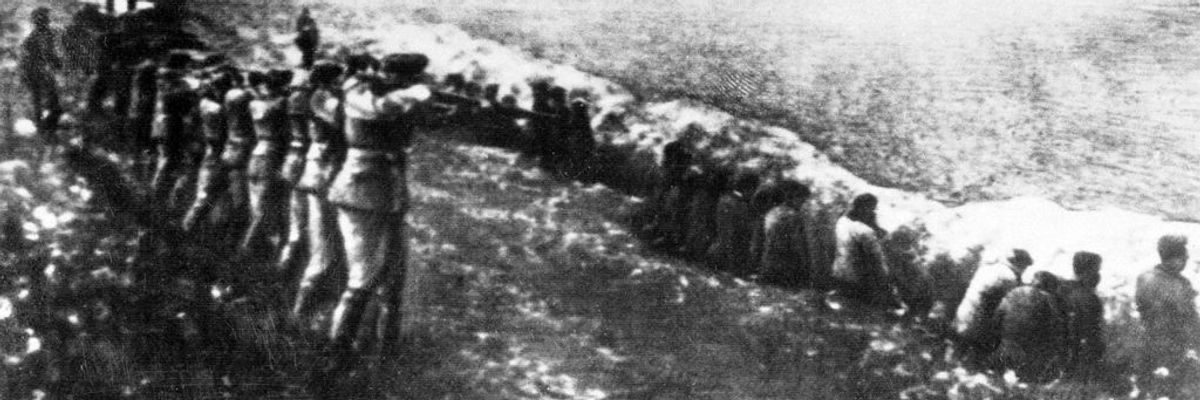
Babi Yar is a ravine in the Ukrainian capital Kiev and the site of a series of massacres carried out by German forces and local Nazi collaborators during their campaign against the Soviet Union. The most notorious and the best documented of these massacres took place in the final days of September 1941, wherein 33,771 Jews were killed in a single operation. The decision to kill all the Jews in Kiev was made by the military governor, Major-General Kurt Eberhard, the Police Commander for Army Group South, SS-Obergruppenfuhrer Friedrich Jeckeln, and the Einsatzgruppe C Commander Otto Rasch.
(Photo by: Pictures From History/Universal Images Group via Getty Images)
Jesse Mackinnon
Aug 16, 2025
Common Dreams
In the last month, ICE has launched a recruitment campaign of unusual scale and persistence. Reports document emails sent to county deputies in Florida, outreach to FEMA personnel, targeted solicitations to retired federal workers, and policy changes that expand the age range for applicants well past forty. The campaign is not framed as an emergency measure but as a permanent expansion, made possible by a $170 billion appropriation for immigration enforcement under the Trump administration. ICE’s leadership has portrayed this as necessary to fulfill the agency’s mission. Local law enforcement leaders, particularly in Florida, have voiced both irritation and unease, objecting to the federal government’s bypassing of their command structures and raising concerns about losing trained officers to ICE’s ranks.
The practical explanation is straightforward: ICE is attempting to rapidly scale up its workforce to meet the Trump administration’s stated political goal of removing an estimated 20 million Latino people from the United States. In 2024, Donald Trump described these individuals as “poisoning the blood” of the country. The recruitment model—its targets, its institutional framing, its bypassing of local intermediaries—mirrors patterns visible in the historical record of the Einsatzgruppen, the Nazi mobile killing units deployed in Eastern Europe during the Second World War. The comparison is not rhetorical excess. It is a study in method. The question is not whether ICE today is equivalent to the Einsatzgruppen. It is whether the logic of building a force for extraordinary enforcement has recurring features that should trigger historical alarm.
The Einsatzgruppen emerged from the SS security apparatus as Germany prepared for the invasion of the Soviet Union in 1941. According to Richard Rhodes in Masters of Death, they were formed from an existing pool of police officers, security agents, and civil servants. Recruitment was highly targeted. Men with experience in policing, intelligence, and military command were sought out for their capacity to operate under orders and within a rigid hierarchy. History makes clear that these were not simply volunteer fanatics. Many were approached through professional networks, offered postings that promised status and advancement, and placed within a structure that normalized their assignments as legitimate state work.
The current ICE recruitment drive is not a historical aberration. It is a recognizable pattern in the history of state enforcement agencies preparing for expansive and potentially coercive missions.
Stefan Kühl, in Ordinary Organizations, underscores that the Einsatzgruppen operated according to the routines of bureaucratic administration. Orders were written in formal language, couched in terms of security and order maintenance. Missions were framed as operational tasks rather than moral questions. Men were told they were combating “banditry” or “partisan activity,” categories that erased the civilian status of their victims. This was a central mechanism for recruiting and retaining participation: the transformation of killing into a technical job, embedded in the standard practices of an organization.
Zygmunt Bauman’s Modernity and the Holocaust identifies this as a hallmark of modern bureaucratic violence. The Holocaust was not an eruption of irrational savagery but the product of systems designed to translate political directives into manageable administrative processes. The Einsatzgruppen were a case study in how to assemble a killing force from ordinary professionals, train them to think in technical rather than moral terms, and deploy them with minimal overt coercion.
The contours of ICE’s recent recruitment push follow a comparable bureaucratic logic. The recruitment targets a pre-screened pool of law enforcement and security professionals. Florida deputies, FEMA personnel, and retired federal agents are not random job seekers. They are individuals whose careers have conditioned them to follow formal orders, work within hierarchical structures, and frame their actions in procedural rather than purely moral language. This mirrors the Nazi recruitment strategy: draw from those already trained to execute state directives.
ICE is actively lowering entry barriers. The policy change lifting the maximum age limit above forty broadens the eligible pool in a way that signals volume as the overriding goal. In Nazi recruitment, similar expansions occurred when the need for personnel outpaced the available pool, with the result that older men or those with less ideal physical profiles were nonetheless brought into field operations. ICE is also leveraging bureaucratic legitimacy. The agency’s recruitment messages describe “enforcement opportunities” and “critical response positions” in terms that emphasize lawful authority, federal mandate, and organizational purpose. This is the same language of legitimization that Kühl and Bauman document in the Einsatzgruppen’s framing: orders presented as components of a rational plan, embedded in established institutional structures.
The campaign shows a willingness to bypass local institutional intermediaries. Florida sheriffs’ complaints that ICE directly contacted their deputies without coordination recalls historical cases in which Nazi units were introduced into territories without consulting local military or police commanders. In both cases, central authority overrode local norms in pursuit of a larger strategic objective.
The deepest similarity lies in the bureaucratic ability to render extraordinary measures administratively ordinary. Bauman warns that this capacity is intrinsic to modern organizations. The division of labor fragments moral responsibility. Language reframes acts of violence as technical assignments. In the Einsatzgruppen, mass shootings of civilians were described as “executions” or “security operations,” terms that masked the nature of the task from the participant’s own conscience.
In ICE’s case, the recruitment pitch itself functions as this kind of framing device. Potential hires are told they will be part of “national security” and “public safety” operations. In the context of an administration that has already pursued mass deportations, family separations, and expanded detention, such language situates controversial or coercive actions within the acceptable vocabulary of law enforcement.
Franklin Mixon’s concept of the “entrepreneurial bureaucrat” sharpens this point. Bureaucracies, and the officials within them, seek opportunities to expand their remit. ICE’s leadership has seized on a political moment—backed by unprecedented funding—to expand its manpower. In historical terms, the Einsatzgruppen leadership did the same within the SS apparatus, enlarging their operational scope whenever political conditions permitted.
The United States is not operating under the same conditions as the Nazi Reich in 1941, but the present safeguards are functionally nonexistent. Judicial review now functions as a rubber stamp for the Trump administration, with courts repeatedly validating executive actions that stretch or disregard statutory limits. Congressional oversight is, in practice, nonexistent, with leadership unwilling to confront or even meaningfully question enforcement policy.
The United States is not operating under the same conditions as the Nazi Reich in 1941, but the present safeguards are functionally nonexistent.
National media outlets remain cautious to the point of self-censorship, their corporate owners fearing retaliatory measures against other business holdings. In this environment, the assumption that legal and institutional checks will restrain an expanded, specially recruited force is untenable. Political leadership can and does issue directives that push beyond the law’s original intent, and the mechanisms designed to resist such directives have already shown their willingness to accommodate them. When that reality is combined with a rapidly enlarging enforcement body trained to operate under centralized command, the potential for escalation is immediate and concrete.
The modern state’s capacity for violence is not determined by the moral character of its personnel but by the institutional and political boundaries within which it functions. Ordinary organizational processes can adapt to deliver extraordinary harm when circumstances shift. The Einsatzgruppen were assembled and deployed in exactly this way, with bureaucratic procedures serving as the mechanism rather than an afterthought.
The current ICE recruitment drive is not a historical aberration. It is a recognizable pattern in the history of state enforcement agencies preparing for expansive and potentially coercive missions. Its targeting of trained law enforcement personnel, lowering of entry barriers, bypassing of local intermediaries, and reliance on bureaucratic framing are all features visible in the assembly of past forces that went on to commit atrocities. To note this is not to equate the present with the past in outcome. It is to recognize the continuity in method, and to understand that method as a warning. The Einsatzgruppen remind us that the path from “ordinary” enforcement to extraordinary violence is often paved with administrative memos, recruitment drives, and appeals to professionalism. The time to interrogate such patterns is before the mission expands and the boundaries shift.
Our work is licensed under Creative Commons (CC BY-NC-ND 3.0). Feel free to republish and share widely.
Jesse Mackinnon
Jesse MacKinnon is a high school history teacher running for Congress in California’s 10th District. He is challenging a sitting Democratic incumbent in the primary because of congressional Democrats’ unwillingness to meaningfully oppose the Trump administration.
Full Bio >
In the last month, ICE has launched a recruitment campaign of unusual scale and persistence. Reports document emails sent to county deputies in Florida, outreach to FEMA personnel, targeted solicitations to retired federal workers, and policy changes that expand the age range for applicants well past forty. The campaign is not framed as an emergency measure but as a permanent expansion, made possible by a $170 billion appropriation for immigration enforcement under the Trump administration. ICE’s leadership has portrayed this as necessary to fulfill the agency’s mission. Local law enforcement leaders, particularly in Florida, have voiced both irritation and unease, objecting to the federal government’s bypassing of their command structures and raising concerns about losing trained officers to ICE’s ranks.
The practical explanation is straightforward: ICE is attempting to rapidly scale up its workforce to meet the Trump administration’s stated political goal of removing an estimated 20 million Latino people from the United States. In 2024, Donald Trump described these individuals as “poisoning the blood” of the country. The recruitment model—its targets, its institutional framing, its bypassing of local intermediaries—mirrors patterns visible in the historical record of the Einsatzgruppen, the Nazi mobile killing units deployed in Eastern Europe during the Second World War. The comparison is not rhetorical excess. It is a study in method. The question is not whether ICE today is equivalent to the Einsatzgruppen. It is whether the logic of building a force for extraordinary enforcement has recurring features that should trigger historical alarm.
The Einsatzgruppen emerged from the SS security apparatus as Germany prepared for the invasion of the Soviet Union in 1941. According to Richard Rhodes in Masters of Death, they were formed from an existing pool of police officers, security agents, and civil servants. Recruitment was highly targeted. Men with experience in policing, intelligence, and military command were sought out for their capacity to operate under orders and within a rigid hierarchy. History makes clear that these were not simply volunteer fanatics. Many were approached through professional networks, offered postings that promised status and advancement, and placed within a structure that normalized their assignments as legitimate state work.
The current ICE recruitment drive is not a historical aberration. It is a recognizable pattern in the history of state enforcement agencies preparing for expansive and potentially coercive missions.
Stefan Kühl, in Ordinary Organizations, underscores that the Einsatzgruppen operated according to the routines of bureaucratic administration. Orders were written in formal language, couched in terms of security and order maintenance. Missions were framed as operational tasks rather than moral questions. Men were told they were combating “banditry” or “partisan activity,” categories that erased the civilian status of their victims. This was a central mechanism for recruiting and retaining participation: the transformation of killing into a technical job, embedded in the standard practices of an organization.
Zygmunt Bauman’s Modernity and the Holocaust identifies this as a hallmark of modern bureaucratic violence. The Holocaust was not an eruption of irrational savagery but the product of systems designed to translate political directives into manageable administrative processes. The Einsatzgruppen were a case study in how to assemble a killing force from ordinary professionals, train them to think in technical rather than moral terms, and deploy them with minimal overt coercion.
The contours of ICE’s recent recruitment push follow a comparable bureaucratic logic. The recruitment targets a pre-screened pool of law enforcement and security professionals. Florida deputies, FEMA personnel, and retired federal agents are not random job seekers. They are individuals whose careers have conditioned them to follow formal orders, work within hierarchical structures, and frame their actions in procedural rather than purely moral language. This mirrors the Nazi recruitment strategy: draw from those already trained to execute state directives.
ICE is actively lowering entry barriers. The policy change lifting the maximum age limit above forty broadens the eligible pool in a way that signals volume as the overriding goal. In Nazi recruitment, similar expansions occurred when the need for personnel outpaced the available pool, with the result that older men or those with less ideal physical profiles were nonetheless brought into field operations. ICE is also leveraging bureaucratic legitimacy. The agency’s recruitment messages describe “enforcement opportunities” and “critical response positions” in terms that emphasize lawful authority, federal mandate, and organizational purpose. This is the same language of legitimization that Kühl and Bauman document in the Einsatzgruppen’s framing: orders presented as components of a rational plan, embedded in established institutional structures.
The campaign shows a willingness to bypass local institutional intermediaries. Florida sheriffs’ complaints that ICE directly contacted their deputies without coordination recalls historical cases in which Nazi units were introduced into territories without consulting local military or police commanders. In both cases, central authority overrode local norms in pursuit of a larger strategic objective.
The deepest similarity lies in the bureaucratic ability to render extraordinary measures administratively ordinary. Bauman warns that this capacity is intrinsic to modern organizations. The division of labor fragments moral responsibility. Language reframes acts of violence as technical assignments. In the Einsatzgruppen, mass shootings of civilians were described as “executions” or “security operations,” terms that masked the nature of the task from the participant’s own conscience.
In ICE’s case, the recruitment pitch itself functions as this kind of framing device. Potential hires are told they will be part of “national security” and “public safety” operations. In the context of an administration that has already pursued mass deportations, family separations, and expanded detention, such language situates controversial or coercive actions within the acceptable vocabulary of law enforcement.
Franklin Mixon’s concept of the “entrepreneurial bureaucrat” sharpens this point. Bureaucracies, and the officials within them, seek opportunities to expand their remit. ICE’s leadership has seized on a political moment—backed by unprecedented funding—to expand its manpower. In historical terms, the Einsatzgruppen leadership did the same within the SS apparatus, enlarging their operational scope whenever political conditions permitted.
The United States is not operating under the same conditions as the Nazi Reich in 1941, but the present safeguards are functionally nonexistent. Judicial review now functions as a rubber stamp for the Trump administration, with courts repeatedly validating executive actions that stretch or disregard statutory limits. Congressional oversight is, in practice, nonexistent, with leadership unwilling to confront or even meaningfully question enforcement policy.
The United States is not operating under the same conditions as the Nazi Reich in 1941, but the present safeguards are functionally nonexistent.
National media outlets remain cautious to the point of self-censorship, their corporate owners fearing retaliatory measures against other business holdings. In this environment, the assumption that legal and institutional checks will restrain an expanded, specially recruited force is untenable. Political leadership can and does issue directives that push beyond the law’s original intent, and the mechanisms designed to resist such directives have already shown their willingness to accommodate them. When that reality is combined with a rapidly enlarging enforcement body trained to operate under centralized command, the potential for escalation is immediate and concrete.
The modern state’s capacity for violence is not determined by the moral character of its personnel but by the institutional and political boundaries within which it functions. Ordinary organizational processes can adapt to deliver extraordinary harm when circumstances shift. The Einsatzgruppen were assembled and deployed in exactly this way, with bureaucratic procedures serving as the mechanism rather than an afterthought.
The current ICE recruitment drive is not a historical aberration. It is a recognizable pattern in the history of state enforcement agencies preparing for expansive and potentially coercive missions. Its targeting of trained law enforcement personnel, lowering of entry barriers, bypassing of local intermediaries, and reliance on bureaucratic framing are all features visible in the assembly of past forces that went on to commit atrocities. To note this is not to equate the present with the past in outcome. It is to recognize the continuity in method, and to understand that method as a warning. The Einsatzgruppen remind us that the path from “ordinary” enforcement to extraordinary violence is often paved with administrative memos, recruitment drives, and appeals to professionalism. The time to interrogate such patterns is before the mission expands and the boundaries shift.
Our work is licensed under Creative Commons (CC BY-NC-ND 3.0). Feel free to republish and share widely.
Jesse Mackinnon
Jesse MacKinnon is a high school history teacher running for Congress in California’s 10th District. He is challenging a sitting Democratic incumbent in the primary because of congressional Democrats’ unwillingness to meaningfully oppose the Trump administration.
Full Bio >
Trump—With Media's Help—Is Creating American Conditions for 'Good Germans'
In both 1940s Germany and today’s America, the effect is similar: the public is shielded from the human scale of state-led actions against targeted groups, making it easier for those policies to continue without mass pushback.

Ethnic Germans wearing traditional regional costumes give the Nazi salute and cheer Adolf Hitler on his visit to the town of Carlsbad in the Sudetenland, just after annexation by Germany in October 1938.
(Photo by © Hulton-Deutsch Collection/CORBIS/Corbis via Getty Images)
Thom Hartmann
Aug 16, 2025

In both 1940s Germany and today’s America, the effect is similar: the public is shielded from the human scale of state-led actions against targeted groups, making it easier for those policies to continue without mass pushback.
Ethnic Germans wearing traditional regional costumes give the Nazi salute and cheer Adolf Hitler on his visit to the town of Carlsbad in the Sudetenland, just after annexation by Germany in October 1938.
(Photo by © Hulton-Deutsch Collection/CORBIS/Corbis via Getty Images)
Thom Hartmann
Aug 16, 2025
Common Dreams
We’re all familiar with Trump’s famous deportation flights of Venezuelans and Kilmar Abrego Garcia to a concentration camp in El Salvador in violation of a court’s order.
But did you know there have been over 1,000 such flights in the past few months, some to absolute hellhole countries?
On top of that, the Washington Post reports this morning that ICE is planning to open or expand 125 new “detention facilities” across the country, including ones to hold families, giving America the largest prison system in the world. The paper notes:
“The documents outline the strategy behind ICE’s breakneck expansion, a chaotic effort that has already triggered lawsuits and accusations of cruelty.”
Are Americans being conditioned by our media to become “Good Germans”?
For several decades I did international relief work for a nonprofit based in Germany; my family and I even lived at the organization’s headquarters in Stadtsteinach for much of 1986/1987. One of my closest co-workers and mentors was a man 25 years my senior, Horst Von Heyer, who’d been a teenage member of the Hitler Youth when WWII ended.
I started working with Horst in the late 1970s after his assistant was eaten by a crocodile in southern Africa; for example, we went into Uganda together to deal with the post-Idi Amin 1980 famine and set up a program for orphaned kids that continues to this day. When we lived in Germany, Horst and I used to have lunch together nearly every day when we were both in town; he became one of my closest friends (he’s now passed away).
So, of course, I asked him how Germans (and him, as a teenager) could possibly have been okay with the Nazis rounding up millions of Jews and other “undesirables” to ship via boxcars to the death camps.
His answer was frankly shocking in its simplicity:
“We didn’t know.”
The concentration camps within Germany were, he explained, for “the worst of the worst” criminals and “traitors” who’d tried to overthrow the country. The Republican Great Depression and the chaos that followed World War I, he told me, had created a massive problem of street crime and homeless people, so most middle-class Germans, feeling unsafe, enthusiastically supported Hitler’s “law and order” agenda.
Those “innocent” Jews, Gypsies, and others removed from local areas were being moved, Horst said he was told, because their residences were slated to be part of what we’d call “urban renewal” efforts. They were simply being resettled, and it would end up better for them and the communities they were leaving.
“I remember how shocked we all were when the pictures came out from the Polish death camps like Auschwitz at the end of the war,” he told me. “You Americans and the rest of the world were shocked, too. Hitler’s men and the German media had done a really good job of keeping it all under wraps.”
In that, I discovered by reading Shirer’s Rise and Fall of the Third Reich and other research, Horst was right.
By the end of 1933, Hitler had largely neutered Germany’s free press; not by market competition, but by bankrupting writers and outlets with libel lawsuits, unleashing police raids for “slander” claims, vigilante “Brownshirt” militia violence against reporters, arrests of publishers for “publishing anti-German propaganda,” the outright seizure of progressive newspapers, and a sweeping Schriftleitergesetz “Editor’s Law” which criminalized journalism that exposed government excesses.
Nazi loyalists and party-friendly oligarchs took over the press outlets that remained in a massive media consolidation project, ensuring that every headline and every radio news report served the regime much like Fox “News” and rightwing hate-radio/podcasts do today for Trump.
When stories were published about Jews and others being transported, they were couched in euphemisms such as Umsiedlung (“resettlement”) or Evakuierung (“evacuation”) and Arbeitseinsatz (“labor deployment”) in official communications, press coverage, and public speeches.
These terms fit neatly into propaganda narratives about “urban renewal,” war-effort labor needs, or “population transfers” from “overcrowded” and “crime-ridden” cities. There were literally no public reports in Germany about mass killings or illegal detentions between 1934 and the end of the war in 1945.
Today in the U.S., the lack of coverage of Trump’s brutal treatment of immigrants, lack of due process, and hundreds of monthly deportation flights to hellhole countries or foreign concentration camps isn’t due to a Schriftleitergesetz legal ban but rather to billionaire owners sucking up to Trump, partisan political framing, and the media’s tendency to underplay ongoing, systemic human rights abuses once they’ve been normalized.
We saw something like this in the early days of the Iraq war when the Bush administration tried to normalize and justify the black sites, torture, and murders that were later exposed to the horror of Americans and the world.
In both 1940s Germany and today’s America, the effect is similar: the public is shielded from the human scale of state-led actions against targeted groups, making it easier for those policies to continue without mass pushback.
In the first week of Trump’s second term, 7,300 people were put on military flights and deported from the US. The numbers have only grown since then, with virtually no oversight and little by way of due process. Since he took power, over 100 immigration judges (about 15%) have been fired nationwide; as Chicago’s former Assistant Chief Immigration Judge Jennifer Peyton noted. She added:
“Since January 2025, the immigration courts under EOIR are no longer honoring or offering due process like they did when I was appointed. The court system has been systematically and intentionally destroyed, defunded, and politicized by this administration. I don't know why this has happened, but I fear for our country and for justice.”
Meanwhile, American media has engaged in a 1940s-German-like scheme to downplay the horrors of these disappearances.
When I heard a guest on CNN Wednesday night mention in passing that there’d been over 1,000 deportation flights in recent months, I was shocked. Why didn’t I know?
Every day I read at least a dozen different news outlets and am a voracious consumer of cable news. Yet, like most Americans, I thought deportation flights to foreign horror chambers were the exception — like with Abrego Garcia — rather than the rule. After all, the Biden administration was also running deportation flights; the difference is that they only happened after due process had been granted the deportees, and they were never sent to foreign concentration camps or dumped in hellholes like South Sudan.
In 1944, as questions were being raised by stories leaking into the foreign press about the boxcars of people traversing the countryside, the Hitler administration produced a slick PR effort around a concentration camp in Theresienstadt, Czechoslovakia. It served as a way-stop on the routes to the death camps, but Goebbels had the barracks painted, gardens planted, and the grounds beautified.
He then organized “social and cultural events for the visiting dignitaries” and the press, and made a documentary film of their one-day visit with the simple title Theresienstadt that played in theaters across Germany.
The international press bought it hook, line, and sinker, reporting to the world that the Nazi detention camps weren’t all that bad and were just part of rebuilding and cleaning up Germany after WWI and the Great Depression.
Which raises the question: How long will it be before we start seeing films and made-for-TV events with Noem or Bondi telling us how “humane” the new private, for-profit “detention centers” are that are being built by Trump’s donors and cronies?
I give them about a month to get their propaganda routine together. In the meantime, they seem to be doing everything they can to make sure we don’t really know the full scope and brutality of their efforts to push Brown and Black people out of the United States.
Our work is licensed under Creative Commons (CC BY-NC-ND 3.0). Feel free to republish and share widely.
Thom Hartmann
Thom Hartmann is a talk-show host and the author of "The Hidden History of Monopolies: How Big Business Destroyed the American Dream" (2020); "The Hidden History of the Supreme Court and the Betrayal of America" (2019); and more than 25 other books in print.
Full Bio >
We’re all familiar with Trump’s famous deportation flights of Venezuelans and Kilmar Abrego Garcia to a concentration camp in El Salvador in violation of a court’s order.
But did you know there have been over 1,000 such flights in the past few months, some to absolute hellhole countries?
On top of that, the Washington Post reports this morning that ICE is planning to open or expand 125 new “detention facilities” across the country, including ones to hold families, giving America the largest prison system in the world. The paper notes:
“The documents outline the strategy behind ICE’s breakneck expansion, a chaotic effort that has already triggered lawsuits and accusations of cruelty.”
Are Americans being conditioned by our media to become “Good Germans”?
For several decades I did international relief work for a nonprofit based in Germany; my family and I even lived at the organization’s headquarters in Stadtsteinach for much of 1986/1987. One of my closest co-workers and mentors was a man 25 years my senior, Horst Von Heyer, who’d been a teenage member of the Hitler Youth when WWII ended.
I started working with Horst in the late 1970s after his assistant was eaten by a crocodile in southern Africa; for example, we went into Uganda together to deal with the post-Idi Amin 1980 famine and set up a program for orphaned kids that continues to this day. When we lived in Germany, Horst and I used to have lunch together nearly every day when we were both in town; he became one of my closest friends (he’s now passed away).
So, of course, I asked him how Germans (and him, as a teenager) could possibly have been okay with the Nazis rounding up millions of Jews and other “undesirables” to ship via boxcars to the death camps.
His answer was frankly shocking in its simplicity:
“We didn’t know.”
The concentration camps within Germany were, he explained, for “the worst of the worst” criminals and “traitors” who’d tried to overthrow the country. The Republican Great Depression and the chaos that followed World War I, he told me, had created a massive problem of street crime and homeless people, so most middle-class Germans, feeling unsafe, enthusiastically supported Hitler’s “law and order” agenda.
Those “innocent” Jews, Gypsies, and others removed from local areas were being moved, Horst said he was told, because their residences were slated to be part of what we’d call “urban renewal” efforts. They were simply being resettled, and it would end up better for them and the communities they were leaving.
“I remember how shocked we all were when the pictures came out from the Polish death camps like Auschwitz at the end of the war,” he told me. “You Americans and the rest of the world were shocked, too. Hitler’s men and the German media had done a really good job of keeping it all under wraps.”
In that, I discovered by reading Shirer’s Rise and Fall of the Third Reich and other research, Horst was right.
By the end of 1933, Hitler had largely neutered Germany’s free press; not by market competition, but by bankrupting writers and outlets with libel lawsuits, unleashing police raids for “slander” claims, vigilante “Brownshirt” militia violence against reporters, arrests of publishers for “publishing anti-German propaganda,” the outright seizure of progressive newspapers, and a sweeping Schriftleitergesetz “Editor’s Law” which criminalized journalism that exposed government excesses.
Nazi loyalists and party-friendly oligarchs took over the press outlets that remained in a massive media consolidation project, ensuring that every headline and every radio news report served the regime much like Fox “News” and rightwing hate-radio/podcasts do today for Trump.
When stories were published about Jews and others being transported, they were couched in euphemisms such as Umsiedlung (“resettlement”) or Evakuierung (“evacuation”) and Arbeitseinsatz (“labor deployment”) in official communications, press coverage, and public speeches.
These terms fit neatly into propaganda narratives about “urban renewal,” war-effort labor needs, or “population transfers” from “overcrowded” and “crime-ridden” cities. There were literally no public reports in Germany about mass killings or illegal detentions between 1934 and the end of the war in 1945.
Today in the U.S., the lack of coverage of Trump’s brutal treatment of immigrants, lack of due process, and hundreds of monthly deportation flights to hellhole countries or foreign concentration camps isn’t due to a Schriftleitergesetz legal ban but rather to billionaire owners sucking up to Trump, partisan political framing, and the media’s tendency to underplay ongoing, systemic human rights abuses once they’ve been normalized.
We saw something like this in the early days of the Iraq war when the Bush administration tried to normalize and justify the black sites, torture, and murders that were later exposed to the horror of Americans and the world.
In both 1940s Germany and today’s America, the effect is similar: the public is shielded from the human scale of state-led actions against targeted groups, making it easier for those policies to continue without mass pushback.
In the first week of Trump’s second term, 7,300 people were put on military flights and deported from the US. The numbers have only grown since then, with virtually no oversight and little by way of due process. Since he took power, over 100 immigration judges (about 15%) have been fired nationwide; as Chicago’s former Assistant Chief Immigration Judge Jennifer Peyton noted. She added:
“Since January 2025, the immigration courts under EOIR are no longer honoring or offering due process like they did when I was appointed. The court system has been systematically and intentionally destroyed, defunded, and politicized by this administration. I don't know why this has happened, but I fear for our country and for justice.”
Meanwhile, American media has engaged in a 1940s-German-like scheme to downplay the horrors of these disappearances.
When I heard a guest on CNN Wednesday night mention in passing that there’d been over 1,000 deportation flights in recent months, I was shocked. Why didn’t I know?
Every day I read at least a dozen different news outlets and am a voracious consumer of cable news. Yet, like most Americans, I thought deportation flights to foreign horror chambers were the exception — like with Abrego Garcia — rather than the rule. After all, the Biden administration was also running deportation flights; the difference is that they only happened after due process had been granted the deportees, and they were never sent to foreign concentration camps or dumped in hellholes like South Sudan.
In 1944, as questions were being raised by stories leaking into the foreign press about the boxcars of people traversing the countryside, the Hitler administration produced a slick PR effort around a concentration camp in Theresienstadt, Czechoslovakia. It served as a way-stop on the routes to the death camps, but Goebbels had the barracks painted, gardens planted, and the grounds beautified.
He then organized “social and cultural events for the visiting dignitaries” and the press, and made a documentary film of their one-day visit with the simple title Theresienstadt that played in theaters across Germany.
The international press bought it hook, line, and sinker, reporting to the world that the Nazi detention camps weren’t all that bad and were just part of rebuilding and cleaning up Germany after WWI and the Great Depression.
Which raises the question: How long will it be before we start seeing films and made-for-TV events with Noem or Bondi telling us how “humane” the new private, for-profit “detention centers” are that are being built by Trump’s donors and cronies?
I give them about a month to get their propaganda routine together. In the meantime, they seem to be doing everything they can to make sure we don’t really know the full scope and brutality of their efforts to push Brown and Black people out of the United States.
Our work is licensed under Creative Commons (CC BY-NC-ND 3.0). Feel free to republish and share widely.
Thom Hartmann
Thom Hartmann is a talk-show host and the author of "The Hidden History of Monopolies: How Big Business Destroyed the American Dream" (2020); "The Hidden History of the Supreme Court and the Betrayal of America" (2019); and more than 25 other books in print.
Full Bio >


No comments:
Post a Comment