Eurovision 2026: Politics collide with a blockbuster show
DW
May 9, 2026
Controversy over Israel's participation and boycotts unprecedented in scale are already weighing on the Eurovision Song Contest before it even kicks off in Vienna.

Ukraine's German connection
Ukrainian singer Viktoria Leleka is competing with a song written in Berlin, hoping to win over the hearts of Eurovision fans with a blend of ethno-pop and musical theater. In an interview with German broadcaster ARD, she spoke about how much she loves Germany and the language, and how important it is to her to give a voice to her homeland and its diverse culture at a time of Russian aggression against her country.
Ukraine is one of the most successful countries in the contest and is almost always among the finalists. Most recently, the Kalush Orchestra won the 2022 contest with "Stefania."
Amid political tensions, Leleka's entry "Ridnym" is being watched with particular interest. The song describes an inner transformation, coping with fear and the power to find hope even in hopeless situations.
Favorites and trends
Musically, it's shaping up to be a typical ESC year: Big emotions, dramatic stage designs and lots of danceable, upbeat electro-pop.
Greece's entry is rapidly climbing the betting odds — whether it can hold its ground will be revealed on Tuesday, May 12, during the first semifinal, when Akylas performs the song live.
Finland will also be competing in the first semifinal with the pop-classical duo Linda Lampenius x Pete Parkkonen, both of whom also have a good chance of winning.
For host country Austria and Big Five member Germany, however, the prospects are not so good — both are traditionally guaranteed a spot in the final and don't have the opportunity to perform in the semifinal shows. For both countries, it's all or nothing in the grand final on Saturday, May 16.
Eurovision Song Contest Asia — a new spin-off
While Europe focuses on Vienna, attention is also turning to the Asian continent. The first Eurovision Song Contest Asia is set to take place on November 14 in the Thai capital, Bangkok. Ten countries, including the Philippines, South Korea and Vietnam, have already confirmed their participation.
An attempt to establish the contest in the US has failed. The American Song Contest 2022 remains a one-time event.
This article was originally written in German.

Silke Wünsch Reporter and editor at DW's culture
Controversy over Israel's participation and boycotts unprecedented in scale are already weighing on the Eurovision Song Contest before it even kicks off in Vienna.

The Eurovision Song Contest returns to Vienna for the first time since 2015I
mage: Max Herbst/APA-Images/picture alliance
The 2026 Eurovision Song Contest in Vienna hasn't even started yet — and yet it has been at the center of heated debates for months. At issue isn't so much the spectacular pop shows themselves as the political tensions that, despite the competition's long-standing claim that it is apolitical, are becoming increasingly difficult to ignore.
The last time the Austrian capital hosted the Eurovision Song Contest was in 2015. This year, on the occasion of its 70th anniversary, the contest returns from May 12-16 to a city that stands for culture and diversity. Expectations are high, as the contest aims to bring people together and send a message of openness. The motto is "United By Music – (In) The Heart Of Europe"
But this is precisely what is becoming an increasingly difficult challenge with each passing year, as political crises in some participating countries are also growing.
Israel is the target of protests
As in previous years, Israel is once again the focus of considerable attention. Amid the ongoing conflict in Gaza, activists and some members of the creative community are once again calling for the country to be excluded or boycotted.
Most recently, more than 1,100 artists signed an open letter with a clear message: No Eurovision Song Contest as long as Israel is participating. Supporters of the "No Music for Genocide" initiative include international stars such as Peter Gabriel, Massive Attack, Roger Waters, Macklemore and Brian Eno.
On the other side, an open letter by the pro-Israel initiative "Creative Community for Peace" has also been signed by around 1,100 members of the entertainment industry, including Helen Mirren, Amy Schumer and Gene Simmons. It advocates for Israel's participation: "We are shocked and disappointed that some members of the entertainment industry are calling for Israel to be excluded from the competition due to its response to the largest massacre of Jews since the Holocaust," the letter states.
The Vienna police are expecting disruptive protests and attempts to block the event, especially on the final day. They announced that a demonstration with around 3,000 expected participants from pro-Palestinian groups has been registered for May 16. However, further actions are to be expected. Demonstrators are also likely to arrive from abroad.
The 2026 Eurovision Song Contest in Vienna hasn't even started yet — and yet it has been at the center of heated debates for months. At issue isn't so much the spectacular pop shows themselves as the political tensions that, despite the competition's long-standing claim that it is apolitical, are becoming increasingly difficult to ignore.
The last time the Austrian capital hosted the Eurovision Song Contest was in 2015. This year, on the occasion of its 70th anniversary, the contest returns from May 12-16 to a city that stands for culture and diversity. Expectations are high, as the contest aims to bring people together and send a message of openness. The motto is "United By Music – (In) The Heart Of Europe"
But this is precisely what is becoming an increasingly difficult challenge with each passing year, as political crises in some participating countries are also growing.
Israel is the target of protests
As in previous years, Israel is once again the focus of considerable attention. Amid the ongoing conflict in Gaza, activists and some members of the creative community are once again calling for the country to be excluded or boycotted.
Most recently, more than 1,100 artists signed an open letter with a clear message: No Eurovision Song Contest as long as Israel is participating. Supporters of the "No Music for Genocide" initiative include international stars such as Peter Gabriel, Massive Attack, Roger Waters, Macklemore and Brian Eno.
On the other side, an open letter by the pro-Israel initiative "Creative Community for Peace" has also been signed by around 1,100 members of the entertainment industry, including Helen Mirren, Amy Schumer and Gene Simmons. It advocates for Israel's participation: "We are shocked and disappointed that some members of the entertainment industry are calling for Israel to be excluded from the competition due to its response to the largest massacre of Jews since the Holocaust," the letter states.
The Vienna police are expecting disruptive protests and attempts to block the event, especially on the final day. They announced that a demonstration with around 3,000 expected participants from pro-Palestinian groups has been registered for May 16. However, further actions are to be expected. Demonstrators are also likely to arrive from abroad.
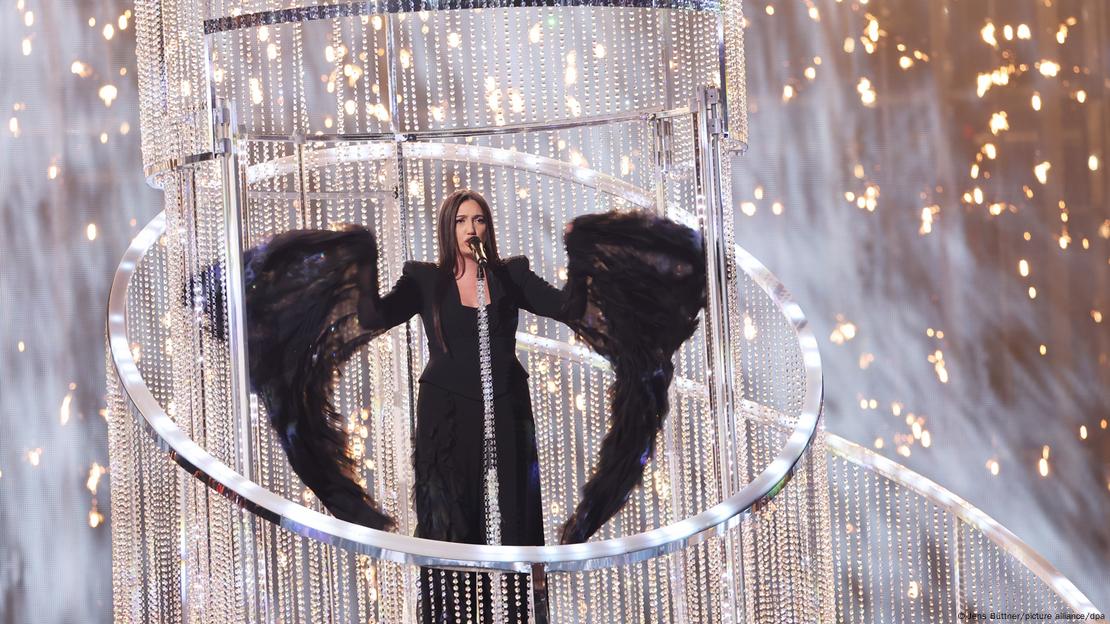
In 2025, Israel's Yuval Raphael came in second
Image: Jens Büttner/picture alliance/dpa
However, Israel, who is sending singer Noam Bettan to Vienna with the seemingly ordinary heartbreak pop song "Michelle," will not be barred from participating, in a decision that aligns with the European Broadcasting Union's (EBU) long-standing position: The competition is an association of broadcasters, not of governments. As a result, Israel remains part of the Eurovision Song Contest.
Even a 'Big Five' country is boycotting the Eurovision Song Contest
This has led some countries to react strongly: Ireland, the Netherlands, Slovenia and Iceland — all Eurovision veterans — are boycotting the contest. Spain has also joined the boycott, meaning that one of the so-called "Big Five" countries (which are the contest's biggest financial backers) will not be participating this year. This has never happened before.
Some countries will not be broadcasting the Eurovision Song Contest on TV. The world's biggest music event, which most recently drew nearly 170 million viewers worldwide, will have a smaller audience this year.
Criticism of Romania's entry
In addition to geopolitical issues, the song submitted by Romania has also sparked debate. One legal professor is quoted in The Guardian as saying that Alexandra Capitanescu's song "Choke Me" demonstrates "an alarming disregard for young women's health and well-being." One of the lines Capitanescu sings is: "All I need is your love, I want it to choke me." Following accusations that the song glorifies violence toward women, the singer explained on Reddit that "Choke Me" is a metaphor — for the pressure and inner fears one imposes on oneself; the title and chorus are not to be taken literally.
The commotion surrounding the song has died down somewhat now — the first rehearsals are over, and the show begins in a few days. But these reactions are a reminder of how delicate the situation has become. What might once have been dismissed as a flamboyant performance is now being scrutinized and interpreted in detail.
However, Israel, who is sending singer Noam Bettan to Vienna with the seemingly ordinary heartbreak pop song "Michelle," will not be barred from participating, in a decision that aligns with the European Broadcasting Union's (EBU) long-standing position: The competition is an association of broadcasters, not of governments. As a result, Israel remains part of the Eurovision Song Contest.
Even a 'Big Five' country is boycotting the Eurovision Song Contest
This has led some countries to react strongly: Ireland, the Netherlands, Slovenia and Iceland — all Eurovision veterans — are boycotting the contest. Spain has also joined the boycott, meaning that one of the so-called "Big Five" countries (which are the contest's biggest financial backers) will not be participating this year. This has never happened before.
Some countries will not be broadcasting the Eurovision Song Contest on TV. The world's biggest music event, which most recently drew nearly 170 million viewers worldwide, will have a smaller audience this year.
Criticism of Romania's entry
In addition to geopolitical issues, the song submitted by Romania has also sparked debate. One legal professor is quoted in The Guardian as saying that Alexandra Capitanescu's song "Choke Me" demonstrates "an alarming disregard for young women's health and well-being." One of the lines Capitanescu sings is: "All I need is your love, I want it to choke me." Following accusations that the song glorifies violence toward women, the singer explained on Reddit that "Choke Me" is a metaphor — for the pressure and inner fears one imposes on oneself; the title and chorus are not to be taken literally.
The commotion surrounding the song has died down somewhat now — the first rehearsals are over, and the show begins in a few days. But these reactions are a reminder of how delicate the situation has become. What might once have been dismissed as a flamboyant performance is now being scrutinized and interpreted in detail.
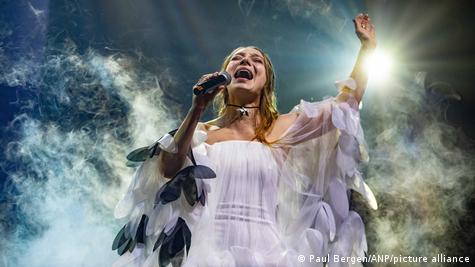
Leleka is competing for Ukraine
Image: Paul Bergen/ANP/picture alliance
Ukraine's German connection
Ukrainian singer Viktoria Leleka is competing with a song written in Berlin, hoping to win over the hearts of Eurovision fans with a blend of ethno-pop and musical theater. In an interview with German broadcaster ARD, she spoke about how much she loves Germany and the language, and how important it is to her to give a voice to her homeland and its diverse culture at a time of Russian aggression against her country.
Ukraine is one of the most successful countries in the contest and is almost always among the finalists. Most recently, the Kalush Orchestra won the 2022 contest with "Stefania."
Amid political tensions, Leleka's entry "Ridnym" is being watched with particular interest. The song describes an inner transformation, coping with fear and the power to find hope even in hopeless situations.
Favorites and trends
Musically, it's shaping up to be a typical ESC year: Big emotions, dramatic stage designs and lots of danceable, upbeat electro-pop.
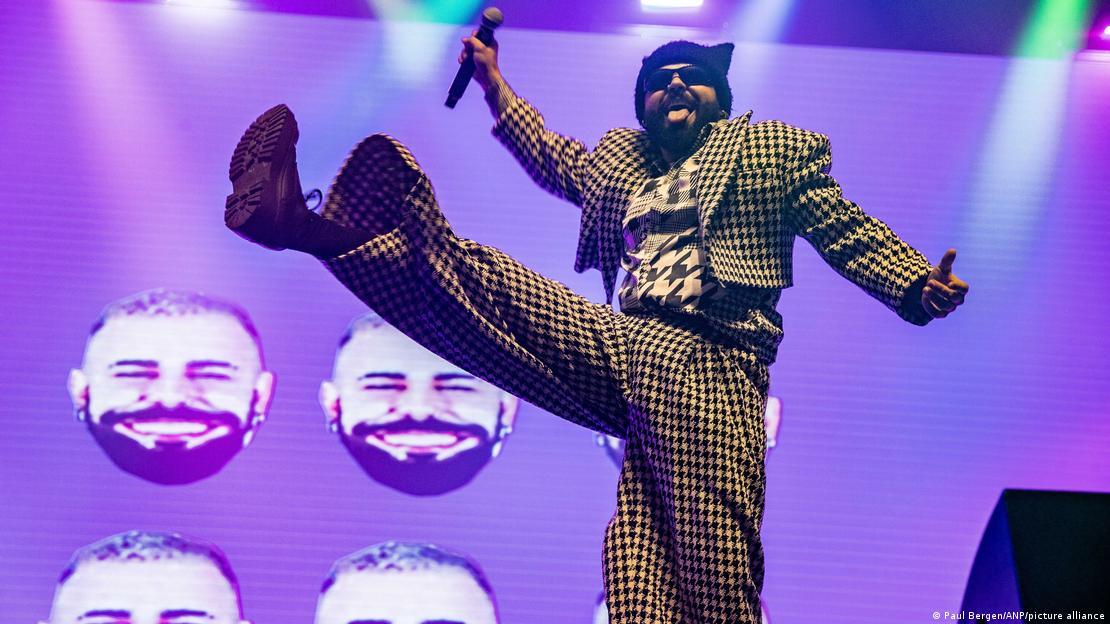
Greece's entry is rapidly climbing the betting odds — whether it can hold its ground will be revealed on Tuesday, May 12, during the first semifinal, when Akylas performs the song live.
Finland will also be competing in the first semifinal with the pop-classical duo Linda Lampenius x Pete Parkkonen, both of whom also have a good chance of winning.
For host country Austria and Big Five member Germany, however, the prospects are not so good — both are traditionally guaranteed a spot in the final and don't have the opportunity to perform in the semifinal shows. For both countries, it's all or nothing in the grand final on Saturday, May 16.
Meme-worthy: Greek singer Akylas
Image: Paul Bergen/ANP/picture alliance
Eurovision Song Contest Asia — a new spin-off
While Europe focuses on Vienna, attention is also turning to the Asian continent. The first Eurovision Song Contest Asia is set to take place on November 14 in the Thai capital, Bangkok. Ten countries, including the Philippines, South Korea and Vietnam, have already confirmed their participation.
An attempt to establish the contest in the US has failed. The American Song Contest 2022 remains a one-time event.
This article was originally written in German.
Silke Wünsch Reporter and editor at DW's culture
The Eurovision song contest turns 70 this year, but the celebration threatens to be overshadowed by the competition’s biggest ever boycott over the continued inclusion of Israel.
ANALYSIS
Issued on: 08/05/2026 -
FRANCE24
By: Joanna YORK
 A light show at the official opening of the stage at the Wiener Stadthalle prior to the 70th Eurovision Song Contest, in Vienna, Austria on April 28, 2026. © Joe Klamath, AFP
The 2026 edition of the Eurovision Song Contest is celebrating two notable milestones – not only is it the event’s 70th birthday, but it also features the lowest number of competing countries in two decades.
Among the delegations gathered in Vienna for the grand final on Saturday, May 16, five competition regulars will be absent, with Iceland, Ireland, the Netherlands, Slovenia and Spain all boycotting the event over the inclusion of Israel.
Officials from Spain’s national broadcaster RTVE said in April that it would not participate as the contest’s stated mission of neutrality had become “impossible to maintain”.
"No one raised an eyebrow when Russia was required to leave international competitions and not participate in Eurovision after the invasion [of Ukraine],” Prime Minister Pedro Sanchez, an outspoken critic of Israel’s policies in Gaza, added in May.
"We cannot allow double standards, not even in culture."
“It certainly is a rather challenging situation for the organisers of the contest this year,” said Dean Vuletic, historian and author of ‘Postwar Europe and the Eurovision Song Contest’.
“This should really have been a huge party, but in the end, we're seeing fewer participants than ever since 2003.”
‘Under the spotlight’
Eurovision describes itself as a non-political event and performances that contain political messages are not allowed under the competition rules.
But critics say the organisation’s continued inclusion of Israel – which has been accused of committing war crimes including genocide in Gaza – is a political gesture in itself.
“It puts the organisers under the spotlight, and makes people ask what they are doing and how they are thinking,” said Christina Oberg, a professor at Sweden’s Linnaeus University and author of several studies on geopolitical tensions and Eurovision.
Opposition to Israel’s inclusion began in 2024, with the competition falling six months after Prime Minister Benjamin Netanyahu launched extensive ground operations in Gaza in response to the October 7 Hamas attacks in Israel.
By May 2025 – as ground operations and aid blockades in Gaza continued – calls for Israel to be excluded from the competition grew. They have reached a fever pitch this year, amid new Israeli military operations in Iran and Lebanon.
But anger against the Eurovision organisers may be misplaced, said Vuletic. “The European Broadcasting Union (EBU) is not a political organisation. It's a technical association of National Public Service broadcasters, and it doesn't have a political mandate to act.”
The decision to exclude Russia from the Eurovision since 2022 over its full-scale invasion of Ukraine was straightforward, as all members of the EBU had shown a united front in imposing international sanctions on Moscow.

 I
I
A light show at the official opening of the stage at the Wiener Stadthalle prior to the 70th Eurovision Song Contest, in Vienna, Austria on April 28, 2026. © Joe Klamath, AFPThe 2026 edition of the Eurovision Song Contest is celebrating two notable milestones – not only is it the event’s 70th birthday, but it also features the lowest number of competing countries in two decades.
Among the delegations gathered in Vienna for the grand final on Saturday, May 16, five competition regulars will be absent, with Iceland, Ireland, the Netherlands, Slovenia and Spain all boycotting the event over the inclusion of Israel.
Officials from Spain’s national broadcaster RTVE said in April that it would not participate as the contest’s stated mission of neutrality had become “impossible to maintain”.
"No one raised an eyebrow when Russia was required to leave international competitions and not participate in Eurovision after the invasion [of Ukraine],” Prime Minister Pedro Sanchez, an outspoken critic of Israel’s policies in Gaza, added in May.
"We cannot allow double standards, not even in culture."
“It certainly is a rather challenging situation for the organisers of the contest this year,” said Dean Vuletic, historian and author of ‘Postwar Europe and the Eurovision Song Contest’.
“This should really have been a huge party, but in the end, we're seeing fewer participants than ever since 2003.”
‘Under the spotlight’
Eurovision describes itself as a non-political event and performances that contain political messages are not allowed under the competition rules.
But critics say the organisation’s continued inclusion of Israel – which has been accused of committing war crimes including genocide in Gaza – is a political gesture in itself.
“It puts the organisers under the spotlight, and makes people ask what they are doing and how they are thinking,” said Christina Oberg, a professor at Sweden’s Linnaeus University and author of several studies on geopolitical tensions and Eurovision.
Opposition to Israel’s inclusion began in 2024, with the competition falling six months after Prime Minister Benjamin Netanyahu launched extensive ground operations in Gaza in response to the October 7 Hamas attacks in Israel.
By May 2025 – as ground operations and aid blockades in Gaza continued – calls for Israel to be excluded from the competition grew. They have reached a fever pitch this year, amid new Israeli military operations in Iran and Lebanon.
But anger against the Eurovision organisers may be misplaced, said Vuletic. “The European Broadcasting Union (EBU) is not a political organisation. It's a technical association of National Public Service broadcasters, and it doesn't have a political mandate to act.”
The decision to exclude Russia from the Eurovision since 2022 over its full-scale invasion of Ukraine was straightforward, as all members of the EBU had shown a united front in imposing international sanctions on Moscow.
Ukraine's Kalush Orchestra won the Grand Final of the Eurovision Song Contest in Turin, Italy, on May 14, 2022. © Luca Bruno, AP
“But when it comes to Israel, Europe is divided over how it should respond to Israel's military actions,” Vuletic added. “For the European Broadcasting Union to make a decision against Israel, it needs a majority of its members to support such a decision, and we're simply not seeing that.”
‘Playing politics’
This year, Israel will be represented by Noam Bettan with a song called "Michelle" that was co-written by last year's entrant, Yuval Raphael, and features a chorus in French.
In 2025, Austria won the competition overall, but Raphael, who is a survivor of the October 7 Hamas attack, won the public vote for Israel in the grand final, sparking accusations that the competition was rigged.
In response, Eurovision organisers in November announced a series of reforms to the voting system, such as capping the number of votes per voter at 10.
But, regardless of what happens on stage, Oberg expects a similar dynamic this year, with a strong result for Israel in the public vote tempered by a low score from the competition judges. “Which side is playing politics is difficult to say,” she said.
“But when it comes to Israel, Europe is divided over how it should respond to Israel's military actions,” Vuletic added. “For the European Broadcasting Union to make a decision against Israel, it needs a majority of its members to support such a decision, and we're simply not seeing that.”
‘Playing politics’
This year, Israel will be represented by Noam Bettan with a song called "Michelle" that was co-written by last year's entrant, Yuval Raphael, and features a chorus in French.
In 2025, Austria won the competition overall, but Raphael, who is a survivor of the October 7 Hamas attack, won the public vote for Israel in the grand final, sparking accusations that the competition was rigged.
In response, Eurovision organisers in November announced a series of reforms to the voting system, such as capping the number of votes per voter at 10.
But, regardless of what happens on stage, Oberg expects a similar dynamic this year, with a strong result for Israel in the public vote tempered by a low score from the competition judges. “Which side is playing politics is difficult to say,” she said.
Israeli singer Yuval Raphael arrives at the Eurovision opening ceremony as protesters wave Palestinian flags in Basel, Switzerland, on May 11, 2025. © Fabrice Coffrini, AFP
Spain’s boycott of the competition is significant as it is one of the “big five” countries – along with France, Germany, Italy and the UK – whose public broadcasting services make the largest financial contribution to the production of the competition and, as such, are guaranteed a place in the final.
Should more of the big five join the boycott, it could destabilise the competition financially. It could also raise broader questions about “where we are with the initial idea that led to the Eurovision, to bring collaboration and peace to Europe after the Second World War”, Oberg said.
Although she added that some countries may find it easier to quit than others. “It would never happen in Sweden because Eurovision is such a big deal for us.”
In fact, given the competition's politically chequered history, it seems unlikely that this year’s boycotts will dent the competition's reputation too badly.
As far back as 1969, Austria boycotted the Madrid final to show its opposition to dictator Francisco Franco. More recently, Moscow hosted the competition in 2009, in a seeming endorsement of Russian President Vladimir Putin’s regime.
“Eurovision has been through many political crises, and it has weathered them all,” said Vuletic, who believes the politics of Eurovision adds to its overall appeal.
“One of the reasons why the contest is so engaging because we like to see how it reflects political issues,” he added. “It is a contest between countries, so it reflects international relations alongside expressing cultural diversity.”
Fans seem to agree. Tickets for this year’s nine final events in Vienna sold out in record time with spots for the grand final snapped up in just 14 minutes.
“To see every single show sell out so quickly is a powerful reminder of what the Eurovision Song Contest represents - joy, togetherness and shared experience at a time when that feels more important than ever”, said Eurovision’s director, Martin Green.
Spain’s boycott of the competition is significant as it is one of the “big five” countries – along with France, Germany, Italy and the UK – whose public broadcasting services make the largest financial contribution to the production of the competition and, as such, are guaranteed a place in the final.
Should more of the big five join the boycott, it could destabilise the competition financially. It could also raise broader questions about “where we are with the initial idea that led to the Eurovision, to bring collaboration and peace to Europe after the Second World War”, Oberg said.
Although she added that some countries may find it easier to quit than others. “It would never happen in Sweden because Eurovision is such a big deal for us.”
In fact, given the competition's politically chequered history, it seems unlikely that this year’s boycotts will dent the competition's reputation too badly.
As far back as 1969, Austria boycotted the Madrid final to show its opposition to dictator Francisco Franco. More recently, Moscow hosted the competition in 2009, in a seeming endorsement of Russian President Vladimir Putin’s regime.
“Eurovision has been through many political crises, and it has weathered them all,” said Vuletic, who believes the politics of Eurovision adds to its overall appeal.
“One of the reasons why the contest is so engaging because we like to see how it reflects political issues,” he added. “It is a contest between countries, so it reflects international relations alongside expressing cultural diversity.”
Fans seem to agree. Tickets for this year’s nine final events in Vienna sold out in record time with spots for the grand final snapped up in just 14 minutes.
“To see every single show sell out so quickly is a powerful reminder of what the Eurovision Song Contest represents - joy, togetherness and shared experience at a time when that feels more important than ever”, said Eurovision’s director, Martin Green.

No comments:
Post a Comment