Tuesday, February 15, 2022

'Londongrad': UK's tough balancing act on Russian sanctions

The British government has announced sanctions against Russia in the event of an invasion of Ukraine. But its own capital has come to be known as "Londongrad" because of its close ties with Kremlin-linked oligarchs.



'Uprooting Kremlin-linked oligarchs will be a challenge' in the UK, said a study

If President Vladimir Putin invades Ukraine, Russian oligarchs will have "nowhere to hide," British Foreign Secretary Liz Truss warned earlier this month, adding that the Kremlin would pay "a heavy price" for an invasion. Prime Minister Boris Johnson has called for new powers to sanction individuals and entities linked to the Kremlin.

For years, however, critics have been unsuccessful in trying to root out Russian investors and Putin allies from the British capital. Dubbed "Londongrad," it's where Russian oligarchs have long sunk their billions and become closely intertwined with the financial world.

'Moscow's gold'

A 2018 report by the Foreign Affairs Select Committee on Russian oligarch money was aptly called "Moscow's Gold. Russian Corruption in the UK." It came to the conclusion that for the government to ignore "London's role in hiding the proceeds of Kremlin-connected corruption risks signaling that the UK is not serious about confronting the full spectrum of President Putin's offensive measures."


"We have again to address the issue of the dirty money in the UK," said committee chairman and conservative lawmaker Tom Tugendhat, a popular interview partner these days, in an interview The Guardian in January. He plans to put the issue back on the agenda in the House of Commons and wants to know why the government hasn't taken any action. In an interview with the BBC, he stressed that "Britain has a responsibility to act because of London's global role in money laundering."

Those comments haven't endeared Tugendhat to members of his Conservative Party. Since Boris Johnson took office in 2019, the Tories have received about €2.4 million ($ 2.7 million) from Russian donors, according to official figures. Changes in legislation, which would have allowed for more transparency in real estate purchases in order to make money laundering more difficult, have stalled for years.
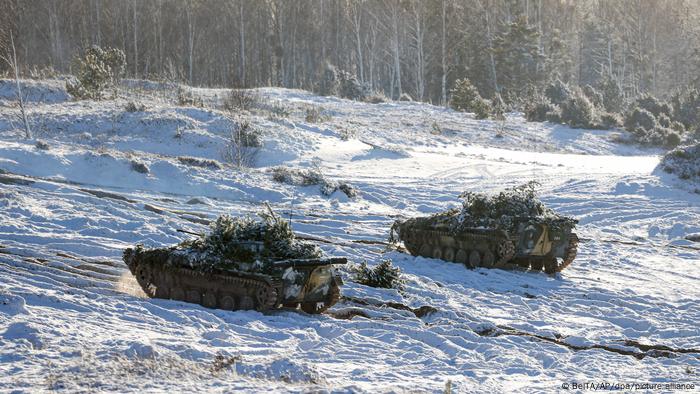

The international community is worried that a Russian attack on Ukraine is imminent

Real estate worth up to $2 billion has been financed with dubious Russian money, according to Transparency International, an anti-corruption organization. A UK documentary showed how unscrupulous brokers in London purchased properties worth millions with suspected slush money.

Russia expert Ben Judah, a journalist who worked on the documentary "From Russia With Cash," said he wanted to "expose how easy it is to launder money in London" and also to show the corrosive impact on Britain's elites, who are turning a blind eye to the corruption.

Oligarchs secure their influence

Russia's Roman Abramovich used some of his billions to buy the Premier League club Chelsea in 2003, granting him access to the British upper class. Alexander Lebedev, a billionaire and former KGB agent, bought the Evening Standard newspaper in 2009 for similar reasons.

Russian oligarchs employ an army of lawyers, PR consultants and domestic staff, send their children to British schools and get divorced in British courts. They are an important part of London's class of super rich, highly visible at horse races at Ascot and at the capital's charity balls and gala events.


Evgeny Lebedev, now a British citizen, is friends with royalty and politicians and has been appointed to the House of Lords

Abramovich was among the few Russians penalized in 2018 after the Novichok poison attackon Sergei Skripal, a former Russian spy, and his daughter. After Abramovich's UK visa expired, the oligarch was not immediately issued a new one. He adopted Israeli citizenship and has been able to move freely in the West ever since. Abramovich later halted the construction of a new stadium for Chelsea, with the club citing an "unfavorable investment climate."

As Western policymakers "focus on a possible Russian invasion of Ukraine, they are turning a blind eye to another invasion: the capture of European elites," Tugendhat wrote in a recent blog post for the Atlantic Council think tank.

He said the Kremlin's influence is everywhere, citing the cases of former French Prime Minister Francois Fillon, who joined the board of the Russian state oil company Zarubezhneft in June; Austria's former Foreign Minister Karin Kneissl, who was appointed to the board of powerful state oil company Rosneft — a board chaired by former German Chancellor Gerhard Schroeder; and former Austrian Chancellor Christian Kern, who is on the supervisory board of Russian Railways.

"Their roles highlight a systemic threat for Europe," said Tugendhat.

'Uprooting Kremlin-linked oligarchs will be a challenge'

A report for the Center for American Progress think tank, which is close to the Biden administration, urged setting up a "US-UK joint counter-kleptocracy working group to prod stronger action from the UK government."

However, the study's author warned that "uprooting Kremlin-linked oligarchs will be a challenge given the close ties between Russian money and the United Kingdom's ruling Conservative Party, the press, and its real estate and financial industry." The analysis reflects Washington's frustration that London is not doing more to combat Russian money laundering.


Roman Abramovich, owner of the Chelsea football club since 2003, has had a significant influence in the UK


In an interview with Times Radio last week, the British foreign secretary announced new laws against Russian money flows, aimed at making it easier to freeze assets. Kremlin spokesman Dmitry Peskov warned that such moves are damaging to Britain's appeal to investors and to British businesses.

Bill Browder, a British-American former financier, focuses on exposing high-level corruption in Russia. Following Browder's campaign on the issue, various Western states have adopted Magnitsky Act legislation to confiscate money associated with human rights violations and state corruption.

"The Achilles heel of the Putin regime is to go after Putin-connected oligarchs in the UK by seizing their assets," said Browder. The investor told a British parliamentary panel that about $800 billion worth of Russian state-backed assets are held outside Russia and could be targeted by sanctions.

British Liberal Democrat MP Layla Moran, quoting the 2020 Intelligence and Security Committee Russia Report, said many Russians with ties close to Putin "are well integrated into the UK business and social scene." Moran said none of the recommendations have been implemented by the government.

"But until the government acts on this front, our response to Russian aggression against Ukraine will remain toothless," she said.

This article was originally written in German
AN EXCUSE TO INVADE
Russian Duma asks Putin to recognize Ukrainian regions as independent

Russian lawmakers have voted to ask President Vladimir Putin to recognize the self-declared Donetsk and Luhansk People's Republics in Ukraine as independent nations


Ukrainian armed forces in Donbass have been fighting Russian-backed separatists

Russia's parliament, the Duma, voted on Tuesday to ask Putin to recognize two Russian-backed breakaway regions in eastern Ukraine as independent.

Recognizing of Donetsk and Luhansk would be a significant step that would effectively end the existing Minsk peace process for eastern Ukraine, which Russia has said is committed to until now. The 2015 deal foresees their reunification with Ukraine, but with Kyiv granting the two regions wide-reaching autonomy.

What did Russian lawmakers say?

The speaker of the Russian parliament's lower house, Vyacheslav Volodin, said that lawmakers would directly call on Putin to recognize the regions as "sovereign and independent states."

The Duma said in a statement that it considered the recognition of the regions to be "morally justified." It accused Ukraine of breaking the terms of the Minsk agreement, subjecting residents to shelling from weapons and imposing an economic blockade on the population.

"The state Duma expresses its unequivocal and consolidated support for the adequate measures taken for humanitarian purposes to support residents of certain areas of the Donetsk and Luhansk regions of Ukraine who have expressed a desire to speak and write in Russian, who want to respect freedom of religion, and who do not agree with the actions of the Ukrainian authorities that violate their rights and freedoms," the appeal stated.

The two regions are in the part of Ukraine known as Donbass, where Russian-backed separatist forces have been fighting the Ukrainian army since 2014. Russia has issued passports to hundreds of thousands of Donbass residents.

Lawmakers had been asked to consider two alternative resolutions on recognition of the self-declared Donetsk and Luhansk People's Republics. One had been to first consult the Russian Foreign Office before forwarding the appeal to the president. However, another resolution, for the direct appeal, won more votes.

The Duma's appeal comes amid an intense diplomatic effort to prevent any Russian invasion of its pro-Western neighbor Ukraine.


Kyiv warns of end to peace deal

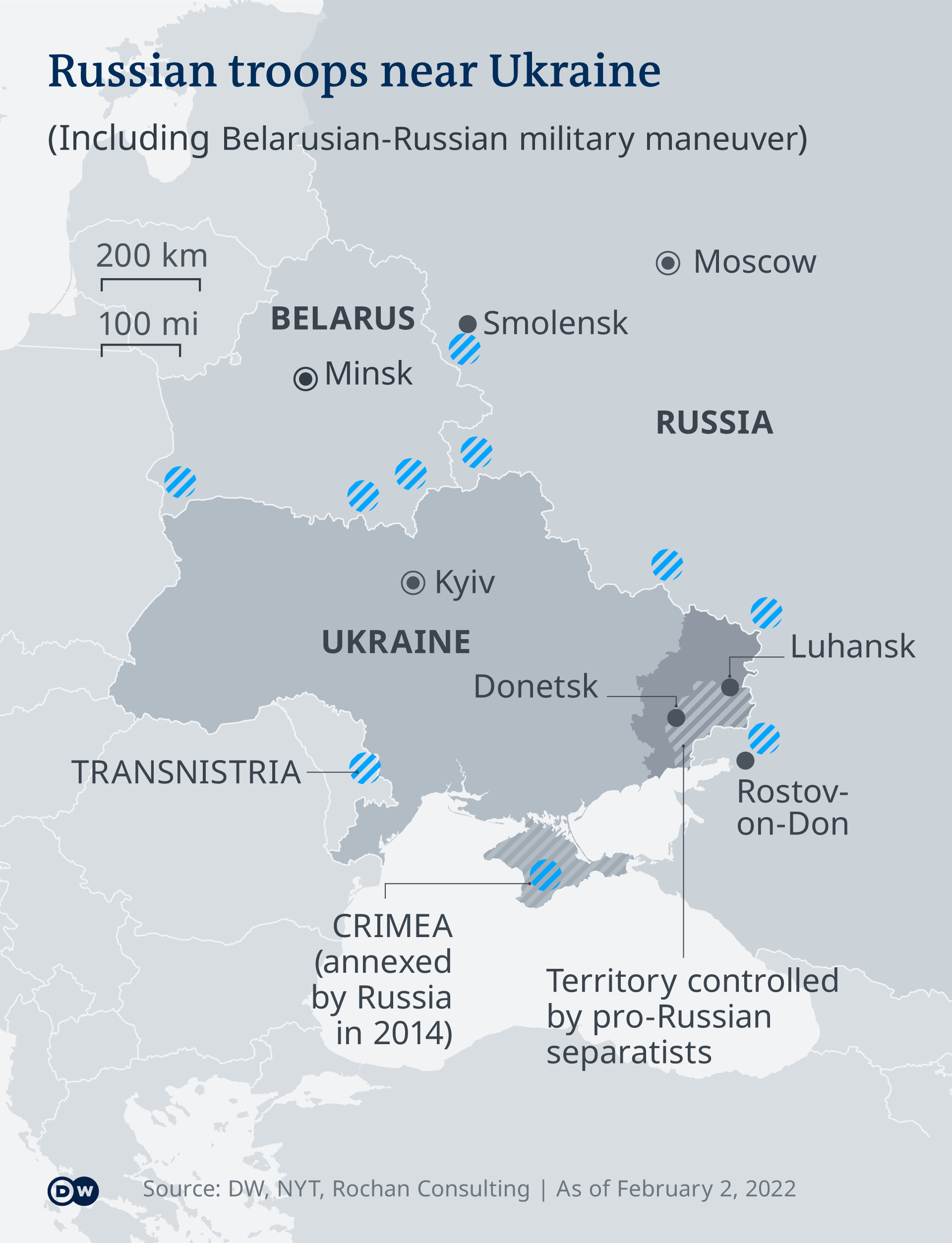
Moscow has amassed around than 130,000 troops near to its border with Ukraine and is also conducting military drills in neighboring Belarus and on the Black Sea.

Ukrainian Foreign Minister Dmytro Kuleba warned that recognition of the rebel territories as independent would mean that "Russia de facto and de jure will withdraw from the Minsk agreements with all the attendant consequences."

"We have already warned our partners about this position," he said.

Kremlin stays guarded

Speaking before the vote, Putin's spokesman Dmitry Peskov did not say if the Kremlin would support any such appeal.

"I cannot answer this question. You know that no official decisions have been made on this matter, there are no official discussions," Peskov said.

However, he added: "The people's representatives reflect the opinion of the people. We treat this with understanding."

Meanwhile, Russia's envoy to the European Union, Vladimir Chizhov, on Tuesday said Moscow would "respond" if Russian citizens started being killed anywhere, including Donbass.

"We will not invade Ukraine unless we are provoked to do that," Chizhov said. "If the Ukrainians launch an attack against Russia, you shouldn't be surprised if we counterattack. Or, if they start blatantly killing Russian citizens anywhere — Donbass or wherever."

rc/dj (Reuters, RIA, Interfax)
Canadian truckers suffer 'morale blow' after infiltrators spam communications channel with 'gay cowboy anthem': report

Matthew Chapman
February 14, 2022

Truckers and supporters on foot arrive at Parliament Hill in Canadian capital Ottawa on January 29, 2022 to protest government vaccination mandates(AFP)

On Monday, following Canadian Prime Minister Justin Trudeau's activation of the Emergencies Act to clear the far-right demonstrators blockading a critical international road to oppose vaccine mandates, BuzzFeed News D.C. bureau chief Paul McLeod reported that communications between the protesters are in currently chaos.

According to McLeod, the protesters were forced to abandon their first method of communication, the app Zello, after counterprotesters flooded their channels "with the gay cowboy anthem Ram Ranch," a song with incredibly explicit homoerotic lyrics.


But the problem was that the person moderating the channel jumped ship and turned out to be a double agent who disrupted their communications to help police catch them.

One anti-vax trucker cited by McLeod described this experience as a "morale blow."


The so-called "Freedom Convoy" sought an end to vaccine mandates for truck drivers in Canada, despite the fact that 90 percent of Canadian truckers are vaccinated already.

Politicians and right-wing pundits in the United States cheered on the blockade, even as it disrupted automobile factories on the U.S. side of the border, and there were half-baked plans to stage similar blockades to disrupt the Super Bowl.
US Navy engineer admits trying to sell nuclear submarine secrets

The federal courthouse where former US Navy engineer Jonathan Toebbe and his wife Diana face their first court hearing on charges that they attempted to sell secrets about nuclear submarines to a foreign power in exchange for cryptocurrency, is seen in Martinsburg, West Virginia, US October 12, 2021. (Reuters)

AFP
Published: 15 February ,2022: 

A US Navy engineer admitted in federal court on Monday that he tried to sell secrets about nuclear submarines to a foreign power, the Justice Department said.

Jonathan Toebbe, 43, pleaded guilty before a federal judge, more than four months after being arrested with his wife Diana Toebbe.

In exchange for his guilty plea, he is expected to be sentenced to between 12.5 to 17.5 years in prison.

His wife, a teacher, has so far maintained her innocence and sought release to care for their two teenage children. But her husband’s plea deal also incriminates her.


“Diana Toebbe knowingly and voluntarily joined the conspiracy to communicate Restricted Data to another person with the intent to secure an advantage to a foreign nation and committed multiple overt acts in furtherance of the conspiracy, including acting as a lookout while Mr. Toebbe serviced three dead drops,” the document said.

The court documents did not however say which country the couple tried to sell their information to.

The documents imply it was a US ally whose principal language is not English.


US nuclear submarines were at the center of a heated diplomatic crisis last September, when Australia canceled a mega-deal with France to announce a strategic partnership with the United States and Britain.

The Justice Department said in its statement that Toebbe had been working since 2012 on the design of the reactors for Virginia-class submarines, the latest generation of attack submersibles in the US fleet.

In April 2020, he had sent a package to a foreign country with an initial set of documents and instructions for establishing contact via a return address in Pittsburgh, Pennsylvania. The package contained “a sample of Restricted Data and instructions for establishing a covert relationship to purchase additional Restricted Data,” the Justice Department said.

“Toebbe began corresponding via encrypted email with an individual whom he believed to be a representative of the foreign government. The individual was really an undercover FBI agent,” the DoJ said.


Over several months, Toebbe received increasing payments in cryptocurrency for tens of thousands of dollars, and hid SD cards loaded with stolen secrets inside a peanut butter sandwich, in a packet of chewing gum and in a Band-Aid wrapper.

According to court documents, the country that Toebbe believed he was selling the secrets to was cooperating with the FBI, to the point of placing a flag in its Washington embassy to gain Toebbe’s confidence.
It’s Time To Stop Rolling the Dice on Chemical Disasters


The Environmental Protection Agency can help protect millions of people who live near industrial facilities — but only if it works now to strengthen an important federal chemical policy. The environmental protection agency can help protect millions of people who live near industrial facilities — but only if it works now to strengthen an important federal chemical policy.

February 14, 2022 by The Revelator 


By Pam Nixon

Have you ever watched somebody shake a can of soda, and then get ready to crack open the top? You know it’s going to explode, but you don’t know when, or how bad it will be. That’s what it’s like living near a chemical plant. Except the consequences can be deadly.

As a lifelong resident of Kanawha County, West Virginia — an area that has been home to dozens of industrial facilities making everything from pesticides to plastics — I know this uncertain feeling all too well. For the past several decades, I’ve listened to emergency sirens go off in my community, indicating that we need to shelter in place, while virtually no information is shared about what happened or how dangerous it might be.

All across the country, disproportionately in low-income communities and communities of color, residents are bombarded with exposure to toxic chemicals from similar facilities, despite the known risks to workers and residents. Not only from explosions, but from chronic and cumulative impacts.

Fortunately, the Environmental Protection Agency has an opportunity to make things right. The agency is in the process of updating one of the most important federal chemical policies that most people have never heard of: the Risk Management Plan Rule, which monitors more than 12,000 facilities across the country that produce, use or store certain hazardous chemicals. These chemicals have known links to cancer, autoimmune disorders and fertility problems — all of which have surfaced in my community and beyond

The rule was first enacted after public outrage over the deadly release of methyl isocyanate at a Union Carbide plant in Bhopal, India, 37 years ago. A half a million people died or were injured, and today survivors and their children still suffer from chronic health effects and ongoing contamination. Union Carbide’s Bhopal “sister plant” was located in my neighborhood and continued for more than 25 years to manufacture and stockpile methyl isocyanate in amounts akin to what was released in India, since no federal or state policy required a transition away from highly toxic chemicals or unsafe processes. It is only by good fortune that my community didn’t suffer the same catastrophic consequences following two separate explosions, years apart, at a unit near an aboveground storage tank that held the chemical.

My community is not alone. There are approximately 177 million Americans living near high-risk facilities across the country right now. A chemical facility in California caused a huge fire and smoke plume in 2012, forcing 15,000 people to seek medical treatment. The following year, a fertilizer facility in West Texas exploded, killing 15 people, injuring 200, and flattening hundreds of homes. In 2020, a chemical plant exploded near my community in West Virginia, killing one person and causing a terrifying shelter-in-place order for all residents within 2 miles. In the past decade, there have been more than 1,500 reported chemical releases or explosions at Risk Management Plan–monitored facilities nationwide, and these are just the disasters that we can see. We have no idea how many have died or become sick from the witches’ brew of chemicals in our air and water.


UPDATE: 12/9/2020 4:30PM- An explosion and fire at a West Virginia chemical plant that shook surrounding homes killed a plant worker and injured three other people.
It happened after 10 p.m. Tuesday at Optima Chemicals Co., a tenant on the Chemours proper https://t.co/yzWN8j7CwT pic.twitter.com/x98wWBTpm4
— WOAY NewsWatch (@WOAYNewsWatch) December 9, 2020

Now EPA Administrator Michael Regan has the chance to turn the tide as his agency works to update the rule. Several common-sense protections are needed that our community has been seeking for decades:

First, a new rule must include requirements for these high-risk facilities to transition to safer chemicals and processes whenever possible.

Second, hazardous facilities at risk from climate-related extreme weather should be required to plan and prepare for these potentially disastrous events, which they currently are not. In the first week after Hurricane Ida, for example, at least nine facilities in Louisiana reported chemical releases triggered by the storm.

Third, right now analyses of “worst-case scenario” releases are only required to include one chemical per facility, even though many facilities use or store multiple hazardous substances. The Risk Management Plan must take into account a broader range of toxic chemicals, as well asnd the cumulative hazards at each facility and all nearby facilities.

Fourth, we need independent safety audits, “root cause” analysis after incidents, broad distribution of findings, and requirements to implement identified safety and prevention measures.

Finally, the updated rule must require that workers be full and active participants in prevention and hazard-reduction planning, and that surrounding community members be fully informed of potential harms and possible solutions. We also need requirements for reliable backup power, incident alerts in multiple languages, real-time fenceline air monitoring, and other proven steps to keep our families safe.

Now is the moment for the EPA to update the Risk Management Plan in a meaningful way that takes into account the health, safety and equity of fenceline communities first and foremost.

The opinions expressed above are those of the author and do not necessarily reflect those of The Revelator, the Center for Biological Diversity or its employees.


This post was previously published on therevelator.org under a Creative Commons License.


SEE
https://libcom.org/files/Bookchin M. Our Synthetic Environment.pdf · PDF file

Our Synthetic Environment Murray Bookchin 1962 Table of contents Chapter 1: THE PROBLEM Chapter 2: AGRICULTURE AND HEALTH Chapter 3: URBAN LIFE AND HEALTH Chapter 4: THE


Here’s How Science Is Trying To Conserve the Monarch Butterfly’s Forests


For several weeks in 2015, the sound of chainsaws cutting down trees was incessant in the angangueo municipality in the mexican state of michoacán.


February 14, 2022 by Mongabay 


By Thelma Gómez Durán

A team of Mexican scientists are developing a successful experiment that allows for the recovery and maintenance of endemic trees in the Monarch Butterfly Biosphere Reserve that provide a habitat for monarch butterflies every winter.
The team is employing a mix of natural restoration, soil conservation and active reforestation that has so far achieved a survival rate of 83 to 84 percent, at least three times more successful than some government reforestation programs.
According to Dr. Cuauhtémoc Sáenz-Romero, one of the researchers of the project, forests where monarch butterfly colonies are located are becoming more susceptible to climate events through unusual foliage loss and increased woodland mortality.
Researchers have started to implement the “assisted migration” of oyamel firs (Abies religiosa) to higher altitudes in the reserve, where they can best resist changing climatic conditions.

For several weeks in 2015, the sound of chainsaws cutting down trees was incessant in the Angangueo municipality in the Mexican state of Michoacán. When a group of people tried to stop the deforestation, it was already too late: 10 hectares (25 acres) of forest had already been destroyed on hillsides in the central area of the Monarch Butterfly Biosphere Reserve.

The land on which the illegal logging took place belongs to the government of the state of Michoacán. There are no communal lands nor Indigenous communities that conduct surveillance in the area, which exist in other areas of the reserve that are collectively owned.

In order to recover the area that was affected by illegal logging, many public officials initially proposed reforestation, regardless of the fact that it was during the dry season and, was therefore an unfavorable time to plant trees. On the other hand, the directors of the reserve preferred to consult scientists.

However, among scientists, there were also conflicting opinions. Some argued that reforestation was the right method. Others advocated that natural regeneration was the way to go by not disturbing the area and waiting for the forest to recover on its own.

“It was a complicated discussion among academics,” said Dr. Cuauhtémoc Sáenz-Romero from the Natural Resource Research Institute (INIRENA) at Michoacan University of Saint Nicholas of Hidalgo (UMSNH).

“However, when we went to the region, it was clear that the conditions for natural regeneration did not exist: the trees that were still standing were gravely damaged and the crowns were destroyed. In the case of oyamel firs [Abies religiosa], the highest part of the crown is where seeds are produced. With a tree like that, you have to wait five to 10 years for the crown to recover and begin producing seeds.”

Dr. José Arnulfo Blanco García, the coordinator of the Restoration Ecology Research Laboratory at the same university, recalls that when they visited the area, “Cuauhtémoc [Sáenz-Romero] and I said: ‘We cannot be sure this will regenerate on its own.’ So we advocated for an active restoration plan for the area.”

For a decade, many groups have discussed whether reforestation or natural restoration was the better method for forest recovery. The debate exists because, on a global scale, it is acknowledged that many reforestation initiatives conducted are not successful; The percentage of trees that survive are often very low, and it is common to use very few tree species in these projects. This creates “very simplified forests,” which means that they do not contain a variety of tree species.

The final decision in this case was to combine active restoration with natural restoration, while at the same time conducting an experiment known as “assisted migration”.

The two scientists from UMSNH, Sáenz-Romero, a specialist in the genetic improvement of forests, and Blanco García, who specializes in ecology, decided to work as a team to restore the Monarch Butterfly Biosphere Reserve and other forested areas. They also decided to implement actions such as the “assisted migration” of trees. This method, which has been used for some time in other countries, including Canada, aims to secure a future for ecosystems and forest species that are threatened by climate change. The oyamel fir (Abies religiosa) is among those species.
Helping revive a forest

In 2016, the scientists began their work restoring the 10 hectares of land affected by illegal logging.

As part of the restoration plan, the team divided the space into different sections of land. The strips on the borders and closest to the nearby forest were not touched. There, they put their faith in natural regeneration. About 70 percent of the remaining land underwent soil conservation and active reforestation work. This project involved more than just planting trees. Each step of the process had to be carefully implemented, which does not always happen and is part of the reason why reforestation projects often fail.

“Reforestation is often unsuccessful because some species planted are too small, planted at unfavorable times, or incorrectly selected for the area,” said Blanco García. “There are several factors that influence the reduced success of reforestation initiatives.”

In the case of this reforestation project, the team of ecologists traveled through the adjacent forest to document the trees they could find and their proportions relative to other species. They found that for every pine tree, there were three oyamel firs. They then used this ratio to select their seeds. Seeds were chosen very carefully and seedlings that were at least one and a half years old were used. This is in contrast to other projects that often choose seedlings that are six months old. Planting took place only during July and almost 200 residents from nearby communities were invited and trained for the reforestation activity.

Five years later, the results from the project surprised the scientists themselves; They achieved a survival rate of 83 to 84 percent. This rate is very high when taking into account the fact that some government reforestation programs, conducted over six-year terms in the past, have had survival rates between 10 and 35 percent.

“When high-profile reforestation initiatives are conducted, it is very probable that they will not have good results and [officials] only want to take photos,” says Blanco García.

The last time the team visited the restored site, the pine trees they had planted were on average three meters tall (10 feet) . The oyamel firs, a species with a slower growth rate, were approximately one and a half meters tall (5 feet).

In the sections where natural regeneration was chosen, the results were also unexpected.


“Five years later, we did not record a single seedling of an oyamel fir, pine tree or any other species from the area,” said Blanco García. “It would have been an error to expect that the entire site would regenerate on its own.”

Through their work in these forests, the researchers have corroborated that natural restoration is not always the best course of action, especially when the forested area is highly degraded and is under increasing pressure from climatic phenomena, such as droughts.

“Nature cannot run its course in a normal way when, instead of having 260 parts per million of carbon dioxide, you have 417,” says Sáenz-Romero. The climate, he insists, is totally removed from its normal course.

“So everything we learned in our ecology classes no longer occurs. There are two permanent alteration factors: climate change and social pressures changing land use. You are recurrently faced with grazing, illegal logging, and timber extraction,” explains Sáenz-Romero. “In nature, things are not how they are in books. It’s because of this that we have to [test ideas through] action.”

Blanco García agrees; “[For] sites that are too degraded, the truth is that there is no way to expect nature to do something.”

Forests that suffer due to climate change

Since 2007, Sáenz-Romero has created climate models in a joint effort with Gerald Rehfeldt from the Moscow Forestry Sciences Laboratory in Idaho, which is affiliated with the USDA Forest Service. The goal was to understand how climate change affects forest species.

These models show Sáenz-Romero that, in the case of Mexico, cloud and coniferous forests are the climatic habitats (the space occupied by the favorable climate for a biome or a species) that are most vulnerable to climate change.

Cloud forests are located in a very narrow strip and require lots of humidity. Temperate forests of coniferous trees are in the high parts of the mountains. Because of climate change, these areas will be subject to higher temperatures.


“The space available with a favorable climate for these forests is decreasing,” says Sáenz-Romero.

In terms of forest species, those that are likely to encounter problems are those that are already undergoing the process of extinction. These include three species that are endemic to Mexico, such as the Chihuahua spruce (Picea chihuahuana), the Martinez spruce (Picea martinezii) and the Mexican spruce (Picea Mexicana).

“These will go extinct unless there is radical action on our part,” says Sáenz-Romero.

Other forest species at risk due to climate change are those that grow in the high parts of the mountains, like the Hartweg’s pine (Pinus hartwegii). This tree is present around Mexican volcanoes like Popocatépetl, Iztaccíhuatl, Nevado de Toluca, and Pico de Orizaba. Another species at risk is the oyamel fir (Abies religiosa).

Climate change models show that, if current tendencies continue, the Monarch Butterfly Biosphere Reserve will not have a suitable climate for the oyamel fir forest in the future.

“This is not to say that the oyamel fir will not exist,” says Blanco García. “It will probably be a mixed community of vegetation in which the pine tree is the most abundant, but the oyamel fir is not.”

What climate models have shown for several years is already beginning to be seen in the region. “All the hillsides that are in the Monarch Butterfly Biosphere Reserve, and that face south, are becoming more susceptible to climate events. And the saddest news is that this is where the butterfly colonies have been historically located,” says Blanco García.

In 2016, for example, a strong winter storm caused severe damage to about 20,000 trees throughout the reserve. Many trees fell, and others lost their highest branches. Because the seeds of the oyamel fir are produced in its highest branches, very few seeds fell during the next few years. This affected the trees’ natural regeneration.

Drier and hotter

Just over 10 years have passed since scientists from UMSNH began documenting the effects of climate change on the trees in the region. In 2010, for example, researchers were contacted by residents of the Indigenous community of Nuevo San Juan Parangaricutiro, in Michoacán, to help them understand what was happening with their trees.

On a national level, this Indigenous community stands out for being one of the most successful in terms of community forest management. The sustainable use of their forest has allowed them to create jobs, have a tourist center, and carry out several projects in the community. For this reason, when their forest began to show changes, they looked to scientists for help.

“They showed us a site, Los Volcancitos, where there had been unusual defoliation of Pinus pseudostrobus [the smooth bark Mexican pine]. The trees were losing foliage, many were already dead and already debilitated. They had infestations, like that of the bark beetle,” says Sáenz-Romero.

“But it was evident that the cause was not the beetle, but that the trees had been severely weakened. They told us: ‘This never happened to us.’”

Sáenz-Romero suspected that it may be an effect of climate change. In order to be sure, he shared photos and data with his colleagues, including scientists from Canada who are studying the effects of climate change on forest species.

In Canada, the researchers documented that summers are becoming increasingly hotter and drier, which is causing tree defoliation. Sáenz-Romero says that, in the case of Mexico, this does not happen in summer, but instead in spring: March, April, and May. There is an increasing amount of heat, and less rain. Therefore, the trees must rely on less water until June, when precipitation increases.

“There is a much hotter and drier environment, which weakens trees,” says Sáenz-Romero.

What happened in Nuevo San Juan Parangaricutiro, according to what Sáenz-Romero has concluded, is a result of the combination of a very dry year with low humidity and the stony conditions of the soil in the Los Volcancitos site.

According to the researchers, this case, and what happens in the Monarch Butterfly Biosphere Reserve, may be examples of a process that is being seen around the world with increasing frequency. This process has been nicknamed “forest decline,” which describes unusual woodland mortality.

Normally, as part of a forest’s natural renovation, about three percent of trees in forests are dead or in the process of dying.

“There are increasingly more sites in the world where there are mortality events above 15 percent, which are very unusual and are related to periods of drought that are hotter. The combination of droughts and temperatures hotter than ever before is becoming deadly for several species of trees,” says Sáenz-Romero.

Blanco García added that it is even more difficult for forests to regenerate naturally and to adapt to these new events.

“What are we going to do?” asks Sáenz-Romero. “Sit back and wait under the belief that nature is intelligent and will regenerate on its own? Or accept that we live in a changing world, [which is] pretty degraded, and that much of what is said in ecology books no longer applies?”

Helping trees migrate


Upon observing the effects of climate change on different forest species, Canadian researchers have begun what they call “assisted migration”; Helping trees, such as conifers, migrate to areas of higher altitudes, where they can best resist changing climatic conditions.

In Mexico, Sáenz-Romero, Blanco García, and others have started to implement the “assisted migration” of oyamel firs in areas of the Monarch Butterfly Biosphere Reserve. They have used this technique, for example, in the areas that were damaged during the 2016 winter storm.

According to Sáenz-Romero, assisted migration involves “collecting oyamel seeds, producing plants in nurseries, and reforesting areas with higher altitudes and where it is predicted that a favorable climate will occur in the future for that particular population.”

The researchers are also using nurse plants, which are bushes that serve to generate protective shade for the seedlings that have been planted nearby.

The researchers acknowledge that several of the techniques they use are already known in communities in an empirical way.

“What we are doing is quantifying things that they have already noticed,” says Blanco García.

The researchers’ experiments are being conducted at sites like Las Palomas in the La Mesa community, which sits at 3,440 meters in altitude in the municipality of San José del Rincón. Las Palomas and Los Ailes, which has an altitude of 3,360 meters, are both within the center of the biosphere reserve. The oyamel fir seedlings that were used for these reforestation projects were produced in nurseries that have an altitude of 3,000 meters.

In Las Palomas, already-existing nurse plants were used to provide shade. The scientists also used more conventional reforestation techniques, like planting in a grid, with a distance of one and a half meters between each tree. With these techniques, the survival rate was 65 percent.

In Los Ailes, the scientists decided to break the norm of planting in a grid. They used nurse bushes there too, but these were plants from a lower altitude, rescued from the forest and planted in circles, “to optimize the usefulness of the shade from the bushes.” The result was a tree survival rate of 92 percent, even after the recent extreme drought that occurred as a consequence of the presence of La Niña (a cold current from the Pacific) in November 2020 to April 2021.

The achievement of these high survival rates was not a small feat, especially with a species like the oyamel fir, which does not prosper easily in reforestation projects. The tree species is located in the Trans-Mexican Volcanic Belt, which spans from the Nevado de Colima on the western border to the Pico de Orizaba in the east. It can be found in mountains with altitudes of 2,800 meters and higher.

The oyamel fir is vital for the preservation of the climatic conditions in the forests of central Mexico. During each winter, it receives monarch butterflies and is part of the process refilling aquifers that supply water to cities in the center of the country.

Studies conducted by Lincoln Brower, a researcher who dedicated a large part of his scientific interest to oyamel fir forests, showed that when these trees are healthy, among other things, they allow a “blanket and umbrella” effect. On cold nights in winter, their crowns function as blankets that help prevent all the heat from escaping from the microsite. When winter storms arrive, the trees’ crowns serve as umbrellas to keep butterflies’ wings from becoming wet and freezing. This process is affected when there are fewer oyamel firs or when they are not in optimal condition.

Sáenz-Romero and Blanco García highlighted that conserving and rescuing the oyamel fir forests is not only vital for the migration of the monarch butterflies and water security for Mexico’s large cities, but also for the future of the communities that live in and around the biosphere reserve. Part of its economy is supported by tourism and, in several cases, by sustainable forest management.

Sáenz-Romero stresses that “if we cannot save the [oyamel fir], we cannot save almost any species, because with it holds the interests of society, of authorities, and of the three countries that the monarch butterfly visits.”


This post was previously published on news.mongabay.com and under a Creative Commons license CC BY-ND 4.

Colorado woman accuses a local company of firing her days after having a miscarriage


After Denver7 asked company for comment, it settled with accuser
Feb 14, 2022

GREENWOOD VILLAGE, Colo. -- Rachel Makkar takes a lot of pride in being a mother to her son, Max.

“I love it. There’s nothing better,” she said.

Her job meant a lot to her too, until she was fired in August 2021.

“I honestly feel like it was because I had a miscarriage,” she said. “Nothing else changed.”

Makkar says she was terminated from J&B Building Company 10 days after having a miscarriage.

She’s now accusing the local commercial real estate company of gender and pregnancy discrimination, and of violating Colorado law in a complaint filed in October with the Colorado Civil Rights Division.

Makkar worked at J&B Building Company as a broker and asset manager.

“I don’t know that they wanted mothers working there,” she said.

According to the complaint, her allegations of discrimination date back to 2019.

“Her employer expressly told her in writing, in a performance review, that she was not going to get a raise due to the fact that she was going to be taking maternity leave,” her attorney David Gottlieb said.

Gottlieb shared that performance review with Denver7 Investigates. It shows that her boss wrote in the typed review, “Given you will be taking a significant period of time off in the next few months, we will hold your salary … for the next twelve months.”

“That’s completely against the law, and they put it in writing,” Gottlieb said. “This is among the most egregious discrimination cases I’ve ever seen.”

Makkar also said the company fired her by phone in August shortly after she suffered her miscarriage. Her boss justified her termination by claiming she was being let go for not working in the office, even though, “I was never directly asked to come into the office again full time,” she said.

Her performance review from 2021 further supports her claim. Handwritten notes on the review dated Aug. 5 state, “[K]eep salary as is, allow remote work.” The same document then crosses out those words and replaces them with “terminate for not willing to work in office.”

“Those two statements are completely at odds,” Gottlieb said. “And that is what we call a smoking gun.”

For Makkar, this is about standing up for other working moms and setting an example for her son.

“I don’t want another mother who is in this situation to think that it’s okay,” she said. “I want my son to see that I stand up for myself.”

Days after Denver7 Investigates reached out for comment and before this story aired and was published, J&B Building Company settled the case with Makkar. The terms of the settlement are confidential.

"We have reached an amicable agreement and have resolved the claims raised with Colorado Civil Rights Division. We stand by our employment policies and deny that we violated any laws, including the Colorado Anti-Discrimination Act, and we remain committed to providing an inclusive and supportive work environment free of discrimination,” an attorney representing the company said in a statement.

The Colorado Civil Rights Division said it cannot comment on complaints filed with the agency.


Fukushima Takes a Turn for the Worse


 Facebook

Photograph Source: IAEA Imagebank – CC BY 2.0

Tokyo Electric Power Company-TEPCO- has been attempting to decommission three nuclear meltdowns in reactors No. 1 No. 2, and No. 3 for 11 years now. Over time, impossible issues grow and glow, putting one assertion after another into the anti-nuke coffers.

The problems, issues, enormous danger, and ill timing of deconstruction of a nuclear disaster is always unexpectedly complicated by something new. That’s the nature of nuclear meltdowns, aka: China Syndrome debacles.

As of today, TEPCO is suffering some very serious setbacks that have “impossible to deal with” written all over the issues.

Making all matters nuclear even worse, which applies to the current mess at Fukushima’s highly toxic scenario, Gordon Edwards’ following statement becomes more and more embedded in nuclear lore: “It’s impossible to dispose of nuclear waste.” (Gordon Edwards in The Age of Nuclear Waste From Fukushima to Indian Point)

Disposing of nuclear waste is like “running in place” to complete a marathon. There’s no end in sight.

As a quickie aside from the horrendous details of the current TEPCO debacle, news from Europe brings forth the issue of nuclear power emboldened as somehow suitable to help the EU transition to “cleaner power,” as described by EU sources. France supports the crazed nuke proposal but Germany is holding its nose. According to German Environment Minister Steffi Lemke: “Nuclear energy could lead to environmental disasters and large amounts of nuclear waste. (Source: EU Plans to Label Gas and Nuclear Energy ‘Green’ Prompts Row, BBC News, Jan. 2, 2022) Duh!

Minister Lemke nailed it. And, TEPCO is living proof (barely) of the unthinkable becoming thinkable and disastrous for humanity. Of course, meltdowns are never supposed to happen, but they do.

One meltdown is like thousands of industrial accidents in succession over generations of lifetimes. What a mess to leave for children’s children’s children over several generations. They’ll hate you for this!

In Fukushima’s case, regarding three nuclear power plants that melted all-the-way (China Syndrome), TEPCO still does not know how to handle the enormously radioactive nuclear fuel debris, or corium, sizzling hot radioactive lumps of melted fuel rods and container material in No. 1, No 2 and No.3, They’re not even 100% sure where all of the corium is and whether it’s getting into underground water resources. What a disaster that would be… what if it is already… Never mind.

The newest wrinkle at TEPCO involves the continuous flow of water necessary to keep the destroyed reactors’ hot stuff from exposure to air, thus spreading explosively red-hot radioactivity across the countryside. That constant flow of water is an absolute necessity to prevent an explosion of all explosions, likely emptying the streets of Tokyo in a mass of screaming, kicking, and trampling event to “get out of town” ASAP, commonly known as “mass evacuation.”

The cooling water continuously poured over the creakily dilapidated ruins itself turns radioactive, almost instantaneously, and must be processed via an Advanced Liquid Processing System (ALPS) to remove most radioactive materials (???) housed in a 17-meter (56 feet) tall building on the grounds of the disaster zone.

Here’s the new big danger, as it processes radioactive contaminated water, it flushes out “slurry” of highly concentrated radioactive material that has to go somewhere. But where to put it?

How to handle and dispose of the radioactive slurry from the ALPS is almost, and in fact may be, an impossible quagmire. It’s a big one as the storage containers for the tainted slurry quickly degrade because of the high concentration of radioactive slurry. These storage containers of highly radioactive slurry, in turn, have to be constantly replaced as the radioactivity slurry eats away at the containers’ liners.

Radioactive slurry is muddy and resembles a shampoo in appearance, and it contains highly radioactive Strontium readings that reach tens of millions of Becquerel’s per cubic centimeter. Whereas, according to the EPA, 148 Becquerel’s per cubic meter, not centimeter, is the safe level for human exposure. Thus, tens of millions per cubic centimeter is “off the charts” dangerous! Instant death, as one cubic meter equals one million cubic centimeters. Ahem!

Since March 2013, TEPCO has accumulated 3,373 special vessels that hold these highly toxic radioactive slurry concentrations. But, because the integrity of the vessels deteriorates so quickly, the durability of the containers reaches a limit, meaning the vessels will need replacement by mid-2025.

Making matters ever worse, if that is possible, the NRA has actually accused TEPCO of “underestimating the impact issue of the radioactivity on the containers linings,” claiming TEPCO improperly measured the slurry density when conducting dose evaluations. Whereas, the density level is always highest at the bottom, not the top where TEPCO did the evaluations, thus failing to measure and report the most radioactive of the slurry. Not a small error.

As of June 2021, NRA’s own assessment of the containers concluded that 31 radioactive super hot containers had already reached the end of operating life. And, another 56 would need replacement within the next 2 years.

Transferring slurry is a time-consuming highly dangerous horrific job, which exposes yet a second issue of unacceptable risks of radioactive substances released into the air during transfer of slurry. TEPCO expects to open and close the transfers remotely (no surprise there). But, TEPCO, as of January 2, 2022, has not yet revealed acceptable plans for dealing with the necessary transfer of slurry from weakening, almost deteriorated containers, into fresh, new containers. (Source: TEPCO Slow to Respond to Growing Crisis at Fukushima Plant, The Asahi Shimbun, January 2, 2022)

Meanwhile, additional batches of a massive succession of containers that must be transferred to new containers will be reaching the end of shelf life, shortly.

Another nightmarish problem has surfaced for TEPCO. Yes, another one. In the aftermath of the 2011 blowup, TEPCO stored radioactive water in underground spaces below two buildings near reactor No.4. Bags of a mineral known as zeolite were placed to absorb cesium. Twenty-six tons (52,000 lbs.) of bags are still immersed with radiation readings of 4 Sieverts per hour, enough to kill half of all workers in the immediate vicinity within one hour. The bags need to be removed.

TEPCO intends to robotically start removing the highly radioactive bags, starting in 2023, but does not know where the bags should be stored. Where do you store radioactive bags containing enough radioactive power to kill someone within one hour of exposure?

Additionally (there’s more) the amount of radioactive rubble, soil, and felled trees at the plant site totals 480,000 cubic meters, as of 2021. TEPCO is setting up a special incinerator to dispose of this. Where to dispose of the incinerated waste is unknown. This is one more add-on to the horrors of what to do with radioactive material that stays hot for centuries upon centuries. Where to put it?

Where to put it? Which is the bane of the nuclear power industry. For example, America’s nuke plants are full of huge open pools of water containing tons of spent nuclear fuel rods. If exposed to open air, spent fuel rods erupt into a sizzling zirconium fire followed by massive radiation bursts of the most toxic material known to humanity. It can upend an entire countryside and force evacuation of major cities.

According to the widely recognized nuclear expert Paul Blanch: “Continual storage in spent fuel pools is the most unsafe thing you could do.” (see- Nuclear Fuel Buried 108 Feet from the Sea, March 19, 2021)

It’s not just Fukushima that rattles the nerves of people who understand the high-risk game of nuclear power. America is loaded with nuclear power plants with open pools of water that hold highly radioactive spent fuel rods.

What to do with it?

Robert Hunziker lives in Los Angeles and can be reached at rlhunziker@gmail.com.

The Smearing of Emma Watson


 Facebook

Drawing by Nathaniel St. Clair

Anyone who has ever been critical of Israeli actions toward the Palestinian people knows what to expect next—an avalanche of pit-bull attacks and smears that their criticisms of Israel are motivated by racism and anti-Semitism. The latest example is the response to actress Emma Watson’s pro-Palestinian Instagram post, which led (predictably) to Israeli officials and supporters accusing her of anti-Semitism. Among many others, former Israeli UN Representative Danny Danon—in a tone-deaf post—wrote, “10 points from Gryffindor for being an antisemite.”

The purpose of such false accusations is of course to deflect attention away from what is happening on the ground—the real (war) crimes that Israel is perpetrating against the Palestinian people—to the supposed motivations of the critics. Unable to defend its criminal actions, all that Israel’s increasingly desperate defenders have left is smear and innuendo, as the attacks on Emma Watson make clear.

But the accusations may also have some other unintended consequences—they make real anti-Semitism (the right-wing fascist variety that really does hate Jews as Jews) more respectable and legitimate—and thus even more deadly. In that sense, the Zionist defenders of Israel are among the most dangerous purveyors of contemporary anti-Semitismthe hatred of Jews as a collective.

There are two steps to how these unintended consequences are blundered into.

First, there is the claim that Israel and Jewishness are the same thing—that Israel is not the state of all its citizens but is the state of the Jewish people alone. The nation-state law, passed in 2018—which gives Jews alone the right of self-determination in Israel, recognizing Hebrew as the sole official national language, and establishing “Jewish settlement as a national value”—makes the link between the Israeli state and Jewishness formal and official. Similarly, the widely adopted International Holocaust Remembrance Alliance (IHRA) definition of anti-Semitism cites one example as “the targeting of the state of Israel, conceived as a Jewish collectivity” and has a similar thrust—Israel equals Jews.

The second step is the increasing visibility of Israeli violence toward Palestinians. Although Israeli propaganda had succeeded for decades in deflecting mainstream attention away from Israel’s crimes, the cloak of invisibility created by its public relations efforts—its hasbara—is disintegrating before the force of reality, its own increasingly cruel and vicious actions, as well as the work of the growing number of pro-Palestinian activists around the world who are using the power of social media to bypass the normal media gatekeepers. While anyone with a passing knowledge of the situation has long known about the brutal matrix of violence and control—from the river to the sea—exerted by Israel over the Palestinian population, that understanding is now increasingly visible and mainstream. (As evidence of this, Emma Watson’s post quickly drew over 1 million likes.)

The problem for all of us, not just Israel, is when these two things are put together—the equation of Israel with Jews and the visibility of Israeli atrocities—then Jews as a whole become tarred with the crimes of the Israeli state. As the Israeli journalist Gideon Levy wrote in 2015, “Some of the hatred toward Jews elsewhere in the world—emphatically, only some and not all of it—is fed by the policies of the state of Israel and especially by its continuing occupation and abuse, decade after decade, of the Palestinian people.”

In this process, the danger is that actually existing anti-Semitism is being made more respectable as there seems to be some rational basis for it—Israeli atrocities. At a time when the real and dangerous anti-Semitism of the fascist right is on the rise—remember the white supremacist Charlottesville thugs were chanting “Jews will not replace us”—the last thing that is needed is to give it any sheen of respectability, as, albeit unwittingly, do those who insist on the indissoluble link between the brutal violence of the Zionist project and Jewishness.

Such a link is of course nonsense. Jews of all political stripes have long been on the front lines of the fight against the racist Zionist enterprise, insisting that it has no part in their own Jewish values based on a belief in universal—not particular—human rights. It is why groups such as Rabbis for Human Rights act as human shields against the attacks on Palestinians by settlers and the Israel Defense Forces. The fight against Israeli policies and Zionist violence is driven by the concerns of social justice and solidarity, not racism toward Jews.

Emma Watson is part of an exponentially fast-growing choir of decent like-minded men and women of good faith all over the world, united in their belief that all people, irrespective of their ethnicity or their religion or their nationality, must have inalienable human rights, including the right to life and liberty and self-determination, from every river to every sea everywhere. That includes the long-suffering people of Palestine. The attempted weaponization of anti-Semitism against this movement not only weakens the term as a description of real fascist racism, but in fact serves to legitimate it. If criticizing cruel Israeli policies toward the Palestinians is anti-Semitic, then what is so wrong with anti-Semitism, so this misguided line of thinking goes. As Robert Fisk once noted, “if this continued campaign of abuse against decent people, trying to shut them up by falsely accusing them of anti-Semitism, continues, the word ‘anti-Semitism’ will begin to become respectable. And that is a great danger.”

The solution to this is clear: break the erroneous link between Israel and all Jews (between Israel and Judaism) and concentrate on the reality that the Zionist enterprise is an old-fashioned settler-colonial project—driven in large part by the geopolitical interests of its principal sponsor, the United States. Once we eliminate the obfuscation and confusion that result from the lazy (but calculated) accusation of anti-Semitism, the building of an unstoppable international movement of justice for the Palestinians can continue. Let’s get to it!

This article was produced by Globetrotter.

Sut Jhally is professor emeritus at the University of Massachusetts at Amherst and founder and executive director of the Media Education Foundation. Roger Waters is a musician.